
Rajasthan Exams 2027: Complete Mock Test Guide
📖 Table of Contents
- Rajasthan Exams 2027 at a glance
- Three boards, one portal, and the CET gateway
- RPSC RAS 2027, the officer examination
- REET 2027, the teacher route in two stages
- RSMSSB Patwari 2027, the revenue post with the biggest recent drive
- Rajasthan Police Constable 2027, the physical examination
- The other four examinations on this page
- How to choose one examination and stay with it
- The calendar, and why dates move
- What the mock tests on this page actually train
- Mistakes that end attempts across Rajasthan examinations
- Where to check, and what this page does not claim
- Rajasthan itself is the syllabus
- A twelve month plan for a first time candidate
- What the last cycles teach about the odds
- The SSO portal and the application routine
- Fees and age limits across the set
- What to do this week
- Sources
Rajasthan Exams 2027: Complete Mock Test Guide
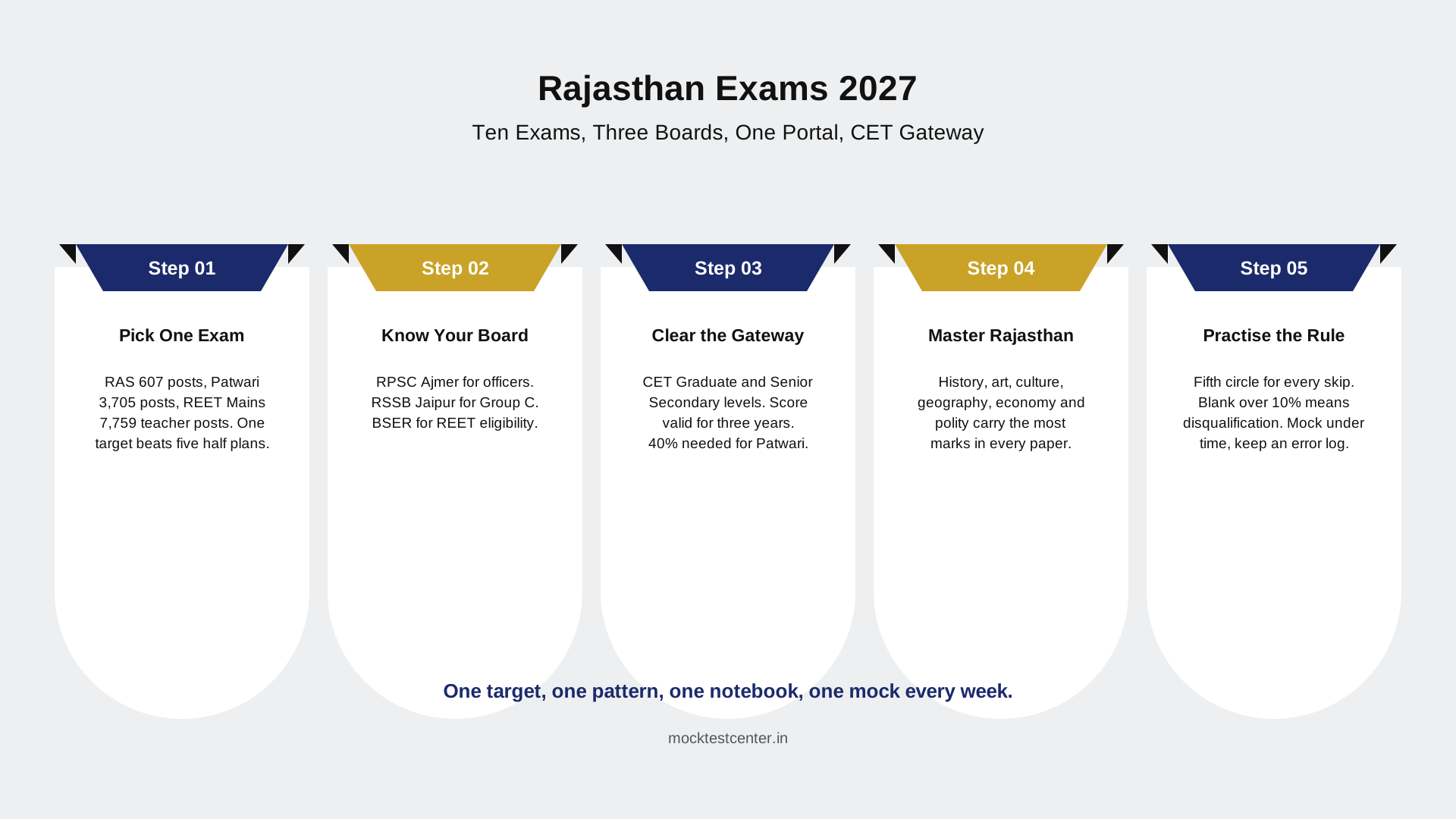
Rajasthan Exams 2027 is the hub page for every major state government examination in Rajasthan, and the first fact to understand is that Rajasthan runs three separate examination systems. The Rajasthan Public Service Commission in Ajmer runs the officer examinations, led by RAS. The Rajasthan Staff Selection Board in Jaipur runs the Group C examinations, led by the Common Eligibility Test and Patwari. The Board of Secondary Education, Rajasthan runs the teacher eligibility examination, REET, and the Staff Selection Board then runs the teacher mains. A candidate who treats these as one system applies to the wrong examination, and this guide exists to stop that happening.
The ten examinations on this page cover the ground most Rajasthan candidates actually apply for. RPSC RAS 2027 leads with 607 posts in its live 2026 cycle. The two CET levels gate entry to most Group C posts. REET 2027 decides who can teach in state schools, and the REET Mains then fills 7,759 teacher posts. Patwari 2027 filled 3,705 posts in its 2025 cycle. Rajasthan Police Constable 2027 runs a 150 mark written paper plus a 5 km run. The remaining four examinations, Sub Inspector, High Court, School Lecturer and LDC Grade II, complete the set. Each one has its own page on this site with its own full guide, and this hub page gives the map of the whole territory.
Three numbers frame the scale. About 6,75,000 candidates applied for the RAS 2024 cycle, and 3,75,657 sat its prelims. The Patwari 2025 cycle drew applications for 3,705 posts after the count was raised from 2,020. The REET Mains 2025 notification carried 7,759 teacher posts. Rajasthan recruitment is large, slow, and fiercely competitive, and the candidates who succeed are usually the ones who picked one examination early and prepared for its exact pattern rather than drifting between five.
Rajasthan Exams 2027 at a glance
| Exam | Conducting body | Last verified cycle |
|---|---|---|
| RPSC RAS 2027 | Rajasthan Public Service Commission, Ajmer | 2026 cycle, 607 posts, prelims 6 December 2026, mains 1 and 2 May 2027 |
| RSSB CET Graduate Level 2027 | Rajasthan Staff Selection Board, Jaipur | 2026 cycle, Advertisement Number 09/2026, examination reported 16 to 18 January 2027 |
| RSSB CET Senior Secondary Level 2027 | Rajasthan Staff Selection Board, Jaipur | 2026 cycle, Advertisement Number 08/2026, examination 1 to 3 December 2026 |
| REET 2027 | Board of Secondary Education, Rajasthan | 2025 cycle, examination 27 and 28 February 2025, REET Mains 7,759 teacher posts |
| Rajasthan Police Constable 2027 | Rajasthan Police, Police Headquarters Jaipur | 2025 cycle, Advertisement Number 25/2024/1360, 9,617 posts, written examination 13 and 14 September 2025 |
| RSSB Patwari 2027 | Rajasthan Staff Selection Board, Jaipur | 2025 cycle, Advertisement Number 02/2025, 3,705 posts, examination 17 August 2025 |
| Rajasthan Police Sub Inspector 2027 | Rajasthan Public Service Commission, Ajmer | 2025-26 cycle, Advertisement Number 05/Exam/SI-PC/RPSC/EP-1/2025-26, 1,015 posts raised to 1,076, written examination 5 and 6 April 2026 |
| Rajasthan High Court 2027 | Rajasthan High Court, Jodhpur | 2022 notification, 2,756 posts, written examination 12 and 19 March 2023 |
| RPSC School Lecturer 2027 | Rajasthan Public Service Commission, Ajmer | 2025 cycle, Advertisement Number 06/2025-26, 3,225 posts, examination 31 May to 11 June 2026 |
| RSSB LDC Grade II 2027 | Rajasthan Staff Selection Board, Jaipur | 2026 cycle, Advertisement Number 04/2026, 10,644 posts, written examination 5 July 2026 |
Across the ten pages, the last verified cycles add to 31,630 posts: RAS 607, Police Constable 9,617, Sub Inspector 1,076, Patwari 3,705, High Court 2,756, School Lecturer 3,225 and LDC Grade II 10,644. REET and the two CET levels carry no posts of their own, because they are eligibility tests. The REET Mains teacher recruitment that follows REET carried 7,759 posts separately, and it is not counted in the 31,630.
Three boards, one portal, and the CET gateway
Rajasthan recruitment runs through the SSO portal at sso.rajasthan.gov.in. Nearly every application, from RAS to Patwari to Police Constable, starts with a single sign on ID on that portal. A candidate registers once, keeps the ID safe, and uses it for every examination. The one time registration system of RPSC works the same way: register once, pay the fee once, and apply to later examinations without paying again. Candidates who lose their SSO login or let their one time registration lapse discover the problem at the last hour of an application window, when no help desk can fix it in time.
The Rajasthan Public Service Commission handles the gazetted and officer posts. RAS is its largest examination, and it also runs the Sub Inspector and Platoon Commander examination, the Assistant Professor examinations, the lecturer examinations and dozens of departmental posts. Its website is rpsc.rajasthan.gov.in. Its examination calendar lists the dates for the year, and its press notes move dates when they change. The RAS prelims date for the 2026 cycle moved from 29 November to 6 December 2026 by a press note dated 2 July 2026, and the Commission confirmed the new date again on 23 September 2026. Candidates who follow only tracker sites learn of such moves late.
The Rajasthan Staff Selection Board, formerly the Rajasthan Subordinate and Ministerial Services Selection Board and still called RSMSSB in many older notices, handles the Group C posts. Its website is rssb.rajasthan.gov.in. Patwari, Village Development Officer, Junior Assistant, Junior Accountant, Forester, Hostel Superintendent and the two CET levels all sit with this board. The board also runs the REET Mains teacher recruitment after the Board of Secondary Education has run the eligibility examination. The board publishes its own examination calendar, and its notices carry the advertisement numbers that candidates should quote when they ask about a result.
The Board of Secondary Education, Rajasthan, known as BSER, runs REET, the Rajasthan Eligibility Examination for Teachers. Its website is reetbser.com and the board site is rajeduboard.rajasthan.gov.in. REET is an eligibility test. It qualifies candidates for the teacher mains run by the Staff Selection Board, and the mains is the examination that fills the posts. The two stage structure confuses first time candidates every year, and the confusion is expensive: a candidate who prepares for the mains without first passing REET cannot apply at all.
The Common Eligibility Test is the newest layer in the system and the one most candidates misunderstand. The CET is a single gateway examination at two levels, Graduate Level and Senior Secondary Level, and a CET score is the ticket to the recruitment examinations for a list of Group C posts. The Graduate Level CET covers twelve posts, including Patwari, Village Development Officer, Junior Accountant, Tehsil Revenue Accountant and Supervisor. The Senior Secondary Level CET covers fourteen posts, including Forester, Constable, Clerk Grade II and Junior Assistant. A CET score stays valid for three years. The CET Graduate Level 2026 examination was notified as Advertisement Number 09/2026 and the Senior Secondary Level as Advertisement Number 08/2026. The Senior Secondary examination is scheduled for 1, 2 and 3 December 2026, and the Graduate Level examination is reported for 16 to 18 January 2027, though one detailed guide lists it for 1 to 3 December 2026 as well, and candidates should confirm the date on rssb.rajasthan.gov.in.
The CET papers carry their own marking rules. The Graduate Level paper has 150 questions for 300 marks in 3 hours. The Senior Secondary Level paper has 120 questions for 240 marks in 2 hours 30 minutes. Both deduct one third of the marks of a question for a wrong answer. Both use the fifth option rule that RAS also uses: a skipped question must have the fifth circle darkened, leaving a question entirely blank costs one third of a mark, and leaving more than 10 percent of questions blank disqualifies the candidate. The CET qualifying mark for the Patwari main examination is 40 percent. A candidate who treats the CET as a formality and skips the fifth circle rule can be disqualified from the gateway itself.
RPSC RAS 2027, the officer examination
RAS is the examination this page is built around, and its live cycle is the strongest reason to start preparation now rather than later. The 2026 cycle carries 607 posts under Advertisement Number 02/Exam/RAS and RTS/RPSC/EP-I/2026-27 dated 27 May 2026. Applications ran from 4 June to 3 July 2026 and closed with no extension. The prelims is scheduled for 6 December 2026 and the mains for 1 and 2 May 2027. The 607 posts split into 192 State Services posts and 415 Subordinate Services posts. Inside State Services, the Rajasthan Administrative Service carries 57 posts, the Rajasthan Police Service 26, and the Accounts Service 36. Inside Subordinate Services, the Tehsildar Service carries 148 posts and the Cooperative Subordinate Service 113.
The pattern is three stages. The prelims is one objective paper, General Knowledge and General Science, with 150 questions for 200 marks in 3 hours, and one third of a mark deducted for each wrong answer. The mains is four descriptive papers of 200 marks each: General Studies I, General Studies II, General Studies III, and General Hindi and General English. The interview is a personality test of 100 marks. Final merit is mains plus interview, 900 marks in all, and prelims marks count for nothing beyond the shortlist. About 15 times the number of vacancies reach the mains. A candidate must secure at least 10 percent in each mains paper and 15 percent in the aggregate to reach the interview.
The age limit in the 2026 cycle is 21 to under 40 years as on 1 January 2027, with an extra one year of relaxation in the advertisement because the previous advertisement had come out in 2024. The fee is a one time registration fee of Rs 600 for general category and creamy layer candidates, and Rs 400 for reserved categories of Rajasthan, with a correction fee of Rs 500. The education rule is a bachelor degree in any discipline. There is no CET stage for RAS and no state language certificate required at application.
The cycle before this one shows the scale. The 2024 cycle began with 733 posts and was raised to 1,096 on 17 February 2025, with 428 in State Services and 668 in Subordinate Services. About 6,75,000 candidates applied and 3,75,657 sat the prelims on 2 February 2025. The prelims result came on 20 February 2025, 21,539 candidates reached the mains, the mains ran on 17 and 18 June 2025, the mains result came on 8 October 2025, and 2,461 candidates reached the interview. The 2026 cycle is smaller, at 607 posts against 1,096, so the competition per post is far tighter. The full RAS guide on this site carries the complete pattern, the syllabus, the fifth option rule in detail, and a preparation plan built around the real weight of each paper.
REET 2027, the teacher route in two stages
REET is the largest teacher examination in Rajasthan and the most misunderstood, because it is two examinations wearing one name. Stage one is the eligibility examination run by the Board of Secondary Education, Rajasthan. Stage two is the mains recruitment run by the Staff Selection Board. Passing stage one is necessary but the mains still decides the appointment. Only candidates who pass REET can apply for the mains, and the mains is where the posts are filled.
The 2025 eligibility examination was held on 27 and 28 February 2025 in two shifts each day, morning from 10 am to 12.30 pm and afternoon from 3 pm to 5.30 pm. Level 1 covers Classes 1 to 5 and Level 2 covers Classes 6 to 8. Each level has 150 multiple choice questions for 150 marks in 150 minutes, covering child development and pedagogy, Language I, Language II, and subject areas such as mathematics, science or social studies depending on the level. The admit card was released on 20 February 2025 and the result on 2 April 2025. A candidate can appear for both levels.
The mains is where the numbers get large. The Staff Selection Board notified the REET Mains 2025 recruitment on 6 November 2025, with applications from 7 November to 6 December 2025, for 7,759 Primary and Upper Primary Teacher posts: 5,636 for Level I and 2,123 for Level II. The mains examination was held from 17 to 20 January 2026 in two shifts each day, with Level I General on 17 January, Level II Science and Maths on 18 January morning, Level II Social Studies on 18 January afternoon, Level II English on 19 January morning, Level II Hindi on 19 January afternoon, and Level I Sanskrit and Level II Sanskrit on 20 January. One tracker site reports the total later raised to 9,759 posts, with Level I at 7,636, and another news report carries 7,123 posts for primary school teachers. This guide uses the 7,759 figure from the notification and flags the other two figures as conflicting tracker reports.
The qualification rules are straightforward. Level I needs 12th pass plus a diploma in education and a REET pass. Level II needs a graduation degree plus a B.Ed degree and a REET pass. The mains examination is the recruitment examination, and its merit decides the appointment. Candidates preparing for teaching posts should treat REET eligibility and the mains as one continuous preparation, because the gap between the eligibility result and the mains notification is usually short.
RSMSSB Patwari 2027, the revenue post with the biggest recent drive
Patwari is the post that most Rajasthan graduates outside the officer examinations aim for, and the 2025 cycle was the biggest Patwari drive in years. Advertisement Number 02/2025 dated 20 February 2025 first carried 2,020 posts. The count was later raised to 3,705 posts, with 3,183 in non scheduled areas and 522 in scheduled areas. Applications ran from 22 February to 23 March 2025, with the form reopened from 23 to 29 June 2025. The written examination was held on 17 August 2025 in morning and evening shifts. The first result list came on 3 December 2025, and document verification scrutiny forms reopened from 8 to 10 December 2025.
The route to Patwari runs through the CET. Only candidates declared eligible in the Common Eligibility Test Graduate Level can apply for Patwari, and the minimum CET score to qualify for the Patwari main examination is 40 percent. The Patwari written examination is a single OMR based objective paper of 150 questions for 300 marks. The syllabus and scheme are given in Section 22 of the Patwar 2025 recruitment notification. The selection runs through the written examination and document verification. The age limit in the 2025 cycle was 18 to 40 years as on 1 January 2026, and the education rule was graduation plus a CET pass. Pay sits at Pay Matrix Level 5.
The Patwari post matters because it is the village level revenue officer. A Patwari maintains land records, assists revenue officers, and supports government schemes at the village and tehsil level. The work is local, the posting is in the district, and the career runs through the revenue hierarchy. The 2025 drive filled 3,705 posts, which is why Patwari dominates the Group C conversation in Rajasthan. The next Patwari cycle will again run through the CET Graduate Level, so candidates aiming for it should treat the CET examination as the immediate milestone and the Patwari main examination as the target after it.
Rajasthan Police Constable 2027, the physical examination
Rajasthan Police Constable is the examination where fitness decides as much as the written paper. The recruitment is run by Rajasthan Police, Police Headquarters Jaipur, and the official website is police.rajasthan.gov.in. The written test is a single paper of 150 questions for 150 marks in 2 hours, in three parts: reasoning with basic computer knowledge for 60 marks, general knowledge with science and current affairs for 45 marks, and Rajasthan history, art, culture, geography, economy and polity for 45 marks. Each wrong answer costs 0.25 marks. The minimum in the written test is 40 percent for most categories and 36 percent for Scheduled Castes and Scheduled Tribes in the latest notice.
The gateway is the CET Senior Secondary Level. Applicants first need a valid CET score and a Class 12 pass, and the selection then runs through the written examination, the physical efficiency test, the physical standards test, a proficiency test for driver and band posts only, and document verification and medical examination. The physical efficiency test is a 5 km run: 25 minutes for men and 35 minutes for women. The physical standards for men in the general category are 168 cm height and 81 cm chest normal with 86 cm expanded. NCC certificates carry extra marks in the merit in recent notices.
The last full cycle is the 2025 recruitment, Advertisement Number 25/2024/1360 dated 9 April 2025, with 9,617 posts: Constable General Duty 7,618, Driver 459, Band 71 and Telecom 1,469. The written examination ran on 13 and 14 September 2025. Tracker reports about a fresh approval of 1,000 posts with a notification expected in January or March 2027, and a separate calendar figure of 4,000 posts, are expectations only for the next cycle, and no fresh constable notification had been published as of 22 November 2026. The dedicated Police Constable page on this site carries the full pattern and physical standards.
The other four examinations on this page
The RPSC Sub Inspector and Platoon Commander examination is the uniformed officer examination of the Commission. The live cycle is the 2025-26 recruitment, Advertisement Number 05/Exam/SI-PC/RPSC/EP-1/2025-26 dated 17 July 2025, with 1,015 posts raised to 1,076 by a corrigendum dated 2 June 2026. Applications ran from 10 August to 8 September 2025, the written examination was held on 5 and 6 April 2026, and interviews ran from 21 to 30 October 2026. The examination runs through two written papers, physical tests and an interview, and the Rajasthan Police Service preference in the RAS examination is the related gazetted route. The dedicated page carries the full pattern, the physical standards, and the 2021 cycle, which was cancelled after a paper leak and re-examined separately.
The Rajasthan High Court examination covers Clerk Grade II, Junior Judicial Assistant and Junior Assistant posts in the district courts and the High Court at Jodhpur. The High Court runs its own recruitment, separate from RPSC and the Staff Selection Board, and its notices appear on the High Court website. The last full cycle is the 2022 notification, with 2,756 posts: Junior Judicial Assistant 320, Clerk Grade II 2,058 and Junior Assistant 378. The written examination was held on 12 and 19 March 2023, with 150 questions for 300 marks in 2 hours and no negative marking, followed by a typing test. No 2027 notification has been published as of 22 November 2026.
The RPSC School Lecturer examination, also called the 1st Grade Teacher examination, fills Senior Teacher posts in government schools across 27 subjects. The live cycle is the 2025 recruitment, Advertisement Number 06/2025-26, with 3,225 posts. The examination was held from 31 May to 11 June 2026, with Paper I of 75 questions for 150 marks and Paper II of 150 questions for 300 marks, and no interview. A postgraduate degree in the subject plus B.Ed is needed, with age 21 to 40 years. The dedicated page carries the full subject table and the preparation plan.
The RSSB LDC Grade II examination fills Lower Division Clerk and Junior Assistant posts across state departments. The route runs through the CET Senior Secondary Level, and the recruitment examination follows for candidates who clear the CET. The live cycle is the 2026 recruitment, Advertisement Number 04/2026, with 10,644 posts: Clerk Grade II 90 and Junior Assistant 10,554. The written examination was held on 5 July 2026, with two papers of 100 marks each, followed by a typing test. The dedicated page carries the verified advertisement number, the post split and the typing test pattern.
The two CET levels are examinations in their own right on this page, not only gateways. The Graduate Level CET covers twelve posts and the Senior Secondary Level covers fourteen posts, and a candidate who clears the CET but misses the main examination of one post can use the same CET score for another post on the list while the score stays valid for three years. That is the practical value of the CET system: one good score opens several doors, and the three year validity means a candidate does not start from zero every year.
How to choose one examination and stay with it
The most common error in Rajasthan preparation is applying to everything and preparing for nothing. The CET system makes this error easy, because one CET score qualifies a candidate for a dozen posts. The correction is to pick one target examination and let the CET serve it. A candidate aiming for RAS prepares for the RAS prelims and mains, and the CET never enters the plan. A candidate aiming for Patwari prepares for the CET Graduate Level first, then the Patwari main examination, and ignores the RAS syllabus entirely. A candidate aiming for Police Constable prepares for the CET Senior Secondary Level, the 150 mark written paper, and the 5 km run, and the run deserves as much calendar time as the books.
Age and education narrow the choice quickly. RAS needs a bachelor degree and allows age up to under 40 years in the 2026 cycle. Patwari needs graduation plus a CET pass, with age 18 to 40 years in the 2025 cycle. Police Constable needs Class 12 plus a CET Senior Secondary score, with age 18 to 24 years for men in the latest tracker reports. REET Level I needs 12th pass plus a diploma in education, and Level II needs graduation plus B.Ed. A candidate who is 30 years old and a graduate can aim for RAS, Patwari and REET Level II. A candidate who is 20 years old and has passed Class 12 can aim for Police Constable, REET Level I and the CET Senior Secondary posts. The choice should be made from the advertisement, not from a friend's advice.
Time is the second filter. RAS runs prelims, mains and interview across about eighteen months from notification to final result, and the mains alone needs five months of descriptive writing practice. REET runs eligibility and then mains within a year. Patwari runs CET, main examination and document verification across a similar span. A candidate with a job should pick the examination whose stages fit the hours available, because a plan that needs six hours a day will fail in the second month if only two hours exist.
Money is the third filter, and it is small but real. RAS charges a one time registration fee of Rs 600 for general category candidates in the 2026 cycle. The CET and the Staff Selection Board examinations charge their own fees per application, and the amounts are given in each advertisement. The total cost of a year of applications is a few thousand rupees. The larger cost is the cost of books, mock tests and travel to examination centres, and candidates should budget for those before the application window opens.
The calendar, and why dates move
Rajasthan examination dates move, and candidates who plan around a fixed date lose money on travel and hotel bookings. The RAS prelims moved from 29 November to 6 December 2026. The Patwari examination was first scheduled for 11 March 2025, then listed for 11 May 2025 in the revised calendar, and finally held on 17 August 2025. The REET Mains examination was first reported for 17 to 21 January 2026 by one tracker and held from 17 to 20 January 2026. The CET Senior Secondary examination date carries its own conflict: one detailed guide lists the Senior Secondary examination for 23 to 25 October 2026 and the Graduate Level for 1 to 3 December 2026, while the official notice position used on this page puts the Senior Secondary examination on 1, 2 and 3 December 2026. This guide flags that conflict rather than hiding it.
The reason dates move is usually administrative: the number of applicants, the availability of centres, a court matter, or a clash with another examination. The Commission and the Board publish the change in a press note or a revised calendar, and the press note is the only source that settles the date. A candidate should check rpsc.rajasthan.gov.in and rssb.rajasthan.gov.in once a week from the application window to the examination, and should book travel only after the admit card is released. The admit card carries the centre, the shift, and the reporting time, and no tracker site can substitute for it.
The examination calendar for 2026 published by the Rajasthan Government lists more than one lakh posts to be filled across the year, and the recruitment pipeline for 2026-27 is reported at about 70,000 posts across 18 major recruitments, including Class IV staff, Police Constable, VDO, Senior Teacher, Patwari and others. Those headline totals are tracker reported and this guide does not repeat them as verified figures. The verified figures are the ones in the at a glance table above, each tied to an advertisement number or a dated notice.
What the mock tests on this page actually train
The mock tests on this site copy the real pattern of each examination, with the same number of questions, marks, time and negative marking as the real paper. The RAS prelims mocks run 150 questions for 200 marks in 3 hours with the fifth option rule enforced, because the fifth circle is the rule that ends attempts. The RAS mains mocks run four descriptive papers across two days, because handwriting stamina is a real constraint. The CET mocks run the Graduate Level paper at 150 questions for 300 marks and the Senior Secondary paper at 120 questions for 240 marks, both with one third negative marking and the fifth option rule. The Patwari mocks run 150 questions for 300 marks. The Police Constable mocks run 150 questions for 150 marks in 2 hours with 0.25 negative marking.
The habit that pays off fastest across all ten examinations is the error log. After every mock, a candidate should write down each wrong answer, the reason it was wrong, and the fact that would have made it right. A log of fifty errors reviewed three times is worth more than five fresh mocks. The second habit is the timed paper. Untimed practice builds knowledge but not examination temperament, and the difference between a candidate who finishes the paper and a candidate who leaves twenty questions blank is usually the timed mock, not the book.
The third habit is the Rajasthan notebook. Every examination on this page, from RAS to Police Constable to Patwari, gives heavy weight to Rajasthan history, art, culture, geography, economy and polity. A single notebook that collects the facts of the state, revised weekly, serves all ten examinations. The candidates who score highest in the Rajasthan section are usually the ones who revised one notebook five times, not the ones who read five books once.
Mistakes that end attempts across Rajasthan examinations
The first mistake is the blank circle. The fifth option rule applies to RAS prelims, both CET levels, and other OMR examinations in the state. A skipped question must have the fifth circle darkened. Leaving a question with no circle darkened costs one third of a mark, and leaving more than 10 percent of questions blank disqualifies the candidate. Practise the rule in every mock until it is automatic, and keep five minutes at the end of the paper for a blank check.
The second mistake is confusing eligibility with recruitment. REET qualifies a candidate to teach, and the mains examination after it decides the appointment. The CET qualifies a candidate for Group C recruitment examinations, and the main examination of the post decides the appointment. Candidates who celebrate the eligibility result and stop preparing lose the mains examination that follows within months.
The third mistake is preparing for the wrong cycle. The RAS 2024 cycle had 1,096 posts. The 2026 cycle has 607. The Patwari 2025 cycle began at 2,020 posts and ended at 3,705. Books and guides printed for an earlier cycle carry the old numbers, and a candidate who plans from them misjudges the competition. Check the advertisement number on any guide before trusting its figures.
The fourth mistake is trusting a single tracker site for a date. The RAS prelims moved once in the 2026 cycle, the Patwari examination moved twice in the 2025 cycle, and the CET dates carry conflicting reports even now. The official press note on rpsc.rajasthan.gov.in or rssb.rajasthan.gov.in is the only source that settles a date, and the admit card is the only source that settles a centre.
The fifth mistake is ignoring the physical test. Police Constable candidates who prepare only for the written paper discover the 5 km run in the last month, and a month is not enough to build running fitness. The run deserves three sessions a week from the start of preparation, alongside the books. The same applies to the Sub Inspector examination, where physical standards and efficiency tests sit between the written test and the final list.
The sixth mistake is applying without reading the advertisement. The advertisement carries the age limit as on a specific date, the fee, the reservation rules, the service wise post break up, and the scheme of the examination. The RAS 2026 advertisement adds an extra year of age relaxation because the previous advertisement came out in 2024. The Patwari 2025 advertisement carries the 40 percent CET qualifying mark. No summary on any website replaces the advertisement itself.
Where to check, and what this page does not claim
The official websites are the only sources that settle a fact. RPSC is rpsc.rajasthan.gov.in. The Staff Selection Board is rssb.rajasthan.gov.in. REET is reetbser.com and the Board of Secondary Education is rajeduboard.rajasthan.gov.in. Rajasthan Police is police.rajasthan.gov.in. Applications run through the SSO portal at sso.rajasthan.gov.in. Each examination on this page has its own dedicated guide with its own sources, and this hub page gives the overview while each dedicated guide gives the detail.
This page does not publish a 2027 notification for any examination, because no 2027 notification had been published as of 22 November 2026. The RAS live cycle is 2026, with mains in May 2027. The CET live cycles are 2026, with examinations in December 2026 and January 2027. The REET and Patwari live cycles are 2025. When the next notification appears for any examination, the figures on its dedicated page will be updated from the advertisement, and the hub table above will be updated with it. Until then, every figure on this page is tied to the last verified cycle, and every conflict is flagged in the package notes rather than smoothed over.
The mock tests on this page follow the pattern of the live cycle for each examination. They do not invent a 2027 pattern. A candidate who works through them in the order of the real examination, under time, with the fifth option rule enforced and an error log kept after each paper, will arrive at the examination hall knowing the pattern, the pace, and the traps. That is the whole purpose of this page.
Rajasthan itself is the syllabus
Every examination in Rajasthan Exams 2027 gives heavy weight to the state, and that weight is the single biggest advantage a Rajasthan candidate holds over a candidate from outside. The RAS prelims paper carries a large Rajasthan share in history, art, culture, geography and economy. The Police Constable written paper gives a full third of its 150 marks to Rajasthan history, art and culture, geography, economy and polity. The Patwari paper and the CET papers both test Rajasthan general knowledge as a core subject. A candidate who knows the state well starts every paper with marks already banked.
The history to learn is specific. The Rajput kingdoms and their capitals, the medieval and modern history of the state, the freedom movement in Rajasthan, and the integration of the princely states after independence all appear. The art and culture to learn is equally specific: the folk music and dance forms, the painting schools of the princely courts, the fairs and festivals, the handicrafts, and the architecture of the forts and palaces. These topics look like general knowledge, but the questions are detailed, and a candidate who has read one good book on Rajasthan art and culture twice will answer questions that a candidate relying on national level books will miss.
The geography and economy to learn is the living state. The Thar desert and its districts, the Aravalli range and its passes, the rivers and their basins, the soil types, the minerals, the irrigation projects, and the major crops district by district. The economy questions cover the state budget, the major schemes of the Rajasthan Government, the industrial areas, and the tourism sector. Current affairs questions in every Rajasthan paper lean heavily on state news: new schemes, appointments, state awards, and the decisions of the Rajasthan Government in the twelve months before the examination.
The polity to learn is the state administrative system. The structure of the secretariat, the district administration, the role of the District Collector and the Sub Divisional Magistrate, the panchayati raj institutions, and the urban local bodies. RAS candidates need this for the mains as well as the prelims, because Paper II of the mains tests administration and governance with a Rajasthan component. Patwari candidates need the revenue administration: the tehsil, the patwar circle, the land records system, and the role of the Tehsildar. Police Constable candidates need the police administration and the laws relating to women and children that form part of their paper.
The practical way to learn all this is one notebook and one book. Pick one solid book on Rajasthan general knowledge, read it fully, and keep a notebook of facts that are hard to remember: dates, names, numbers, and district wise details. Revise the notebook weekly. Add to it from every mock test, because the mock tests on this site are built from the same syllabus and the questions that appear in mocks are the questions that appear in the real papers. A candidate who revises one notebook five times will outscore a candidate who reads five books once, and the gap is largest in the Rajasthan section.
A twelve month plan for a first time candidate
A first time candidate in Rajasthan Exams 2027 should plan in four quarters, and the quarters should match the real calendar of the examinations. The first quarter is foundation. Read the Rajasthan general knowledge book fully, read the standard books for Indian history, polity, geography and economy, and read the newspaper daily with a focus on Rajasthan news. No mock tests in the first month except one diagnostic paper to find the weak subjects. The diagnostic paper gives a map of what to study, and the score itself matters less than the gaps it reveals.
The second quarter is subject depth. Finish the syllabus of the target examination, subject by subject, and write short notes for each subject. For RAS candidates, this quarter should include the first descriptive answers: one mains answer by hand every day, within its word limit, from a previous year paper. For CET and Patwari candidates, this quarter should include daily practice of 50 questions with the fifth option rule enforced. For Police Constable candidates, this quarter should include the 5 km run three times a week, because fitness cannot be built in the last month.
The third quarter is mock tests and revision. One full length mock every week, under time, with an error log after each paper. The error log is the most valuable document in the whole preparation: every wrong answer, the reason it was wrong, and the fact that would have made it right. Revise the log before the next mock. Revise the Rajasthan notebook weekly. Stop reading new books in this quarter. The syllabus is finite, and new books add anxiety rather than marks.
The fourth quarter is the examination quarter. The last thirty days before the examination carry no new topic and no new book. They carry revision of notes, previous year papers, and full length mocks with error analysis. Sleep, food and travel planning matter in this quarter as much as study, because a candidate who arrives at the centre tired or late has already lost marks. Check the admit card the day it is released, confirm the centre and the shift, and travel the day before if the centre is in another district.
The plan changes with the target. A RAS candidate needs eighteen months from notification to final result, and the mains deserves five months of descriptive writing practice after the prelims. A REET candidate needs the eligibility examination first and the mains immediately after, so the two stages should be prepared as one continuous course. A Patwari candidate needs the CET first and the main examination after, so the CET date is the first deadline and the Patwari main examination is the second. A Police Constable candidate needs the run alongside the books from the first week. The plan should be written down, with dates, and reviewed every Sunday.
What the last cycles teach about the odds
The RAS 2024 cycle gives the clearest picture of the odds in any Rajasthan examination, because its numbers are complete from application to interview. About 6,75,000 candidates applied. Of those, 3,75,657 sat the prelims, which means about 55 percent of applicants actually appeared. Of those who appeared, 21,539 reached the mains, which is about 5.7 percent of the candidates who sat. Of those who reached the mains, 2,461 reached the interview, which is about 11.4 percent of the mains candidates. The overall chance of reaching the interview from the prelims hall was about 0.65 percent. Those are the real odds, and they explain why the preparation advice on this page is strict about mocks, error logs and the fifth option rule.
The Patwari 2025 cycle teaches a different lesson, about vacancy revisions. The notification carried 2,020 posts, and the count was later raised to 3,705. Candidates who had decided the competition was too stiff at 2,020 posts found the odds nearly doubled in their favour. The RAS 2024 cycle did the same, rising from 733 to 1,096 posts during the cycle. The lesson is not to count posts and give up. The lesson is to prepare regardless of the count, because the count can move in the candidate's favour after the application window has closed.
The REET Mains 2025 cycle teaches a third lesson, about conflicting numbers. The notification carried 7,759 posts. One news report carried 7,123 posts. One tracker site later reported 9,759 posts. The three figures describe the same recruitment, and the difference is the revision of vacancies during the cycle. Candidates should use the notification figure for planning and watch for the revised figure in the result notice. The same caution applies to the Police Constable figures, where tracker reports carry 1,000 posts and 4,000 posts for the next cycle while the last completed cycle carried 9,617 posts.
The CET system teaches a fourth lesson, about validity. A CET score stays valid for three years, so a candidate who clears the CET in 2026 can use the score for recruitments notified in 2027 and 2028. That changes the strategy for Group C candidates: the CET gives a candidate more than one chance, because a good score stays valid for three years. Candidates should aim for a high CET score rather than a bare pass, because the main examinations shortlist from the CET merit, and a higher score means a better rank in the shortlist.
The SSO portal and the application routine
Nearly every Rajasthan application runs through the SSO portal at sso.rajasthan.gov.in, and the routine is the same across examinations. Register with a mobile number and an email address that will stay active for two years. Keep the password written down in a safe place. Upload a photograph and a signature in the size the portal asks for, and keep the original files. Fill the form in one sitting where possible, and save a copy of the submitted form as a PDF. Pay the fee online and save the receipt. The fee is not refundable, and a failed payment that is deducted twice needs a bank complaint, not a portal complaint.
The RPSC one time registration works alongside the SSO portal. Register once, pay the fee once, and use the registration for later examinations without paying again. The 2026 RAS cycle charges Rs 600 for general category candidates and Rs 400 for reserved categories of Rajasthan as a one time registration fee, with a correction fee of Rs 500. Candidates who already hold a one time registration do not pay again. The correction window is short, usually a few days, and the fee for correction is separate from the application fee.
Documents should be ready before the application window opens. Degree certificate or provisional certificate, mark sheets, caste certificate where applicable, Economically Weaker Section certificate where applicable, domicile certificate, identity proof, and the photograph and signature files. Category certificates must be in the format the advertisement asks for and within the validity period it specifies. A certificate in the wrong format is the most common reason for rejection at the document verification stage, and it is also the most avoidable.
After the application, the routine is the admit card, the answer key, the result, and the document verification. The admit card appears on the conducting body website about a week before the examination. The provisional answer key appears on the day of the examination or soon after, and candidates can object to it within a short window for a fee per question. The result appears as a roll number list, and the cut off marks appear with it or soon after. Document verification follows for the shortlisted candidates, and the final list follows that. Each stage has its own notice, and each notice has its own deadline. Checking the official website once a week from application to final result is the cheapest insurance a candidate can buy.
Fees and age limits across the set
Fees in Rajasthan examinations are small, and the advertisement of each examination carries the exact table. RAS charges a one time registration fee in the 2026 cycle: Rs 600 for general category and creamy layer candidates, and Rs 400 for reserved categories of Rajasthan, with a correction fee of Rs 500. Candidates who already hold a one time registration do not pay again. The Staff Selection Board examinations charge a fee per application, and the amount differs by category and by examination. The CET charges its own fee. The total cost of applying to three or four examinations in a year is a few thousand rupees, and the larger cost is books, mock tests and travel to examination centres in other districts.
Age limits differ widely across the set, and the advertisement of each examination states the limit as on a specific date. RAS allows 21 to under 40 years as on 1 January 2027 in the 2026 cycle, with an extra year of relaxation because the previous advertisement came out in 2024. Patwari allowed 18 to 40 years as on 1 January 2026 in the 2025 cycle. Police Constable allows 18 to 24 years for men in the latest tracker reports, which makes it the youngest entry point on this page. REET carries no upper age limit of its own in the eligibility stage, because the age rule applies at the mains recruitment stage. A candidate should always read the age as on date in the advertisement, because a limit quoted as on 1 January of one year is a different limit from the same figure quoted as on 1 January of the next year.
Relaxations apply on top of the base limit. Scheduled Castes, Scheduled Tribes, Other Backward Classes, Economically Weaker Sections, ex servicemen, persons with disabilities, and women candidates receive relaxations under the Rajasthan service rules, and the relaxation differs between services. The Police Service and other uniformed services carry their own age and physical rules. The advertisement lists the relaxation table service by service, and candidates near the upper edge should read that table rather than rely on a summary on any website. A candidate who misses a relaxation by one year has lost the attempt, and a candidate who claims a relaxation without the certificate has lost the appointment.
Reservation follows the Rajasthan rules. The State Services and Subordinate Services posts in RAS carry reservation for Scheduled Castes, Scheduled Tribes, Other Backward Classes, Extremely Backward Classes, Economically Weaker Sections and other categories as per the state roster, and the advertisement carries the category wise break up. The Staff Selection Board examinations carry the same structure. Candidates from other states can apply to most examinations, but reservation benefits go to candidates with Rajasthan domicile, and the fee for other state candidates is the general category fee. The domicile and category certificates must be in the format the advertisement asks for, and they must be valid on the date the advertisement specifies.
What to do this week
A candidate reading Rajasthan Exams 2027 for the first time should do four things this week. First, pick one target examination from the ten on this page and write the choice down. Second, open the official website of the conducting body and read the latest advertisement for that examination in full, including the age limit as on date, the fee, and the scheme of the examination. Third, attempt one full length mock test of the target examination under time, with the fifth option rule enforced, and write down every wrong answer in an error log. Fourth, start the Rajasthan notebook with one page of history, one page of geography, and one page of current affairs from the last month.
The rest of the preparation follows from those four steps. The mock tests on this page are organised by examination, so a candidate can work through the prelims papers of the target examination first and the mains papers after. The dedicated guide for each examination carries the full pattern, the syllabus, the sources, and the preparation plan for that examination alone. This hub page stays as the map: ten examinations, three boards, one portal, and the CET gateway that connects most of them. The work itself is one examination at a time, one paper at a time, one mock at a time.
Mock tests for other state examinations and civil service examinations on this site include Bihar Exams, Goa Exams, Punjab Exams, UPPSC PCS 2027, KPSC KAS 2027, JKAS 2027, Goa PSC 2027, UPSC CSE Prelims 2027, SSC CGL 2027, IBPS PO 2027.
Sources
Rajasthan Public Service Commission, Advertisement Number 02/Exam/RAS and RTS/RPSC/EP-I/2026-27 dated 27 May 2026, 607 posts, applications 4 June to 3 July 2026, on rpsc.rajasthan.gov.in. RSSB, Advertisement 09/2026 and Advertisement 08/2026, CET Graduate and Senior Secondary Levels, on rssb.rajasthan.gov.in. Board of Secondary Education Rajasthan, REET 2024, examination 27 and 28 February 2025. Rajasthan Staff Selection Board, Advertisement 02/2025, Patwari 3,705 posts. Rajasthan Police, Advertisement 25/2024/1360, 9,617 posts. RPSC, Advertisement 05/Exam/SI-PC/RPSC/EP-1/2025-26, 1,015 posts raised to 1,076. Rajasthan High Court, 2022 notification, 2,756 posts, examination 12 and 19 March 2023. RPSC, Advertisement 06/2025-26, School Lecturer 3,225 posts. RSSB, Advertisement 04/2026, LDC Grade II 10,644 posts.