
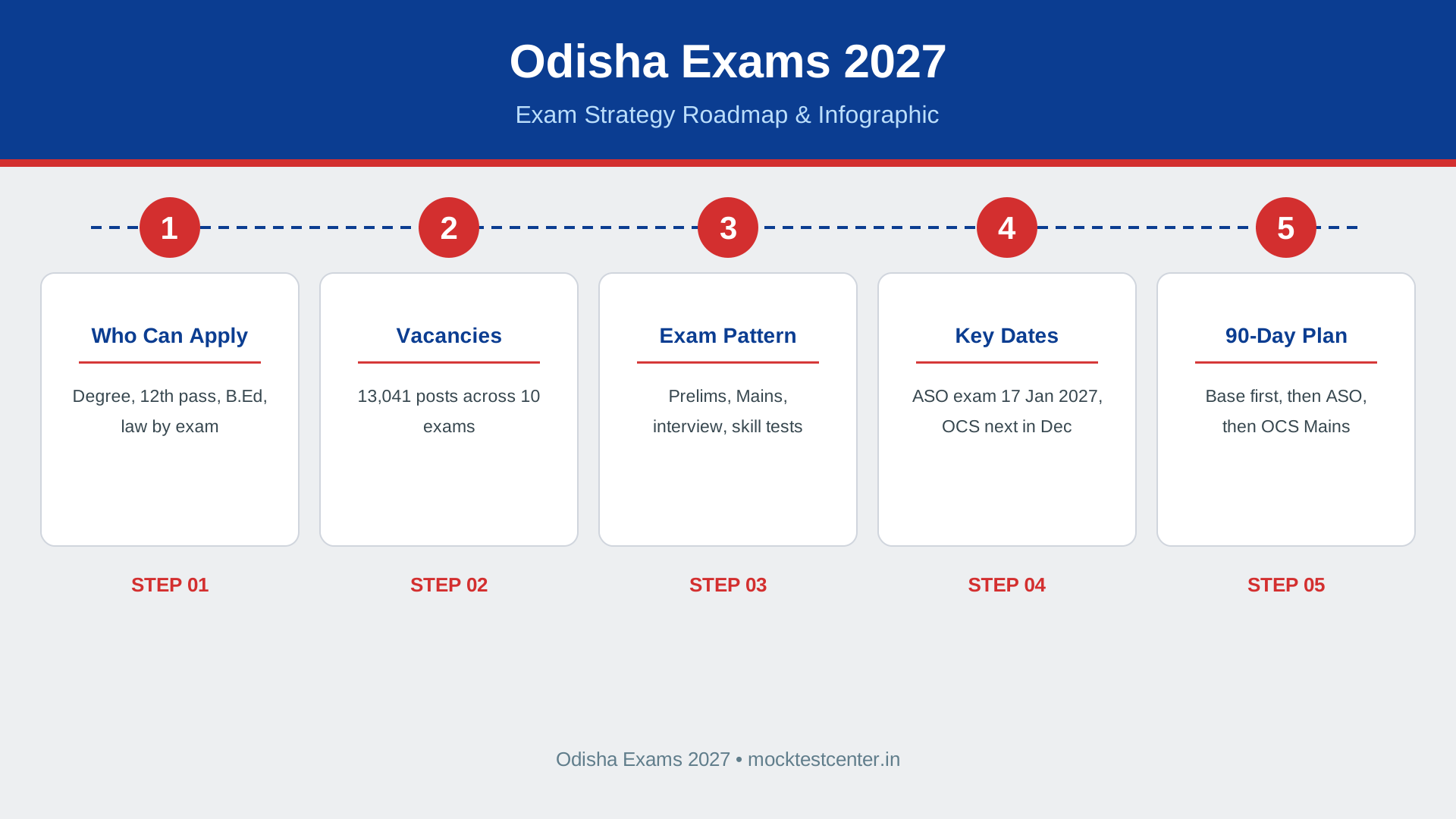
Odisha Exams 2027: Complete Mock Test Guide
📖 Table of Contents
- All 10 Odisha exams in one table
- Which exam fits your qualification
- OPSC OCS 2027: the civil services, 465 posts
- OPSC ASO 2027: 340 secretariat posts, exam on 17 January 2027
- OSSC CGL 2027: 1,576 graduate posts across the departments
- OSSSC RI ARI Amin 2027: 3,250 district posts in one exam
- Odisha Police Constable 2027: 7,268 posts, the largest drive in the set
- Odisha Police SI 2027: the graduate uniformed post, now with OUSSSC
- OTET 2027: the primary teacher eligibility test
- OSSTET 2027: the secondary teacher eligibility test
- Orissa High Court 2027: 64 Group C posts in Cuttack
- OPSC OJS 2027: 78 Civil Judge posts
- How the 10 exams line up on the calendar
- The Odia thread that runs through every exam
- Fees and age limits side by side
- A single preparation plan for the whole set
- How to use the mock tests on this page
- Sources
Odisha Exams 2027: Complete Mock Test Guide
Odisha Exams 2027 brings ten major recruitments onto one page. The Odisha Public Service Commission, the Odisha Staff Selection Commission, the Odisha Sub-Ordinate Staff Selection Commission, the Odisha Uniformed Services Staff Selection Commission, the Board of Secondary Education, the High Court of Orissa together advertised more than 13,000 posts in the current cycle. This guide covers all ten exams: OPSC OCS, OPSC ASO, OSSC CGL, OSSSC RI ARI Amin, Odisha Police Constable, Odisha Police SI, OTET, OSSTET, Orissa High Court and OPSC OJS. Each section gives the live vacancy count, the dates that matter, the pattern, the age rule and the fee, with nothing invented and nothing carried over from an old cycle without a label.
The ten exams split into four groups. OPSC runs the civil services, the secretariat and the judicial service. OSSC and OSSSC run the graduate and district cadre posts.
OUSSSC runs the uniformed services. BSE Odisha runs the two teacher eligibility tests, and the High Court runs its own Group C recruitment. A graduate in Odisha can sit for six of the ten in a single year, and a 12th pass candidate can sit for three. The sections below show which ones fit which qualification, so a candidate can pick a shortlist in one reading.
The scale of the Odisha Exams 2027 set is unusual. Most states run one or two large graduate exams a year.
Odisha runs five graduate exams, two uniformed exams, two teacher tests and a court recruitment in the same twelve months, and the total crosses 13,000 posts. The overlap is the opportunity. A graduate who prepares the common base once can sit for OCS, ASO, CGL, OSSSC, the police SI with the same notes, and each exam becomes another chance at the same preparation rather than a fresh start.
All 10 Odisha exams in one table
| Exam | Body | Posts | Live cycle |
|---|---|---|---|
| OPSC OCS 2027 | OPSC | 465 | Advt. 05 of 2025-26, Mains held 31 Oct to 7 Nov 2026 |
| OPSC ASO 2027 | OPSC | 340 | Advt. 15 of 2026-27, written exam 17 Jan 2027 |
| OSSC CGL 2027 | OSSC | 1,576 | CGLRE 2025, Advt. 5751/OSSC |
| OSSSC RI ARI Amin 2027 | OSSSC | 3,250 | CRE 2025-26, district cadre posts |
| Odisha Police Constable 2027 | OUSSSC | 7,268 | Advt. 01-CRE-2026, applications closed 17 Nov 2026 |
| Odisha Police SI 2027 | OUSSSC | Graduate SI posts | Recruitment moved from OPRB to OUSSSC in 2026 |
| OTET 2027 | BSE Odisha | Eligibility test, no posts | OTET 2025, exam held 17 Dec 2025 |
| OSSTET 2027 | BSE Odisha | Eligibility test, no posts | OSSTET 2025, exam held 20 Jan 2026 |
| Orissa High Court 2027 | High Court of Orissa | 64 | Advt. 06/2026 and 07/2026, apply to 7 Dec 2026 |
| OPSC OJS 2027 | OPSC | 78 | Advt. 02 of 2026-27, Prelims date awaited (5 Jul 2026 dropped by corrigendum) |
The eight post bearing exams in the table add up to 13,041 posts, and that count leaves the Police SI out because its figures are unsettled. The two teacher eligibility tests carry no posts of their own. They certify a candidate to apply for teacher posts, and their value shows up in the recruitment that follows.
Women hold a large share of the posts in the Odisha Exams 2027 set. The reservation runs at 154 of the 465 OCS posts, 114 of the 340 ASO posts, 504 of the 1,576 CGL posts, 1,819 of the 7,268 constable posts, 26 of the 78 OJS posts and 21 of the 64 High Court posts. The constable figure includes 1,393 women in Constable (Civil) alone. A woman candidate in Odisha has more reserved posts in this set than in any comparable state set this year, and the reservation applies horizontally, so it sits inside the category split rather than on top of it.
Which exam fits your qualification
| Your qualification | Exams open to you |
|---|---|
| 12th pass | Odisha Police Constable, OSSSC RI ARI Amin for some posts, OTET Paper I with D.El.Ed |
| Any bachelor degree | OPSC OCS, OPSC ASO, OSSC CGL, OSSSC RI ARI Amin, Odisha Police SI, Orissa High Court |
| Bachelor degree with B.Ed or D.El.Ed | OTET, OSSTET, plus every graduate exam above |
| Law degree with 3 years practice | OPSC OJS, plus OPSC OCS and OSSC CGL |
| Degree with shorthand and typing | Orissa High Court Junior Stenographer, plus the graduate exams |
| Degree with PGDCA and typing | Orissa High Court Typist and DEO, plus the graduate exams |
Two threads run through the whole set. Odia is the first. Nearly every exam in this set requires the ability to read, write, speak Odia, and OCS tests it as a full Mains paper.
Age is the second. Most graduate exams in Odisha now use 21 to 42 years as the window, and the police exams use lower windows. The sections below give the exact age rule for each exam, because the window is the first filter a candidate should apply.
Age decides the shortlist before preparation starts. A candidate of 27 can sit for every graduate exam in the set and both police exams. A candidate of 35 can sit for the graduate exams but not for the constable posts.
A candidate of 43 can sit for OTET and OSSTET, which carry no age limit, and for nothing else in the set. Check the age window first, then the qualification, then the dates. That order saves months of preparation aimed at an exam the candidate cannot sit for.
OPSC OCS 2027: the civil services, 465 posts
OPSC OCS is the top exam in this set. The Odisha Public Service Commission runs it to fill Group A and Group B posts across the state government, from the Odisha Administrative Service to the Odisha Revenue Service.
The live cycle is OCS 2025, advertised as Advt. No. 05 of 2025-26 on 31 December 2025. It notified 314 posts, then raised the count to 465 through the 1st Addendum of 3 January 2026, with 154 posts reserved for women.
The added 151 posts came from four services. The Revenue Service took 113, the Welfare Service took 16, the Administrative Service took 14, and the Transport Service took 8. The original 314 posts sat with the Taxation and Accounts Service at 176, the Labour Service at 98, the Police Service at 12, the Skill Development and Employment Service at 10, the Tourism Service at 8, the Excise Service at 6, and the Co-operative Service at 4.
Applications ran from 20 January to 12 March 2026, after two extensions moved the last date from 27 February. The fee was Rs 700 for candidates other than SC, ST, PwD, and OPSC refunds it to candidates who appear in both Prelims papers. Prelims took place on 7 June 2026, and 5,690 candidates qualified when the result came out on 10 July 2026. Mains ran from 31 October to 7 November 2026, after Cyclone Arnab moved the language papers from 29 October to 31 October and the Essay paper from 30 October to 5 November.
The pattern has three stages. Prelims has two objective papers of 200 marks each. General Studies decides the shortlist, and CSAT qualifies at 33 percent, with negative marking of one third per wrong answer.
Mains has nine descriptive papers of 250 marks each: Odia and English as qualifying papers, then Essay, four General Studies papers and two optional papers for merit. The interview adds 250 marks, and the final total runs to 2,000. The age window is 21 to 42 years as on 1 January 2025, with five years of relaxation for SC, ST, SEBC, women, ex-servicemen, and ten years for PwD candidates.
One change in this cycle matters for every future OCS aspirant. The Odisha Cabinet removed the attempt limit on 9 November 2026.
General candidates could earlier appear six times and SEBC candidates nine times. Now every category can appear without a limit on attempts, as long as the age limit allows. The age window is now the only clock on an OCS career.
The services behind the 465 posts shape the career that follows. The Odisha Administrative Service leads the field postings in the districts, and its officers rise to collector and secretary level posts. The Odisha Police Service supplies the deputy superintendents who run the police districts.
The Odisha Finance Service, recruited here as the Taxation and Accounts Service, handles the state accounts and the commercial tax machinery. The Revenue Service runs land records and revenue administration in the subdivisions. Each service has its own promotion ladder, and the allocation at the end of the exam fixes the ladder a candidate climbs for the next thirty years.
That allocation is why the Mains matters more than Prelims. Prelims only opens the door, and its marks vanish from the record. Mains and the interview decide the service, and the difference between two adjacent ranks can be a single service. Candidates who treat Prelims as the exam and Mains as an afterthought lose the only part that counts.
The 2025 cycle grew sharply over the 2024 cycle, which notified 200 posts on 31 December 2024. The jump to 465 posts came from a government clearing backlogs in the Taxation and Accounts Service and the Revenue Service at the same time. Backlog clearances come in waves, and a future cycle could return to a smaller count. Candidates should treat 465 as the high water mark of a clearing wave, not as the new normal for OCS.
OPSC ASO 2027: 340 secretariat posts, exam on 17 January 2027
The Assistant Section Officer exam is the fastest route into the Odisha Secretariat for a graduate. OPSC issued the notification as Advt. No. 15 of 2026-27 on 5 November 2026, for 340 Assistant Section Officer posts in the Odisha Secretariat Service Cadre under the Home Department.
The written examination is set for 17 January 2027, a Sunday. The date stays tentative until OPSC confirms the centres.
The 340 posts split as 144 unreserved, 38 SEBC, 81 SC, 77 ST, with 114 posts reserved for women. The pay is Rs 35,400 in Level 9, Cell 1, plus allowances. Applications opened on 9 November 2026 and close on 30 November 2026 at 5 PM. One report puts the opening date at 11 November, so candidates should treat the OPSC website as the final word on the opening day and file early either way.
The age window is 21 to 42 years as on 1 January 2026. A candidate needs a bachelor degree in any discipline, basic computer knowledge, and knowledge of Odia. Selection runs through a written examination of 400 marks in three papers, followed by a computer skill test of 50 marks that qualifies. The written paper carries the merit, and the skill test only decides whether a candidate stays in the race.
ASO suits a candidate who wants a desk post in Bhubaneswar with a fixed work pattern. The exam is shorter than OCS, the syllabus is narrower, and the January date gives a clear target. A candidate preparing for OCS can add ASO with little extra study, because the General Studies and Odia preparation overlaps. The computer skill test is the part to practise separately, because it tests speed on a keyboard rather than knowledge.
The ASO post carries a clear promotion path. An Assistant Section Officer rises to Section Officer, then to Under Secretary level posts in the secretariat. Seniority and departmental examinations decide the pace.
The work is file work: noting, drafting. It rewards accuracy and knowledge of the rules over speed. A candidate who likes structured office work and a Bhubaneswar posting will find the ASO post a better fit than a field post in the districts.
OSSC CGL 2027: 1,576 graduate posts across the departments
The Odisha Staff Selection Commission runs the Combined Graduate Level Recruitment Examination, CGLRE, for Group B and Group C posts across the departments of the state government. The 2025 cycle, Advt. No. 5751/OSSC, came out on 12 December 2025 for 1,576 posts, with 504 posts reserved for women.
Applications ran from 19 December 2025 to 21 January 2026, with registration closing on 18 January 2026.
The largest block is Junior Assistant posts across the heads of departments, numbering over 1,000. Junior Clerk in the state cadre adds 255, Block Social Security Officer adds 146. Assistant CT and GST Officer adds 54, and Auditor of Co-operative Societies adds 57. The post wise split in the trackers does not add cleanly to 1,576, so candidates should take the total from the notification and the post wise split from the OSSC website.
The age window is 21 to 42 years as on 1 January 2025. A bachelor degree in any discipline qualifies, and candidates also need Odia language proficiency. The fee is Rs 500 for general candidates, with exemptions for reserved categories. Selection runs through a Preliminary examination, a Mains examination and document verification, and the Preliminary examination took place on 19 April 2026, with the Mains on 7 and 8 July 2026.
CGL is the volume exam in this set. It offers the most posts after the police constable drive, and it covers the widest spread of departments, from Water Resources to Health Services to Commercial Tax and GST. A candidate who wants a government post in Odisha without the long OCS runway should treat CGL as the main target and OCS as the stretch target, because the two share most of the General Studies syllabus.
A Junior Assistant in a head of department office handles the files that keep the department running: correspondence, records, bills, reports. A Block Social Security Officer runs social security pensions and allowances at the block level, and meets beneficiaries face to face.
An Assistant CT and GST Officer works in the commercial tax machinery, and an Auditor of Co-operative Societies audits the accounts of co-operative bodies. The variety is the point. CGL covers a dozen jobs under one examination, and the post preference a candidate files decides which one follows.
OSSSC RI ARI Amin 2027: 3,250 district posts in one exam
The Odisha Sub-Ordinate Staff Selection Commission runs the Combined Recruitment Examination, CRE 2025-26, for district cadre Group B and Group C posts. The drive covers 3,250 posts across seven roles that sit at the base of the district administration: Revenue Inspector, Assistant Revenue Inspector, Amin, Junior Assistant, Village Agricultural Worker, ICDS Supervisor, Statistical Field Surveyor.
The post wise split puts Junior Assistant first with 1,237 posts. Village Agricultural Worker follows with 520, Assistant Revenue Inspector with 422, Amin with 378, ICDS Supervisor with 286, Statistical Field Surveyor with 242, and Revenue Inspector with 165. The seven figures add to exactly 3,250, and the spread shows where the demand sits. Junior Assistant posts dominate because every department needs them, while Revenue Inspector posts are few because each district needs only a small number.
These are district posts, and that shapes the job. A Revenue Inspector works in the field on land records and revenue collection. An Amin measures land.
An ICDS Supervisor runs child development centres. A Village Agricultural Worker supports farmers at the village level. Candidates who want a posting near home should weigh this set carefully, because district cadre posts keep a candidate in the districts rather than moving them to the state capital.
Eligibility varies by post, and the notification sets the qualification for each role separately. Most posts need a bachelor degree or 12th pass with the relevant training, and Odia proficiency applies across the set. The selection runs through a written examination with a skill test or physical test where the post needs one. Candidates should read the post wise eligibility in the OSSSC notification before choosing a preference, because the same exam serves posts with different qualifications.
Choosing among the seven roles is the first decision in this exam, and it deserves care. Revenue Inspector and Amin suit candidates who like field work on land and revenue. Junior Assistant suits candidates who prefer office work. Village Agricultural Worker suits candidates with an agriculture background who want village level work.
ICDS Supervisor suits candidates who want to work with women and children in the villages. Statistical Field Surveyor suits candidates who are comfortable with data and field surveys. The written paper is common, so the choice of role leaves the preparation unchanged. It changes the career.
Odisha Police Constable 2027: 7,268 posts, the largest drive in the set
The Odisha Uniformed Services Staff Selection Commission, OUSSSC, released the Combined Uniformed Services (Below Graduate Level) Examination 2026 as Advt. No. 01-CRE-2026 on 23 October 2026. The drive covers 7,268 posts, the largest single recruitment in this set, and it is the first constable drive run by OUSSSC after the Home Department moved constable and SI level recruitment to the new commission in 2026.
Constable (Civil) holds the largest share with 4,219 posts. Constable (OISF) follows with 2,212. Constable (Communication) has 300, Firefighter has 317, Driver PMT has 154, Firefighting Driver has 62, and Traffic Constable has 4. The seven figures add to exactly 7,268.
Applications opened on 23 October 2026 at 5 PM. The first last date was 12 November 2026, and OUSSSC extended it to 17 November 2026 at 10 PM, with fee payment extended to 18 November 2026. Candidates apply through ousssc.odisha.gov.in, and the written examination date follows the close of applications.
Education depends on the post. Constable (Civil) needs 12th pass. Constable (OISF) needs 10th pass. Constable (Communication) needs 12th Science with physics, chemistry, mathematics, or a three year diploma in Electronics, Computer Science or IT.
The age window for Constable (Civil) is 18 to 26 years as on 1 January 2026, and for Constable (Communication) and Constable (OISF) it is 18 to 23 years, with relaxations under the state rules. The fee is Rs 500 for UR and SEBC candidates, refunded to those who appear in the written examination. SC and ST candidates pay nothing.
Selection runs through a computer based test, a physical measurement test, a physical efficiency test and a medical examination. The posts sit in Pay Matrix Level 5, Rs 21,700 to 69,100, and 1,819 of the 7,268 posts are reserved for women.
The constable drive suits 10th and 12th pass candidates who want a uniformed post without a degree. The physical tests decide as much as the written test, and candidates should train for running and the measurement standards alongside their studies. A candidate who clears the written test but fails the physical standards exits the process, whatever the written score.
The three cadres behind the constable posts shape the posting. Constable (Civil) serves in the district police, Constable (OISF) serves in the Odisha Industrial Security Force guarding industrial installations, and Constable (Communication) serves in the police wireless and communication wing. The training follows the posting, and the daily work differs sharply between a district police station and an industrial security unit. Candidates should read the cadre before choosing a preference, because the cadre decides the next decade of postings.
Odisha Police SI 2027: the graduate uniformed post, now with OUSSSC
The Sub-Inspector post is the graduate entry into the Odisha Police, and its recruitment story changed in 2026. The Odisha Police Recruitment Board, OPRB, ran SI recruitment for years. In 2026 the Home Department moved SI recruitment to the Odisha Uniformed Services Staff Selection Commission, OUSSSC, the same body that now runs the constable drive. The move puts constable and SI recruitment under one commission for the first time.
SI and equivalent posts cover Sub-Inspector of Police, Sub-Inspector (Armed), Station Officer in the Fire Service and Assistant Jailor. A bachelor degree qualifies for the SI posts, and the Station Officer post needs a Science or Engineering degree. The age window for SI and equivalent posts sits at 21 to 28 years, and that figure already includes a three year one time relaxation that the state granted.
The figures around this recruitment are unsettled, and this guide states none of them. Different trackers report different vacancy counts, different application dates and different exam dates, and the commission has not published a settled notification for the SI cycle. Candidates should treat any SI vacancy number seen online as unconfirmed until OUSSSC publishes it on ousssc.odisha.gov.in.
What is settled is the shape of the selection. SI selection runs through a written examination, physical measurement, physical efficiency tests and document verification, with the written paper carrying the merit. A graduate preparing for OPSC OCS or OSSC CGL can carry most of the written preparation across to SI, because the General Studies and reasoning syllabus overlaps. The physical standards are the part that needs separate preparation, and they need months rather than weeks.
A Sub-Inspector runs a police station or a section of one, and the post carries investigation and public dealing from the first day. A Station Officer in the Fire Service commands a fire station.
An Assistant Jailor manages prison administration. These are command posts at the cutting edge of the uniformed services, and they suit graduates who want responsibility early. The written paper tests the same General Studies and reasoning as the other graduate exams, so a candidate preparing for OCS or CGL can add SI with physical training on top.
OTET 2027: the primary teacher eligibility test
The Odisha Teacher Eligibility Test, OTET, certifies candidates to teach Classes 1 to 8 in government, private aided, unaided schools across Odisha. The Board of Secondary Education, Odisha, Cuttack, runs it.
The 2025 cycle opened with a short notification, No. 2006, on 11 November 2025. Applications ran from 12 to 25 November 2025, and the admit card came out on 10 December 2025. The exam took place on 17 December 2025.
OTET has two papers. Paper I covers primary teaching for Classes 1 to 5, and Paper II covers upper primary teaching for Classes 6 to 8.
Paper I ran from 9 AM to 11:30 AM on the exam day, and Paper II ran from 2 PM to 4:30 PM. Each paper runs for two and a half hours. A candidate can sit for one paper or both, depending on the classes they want to teach.
There is no age limit for OTET. Eligibility rests on education and training.
Paper I needs higher secondary with at least 50 percent marks and a two year Diploma in Elementary Education, or graduation with a two year D.El.Ed, or equivalent combinations under NCTE norms. Paper II needs graduation with a two year D.El.Ed or B.Ed. The fee is Rs 600 for most candidates and Rs 400 for SC and ST candidates.
The OTET certificate stays valid for a lifetime. That makes the test a one time qualification rather than a recurring exam, and it changes how a candidate should treat it.
A D.El.Ed or B.Ed student should sit for OTET in the final year of training, because the certificate then stays ready for every teacher recruitment that follows. The test itself is qualifying only. It opens the door, and the teacher recruitment that follows decides the post.
OTET has run every year in recent cycles, and it ran twice in 2022. The Board also holds a Special OTET for candidates who missed the regular cycle, and the Special OTET result for 2025 came out on 15 November 2025. A candidate who misses the regular OTET should watch for the special cycle rather than waiting a full year. The certificate from either cycle carries the same lifetime validity.
The OTET certificate feeds directly into teacher recruitment. The state teacher recruitment that follows asks for OTET qualification as the first filter, and the merit in that recruitment comes from academic marks and the recruitment examination. OTET itself gives no rank and no merit list. It only certifies, and that is why its pass mark matters more than its score.
OSSTET 2027: the secondary teacher eligibility test
The Odisha Secondary School Teacher Eligibility Test, OSSTET, certifies candidates to teach in secondary schools in Odisha. The Board of Secondary Education, Odisha, runs it. The 2025 cycle opened with a notification on 5 December 2025. Applications ran from 6 to 17 December 2025, and the exam took place on 20 January 2026.
OSSTET has two papers. Paper 1 covers Trained Graduate Teachers in Arts, Science, Hindi, Classical subjects.
Paper 2 covers Physical Education Teachers. Each paper has 150 questions for 150 marks, runs for two and a half hours, and carries no negative marking. The paper tests Odia as Language I, English as Language II, and the subject content for the teaching category.
Eligibility depends on the teaching category. A Trained Graduate Teacher in Science needs a bachelor degree in Science or a B.Tech or BE degree with the relevant subjects, plus a B.Ed or an integrated B.Ed M.Ed from an NCTE recognised institute. Arts, Hindi and Classical teachers need the matching degree and training. The fee is Rs 900 for general candidates and Rs 600 for SC and ST candidates.
OSSTET differs from OTET in one important way. OTET certifies primary and upper primary teaching, while OSSTET certifies secondary teaching, and the two tests serve different recruitment pipelines. A candidate with a B.Ed should sit for both where eligible, because the two certificates together cover Classes 1 to 10. The secondary teacher recruitment that follows OSSTET draws on the OSSTET qualified pool, and the certificate is the entry ticket.
The teaching categories in OSSTET Paper 1 cover Trained Graduate Teachers in Arts, Science with physics, chemistry, mathematics or chemistry, botany, zoology, Hindi, Classical languages such as Urdu, Telugu, Sanskrit. Each category has its own subject paper, and a candidate sits for the category that matches the degree and the B.Ed specialisation. Paper 2 covers Physical Education Teachers, and it has its own subject paper and its own eligibility.
Orissa High Court 2027: 64 Group C posts in Cuttack
The High Court of Orissa, Cuttack, issued two advertisements on 11 November 2026 for Group C posts in the court establishment.
Advt. No. 06/2026 covers 33 Junior Stenographer posts, and Advt. No. 07/2026 covers 31 Junior Grade Typist and Data Entry Operator posts.
Together they make 64 posts, with 11 reserved for women in the stenographer cadre and 10 in the typist cadre.
Applications opened on 13 November 2026 at 10 AM and close on 7 December 2026 at 11:59 PM. One tracker puts the last date at 14 December, so candidates should treat the High Court website as final and file before 7 December. The age window is 21 to 42 years as on 12 November 2026. The fee is Rs 500 for general and SEBC candidates, and SC, ST, PwD candidates pay nothing.
Junior Stenographer needs a bachelor degree in any discipline, shorthand speed of 80 words per minute, typing speed of 40 words per minute, and adequate knowledge of computer applications. Junior Grade Typist and Data Entry Operator needs a bachelor degree, typing speed of 40 words per minute on a computer, and a PGDCA or equivalent qualification. The pay is Level 7 (Rs 25,500 to 81,100) for Junior Stenographer, and Level 4 (Rs 19,900 to 63,200) for Typist and Data Entry Operator.
These are skill posts, and the skill test decides them. A degree alone does not clear the shorthand or typing bar, and the speed standards are strict.
Shorthand at 80 words per minute needs months of daily practice, and typing at 40 words per minute needs the same. Candidates who already hold the speeds should apply at once. Candidates who do not should start practice before applying, because the skill test follows the written test without a long gap.
Selection runs through a written examination, a skill test in shorthand and typing, and document verification. The written paper tests General English, General Knowledge, reasoning, and the skill test measures the speeds the notification fixes. The court establishment offers a Cuttack posting with a fixed work pattern, and the work is the drafting, dictation, record keeping that keeps the court running. A candidate with shorthand already at speed should treat this as a high value target, because the skill bar keeps the competition small.
OPSC OJS 2027: 78 Civil Judge posts
The Odisha Judicial Service examination recruits Civil Judges (Junior Division) for the Law Department.
OPSC issued the notification as Advt. No. 02 of 2026-27 on 30 April 2026, for 78 posts with 26 reserved for women. The category split is 35 unreserved, 9 SEBC, 13 SC, 18 ST, 3 for persons with benchmark disabilities.
Applications ran from 8 May to 8 June 2026. The Preliminary examination was first set for 5 July 2026, but a corrigendum dated 30 May 2026 dropped that date, and no new Prelims date had been announced as of November 2026. The age window is 23 to 42 years as on 1 April 2025. A candidate needs a law degree from a recognised university and at least three years of practice as an advocate by 1 April 2025. The pay scale is Rs 77,840 to 1,36,520, and the fee is Rs 700 for candidates other than SC, ST and PwD.
Selection runs through three stages: a Preliminary examination, a Mains examination and an interview. The Preliminary paper tests law and general knowledge, the Mains tests substantive law in depth, the interview tests temperament and judgment. The three year practice requirement narrows the field sharply. A fresh law graduate cannot sit for OJS, and the candidates who can are advocates with courtroom experience behind them.
OJS is the smallest exam in this set by posts, and it is also the most specialised. A law graduate preparing for it should treat the Mains as the real exam, because the Preliminary paper only screens. The Mains papers on civil law, criminal law, the Constitution, procedural law need the kind of preparation that comes from practice, and the best preparation is the candidate's own case work read back against the bare acts.
A Civil Judge (Junior Division) presides over civil cases at the lowest rung of the district judiciary, and the post is the entry point to the judicial service. Promotion runs to Civil Judge (Senior Division) and then to District Judge. Seniority and the higher judicial service examination decide the pace. The work is courtroom work from the first day, and the three year practice requirement exists because the post needs advocates who have already seen a courtroom from the bar side.
How the 10 exams line up on the calendar
The Odisha Exams 2027 set runs on five calendars, and the dates overlap. OCS notified in December 2025 and its Mains closed in November 2026. OJS notified in April 2026 and its Prelims ran in July 2026.
CGL notified in December 2025, OSSSC ran its CRE through 2026, and the police constable drive opened in October 2026. ASO and the High Court notified in November 2026, with exams in January 2027 and after. OTET ran in December 2025 and OSSTET in January 2026. A candidate tracking all ten needs a calendar, not a memory.
| Exam | Notification | Exam date in the live cycle |
|---|---|---|
| OPSC OCS 2027 | 31 Dec 2025 | Prelims 7 Jun 2026, Mains 31 Oct to 7 Nov 2026 |
| OPSC ASO 2027 | 5 Nov 2026 | Written exam 17 Jan 2027 |
| OSSC CGL 2027 | 12 Dec 2025 | Prelims 19 Apr 2026, Mains 7 to 8 Jul 2026 |
| OSSSC RI ARI Amin 2027 | CRE 2025-26 | As per the OSSSC schedule |
| Odisha Police Constable 2027 | 23 Oct 2026 | After applications closed 17 Nov 2026 |
| Odisha Police SI 2027 | OUSSSC, 2026 | Awaited from OUSSSC |
| OTET 2027 | 11 Nov 2025 | 17 Dec 2025 |
| OSSTET 2027 | 5 Dec 2025 | 20 Jan 2026 |
| Orissa High Court 2027 | 11 Nov 2026 | To be notified |
| OPSC OJS 2027 | 30 Apr 2026 | Prelims date awaited, 5 Jul 2026 dropped |
Two dates in that table matter most for a candidate planning now. The ASO written exam on 17 January 2027 is the nearest fixed date in the whole set, and it is the exam to prepare for first. The next OCS notification is expected in December, following the pattern of the last two years, and the candidate who starts OCS preparation in December gets a full year before the Prelims that follows.
The Odia thread that runs through every exam
Odia is the one requirement that appears in nearly every exam in this set. OPSC asks for knowledge of Odia in OCS, ASO, OJS. OSSC asks for Odia proficiency in CGL.
OSSSC applies Odia proficiency across its district posts. BSE Odisha tests Odia as Language I in OSSTET. The police exams test Odia as part of their written papers. Only the High Court skill posts treat it differently, and even there the working language of the court is Odia and English together.
OCS goes further than the rest. It tests Odia as a full qualifying Mains paper of 250 marks, with comprehension, precis writing, usage, vocabulary, short essays, translation. A candidate who cannot write Odia at matriculation standard has no route through OCS, whatever the General Studies score. That makes Odia a subject to study from the first month, not a formality to handle in the last week.
The practical advice is simple. Read an Odia newspaper every day, write one paragraph in Odia every day, and practise translation between Odia and English every week. Candidates from Odia medium schools hold an advantage here, and English medium candidates need to close the gap deliberately. The gap is closable in three months of daily practice, and it is not closable in three days.
English medium candidates face the Odia requirement as a separate subject, and the fix is daily practice rather than a crash course. The Odia paper in OCS Mains carries the same 250 marks as a General Studies paper, and it can end an attempt on its own. The teacher tests carry Odia as a language paper, and the OSSSC and police exams carry Odia questions in their written papers. Three months of daily Odia reading and writing closes the gap for most candidates, and the candidates who start it in the first month never feel it as a burden.
Fees and age limits side by side
| Exam | Fee | Age window | |
|---|---|---|---|
| OPSC OCS 2027 | Rs 700, exempt SC, ST, PwD | 21 to 42 years | |
| OPSC ASO 2027 | As per Advt. 15 of 2026-27 | 21 to 42 years | |
| OSSC CGL 2027 | Rs 500, exemptions for reserved categories | 21 to 42 years | |
| OSSSC RI ARI Amin 2027 | As per the CRE notification | Varies by post | |
| Odisha Police Constable 2027 | Rs 500, exempt SC, ST | 18 to 26 years, Constable Civil | |
| Odisha Police SI 2027 | As per the OUSSSC notification | 21 to 28 years | |
| OTET 2027 | Rs 600, Rs 400 for SC, ST | No age limit | |
| OSSTET 2027 | Rs 900, Rs 600 for SC, ST | As per the BSE notification | |
| Orissa High Court 2027 | Rs 500, exempt SC, ST, PwD | 21 to 42 years | 21 to 42 years |
| OPSC OJS 2027 | Rs 700, exempt SC, ST, PwD | 23 to 42 years |
The table shows the pattern clearly. Graduate exams in Odisha cluster at 21 to 42 years, the police exams run younger, and the teacher eligibility tests drop the age limit entirely.
Fees cluster at Rs 500 to Rs 900, with the same exemption pattern in most exams. Where the table says "as per the notification", the fee figure was not confirmed in the sources used for this guide, and the upload check should confirm it from the official notification. The constable fee payment date also carries two tracker versions: 18 November, 20 November 2026, and the commission notice decides between them.
Fees in this set stay modest, and the refund rules reward candidates who appear. OCS refunds its Rs 700 fee to candidates who sit for both Prelims papers, and the constable drive refunds its Rs 500 fee to candidates who appear in the written examination. The exemptions follow the same pattern in most exams: SC and ST candidates pay nothing, and PwD candidates pay nothing in the OPSC exams. A candidate applying for four exams in the set pays under Rs 3,000 in fees, and most of it comes back on appearing.
A single preparation plan for the whole set
A candidate who wants more than one exam in this set should build one preparation base and add exam specific layers on top. The base is General Studies, Odia, English, reasoning, current affairs. Those five subjects appear in OCS, ASO, CGL, OSSSC, the police written tests and the teacher tests in different mixes. Six months on the base covers most of the set.
Start with the base and add the layers by exam date. ASO has the nearest date, 17 January 2027, so its three paper written test and computer skill test come first.
The police constable written test follows the close of applications. OCS Mains preparation runs through the year, because the next OCS notification is expected in December and the cycle runs for a full year after it. OTET and OSSTET need teacher specific preparation in pedagogy and the school subjects, and the High Court posts need shorthand and typing practice that cannot be compressed.
Take mock tests for the exam you are actually sitting next, not for all ten at once. A mock test for OCS Prelims helps ASO and CGL, because the General Studies questions overlap. A mock test for the police constable written test helps only the police exams, because the physical tests and the post specific syllabus differ. Match the mock to the next date on the calendar, and rotate the mock as the dates pass.
Keep one notebook for Odisha facts. The state budget, the major schemes, the districts, the rivers, the tribal communities, the art forms and the recent notifications recur across OCS, CGL, OSSSC and the police exams. A candidate who knows Odisha well scores in every exam in the set, and a candidate who knows only national material leaves the same marks behind in each one.
Set the order by date, not by preference. ASO comes first on 17 January 2027, so its written papers and computer skill test take the next eight weeks.
The police constable written test comes next, and its physical tests need training time alongside the studies. The High Court skill test needs daily shorthand and typing practice that cannot start late. OCS preparation runs underneath all of it, because its syllabus covers the base that every other exam draws on.
Keep one revision cycle for the whole set. Read the Odisha budget and the state economic survey once, and the knowledge serves OCS, CGL, OSSSC and ASO together.
Read the major central schemes once, and the same notes serve four exams. The candidate who studies each exam separately repeats the same work four times. The candidate who studies the base once and adds the exam layers on top finishes four preparations in the time of one.
How to use the mock tests on this page
Each exam in this set has its own mock test page on this site, with full tests and section tests built on the live pattern. Start with a diagnostic test for the exam you are targeting, and read the result by section rather than by total score. The section scores show where the preparation should go, and the total score only shows where it stands.
Repeat the mock tests on a fixed schedule. One full test a week from three months before the exam, and two a week in the last month, gives enough data to track progress without burning out. Review every wrong answer the same day, and keep a list of the topics behind the wrong answers. That list becomes the revision plan for the last two weeks.
Do not wait for the admit card to start the mock tests. The candidates who score best in these exams are the ones who treated the mock tests as practice from the start, not as a check at the end. The exam dates in this guide show how short the gaps are between stages, and the mock tests are the only way to build speed inside those gaps.
Review the mock test the same day you take it, while the questions are still fresh. Note the topic behind every wrong answer, and add those topics to the next week of study. A mock test reviewed late is a mock test wasted, because the candidate remembers the score and forgets the mistake. The list of weak topics from five mock tests is the most honest syllabus a candidate will ever get, and it beats any fixed study plan.
Before applying for any exam in the Odisha Exams 2027 set, check four things on the official website. First, the last date and time, because OPSC and OUSSSC both extended dates in this cycle and the extension notice is the only reliable source.
Second, the photo and signature specifications, because a rejected upload ends the application. Third, the fee payment window, because the payment last date differs from the form last date in the OCS and constable cycles. Fourth, the document list for verification, because a missing caste or residence certificate at verification ends a candidature that cleared the exam.
The next notification to watch is OCS. OPSC notified OCS on 31 December in both 2024 and 2025, and the pattern points to another December notification for the next cycle.
ASO is the exam with the nearest date, and the High Court skill tests follow it. A candidate who starts now can sit for ASO in January, the High Court tests after that, and the next OCS Prelims later in the year, with the same General Studies base carrying through all three. The Odisha Exams 2027 set rewards the candidate who starts early and keeps one preparation running across the whole calendar.
Sources
Odisha Staff Selection Commission, ossc.gov.in, CGLRE 2025, Advt. 5751/OSSC
Odisha Sub-Ordinate Staff Selection Commission, osssc.gov.in, CRE 2025-26
Odisha Uniformed Services Staff Selection Commission, ousssc.odisha.gov.in, Advt. 01-CRE-2026
Board of Secondary Education Odisha, bseodisha.ac.in: OTET 2025, OSSTET 2025 notifications
High Court of Orissa, orissahighcourt.nic.in, Advt. 06/2026 and 07/2026
Times of India, 10 November 2026: Cabinet approves unlimited attempts for OCS
StudyIQ: OPSC OCS Prelims Result 2026, 5,690 candidates qualify for Mains
Pragativadi: OPSC ASO Recruitment 2026, 340 posts, exam 17 January 2027
CareerPower: How to get a police job in Odisha, OUSSSC constable, SI detail
JagranJosh: OSSTET 2025, notification 5 December 2025, exam 20 January 2026
MTimes: OTET 2025 notification, exam 17 December 2025
Testbook: Orissa High Court Recruitment 2026, 64 posts, Advt. 06/2026 and 07/2026
OPSC OJS 2025 detailed notification, Advt. 02 of 2026-27, 78 Civil Judge posts