
About REET 2027 Exam Series
📖 Table of Contents
- REET 2027 at a glance
- What REET is and what it is not
- The 2024 cycle, date by date
- Who can apply: Level 1
- Who can apply: Level 2
- REET exam pattern: Level 1
- REET exam pattern: Level 2
- The fifth option rule
- Qualifying marks: the line you must cross
- Certificate validity: lifetime, and what changed
- Fee and how to apply
- The syllabus, section by section
- REET Mains: the second exam that actually fills posts
- A 90 day plan that fits the real paper
- Mistakes that cost candidates marks
- Where to check next
- Sources
REET 2027: Complete Exam Guide
REET 2027 is the Rajasthan Eligibility Examination for Teachers, the test that decides who can apply for government school teacher posts in Rajasthan. The Board of Secondary Education Rajasthan, known as BSER and based in Ajmer, runs it. No notification for the 2027 cycle has appeared as of 22 November 2026, so this guide anchors on the last complete cycle, REET 2024, whose exam was held on 27 and 28 February 2025. Every date and figure below comes from that cycle, and every 2027 figure is marked as not yet announced.
That anchor matters because REET confuses more candidates than almost any other Rajasthan exam. The confusion has one root. REET gives you a certificate. It gives you no post. The post comes later, through a separate recruitment run by the Rajasthan Staff Selection Board, and that second exam has its own name, its own pattern and its own vacancy count. Candidates who mix the two up prepare for the wrong paper. This guide keeps them apart from the first paragraph to the last, so a REET 2027 candidate prepares for the right paper.
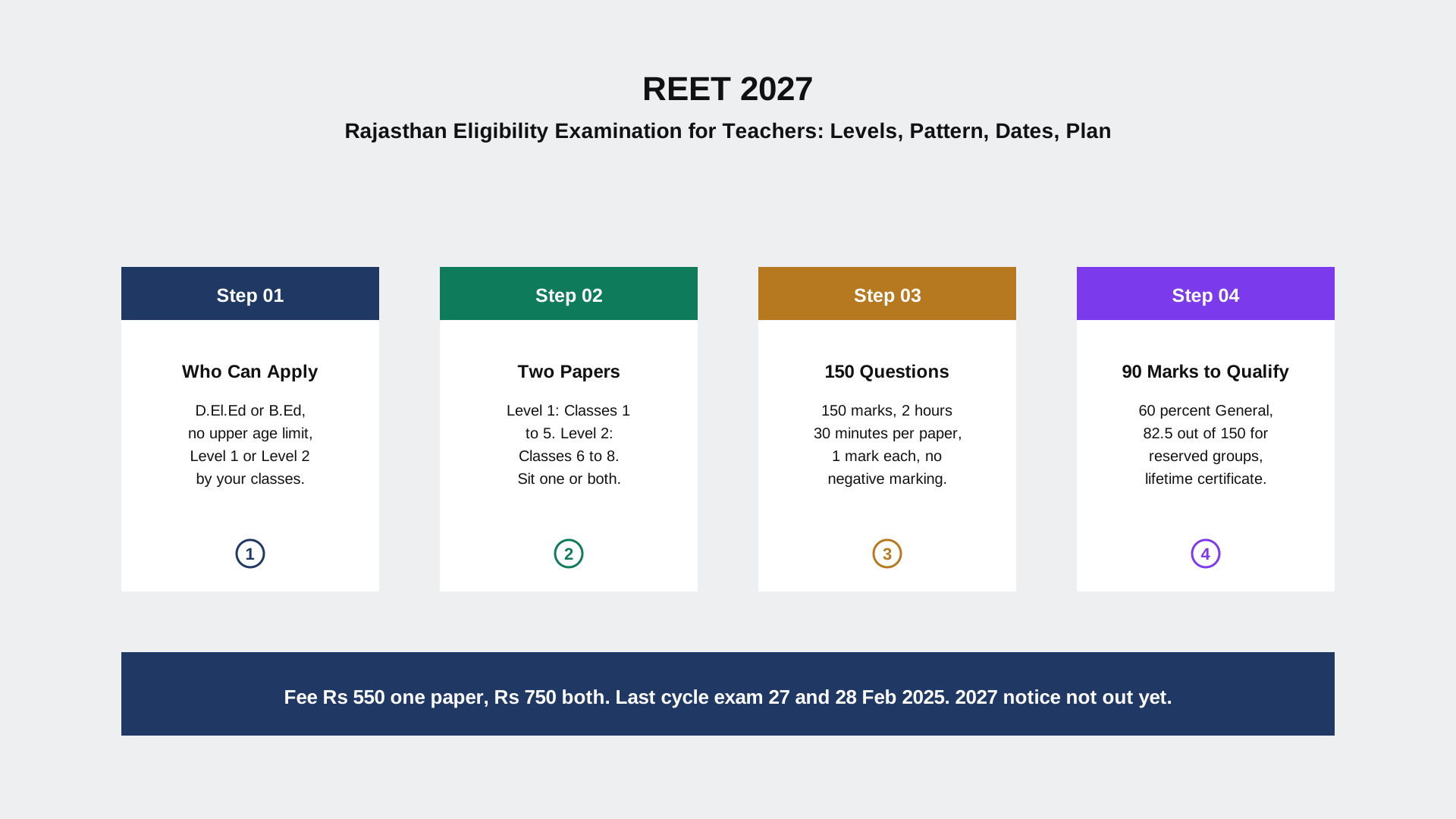
Here is the short version. The REET exam pattern is simple. Each paper has 150 questions for 150 marks and runs for 150 minutes. A wrong answer costs nothing. A blank answer costs one third of a mark, and leaving more than 10 percent of the paper blank disqualifies you. General category candidates need 60 percent to qualify. The certificate lasts for life. The fee was Rs 550 for one paper and Rs 750 for both in the last cycle.
REET 2027 at a glance
| Detail | REET 2027, as last run in the 2024 cycle |
|---|---|
| Conducting body | Board of Secondary Education Rajasthan (BSER), Ajmer |
| Exam | Rajasthan Eligibility Examination for Teachers (REET), earlier called Rajasthan Teacher Eligibility Test (RTET) |
| Last cycle | REET 2024, Advertisement 01/2024, notification 11 December 2024 |
| Posts in REET itself | None. REET is an eligibility test only |
| 2027 notification | Not published as of 22 November 2026 |
| Papers | Level 1 for Classes 1 to 5, Level 2 for Classes 6 to 8 |
| Each paper | 150 questions, 150 marks, 150 minutes, pen and paper with an OMR sheet |
| Negative marking | None for a wrong answer. A blank answer costs one third of a mark |
| Qualifying marks | 60 percent for general category, 90 out of 150, with relaxation for reserved categories |
| Certificate validity | Lifetime, under a Rajasthan government order dated 16 March 2022 |
| Age limit | No age limit in the REET 2024 notification |
| Fee in last cycle | Rs 550 for one paper, Rs 750 for both papers |
| Official website | rajeduboard.rajasthan.gov.in |
What REET is and what it is not
REET is a gate, not a job. You sit the paper, you cross the qualifying line, and BSER gives you a certificate that says you are eligible to teach in Rajasthan government schools. That certificate sits in your file until a recruitment opens. It wins you nothing by itself. No appointment letter follows it. No school calls you. The certificate only lets you enter the next race.
The next race is the 3rd Grade Teacher recruitment, run by the Rajasthan Staff Selection Board (RSSB). In the current round it carries 7,759 posts, 5,636 for Level 1 and 2,123 for Level 2, under a notification dated 6 November 2025. Only REET qualified candidates can apply for it. Its exam, often called REET Mains, is a different paper from REET itself. It has 150 questions for 300 marks, two marks per question, and it does carry negative marking of one third of a mark per wrong answer. Treating the two exams as one is the single most common preparation error in Rajasthan teaching exams.
The mix up has a history. Before 2021, Rajasthan ran RTET, the Rajasthan Teacher Eligibility Test. The state renamed it REET and kept the same job: eligibility only. Trackers still label the 2024 cycle as REET 2025 in many places, because the exam fell in February 2025. The official advertisement number is 01/2024, and the notification came out in December 2024. When you search for the next cycle, check the advertisement number, not the year in a tracker headline. A page that says REET 2025 and a page that says REET 2024 usually describe the same exam.
Why does the state run two exams for one job? The answer sits in the design. REET tests whether you know how to teach: child development, pedagogy, languages, maths, environmental studies. The Mains tests whether you know the subjects you will teach, plus Rajasthan general knowledge, at a deeper level. The first paper filters for teaching ability. The second ranks candidates for actual posts. A candidate who clears REET with 90 marks and then ignores the Mains pattern has done half the work.
One more distinction saves candidates from a costly mistake. REET Level 1 and Level 2 are separate papers with separate eligibility rules. A D.El.Ed holder aims at Level 1. A B.Ed graduate aims at Level 2. You can sit both if you hold both qualifications, and many candidates do, because two certificates double the recruitments you can enter. The fee for both papers together was Rs 750 in the last cycle, only Rs 200 more than one paper alone. That small gap makes the second paper cheap insurance for anyone who qualifies for both.
The 2024 cycle, date by date
The 2024 cycle moved fast once it started. BSER issued the short notification on 11 December 2024 and published the detailed notification on 12 December 2024. Applications opened on 16 December 2024 and closed on 15 January 2025. A correction window ran from 17 to 19 January 2025. Admit cards came out on 19 February 2025, and the exam followed within days.
The exam itself ran on 27 and 28 February 2025 in several shifts across Rajasthan. Level 1 sat in the morning shift of 10.00 AM to 12.30 PM on 27 February, and Level 2 sat in the afternoon shift of 3.00 PM to 5.30 PM the same day. A further shift ran on 28 February. Some tracker pages report the exam as a single day, 27 February only, and others report both days. The two day version matches the shift table published before the exam, which listed a morning shift on 28 February as well. Candidates should treat 27 and 28 February 2025 as the exam dates and ignore pages that compress the schedule to one day.
After the exam, the answer key came out on 25 March 2025. The result followed on 8 May 2025, announced at 3.15 PM. Certificates became available for download on 27 July 2025. From notification to certificate, the cycle took about seven and a half months. That is quick by Rajasthan standards, and it is one reason the 2024 cycle drew such a large entry. Candidates knew the timeline would not drag across two years.
How large was the entry? No official applicant count was found in the sources checked for this guide. Tracker pages quote figures in lakhs, but they disagree with each other and none of them cites a BSER release. This guide prints no applicant number rather than repeat one. What is certain is the scale of the next step. The 3rd Grade Teacher recruitment that followed drew on the REET 2024 qualified pool and advertised 7,759 posts. Aspirants protested that number as low, and the protest trended under the demand to raise posts in the third grade drive. The gap between the size of the qualified pool and the size of the recruitment is the real story of REET. Clearing the eligibility test puts you in a large crowd. The Mains decides who gets a chair.
Who can apply: Level 1
Level 1 is the REET 2027 paper for primary teaching, Classes 1 to 5. The rules list several routes in, and each route pairs a school qualification with a teacher training qualification. The most common route is Senior Secondary, the 12th pass, with at least 50 percent marks, plus a two year Diploma in Elementary Education, D.El.Ed, passed or appearing in the final year. The diploma goes by several names across states, BSTC in Rajasthan and JBT in Haryana among them, and the notification accepts it under any of those names.
A second route lowers the 12th bar to 45 percent for candidates whose two year D.El.Ed follows the NCTE Regulations of 2002. A third route accepts 12th with 50 percent plus a four year Bachelor of Elementary Education, B.El.Ed, passed or appearing. A fourth accepts 12th with 50 percent plus a two year Diploma in Education in Special Education, passed or appearing. A fifth accepts graduation plus a two year D.El.Ed, passed or appearing. Final year students can apply under the appearing routes, which matters for candidates finishing their diploma in the exam year.
Two points in this list catch candidates out. First, the percentage applies to Senior Secondary, not to the diploma. A candidate with 48 percent in 12th and a strong D.El.Ed score cannot use the most common route, though the 45 percent route may still work if the diploma follows the 2002 NCTE regulations. Second, appearing candidates must complete the qualification before the recruitment stage, not merely before the REET exam. The certificate is provisional until the training is complete.
Level 1 has no age limit. The REET 2024 notification sets no minimum or maximum age. One tracker page lists 18 to 40 years, but that figure belongs to the 3rd Grade Teacher recruitment, where the age limit is 18 to 40 years as on 1 January 2026. It does not belong to REET itself. A candidate of 45 with a fresh D.El.Ed can sit REET Level 1. The same candidate faces the 18 to 40 limit only at the Mains stage. Keep the two limits apart.
Who can apply: Level 2
Level 2 is the REET 2027 paper for upper primary teaching, Classes 6 to 8. The routes here start from graduation. The most common route is graduation plus a two year D.El.Ed, passed or appearing. A second route is graduation with at least 50 percent marks plus a one year Bachelor in Education, B.Ed. A third route is graduation with at least 45 percent marks plus a one year B.Ed under NCTE norms. A fourth route is Senior Secondary with 50 percent plus a four year B.A. Ed or B.Sc. Ed, or a four year Bachelor in Elementary Education, passed or appearing in the final year.
The Level 2 list also covers Sanskrit teaching. Candidates with Shastri or an equivalent traditional Sanskrit examination plus a two year D.El.Ed, or Shastri with at least 50 percent plus a one year B.Ed, qualify for the Sanskrit route at the recruitment stage. The REET paper itself does not split by subject in the way the Mains does. Level 2 candidates choose a subject block in the paper, maths and science or social studies, and that choice shapes which Mains subject they can later apply for.
Post graduation with 55 percent marks plus a three year integrated B.Ed and M.Ed also appears in the recruitment rules for Level 2 posts. That route belongs to the RSSB recruitment, and it is worth knowing early, because a candidate planning a long teaching career may find it opens doors that a plain B.Ed leaves shut. REET itself asks for the same qualifications either way.
As with Level 1, there is no age limit for REET Level 2. The 18 to 40 limit that appears on tracker pages is the Mains limit. Candidates sometimes read it as a REET limit and delay their attempt until they are inside it, which is backwards. REET has no clock. The Mains has one. Sitting REET early, even years before a recruitment, banks a lifetime certificate and removes the eligibility question from every later attempt.
REET exam pattern: Level 1
The REET exam pattern for Level 1 is a flat table. Five sections, 30 questions each, one mark each, 150 questions for 150 marks in 150 minutes. Child Development and Pedagogy opens the paper with 30 questions. Language 1 follows with 30. Language 2 follows with 30. Mathematics follows with 30. Environmental Studies closes with 30. No section carries more weight than another. A candidate who masters four sections and ignores the fifth gives away a fifth of the paper.
| Section | Questions | Marks |
|---|---|---|
| Child Development and Pedagogy | 30 | 30 |
| Language 1 (Hindi, English, Sanskrit, Urdu, Sindhi, Punjabi or Gujarati) | 30 | 30 |
| Language 2 (must differ from Language 1) | 30 | 30 |
| Mathematics | 30 | 30 |
| Environmental Studies | 30 | 30 |
| Total | 150 | 150 |
Language choice deserves a closer look, because it decides 60 of your 150 marks. Language 1 and Language 2 must differ. A candidate who picks Hindi as Language 1 cannot pick Hindi again as Language 2. Most candidates pick Hindi as one language and English as the other, and that is a sound default, because both languages are tested at school level and both appear in the Mains as well. Candidates with Sanskrit, Urdu or another listed language should weigh one thing before choosing. Pick the language you can read fastest under pressure. The language sections reward reading speed as much as grammar knowledge, and 30 questions in a language you read slowly will eat time that mathematics needs.
The paper runs for 150 minutes, which gives you exactly one minute per question. That sounds generous until you meet the pedagogy section, where some questions run to four lines and four options each. The candidates who finish comfortably are the ones who treat the first 30 questions as a sprint. Child Development and Pedagogy has the most predictable questions in the paper, and it rewards candidates who have revised it last. Do it first, bank the marks, and carry the confidence into the languages.
Environmental Studies is the section most candidates underprepare. It covers the world around a primary school child: food, shelter, water, plants, animals, family, work, transport, and the Rajasthan environment in particular. Candidates who revise it from a Class 1 to 5 EVS textbook score well. Candidates who revise it from a general knowledge book score badly, because the questions ask how a child learns about the environment, not what a civil service aspirant knows about it.
REET exam pattern: Level 2
The REET exam pattern for Level 2 shares its first 90 marks with Level 1 and then splits. Child Development and Pedagogy carries 30 questions. Language 1 carries 30. Language 2 carries 30. Then comes the subject block, 60 questions for 60 marks, and the candidate picks one block. Mathematics and Science is one block. Social Studies or Social Science is the other. Some subject routes allow another subject in place of these two, and the notification lists the options for each qualification. The total stays 150 questions for 150 marks in 150 minutes.
| Section | Questions | Marks |
|---|---|---|
| Child Development and Pedagogy | 30 | 30 |
| Language 1 (Hindi, English, Sanskrit, Urdu, Sindhi, Punjabi or Gujarati) | 30 | 30 |
| Language 2 (must differ from Language 1) | 30 | 30 |
| Mathematics and Science, or Social Studies, or another subject | 60 | 60 |
| Total | 150 | 150 |
The 60 mark block is where Level 2 is won or lost. It is 40 percent of the paper, and it tests subject knowledge at the level of Classes 6 to 8 plus the pedagogy of teaching that subject. A mathematics graduate who picks the maths and science block faces questions on Class 6 to 8 maths and science, not on graduation level maths. A social science graduate who picks social studies faces history, geography, civics and economics at school level. The trap is picking the block that matches your degree rather than the block that matches your school level revision. Your degree subject and your strongest school subject are often the same, but when they differ, pick the school subject.
Level 2 candidates who sit both papers face a long day. Two papers of 150 minutes each, with a break between shifts, means five hours of examination plus waiting time. Candidates who do this should practise two full papers back to back at least twice before the exam. The second paper always feels harder than the first, and the reason is fatigue, not difficulty. A candidate who has never sat two papers in one day discovers this in the hall. A candidate who has practised it treats the second paper as routine.
The fifth option rule
Every question in REET 2027 carries five bubbles on the OMR sheet, not four. Options A to D hold the answers. Option E records a deliberate skip. This fifth bubble is the most misunderstood rule in the exam, and it is the rule that decides more results than any syllabus topic.
A wrong answer costs nothing in REET. There is no negative marking for marking a wrong option. A blank answer, a question left with no bubble darkened at all, costs one third of a mark. And leaving more than 10 percent of the questions with no bubble darkened disqualifies the candidate from that paper. Ten percent of 150 is 15 questions. Leave 16 questions entirely blank and the paper is gone, however well you answered the rest.
The logic is simple once you see it. The board wants every question answered or consciously skipped. Guessing costs nothing, so guess. Leaving a question untouched costs marks and risks disqualification, so never leave one untouched. If you cannot answer a question, darken option E. That is what E is for. It records a deliberate skip and costs nothing by itself. The penalty falls only on the candidate who leaves the bubble sheet empty.
Some older tracker pages still claim REET carries negative marking of one third of a mark per wrong answer. That claim mixes REET up with the Mains, where one third negative marking does apply, and with older TET rules from other states. The REET 2024 notification position, as reported by the sources that read the notification itself, is clear. Wrong answers carry no deduction. Blank answers carry the deduction. This guide follows the notification reading and flags the older claim as a conflict in the package notes.
Put the rule to work in mocks. Every mock you attempt should use a five option sheet, or at least a rule that every question gets an answer or an E. Candidates who practise with four options build a habit of skipping hard questions, and that habit costs them on exam day. Candidates who practise the E rule build a habit of deciding on every question, and that habit is worth marks by itself.
Qualifying marks: the line you must cross
REET 2027 qualifying marks are percentages of 150, and the line moves by category. General category candidates need 60 percent, which is 90 marks out of 150. Scheduled Caste, Other Backward Class, Most Backward Class and Economically Weaker Section candidates need 55 percent, which is 82.5 marks. Widows, divorced women and ex servicemen need 50 percent, which is 75 marks. Persons with disabilities need 40 percent, which is 60 marks. Sahariya tribe candidates need 36 percent, which is 54 marks.
| Category | Qualifying percent | Marks out of 150 |
|---|---|---|
| General | 60 | 90 |
| SC, OBC, MBC, EWS | 55 | 82.5 |
| Scheduled Tribe, outside TSP areas | 55 | 82.5 |
| Scheduled Tribe, inside TSP areas | 36 | 54 |
| Widows, divorced women, ex servicemen | 50 | 75 |
| Persons with disabilities | 40 | 60 |
| Sahariya tribe | 36 | 54 |
The Scheduled Tribe line needs care. It is 55 percent outside Tribal Sub Plan areas and 36 percent inside them. A single ST figure quoted on a tracker page may be the wrong one for your area. Check which area your domicile falls in before you set your target score. The same caution applies to the disability line. One older tracker table prints 80 percent for persons with disabilities, which is plainly wrong against the notification figure of 40 percent. That table appears to have swapped a column. Do not plan around it.
Note what qualifying means here. It means you pass. It does not mean you rank. REET has no merit list for jobs, because it fills no posts. A general candidate with 90 marks and a general candidate with 140 marks hold the same certificate. The difference shows up only in the Mains, where every mark counts. That is why the smart target for REET sits at 110 or more rather than 90, with the extra marks coming from the subject block and pedagogy, because the revision that lifts you from 90 to 110 in REET is the same revision that lifts your Mains score.
Certificate validity: lifetime, and what changed
The REET certificate is valid for life. A Rajasthan government order dated 16 March 2022 made the validity lifetime, and the REET 2024 notification restated it. A candidate who qualified in 2022 can use that certificate for the 2025 recruitment without sitting REET again. A candidate who qualifies in the next cycle will hold the certificate for every recruitment that follows, with no expiry date to watch.
This was not always the rule. Older pages still say the certificate lasts three years, and some say seven. Those figures belonged to earlier TET rules, before the lifetime order. The three year figure still appears on tracker pages that copied old REET articles without updating them. If a page tells you your REET certificate expires in three years, it is out of date. The lifetime rule also matches the national position. The National Council for Teacher Education made TET certificates valid for life, and Rajasthan followed the same line.
Lifetime validity changes how you should plan. There is no reason to wait for a recruitment announcement before sitting REET. Sit it at the next cycle, bank the certificate, and then prepare for the Mains at your own pace. Candidates who wait for a vacancy notice before sitting REET compress two exams into one short window and prepare for neither properly. Candidates who sit REET early split the work across two calm periods.
Fee and how to apply
The REET 2024 fee was simple. One paper cost Rs 550 for all categories. Both papers together cost Rs 750 for all categories. The fee was the same for every category, which is unusual among Rajasthan exams and worth noting. The fee was paid online with the application, and it was non refundable once paid.
Applications ran online at rajeduboard.rajasthan.gov.in. The 2024 window ran from 16 December 2024 to 15 January 2025, and a correction window followed from 17 to 19 January 2025. Candidates applied for Level 1, Level 2, or both, and the fee followed the choice. The admit card came out on 19 February 2025, about a week before the exam.
When the REET 2027 notification comes, expect the same shape. Online form, one paper or both, fee per paper, correction window, admit card about a week before the exam. The fee figure may change, so check the new notification rather than assuming Rs 550 and Rs 750 will hold. What will not change is the structure. REET has kept the same application shape across cycles, and the board has no reason to rebuild it.
The syllabus, section by section
Child Development and Pedagogy is the backbone of both papers, 30 questions in each. It covers how children grow and learn, individual differences, learning theories, assessment, and inclusive education. The questions test whether you can apply a theory to a classroom situation, not whether you can recite the theory. A question will describe a child who cannot sit still in class and ask what the teacher should do first. The answer comes from understanding, not memory. Revise this section from your D.El.Ed or B.Ed notes, not from a general book, because your training notes already frame every concept as a classroom decision.
Language 1 and Language 2 test comprehension, grammar, vocabulary and pedagogy of language teaching. Each language paper asks about unseen passages, word meanings, sentence correction, and how language should be taught to children. The pedagogy questions in the language sections catch candidates who revise only grammar. A candidate who knows every rule of Hindi grammar but has not read how language is taught in primary classes will drop marks here. Spend a third of your language revision on teaching methods.
Mathematics in Level 1 covers number systems, arithmetic, geometry, measurement and data at primary level, plus the pedagogy of teaching maths to young children. The questions are school level, and a graduate can answer most of them without revision. The marks are lost on speed, not difficulty. Practise 30 primary maths questions in 25 minutes and you will see the pattern. The easy questions come first in your mind, and the calculation heavy ones eat the clock. Do the quick ones first, then return to the heavy ones.
Environmental Studies in Level 1 covers the child and the world: family, food, shelter, water, travel, plants, animals, and the local environment of Rajasthan. The syllabus follows the primary EVS curriculum, and the best source is the Class 1 to 5 EVS textbook itself. Read it as a teacher, not as a student. Every chapter asks what a child should notice, and the exam asks what a teacher should help the child notice.
The Level 2 subject block goes deeper. Mathematics and Science covers Class 6 to 8 maths and science with subject pedagogy. Social Studies covers history, geography, civics and economics at the same level, with the same pedagogy angle. Both blocks reward candidates who revise from NCERT Class 6 to 8 textbooks. Those books are the syllabus in practice, and the questions follow their chapters closely. A candidate who reads the textbooks twice will recognise the source of most questions in the hall.
REET Mains: the second exam that actually fills posts
REET Mains is the exam that turns a certificate into a job. The Rajasthan Staff Selection Board runs it for 3rd Grade Teacher posts, and the current round is the largest teacher recruitment Rajasthan has run in years. The notification came out on 6 November 2025, after a short notice in July 2025. Applications ran from 7 November to 6 December 2025. The exam was held from 17 to 20 January 2026 across several shifts. Some tracker pages extend the window to 21 January, and the difference comes from how the last shift is counted. The 17 to 20 January window matches the detailed schedule.
The vacancy count is 7,759 posts. Level 1 carries 5,636 posts, and Level 2 carries 2,123. Inside Level 1, Elementary Education holds 5,000 posts, General Education holds 449, and Sanskrit Education holds 187. Inside Level 2, Maths and Science holds 1,043 posts, Sanskrit holds 389, Social Science holds 296, English holds 221, and Hindi holds 174. These are 3rd Grade Teacher posts, not REET posts. REET itself has no posts at all, and any page that lists 7,759 as REET vacancies is mixing the two exams.
The Mains pattern is one paper per level, 150 questions for 300 marks, two marks per question, in 2 hours and 30 minutes. The sections are Rajasthan geography, history and culture, general knowledge of Rajasthan, current affairs, the Right to Education Act, school subjects, education pedagogy, education psychology, and information technology. Negative marking applies here: one third of a mark per wrong answer, which is two thirds of a mark per wrong question at two marks each. The Mains also has the fifth option rule, so the blank answer penalty applies here too.
The Mains age limit is 18 to 40 years as on 1 January 2026, with relaxation under the Rajasthan rules, up to five years for EWS, OBC, MBC, SC, ST and Sahariya candidates. The Mains fee follows the one time registration system: Rs 600 for general and OBC creamy layer, Rs 400 for OBC non creamy layer, SC and ST, with a Rs 300 correction charge. Only REET qualified candidates can apply, and the REET qualification must match the level and subject applied for.
Aspirants protested the 7,759 figure as low, and the protest is worth understanding. Rajasthan has a large pool of REET qualified candidates, built up over several cycles, and 7,759 posts cannot absorb it. The protest demanded more posts in the third grade drive. Whether the count rises in a later addendum is a matter for the board, and this guide will not guess. What is certain is the competition. A candidate who treats the Mains as an extension of REET, with the same one mark questions and no negative marking, will lose marks on every wrong guess. The Mains punishes guessing, while REET leaves wrong answers unpunished. That single difference should change how you attempt the two papers.
A 90 day plan that fits the real paper
Ninety days is enough for REET 2027 if the days are spent on the paper as it is, not on the paper candidates imagine. The first 30 days belong to the two sections that carry 60 marks in Level 1 and 90 in Level 2 when the subject block is counted with them: child development and pedagogy, and your chosen subject block. Read your training notes for pedagogy and the NCERT textbooks for the subject block. Do not buy a new guide in this phase. Your training notes and the school textbooks are the syllabus, and a guide only rearranges them.
Days 31 to 60 belong to the languages and to mathematics or environmental studies. Work one language each day, alternating Hindi and English, with 30 questions of practice after each reading session. Mathematics needs 30 questions a day under a timer, because speed is the skill being tested. Environmental Studies needs the Class 1 to 5 textbook, read once through with a pencil, marking every fact that could become a question about a child and the world.
Days 61 to 75 belong to mocks. Sit one full paper every second day, 150 questions in 150 minutes, with the fifth option rule in force, so the REET exam pattern becomes habit rather than a surprise on exam day. Score each mock by the real rules: one mark per correct answer, nothing lost for a wrong answer, one third lost for each blank. Then spend the day after each mock on the questions you got wrong, not on the questions you got right. The wrong answers show your gaps. The right answers only show your strengths.
Days 76 to 90 belong to revision and to the second paper, if you sit both. Revise pedagogy and the subject block twice in this phase, because they carry the most marks and they fade fastest. Sit two full papers back to back at least twice, to practise the fatigue of a two paper day. In the last week, stop learning new topics. New topics in the last week cost confidence and add little. Revise what you know, sleep properly, and arrive at the hall with the OMR rules clear in your head.
One habit matters more than any timetable. Every mock should end with a count of blanks. If you left more than 15 questions blank in a 150 question mock, you have a disqualification risk, not a score problem. Fix the blank habit before you fix the score. Darken option E for every question you cannot answer, and the risk disappears. Candidates who practise this rule never face it in the hall. Candidates who never practise it discover it when the result comes out.
Mistakes that cost candidates marks
The first mistake is leaving questions blank. The rule is written in this guide twice because it decides results. A blank costs one third of a mark, and 16 blanks disqualify the paper. Guess when you do not know, and darken E when you choose not to guess. Never leave a bubble empty.
The second mistake is preparing for the Mains pattern while sitting REET. Candidates who have read Mains guides arrive at REET afraid to guess, because the Mains punishes wrong answers. REET does not punish wrong answers. Guessing is free in REET. A candidate who leaves 20 questions unanswered out of fear of negative marking has given away marks that cost nothing to attempt.
The third mistake is ignoring the language sections. Sixty marks sit in the two languages, and candidates who revise only pedagogy and maths give away more than a third of the paper. The languages are also the sections where revision pays fastest, because the grammar and comprehension questions repeat their patterns every cycle.
The fourth mistake is picking the wrong Level 2 block. A candidate with a science degree who has not opened a Class 6 science book in years will score lower in the maths and science block than in social studies, if social studies is the subject they actually read. Pick the block you can revise from school textbooks with confidence, not the block that matches your degree certificate.
The fifth mistake is waiting for a recruitment notice before sitting REET 2027. The certificate lasts for life, and the recruitment comes when it comes. A candidate who sits REET at the next cycle holds the certificate for every recruitment after it. A candidate who waits holds nothing. The exam is cheap, the fee is Rs 550 for one paper, and the certificate never expires. There is no reason to delay.
Where to check next
The REET 2027 notification will appear on rajeduboard.rajasthan.gov.in, the BSER website, and the board also publishes notices through the Rajasthan education portal. Check the board website directly. Tracker pages will carry the news within hours, but they will also carry wrong dates in headlines, because several of them still label the 2024 cycle as REET 2025. When a new notification appears, read the advertisement number first. REET 2024 was Advertisement 01/2024. The next cycle will carry its own number, and that number is the only reliable way to tell a new cycle from a recycled old article.
The 3rd Grade Teacher recruitment, the Mains, lives on rssb.rajasthan.gov.in, the RSSB website. That is where the vacancy count, the application window and the exam dates for the recruitment appear. Do not look for Mains dates on the BSER website. BSER runs REET. RSSB runs the recruitment. Two bodies, two websites, two exams. Candidates who bookmark both never miss a date.
Until the REET 2027 notification lands, the 2024 cycle in this guide is the best map of the exam. The pattern has been stable across cycles, the qualifying lines have been stable, and the certificate rule has been stable since 2022. A new notification may change the fee or the dates. It is unlikely to change the shape of the paper. Prepare on the shape in this guide, and adjust the dates when the board publishes them.
Sources
Board of Secondary Education Rajasthan, REET 2024 notification, Advertisement 01/2024, December 2024, on rajeduboard.rajasthan.gov.in. JobSafal, REET 2024 exam date, pattern, eligibility and fees. Veda Sakthi TET, REET page, notification section 6 qualifying marks and certificate validity, read from BSER documents. Adda247, REET Notification 2025, exam dates 27 and 28 February 2025. Khan Global Studies, REET Exam 2025 notification and REET syllabus and exam pattern. SpeedJob, Rajasthan REET Exam, application dates 16 December 2024 to 15 January 2025 and result 8 May 2025. ResultBharat, REET 2024 result, fee Rs 550 one paper and Rs 750 both papers, certificate available 27 July 2025. PW Live, REET Application Form 2024, eligibility and fee. PlacementStore, BSER REET 2024 notification, age limit and admit card 19 February 2025. SarkariExam Center, REET Notification 2025 application schedule and exam dates. CollegeDekho, REET 2025, Mains exam 17 to 20 January 2026. NaukariMitra, RSSB Teacher Vacancy 2025 notification, 7,759 posts, Level 1 5,636 and Level 2 2,123, application window 7 November to 6 December 2025. Shiksha, Rajasthan teacher aspirants demand more jobs, 7,759 REET Mains 2025 vacancies and Mains pattern 150 questions for 300 marks. Sakshi Education, RSSB REET Main Exam notification for 7,759 vacancies. Testbook, Rajasthan 3rd Grade Teacher syllabus 2026 and exam pattern. Government of Rajasthan order dated 16 March 2022 on lifetime validity of the REET certificate, as restated for REET 2024.







