About Rajasthan High Court 2027 Exam Series
📖 Table of Contents
- Rajasthan High Court 2027 at a glance
- Three cycles, one name, and why most pages get this exam wrong
- The three posts and what each one does
- Who can apply
- Rajasthan High Court LDC exam pattern
- The syllabus, section by section
- Fee, pay and posting
- A preparation plan built on the real paper
- Rajasthan High Court 2027: cut offs and competition
- Rajasthan High Court 2027: what to check before you trust a date
- Sources
Rajasthan High Court 2027: Complete Exam Guide
Rajasthan High Court 2027 is the name candidates use for the next clerk recruitment from the Rajasthan High Court in Jodhpur. The last full cycle ended in June 2023 with 2,756 posts filled across the High Court, the district courts and the legal services authorities. No fresh notification for the next cycle has appeared on hcraj.nic.in as of November 2026. This guide anchors on the 2022 cycle, the freshest complete map of the exam, and marks every 2027 figure as not yet announced.
That matters because the exam has no fixed calendar. The High Court recruits clerks when posts fall vacant, not every year. The gap between the 2020 notification and the 2022 notification was two years. The gap since the 2022 notification is already longer. Candidates who wait for a date before they start preparing lose the one advantage this exam gives them, which is time. The written paper tests three school level subjects, Hindi, English and general knowledge, and the typing test rewards daily practice over last minute effort.
This guide covers the exam as it actually runs. The three posts in the joint recruitment and what each one does, the graduation and computer rules, the written paper of 150 questions for 300 marks, the typing test that follows it, the fee for each category, and a preparation plan built around the real weight of each part. Where tracker sites disagree with each other, this guide says so and names the figure it uses.
Rajasthan High Court 2027 at a glance
| Detail | Rajasthan High Court 2027, as last run in the 2022 cycle |
|---|---|
| Conducting body | Rajasthan High Court, Jodhpur |
| Exam | Junior Judicial Assistant, Junior Assistant and Clerk Grade II, joint recruitment |
| Last cycle | 2022 notification, applications 22 August to 22 September 2022 |
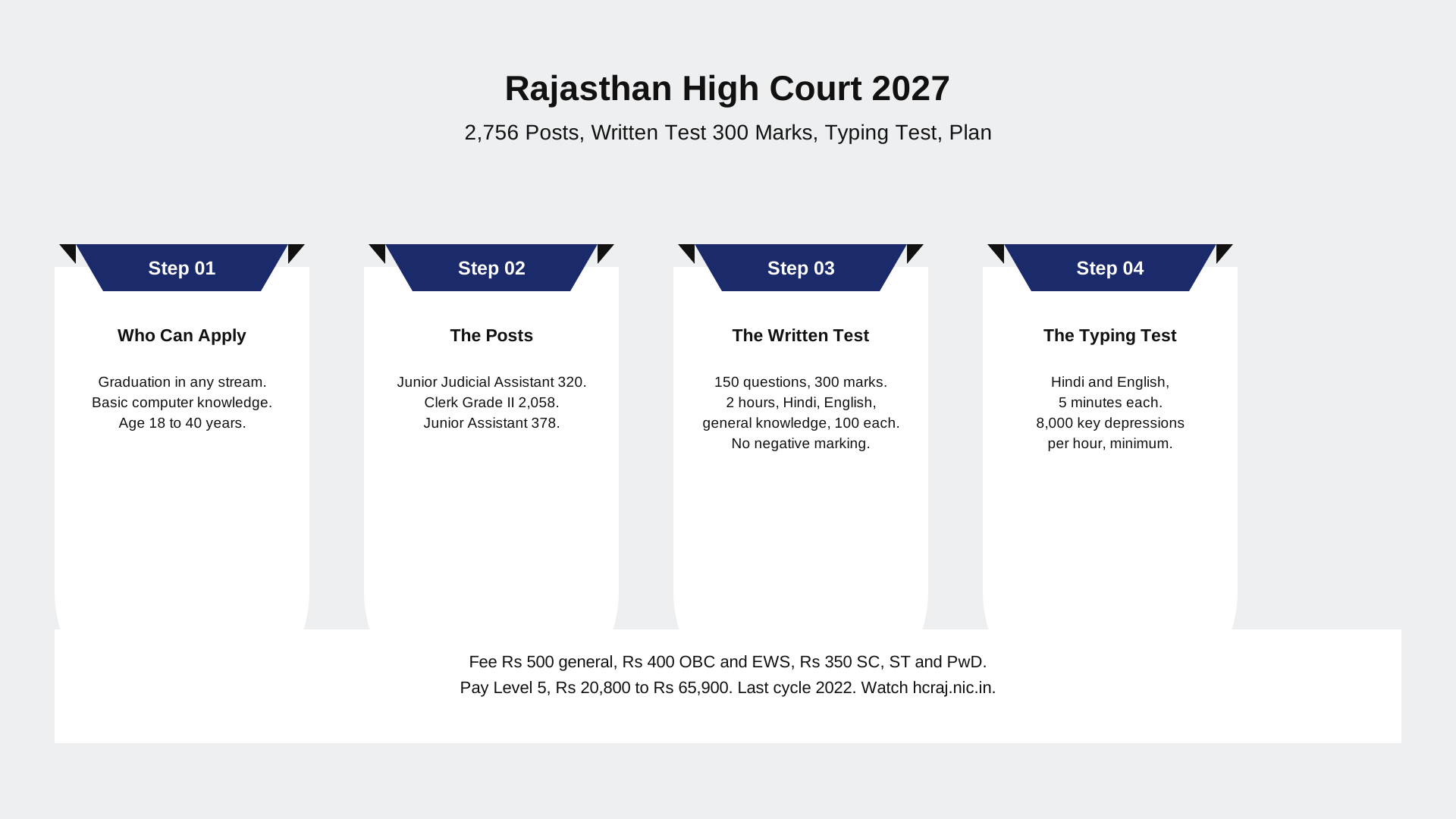
| Posts in last cycle | 2,756: Junior Judicial Assistant 320, Clerk Grade II 2,058, Junior Assistant 378 |
| 2027 notification | Not published as of November 2026 |
| Education | Bachelor degree in any stream, plus basic knowledge of computers |
| Age limit | 18 to 40 years as on 1 January 2023 in the last cycle |
| Fee in last cycle | Rs 500 for general category, Rs 400 for OBC and EWS, Rs 350 for SC, ST and persons with disabilities |
| Written test | 150 questions, 300 marks, 2 hours, Hindi 100, English 100, general knowledge 100 |
| Negative marking | None in the written test |
| Second stage | Computer typing test, Hindi and English, minimum 8,000 key depressions per hour |
| Pay | Pay Matrix Level 5, Rs 20,800 to Rs 65,900, after a two year probation on fixed pay |
| Official website | hcraj.nic.in |
Three cycles, one name, and why most pages get this exam wrong
Search for this exam and the first page of results will confuse you. One page says 1,760 posts. Another says 2,756. A third says 10,644. A fourth says 5,670. All four numbers are real. They belong to four different recruitments, and only one of them is the Rajasthan High Court clerk exam.
The 1,760 figure belongs to the 2020 cycle. The High Court advertised 1,760 Junior Assistant, Junior Judicial Assistant and Lower Division Clerk Grade II posts in 2020, applications closed on 1 November 2020, and the written exam finally took place on 13 March 2022 after pandemic delays. Several tracker pages still carry this cycle under a 2022 or 2023 label, which is how the number keeps resurfacing. It is history now, not the current cycle.
The 2,756 figure belongs to the 2022 cycle, the one this guide uses. The High Court invited applications from 22 August to 22 September 2022 for Junior Judicial Assistant, Junior Assistant and Clerk Grade II posts in the High Court establishment, the Rajasthan State Judicial Academy, the district courts and the legal services authorities. The written exam ran on 12 and 19 March 2023. The typing test ran from 26 to 29 May 2023. The final result came on 12 June 2023, with a revised final result on 22 June 2023. The Indian Express reported the drive on 21 August 2022, the day before applications opened, and Testbook tracked it through the revised result.
The 10,644 figure belongs to a different body altogether. The Rajasthan Staff Selection Board, known as RSSB, advertised 10,644 Lower Division Clerk Grade II and Junior Assistant posts in January 2026 under Advertisement Number 04 of 2026, for departments across the Rajasthan government. That drive needs a pass in the Common Eligibility Test at Senior Secondary Level, and applications ran from 15 January to 13 February 2026 through the SSO portal. It is a large and genuine recruitment, and it has nothing to do with the High Court. Candidates who prepare from RSSB LDC pages will study the wrong syllabus and the wrong selection process.
The 5,670 figure is also from the High Court, but from a different post. In June 2025 the High Court advertised 5,670 Class IV posts, peons and equivalent posts, for candidates who had passed Class 10. Applications ran from 27 June to 26 July 2025. NDTV and Scroll both reported it. It is a Class IV drive. It is not a clerk drive, and no clerk notification came with it.
One more number floats around the 2026 pages and needs a warning. Some tracker pages print a 2026 High Court LDC notification with 2,309 or 3,678 posts and application dates in early 2026. No such notification appears on hcraj.nic.in, and one tracker page itself admits that no fresh LDC notification had been released as of July 2025. Treat any 2026 clerk figure as unverified until the High Court publishes it. A separate tracker page reports that the Finance Department approved a cadre restructuring on 12 August 2026, sanctioning 1,446 fresh ministerial posts, and that a new JJA and Clerk Grade II notification is expected soon. That approval is tracker reported only, and this guide does not treat it as a notification. The honest position as of November 2026 is simple. The last clerk cycle is the 2022 cycle, and the next one has no date.
The three posts and what each one does
The joint recruitment fills three posts through one written paper and one typing test. Candidates apply for the posts together, and the High Court allots posts by merit and preference. The work differs more than the paper suggests, so the choice of preference deserves thought before the form opens.
Junior Judicial Assistant, 320 posts in the last cycle, works in the Rajasthan High Court itself at Jodhpur. The post sits closest to the judges and the court registry. Daily work runs through case files, cause lists, orders and the movement of papers between courtrooms and the record room. A Junior Judicial Assistant who learns court procedure fast becomes useful quickly, because the registry runs on people who know where a file is and what stage a case has reached. The post carries the same Level 5 pay as the others, and it carries the most direct exposure to how a High Court functions.
Clerk Grade II, 2,058 posts in the last cycle, is the bulk of the drive. Almost all of these posts sit in the district courts, 1,985 in non scheduled areas and 69 in scheduled areas, with 4 more in the Rajasthan State Judicial Academy. District court clerks keep the trial courts running. They receive filings, maintain registers, issue summons and notices, record evidence dates, and prepare the daily board. The work is steady and heavy, and it is the post most selected candidates will actually join. Anyone who imagines a quiet desk job should spend a morning in a district court registry first.
Junior Assistant, 378 posts in the last cycle, works in the legal services authorities, 343 in non scheduled areas and 17 in scheduled areas under the District Legal Services Authorities, plus 18 in the Rajasthan State Legal Services Authority itself. Legal services authorities run legal aid, Lok Adalats and the free legal help that the Constitution promises. A Junior Assistant here deals with applications from people who cannot afford a lawyer, and the work mixes office routine with public contact. It suits candidates who like dealing with people rather than files alone.
The split matters for a practical reason. Clerk Grade II has the most posts by a wide margin, so its cut off tends to sit lower than the Junior Judicial Assistant cut off for the same marks. A candidate who insists on the High Court post alone competes for 320 seats. A candidate who lists all three posts in order of preference competes for 2,756. The form asks for preferences. Fill it with the full list.
Who can apply
The education rule is short. A bachelor degree in any stream from a university recognised by the Government, plus basic knowledge of computer applications. The degree subject does not matter. A history graduate and a physics graduate sit the same paper. The computer condition is basic knowledge, not a certificate course with a fixed name, though candidates should be able to type in Hindi and English on a computer before they reach the second stage. The typing test will expose anyone who only studied theory.
The age rule in the last cycle was 18 to 40 years as on 1 January 2023. Relaxation applied under the Rajasthan High Court recruitment rules for reserved categories, women, ex servicemen and persons with disabilities, in the usual pattern for Rajasthan government posts. The exact relaxation table changes with each notification, so read it fresh when the next advertisement appears rather than carrying the last cycle numbers forward.
Two conditions catch candidates out. First, the age cut off date is 1 January of the recruitment year, not the date of the exam. A candidate who turns 41 between the notification and the exam is still inside the limit if they were 40 on 1 January. Second, the degree must be complete by the date the notification fixes. Final year students should not assume they can apply and finish the degree later. The notification states the position plainly each time, and the document check at the end is strict.
There is no interview in this recruitment. Selection runs through the written test, the typing test and document verification. That shape favours candidates who score well on paper over candidates who interview well, and it means the written marks carry the whole selection until the typing stage.
Rajasthan High Court LDC exam pattern
The Rajasthan High Court LDC exam pattern has two stages, and the second stage removes more candidates than most first timers expect. The written test comes first. The computer typing test comes second, only for candidates who clear the written test. Both stages must be passed. A high written score does not rescue a failed typing test.
The written test is one paper of 150 questions for 300 marks, to be finished in 2 hours. Each question carries 2 marks. All questions are multiple choice, answered on an OMR sheet. The paper has three parts of equal weight. Part A is Hindi, 50 questions for 100 marks. Part B is English, 50 questions for 100 marks. Part C is general knowledge, 50 questions for 100 marks. There is no negative marking in the written test. A wrong answer costs nothing, so every question deserves an attempt, and a guessed answer can only help.
The equal split is the first thing a preparation plan should respect. Hindi, English and general knowledge each carry one third of the marks. Candidates who spend four months on general knowledge and two weeks on Hindi are planning to lose a third of the paper. The Hindi section tests grammar at school and college level, sandhi, samas, upsarg and pratyay, synonyms and antonyms, words with more than one meaning, sentence correction, idioms and proverbs. The English section tests tenses, articles and determiners, prepositions, voice, narration, sentence improvement, synonyms and antonyms, one word substitution, and idioms. The general knowledge section tests current affairs, the history and culture of Rajasthan, the geography and natural resources of the state, and the agricultural, industrial and economic development of Rajasthan.
Minimum qualifying marks apply to the written test. Tracker pages report the bar as 120 marks out of 300 for SC, ST and persons with disabilities, and 135 marks for other candidates. This guide could not verify those two numbers from the official notification text, and it flags them as tracker reported. What is certain is that a minimum exists and that it applies to the total, not to each part separately. A candidate who scores 90 in Hindi and 20 in English still has 110 plus general knowledge. The parts balance each other.
The typing test follows the written result. It has two papers. Paper 1 is a speed test in Hindi and English, five minutes each, 25 marks each, on a computer. Paper 2 is an efficiency test, which checks formatting and accuracy in word processing, tables and paragraphs, not speed alone. Hindi typing uses the Kruti Dev 010 font. English typing uses Calibri. The minimum speed is 8,000 key depressions per hour. That number sounds large until it is converted. It works out to about 27 words per minute in English typing terms, a speed any candidate who types daily for a month can reach. The problem is Hindi typing. Candidates who have never typed in Kruti Dev will spend the first minutes hunting for keys, and the test gives no extra time for that.
The final merit list comes from the written test and the typing test together, after document verification. The High Court published the final result of the last cycle on 12 June 2023 and a revised final result on 22 June 2023, which tells candidates something useful about how the process ends. Results can change after revision, and the list that matters is the revised one. Keep the roll number and the application printout until the joining letter arrives.
The syllabus, section by section
Hindi carries 100 marks and rewards candidates who studied the language properly at school. The topics are sandhi and its kinds, samas and its kinds, upsarg and pratyay, paryayvachi and vilom words, anekarthak words, words that sound alike but mean different things, word and sentence correction, vachya, one word for a phrase, and muhavare and lokoktiyan. None of this needs a new book. The Hindi grammar a candidate studied for Class 10 and Class 12 covers most of it. The marks leak away on small things, a wrong sandhi vicched here, a confused samas there, and the fix is practice sets with an answer key, not more reading. Fifty questions in this section means fifty small decisions, and each one is worth 2 marks.
English also carries 100 marks, and its syllabus reads like a standard grammar paper. Tenses and sequence of tenses, articles and determiners, prepositions, correction of sentences including subject verb agreement and degrees of adjectives, synonyms and antonyms, one word substitution, idioms and phrases, confusable words, prefixes and suffixes, narration in direct and indirect forms, voice in active and passive forms, transformation of sentences between assertive, negative, interrogative and exclamatory forms, and improvement of sentences. The section punishes candidates who read English but never studied its rules. A reader who knows what sounds right will still miss the question that asks which word is wrongly used. Grammar rules settle those questions in seconds, and they are the cheapest marks in the paper.
General knowledge carries the last 100 marks, and it is the section where Rajasthan decides the result. The syllabus names current affairs, geography and natural resources, history and culture of Rajasthan, and the agricultural, industrial and economic development of the state. That list points straight at the reading. Rajasthan history means the Rajput states, the freedom movement in the state, the peasant and tribal movements, and the integration of the princely states. Rajasthan geography means the Aravalli range, the Thar desert, rivers, lakes, soils, climate, minerals and forests, district by district. Current affairs means the last twelve months of national and state news, with state government schemes, appointments and awards at the front. A candidate who studies Indian general knowledge and skips Rajasthan will drop marks in the one section where the paper is most specific.
The balance between the three sections gives the preparation plan its shape. A candidate strong in Hindi and English but weak in Rajasthan general knowledge starts the paper 100 marks behind a candidate who knows the state. The reverse is also true. A candidate who knows Rajasthan well but cannot do Hindi grammar gives away the easiest third of the paper. The written test has no sectional cut off that this guide could verify, so a strong section can carry a weak one, but only up to a point. A total near the minimum qualifying mark needs at least two sections working well.
Fee, pay and posting
The application fee in the last cycle is reported differently by different tracker pages, and the difference is worth naming. The Indian Express, reporting on 21 August 2022 as applications opened, put the fee at Rs 500 for general category, OBC and other state candidates, Rs 400 for OBC non creamy layer and EWS, and Rs 300 for SC, ST and persons with disabilities. Other tracker pages print Rs 500 for general category, Rs 400 for OBC and EWS, and Rs 350 for SC, ST and persons with disabilities. Testbook prints Rs 650 for general category and Rs 400 for SC, ST and persons with disabilities, a figure that matches the 2025 Class IV fee rather than the clerk fee, and this guide treats it as a copy error. This guide uses Rs 500, Rs 400 and Rs 350, and flags the SC, ST and persons with disabilities figure as disputed between Rs 300 and Rs 350. The fee was payable online by debit card, credit card, net banking or e challan, and the last date to pay was 23 September 2022, a day after the form closed.
Pay sits at Level 5 of the Pay Matrix, Rs 20,800 to Rs 65,900 a month after probation, plus the usual allowances that Rajasthan government employees receive. The probation period runs two years on fixed remuneration of Rs 14,600 a month, as reported by tracker pages that reproduce the notification. That fixed pay figure is tracker reported, and candidates should confirm it from the next notification. The post is a regular government post, not a contract post, and it carries the pension and leave rules of the Rajasthan government.
Posting follows the court system. Junior Judicial Assistants join the High Court at Jodhpur. Clerks Grade II join district courts across the state, and the district depends on the vacancy list and the merit list. Junior Assistants join the legal services authorities. Transfers inside the judicial service follow the rules of the High Court, and a clerk should expect to serve in different districts over a career. That is the nature of a state level post, and candidates who apply only for a home district posting will be disappointed.
A preparation plan built on the real paper
Start with the typing test, not the written paper. That sounds backwards, and it is the single most useful decision a candidate can make. The written paper can be prepared in three months of steady study. Hindi typing in Kruti Dev cannot be learned in a week, and the typing test is the stage that removes candidates who cleared the written paper. Thirty minutes a day on a computer, Hindi in the morning and English in the evening, builds the speed to 8,000 key depressions per hour within two months for most candidates. The software matters too. Practice on the word processor the test uses, with tables and paragraphs, because the efficiency paper tests formatting as well as speed.
For the written paper, give each section its own hour a day. Hindi grammar from a standard school grammar book, fifty questions a day from a practice set, with every wrong answer written down and revised weekly. English grammar the same way, with a notebook for prepositions and idioms, because those two topics repeat in every clerk paper. General knowledge needs a different rhythm. Read a daily newspaper for current affairs, and keep a separate notebook for Rajasthan, one page per district for geography, one page per movement for history, one page per scheme for the state government. Revision beats fresh reading in the last month. The candidate who revises three notebooks twice scores more than the candidate who reads three new books once.
Mock tests deserve a fixed slot, one full paper a week under exam conditions. Two hours, OMR sheet or an answer sheet, no phone, no breaks. The point is not the score. The point is learning the order that suits you. Some candidates do Hindi first because it is fast. Others do general knowledge first because it needs recall before fatigue sets in. The mock test shows which order holds up over 150 questions. It also shows the time. Two hours for 150 questions allows 48 seconds per question, and candidates who spend three minutes on one hard question are borrowing time from three easy ones. Since there is no negative marking, the rule is simple. Answer everything, mark the doubtful ones, and return to them only after the sure ones are done.
Previous papers are the best mock tests of all. The 2022 cycle paper from 12 and 19 March 2023 is the freshest real paper, and the 2020 cycle paper from 13 March 2022 is the one before it. Solve both under time, then check every answer against the official answer key. The High Court released the answer key for the last cycle on 20 March 2023, a week after the exam, and the final answer key came with the result on 1 May 2023. Those keys are the most honest guide to what the paper asks, and they are free.
Rajasthan High Court 2027: cut offs and competition
No official cut off table for the Rajasthan High Court 2027 cycle exists, because the cycle itself does not exist yet, and this guide found no official cut off table for the 2022 cycle in the sources it retrieved either. Tracker pages print cut off numbers for the last cycle, but they disagree with each other and none of them cites a High Court result document, so this guide does not repeat them. A cut off without a source is a guess dressed as a fact, and candidates who plan around a guessed number prepare for the wrong target.
What the last cycle does show is the shape of the competition. Clerk Grade II carried 2,058 of the 2,756 posts, roughly three quarters of the drive, while Junior Judicial Assistant carried 320. A candidate who lists all three posts competes for the whole drive. A candidate who wants the High Court post alone competes for one post in nine. The written paper has no negative marking, so the field is compressed at the top, and small differences decide the list. Five extra questions right in general knowledge can move a candidate past hundreds of others, because every candidate faces the same easy paper and the same two hour limit.
The typing test adds a second filter that the cut off never shows. Candidates who clear the written test and fail the typing test leave the list entirely, whatever their written score. That is why the preparation plan in this guide starts with typing. The written paper decides the order of the list. The typing test decides who stays on it. Both matter, and the second one is the one candidates forget until the written result arrives and the typing test is four weeks away.
Rajasthan High Court 2027: what to check before you trust a date
The next notification will appear on hcraj.nic.in first, under the recruitment section, and nowhere else counts as an announcement. A YouTube video, a Telegram channel and a tracker page are all second hand. Check the High Court website once a week, and check the recruitment page itself rather than the home page. When the notification appears, read four things before anything else: the post wise vacancy table, the age cut off date, the fee table, and the last date to apply. Those four decide whether you can apply and what it costs. The syllabus and pattern have stayed stable across cycles, so the 2022 pattern in this guide is the right base for preparation, but the dates, the fee and the vacancy count must come from the new notification alone.
One more check saves candidates from a common mistake. The RSSB LDC drive and the High Court clerk drive share the words Lower Division Clerk and Junior Assistant, and coaching advertisements mix them freely. If a page asks for a Common Eligibility Test score, it is the RSSB drive. If a page asks for a bachelor degree and a typing test, it is the High Court drive. The two exams have different bodies, different eligibility and different papers, and preparing for one while applying for the other wastes a cycle.
Prepare on the 2022 pattern, practise typing every day, and watch hcraj.nic.in for the next notification. The exam rewards steady work in three school subjects and a keyboard skill that only daily practice builds. When the notification comes, the candidates who are already ready will file the form on the first day and spend the waiting time revising instead of starting.
Sources
Rajasthan High Court, official website hcraj.nic.in. Indian Express, 21 August 2022, Rajasthan High Court recruitment for 2,756 vacancies. Testbook, Rajasthan High Court Recruitment 2023, final result and exam dates. Testbook, Rajasthan High Court syllabus and exam pattern. CareerGuide, Rajasthan High Court Clerk Recruitment, 1,760 vacancies in the 2020 cycle and exam pattern. Entri, Rajasthan High Court admit card 2022, exam on 13 March 2022. NDTV, 27 June 2025, Rajasthan High Court recruitment for 5,670 Class IV vacancies. Scroll, 27 June 2025, Rajasthan High Court Class IV recruitment. Moneycontrol, 13 January 2026, Rajasthan LDC recruitment for 10,644 vacancies by the Rajasthan Staff Selection Board. Careers360, RSSB LDC recruitment 2026, Advertisement Number 04 of 2026. ToppersExam, High Court LDC recruitment 2025, no fresh LDC notification as of July 2025. StudyClap, Rajasthan High Court Clerk 2026, vacancy table for the 2022 cycle. Sarkari Aspirant, Rajasthan High Court JJA and Clerk skill test admit card 2023, post wise vacancy table. A2Z Exam Detail, Rajasthan High Court JJA, Junior Assistant and Clerk Grade II joint recruitment, cadre restructuring reported 12 August 2026.