
Regulatory Exams 2027 – RBI, SEBI, NABARD, PFRDA, IRDAI, SIDBI, IFSCA and FSSAI
📖 Table of Contents
- One page, eleven regulators, and a different kind of government job
- What a regulator does, in plain words
- The eleven exams in this category
- RBI, the flagship
- NABARD and SIDBI, the development banks
- SEBI, PFRDA, IRDAI and IFSCA, the market regulators
- FSSAI, the food regulator
- Who should pick which exam
- How the stages differ across regulators
- Eligibility, the first filter
- Pay, and what it does not tell you
- A study plan that works for any regulator
- Mistakes that cost regulatory candidates
- Where to start today
Regulatory Exams 2027
One page, eleven regulators, and a different kind of government job
Regulatory exams are not like other government exams. A bank clerk exam tests one bank. A state exam tests one state. A regulatory exam tests a whole sector, and it puts you inside the body that writes the rules for that sector. The Reserve Bank of India writes the rules for banks. The Securities and Exchange Board of India writes the rules for the securities market. The Food Safety and Standards Authority of India writes the rules for food. Eleven regulators sit in this category, and each one hires in its own way, with its own pattern and its own subject mix.
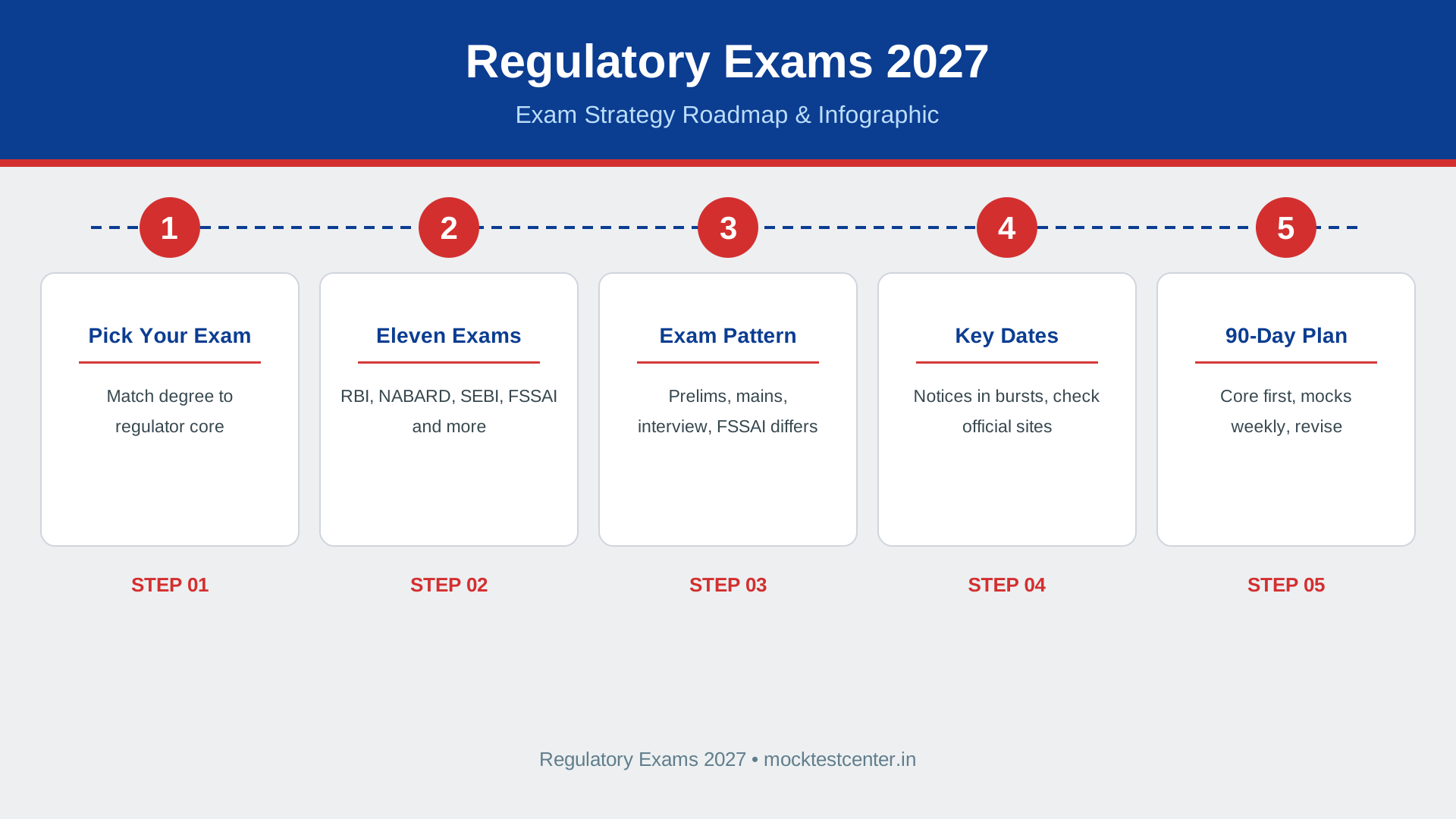
This page is the starting point for the 2027 cycle. It explains what a regulator is, how these eleven bodies differ, and which exam fits which candidate. The detail for each exam sits on its own page, linked below, because the patterns differ too much to compress into one table. Use this page to choose, and use the exam page to prepare.
One warning belongs at the top. Regulators recruit in bursts, not every year, and their notices are short. A candidate who waits for the notice to start reading economics, finance, law or food science will be months behind the candidate who started with the regulator's own work. The syllabus for most of these exams is the regulator's own law, its own reports and its own market, and that material is public all year.
What a regulator does, in plain words
A regulator sets the rules for a market or a sector, checks that the players follow them, and acts when they do not. It does not run the banks, the companies or the food factories. It watches them. That work needs officers who can read a balance sheet, read a law, read a lab report or read a market, depending on the sector. The exam for each regulator tests the reading its own work needs.
That is why the papers differ so much. The Reserve Bank paper tests economics, finance and management. The SEBI paper tests securities law and finance. The FSSAI paper tests food law, food chemistry and microbiology. A candidate who prepares for one regulator with another regulator's syllabus will fail both, because the shared part is only the general aptitude and the English and reasoning that sit around the core.
Regulators are also small employers next to the big recruiters. The Staff Selection Commission hires in the thousands. A regulator hires in the tens or the low hundreds for one post. That makes the contest tight, and it makes the cut off high, but it also makes the job different: a new officer in a regulator sees the whole sector early, and the work is closer to policy than to routine file work.
The eleven exams in this category
This category covers eleven sub categories. RBI Grade B 2027 is the flagship, the generalist officer post at the central bank. RBI Grade B DEPR 2027 is the economics research stream at the same bank, for candidates with an economics background. NABARD Grade A 2027 and NABARD Grade B 2027 are the assistant manager and manager posts at the agriculture and rural development bank. SEBI Grade A 2027 is the assistant manager post at the securities regulator.
PFRDA Grade A 2027 is the assistant manager post at the pension regulator. IRDAI Assistant Manager 2027 is the assistant manager post at the insurance regulator. SIDBI Grade A 2027 is the assistant manager post at the small industries development bank. IFSCA Grade A 2027 is the assistant manager post at the regulator for international financial services centres. FSSAI Technical Officer 2027 and FSSAI Assistant 2027 are the technical and administrative posts at the food safety regulator.
Each exam page in this list gives that exam's own pattern, syllabus, eligibility, pay and dates, from the last real notice. Do not carry one exam's pattern to another. The RBI Grade B paper has a descriptive English paper and an economics and finance core. The FSSAI Assistant paper is a single objective test with a large computer and FSSAI block. The two papers share almost nothing except the general aptitude around the edges.
RBI, the flagship
The Reserve Bank of India is the central bank of India. It issues currency, sets monetary policy, regulates banks and non banking finance companies, manages foreign exchange and runs the payment systems. Its Grade B officer post is the best known regulatory job in the country, and it draws graduates from every stream. The generalist stream takes any degree, and the DEPR stream takes economics, so a candidate should read both pages before choosing, because the papers are different and the preparation is different.
RBI Grade B is also the exam that sets the standard for the rest of this category. It has a preliminary objective test, a mains test with descriptive English, and an interview, and it tests economics, finance, management, ethics and current affairs at a depth that no other regulator paper matches in breadth. A candidate who can clear the RBI mains will find most other regulatory papers easier on the general side, but the other papers have their own sector core, and that core still has to be learned from scratch.
Check the official site rbi.org.in for every RBI notice, because only the official notice is final for dates, posts and pattern.
NABARD and SIDBI, the development banks
NABARD is the National Bank for Agriculture and Rural Development. It finances agriculture, rural development and village industries, and it works with banks, cooperatives and state governments. Its Grade A and Grade B papers test agriculture, rural development, economics and finance, with a strong rural focus that no other regulator paper has. A candidate with an agriculture background has a real edge here, and a candidate without one has to learn the rural economy from the ground up.
SIDBI is the Small Industries Development Bank of India. It finances micro, small and medium enterprises, and it works with banks, non banking finance companies and microfinance institutions. Its Grade A paper tests finance, economics, management and the MSME sector. A candidate who prepares for SIDBI should read the MSME definition, the schemes for small industry and the way small loans are appraised, because that is the sector the bank serves.
Check nabard.org for NABARD notices and sidbi.in for SIDBI notices.
SEBI, PFRDA, IRDAI and IFSCA, the market regulators
SEBI regulates the securities market: stock exchanges, brokers, mutual funds, listed companies and the rules that protect investors. Its Grade A paper tests securities law, finance, economics, accounting and management, and it has streams for general, legal, information technology, research and official language, so a candidate must pick a stream and prepare for that stream's core.
PFRDA regulates pensions. It runs the National Pension System and the Atal Pension Yojana, and it registers pension fund managers and other intermediaries. Its Grade A paper tests finance, economics, law and management, with a pension focus that is small in syllabus and deep in the questions it asks.
IRDAI regulates insurance. It licenses insurers, protects policyholders and sets the rules for insurance products and intermediaries. Its Assistant Manager paper tests insurance, finance, law and management, and a candidate who has never read an insurance contract will find the core strange at first, because insurance has its own words for risk, premium and claim.
IFSCA regulates international financial services centres, including the centre at GIFT City in Gujarat. It is the youngest regulator in this set, and its Grade A paper tests finance, law and economics with an international focus. A candidate who follows global finance news will have an edge here.
Check sebi.gov.in, pfrda.org.in, irdai.gov.in and ifsca.gov.in for the official notices of these four bodies.
FSSAI, the food regulator
FSSAI is the Food Safety and Standards Authority of India, a statutory body under the Ministry of Health and Family Welfare, created under the Food Safety and Standards Act, 2006. It sets food standards and regulates manufacture, storage, distribution, sale and import, so that people get safe and wholesome food. Its two posts in this category are the most different from the rest, because they test food science, not finance.
Technical Officer had 125 posts in Advertisement DR-04/2021, dated 30 September 2021, with two computer based tests carrying 50 percent weight each, and a Pay Level 7 salary. Assistant had 33 posts in the same advertisement, with a single computer based test carrying 100 percent weight, and a Pay Level 6 salary. Any bachelor degree qualified for Assistant, while Technical Officer needed a science or food qualification. Both posts had an age limit of 30 years in that cycle, and both papers gave a large weight to knowledge of FSSAI itself.
No 2027 direct recruitment notice for either FSSAI post has been announced, and the only 2025 recruitment this pass could verify was a deputation circular, DEP-01/2025, for 33 Group A and B posts, with a maximum age of 56 years. That circular was for serving officers, not for fresh graduates. Check fssai.gov.in under Jobs at FSSAI for the next notice.
Who should pick which exam
A graduate with any degree and a strong grip on economics, finance and current affairs should start with RBI Grade B, because it is the largest and best known post, and its preparation carries across to SEBI, PFRDA, IRDAI and IFSCA. A graduate with economics should also look at RBI DEPR, because it tests economics at a depth the generalist paper does not, and the competition there is smaller.
A graduate with an agriculture background should start with NABARD, because its paper rewards that background directly. A graduate with a commerce or finance background should look at SIDBI and SEBI, because their papers test accounting, finance and management. A law graduate should look at the legal streams in SEBI and IRDAI, where the law core is the main test, not a side subject.
A science graduate with a food or chemistry degree should start with FSSAI Technical Officer, because it is the only post in this set that tests food science in depth. A graduate with any degree who wants a single stage paper should look at FSSAI Assistant, because its paper is one test, and its largest blocks are computers and knowledge of FSSAI, which can be learned in a few months.
Do not pick an exam because a friend picked it. Pick it because your degree fits its eligibility, your strengths fit its core, and you can give its core six months of steady work. A wrong pick costs a year, and a right pick makes the same year feel short.
How the stages differ across regulators
Most of these exams run in three stages: a preliminary objective test, a mains test, and an interview. RBI Grade B follows that shape, with descriptive English in the mains. SEBI and NABARD follow a similar shape, with a mains test that mixes objective and descriptive parts by stream. PFRDA, IRDAI, SIDBI and IFSCA follow the same broad shape, with the mains core set by their own sector.
FSSAI is the exception in this set. Assistant is a single stage test, and Technical Officer is two computer based tests with no interview in the DR-04/2021 scheme. That difference matters for planning. A candidate who prepares for RBI must also prepare for descriptive writing and for an interview, while a candidate who prepares for FSSAI Assistant must put everything into one objective paper, because there is no second stage to repair a weak day.
Read the stage list on each exam page, not on this page, because the stages change. SEBI has changed its mains pattern before, and FSSAI changed its Stage 2 marking in September 2022. The exam page for each post gives the last verified pattern, and the official notice gives the pattern that counts.
Eligibility, the first filter
Eligibility is the first filter, and it is the one candidates check last, which is a mistake. RBI Grade B generalist takes any degree. RBI DEPR takes economics. NABARD Grade A takes a degree with agriculture or a related subject for some streams, and any degree for others, so the stream matters. SEBI Grade A takes a degree by stream, with law, engineering, research and commerce streams each with their own rule. FSSAI Technical Officer takes a science or food degree, and FSSAI Assistant takes any degree.
Age limits also differ, and they are counted as on the closing date of application, not on the test date. That rule decides eligibility, and a candidate who misses it by a month loses the cycle. Check the age limit, the degree rule and the closing date rule on the exam page for the post you want, and check them against your own degree, branch by branch, before you start studying.
Category certificates, disability certificates and ex-serviceman status follow central government rules, and the notice names the groups that get relaxation. Keep the certificates ready in the format the notice asks for, because a certificate in the wrong format is the most common reason a candidate loses a seat after clearing the test.
Pay, and what it does not tell you
Pay in this set sits in the Grade A and Grade B range, with most assistant manager posts in Pay Level 10 or nearby, and the FSSAI posts in Level 6 and Level 7. RBI Grade B is the highest paid post in the set, and it is also the hardest to clear. FSSAI Assistant is the lowest paid post in the set, and it is also the most open on education. Pay and difficulty move together, and a candidate who picks only by pay will pick the hardest paper without the background it needs.
Pay also hides the real difference between these jobs, which is the work. A regulator officer reads the market every day, writes notes that can change a rule, and meets the people who run the sector. That work is the reason most candidates pick a regulator over a larger recruiter, and it is the reason the preparation feels different, because you are learning a sector, not just a syllabus.
Do not compare pay across regulators by a single in hand number from a coaching site. Dearness allowance changes, house rent allowance depends on the city, and the pay matrix is the only stable fact. The exam pages in this set give the pay level for each post, and that level is the right way to compare.
A study plan that works for any regulator
Give the first month to the core. Read the regulator's own law and its annual report, and make notes in your own words. Read economics or finance or food science, whichever the core needs, from one good book, one chapter a day. Read the newspaper daily, and make short notes on current affairs, because every regulator paper tests the news of its own sector.
Give the second and third months to depth and testing. Take one mock test a week, in the real pattern, with the real time limit, and spend an hour after each test on analysis. Note every wrong answer with the correct rule or fact. Revise the core twice in this block, because it is the part most candidates forget first.
Give the last month to revision and more testing. Take a mock test every three days, and in the last two weeks take one every two days. Revise short notes daily, and in the last week solve only past papers and your error notes. Keep one day a week for current affairs, because the general part rewards a steady habit, not a last week rush.
Mistakes that cost regulatory candidates
The first mistake is to prepare for a general exam and skip the sector core. The core is half the paper or more in most of these exams, and a candidate who scores well in reasoning and blanks on the core starts from behind. The second mistake is to trust a date or a vacancy number from a tracker. Regulators recruit in bursts, and a tracker that gives a 2027 date today is inventing it.
The third mistake is to apply for every regulator at once. The papers differ, the cores differ, and a candidate who tries to prepare for five cores at once prepares for none of them. Pick one main exam and one backup with a shared core, and give the main exam six months of steady work. The fourth mistake is to ignore descriptive English and the interview, where they exist, until the mains result comes. Descriptive writing needs practice, and an interview needs reading, and both need months, not weeks.
The fifth mistake is to pay a fee or fill a form on any site other than the official site of the regulator. The notice, the link and the fee all come from the regulator's own site, and a form filled elsewhere is a form wasted.
Where to start today
Start with the exam page for the post that fits your degree. Read its pattern, its syllabus and its last cycle dates, and then read the regulator's own law and annual report for one hour a day. Take a mock test every week from the second month, and track your score in each block separately, so you can see which block needs the textbook and which block needs more tests.
If you have not chosen yet, read the RBI Grade B page first, because it is the flagship, and then read the page for the post that fits your degree best. The choice should take a day, not a month. After that, the work is the same every day: one chapter of the core, one hour of current affairs, and one set of questions, until the notice comes.