
Tamil Nadu Exams 2027: Complete Mock Test Guide
📖 Table of Contents
- Tamil Nadu Exams 2027 at a glance
- How the Tamil Nadu exam system works
- TNPSC Group 1 2027: the senior Commission exam
- TNPSC Group 2 and 2A 2027: the graduate exam with the widest reach
- TNPSC Group 4 2027: the largest drive in the set
- Tamil Nadu Police Constable 2027: the uniformed entry for school leavers
- Tamil Nadu Police Sub Inspector 2027: the graduate police exam
- TNTET 2027: the eligibility test that opens teaching jobs
- TRB PG Assistant 2027: the postgraduate teaching post
- TNPSC Combined Technical Services 2027: the specialist exam
- TANGEDCO Field Assistant 2027: one post, two recruitments
- Tamil Nadu High Court 2027: three drives, one court
- Eligibility, age and fee across the set
- How to choose your exam
- A 90 day plan for the Commission exams
- A 90 day plan for the police and uniformed exams
- A 90 day plan for the teacher exams
- A 90 day plan for TANGEDCO, the High Court and the technical posts
- Five mistakes that cost Tamil Nadu candidates marks
- When each notification lands
- How to use mock tests for Tamil Nadu exams
- Sources
Tamil Nadu Exams 2027: Complete Mock Test Guide
Tamil Nadu fills its government posts through five different bodies, and a candidate who mixes them up applies on the wrong website, pays the wrong fee, or prepares for the wrong paper. This Tamil Nadu Exams 2027 guide puts the whole set on one page. Ten exams, ten post counts, one system, and a plan for each type of exam.
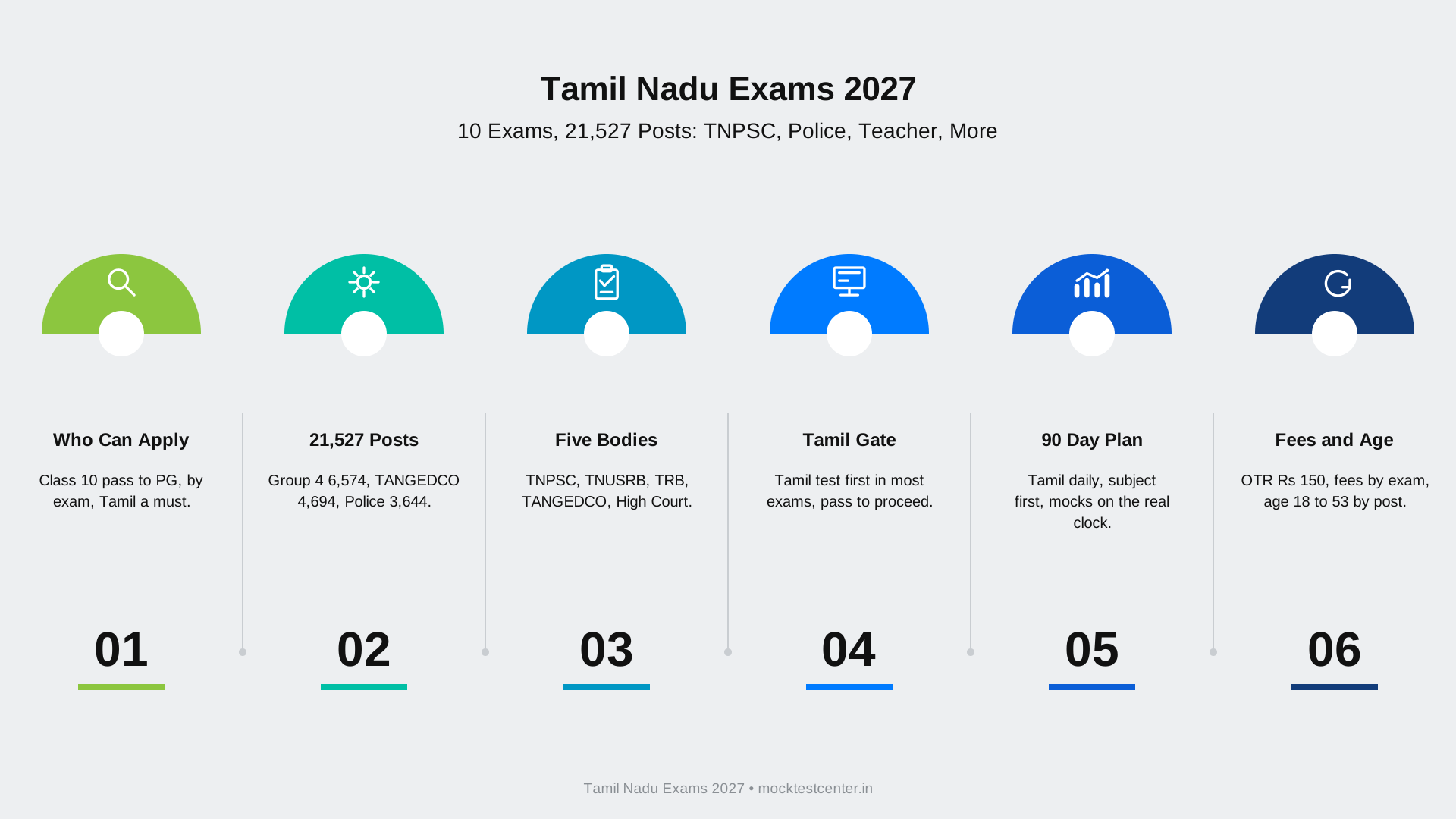
The headline numbers are large. TNPSC Group 1 2027 works from 46 posts in its 2026 cycle and 72 posts in its 2025 cycle. TNPSC Group 2 and 2A 2027 offers 821 posts in 2026 and 645 in 2025. TNPSC Group 4 2027 offers 6,574 posts, with its written exam on 10 January 2027. Tamil Nadu Police Constable 2027 offers 3,644 posts. Tamil Nadu Police Sub Inspector 2027 offers 1,299 posts. TNTET 2027 is an eligibility test with no posts of its own, and it opens the door to teaching jobs. TRB PG Assistant 2027 offers 1,996 posts. TNPSC Combined Technical Services 2027 offers 76 interview posts in its anchor cycle. TANGEDCO Field Assistant 2027 offers 4,694 posts across two 2025 cycles. Tamil Nadu High Court 2027 offers 2,377 posts across three 2025 drives. Together the set offers 21,527 posts, and that scale is why Tamil Nadu exams draw candidates from every district of the state.
The ten exams share a state, a language of examination, and a habit of short application windows. They differ in almost everything else. The Commission exams are descriptive after Prelims and take a year. The Board exams are objective and finish in a day. The teacher exams test a degree plus a teaching qualification. The police exams test the body as well as the mind. The High Court exams run on their own calendar entirely. A candidate who picks one exam and prepares for its exact shape beats a candidate who prepares for all ten at once, and this Tamil Nadu Exams 2027 guide shows how to make that choice.
Tamil Nadu Exams 2027 at a glance
| Exam | Conducting body | Posts | Who can apply |
|---|---|---|---|
| TNPSC Group 1 2027 | Tamil Nadu Public Service Commission | 46 in 2026, 72 in 2025 | Any graduate, age 21 to 34 |
| TNPSC Group 2 and 2A 2027 | Tamil Nadu Public Service Commission | 821 in 2026, 645 in 2025 | Any graduate, as per the notification |
| TNPSC Group 4 2027 | Tamil Nadu Public Service Commission | 6,574 | SSLC pass, age 18 to 32 |
| Tamil Nadu Police Constable 2027 | Tamil Nadu Uniformed Services Recruitment Board | 3,644 | SSLC pass with Tamil, age 18 to 26 |
| Tamil Nadu Police Sub Inspector 2027 | Tamil Nadu Uniformed Services Recruitment Board | 1,299 | Graduate, age 20 to under 30 |
| TNTET 2027 | Teachers Recruitment Board | No posts, eligibility test only | D.El.Ed. or B.Ed. holders, age 18 plus |
| TRB PG Assistant 2027 | Teachers Recruitment Board | 1,996 | PG with B.Ed., age up to 53 |
| TNPSC Combined Technical Services 2027 | Tamil Nadu Public Service Commission | 76 interview posts | Degree or PG by post, age 21 plus |
| TANGEDCO Field Assistant 2027 | TANGEDCO and TNPSC | 4,694 across two cycles | SSLC with ITI trade, age 18 to 32 |
| Tamil Nadu High Court 2027 | Madras High Court | 2,377 across three drives | Class 8 or 10 pass to degree, by post |
Four of the ten exams run through the Public Service Commission. Two run through the Uniformed Services Recruitment Board. Two run through the Teachers Recruitment Board. One runs through the electricity board, in two different ways. One runs through the High Court. The table is the map, and the sections below walk each road.
How the Tamil Nadu exam system works
Five bodies fill most state government posts in Tamil Nadu, and each one has its own website, its own calendar, and its own way of testing.
The Tamil Nadu Public Service Commission, TNPSC, holds the Combined Civil Services Examinations for Group I, Group II and IIA, and Group IV, and it holds the Combined Technical Services Examination for specialist posts. Its exams start with an objective Prelims or a single objective paper, then move to descriptive Mains for the senior groups. Its website is tnpsc.gov.in, and applications run through tnpscexams.in. Its fees follow one pattern across exams: a one time registration of Rs 150, valid for five years, plus an exam fee that changes with the exam. Its notifications carry numbers like 04/2025, 05/2026 and 11/2026, and its addenda can change post counts and exam dates after the first notice, so a candidate must read the addenda as well as the notification.
The Tamil Nadu Uniformed Services Recruitment Board, TNUSRB, holds the police constable and sub inspector recruitments. Its exams test Tamil first, then general knowledge and psychology, then the body through endurance and physical efficiency tests. Its website is tnusrb.tn.gov.in. Its selection totals are small and exact: 100 marks for the constable and 100 marks for the sub inspector, with the written paper, the physical tests, the viva and the special marks each carrying a fixed share. Its annual planner gives the next notifications in advance, and the 2026-27 planner already lists the next sub inspector cycles.
The Teachers Recruitment Board, TRB, holds the Tamil Nadu Teacher Eligibility Test and the PG Assistant recruitment, along with the other teacher recruitments. Its website is trb.tn.gov.in. Its tests are offline and OMR based. TNTET gives a lifetime certificate and no job by itself, while the PG Assistant test fills real teaching posts in schools and welfare departments. The two tests share one rule: a Tamil eligibility test sits in front of the main paper, and a candidate who fails it never reaches the ranking paper.
The Tamil Nadu Generation and Distribution Corporation, TANGEDCO, fills its Field Assistant posts in two ways. In one cycle it recruits directly, with its own notification, its own fee and its own OMR paper. In the other cycle it asks TNPSC to hold the exam, with TNPSC fees, a computer based test and a different physical test order. The two cycles ran in the same year, 2025, and a candidate who applied to both faced two different patterns for the same post. Its website is tangedco.gov.in.
The Madras High Court recruits its own staff and the staff of the district courts. Its advertisements carry their own numbers, such as Notifications 72 and 73 of 2025 for Group D posts, and its tests, its syllabus and its calendar do not follow the Commission or the Board. A candidate who waits for the TNPSC calendar to learn the High Court dates will miss the High Court entirely. Its website is mhc.tn.gov.in.
One rule runs through all five bodies. Tamil matters everywhere. Every exam in this set has a Tamil test, a Tamil paper, or a Tamil knowledge rule, and most of them gate the rest of the exam behind it. Group 1 has a Tamil eligibility paper in Mains. Group 2 has a Tamil eligibility paper in Mains. Group 4 has a Tamil part that must be passed before the other parts are marked. The police exams open with a Tamil test. TRB opens with a Tamil test. TANGEDCO asks for adequate knowledge of Tamil. The High Court tests General Tamil in its written papers. A candidate who treats Tamil as a formality loses the whole exam at the first gate.
The practical lesson is simple. Bookmark five websites, tnpsc.gov.in, tnusrb.tn.gov.in, trb.tn.gov.in, tangedco.gov.in and mhc.tn.gov.in, and check each one separately. No single calendar covers all five bodies, and no single tracker page keeps all five dates right at the same time.
TNPSC Group 1 2027: the senior Commission exam
TNPSC Group 1 is the senior exam in this set and the longest road in it. It fills Deputy Collector, Assistant Commissioner of Commercial Taxes, District Registrar, Deputy Registrar of Co-operative Societies, Assistant Director of Rural Development, District Employment Officer and Assistant Commissioner of Labour, along with the Assistant Conservator of Forests in the Group IA stream. The 2025 cycle advertised 72 posts under Notification No. 04/2025, Advt. No. 706, dated 1 April 2025. Its split was Deputy Collector 28, Assistant Commissioner of Commercial Taxes 19, Assistant Director of Rural Development 7, Deputy Superintendent of Police 7, Assistant Commissioner of Labour 6, District Employment Officer 3 and Assistant Conservator of Forests 2. Applications ran from 1 to 30 April 2025, Prelims ran on 15 June 2025, the result came on 28 August 2025, and Mains ran from 1 to 4 December 2025 in Chennai only.
The 2026 cycle is the newest one, and it shows how TNPSC changes a recruitment after the first notice. Notification No. 05/2026, Advt. No. 736, dated 23 June 2026, opened with 26 posts. Addendum 5A/2026 of 16 July 2026 moved Prelims from 6 September to 27 September 2026. Addendum 5B/2026 of 13 August 2026 added 20 posts and took the total to 46. Addendum 5C/2026 of 4 November 2026 gave the reservation split without changing the total. The 2026 split is Deputy Collector 12, Assistant Commissioner of Commercial Taxes 10, District Registrar 8, Deputy Registrar of Co-operative Societies 6, Assistant Director of Rural Development 6, District Employment Officer 3 and Assistant Commissioner of Labour 1. There is no Deputy Superintendent of Police post in the 2026 cycle. Prelims was held on 27 September 2026 at 38 district centres, the tentative answer key came on 6 October 2026, and the Prelims result was not out as of early November 2026, with the Mains date to be announced with the result.
The pattern is the same in both cycles. Prelims is one OMR paper of 200 questions and 300 marks in 3 hours, with General Studies at degree standard for 175 questions and Aptitude and Mental Ability at SSLC standard for 25 questions, at 1.5 marks each. There is no negative marking. The qualifying mark is 120 for other candidates and 90 for reserved candidates, and Prelims is screening only, with a shortlist of 1 to 20 per vacancy for Mains. Mains opens with Paper I, the Tamil Eligibility Test, of 100 marks, with 40 marks to pass, and it counts for nothing in the ranking. Papers II to IV are General Studies, descriptive, 250 marks each, for 750 marks in all, with a qualifying mark of 340 for other candidates and 255 for reserved candidates across the three papers. The interview, called the oral test, carries 100 marks with no minimum, and the final rank is decided on 850 marks.
Eligibility is a bachelor degree in any discipline. The age window, as on 1 July of the notification year, starts at 21 for all posts. The maximum is 34 for other candidates and 39 for reserved categories, with 35 and 40 for Assistant Commissioner of Commercial Taxes with a B.L. degree, 44 and 49 for PwBD candidates, and 50 and 55 for ex-servicemen. The Deputy Superintendent of Police post is not open to PwBD candidates. Other candidates with five or more years of government service are not eligible in the 2026 cycle. The fees are a one time registration of Rs 150, valid for five years, plus Rs 100 for Prelims and Rs 200 for Mains. SC, SC(A), ST, PwBD and destitute widow candidates are fully exempt, while MBC and DC, BC and BCM candidates get three free chances and ex-servicemen get two. All seven 2026 posts sit at Level 22 of the Tamil Nadu pay matrix.
Tamil knowledge is a condition of appointment, proved by SSLC, HSC or degree with Tamil as a language, by Tamil medium study, or by the TNPSC Second Class Language Test in Tamil. A candidate who cannot prove it must pass the test within two years of appointment. The Group 1 syllabus gives Tamil Nadu a large share of the paper, and a candidate who studies national topics and skips the state units gives away marks in every paper instead of one. The full pattern, post list, syllabus and 90 day plan for this exam are covered in the TNPSC Group 1 2027 guide on this site.
TNPSC Group 2 and 2A 2027: the graduate exam with the widest reach
TNPSC Group 2 and 2A is the exam most graduates in Tamil Nadu actually sit for. It fills Group II posts, which carry an interview in some cycles and a descriptive Mains paper, and Group IIA posts, which are non interview posts with a computer based Mains paper. One common Prelims serves both groups, and a candidate applies once and is sorted into the two streams by the Mains stage. The 2025 cycle advertised 645 posts under Notification No. 11/2025, Advt. No. 713, dated 15 July 2025, with 50 Group II posts and 595 Group IIA posts. Applications ran from 15 July to 13 August 2025, Prelims ran on 28 September 2025, the result came on 22 December 2025, and Mains ran with Paper I on 8 February 2026 and Paper II on 22 February 2026.
The 2026 cycle is bigger. Notification No. 07/2026, dated 11 August 2026, advertised 821 posts, with 41 Group II posts and 780 Group IIA posts. Applications ran from 11 August to 9 September 2026, with a correction window from 13 to 15 September 2026. Prelims ran on 1 November 2026, from 9.30 AM to 12.30 PM, across 38 districts. The Prelims result was not announced as of November 2026, and the Mains date is to be announced with the result. The jump from 645 to 821 posts came almost entirely from Group IIA, which grew from 595 to 780, while Group II itself fell from 50 to 41.
The pattern starts with a common Prelims, one OMR paper of 200 questions and 300 marks in 3 hours, with General Studies at degree standard plus Aptitude and Mental Ability at SSLC standard, at 1.5 marks each. There is no negative marking. The minimum qualifying score is 90 for all communities, Prelims is screening only, and the shortlist runs at 1 to 10 per reservation group. Mains has Paper I, the Tamil Eligibility Test, of 100 marks, with 40 marks to pass, and it counts for nothing in the ranking. Paper II is General Studies of 300 marks, and it decides the rank alone. Group II Paper II is descriptive. Group IIA Paper II is computer based and objective. There is no interview in the 2025 scheme, and none was reported in the 2026 scheme.
Eligibility is a bachelor degree, and the fee pattern follows the TNPSC standard: a one time registration of Rs 150 plus an exam fee of Rs 100. The Group 2 exam suits a graduate who wants a state government post without the long descriptive Mains of Group 1 and without a physical test. The risk is the size of the field, because the single paper format and the low fee bring in lakhs of candidates for a few hundred posts in Group II, and the Group IIA posts, though far more numerous, are clerical and ministerial posts with slower promotion. A candidate who picks Group 2 should decide early whether the target is a Group II post or a Group IIA post, because the Mains paper differs, and the preparation for a descriptive paper is not the same as the preparation for an objective computer based paper.
TNPSC Group 4 2027: the largest drive in the set
TNPSC Group 4 is the largest single recruitment in this set, with 6,574 posts, and it is the only exam here with a written exam date already fixed in 2027. Notification Number 11 of 2026, Advertisement Number 747, dated 6 October 2026, opened applications from 6 October to 5 November 2026, with a correction window from 9 to 11 November 2026. The written examination is on 10 January 2027, from 9.30 AM to 12.30 PM. The 6,574 posts are tentative vacancies across 46 post entries, and the largest blocks are Junior Assistant in the Ministerial Service at 2,610, Tax Collector at 1,071, Typist at 856 plus 377, Junior Assistant in the Judicial Ministerial Service at 252, Junior Assistant in Accounts at 422, Steno Typist Grade III at 209 plus 145, and Village Administrative Officer at 291. Smaller blocks include Bill Collector 59, Revenue Assistant 96, Executive Officer Grade IV 46, Forest Watcher 40 and Forest Guard with Driving Licence 1.
The pattern is one OMR paper of 200 questions and 300 marks in 3 hours. Part A is the Tamil Eligibility cum Scoring Test, 100 questions and 150 marks at SSLC standard. Part B is General Studies, 75 questions. Part C is Aptitude and Mental Ability, 25 questions. Parts B and C together carry 150 marks. The Tamil gate is the heart of this exam: a candidate must score 40 percent, or 60 out of 150, in Part A before Parts B and C are even evaluated. The minimum qualifying mark for selection is 90 out of 300, for all communities. There is no interview. Selection runs through the written examination, certificate verification and counselling.
Eligibility is an SSLC pass for most posts. The Village Administrative Officer needs the minimum general educational qualification, described by several guides as Higher Secondary. The Typist needs the Government Technical Examination in Typewriting plus the Certificate Course in Computer on Office Automation. The Steno Typist needs the shorthand qualification. The age window, as on 1 July 2026, is 18 to 32 for general candidates for most posts, with a minimum of 21 for the Village Administrative Officer and the forest posts. The upper limit is 37 for SC, ST and destitute widows for other posts and 42 for the Village Administrative Officer, and 34 for MBC, DC, BC and BCM candidates for other posts. The fee is a one time registration of Rs 150, valid for five years, plus an exam fee of Rs 100, with exemption for SC, ST, persons with disabilities, ex-servicemen, destitute widows and the other categories named in the notification.
The pay for the Village Administrative Officer, Junior Assistant and Typist is Level 8, Rs 19,500 to Rs 71,900 a month plus allowances. Steno Typist Grade III is Level 10. The previous cycle shows the scale of this exam. The 2025 cycle, Notification Number 07 of 2025, dated 25 April 2025, advertised 3,935 posts, held its examination on 12 July 2025, and about 13.89 lakh candidates appeared. The 2026 cycle is nearly two thirds bigger than the 2025 cycle, and the 2024 cycle had 6,244 posts, so the count moves up and down with the departments that report vacancies. Group 4 suits a candidate who has finished school and wants a state government post without a degree, and the preparation is school level Tamil, general studies and aptitude. The risk is the Tamil gate, and the fix is to treat Part A as half the exam, because it is half the marks and it decides whether the other half is read at all.
Tamil Nadu Police Constable 2027: the uniformed entry for school leavers
The Tamil Nadu Police Constable recruitment is the uniformed entry for school leavers in this set, and it is the only exam here where the final selection list arrived a full year after the written exam. The current cycle is the Common Recruitment 2025, Notification Number 02 of 2025, dated 21 August 2025. Applications ran from 22 August to 21 September 2025. The written examination ran on 9 November 2025, the admit card came on 22 October 2025, and the written result came on 26 December 2025. The physical measurement test, endurance test, physical efficiency test and certificate verification ran from 22 January to 2 February 2026, and the final provisional selection list came on 1 November 2026.
The notification advertised 3,644 posts: Grade II Police Constable 2,833, Fireman 631 and Grade II Jail Warder 180. The final selection list carried 3,665 posts, including 21 shortfall posts for the ST category. The written examination has two parts. Part I is the Tamil Language Aptitude Test, 80 questions and 80 marks in 80 minutes, qualifying only, with 32 marks, or 40 percent, to pass, and its marks do not count in the merit. Part II is the Main Written Examination, 70 questions and 70 marks in 80 minutes, with General Knowledge for 45 questions and Psychology for 25 questions. There is no negative marking, per trackers quoting the notification. The merit total is 100 marks: Part II for 70, the physical efficiency test for 24, and special marks for 6.
Eligibility is an SSLC pass with Tamil, and the age window is 18 to 26 years, with relaxation as per the rules. The fee is Rs 250. The physical stage is where this exam is won or lost. The endurance test and the physical efficiency test carry 24 of the 100 merit marks, and a candidate who clears the written paper but arrives unfit gives away nearly a quarter of the total before the final list is drawn. The constable drive suits a candidate who has finished school, knows Tamil well, and is ready to run from the first week of preparation. The risk is the long wait between the written exam and the final list, and the fix is to keep training through the wait, because the physical tests come months after the written result and fitness fades faster than knowledge.
Tamil Nadu Police Sub Inspector 2027: the graduate police exam
The Tamil Nadu Police Sub Inspector recruitment is the graduate police exam in this set, and its 2025 cycle carries a story no other exam in the set has: a result that had to be revised after a software error. The current cycle is the Sub Inspector of Police, Taluk and Armed Reserve, Recruitment 2025, Notification No. 01/2025, dated 4 April 2025. Applications ran from 7 April to 10 May 2025, after the first last date of 3 May was extended. The written examination ran on 21 December 2025 at 46 centres, with the Main Written Examination in the forenoon and the Tamil Language Eligibility Test in the afternoon. The preliminary answer keys came on 26 December 2025, with representations accepted till 6 PM on 2 January 2026.
Addendum No. 1A/2025, dated 31 October 2025, changed the exam for departmental candidates. It followed a Supreme Court order and two Home Department government orders, and it made the written exam common for open and departmental quota candidates. Before it, departmental candidates sat a separate 85 mark paper and skipped the physical efficiency test. After it, all candidates take the same written exam, endurance test and physical efficiency test, and departmental candidates stay exempt only from the physical measurement test. The written result, at a 1 to 5 ratio, came on 27 January 2026. TNUSRB then reported a software error: departmental candidates who switched from the open quota to the departmental quota after the government order of 18 August 2025 were wrongly placed in the open list. A revised 1 to 5 result was announced, and as of early November 2026 no revised result or physical test call was listed on the board site.
The notification advertised 1,299 posts: Taluk 933, with 654 men and 279 women, and Armed Reserve 366, with 255 men and 111 women. Men hold 909 posts and women hold 390 in total. Another 53 shortfall vacancies for Sub Inspector, Taluk, sit outside that count, with SC 10 and ST 43, and no departmental, sports, wards or PSTM quota on the shortfall posts. Reservation runs through the 200 point roster. The pay is Rs 36,900 to Rs 1,16,600 a month.
Eligibility is a bachelor degree from a UGC or government recognised university, held on or before 4 April 2025, following an accepted pattern of study. The age window is at least 20 and under 30 years as on 1 July 2025, with upper limits of 32 for BC, BC(M) and MBC/DNC candidates, 35 for SC, SC(A), ST and transgender candidates, 37 for destitute widows, and 47 for ex-servicemen, ex-CAPF and serving military personnel retiring within a year, and for the departmental quota. The fee is Rs 500 for the open or departmental quota, and Rs 1,000 for a departmental candidate who applied under both quotas, paid online only.
The written exam has two parts. Part I is the Tamil Language Eligibility Test, 100 objective questions and 100 marks in 100 minutes, with 40 marks to pass, qualifying only, and its marks do not count. Part II is the Main Written Examination, 140 questions and 70 marks in 2.5 hours, at half a mark per question, with General Knowledge for 80 questions and 40 marks and the Psychology Test for 60 questions and 30 marks. The minimum to qualify is 25 marks, or 35 percent. No negative marking is mentioned in the notification or the syllabus. The final total is 100 marks: the Main exam for 70, the physical efficiency test for 15, the viva voce for 10, and special marks for 5. The Tamil test sits outside the total. The endurance test is qualifying: men run 1,500 m in 7 minutes, women run 400 m in 2 minutes 30 seconds, and ex-servicemen run 1,500 m in 8 minutes. The physical efficiency test has three events, each worth 0, 2 or 5 marks, and skipping an event disqualifies the candidate. The viva voce carries 10 marks, and special marks go up to 5 for NCC, NSS and sports.
The next notifications are already on the board calendar. The TNUSRB Annual Planner 2026-27, published on 2 September 2026, lists Sub Inspector, Women, Taluk, for December 2026, Sub Inspector, Technical, for February 2027, and direct recruitment of Sub Inspectors of Police for June 2027. No SI 2026 notification has been issued. The sub inspector exam suits a graduate who wants a uniformed officer post with a viva and a physical stage, and the preparation must cover the written paper, the run and the interview together, because the final total gives the written paper only 70 of its 100 marks.
TNTET 2027: the eligibility test that opens teaching jobs
TNTET is the one exam in this set with no posts at all, and that fact confuses more candidates than any other in the set. It is an eligibility test only. Passing it gives no job, no appointment and no merit list. The result shows Qualified or Not Qualified, and nothing else. What it gives is a lifetime certificate to teach Classes 1 to 8 in Tamil Nadu, and that certificate is the entry ticket for the real teaching recruitments, which the Teachers Recruitment Board holds separately for Secondary Grade Teachers, Graduate Teachers and BT Assistants. A candidate who clears TNTET and then waits for a posting has misunderstood the test. The next step after the certificate is a separate recruitment, with its own notification, its own posts and its own written exam.
The current open cycle is TNTET 2025, Notification No. 03/2025, dated 11 August 2025. Applications ran from 11 August to 10 September 2025, after the first last date of 8 September was extended, with an edit window from 9 to 11 September 2025. Paper I ran on 15 November 2025 and Paper II ran on 16 November 2025, each in a single morning shift from 10 AM to 1 PM, with PwD candidates given time till 2 PM. The dates were first announced as 1 and 2 November 2025, then revised by a board notice of 14 August 2025. Hall tickets came on 3 November 2025, and the tentative answer key came on 25 November 2025. The result came under a TRB notice dated 30 January 2026, following the government order of 28 January 2026, and the PwD pass mark was set at 40 percent by a further order of 25 February 2026. Certificates were issued from about 2 February 2026.
Both papers are offline and OMR based, with 150 multiple choice questions and 150 marks in 3 hours, at 1 mark per question, with no negative marking. Paper I is for Classes 1 to 5, with five sections of 30 marks each: Child Development and Pedagogy for ages 6 to 11, Language I in Tamil, Telugu, Malayalam, Kannada or Urdu, Language II in English, Mathematics, and Environmental Studies. Paper II is for Classes 6 to 8, with Child Development and Pedagogy for ages 11 to 14 for 30 marks, Language I for 30, Language II in English for 30, and Mathematics and Science or Social Science for 60. The qualifying marks are 60 percent, or 90 marks, for general candidates, 50 percent, or 75 marks, for BC, BC(M) and MBC/DNC candidates, and 40 percent, or 60 marks, for SC, SC(A) and ST candidates. PwD candidates pass at 40 percent under the February 2026 order.
The fee is Rs 600 per paper for general and other categories, and Rs 300 per paper for SC, SC(A), ST and differently abled candidates. Paper I and Paper II need separate applications and separate fees, paid online only, and the fee is not refundable. The minimum age is 18 years as on 1 July 2025, with no upper age limit. Eligibility for Paper I is Higher Secondary with at least 50 percent plus a two year D.El.Ed., or a four year B.El.Ed., or a Diploma in Education in Special Education, or graduation with a two year D.El.Ed., or graduation with at least 50 percent plus a B.Ed. Eligibility for Paper II is graduation with at least 50 percent plus a B.Ed., or graduation with a two year D.El.Ed., or Higher Secondary with 50 percent plus a four year B.El.Ed., B.A.Ed. or B.Sc.Ed., or graduation or post graduation with at least 50 percent plus a B.Ed. in Special Education. Final year D.El.Ed., B.El.Ed. and B.Ed. candidates may appear, and the certificate is issued only after they pass the course and submit proof to TRB. The certificate is valid for life, under a Tamil Nadu government order of August 2021. Before that order it was valid for seven years.
A special TNTET runs alongside the regular test for working teachers. It follows a September 2025 Supreme Court ruling that in service teachers of Classes 1 to 8 must clear the test. The first session, Notification No. 01/2026 of 13 February 2026, held Paper I on 4 July 2026 and Paper II on 5 July 2026, with results on 12 October 2026. The second session, Notification No. 02/2026 of 26 October 2026, opened applications from 27 October to 19 November 2026, with the exam tentatively on 20 December 2026, only for working Secondary Grade Teachers, BT Assistants, BRTEs, equivalent cadre teachers and IEDSS special education teachers appointed on or before 1 September 2025. The next regular TNTET for fresh candidates was not announced as of early November 2026. A candidate who holds a teaching qualification and has not yet cleared TNTET should treat it as the first step, not the last one, and should sit for it before the teacher recruitments open, because a TET pass is required for those posts and the test is held only when the Board announces it.
TRB PG Assistant 2027: the postgraduate teaching post
TRB PG Assistant is the postgraduate teaching post in this set, and it is the exam with the most generous age window in the set. The current cycle is TRB Notification No. 02/2025, dated 10 July 2025, post code 25 PGA. It advertised 1,996 posts: 1,916 current vacancies plus 80 backlog vacancies, with 78 in School Education and 2 in Adi Dravidar Welfare. The subject split of the current posts is Physics 226, Mathematics 224, Chemistry 211, Tamil 210, English 191, Commerce 184, Economics 159, Botany 140, Zoology 127, Physical Director Grade I 101, History 65, Computer Instructor Grade I 56, Geography 14 and Political Science 8. The department split is School Education 1,699, Adi Dravidar Welfare 81, Tribal Welfare 31, Most Backward Classes Welfare 23, Chennai Corporation 43, Coimbatore Corporation 16, Madurai Corporation 4, Differently Abled Welfare 12 and Forest 7.
Applications ran from 10 July to 12 August 2025, with an edit window from 13 to 16 August 2025. The exam date in the notification was 28 September 2025, and the exam was actually held on 12 October 2025. The answer key came on 15 October 2025, the result came on 27 November 2025, and the provisional select list came on 23 January 2026. The age window, as on 1 July 2025, allows general candidates up to 53 years, and SC, ST, BC, BCM, MBC/DNC and destitute widow candidates up to 58 years. Applicants from non reserved categories with five years or more of state service are not eligible. The fee is Rs 600 for all candidates, and Rs 300 for SC, SCA, ST and differently abled candidates, paid online only, and it is not refundable. The pay is Rs 36,900 to Rs 1,16,600, at Level 18.
Eligibility for the PG Assistant post is a PG degree with at least 50 percent marks plus a B.Ed. from an NCTE recognised institution, or a PG at 45 percent plus a B.Ed. under the NCTE Regulations of 2002 or 2007, or a PG at 50 percent plus a B.A.Ed. or B.Sc.Ed. The bachelor and master degrees must be in the same subject. The Physical Director Grade I post needs a B.P.Ed. or B.P.E. or B.Sc. in Health and Physical Education plus an M.P.Ed. of two years. The Computer Instructor Grade I post needs a PG at 50 percent plus a B.Ed.
The pattern opens with the Tamil Language Eligibility Test, Part A, of 30 questions and 50 marks in 30 minutes, at SSLC level, with 40 percent, or 20 marks, to pass, and its marks do not count for ranking. The main written test, Part B, is a single OMR paper of 3 hours, with 150 multiple choice questions at 1 mark each. For the PG Assistant and Physical Director Grade I posts, the paper is Main Subject 110, Educational Methodology 30 and General Knowledge 10. For the Computer Instructor Grade I post, the paper is Computer Science 130, Education Psychology 10 and General Knowledge 10. The qualifying mark is 50 percent, or 75 marks, for general and other candidates, 45 percent, or 68 marks, for SC and SCA candidates, and 40 percent, or 60 marks, for ST candidates. The medium is Tamil for Tamil papers and English for English papers, and bilingual Tamil and English for other subjects. Selection runs through the Tamil test, the written examination and certificate verification, with no interview. The previous cycle, the 2021 recruitment, advertised 2,207 vacancies for PG Assistant and Physical Director Grade I, so the 2025 cycle is slightly smaller than the one before it. The PG Assistant exam suits a postgraduate with a B.Ed. who wants a school teaching post, and the preparation is the subject first, because 110 of the 150 marks sit in the main subject, and the Tamil test second, because it gates the paper.
TNPSC Combined Technical Services 2027: the specialist exam
TNPSC Combined Technical Services is the specialist exam in this set, and it is the one exam here whose official notification PDF was read directly from the Commission website in the sub package build. The anchor cycle is Notification No. 19/2025, Advertisement No. 728, dated 22 December 2025, for the Combined Technical Services Examination, Interview Posts II. It advertised 76 posts across 14 post types: Assistant Director of Agriculture, Extension, 26; Senior Officer, Finance, 21; Assistant Manager, Accounts, 9; Accounts Officer Class III, 8; Assistant Manager, Legal, 3; and one post each for Senior Accounts Officer, Manager Grade III, Finance, Senior Officer, Legal, Manager, Mechanical, Manager, Marketing, Deputy Manager, Electrical, Deputy Manager, Mechanical, Deputy Manager, Materials, and Assistant Manager, Materials. The pay levels run from Level 22 to Level 26. Applications ran from 22 December 2025 to 20 January 2026, with a correction window from 24 to 26 January 2026, and the written exam ran on 7 and 8 March 2026.
The pattern, taken from the official scheme of examination, has two papers. Paper I runs for 3 hours and is computer based. Part A is the Tamil Eligibility Test at SSLC standard, 100 questions and 150 marks, with 40 percent, or 60 marks, to pass. Part B is General Studies at degree standard, 75 questions. Part C is Aptitude and Mental Ability at SSLC standard, 25 questions. Parts B and C together are 100 questions and 150 marks. Paper II is the subject paper, 200 questions and 300 marks in 3 hours. The merit total is 450 marks, from Parts B and C of Paper I plus Paper II, and the interview carries 60 marks, for a grand total of 510 marks. Appearance in Paper I, Paper II and the interview is compulsory. Parts B and C of Paper I and Paper II are evaluated only if the candidate clears Part A. The minimum qualifying marks for the 450 mark merit total are 135 marks for SC, SC(A), ST, MBC/DC, BC(OBCM) and BCM candidates, and 180 marks for other candidates.
The subject papers are Agriculture, Business Administration, Electrical and Electronics Engineering, Financial and Cost Accountancy, Law, and Mechanical, Production and Manufacturing Engineering. The age window, as on 1 July 2025, starts at 21 for all posts. The maximum for other category candidates is 34 for the Assistant Director of Agriculture, Extension, and 32 for the Senior Officer, Finance, and the Accounts Officer Class III, with 37 for persons in regular service under the Government of Tamil Nadu. There is no maximum age limit for SC, SC(A), ST, MBC/DC, BC(OBCM) and BCM candidates, except that they must not have completed 60 years. The fee is an examination fee of Rs 200, plus a one time registration of Rs 150, valid for five years, with fee exemption for the special categories under Annexure II. Aadhaar linking with the one time registration is mandatory.
Three sibling cycles ran in 2025 with the same Paper I and Paper II scheme. Interview Posts I, Notification No. 08/2025, advertised 330 posts, with the exam from 20 to 23 July 2025. Non Interview Posts, Notification No. 09/2025, Advertisement No. 711, advertised 615 posts across 47 post types, with the exam from 4 to 10 August 2025. The Diploma and ITI Level cycle, Advertisement No. 10/2025, advertised 1,910 posts. The non interview and diploma level posts have no interview. A candidate with a professional degree should look at all four cycles together, because the 76 post anchor cycle is the smallest of the four, and the same preparation covers the larger cycles too.
TANGEDCO Field Assistant 2027: one post, two recruitments
TANGEDCO Field Assistant is the one exam in this set that ran twice in the same year through two different bodies, and a candidate who applied to both faced two different patterns for the same post. The two 2025 cycles together advertised 4,694 posts. The direct cycle, TANGEDCO Notification 05 of 2025, advertised 2,900 Field Assistant Trainee posts, with applications from 15 February to 16 March 2025 and bank fee payment to 20 March 2025. Its split is men 2,032 and women 868, with GT 899, BC 769, MBC 580, SC 435, BCM 101, SC(A) 87 and ST 29, and 145 posts are reserved for ex-servicemen. The TNPSC cycle, Notification 13 of 2025, Advertisement 717, post code 3749, advertised 1,794 posts, with applications from 3 September to 2 October 2025, a correction window from 6 to 8 October 2025, a written exam on 16 November 2025, and a result on 9 April 2026 with the marks of 14,221 candidates.
Eligibility is an SSLC pass with an NTC or NAC in the Electrician, Wireman or Electrical trade under the Centre of Excellence scheme, and adequate knowledge of Tamil is mandatory. The age window differs between the cycles. In the direct cycle, SC, SC(A), ST and destitute widow candidates are 18 to 35, MBC, DC, BCO and BCM candidates are 18 to 32, and others are 18 to 30. In the TNPSC cycle, general candidates are 18 to 32, BC, BCM, MBC and DC candidates are 18 to 34, SC, SC(A) and ST candidates are 18 to 37, PwBD candidates are up to 42, ex-servicemen up to 50, and destitute widows up to 37. The fee differs too. The direct cycle charges Rs 1,000 for OC, BCO, BCM and MBC or DC candidates, and Rs 500 for destitute widows and differently abled candidates. The TNPSC cycle charges an exam fee of Rs 100 with a one time registration of Rs 150, valid for five years. The pay is Level 2, Rs 18,800 to Rs 59,900 a month, under the Contributory Pension Scheme, plus DA and HRA.
The written exams differ as well. The TNPSC written exam is a computer based test. Paper 1 carries 300 marks in 3 hours, with a Tamil eligibility part of 100 questions and 150 marks, General Studies of 75 questions and 150 marks, and Aptitude and Mental Ability of 25 questions and 50 marks. Paper 2 carries 300 marks in 3 hours, with the trade paper of 200 questions. The ranking total is 450 marks, the Tamil eligibility pass mark is 60 out of 150, and the minimum qualifying marks are reported as 180 for other categories and 135 for SC, ST and MBC candidates. The direct written exam is OMR, with 100 questions and 100 marks in 2 hours, split into General Tamil and General English for 20, Aptitude and Mental Ability for 20, and the trade for 60. It carries negative marking of one third per wrong answer, while blank answers lose nothing, and ranking runs by OMR marks with a tie break on fewer wrong answers, then on older age by date of birth.
The physical test is the same work in both cycles, and it is the hardest physical test in this set. It has three activities, with one chance each. The candidate must climb a 9 metre pole and fix the cross arm within 8 minutes, must plait rope with AAAC 7 by 3.15 mm conductor, with at least 20 rounds of binding, within 2 minutes, and must lift and carry three cross arms of about 35 kg for 100 metres within 1 minute without putting the weight down. The order differs: in the direct cycle the physical test comes first, then certificate verification, then the written exam, while in the TNPSC cycle the written exam comes first, then on screen certificate verification, then the physical test, then final verification. The TNPSC cycle physical test dates were 24 and 25 August 2026 and 11 to 14 November 2026, as listed on the TNPSC press release page. The Field Assistant exam suits an ITI holder who is ready for hard physical work, and the preparation must include the pole climb from the start, because no amount of trade theory passes a physical test that gives one chance.
Tamil Nadu High Court 2027: three drives, one court
The Tamil Nadu High Court recruitment is three drives in one entry, and the three drives advertised 2,377 regular posts in 2025. The district courts drive is the anchor cycle, with 1,412 posts and applications closing on 22 August 2025. Its split is Junior Bailiff 574, Senior Bailiff 302, Xerox Operator 267, Examiner 118, Driver 59, Process Server 41, Reader 39, Lift Operator 9 and Process Writer 3. Eight of its posts need a Class 10 pass, and the Driver post needs a Class 8 pass with a valid driving licence. The age window is 18 to 30 for general candidates and 18 to 35 for SC, ST and BC candidates. The written exam is 50 marks in 75 minutes, with General Knowledge for 35 questions and General Tamil for 15 questions, and selection is by the written exam only.
The High Court drive advertised 573 posts, with applications from 1 July to 31 July 2025 and fee payment at the bank to 2 August 2025, and the written exam in the last week of August 2025. Its split is Typist 229, Reader and Examiner 142, Assistant 119, Computer Operator 76 and Xerox Operator 7. The fee is Rs 300 for BC and general candidates, with other categories exempt, paid by challan at SBI or Indian Bank. The qualifications are a degree with English and Tamil typewriting, shorthand at the higher grade, and an office automation certificate for the Typist and Assistant posts, a degree in computer science with English and Tamil shorthand certification for the Computer Operator post, and a degree from a recognised university for the Reader, Examiner and Xerox Operator posts. Selection for the Assistant, Reader, Examiner and Xerox Operator posts runs through a written exam of 100 marks in 120 minutes, an English Language Proficiency Test of 100 marks in 120 minutes, and an oral test of 15 marks. The Typist written exam is 75 marks and the Computer Operator written exam is 150 marks, with a skill test of 75 marks in 90 minutes.
The Group D drive, Notifications 72 and 73 of 2025, dated 6 April 2025, advertised 392 posts, with applications from 6 April to 5 May 2025. Notification 72 covered Office Assistant 137, Residential Assistant 87, Chobdar 12 and Room Boy 4, for 240 posts. Notification 73 covered Sweeper, Gardener, Waterman, Sanitary Worker and Watchman, for 152 posts between them. The Group D posts need a Class 8 pass, with a maximum qualification of Class 12 on the date of the notification. The age window is 18 to 32 as on 1 July 2025. The pay is Level 1, Rs 15,700 to Rs 58,100. The written exam is 65 marks in 90 minutes, with Part A, the Tamil eligibility test, of 25 questions and 25 marks, and Part B, General Knowledge, of 40 questions and 40 marks. The skill test carries 40 marks for the Office Assistant post, with cooking for 20 and housekeeping for 20, and preference goes to Office Assistant candidates with a valid LMV driving licence, cooking experience and housekeeping experience. Selection runs through the written exam, the skill test and certificate verification.
The previous district courts cycle, the 2024 notification, advertised 2,329 posts, so the 2025 district drive is smaller than the one before it. A separate contract drive also ran in 2026: Notification 217 of 2026, dated 23 September 2026, advertised 115 Data Entry Operator posts for e-Sewa Kendras on contract, with consolidated pay of Rs 15,000, no permanency, applications from 23 to 29 September 2026, no fee, an age window of 18 to 35 as on 1 September 2026, a degree in a computer field, and a written cum skill test on 10 and 11 October 2026 with a viva voce on 24 and 25 October 2026. The High Court exams suit a candidate who wants court work, from Class 8 pass posts to degree posts, and the preparation must match the post, because a Typist needs shorthand and typing, a Computer Operator needs a computer degree, and a Group D candidate needs Tamil and general knowledge only.
Eligibility, age and fee across the set
The ten exams cover every education level in the state, from Class 8 to a postgraduate degree, and the table below puts the entry rules side by side. A candidate should read it against the notification for the chosen exam, because the rules change with the post and the cycle, and a tracker page that mixes two cycles will show the wrong age window.
| Exam | Minimum education | Age window | Fee |
|---|---|---|---|
| TNPSC Group 1 | Bachelor degree | 21 to 34, relaxation by category | OTR Rs 150, Prelims Rs 100, Mains Rs 200 |
| TNPSC Group 2 and 2A | Bachelor degree | As per the notification | OTR Rs 150, exam fee Rs 100 |
| TNPSC Group 4 | SSLC pass | 18 to 32, 21 minimum for VAO and forest posts | OTR Rs 150, exam fee Rs 100 |
| Police Constable | SSLC pass with Tamil | 18 to 26 | Rs 250 |
| Police Sub Inspector | Bachelor degree | 20 to under 30 | Rs 500, Rs 1,000 for both quotas |
| TNTET | D.El.Ed. or B.Ed. | 18 plus, no upper limit | Rs 600 per paper, Rs 300 reserved |
| TRB PG Assistant | PG with B.Ed. | Up to 53, up to 58 reserved | Rs 600, Rs 300 reserved |
| Combined Technical Services | Degree or PG by post | 21 plus, by post | Exam fee Rs 200, OTR Rs 150 |
| TANGEDCO Field Assistant | SSLC with ITI trade | 18 to 32, relaxation by category | Rs 100 TNPSC cycle, Rs 1,000 direct cycle |
| High Court | Class 8 or 10 pass to degree, by post | 18 to 30 or 32, by drive | Rs 300 High Court drive, exempt for many |
Three fee facts deserve attention. First, the TNPSC one time registration of Rs 150, valid for five years, covers Group 1, Group 2, Group 4, Combined Technical Services and the TNPSC cycle of TANGEDCO, so a candidate who sits for several TNPSC exams pays it once. Second, the exemption lists are generous: SC, SC(A), ST, PwBD and destitute widow candidates are fully exempt from the TNPSC exam fees, and the police and teacher exams carry their own reserved fee rates. Third, the TANGEDCO direct cycle fee of Rs 1,000 is ten times the TNPSC cycle fee of Rs 100 for the same post, and a candidate who applied to both cycles in 2025 paid both. A candidate should check the fee table in the notification before paying, because the fee in a tracker page may belong to the other cycle.
Age is measured as on 1 July of the notification year in most exams in this set, and the relaxation follows the Tamil Nadu roster: BC, BCM, MBC and DC candidates get a few extra years, SC, SC(A) and ST candidates get more, and destitute widows, PwBD candidates and ex-servicemen get the most. The TRB PG Assistant age window is the widest in the set, up to 53 for general candidates and 58 for reserved candidates, while the police constable window is the narrowest, 18 to 26. A candidate at 30 with a degree has Group 1, Group 2, the sub inspector exam and the PG Assistant exam open, while a candidate at 40 with a degree has Group 1 closed and the PG Assistant exam still open.
How to choose your exam
The choice starts with education, not with ambition. A candidate who has finished school and holds no degree has Group 4, the police constable exam, the TANGEDCO Field Assistant exam and the High Court district and Group D drives open. A candidate with an ITI trade certificate adds the Field Assistant exam to that list. A candidate with a degree adds Group 1, Group 2, the sub inspector exam, the High Court degree posts and the Combined Technical Services posts. A candidate with a teaching qualification adds TNTET and the teacher recruitments. A candidate with a PG and a B.Ed. adds the PG Assistant exam, which is the best paid teaching post in this set.
The second question is time. Group 1 takes a year from Prelims to the final rank, with a descriptive Mains and an interview, and it suits a candidate who can study for a year without income pressure. Group 2 takes a similar road but with a single paper Mains and no interview. Group 4, the police exams, the teacher exams and the High Court exams finish their written stage in a day, and they suit a candidate who needs a result in months rather than a year. The TANGEDCO Field Assistant exam suits a candidate who is ready for physical work and outdoor duty.
The third question is the body. The police constable and sub inspector exams test running, jumping and rope climbing, and the Field Assistant exam tests pole climbing, rope plaiting and carrying 35 kg. A candidate who is unfit should not pick these exams and hope the physical stage goes away, because the physical marks are part of the merit total and the physical tests come after the written result, when there is no time left to build fitness. The Commission exams, the teacher exams and the High Court exams have no physical stage, and they suit a candidate whose strength is study alone.
The fourth question is Tamil. Every exam in this set tests Tamil, and most of them gate the rest of the exam behind it. A candidate who studied in Tamil medium has an edge in Group 4, where Tamil is half the marks, and in the police exams, where Tamil opens the paper. A candidate who studied in English medium and knows Tamil only as a second language should still sit for these exams, but should start Tamil preparation on day one, because the Tamil gate is not a formality and it fails candidates every cycle.
A practical way to choose is to pick one exam as the main target and one exam as the backup, where the backup shares the syllabus. Group 1 and Group 2 share General Studies and aptitude, so a Group 1 candidate can sit for Group 2 with the same preparation. Group 4 and the police constable exam share Tamil and general knowledge, so a Group 4 candidate can sit for the constable exam with the same preparation plus running. TNTET and the PG Assistant exam share pedagogy and Tamil, so a teacher candidate can sit for both. The mistake is to pick three exams with three different patterns and prepare for none of them properly.
A 90 day plan for the Commission exams
The Commission exams are Group 1, Group 2 and Group 4, and the plan below fits all three, with the weight shifted by the exam. Days 1 to 30 build the base. Tamil runs every day, because it is the gate in all three exams, and the Tamil syllabus is the state board syllabus up to Class 10 for Group 4 and up to the degree level for Group 1. General Studies runs every day as well, with Indian polity, history, geography, economy and science, and the Tamil Nadu units get a fixed share of the day, because the state units appear in every paper. Aptitude and Mental Ability runs for an hour a day, at SSLC level, and the practice is timed from the start.
Days 31 to 60 move to mock tests. A full paper every week, on the real clock, with the Tamil part first and the general studies part second, exactly as the real paper runs. Each mock is followed by a full review the same day, with every wrong answer traced to the chapter it came from. Group 1 candidates add descriptive writing in this block, with one General Studies answer a day, because the Mains papers are descriptive and the Prelims is only the screening stage. Group 2 candidates add the Mains paper for their stream in this block, descriptive for Group II and objective for Group IIA.
Days 61 to 90 are revision and speed. The syllabus is closed by day 70, and the last twenty days are mock tests, previous papers and revision of the short notes made in the first sixty days. No new topic is started after day 70. The last week is two full papers, one at the start of the week and one two days before the exam, with the day before the exam kept for light revision and rest. A candidate who follows this plan sits for the exam having written at least ten full papers on the real clock, and that is the difference between knowing the syllabus and finishing the paper.
A 90 day plan for the police and uniformed exams
The police exams are the constable and sub inspector recruitments, and the plan splits the day between the mind and the body. The morning is for running, because the endurance test and the physical efficiency test carry a fixed share of the merit total and fitness cannot be built in the last month. The constable candidate runs the endurance distance on alternate days and practises the physical efficiency events twice a week. The sub inspector candidate does the same, and adds the rope climb, the jump and the sprint as separate drills, because each event carries its own marks and skipping an event disqualifies the candidate.
The afternoon is for the written paper. Tamil runs every day, because the Tamil test opens both exams and its marks do not count in the merit but its pass mark decides whether the main paper is read. General Knowledge runs every day for the constable exam, with 45 of the 70 marks, and for the sub inspector exam, with 40 of the 70 marks. Psychology runs every day for both exams, with 25 marks in the constable paper and 30 in the sub inspector paper. The sub inspector candidate adds viva preparation in the last thirty days, with current affairs and a mock interview, because the viva carries 10 of the 100 marks and the call comes at twice the vacancies.
Mock tests run every week from day 30, with the Tamil test first and the main paper second, on the real clock. The last twenty days are revision of the short notes and a mock test every three days, with running kept light in the final week so the body is fresh for the physical stage. A candidate who starts running on day one and studies every afternoon arrives at the written exam fit and at the physical stage fresh, and that is the whole plan.
A 90 day plan for the teacher exams
The teacher exams are TNTET and the TRB PG Assistant recruitment, and the plan starts with the subject. For TNTET, the subject is Child Development and Pedagogy, which carries 30 marks in both papers, plus the language papers and the content papers for the chosen classes. For the PG Assistant exam, the subject carries 110 of the 150 marks, so the subject is the exam. Days 1 to 30 are the subject, with the PG syllabus for the PG Assistant candidate and the Class 1 to 8 content for the TNTET candidate, plus Educational Methodology for the PG Assistant candidate and pedagogy for the TNTET candidate.
Days 31 to 60 add Tamil and General Knowledge. The Tamil test is 30 questions and 50 marks in 30 minutes for the PG Assistant exam, and it gates the main paper, so it gets a daily slot from day 30. General Knowledge carries 10 marks in the PG Assistant paper, and it is the easiest 10 marks in the set, so it is practised with a daily quiz rather than a textbook. TNTET candidates add the second language paper and the Mathematics and Science or Social Science paper in this block, because Paper II carries 60 marks in the content section.
Days 61 to 90 are mock tests and revision. A full paper every week, on the real clock, with the Tamil test first, exactly as the real exam runs. The last twenty days are revision of the short notes, and no new topic is started after day 70. A teacher candidate who clears TNTET should not stop there, because the certificate is only the entry ticket, and the next step is the teacher recruitment for the chosen cadre, which needs the same preparation plus the subject paper.
A 90 day plan for TANGEDCO, the High Court and the technical posts
The remaining exams are the TANGEDCO Field Assistant, the High Court drives and the Combined Technical Services, and each one needs its own weight. The Field Assistant candidate splits the day between the trade and the body. The trade paper carries 200 questions in the TNPSC cycle and 60 of the 100 marks in the direct cycle, so the trade is the exam, and the pole climb, the rope plaiting and the 35 kg carry are practised from day one, because the physical test gives one chance and the pole is 9 metres high. The High Court candidate prepares by the post: typing and shorthand for the Typist post, a computer degree for the Computer Operator post, and Tamil and General Knowledge for the district and Group D posts, where the written exam is 50 marks in 75 minutes and 65 marks in 90 minutes. The Combined Technical Services candidate prepares the subject paper first, because it carries 300 of the 450 merit marks, and General Studies and aptitude second, because they carry 150, with Tamil daily, because the Tamil part gates the rest.
Five mistakes that cost Tamil Nadu candidates marks
The first mistake is ignoring the Tamil gate. Candidates prepare General Studies for months and start Tamil in the last week, and then they fail Part A of Group 4, or the Tamil test of the police exams, or the Tamil test of TRB, and their main paper is never read. Tamil is half the Group 4 paper and the first gate in every other exam in this set, and it deserves a daily slot from day one.
The second mistake is applying on the wrong website. TNPSC applications run through tnpscexams.in, TNUSRB applications run through tnusrb.tn.gov.in, TRB applications run through trb.tn.gov.in, and the High Court applications run through the court registration portal named in its notification. A candidate who searches for the notification and lands on a tracker page may find an old link, and the application window is short, so the official site should be bookmarked before the notification lands.
The third mistake is reading the first notification and missing the addendum. The Group 1 2026 cycle changed its post count from 26 to 46 and its Prelims date from 6 September to 27 September 2026 through addenda, and the Group 2 2025 cycle revised its vacancies through an addendum. A candidate who prepares from the first notice alone works with the wrong post count and the wrong date. The addenda are on the same Commission page as the notification, and they should be read every week till the exam.
The fourth mistake is preparing for the physical stage after the written result. The police exams and the TANGEDCO exam test the body after the written paper, and fitness takes months to build and days to lose. A candidate who starts running after the written result has no time left, and the physical marks are part of the merit total, so the loss is not just a failed test but a lost rank. Running starts on day one.
The fifth mistake is treating TNTET as a job. Candidates clear TNTET and wait for a posting, and then they miss the teacher recruitment that follows, because the certificate is only the entry ticket and the recruitment is a separate exam with its own notification. A TNTET pass should be followed at once by preparation for the teacher recruitment of the chosen cadre, while the pedagogy is still fresh.
When each notification lands
The Tamil Nadu calendar does not run on one date, and the table below gives the anchor cycle for each exam so a candidate can watch the right site at the right time. Group 1 notifications land in April or June, with Prelims in June or September. Group 2 notifications land in July or August, with Prelims in September or November. Group 4 notifications land in April or October, with the exam in July or January. The police constable notification lands in August, with the written exam in November. The sub inspector notification lands in April, with the written exam in December, and the board planner already lists the next sub inspector cycles for December 2026, February 2027 and June 2027. TNTET notifications land in August, with the papers in November. The PG Assistant notification lands in July, with the exam in September or October. The Combined Technical Services notifications land through the year, with the anchor cycle notified in December and the exam in March. The TANGEDCO cycles land in February and September. The High Court drives land in April and July. A candidate who watches the five official sites through the year will see every notification in this set, and a candidate who watches only one site will miss four of them.
How to use mock tests for Tamil Nadu exams
Mock tests work for Tamil Nadu exams only when they copy the real paper. The Tamil test must come first, because it comes first in the real exam and its pass mark decides whether the main paper is read. The paper must run on the real clock, because the Group 4 paper is 200 questions in 3 hours, the Group 1 Prelims is 200 questions in 3 hours, and the police main paper is 70 questions in 80 minutes, and a candidate who practises without a clock learns the syllabus but not the speed. The review must follow the same day, with every wrong answer traced to the chapter it came from, because a mock test without a review is only a score.
The number of mock tests matters less than the pattern. Ten full papers on the real clock, with a review after each one, beat thirty papers taken without a clock and without a review. The last three mock tests should be the previous year papers of the same exam, because the previous papers show the real weight of each topic, and the Tamil Nadu exams repeat their shape from cycle to cycle even when the questions change. A candidate who finishes the syllabus by day 70 and spends the last twenty days on mock tests and revision arrives at the exam with the syllabus in the short notes and the speed in the hands, and that is the best use of a mock test.
Sources
The facts in this guide come from the official notifications and the official websites named below, and from the ten sub package builds on this site, which verified each exam against the trackers quoting its notification. The official sites are the Tamil Nadu Public Service Commission at tnpsc.gov.in, the Tamil Nadu Uniformed Services Recruitment Board at tnusrb.tn.gov.in, the Teachers Recruitment Board at trb.tn.gov.in, the Tamil Nadu Generation and Distribution Corporation at tangedco.gov.in, and the Madras High Court at mhc.tn.gov.in. The sub package builds read the notification facts through trackers quoting the notifications, except for the Combined Technical Services anchor cycle, whose official PDF was read directly from tnpsc.gov.in. The post counts, dates, patterns, fees and age windows in this guide are the verified figures from those builds, and the upload pre-check should confirm each one against the official notification PDF before the linked exam pages are published. The sibling counts were verified by the sub package builds against trackers quoting the notifications, and the official notification PDFs were not read directly for every exam in this round.