
About RPSC RAS 2027 Exam Series
📖 Table of Contents
- RPSC RAS 2027 at a glance
- The 607 posts, service by service
- Who can apply, and the age rule that changed
- The RPSC RAS 2027 prelims paper, and the fifth option rule that removes candidates
- The mains papers, where the merit is made
- The interview and the final 900 marks
- The 2024 cycle, told as history
- What changed between 2024 and 2026
- How to prepare, in the order that matters
- Mistakes that end attempts
- Pay, posting and the job itself
- Where to check, and what this guide does not claim
- Sources
RPSC RAS 2027: Complete Exam Guide
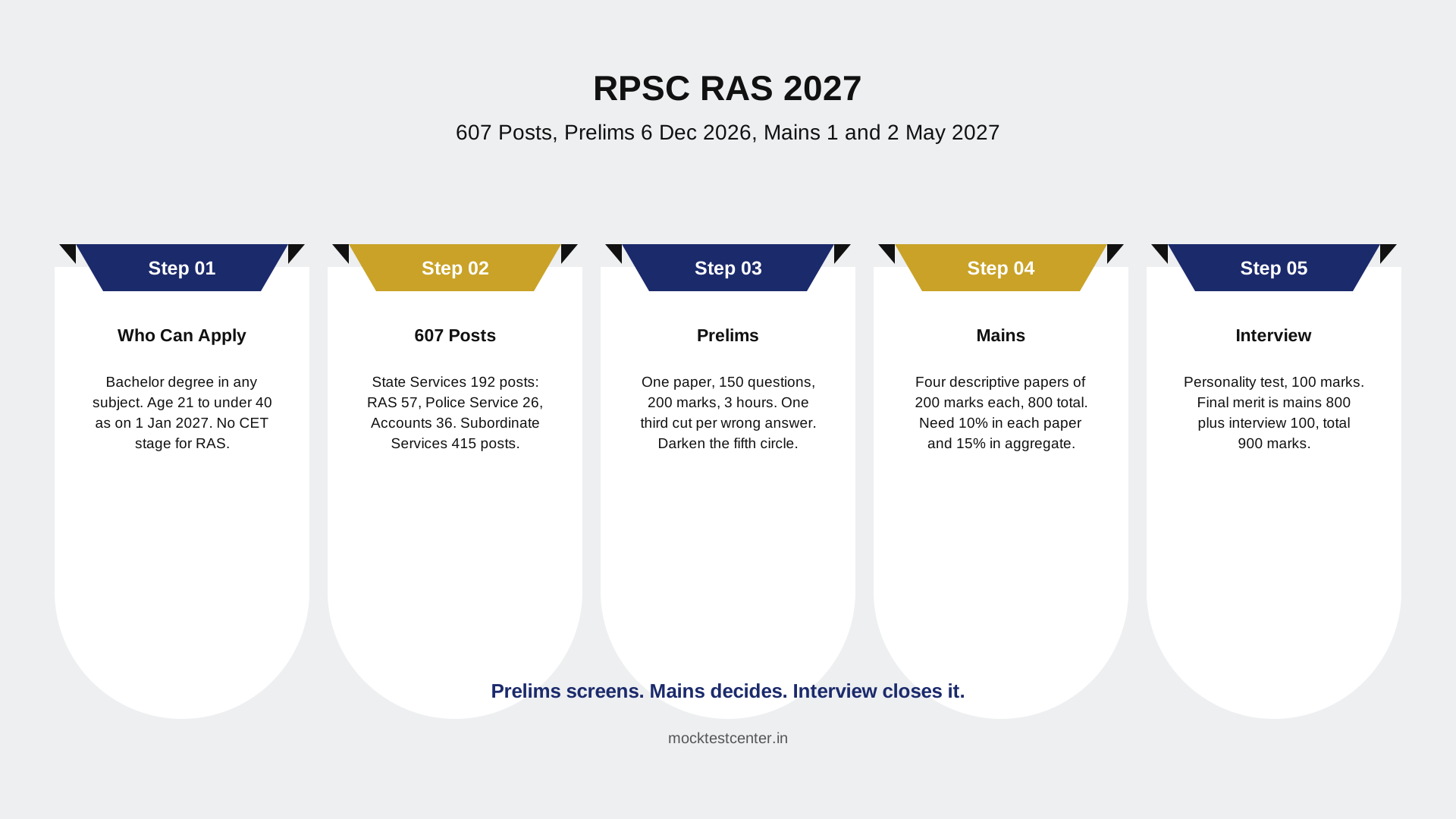
The RPSC RAS 2027 page on this site follows the live cycle of the Rajasthan Administrative Service examination, and the live cycle is the 2026 examination. The Rajasthan Public Service Commission, known as RPSC, published Advertisement Number 02/Exam/RAS and RTS/RPSC/EP-I/2026-27 on 27 May 2026 for 607 posts. Applications ran from 4 June to 3 July 2026. The Preliminary Examination is scheduled for 6 December 2026 and the Main Examination for 1 and 2 May 2027. No separate 2027 notification has been published as of 22 November 2026, so this guide anchors on the 2026 cycle and says so wherever a 2027 figure would otherwise be guessed.
That matters because RAS is the one Rajasthan examination where a wrong year can cost a candidate a full attempt. The 2024 cycle, the one before this, began with 733 posts and ended with 1,096 after the Commission raised the count in February 2025. About 6,75,000 candidates applied for that cycle and 3,75,657 sat the prelims. The 2026 cycle is smaller at 607 posts, and the age limit moved up to 40 years. A candidate who prepares from the 2024 numbers will overestimate the seats and underestimate the competition. This guide uses the 2026 figures throughout and keeps the 2024 cycle as history, clearly labelled as history.
The examination has three stages and only three stages. A single objective prelims paper screens candidates. Four descriptive mains papers decide most of the merit. A personality test of 100 marks closes the selection. Final merit comes from mains plus interview, 900 marks in all. Prelims marks count for nothing beyond the shortlist. That single fact shapes every sensible preparation plan, and this guide returns to it more than once.
RPSC RAS 2027 at a glance
| Detail | RPSC RAS 2027, as run in the 2026 cycle |
|---|---|
| Conducting body | Rajasthan Public Service Commission (RPSC), Ajmer |
| Exam | Rajasthan State and Subordinate Services Combined Competitive Examination (RAS/RTS) |
| Live cycle | 2026, Advertisement Number 02/Exam/RAS and RTS/RPSC/EP-I/2026-27 dated 27 May 2026 |
| Posts in live cycle | 607, with 192 in State Services and 415 in Subordinate Services |
| Applications | 4 June to 3 July 2026, closed, no extension reported |
| Prelims | 6 December 2026, one paper, 150 questions, 200 marks, 3 hours |
| Mains | 1 and 2 May 2027, four descriptive papers of 200 marks each |
| Interview | 100 marks, personality test |
| Final merit | Mains 800 plus interview 100, total 900 marks |
| Education | Bachelor degree in any discipline from a recognised university |
| Age limit | 21 to under 40 years as on 1 January 2027, with an extra one year relaxation in the 2026 advertisement |
| Fee in live cycle | Rs 600 for general and creamy layer categories, Rs 400 for reserved categories of Rajasthan, correction fee Rs 500 |
| 2027 notification | Not published as of 22 November 2026 |
The 607 posts, service by service
The 607 posts split into two families and the split decides what kind of officer a candidate becomes. State Services carry 192 posts. Subordinate Services carry 415 posts. The two families sit in the same examination and the same merit list, but the jobs differ in pay, rank and daily work. A candidate fills service preferences after the mains result, and the rank in the final list decides which preference is granted.
Inside State Services, the Rajasthan Administrative Service itself carries 57 posts. These are the district administration posts most candidates picture when they say RAS. The Rajasthan Police Service carries 26 posts. The Rajasthan Accounts Service carries 36 posts. The remaining State Service posts sit in departments such as planning, cooperation, tourism, industry, excise and food and civil supplies. The Commission publishes the full service wise break up in the advertisement, and the numbers above are the ones reported from that document by the Indian Express and by PW Live.
Inside Subordinate Services, two services dominate the count. The Rajasthan Tehsildar Service carries 148 posts, the largest single block in the whole examination. The Rajasthan Cooperative Subordinate Service carries 113 posts. Together those two services hold 261 of the 415 subordinate posts. The rest sit in labour welfare, social justice and empowerment, devasthan and other departments. A candidate who ranks in the middle of the final list is far more likely to land in one of these two services than in the Administrative Service itself, and preparation advice that pretends otherwise misleads.
The count can still change. In the 2024 cycle the Commission raised the posts from 733 to 1,096 on 17 February 2025, after the prelims application window had closed and days before the prelims examination. The increase added 428 State Service posts and 668 Subordinate Service posts in the revised total. Candidates in the 2026 cycle should watch for a similar revision notice on rpsc.rajasthan.gov.in rather than treat 607 as fixed. This guide will not guess a revised number.
Who can apply, and the age rule that changed
The education rule is simple. A bachelor degree in any discipline from a recognised university qualifies a candidate. There is no restriction on the subject of the degree. Final year students could apply in earlier cycles subject to producing proof of passing before the mains examination, and the 2026 advertisement keeps the same structure of eligibility. The degree rule is the reason RAS draws candidates from engineering, medicine, law, commerce and arts in the same hall.
The age rule changed in 2026 and the change helps older candidates. The minimum age is 21 years. The maximum age is under 40 years as on 1 January 2027. The 2024 cycle used a lower upper limit, and the 2026 advertisement adds an extra one year of relaxation on top of the usual relaxations because the previous advertisement had come out in 2024. Category wise relaxations apply above that base as per the Rajasthan service rules, and the advertisement lists them service by service. A candidate near the upper edge should read the relaxation table in the advertisement itself rather than rely on a summary, because the relaxation differs between services such as the Police Service and the rest.
There is no Rajasthan domicile condition that bars other Indians from applying, and there is no requirement to have passed a Rajasthan language paper at the application stage. That surprises candidates who know the Punjab or Haryana services, where a state language at matric level is mandatory. Rajasthan asks for no such certificate for RAS. The examination itself is bilingual, Hindi and English, and the mains Paper IV tests General Hindi and General English directly.
The fee in the 2026 cycle is a one time registration fee. General category candidates and candidates from the creamy layer of Backward Classes and Extremely Backward Classes pay Rs 600. Candidates from the reserved categories of Rajasthan, including Scheduled Castes, Scheduled Tribes, non creamy layer Backward Classes, non creamy layer Extremely Backward Classes, Economically Weaker Sections and persons with disabilities, pay Rs 400. Candidates from other states pay the general rate. A candidate who already holds a one time registration with RPSC does not pay again. The correction fee is Rs 500. The application window closed on 3 July 2026 at midnight and no extension was issued.
The RPSC RAS 2027 prelims paper, and the fifth option rule that removes candidates
The RPSC RAS exam pattern starts with a single prelims paper. It is General Knowledge and General Science, objective in type, with 150 multiple choice questions for 200 marks in 3 hours. The standard is that of a bachelor degree. The paper is a screening test only. Its marks do not count in the final merit list. About 15 times the number of vacancies are admitted to the mains, with relaxed standards for reserved categories where needed. For 607 posts that means roughly 9,100 candidates reach the mains, though the exact count depends on the cut off in each category.
The marking rule is where careless candidates lose marks they never expected to lose. One third of a mark is deducted for each wrong answer. That part is standard. The part that catches people is the fifth option. Every question on the OMR sheet has five circles. The fifth circle means the candidate is not attempting the question. A candidate who skips a question must darken the fifth circle. If no circle is darkened at all, one third of a mark is deducted just as if the answer were wrong. And a candidate who leaves more than 10 percent of the questions with no circle darkened is disqualified from the examination entirely. More than 10 percent of 150 questions is 15 questions, so 16 blank questions ends the attempt.
The rule exists because the Commission wants a clean record of what was attempted and what was skipped. In practice it punishes two habits. The first is the habit of leaving hard questions blank and moving on without marking anything. The second is the habit of rushing the last ten minutes and leaving the final questions untouched. Both habits are fixable in mock tests. A candidate should practise darkening the fifth circle for every skipped question until it becomes automatic, and should keep five minutes at the end of the paper purely for checking that no question is left entirely blank.
The syllabus for the prelims paper is wide rather than deep. History, art, culture, literature, tradition and heritage of Rajasthan take a large share, and Rajasthan specific questions are the part of the paper where a well prepared candidate pulls away from the rest. Indian history, Indian polity, geography of India and Rajasthan, the Indian economy, science and technology, logical reasoning and mental ability, and current affairs complete the paper. The Commission published a fresh scheme and syllabus on 9 January 2026, and the 2026 cycle runs on that document. Candidates using an older syllabus risk studying topics the Commission has dropped.
Speed matters as much as knowledge. One hundred and fifty questions in 180 minutes allows 72 seconds per question on average. A candidate who spends three minutes on a single hard question has already borrowed time from two other questions. The mock test habit that pays off fastest is the habit of marking an answer or the fifth circle and moving on, then returning only if time remains. Accuracy matters more than attempts because of the one third deduction, so blind guessing across the whole paper is a losing strategy. Informed guessing, where two options can be eliminated, is a different matter and usually pays.
The mains papers, where the merit is made
The mains examination has four descriptive papers of 200 marks each, and every paper lasts 3 hours. Paper I is General Studies I. Paper II is General Studies II. Paper III is General Studies III. Paper IV is General Hindi and General English. The total is 800 marks, and all four papers count in the final merit. The General Studies papers are set at bachelor degree standard. Paper IV is set at senior secondary standard, which means a graduate who writes plain and correct Hindi and English can score well in it without special study.
Paper I covers the history and economy of Rajasthan and India. The Rajasthan part runs deep: the medieval and modern history of the state, its art and culture, its freedom movement, and its economic structure. Paper II covers administration, polity and governance, with a strong Rajasthan component on the state administrative system, panchayati raj, and public policy. Paper III covers science and technology, the environment, and contemporary issues of national and state importance. Paper IV splits between Hindi and English, testing grammar, comprehension, precis, translation and essay style writing in both languages.
The qualifying rule for the mains is strict and it is stated in the scheme. A candidate must secure at least 10 percent of the marks in each paper and 15 percent in the aggregate to qualify for the interview. Ten percent of 200 is 20 marks, and 15 percent of 800 is 120 marks. A candidate who scores high in three papers and nearly nothing in the fourth does not reach the interview. The rule forces balanced preparation across all four papers, and it punishes the common habit of ignoring Paper IV because it looks easy.
The question pattern inside the General Studies papers uses short, medium and long answers carrying 2, 5 and 10 marks, with word limits attached to each type. Short answers run to about 50 words, medium answers to about 150 words, and long answers are descriptive. That structure rewards candidates who can write a complete answer in 50 words without padding. Long winded answers waste time and earn nothing extra, because the examiner marks against set points rather than length. Mock tests for the mains should be written by hand, under time, with a strict word limit, because typing practice does not build handwriting speed.
One reported change in the 2026 cycle deserves a clear flag. StudyIQ reports that questions based on mathematics have been removed from the mains examination in the refined 2026 pattern. This guide could not verify that change in an official RPSC document, so it is stated here as a tracker report and not as a confirmed fact. Candidates should confirm it from the official syllabus dated 9 January 2026 on rpsc.rajasthan.gov.in before dropping mathematics from their mains preparation entirely.
The interview and the final 900 marks
The interview is a personality test of 100 marks. Only candidates who qualify the mains are called. The board tests suitability for public service: clarity of thought, communication, confidence, awareness of Rajasthan and India, and the ability to take a view and defend it calmly. There is no fixed syllabus and no set of questions that repeats from year to year. Candidates who treat the interview as a test of facts usually score less than candidates who treat it as a conversation about their own background, their district, and the service they want to join.
Final merit is the sum of the mains and the interview, 900 marks in all. The prelims contributes nothing. That means a candidate who barely clears the prelims cut off starts the mains on equal footing with the prelims topper. The 2024 cycle shows how open the race stays: 21,539 candidates reached the mains from 3,75,657 who sat the prelims, and 2,461 of those reached the interview. The ratio at each stage is brutal, but the slate is wiped clean at the mains.
The detailed application form stage sits between the prelims result and the mains examination. In the 2024 cycle the Commission opened a detailed form submission through the SSO portal, and candidates who qualified the prelims had to complete it before the mains. The 2026 cycle follows the same structure. Candidates should keep their documents ready: degree certificate, caste and category certificates where applicable, domicile and identity proof, and the one time registration details. A missing certificate at the detailed form stage has ended attempts that had already cleared the prelims.
The 2024 cycle, told as history
The 2024 cycle is the freshest completed map of how RAS actually runs, and its numbers are worth reading in full. The notification came on 2 September 2024 as Advertisement Number 04/2024, or in the Commission file numbering 13/Exam/RAS and RTS/RPSC/EP-I/2024-25. Applications ran from 19 September to 18 October 2024. The count of applicants reached about 6,75,000. The prelims was held on 2 February 2025 in a single shift from 12 noon to 3 pm, and 3,75,657 candidates appeared. The provisional answer key was issued the same day. The prelims result came on 20 February 2025, and 21,539 candidates qualified for the mains.
The vacancy count moved during the cycle. The notification carried 733 posts. On 17 February 2025 the Commission raised the total to 1,096 posts, with 428 in State Services and 668 in Subordinate Services. The mains examination was held on 17 and 18 June 2025 in two shifts each day, morning from 9 am to 12 noon and afternoon from 2.30 pm to 5.30 pm. The mains result was declared on 8 October 2025, and 2,461 candidates were selected for the interview. The first phase of interviews began in November 2025. The interview letters were released on 24 November 2025. One tracker site reports the final result on 18 April 2026, and this guide flags that date as tracker reported rather than confirmed from an RPSC notice.
The cycle before that, the 2023 cycle, carried 905 posts. Its prelims was held on 1 October 2023 and its mains on 20 and 21 July 2024. The gap between the 2023 notification in July 2023 and the 2024 notification in September 2024 was about fourteen months. The gap between the 2024 notification and the 2026 notification in May 2026 was about twenty months. RAS does not run every year on a fixed calendar, and candidates who wait for a notification instead of preparing lose the months that decide the result.
What changed between 2024 and 2026
Four changes separate the two cycles, and each one changes preparation. First, the posts fell from 1,096 in the revised 2024 count to 607 in 2026. The competition per post is therefore far tighter in 2026 than it was in 2024. Second, the upper age limit rose to under 40 years as on 1 January 2027, with an extra year of relaxation, which brings back candidates who were over age in 2024. Third, the Commission issued a fresh scheme and syllabus on 9 January 2026, and the 2026 cycle runs on that document rather than the older syllabus. Fourth, the prelims date moved once: it was first proposed for 29 November 2026 and then moved to 6 December 2026 by a press note dated 2 July 2026, confirmed again by a press note dated 23 September 2026.
The fee structure also changed its shape. The 2026 cycle uses a one time registration fee of Rs 600 for general category candidates and Rs 400 for reserved categories of Rajasthan, with a correction fee of Rs 500. Candidates who already hold a one time registration do not pay again. That is a simpler structure than the tiered examination fees of some other state services, and it removes the fee as a barrier for candidates who registered once and apply again in a later cycle.
The examination calendar itself is worth noting. RPSC published an examination calendar for 2025 covering 35 major recruitments, and the RAS prelims of the 2024 cycle sat inside that calendar. The 2026 cycle prelims on 6 December 2026 and mains on 1 and 2 May 2027 sit inside the Commission calendar for the current year. Candidates who follow only the RAS notification miss the fact that the Commission runs dozens of examinations in parallel, and the calendar is the earliest warning of date clashes.
How to prepare, in the order that matters
Preparation should follow the weight of the marks, not the order of the stages. The mains carries 800 of the 900 merit marks in RPSC RAS 2027, so mains writing deserves the largest share of study time from the start. The prelims deserves enough time to clear the cut off safely, and no more. Candidates who spend a full year on prelims facts and then discover descriptive writing in the last month usually fail the mains qualifying rule in at least one paper.
For the prelims, Rajasthan is the highest value subject. The history, art, culture, geography and economy of the state appear in a large share of the 150 questions, and most candidates from outside the state score their lowest marks here. A candidate should read one solid book on Rajasthan history and one on Rajasthan geography and economy, then revise them three times rather than reading three books once. Current affairs should cover the twelve months before the examination, with a focus on Rajasthan government schemes, appointments and state budget figures.
For the mains, the single most useful habit is writing one answer every day by hand. Pick a question from a previous year paper, set a timer for the word limit, write the answer, then compare it with the points a good answer should carry. Short answers of 50 words should state the point and stop. Long answers should open with the definition, cover two or three dimensions, and close with one line on the way forward. Paper IV deserves two sessions a week from the start, because Hindi and English writing improve slowly and cannot be fixed in a fortnight.
Mock tests for RPSC RAS 2027 should copy the real conditions. Prelims mocks should run 150 questions in 3 hours with the fifth option rule enforced, including the penalty for leaving a question entirely blank. A candidate who has never practised the fifth circle rule will forget it under pressure, and the disqualification rule for more than 10 percent blank questions is not a rule to learn on examination day. Mains mocks should run four papers across two days, mirroring the 1 and 2 May 2027 schedule, so that handwriting stamina is built before the real examination.
Revision should be planned backwards from 6 December 2026 for the prelims and from 1 May 2027 for the mains. The last thirty days before the prelims should carry no new book and no new topic. They should carry revision of notes, previous year papers, and full length mocks with error analysis. The gap between the prelims and the mains is about five months, and that gap is the real mains preparation window for candidates who clear the prelims. Candidates who wait for the prelims result before starting mains writing waste most of that window.
Mistakes that end attempts
The first mistake in RPSC RAS 2027 is confusing RAS with the CET. Rajasthan runs a Common Eligibility Test for many Group C posts, and candidates often assume RAS needs a CET score. It does not. RAS is conducted directly by RPSC and has no CET stage. A candidate who spends months preparing for the CET Graduate Level paper instead of the RAS prelims has prepared for the wrong examination.
The second mistake is the blank circle. The fifth option rule is described above in full because it ends attempts every year. Darken the fifth circle for every skipped question. Check the OMR sheet in the last five minutes. Never leave a question with no circle darkened.
The third mistake is ignoring Paper IV. General Hindi and General English carry 200 marks, the same as each General Studies paper, and the 10 percent per paper rule applies to it. A candidate who scores 150 in each General Studies paper and 15 in Paper IV fails to reach the interview. Two sessions a week from the start prevents that outcome.
The fourth mistake is trusting a single tracker site for dates. The prelims date for the 2026 cycle was first reported as 29 November 2026 and later moved to 6 December 2026. Candidates who booked travel for the earlier date had to change plans. The official RPSC press notes and the examination calendar on rpsc.rajasthan.gov.in are the only sources that settle a date. This guide lists the press note dates wherever a date moved.
The fifth mistake is preparing from the wrong cycle. The 2024 cycle had 1,096 posts and an upper age limit below the 2026 limit. The 2026 cycle has 607 posts and an upper age limit of under 40 years. Books and guides printed for the 2024 cycle still circulate, and their vacancy and age figures are wrong for the 2026 cycle. Check the advertisement number on the cover of any guide: the live cycle is Advertisement Number 02/Exam/RAS and RTS/RPSC/EP-I/2026-27 dated 27 May 2026.
Pay, posting and the job itself
The pay for RAS officers sits in the state pay matrix at levels that vary by service, and the exact level for each service is given in the advertisement. The Rajasthan Administrative Service posts carry the highest profile: a probationer trains, then works as Sub Divisional Magistrate, and later moves to district and secretariat postings. The Rajasthan Police Service posts lead to Deputy Superintendent of Police rank. The Accounts Service posts lead to treasury and finance roles. The Tehsildar Service posts lead to revenue administration at the tehsil level. The Cooperative Service posts lead to registrar and cooperative administration roles.
The job is a transferable state service. Postings move across districts, and the first posting is rarely the home district. Candidates who join for a posting near home should understand that the service does not work that way. The work covers revenue, law and order support, development schemes, elections, disaster management and public grievance handling, often in the same week. The interview board looks for candidates who understand that breadth and still want the job.
Promotion runs through the state service hierarchy, and the Rajasthan Administrative Service is the feeder for senior state posts. The precise promotion timelines depend on vacancies and seniority, and this guide does not publish a timeline because the Commission does not publish one in the advertisement. Candidates should treat any tracker site promotion chart as indicative rather than official.
Where to check, and what this guide does not claim
Every date, post count and fee in this guide comes from the sources listed below. The official website is rpsc.rajasthan.gov.in, and the SSO recruitment portal at sso.rajasthan.gov.in carries the application form. The examination calendar, press notes, answer keys and results appear on the RPSC website first, and every other site copies them. A candidate who checks the RPSC website once a week from application to result will never miss a notice.
This guide does not publish a 2027 notification, because none exists as of 22 November 2026. It does not publish a 2027 vacancy count, a 2027 application window, or a 2027 fee. When the next notification appears, the figures in this guide will need updating, and the first place to check is the advertisement number on the RPSC website. The mock tests on this page follow the pattern of the live cycle: 150 questions and 200 marks for the prelims, four descriptive papers for the mains, and the fifth option rule in every prelims mock.
One more caution belongs here. Several tracker sites label the 2026 cycle as RAS 2025, because the examination year and the notification year differ and the cycle straddles two calendar years. The notification is dated 27 May 2026, the prelims falls on 6 December 2026, and the mains falls on 1 and 2 May 2027. The correct label for the live cycle is the 2026 cycle, and this guide uses that label throughout. The page title carries 2027 because that is the year in which the mains examination and the final selection conclude, and because this site groups its examination pages by that year.
Mock tests for other civil service and graduate level examinations on this site include UPPSC PCS 2027, KPSC KAS 2027, JKAS 2027, Goa PSC 2027, UPSC CSE Prelims 2027, SSC CGL 2027, IBPS PO 2027, RRB NTPC 2027, UPPSC RO ARO 2027, UP Police Sub Inspector 2027.
Sources
Rajasthan Public Service Commission, Advertisement Number 02/Exam/RAS and RTS/RPSC/EP-I/2026-27 dated 27 May 2026, 607 posts, applications 4 June to 3 July 2026, on rpsc.rajasthan.gov.in. RPSC press note dated 2 July 2026, prelims moved from 29 November to 6 December 2026, confirmed by press note dated 23 September 2026. RPSC scheme and syllabus dated 9 January 2026. Indian Express, 27 May 2026, RPSC RAS recruitment 2026, 607 vacancies. Hindustan Times, 27 May 2026, RPSC RAS Recruitment 2026 notification for 607 posts. PW Live, RPSC RAS 2026 registration closes 3 July 2026, 607 posts. StudyIQ, RPSC RAS Apply Online 2026, fee Rs 600 and Rs 400, age 21 to 40 years as on 1 January 2027. Drishti IAS, RPSC RAS Exam Pattern, prelims 150 questions and 200 marks, mains four papers of 200 marks, interview 100 marks. Testkart, RPSC RAS Exam Pattern 2026, prelims 6 December 2026, mains 1 and 2 May 2027, negative marking one third. AglaSem, RPSC RAS 2026, prelims 6 December 2026, mains 1 and 2 May 2027. Indian Express Education, RPSC RAS Exam 2024, 733 vacancies raised to 1,096, prelims 2 February 2025, mains 17 and 18 June 2025. Dainik Bhaskar English, RAS 2024 interviews, 1,096 posts, 3,75,657 appeared in prelims, 21,539 selected for mains, 2,461 selected for interview, mains result 8 October 2025. EduRev, RPSC RAS Syllabus 2026, Advertisement Number 02/Exam/RAS and RTS/RPSC/EP-I/2026-27, 607 posts, 192 State Services and 415 Subordinate Services. NaukriTips, RPSC RAS 2026, prelims 6 December 2026, mains 1 and 2 May 2027, age 21 to under 40 with extra one year relaxation, Tehsildar 148 posts, Cooperative 113 posts, RAS 57 posts, Police Service 26 posts, Accounts 36 posts.







