About UPPSC PCS 2027 Exam Series
📖 Table of Contents
- What PCS gives you: the posts behind the exam
- Where the 2027 cycle stands right now
- The Prelims pattern in plain words
- The Mains: eight papers, 1500 marks
- The interview: 100 marks that sort the list
- Who can apply: the eligibility rules
- Age limit and relaxations
- Prelims syllabus: what Paper 1 tests
- Prelims syllabus: what the CSAT paper tests
- Mains syllabus: the six General Studies papers
- The 2025 cycle: what actually happened
- The 2026 cycle: the one running now
- Fee, form and the OTR rule
- How the cut off works, and why no one can predict it
- Best books for UPPSC PCS 2027
- A six month plan that fits real life
- Mock test strategy: how to use mocks without wasting them
- Common mistakes that cost good candidates marks
- What to check the day the 2027 notice arrives
UPPSC PCS 2027: Pattern, Syllabus, Eligibility, Age Limit and Cut Off
UPPSC PCS 2027 is the Combined State Upper Subordinate Services Examination of Uttar Pradesh, the state civil services exam that fills Deputy Collector, Deputy Superintendent of Police, Block Development Officer and other Group A and Group B posts. The Uttar Pradesh Public Service Commission runs it in three stages, a Preliminary exam, a Main written exam and an interview, and the final rank comes from the Mains plus the interview only. As of 19 November 2026 the 2027 notification has not come out, so this guide gives no 2027 dates, no 2027 fee and no 2027 vacancy count. It rests on the 2025 and 2026 cycles, and it says where each fact comes from.
That matters because PCS rewards the candidate who starts before the notice. The syllabus stays fixed from cycle to cycle, the pattern has stayed the same for years, and the only things that change with a new notice are the dates, the fee and the vacancy list. A candidate who finishes the syllabus before the notice arrives meets the form window with calm. A candidate who waits for the notice starts six months behind.
What PCS gives you: the posts behind the exam
PCS is the single door to the senior executive posts of the Uttar Pradesh government. The best known post is Deputy Collector, the Sub Divisional Magistrate, who runs a tehsil, handles revenue work, law and order, elections and development schemes in one charge. The second best known post is Deputy Superintendent of Police, who commands a police circle. Below them sit Block Development Officer, Sub Registrar, Assistant Labour Commissioner, Assistant Regional Transport Officer, District Audit Officer, Treasury Officer and a long list of departmental posts that change a little with each notification.
The 2025 notification listed 200 vacancies across these posts. The 2026 notification listed 500. That jump tells you something useful. Vacancy counts swing hard between cycles, and a low vacancy year is no reason to skip the exam, because the next cycle can double the seats. The 2024 cycle carried 947 vacancies after the Commission raised the count, which shows the number can move even after the first notice.
PCS posts carry real authority from the first posting, and that is why lakhs of graduates apply for a few hundred seats. The pay sits in the state gazetted scales, the posting stays inside Uttar Pradesh, and the career path runs upward through promotion to the Indian Administrative Service for the best officers. A Deputy Collector who performs well can reach District Magistrate in time, and that path is what draws serious candidates year after year.
PCS is not the only UPPSC route to a government post. The Commission also runs the Review Officer and Assistant Review Officer exam for secretariat posts, and the UPPSC RO ARO 2027 page covers that exam for candidates who want office work in Lucknow rather than field postings. Law graduates have a separate route too, and it appears in the eligibility section below.
Where the 2027 cycle stands right now
The 2027 notification has not come out yet. UPPSC releases each PCS notification on its official portal, uppsc.up.nic.in, and the 2027 notice will appear there first. As of 19 November 2026, no date, no fee and no exam window for 2027 exists in any official notice, so any website that gives you a fixed 2027 exam date today is guessing.
The 2026 cycle still runs ahead of you. Its Prelims sit on 6 December 2026, per the UPPSC exam calendar released on 30 January 2026, and its Mains will follow in 2027. Candidates who sit in December 2026 will see their result before the 2027 notice arrives, and their experience will set the tone for the next cycle. If you plan to sit in 2027, watch the December 2026 Prelims, its answer key date and its result date, and you will know the rhythm of the exam before your own cycle starts.
One date rule saves candidates from panic every year. The calendar calls its dates proposed and tentative, and the Commission can change them. The 2026 Prelims date of 6 December 2026 comes from that calendar and from the 2026 notification, so treat it as the working date and check the admit card when it arrives, because the admit card carries the final word.
The Prelims pattern in plain words
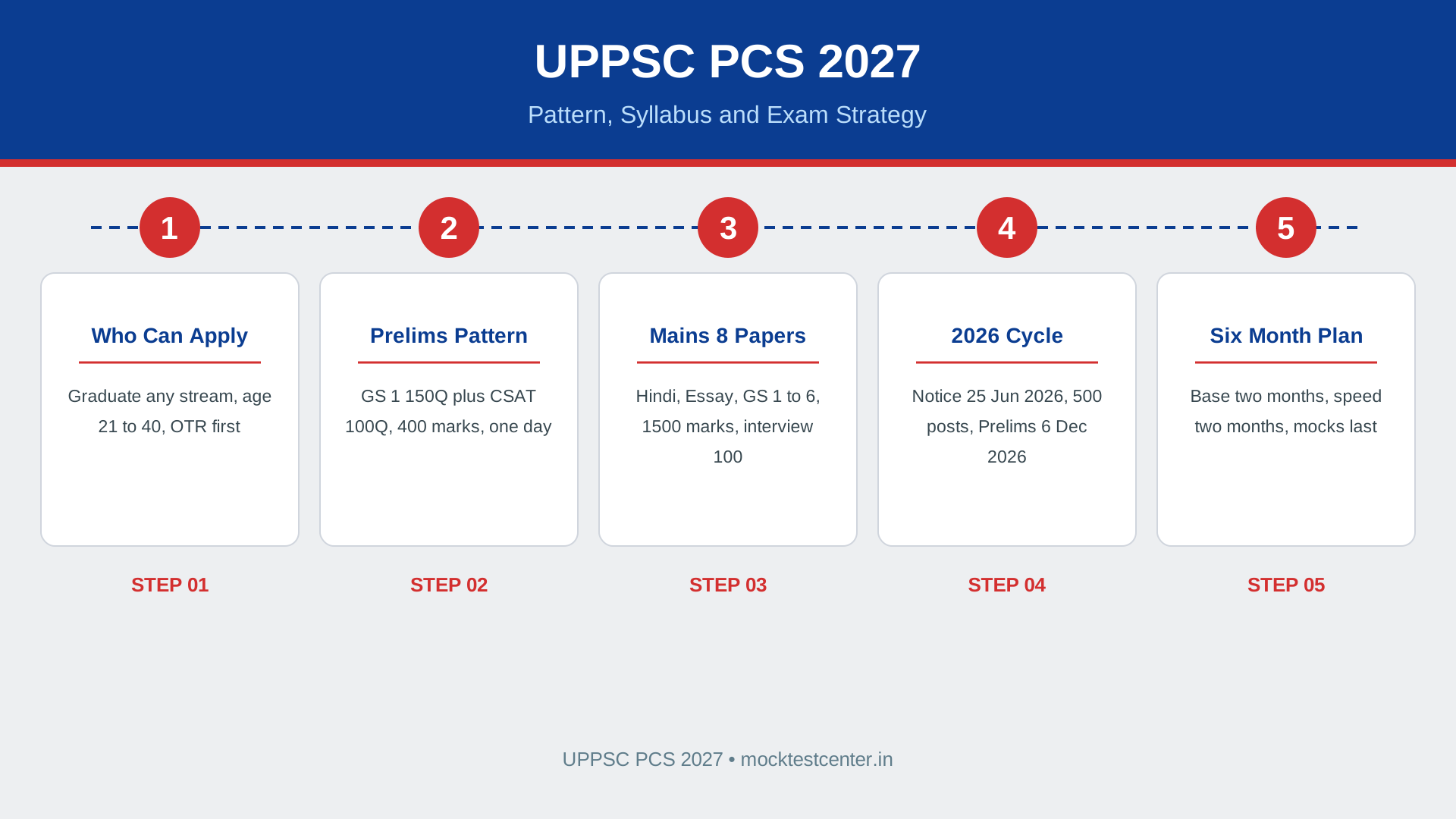
Prelims is a screening test, and its marks stay out of the final merit. The exam runs on one day, in two sittings. Paper 1, General Studies 1, runs from 9.30 am to 11.30 am. Paper 2, General Studies 2, the aptitude paper called CSAT, runs from 2.30 pm to 4.30 pm. Each paper carries 200 marks and two hours.
Paper 1 has 150 objective questions, each worth about 1.33 marks, and it decides the merit for the Mains. Paper 2 has 100 objective questions, each worth 2 marks, and it only qualifies you. You must score at least 33 percent in Paper 2, which means 66 marks out of 200, to stay in the race. A candidate who tops Paper 1 and fails Paper 2 goes home, and that happens every year to candidates who ignore the aptitude paper.
| Paper | Questions | Marks | Time | Role |
|---|---|---|---|---|
| General Studies 1 | 150 | 200 | 2 hours, 9.30 to 11.30 am | Decides Mains merit |
| General Studies 2 (CSAT) | 100 | 200 | 2 hours, 2.30 to 4.30 pm | Qualifying, 33 percent needed |
| Total | 250 | 400 | One day | Screening only |
Wrong answers cost marks in Prelims. The Commission deducts one third of the marks allotted to a question for a wrong answer. That rule changes how you should play the paper. A blind guess on a question you know nothing about loses marks, while a guess between two options you have narrowed down can pay. The mock test section of this guide shows how to practise that choice.
Prelims calls about thirteen times the number of vacancies to the Mains, though the exact multiple comes from the notification of each cycle. The cut off for Paper 1 decides who gets that call, and the cut off moves every cycle with the paper and the competition. No one can give you a fixed cut off for 2027, and this guide gives no cut off numbers at all, because the 2025 cut off was not verified against the official list in this pass.
The Mains: eight papers, 1500 marks
Mains is a written exam, and it decides your rank. It has eight papers, all descriptive, each of three hours. General Hindi carries 150 marks. Essay carries 150 marks. General Studies 1, 2, 3 and 4 carry 200 marks each. General Studies 5 and 6, the two Uttar Pradesh special papers, carry 200 marks each. The written total comes to 1500 marks, and the interview adds 100 more, for a grand total of 1600.
| Paper | Subject | Marks |
|---|---|---|
| Paper 1 | General Hindi | 150 |
| Paper 2 | Essay | 150 |
| Paper 3 | General Studies 1 | 200 |
| Paper 4 | General Studies 2 | 200 |
| Paper 5 | General Studies 3 | 200 |
| Paper 6 | General Studies 4 | 200 |
| Paper 7 | General Studies 5, Uttar Pradesh special | 200 |
| Paper 8 | General Studies 6, Uttar Pradesh special | 200 |
| Total written | Eight papers | 1500 |
Two facts about Mains shape every serious plan. First, the optional subjects are gone. UPPSC removed the optional papers, and the two Uttar Pradesh special papers took their place. A candidate who prepares from an old book that still lists optionals wastes weeks. Second, General Hindi needs a flag. Several trackers describe the Hindi paper as qualifying in nature, which would mean the counted merit comes from 1350 Mains marks plus the 100 mark interview. Other trackers count the full 1500 plus 100. This guide states the widely reported total of 1600 and flags the Hindi question, because the official notification settles it and the notification was not opened directly in this pass.
Mains answers are handwritten in Hindi or English, and you pick the medium in the form. Pick the language you write fastest in, because three hour papers punish slow writing more than they punish weak ideas. Candidates who write in Hindi should practise answer writing in Hindi from the first month, and candidates who write in English should do the same, because thinking in one language and writing in another costs marks under the clock.
The interview: 100 marks that sort the list
The interview, or personality test, carries 100 marks, and it runs at the Commission office in Prayagraj. About three times the number of vacancies get called to the interview, and post preferences are taken at this stage and cannot change later. Original certificates are verified at the interview, so a candidate with a wrong certificate or a missing document can lose the post at the last step.
The interview tests the person behind the marks. The board asks about your district, your degree, your hobbies, current events in Uttar Pradesh and India, and the post you have put first. It also tests how you think under pressure, because a Deputy Collector faces pressure every day. Short, direct answers beat long speeches, and an honest "I do not know" beats a confident invention. The board has heard both many times, and it can tell them apart.
For the 2025 cycle the interviews ran from 28 September to 24 October 2026, in two sessions a day, with interview letters out from 22 September 2026. That schedule shows how long a PCS cycle runs. The 2025 notification came in February 2025, and the interviews closed in October 2026, about twenty months later. PCS is a long race, and candidates who plan for a sprint run out of patience halfway.
Who can apply: the eligibility rules
You need a Bachelor degree in any discipline from a recognised university, and you must hold the degree by the last date for receipt of the application. Final year students are not eligible to apply, and that rule catches candidates every year, because other exams allow final year students and PCS does not. A candidate who applies in the final year wastes the fee and the attempt.
Some posts ask for more than a plain degree. Labour Enforcement Officer needs graduation in Economics, Sociology or Commerce plus a postgraduate diploma or Master degree in Law, Labour Welfare or Personnel Management. Other posts carry their own conditions, and the notification lists them post by post. Read the post wise table in the notification before you fill the form, because the form asks you to pick posts and the choices stay fixed.
Law graduates should note the separate judicial exam. The UPPSC PCS J 2027 page covers the Civil Judge Junior Division exam, which needs an LLB degree and runs on its own pattern of two Prelims papers, six Mains papers and an interview. A law graduate can sit for both PCS and PCS J, and many do, because the General Studies base overlaps.
Indian citizenship is required, and the age rule below applies to all posts with small variations. The Principal post carries a minimum age of 30 years, where most posts start at 21. Check the notification for the post you want, because the age table differs by post.
Age limit and relaxations
The age limit for most PCS posts is 21 to 40 years, counted as on 1 July of the recruitment year. For the 2026 cycle that date was 1 July 2026, which means candidates born not earlier than 2 July 1986 and not later than 1 July 2005 could apply. The 2027 cycle will fix its own date, and the notification will state it, so check it carefully before you count yourself in or out.
Relaxation follows the Uttar Pradesh government rules. SC, ST and OBC candidates of Uttar Pradesh get five years of relaxation on the upper age limit, which takes the ceiling to 45 years. Skilled players of Uttar Pradesh and government employees get five years too. Physically handicapped candidates get a longer relaxation, and several trackers put it at fifteen years, though that figure was not verified against the notification in this pass. A candidate who claims relaxation must hold the certificate that proves it, because the certificate check happens at the interview.
Age is the one rule that no amount of study can fix, so check it first. A candidate who turns 41 before the cut off date cannot apply, and a candidate who turns 21 after the cut off date cannot apply either. Both edges cost candidates every cycle, and both are easy to check in one minute against the notification.
Prelims syllabus: what Paper 1 tests
Paper 1 covers General Studies with a strong Uttar Pradesh flavour. The syllabus lists current events of national and international importance, history of India and the Indian National Movement, Indian and world geography, Indian polity and governance, economic and social development, environment and ecology, and general science. It also lists the history, culture, geography, economy and polity of Uttar Pradesh in detail, and that state section is where PCS differs from UPSC. A candidate who studies only the national syllabus and skips Uttar Pradesh loses easy marks.
Uttar Pradesh questions cover the state freedom movement, the state economy, the main crops and industries, the rivers and the districts, the state government schemes, and the folk culture and festivals. Keep a short note on your own district, its history, its rivers, its main crops and its famous places, because the paper asks about districts and the interview asks about them too. One page of notes per district in your division builds the base fast.
Current events carry heavy weight in Paper 1, and the paper reaches back about eighteen months from the exam date. For the December 2026 Prelims, that means news from mid 2025 onward. Read a daily newspaper and keep a monthly note of the big events, the government schemes, the court judgments, the awards and the sports results. A monthly note of two pages beats a last minute pile of magazines, because you remember what you wrote yourself.
Prelims syllabus: what the CSAT paper tests
Paper 2 tests aptitude, and it needs practice more than reading. The syllabus lists comprehension, interpersonal skills including communication skills, logical reasoning and analytical ability, decision making and problem solving, general mental ability, elementary mathematics up to Class 10 level, and general English up to Class 10 level, plus general Hindi up to Class 10 level. The English and Hindi sections test basic grammar and comprehension, and they reward the candidate who reads the passage twice before touching the options.
The trap in Paper 2 is complacency. Candidates score high in Paper 1 mocks and leave Paper 2 for the last week, then miss the 33 percent bar by a few marks. The 2025 Prelims answer key came out on 18 October 2025, six days after the exam, and the result followed on 1 December 2025, which shows the Commission moves fast after Prelims. A candidate who fails Paper 2 learns it in December and waits a full year for the next chance. Give Paper 2 one hour a day from the start, and take a full Paper 2 mock every week, because the qualifying bar is low and the cost of missing it is a year.
Mains syllabus: the six General Studies papers
General Studies 1 covers history, Indian culture and geography. It asks about the freedom movement, the art and architecture of India, the physical geography of India and the world, and the social issues that run through them. General Studies 2 covers polity, governance, constitution and international relations, with the Indian Constitution, the parliament and state legislatures, the judiciary, and the welfare schemes of the central and state governments.
General Studies 3 covers economic development, agriculture, science and technology, environment and security. It asks about the Indian economy, the farm sector, the food processing industry, the infrastructure, and the internal security challenges. General Studies 4 covers ethics, integrity and aptitude, with case studies that test how a future officer should act. That paper rewards clear thinking and short answers, and it punishes candidates who write long theory with no decision at the end.
General Studies 5 and 6 are the Uttar Pradesh special papers, and they are the reason PCS preparation differs from UPSC preparation. Paper 5 covers the history, culture, geography and economy of Uttar Pradesh in depth, with the state freedom movement, the state rivers and districts, the state agriculture and industry, and the state government schemes. Paper 6 covers the polity, governance and administration of Uttar Pradesh, with the state legislature, the district administration, the panchayati raj, the urban bodies and the state public services. Together they carry 400 marks, a quarter of the written total, and candidates who master them gain a lead that the national papers cannot give.
The Essay paper carries 150 marks and asks for essays on social, economic, political and philosophical themes. Three essays in three hours is the usual shape, and the paper rewards structure more than language. A clear introduction, three arguments with one example each, and a short ending beats a long essay that wanders. Practise one essay a week from the second month, and keep a notebook of examples, because an essay with a real example scores higher than an essay with only opinions.
The 2025 cycle: what actually happened
The 2025 notification came on 20 February 2025 under advertisement number A-1/E-1/2025, with 200 vacancies. Applications ran from 20 February to 24 March 2025, though one tracker records the last date as 20 March, and this guide uses 24 March as the majority date while flagging the other claim. The Prelims ran on 12 October 2025 in two shifts, the answer key came on 18 October 2025, and the Prelims result came on 1 December 2025.
The vacancy count needs a flag of its own. Most trackers agree the notification listed 200 vacancies, while Shiksha records that the Commission notified 930 vacancies for the 2025 exam. The 930 figure may reflect later additions or a reporting error, and this guide does not settle it. What is certain is that the notification figure was 200, and the 2024 cycle rose to 947 after the Commission raised the count, so vacancy numbers move after the first notice and candidates should check the final vacancy table before the Mains.
The Mains for the 2025 cycle ran from 29 March to 1 April 2026, per the UPPSC exam calendar released on 30 January 2026, and the interviews ran from 28 September to 24 October 2026. That timeline shows the shape of a PCS cycle. Notification in February, Prelims in October, Mains in March, interviews in September and October. The whole cycle takes about twenty months, and a candidate who plans for the next cycle should count in months, not weeks.
The 2026 cycle: the one running now
The 2026 notification came on 25 June 2026 under advertisement number A-1/E-1/2026, with 500 vacancies. Applications ran from 25 June to 27 July 2026, extended to 3 August 2026. The Prelims sit on 6 December 2026, per the exam calendar of 30 January 2026, and the Mains will follow in 2027 on dates the Commission will announce after the Prelims result.
The vacancy count for 2026 needs the same honest flag as 2025. Most trackers report 500 posts from the notification, while one tracker reports more than 750 vacancies as expected before the notification. This guide uses 500, the notification figure, and flags the 750 claim. The fee for 2026 was 125 rupees for General, OBC and EWS candidates, 65 rupees for SC and ST candidates, and 25 rupees for physically handicapped candidates, made of an exam fee plus a 25 rupee online processing fee.
The 2026 cycle also shows how crowded the UPPSC calendar is. The same calendar lists the UPPSC Staff Nurse 2027 exam, the Medical Officer screening test on 18 December 2026, the Assistant Prosecution Officer Prelims on 22 March 2026, and the Forest Services exam from 14 to 16 July 2026. PCS sits at the top of that calendar, and its Prelims date of 6 December 2026 closes the year. Candidates who prepare for UPPSC PCS 2027 alongside another UPPSC exam should read both pages, because the General Studies base overlaps.
Fee, form and the OTR rule
The fee for the 2026 cycle was 125 rupees for General, OBC and EWS candidates, 65 rupees for SC and ST candidates, and 25 rupees for physically handicapped candidates. The 2025 fee followed the same slabs. The 2027 fee will come from the 2027 notification, and this guide gives no 2027 fee, because the notice has not come out.
One rule governs every UPPSC form, and it catches new candidates every cycle. You must complete One Time Registration, or OTR, before you can apply, and you need your OTR number at least 72 hours before you submit the form. OTR runs on the portal otr.pariksha.nic.in, where you verify your email and mobile number through OTP, upload your photo and signature, and enter your personal, communication and education details. Do OTR in your first week of preparation, not in the last week of the form window, because the portal slows down near the last date and the 72 hour rule leaves no room for a delay.
Apply early in the window and keep a copy of the filled form, the fee receipt and the application number. Check your photo, your signature, your category and your post preferences before you submit, because the correction window fixes small errors and never fixes a wrong post choice. The UPPSC Medical Officer 2027 page follows the same OTR rule, and a candidate applying for two UPPSC exams uses one OTR number for both.
How the cut off works, and why no one can predict it
The cut off is the Paper 1 score of the last candidate called to the Mains, and it moves every cycle. It moves with the difficulty of Paper 1, with the number of candidates, and with the number of vacancies. A cycle with 500 vacancies calls more candidates to the Mains than a cycle with 200 vacancies, and that pulls the cut off down. A hard Paper 1 pulls it down too. A cycle with a flood of well prepared candidates pushes it up. Three forces pull in different directions, so no coaching institute can give you a fixed cut off for UPPSC PCS 2027, and this guide gives no cut off numbers for UPPSC PCS 2027 in any cycle, because the 2025 cut off was not verified against the official list in this pass.
The useful way to use the cut off is to study the last cycle and aim above it. Take the last Prelims paper, solve it under exam conditions, and score yourself with the negative marking applied. Then add fifteen marks to the last known cut off for your category and make that your mock target. A target ten to fifteen marks above the last line leaves room for a hard paper and a strong field, and it keeps you honest in your mocks, because a mock score without a target teaches nothing.
Category cut offs differ sharply, and that is normal. The reservation rules split the Mains call by category, so the cut off for one category can sit far below another. Check the cut off for your own category only, and ignore the general cut off if it does not apply to you. The UPPSC Assistant Engineer 2027 page explains the same cut off idea from a technical exam, and the mechanism is the same even when the papers differ.
Best books for UPPSC PCS 2027
PCS rewards candidates who read the standard books, so pick books that cover the syllabus in full. Six books carry most of the weight, and each one earns its place for a different reason. Start with the NCERT books for history, geography, polity and economics, Classes 6 to 12, because they build the base that every other book assumes. Read them once with notes, and you will find the standard books easier.
For Indian polity, read M. Laxmikanth, Indian Polity, and keep it beside you through the whole preparation. For modern history, read Spectrum, A Brief History of Modern India, by Rajiv Ahir. For geography, read G. C. Leong, Certificate Physical and Human Geography, and the NCERT geography books. For the economy, read the NCERT economics books and follow the Union Budget and the Economic Survey each year, because the paper asks about both.
For Uttar Pradesh, read the state general knowledge books that cover the state history, geography, economy and polity, and keep the state government website and the state Economic Survey in mind as sources. The UPPSC ACF RFO 2027 page lists the forest service books, and its Uttar Pradesh section overlaps with PCS, so a candidate preparing for both can share the state notes.
Finish with a previous year papers book for UPPSC PCS 2027, solved year by year, and check every answer against the syllabus topic it belongs to. Buy the latest edition of each book, and check the edition year before you pay. A book from 2023 still teaches the syllabus, because the pattern has stayed the same, but a newer edition carries better questions and cleaner answers. Keep one book per subject open at a time, and finish one book before you buy the next. A shelf full of unread books helps no one, and a single book read twice beats three books read once.
A six month plan that fits real life
Six months divide into three parts, and each part has one job. Months 1 and 2 build the base. Read the NCERT books and the standard books subject by subject, and make short notes as you read. Give Paper 1 three hours a day and Paper 2 one hour a day in this phase. End each week with a previous year paper, solved without a time limit, and mark the questions you got wrong.
Months 3 and 4 build speed and start the Mains base. Start timed practice, one full Prelims set every third day, and one Paper 2 set every week. Begin answer writing for Mains, two answers a day, short at first, then full length. Revise your notes every Sunday, and rewrite the notes that feel thin. This is the phase where weak subjects show themselves, and the right move is to give the weakest subject the most hours, even when the strongest subject feels better to study.
Months 5 and 6 build exam fitness. Sit for a full mock every second day, 250 questions in four hours across the two sittings, with no phone. Analyse each mock the same evening, and write down three things, the topics that cost marks, the question types that ate time, and the silly errors. Revise only from your notes and your error list in the last ten days, and stop learning new material five days before the exam. Sleep well in the last week, because a tired mind drops more marks than a thin syllabus does.
Working candidates can follow the same plan with smaller daily hours. Two hours a day for six months beats six hours a day for two months, because the syllabus needs repetition more than it needs long sittings. Keep a simple daily log, date, hours, subjects covered, questions solved, and the log itself will keep you honest when motivation dips. The UPPSC TGT 2027 page uses the same six month shape, so one log can serve both exams.
Mock test strategy: how to use mocks without wasting them
A mock test measures, and the analysis after it teaches. Sit for the mock in exam conditions, two papers in one day, with the same timings as the real exam, 9.30 to 11.30 am and 2.30 to 4.30 pm, with no phone and no notes. PCS mocks test speed and accuracy together, because the negative marking punishes blind guesses, so practise the guess decision in every mock. Mark a question only when you can remove at least one wrong option, and leave the rest.
Analyse the mock the same day, while the questions still feel fresh. Sort every wrong answer into three piles, concept gap, silly error, and time pressure. Concept gaps need a return to the book. Silly errors need a slower reading habit. Time pressure needs more timed sets. A mock without this sorting wastes four hours, because the score alone teaches nothing.
Take mocks from the full syllabus, and mix subjects only for Paper 2. Your Paper 1 mocks should stay inside UPPSC PCS 2027, because a mixed mock hides your weak topics. Keep a running table of your mock scores, Paper 1 and Paper 2 separately, and watch the trend across weeks, because a rising trend tells you the plan works and a flat trend tells you to change the plan. The UPPSC Lecturer GIC 2027 page follows the same mock method, and the analysis habit is the same even when the syllabus differs.
Common mistakes that cost good candidates marks
The first mistake is starting without the syllabus. Candidates read random books for months and then find the paper asking about topics they never opened. Print the syllabus, pin it on the wall, and tick each topic as you finish it. The syllabus is the exam, and everything else is commentary on it.
The second mistake is ignoring Uttar Pradesh. Candidates prepare for UPSC and sit for PCS with the same notes, then lose the state questions that carry the easiest marks in Paper 1 and 400 marks in Mains. Give the state section its own hours from the first month, and keep a state notebook that grows every week.
The third mistake is ignoring Paper 2. Candidates who score high in Paper 1 and skip the aptitude paper fail the 33 percent bar and lose a year. One hour a day from day one keeps Paper 2 level with Paper 1, and a level Paper 2 saves many borderline results.
The fourth mistake is taking mocks and skipping the analysis. A mock score without analysis is a number without a lesson, and a candidate who repeats the same errors in ten mocks learns nothing from any of them. Analyse every mock, write the error list, and fix one error type before the next mock.
The fifth mistake is trusting unofficial dates. Websites guess the 2027 dates every year, and candidates who plan around a guessed date lose weeks. Trust only the official portal, and plan around the syllabus until the notice arrives. The UPPSC APO 2027 page makes the same point for the prosecution service exam, because the same guessing sites cover every UPPSC exam.
What to check the day the 2027 notice arrives
Read the notice on the official portal, uppsc.up.nic.in, and check seven things in order. First, the application window and the last date for fee payment. Second, the Prelims date and the exam month. Third, the fee for your category. Fourth, the vacancy table post by post, to see which posts you can apply for and how many seats each one carries.
Fifth, the age limit date, 1 July of the recruitment year, and the relaxation table for your category. Sixth, the post wise eligibility table, to confirm your degree fits the posts you want. Seventh, the syllabus link, to confirm the papers have stayed the same.
Apply early in the window, and keep a copy of the filled form, the fee receipt and the application number. Check your photo, your signature, your category and your post preferences before you submit, because the correction window fixes small errors and never fixes a wrong post choice. Then return to your plan, and let the notice change your dates, not your study.
Your preparation starts before the notice, and the notice only sets the dates. A candidate who has covered the syllabus, solved the previous year papers and taken the mocks will meet the notice with calm, and a candidate who waits for the notice will meet it with panic. The UPPSC Assistant Professor 2027 page follows the same notice check, and a candidate preparing for two UPPSC exams can use one checklist for both. Start now, and let UPPSC PCS 2027 find you ready.