
Teaching Exams – UGC NET Paper 1 and Subject Papers 2027
📖 Table of Contents
- What Teaching Exams means on this site
- UGC NET is the flagship exam
- Two papers, one sitting
- JRF, Assistant Professor, and PhD admission
- Who should prepare
- Paper 1: the paper everyone takes
- The 12 subject papers
- Eligibility and age in brief
- How the result works in brief
- The last two cycles
- June 2027: what is known
- How to use this category
- What to do next
Teaching Exams
What Teaching Exams means on this site
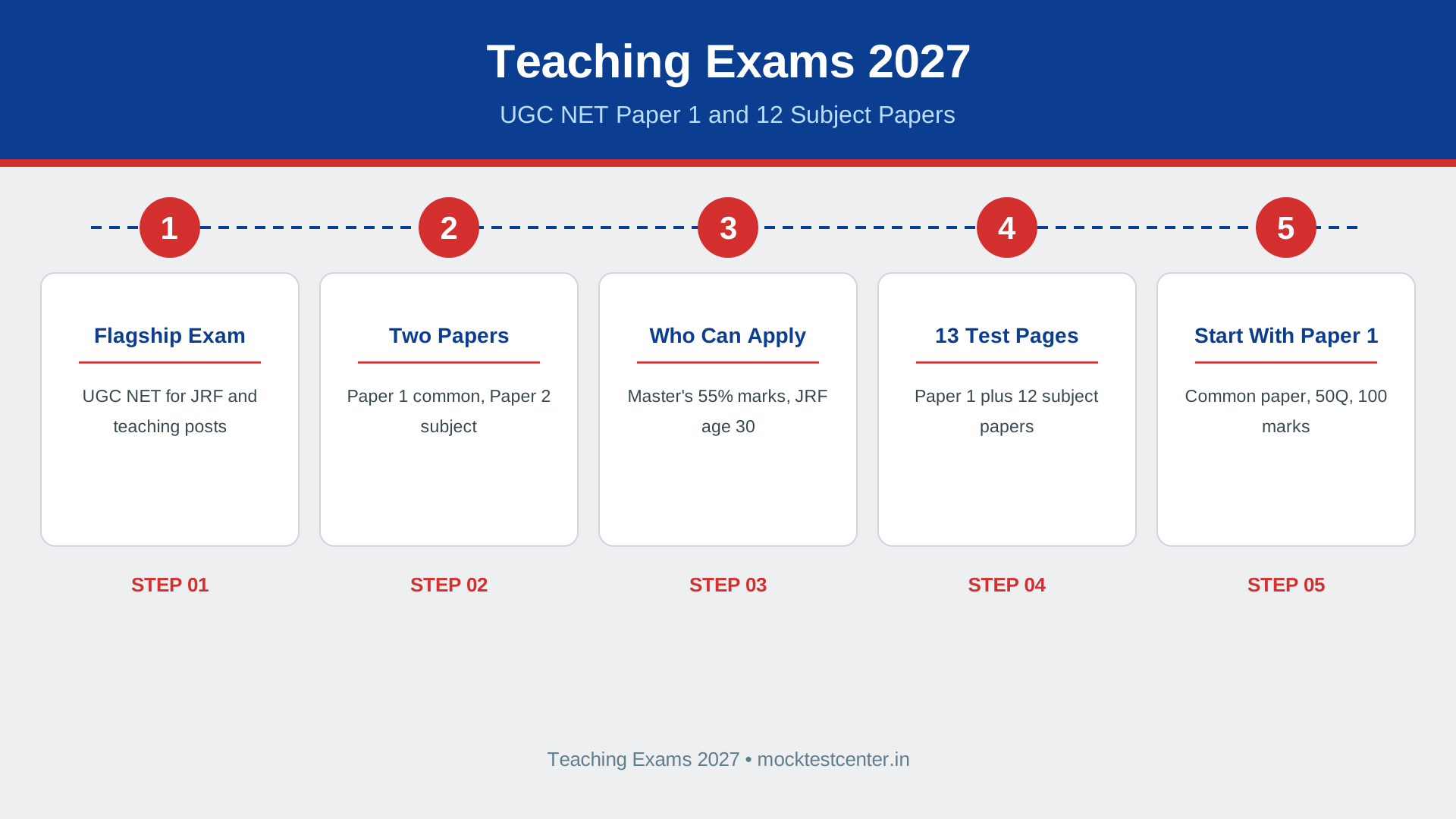
Teaching Exams is the home on MockTestCenter.in for every test that opens a teaching or research career. The flagship exam here is UGC NET, the national test that decides who can teach in colleges and universities and who can take up a Junior Research Fellowship. This category holds 13 test pages: one for Paper 1, the common paper, and 12 for the subject papers of Paper 2. Each page gives the pattern, the syllabus, the dates, and free mock tests for that paper.
A teaching career in India runs through this one exam more than any other. Colleges ask for NET qualification when they hire Assistant Professors. Universities ask for it when they admit PhD scholars. Research institutes look for JRF holders when they fill project posts. One exam, taken twice a year, feeds all three doors, and that is why lakhs of Master's degree holders sit for it in every cycle.
This page is the map of the whole category. It explains what UGC NET is, how the two papers work, what JRF and Assistant Professor mean, who can apply, and how the result is decided. Then it points you to the 13 test pages, so you can start with the paper that matters to you. The UGC NET 2027 June notification has not come out yet, as of 19 November 2026, so this page gives no 2027 dates. It rests on the June 2026 and December 2026 cycles, and it flags every fact that needs a fresh check.
UGC NET is the flagship exam
UGC NET stands for the University Grants Commission National Eligibility Test. The National Testing Agency, or NTA, runs the exam on behalf of UGC, and NTA has run it since the December 2018 cycle. The official sites are ugcnet.nta.ac.in and ugcnet.nta.nic.in, and every notice, answer key, and result appears there first. Check those sites before you trust any other page, including this one.
The exam runs twice a year, in a June cycle and a December cycle. Each cycle has its own notification, its own form window, and its own exam dates, but the pattern and the syllabus stay the same. That rhythm matters for planning. If you miss the June cycle, the December cycle follows in about six months, and your preparation carries over, because the syllabus has not changed since June 2019.
The test runs on a computer, in one sitting of 3 hours, with no break between the two papers. You answer 150 questions in that sitting, and there is no negative marking, so a wrong answer costs you nothing beyond the marks you miss. The exam is bilingual, and you pick Hindi or English when you fill the form. Pick the language you read fastest in, because the clock, not the subject, is the hardest part of this exam.
Two papers, one sitting
Paper 1 is the General Paper on Teaching and Research Aptitude, code 00. Every candidate takes it, whatever subject they choose for Paper 2. It has 50 questions for 100 marks, spread over 10 units, with about 5 questions from each unit. It tests how well you can teach, how well you can research, and how well you can read, reason, and handle data.
Paper 2 tests the subject you chose in the form. It has 100 questions for 200 marks, all from that one subject. The two papers together make 150 questions for 300 marks. You must appear in both papers to get a result. A candidate who skips either paper gets no result, even with a high score in the other.
| Paper | Questions | Marks | Who takes it |
|---|---|---|---|
| Paper 1 (Code 00) | 50 | 100 | Every candidate |
| Paper 2 (subject) | 100 | 200 | Every candidate, in their subject |
| Total | 150 | 300 | One sitting, 3 hours, no break |
Paper 1 carries one third of your total score, so it can lift or sink your result. Many candidates spend all their time on Paper 2 and leave Paper 1 for the last month. That is a mistake, because Paper 1 is the more predictable paper. Its syllabus is fixed, its units repeat, and its questions reward method more than memory. A candidate who scores 80 in Paper 1 starts the result race 20 marks ahead of a candidate who scores 60, and that gap is hard to close in Paper 2 alone.
JRF, Assistant Professor, and PhD admission
UGC NET opens three doors, and the result sorts you into one of three categories. Category 1 covers JRF and Assistant Professor plus PhD admission. Category 2 covers Assistant Professor and PhD admission. Category 3 covers PhD admission only. The category you land in depends on your aggregate score and on the cut off for your subject and group.
JRF is the Junior Research Fellowship, and it is the most sought after result. A Junior Research Fellow gets 37,000 rupees a month for the first two years, then 42,000 rupees a month as a Senior Research Fellow, plus house rent allowance as per UGC rules. The fellowship funds a PhD, so a JRF holder can study and earn at the same time. Only the top scorers reach Category 1, and the JRF age limit of 30 years keeps the race young.
Assistant Professor is the teaching door. Colleges and universities ask for NET qualification when they hire Assistant Professors, and a Category 1 or Category 2 result clears that bar. There is no upper age limit for Assistant Professor, so a candidate of any age can aim for it. PhD admission is the third door. For Categories 2 and 3, universities give the NET score 70 percent weight and their own interview 30 percent weight for PhD admission, and the NET score stays valid for PhD admission for 1 year from the result date.
Who should prepare
If you hold a Master's degree, or you are in your final year of one, this exam is for you. It suits the student who wants to teach in a college, the student who wants a funded PhD, and the working graduate who wants a stable academic career. It also suits the candidate who has tried other exams and wants a second path, because the syllabus stays fixed and the exam returns every six months.
A four year bachelor's degree opens a narrower door. With 75 percent aggregate, or 70 percent for reserved groups, in a four year, 8 semester bachelor's degree, you can sit for JRF and PhD admission, but not for Assistant Professor. Read the bulletin with care before you apply through this route, because the rule is new and it catches many candidates by surprise.
Start early if you can. The syllabus is wide, with 10 units in Paper 1 and 10 units in most Paper 2 subjects, and it rewards steady study over months, not a rush in the last weeks. A candidate who starts 6 months ahead of UGC NET 2027 can finish the syllabus twice and take 20 mock tests. A candidate who starts 6 weeks ahead can only skim it once.
Paper 1: the paper everyone takes
Paper 1 is the same for every candidate, and it is the best place to start your preparation. Its 10 units are Teaching Aptitude, Research Aptitude, Comprehension, Communication, Mathematical Reasoning and Aptitude, Logical Reasoning, Data Interpretation, Information and Communication Technology, and People, Development and Environment, plus the Higher Education System. Each unit gives about 5 questions, worth about 10 marks.
The units split into reading units and practice units. Teaching Aptitude, Research Aptitude, Communication, ICT, and Higher Education System are reading units, and you can finish them with a good book. Mathematical Reasoning, Logical Reasoning, Data Interpretation, and Comprehension are practice units, and they need daily questions, not just reading. Give the practice units 30 minutes a day from the start, because speed in those units grows slowly.
Read the full UGC NET Paper 1 2027 guide on this site before you plan your study. It covers each unit in depth, with the facts to learn, the books to use, and a 90 day plan. See UGC NET Paper 1 2027 for the full guide and mock tests.
The 12 subject papers
Paper 2 is where your subject decides the game. You pick one subject in the form, and the 100 questions come from that subject alone. Most subjects have 10 units, and the syllabus for each subject is fixed by UGC. Pick the subject that matches your Master's degree, because NTA links the subject to your degree, and a mismatch can block your form.
This category covers 12 subject papers, and each one has its own test page with the full syllabus, the pattern, the dates, and free mock tests. Start with your subject page, learn its 10 units, and take its mock tests alongside Paper 1, because the two papers share one sitting and one score.
- UGC NET Commerce 2027 mock test, Paper 2 subject code 08
- UGC NET Economics 2027 mock test, Paper 2 subject code 01
- UGC NET History 2027 mock test, Paper 2 subject code 06
- UGC NET English 2027 mock test, Paper 2 subject code 30
- UGC NET Management 2027 mock test, Paper 2 subject code 17
- UGC NET Law 2027 mock test, Paper 2 subject code 58
- UGC NET Political Science 2027 mock test, Paper 2 subject code 02
- UGC NET Psychology 2027 mock test, Paper 2 subject code 04
- UGC NET Computer Science 2027 mock test, Paper 2 subject code 87
The category also covers Geography, Home Science, and Sociology, with the same pattern and the same depth on their own test pages. Geography is subject code 80, Home Science is subject code 12, and Sociology is subject code 05. Together with the 9 subjects above and Paper 1, they make the full set of 13 test pages in this category.
Eligibility and age in brief
You need a Master's degree or an equal qualification from a UGC recognised university, with at least 55 percent marks if you belong to the General or General EWS group, and at least 50 percent if you belong to OBC NCL, SC, ST, PwD, or third gender. NTA counts the marks without rounding off, so 54.9 percent does not count as 55 percent. Final year Master's students can apply, and their result stays provisional till they pass with the needed marks.
Age matters only for JRF. The upper age limit for JRF is 30 years as on the 1st day of the exam month. For the June 2026 cycle that date was 1 June 2026, and for the December 2026 cycle it was 1 December 2026. NTA gives relaxation up to 5 years for OBC NCL, SC, ST, PwD, third gender, and women. Research experience, an LL.M. degree, and armed forces service also earn relaxation, and the total relaxation stays capped at 5 years. Assistant Professor and PhD admission carry no upper age limit at all.
One rule needs a flag, because it rests on a single source. Candidates must complete their Master's within 2 years of the result date for the first two result categories, and within 1 year for the third category. Check the latest bulletin on ugcnet.nta.ac.in before you rely on this window, because NTA can change it in a new notice. Each subject page in this category repeats the eligibility rules with the subject codes, so read your own page too.
How the result works in brief
The result follows a clear chain. First, you must appear in both papers. Second, you must cross the minimum aggregate across both papers. The bar is 40 percent, or 120 of 300 marks, for General and General EWS candidates. The bar is 35 percent, or 105 of 300 marks, for SC, ST, OBC NCL, PwD, and third gender candidates. These bars only open the door. The real cut off sits higher, and it changes with each cycle, subject, and category.
Third comes the 6 percent rule, which sets the cut off. NTA caps the number of candidates who qualify for Assistant Professor at 6 percent of the candidates who appeared in both papers. NTA then splits that 6 percent by reservation category and then by subject, and that split gives the subject wise, category wise cut off. A subject with more candidates gets more qualifying slots, and a category with more candidates gets more slots too. That is why the cut off for the same subject can differ sharply between categories, and why no one can give you a fixed cut off before the exam.
The result gives the three categories described above, and each subject page on this site explains the cut off mechanism with its own subject in mind. Do not trust any site that gives an exact cut off for the next cycle. Aim for the highest aggregate you can, because a higher aggregate keeps all three doors open.
The last two cycles
The June 2026 cycle ran on a tight calendar. NTA released the notification on 29 April 2026. One tracker says 28 April, but most sources say 29 April, and this page uses 29 April with that flag. Applications ran from 29 April to 20 May 2026, then NTA extended the window to 23 May 2026, with fee payment till 23 May, 11:50 PM. One source says the window closed on 24 May, and that claim stays flagged here. The exam ran from 22 to 30 June 2026, on 22, 23, 24, 25, 29, and 30 June, as a computer based test.
The fee for June 2026 was 1,150 rupees for General, 600 rupees for General EWS and OBC NCL, and 325 rupees for SC, ST, PwD, and third gender, paid online only, and non refundable. The number of subjects also needs a flag. Most trackers say 85 subjects, while Oswaal says 87, with Statistics and Forestry as two newly added subjects. This page does not settle that count, because the official bulletin was not opened in this pass. NTA released the cut off lists on 28 August 2026, and for English and Commerce a re exam cut off list came on 17 September 2026. Certificates came on 24 September 2026.
The December 2026 cycle followed quickly. NTA released the notification on 8 October 2026, then a revised bulletin on 16 October 2026. Applications ran from 8 October to 31 October 2026, with fee payment extended to 1 November 2026, and a correction window from 2 November 2026. The exam dates were revised too. NTA first announced 14 to 19 December, then fixed the exam for 14, 15, 16, 17, 18, and 21 December 2026. If you sat either cycle, your score came from the same rules this page describes, and the June 2027 cycle will use the same pattern unless a new bulletin changes it.
June 2027: what is known
As of 19 November 2026, NTA has released no notification for the June 2027 cycle. No dates, no fee, and no subject list exist for June 2027, and any site that gives a fixed June 2027 exam date today is guessing. The December 2026 exam is still ahead as this page is written, so the June 2027 notice will come after that cycle closes.
What you can count on in UGC NET 2027 is the pattern. The exam runs twice a year, in June and December, with Paper 1 and Paper 2 in one sitting of 3 hours, and the syllabus has stayed fixed since June 2019. Use the waiting time to finish the 10 units of Paper 1 and the 10 units of your subject, and to take mock tests on the June 2026 and December 2026 pattern. When the notice comes, check the fee, the dates, and the subject list on ugcnet.nta.ac.in first, and fill the form early, because the window is short and the site slows down near the last date.
How to use this category
Start with Paper 1, because every candidate takes it and it is the most predictable paper. Read the Paper 1 guide, learn its 10 units, and take a mock test to find your base score. Then open your subject page and do the same for Paper 2. Study the two papers side by side, not one after the other, because the exam tests them in one sitting.
Take mock tests the way the real exam runs. Sit for the full 3 hours with both papers, with no phone and no pauses. After each test, spend an hour on analysis, and track your score unit by unit. Two or three good tests a week, with full analysis, beat ten tests taken in a rush. Keep your documents ready, your photo and signature in the right size, and your category certificate at hand, so the form takes minutes when the notice comes.
What to do next
Pick your subject page from the list above and start with Unit 1 of Paper 1 today. The syllabus is fixed, the pattern is known, and the next cycle is about six months away. That is enough time to finish the syllabus twice, if you start now. Check the NTA site once a week for the June 2027 notice, and keep studying till it comes.