
Andhra Pradesh Exams 2027: Complete Mock Test Guide
📖 Table of Contents
- Andhra Pradesh Exams 2027: who runs which exam
- APPSC Group 1: the top of the ladder
- APPSC Group 2: the biggest APPSC intake
- Group 3 and Group 4: the ministerial route, and the exam that stopped
- APPSC ASO: the new exam on the list
- AP Police Constable and SI: the physical test decides first
- AP High Court District Judiciary: 1,621 posts in one drive
- AP DSC and APTET: the teacher ladder, in the right order
- Eligibility, age, and fee at a glance
- How to use the mock tests on this page
- A 90 day plan that fits any of these exams
- Mistakes that cost candidates a year
- Where to check next
Andhra Pradesh Exams 2027: Complete Mock Test Guide
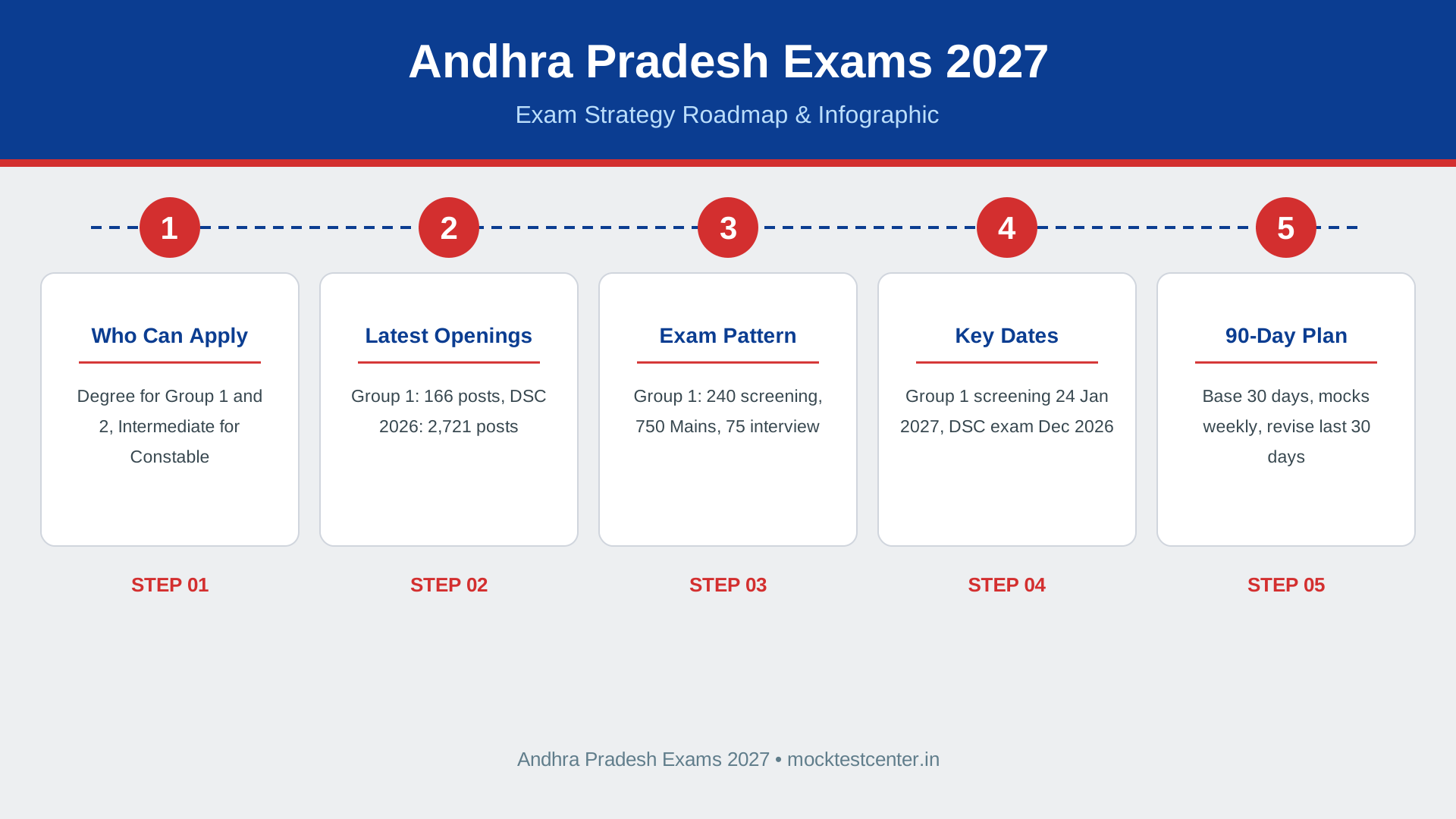
Andhra Pradesh has two live recruitments on the table as this guide is written. The Andhra Pradesh Public Service Commission notified 166 Group 1 posts in October 2026, with the screening test set for 24 January 2027. The School Education Department notified 2,721 teacher posts under DSC 2026, with applications closing on 30 November 2026 and the computer based test running from 20 December 2026 to 13 January 2027. That is the honest starting point for Andhra Pradesh Exams 2027. Some exams have fresh notifications and fixed dates. Others are still running on their last completed cycle, and a candidate who plans from those cycles will be ready when the next notification lands. This guide covers the whole ladder, from Group 1 down to the High Court Office Subordinate post, with the pattern, the eligibility, and the last real dates for each exam.
Andhra Pradesh does not run its exams through one body. Four bodies share the work, and each one has its own portal and its own calendar. The Andhra Pradesh Public Service Commission, known as APPSC, runs Group 1, Group 2, Group 3, Group 4, and the Assistant Statistical Officer exam. Its portal is psc.ap.gov.in. The Andhra Pradesh State Level Police Recruitment Board, known as SLPRB, runs Constable and Sub Inspector recruitment. Its portal is slprb.ap.gov.in. The High Court of Andhra Pradesh runs recruitment for the District Judiciary, including Junior Assistant, Typist, Stenographer, and Office Subordinate posts. Its portal is aphc.gov.in. The Department of School Education runs the District Selection Committee teacher recruitment and the Andhra Pradesh Teacher Eligibility Test. Its portals are cse.ap.gov.in, apdsc.apcfss.in, and aptet.apcfss.in. Learn which body runs your exam first, because that decides where the notification appears and where you apply.
No 2027 notification had been announced for Group 2, Group 3, Group 4, AP Police, the High Court, or APTET as of 20 November 2026. The dates in this guide are the latest completed or announced cycles, and every one of them is labelled with its year so you can tell a fact from a forecast. Where sources disagree, this guide says so and gives both figures. Check the official notification for your cycle before you apply, because a notification can change a fee, an age limit, or a paper pattern, and the notification is the only document that counts.
Andhra Pradesh Exams 2027: who runs which exam
Start with the map. APPSC sits in Vijayawada and recruits for Group A and Group B posts across state departments, plus the Group 3 and Group 4 ministerial posts. Its best known exam is Group 1, which fills Deputy Collector, Deputy Superintendent of Police, Assistant Commissioner of State Tax, and similar posts. APPSC also runs Group 2 for Executive and Non Executive posts, Group 3 for Panchayat Secretary, Group 4 for Junior Assistant, and single post exams like the Assistant Statistical Officer. One habit matters more than any other for APPSC candidates. Read the notification PDF on psc.ap.gov.in before you trust any summary, because APPSC changes details between cycles and the summary pages often carry the last cycle figures.
The police board works differently. SLPRB runs one large combined drive at a time, and its last drive covered 6,511 posts in a single notification. The physical tests sit in the middle of the process, between the preliminary written test and the final written exam, so a candidate who only studies books will fail at the running track. The High Court runs its own recruitment for the District Judiciary, and its 2025 drive was one of the largest single court recruitments in the state, with 1,621 posts. The School Education Department runs the teacher ladder, and that ladder has two rungs that confuse people. APTET only proves you are eligible to teach. DSC is the recruitment that gives you the job. You need the first to apply for the second, for most teaching posts.
The table below puts the whole set on one page. Use it to pick your exam, then read the section for that exam in full.
| Exam | Conducted by | Latest cycle | Posts |
|---|---|---|---|
| APPSC Group 1 | APPSC | Notification 07/2026, screening 24 Jan 2027 | 166 |
| APPSC Group 2 | APPSC | Notification 37/2026, Screening 21 Feb 2027 | 720 |
| APPSC Group 3 | APPSC | Notification 13/2018, no cycle since | 1,051 |
| APPSC Group 4 | APPSC | Notification 23/2021, Mains 4 Apr 2023 | 670 |
| APPSC ASO | APPSC | Notification 20/2026, applications closed 12 Nov 2026 | 196 |
| AP Police Constable and SI | SLPRB | 2026 drive, Rc.91/2026 and Rc.81/2026 | 827 constables plus 378 SIs |
| AP High Court District Judiciary | High Court of AP | 2025 drive, exam 20-24 Aug 2025 | 1,621, revised to 1,630 |
| AP DSC (APTRT) | School Education Dept | DSC 2026, exam 20 Dec 2026 to 13 Jan 2027 | 2,721 |
| APTET | School Education Dept | Dec 2025 cycle, exam 10-21 Dec 2025 | Eligibility test, no posts |
One more fact belongs at the top. Andhra Pradesh runs its recruitments on a district cadre and local status system, which means your district and your local or non local status can decide which posts you can claim. The details sit in each notification, and they change by post. Do not assume the rules from another state apply here.
APPSC Group 1: the top of the ladder
Group 1 is the exam every APPSC aspirant measures the rest against. It fills the senior posts of the state service, and the list from the last full cycle shows why. Deputy Collector in the Andhra Pradesh Civil Service, Assistant Commissioner of State Tax, Deputy Superintendent of Police, Deputy Registrar of Cooperative Societies, District Backward Classes Welfare Officer, District Social Welfare Officer, Municipal Commissioner Grade II, Assistant Treasury Officer, District Employment Officer, and Assistant Audit Officer were all on it. The last completed cycle started with Notification 12/2023, dated 8 December 2023. It listed 81 posts. An addendum dated 16 March 2024 took the total to 89. Applications ran from 1 January to 21 January 2024. The screening test was held on 17 March 2024, and press reports put the number who sat it at 91,463. The Main exam ran from 3 to 9 May 2025 across four district centres, and the selection notification was issued on 30 January 2026. That is a cycle of about 25 months from notification to selection, and a candidate who starts now should plan for the same kind of wait.
The new cycle is already open. APPSC issued brief Notification 07/2026 on 15 September 2026, listing 163 vacancies across 13 posts, and the detailed notification of 6 October 2026 listed 166 posts. Applications ran from 6 to 27 October 2026, and the screening test is scheduled for 24 January 2027. The Main exam dates had not been announced when this guide was written. The brief and detailed notifications disagree by three posts, and the detailed figure of 166 is the one to use, because the notification itself calls the vacancies provisional and subject to confirmation from the departments. Treat the count as 166 with a note that it can still move.
The pattern has three stages, and only two of them decide your rank. The screening test has two objective papers of 120 marks each, for 240 marks in total, with 120 minutes per paper. Paper I covers General Studies, and Paper II covers General Aptitude, including mental ability, reasoning, numeracy, science and technology, and current events. Each wrong answer loses one third of the marks assigned to the question, under the government order that governs APPSC objective papers. The screening test is qualifying only. The commission uses it to shortlist candidates for the Main exam, and the marks play no part in the final merit list.
The Main exam has seven papers of 150 marks each, with three hours per paper. Two of them are qualifying language papers in Telugu and English, and their marks do not count toward merit. You need 40 percent in each language paper if you are in the open category, a sportsperson, or EWS, 35 percent if you are BC, and 30 percent if you are SC, ST, or a person with benchmark disability. The five merit papers are General Essay, History Culture and Geography of India and Andhra Pradesh, Polity Constitution Governance Law and Ethics, Economy and Development, and Science Technology and Environment. They carry 750 marks. The interview carries 75 marks, and two candidates are called to interview for each vacancy. Final merit is out of 825 marks, which is 750 from the Main exam plus 75 from the interview.
Two traps catch Group 1 candidates every cycle. The first is the Telugu qualifying paper. It is set at SSC standard, and candidates who spent all their time on the merit papers have failed on it. Treat it as a paper you must pass, not a formality. The second is the screening test itself. It looks easy next to the Main exam, but 91,463 candidates sat it in the last cycle, and only a small share reached the Main exam. A mock test score in the screening pattern is the honest measure of where you stand, because the Main exam never happens for a candidate who misses the screening cut.
Eligibility is a degree in any discipline, and the age limit in Notification 12/2023 was 18 to 42 years as on 1 July 2023. Age relaxations apply by category under the state rules, and the exact limits sit in the notification for your cycle. Do not plan your attempt count from a tracker page. The notification is the only source that counts, and APPSC has changed the upper age limit between cycles before.
APPSC Group 2: the biggest APPSC intake
Group 2 is the largest APPSC recruitment in a normal cycle, and it is the exam most graduates should look at first. Notification 11/2023, dated 7 December 2023, listed 897 posts, with 331 Executive posts and 566 Non Executive posts. The count was later revised to 905. Some tracker pages report 899 at the notification stage, and the difference comes from carried forward posts counted at different dates. Use 897 as the notified figure and 905 as the revised figure, and check the final selection notice for the count that actually filled.
Applications ran from 21 December 2023 to 10 January 2024. The screening test was held on 25 February 2024. It has one paper, General Studies and Mental Ability, with 150 questions for 150 marks. The Main exam was first scheduled for 28 July 2024, then postponed, then scheduled for 5 January 2025, then rescheduled again to 23 February 2025. That is three dates for one exam, and it is a normal part of APPSC cycles rather than an exception. A candidate who stops studying when a date moves will be unprepared when the new date arrives. The Main exam has two papers of 150 questions each, for 300 marks in total. Paper I covers the social history of Andhra Pradesh and a general overview of the Indian Constitution. Paper II covers the Indian and Andhra Pradesh economy, plus science and technology. A Computer Proficiency Test follows the Main exam for candidates shortlisted on Main merit. The commission shortlisted 92,250 candidates for the Main exam, which shows the scale of the screening cut.
Group 2 suits a graduate who wants a state government post without the descriptive Main exam that Group 1 demands. The whole Group 2 written process is objective, and the Computer Proficiency Test is qualifying. That makes it a paper where speed and accuracy matter more than essay writing. The negative marking rule is the same as Group 1, with one third of the marks deducted for each wrong answer. A candidate who guesses on every uncertain question will lose marks steadily, and the mock test habit that matters most here is learning when to leave a question blank.
The new cycle is already open. APPSC issued Detailed Notification 37/2026 on 10 November 2026 for 720 posts, with 471 Executive posts and 249 Non Executive posts. Applications ran from 10 November to 11 December 2026, and the Screening Test is set for 21 February 2027. The Screening Test has one paper, General Studies and Mental Ability, with 150 questions for 150 marks in 150 minutes, and the Main exam has two papers of 150 marks each. The pattern in this section comes from the 11/2023 cycle, which is the latest completed round, and the 37/2026 notification keeps the same structure. When you read the notification, check the post list first, because the Executive and Non Executive split decides which posts your rank can reach, and that split changes every cycle.
Group 3 and Group 4: the ministerial route, and the exam that stopped
Group 3 and Group 4 fill the ministerial posts that keep government offices running, and they are the two APPSC exams that behave most differently from each other. One of them has not been notified for years. The other now appears in small post specific notifications instead of one large round. A candidate who waits for a big Group 3 or Group 4 notification like the old ones may wait a long time, so this section states the position plainly.
Group 3 recruits Panchayat Secretary Grade IV in the Andhra Pradesh Panchayat Raj Subordinate Service. The last notification was No. 13/2018, dated 21 December 2018. It listed 1,051 posts, with 1,000 fresh posts and 51 carried forward posts, spread district by district. Applications ran from 27 December 2018 to 19 January 2019, with the last date extended to 29 January 2019. The screening test was held in April 2019, the Main exam on 2 August 2019, and the district ranking lists were published in February 2020. The pay scale in that notification was Rs 16,400 to Rs 49,870 per month, and the age limit was 18 to 42 years as on 1 July 2018. No Group 3 notification has been issued since. The reason is a rule change. Under the rules as amended in 2019, Grade IV vacancies are now filled by promotion from Grade V rather than by direct recruitment. The state job calendar announced in 2026, which spoke of 10,060 posts in four phases, lists no Panchayat Secretary or Group 3 posts. That calendar figure comes from tracker coverage, not from a notification, and it is recorded here only to show that no Group 3 round is on the horizon. Do not plan your year around a Group 3 notification. If one ever comes, it will be news, and this guide will be wrong in a good way.
Group 4 recruits Junior Assistant and similar ministerial posts, and its last large cycle was Notification 23/2021, dated 28 December 2021. It listed 670 Junior Assistant cum Computer Assistant posts in the Revenue Department, across 13 districts, in the pay scale of Rs 16,400 to Rs 49,870. The age limit was 18 to 42 years as on 1 July 2021, with five years of relaxation for SC, ST, BC, and EWS candidates. The fee was Rs 250 toward application processing plus Rs 80 toward the examination fee, with the examination fee exempted for SC, ST, BC, PH, and ex servicemen candidates. Applications ran from 30 December 2021 to 19 January 2022, and the window was extended into February 2022. The screening test was held on 31 July 2022, with results in October 2022, and the Main exam was held on 4 April 2023. The pattern has a screening test of 100 marks in General Studies and Mental Ability, then a Main exam of two papers of 150 marks each, one in General Studies and Mental Ability and one in General English and General Telugu, followed by a 50 mark Computer Proficiency Test in office automation with typing. The Main exam papers are objective, and the negative marking rule is the same one third deduction that applies across APPSC objective papers.
Since the 670 post round, Group 4 has not returned as a large statewide recruitment. Notification 06/2022, dated 26 September 2022, covered six posts across six departments, with a computer based test in October 2023 and a selection notification in February 2024. Notification 22/2025, dated 24 September 2025, covered a single Junior Office Assistant post in the Prisons and Correctional Services, with the written exam held in January 2026 and the ranking list published in May 2026. The lesson is plain. Group 4 now arrives post by post, and a candidate who wants a Junior Assistant post should watch the APPSC notifications page through the year instead of waiting for one big announcement. The 23/2021 pattern is still the pattern to prepare from, because the scheme has held across these small cycles.
APPSC ASO: the new exam on the list
The Assistant Statistical Officer exam is the newest APPSC recruitment on this page, and it is also the most straightforward to prepare for. Notification 20/2026 covers 196 Assistant Statistical Officer posts in the Andhra Pradesh Economics and Statistical Subordinate Service. The brief notification is dated 15 September 2026, and the detailed notification is dated 13 October 2026. Applications ran from 13 October to 12 November 2026, after APPSC extended the last date from 2 November. The pay scale is Rs 37,640 to Rs 1,15,500. The exam date had not been announced when this guide was written.
The pattern is a single level written exam in online computer based mode, with no screening test regardless of how many applications come in. Paper I is General Studies and Mental Ability, with 150 questions for 150 marks in 150 minutes. Paper II is the subject paper, covering statistics, economics, and allied topics, with 150 questions for 150 marks in 150 minutes. The total is 300 marks. Each wrong answer loses one third of the marks assigned to the question. A Computer Proficiency Test follows for candidates shortlisted on the written exam. It is a practical test of 60 minutes for 100 marks, covering office automation with computers and associated software, and the qualifying marks are 40 for open category candidates, 35 for BC candidates, and 30 for SC, ST, and persons with benchmark disabilities. Certificate verification follows the proficiency test.
ASO suits a graduate with a statistics or economics background who wants a specialist post rather than a generalist one. Paper I is the same General Studies and Mental Ability that APPSC sets across its exams, so preparation for Group 2 Paper I carries over directly. Paper II is where the exam is won or lost, because it tests the subject at degree standard, including economic concepts, national income, demand and production, public finance, probability, sampling, averages, dispersion, correlation, time series, and index numbers. A candidate with no statistics background should not pick this exam as a first attempt at APPSC. A candidate with the background should treat it as one of the best openings of 2026, because 196 specialist posts draw far fewer applicants than a general Group 2 round.
AP Police Constable and SI: the physical test decides first
A new drive is already notified. The board issued Rc.No.91/SLPRB/Rect.2/2026 on 16 September 2026 for 1,156 posts, including 827 Stipendiary Cadet Trainee Police Constables, 542 Civil and 285 Armed Reserve, and Rc.No.81/SLPRB/Rect.1/2026 the same day for 378 Sub Inspector posts, 253 Civil, 116 Reserve Sub Inspector in the Armed Reserve, and 9 in the Special Protection Force. The application dates and the preliminary test dates had not been announced when this guide was written. The 2026 age limits are 18 to 24 years for Constables and 21 to 27 years for Sub Inspectors, as on 1 July 2026.
Police recruitment in Andhra Pradesh runs through the State Level Police Recruitment Board, and its last drive was one of the largest in the state. The government sanctioned the recruitment through G.O.Ms. No. 153 of the Home Department, dated 20 October 2022, covering 411 Sub Inspector posts and 6,100 Police Constable posts. The Sub Inspector posts split into 315 Civil Sub Inspectors, open to men and women, and 96 Reserve Sub Inspectors in the Andhra Pradesh Special Police, open to men only. The Constable posts split into 3,580 Civil Constables, open to men and women, and 2,520 APSP Constables, open to men only. The notification number is 161/SLPRB/RECT.2/2022, dated 28 November 2022. Constable applications ran from 30 November to 28 December 2022, with the preliminary written test on 22 January 2023. Sub Inspector applications ran from 14 December 2022 to 18 January 2023, with the preliminary written test on 19 February 2023. The final results for the Sub Inspector posts came out in December 2023.
The selection process has three parts, and the order matters. A preliminary written test comes first. A physical measurement test and a physical efficiency test come next. A final written exam comes last. The preliminary test for Constable has 200 questions for 200 marks in three hours, with 100 questions from Arithmetic and Test of Reasoning and Mental Ability and 100 questions from General Studies. The preliminary test for Sub Inspector has two papers of 100 marks each, one in Arithmetic and Test of Reasoning and Mental Ability at SSC standard and one in General Studies at degree standard. The preliminary marks play no part in final selection. They only decide who reaches the physical tests.
The physical tests are qualifying for Civil posts and carry marks for APSP posts, and the standards are strict. For Sub Inspector, the height is not less than 167.6 cm for men and 152.5 cm for women, the chest is not less than 86.3 cm for men, and the weight is not less than 40 kg for women. The efficiency events for Civil Sub Inspectors are the 1,600 metre run and one of the 100 metre run or the long jump. Reserve Sub Inspectors must qualify in all three events, with marks given for performance. For Constable, the physical efficiency test includes the 1,600 metre run in 8 minutes for men and 10 minutes 30 seconds for women, the 100 metre run in 15 seconds for men and 18 seconds for women, and the long jump of 3.80 metres for men and 2.75 metres for women. A candidate who starts running only after the preliminary result will be too late. Physical preparation has to run alongside study from the first week.
The final written exam for Constable is one paper of 200 marks in three hours, covering English, Arithmetic, Test of Reasoning and Mental Ability, General Science, History of India, Indian culture, Indian National Movement, Indian Geography, Polity and Economy, and current events. The final written exam for Sub Inspector has four papers of three hours each, with English and Telugu or Urdu as descriptive papers of 100 marks each, and two objective papers in Arithmetic and Reasoning and General Studies. The paper split for the Sub Inspector final exam is taken from tracker summaries of the notification, so check it against the notification PDF when the next cycle opens.
Two facts about this drive need honest flags. The fee was Rs 300 for OC and BC candidates and Rs 150 for SC and ST candidates, and that figure is consistent across tracker pages. The age limits are not consistent. Tracker pages report the Constable age limit as 18 to 24 years as on 1 July 2022 in one summary, 18 to 32 years in another, and 18 to 30 years in a third, and the Sub Inspector age limit as 21 to 27 years in most summaries and 21 to 25 years in one. The notification is the only source that settles this, and the uploader should read the age clause in the notification before publishing any age figure for police recruitment. A new police drive is already notified, Rc.No.91/2026 for 827 Constables and Rc.No.81/2026 for 378 Sub Inspectors, both dated 16 September 2026, with application dates still to be announced. The 2022-23 drive is the latest completed round, so its pattern is the pattern to prepare from, and the 2026 notification keeps the same three stage structure.
AP High Court District Judiciary: 1,621 posts in one drive
The High Court of Andhra Pradesh runs recruitment for the District Judiciary, and its 2025 drive was the largest court recruitment most candidates will see in a single year. Applications ran from 13 May to 2 June 2025 through the High Court website and the district court websites. The drive covered 1,621 posts, including Stenographer Grade III, Junior Assistant, Typist, Field Assistant, Examiner, Copyist, Driver, Record Assistant, Process Server, and Office Subordinate. Office Subordinate had the largest share at 651 posts, and Junior Assistant had 230 posts. The computer based exam was held from 20 to 24 August 2025. A corrigendum dated 19 December 2025 raised the total to 1,630 posts, because of promotions, resignations, and retirements, and the results also came out on 19 December 2025. That revision came after the exam, so the 1,621 figure is the notified count and 1,630 is the revised count. Both figures are correct for different dates, and this guide uses both with their dates attached.
The exam pattern is short and sharp, which is why it suits a candidate who prepares in a few months rather than a few years. The computer based test has 80 objective questions for 80 marks in 90 minutes, with one mark per question and no negative marking. For Junior Assistant, Stenographer, Typist, Field Assistant, Examiner, Copyist, and Record Assistant, the paper splits into 40 questions of General Knowledge and 40 questions of General English. For Office Subordinate, Process Server, and Driver, the paper covers General Knowledge, General English, and Mental Ability. The minimum qualifying marks are 40 percent for open category and EWS candidates, 35 percent for BC candidates, and 30 percent for SC, ST, and persons with benchmark disabilities. The General Knowledge paper is set in English and Telugu, and the English version is treated as final if the two disagree.
Selection does not end with the written test. Stenographer, Copyist, and Typist candidates face an English typewriting skill test, and the skill test carries 50 marks. Drivers face a driving skill test. Document verification and a medical examination follow. The qualification varies by post, and that is the first thing to check. Office Subordinate needs a pass in the 7th class. Junior Assistant needs a bachelor degree in any discipline. A graduate who applies for Office Subordinate by mistake will waste an application, and a 7th class pass candidate who applies for Junior Assistant will be rejected at verification. Read the post wise qualification table in the notification before you apply, not after.
No 2027 notification for the District Judiciary had come from the High Court as of 20 November 2026. The 2025 drive is the latest cycle, and its pattern is the pattern to prepare from. Court recruitment does not follow a fixed annual calendar, so the next drive may come with little warning. A candidate who keeps General Knowledge and General English ready through the year will be able to apply the day a notification appears, while a candidate who starts from zero will miss the short application window. The 2025 window was only 21 days.
AP DSC and APTET: the teacher ladder, in the right order
The teacher ladder confuses more candidates than any other exam on this page, because two different tests share the same portals and the same acronyms. APTET is the eligibility test. DSC is the recruitment. APTET proves you can teach. DSC gives you the job. A candidate who clears DSC without a valid TET score, where TET is mandatory, will not be selected. A candidate who clears APTET and never applies for DSC has a certificate and no job. Keep the two separate in your head, and prepare for them in the right order.
APTET is run by the Department of School Education. It has two papers. Paper I is for a person who intends to teach Classes I to V, and Paper II is for a person who intends to teach Classes VI to VIII. A candidate who wants to teach both levels must appear in both papers. Each paper has 150 multiple choice questions for 150 marks, with a duration of two hours and 30 minutes, and there is no negative marking. Paper I splits into five equal parts of 30 marks each, covering Child Development and Pedagogy, Language I, Language II in English, Mathematics, and Environmental Studies. Paper II has 30 marks each for Child Development and Pedagogy, Language I, and Language II in English, plus 60 marks for the subject, which is Mathematics and Science, Social Studies, or a language, depending on the teaching post. The question paper is bilingual, in English followed by the Language I chosen by the candidate, for all languages except Sanskrit. The qualifying marks are 60 percent for general category candidates, 50 percent for BC candidates, and 40 percent for SC, ST, differently abled, and ex servicemen candidates. There are separate papers for regular schools and special schools, marked 1A and 1B for Paper I and 2A and 2B for Paper II.
The two 2024 cycles show how fast APTET moves. The February 2024 cycle was notified on 8 February 2024, with applications from 8 to 18 February, a mock test on 19 February, hall tickets from 23 February, the exam from 27 February to 9 March 2024, and the result on 14 March 2024. That is five weeks from notification to result. The July 2024 cycle was notified on 2 July 2024, with applications from 4 to 17 July. The exam was postponed from its first schedule and was actually held from 3 to 20 October 2024, with the result on 2 November 2024. A December 2025 cycle followed, notified on 24 October 2025, with the exam from 10 to 21 December 2025 and the result on 9 January 2026. The pattern has not changed across these cycles, so the 2024 pattern is the pattern to prepare from. One flag belongs here. The 2024 information bulletin stated that the TET certificate was valid for seven years. National rules on TET validity have changed since then, and this guide does not state a current validity period, because the next APTET bulletin will carry the figure that applies. Check the bulletin when it comes.
DSC is the recruitment, and its last two cycles could not be more different in size. The Mega DSC of 2025 was notified on 20 April 2025, and it listed 16,347 posts, including Principals, Post Graduate Teachers, Trained Graduate Teachers, Physical Directors, School Assistants, Secondary Grade Teachers, and Physical Education Teachers. The computer based test ran from 6 June to 6 July 2025, with the exams first scheduled for 20 and 21 June moved to 1 and 2 July 2025. Selection uses a weighted score. The Teacher Recruitment Test carries 80 percent, and the TET score carries 20 percent, for posts where TET is mandatory. TET is mandatory for Secondary Grade Teacher and School Assistant posts. It is not required for Principal, Post Graduate Teacher, Physical Director, and Physical Education Teacher posts. For School Assistants, Secondary Grade Teachers, and Trained Graduate Teachers, the written test has 160 multiple choice questions for 80 marks in two hours and 30 minutes. For Post Graduate Teachers and Principals, the written test carries 100 marks in three hours. The minimum TET qualifying marks that feed into the weightage are 60 percent for open category and EWS candidates, 50 percent for BC candidates, and 40 percent for SC, ST, persons with disabilities, and ex servicemen candidates. Selection is post specific and district specific, so your district and your subject decide your competition, not the state total.
DSC 2026 is live now, and it is a smaller and sharper recruitment. It runs as the Andhra Pradesh Teacher Recruitment Test, known as APTRT 2026 and also called DSC 2026. Brief notifications No. 1, 2, and 3 were issued on 13 October 2026, and the detailed notifications followed on 5 November 2026, with the Information Bulletin No. 01/DSC-TRC-1/2026 dated 6 November 2026. The total is 2,721 posts. Notification No. 01 covers 2,111 regular School Assistant and Secondary Grade Teacher posts, with 906 School Assistants and 1,205 Secondary Grade Teachers. Notification No. 02 covers 350 special education posts. Notification No. 03 covers 260 posts in residential societies and other managements. Applications run from 11 to 30 November 2026 on the portal tet2dsc.apcfss.in, and the fee is Rs 1,000 per post. The age limit is 18 to 44 years as on 1 July 2026, with relaxations by category. The computer based test runs from 20 December 2026 to 13 January 2027. The three notifications have different managements, qualifications, and selection provisions, so a candidate must read the notification that covers their post, not a summary of the total. The 80 percent written test and 20 percent TET weightage carries over from the Mega DSC for the posts where TET applies.
The teacher ladder rewards one habit above all others. Keep your TET score ready before a DSC notification appears. The Mega DSC gave candidates about seven weeks between notification and exam. DSC 2026 gave about six weeks between the detailed notification and the start of the exam. A candidate who starts TET preparation after the DSC notification will be studying two syllabuses at once, and the TET score will drag the final merit down even if the written test goes well. Clear APTET first, keep the certificate safe, and then prepare for the DSC written test with the full 80 percent weight in mind.
Eligibility, age, and fee at a glance
The table below collects the eligibility, age, and fee figures from the sections above. Every figure is tied to its notification, and the notification is the source to check before you apply. Where sources disagreed, the table says so instead of picking a number and hiding the doubt.
| Exam | Education | Age in latest cycle | Fee in latest cycle |
|---|---|---|---|
| Group 1 | Any degree | 18 to 42 years | Check the notification |
| Group 2 | Any degree | 18 to 44 years in 37/2026 | Rs 250 plus Rs 80 |
| Group 3 | Degree, per 13/2018 | 18 to 42 years | Check the 2018 notification |
| Group 4 | Degree plus Computer Proficiency Test | 18 to 42 years | Rs 250 plus Rs 80 |
| ASO | Degree with statistics or economics | 18 to 44 years in 20/2026 | Rs 250 plus Rs 80 |
| Police Constable | Intermediate | 18 to 24 years in 2026, Home Guards to 32 | Rs 300, Rs 150 for SC and ST |
| Police SI | Degree | 21 to 27 years in 2026 | Rs 300, Rs 150 for SC and ST |
| High Court Junior Assistant | Any degree | Check the 2025 notification | Check the 2025 notification |
| High Court Office Subordinate | 7th class pass | Check the 2025 notification | Check the 2025 notification |
| DSC SGT | Intermediate plus D.El.Ed, with APTET Paper I | 18 to 44 years in DSC 2026 | Rs 1,000 per post in DSC 2026 |
| DSC School Assistant | Degree in the subject plus B.Ed, with APTET Paper II | 18 to 44 years in DSC 2026 | Rs 1,000 per post in DSC 2026 |
| APTET | D.El.Ed or B.Ed, by paper | No age limit in the bulletin | Check the bulletin |
Three patterns in this table deserve attention. The first is that APPSC keeps returning to 18 to 42 years for its Group exams, which is more generous than most states, and it is one reason the applicant numbers run so high. The second is that the fee is the smallest part of the cost. A Group 4 candidate pays Rs 330 in total, and a DSC 2026 candidate pays Rs 1,000 per post, but the real cost is the year of preparation. The third is that the table has gaps, and the gaps are honest. No fee figure is printed for Group 1 or the High Court, because no fee figure could be matched to the notification in the sources used for this guide. A guide that invents a fee is worse than a guide that says check the notification.
Two more rules apply across the exams. The first is negative marking. APPSC objective papers deduct one third of the marks for each wrong answer, under G.O.Ms. No. 235 of the Finance Department, dated 6 December 2016. APTET and the High Court exam have no negative marking. The police exams have their own marking rules in the SLPRB notification, and the DSC written test follows the School Education Department bulletin. The second is the Computer Proficiency Test. Group 2, Group 4, and ASO all end with one, and it is qualifying rather than ranking. A candidate who can write a good essay but cannot type at the required speed will fail at the last step, and the fix is practice on a keyboard, not more reading.
How to use the mock tests on this page
Each exam in the Andhra Pradesh Exams 2027 set on this page has its own mock test set, built on the pattern of its latest cycle. Use them in the order that matches the exam, not in the order that feels comfortable. Start with a full mock test before you study, and take the score as a baseline. A Group 1 candidate should start with a screening pattern mock, because the screening test is the gate. A DSC candidate should start with a written test mock in their subject, because the subject carries the largest share of the written marks. A police candidate should take a preliminary mock and then go for a run on the same day, because the real process demands both on the same week.
After the baseline, use sectional mocks for the weak parts. Group 1 and Group 2 candidates should drill General Studies and Mental Ability in short timed sets, because those papers reward speed as much as knowledge. DSC candidates should drill their subject and methodology sections, because the subject carries 60 of the 80 written marks for School Assistants and Secondary Grade Teachers. APTET candidates should drill Child Development and Pedagogy and the language sections, because those 90 marks are common to both papers and they are the easiest marks to raise quickly. High Court candidates should drill General Knowledge and General English in 90 minute sets, because the real exam is only 90 minutes and time pressure is the main difficulty.
Review every mock the same day you take it. Write down the questions you got wrong, sort them into three piles, and act on each pile differently. The first pile is facts you did not know, and the fix is a short note you revise weekly. The second pile is questions you knew but answered in a hurry, and the fix is slower reading and a habit of marking uncertain questions for a second pass. The third pile is questions you guessed on, and the fix is to stop guessing in exams with negative marking. A mock test that is taken and never reviewed is just a score. A mock test that is reviewed properly is a study plan.
Take a full mock every week in the last month before your exam, at the same time of day as the real exam. Group 1 Main papers run for three hours each, and a candidate who has never sat for three hours will fade in the last hour. DSC papers run for two hours and 30 minutes, and the same rule applies. The mock tests on this page follow the latest pattern for each exam, so a weekly full mock will show whether your score is rising or flat, and a flat score for three weeks is a signal to change your study method rather than to take more mocks.
The weekly mock habit works beyond Andhra Pradesh too. Candidates who also sit national exams use the same routine for SBI PO 2027 and IBPS PO 2027, for IBPS Clerk 2027 and RBI Assistant 2027, and for SSC GD 2027. Civil services candidates run the same cycle for UPSC CSE Prelims 2027 and UPPSC PCS 2027, while state service candidates compare notes with KPSC KAS 2027 and Karnataka PSI 2027. Teachers add UGC NET Paper 1 2027 to the same weekly routine.
A 90 day plan that fits any of these exams
Ninety days is enough to move a score, and it is short enough that a plan has to be honest about what gets cut. This plan works for Group 1 screening, Group 2, ASO Paper I, DSC, APTET, and the High Court exam, with the subject hours swapped to match your exam, and it fits any paper in the Andhra Pradesh Exams 2027 set. It assumes four to five hours of study a day. A candidate with a job should stretch it to 120 days and keep the same order.
Days 1 to 30 are for the base. Cover the full syllabus once, at speed, without stopping to master any topic. For APPSC exams, that means General Studies, Mental Ability, current affairs of Andhra Pradesh and India, and the subject paper for ASO. For DSC, that means the subject content and methodology plus General Knowledge. For APTET, that means Child Development and Pedagogy, the languages, and the subject. For the High Court exam, that means General Knowledge and General English. Take one sectional mock at the end of each week, and keep a notebook of every fact you got wrong. Police candidates add running and the physical events from day one, because fitness cannot be built in the last month. Do not take a full mock in the first 30 days. You do not have the syllabus yet, and a low score will only waste a day.
Days 31 to 60 are for depth and for the first full mocks. Revisit the topics where your sectional scores were lowest, and study them from a second source. Take a full mock every Sunday, and review it on Monday. This is also the stage to start the parts that candidates leave too late. Group 1 candidates should start writing one essay a week and one Telugu qualifying paper a fortnight, because both need practice rather than reading. Group 2 and Group 4 candidates should practise the Computer Proficiency Test twice a week, because typing speed and office software need muscle memory. DSC candidates should start timed subject mocks, because the subject section is where the merit is decided. APTET candidates should take a full 150 question paper every week, because 150 questions in 150 minutes is a pace that has to be trained. High Court candidates should take 90 minute mocks, because the real exam gives just over a minute per question.
Days 61 to 90 are for revision and for exam conditions. Stop adding new material after day 70, except for current affairs, which never stops. Revise from your notebook, not from the textbook, because the notebook holds the facts you actually got wrong. Take a full mock every three days, and take it at the same time as the real exam. Spend the day after each mock on review only. In the last week, take two full mocks and then stop. The day before the exam is for light revision and rest, not for a new topic. A candidate who studies a new topic the night before the exam will carry that topic into the hall and forget three others.
One rule runs through all 90 days. Current affairs of Andhra Pradesh matter in every exam on this page, and they are the easiest marks to gain. Follow the state government schemes, the Assembly, the High Court, the School Education Department, and the APPSC and SLPRB portals through the whole 90 days. A candidate who reads only national current affairs will lose the state questions, and the state questions are the ones that separate two candidates with the same national knowledge.
Mistakes that cost candidates a year
The first mistake is preparing for the wrong cycle. A candidate who studies the old Group 1 pattern with one screening paper will be surprised by two papers of 120 marks each. A candidate who prepares for DSC with the Mega DSC post list will be surprised by the 2,721 post list of DSC 2026. Check the latest notification, not the coaching institute poster. The second mistake is ignoring the qualifying stages. The Telugu paper in Group 1, the Computer Proficiency Test in Group 2, Group 4, and ASO, the physical tests in police recruitment, and the typing test in the High Court exam have all ended the run of candidates who were strong on the main papers. Qualifying does not mean easy. It means you must pass it to go further.
The third mistake is treating APTET and DSC as one exam. They are two exams with two syllabuses and two calendars, and the TET score carries 20 percent of the DSC merit. A candidate who clears DSC preparation and ignores TET will lose a fifth of the final score. The fourth mistake is guessing in exams with negative marking. APPSC deducts one third of a mark for each wrong answer, and a candidate who guesses on 30 questions will lose about 10 marks. That is often the difference between selection and the waiting list. The fifth mistake is waiting for a notification before starting. Group 3 has had no notification since 2018. The High Court gave 21 days to apply in 2025. DSC 2026 gave about six weeks from the detailed notification to the exam. The candidates who were ready when the notification appeared were the ones who had been studying the last cycle pattern all along.
Where to check next
Pick one exam from this guide and open its mock test set on this page. Take the baseline mock this week, and write down the score with the date. Then open the official portal for your exam and read the latest notification, even if it is an old one. That is how the Andhra Pradesh Exams 2027 preparation starts, with a real pattern and a real score, not with a plan on paper. The notification will tell you the pattern, the eligibility, and the fee for your cycle, and the mock test will tell you where you stand against that pattern. Check the portal again every week until your exam, because APPSC, SLPRB, the High Court, and the School Education Department all change dates through web notes, and a web note is easy to miss. The next notification for your exam will come. The question is whether you will be ready on the day it does.
Sources: Andhra Pradesh Public Service Commission, notifications 12/2023, 11/2023, 13/2018, 23/2021, and 20/2026, and brief notification 07/2026, on psc.ap.gov.in, as reported by FreeJobAlert, Times of India, Scroll, Adda247, and the APPSC notification PDFs carried by Testbook; BLOOM APPSC Group 1 guide, checked against APPSC notifications 12/2023 and 07/2026; Andhra Pradesh State Level Police Recruitment Board notification 161/SLPRB/RECT.2/2022 and G.O.Ms. No. 153, Home Department, dated 20 October 2022, on slprb.ap.gov.in, as reported by AP Teachers, Adda247, and IACE; High Court of Andhra Pradesh District Judiciary recruitment 2025, applications 13 May to 2 June 2025, exam 20 to 24 August 2025, corrigendum dated 19 December 2025, on aphc.gov.in, as reported by CareerPower, Adda247, StudyIQ, and JagranJosh; Department of School Education, Mega DSC 2025 notification dated 20 April 2025 and APTRT DSC 2026 notifications No. 01, 02, and 03/DSC-TRC-1/2026 dated 5 November 2026, on apdsc.apcfss.in and tet2dsc.apcfss.in, as reported by The Hindu, Testbook, and Adda247; Andhra Pradesh Teacher Eligibility Test February 2024 and July 2024 information bulletins, on aptet.apcfss.in, as reported by Indian Express, Times of India, Careers360, and Oliveboard; BrollyExamPrep APPSC Group 3 and Group 4 guides, checked 11 November 2026 against the APPSC notification index. All sources read 20 November 2026.