







Madhya Pradesh Exams 2027: Complete Mock Test Guide
📖 Table of Contents
- Madhya Pradesh Exams 2027 at a glance
- How the Madhya Pradesh exam system works
- MPPSC SSE 2027: the Commission exam
- MP Police Constable 2027: the largest drive in the set
- MP Police SI 2027: the graduate police exam
- MPTET Varg 2 2027: middle school teacher
- MPTET Varg 3 2027: primary teacher, the biggest count
- MP High Court 2027: the court exam
- MP Patwari 2027: the revenue post inside Group 2
- MP Forest Guard and Jail Prahari 2027: the uniformed Board exams
- MP Excise Constable 2027: the small specialist drive
- MPPEB Group 4 2027: the clerical entry
- Eligibility, age and fee across the set
- How to choose your exam
- A 90 day plan for the Commission exam
- A 90 day plan for the police and uniformed exams
- A 90 day plan for the teacher exams
- A 90 day plan for Patwari, Group 4 and the High Court exams
- Five mistakes that cost MP candidates marks
- When each notification lands
- How to use mock tests for MP exams
- Sources
Madhya Pradesh Exams 2027: Complete Mock Test Guide
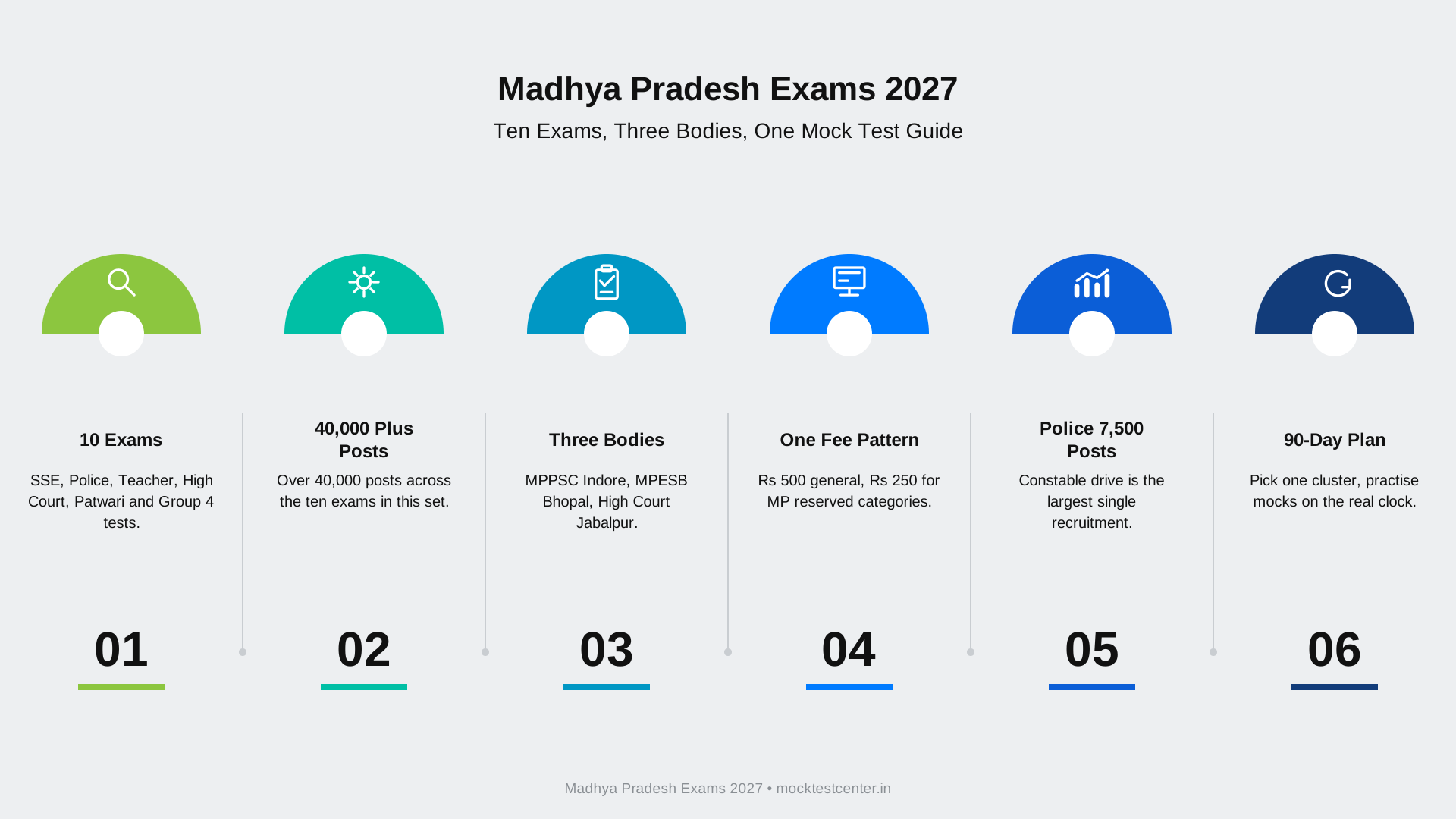
Madhya Pradesh fills its government posts through three different bodies, and a candidate who mixes them up applies on the wrong website, pays the wrong fee, or prepares for the wrong paper. This Madhya Pradesh Exams 2027 guide puts the whole set on one page. Ten exams, ten post counts, one system, and a plan for each type of exam.
The headline numbers are large. MPPSC SSE 2027 works from 158 posts in its 2025 cycle and 156 in its 2026 cycle. MP Police Constable 2027 offers 7,500 posts. MP Police SI 2027 offers 500 posts. MPTET Varg 2 2027 offers 10,758 posts and MPTET Varg 3 2027 offers 18,650 posts, as per the notification. MP High Court 2027 offers 418 posts under Advt. 666/2026. MP Patwari 2027 sits inside the Group 2 Sub Group 4 test with 2,306 posts including a special Patwari recruitment of 200 posts. MP Forest Guard and Jail Prahari 2027 offers 1,679 posts in the first notification, with the Forest Guard count later revised from 728 to 1,111. MP Excise Constable 2027 offers 253 posts. MPPEB Group 4 2027 offers 966 posts. Together the set crosses 40,000 posts, and that scale is why MP exams draw candidates from every district of the state.
The ten exams share a state, a language of examination, and a habit of short application windows. They differ in almost everything else. The Commission exam is descriptive and takes a year. The Board exams are objective and finish in a day. The teacher exams test a degree plus a teaching qualification. The police exams test the body as well as the mind. The High Court exam runs on its own calendar entirely. A candidate who picks one exam and prepares for its exact shape beats a candidate who prepares for all ten at once, and this Madhya Pradesh Exams 2027 guide shows how to make that choice.
Madhya Pradesh Exams 2027 at a glance
| Exam | Conducting body | Posts | Who can apply |
|---|---|---|---|
| MPPSC SSE 2027 | Madhya Pradesh Public Service Commission, Indore | 158 in 2025, 156 in 2026 | Any graduate, age 21 to 40, 21 to 33 for uniformed posts |
| MP Police Constable 2027 | Madhya Pradesh Employees Selection Board, Bhopal | 7,500 | Class 10 pass, age 18 to 33 |
| MP Police SI 2027 | Madhya Pradesh Employees Selection Board, Bhopal | 500 | Graduate, as per the notification |
| MPTET Varg 2 2027 | Madhya Pradesh Employees Selection Board, Bhopal | 10,758 | Graduate with teaching qualification, as per the notification |
| MPTET Varg 3 2027 | Madhya Pradesh Employees Selection Board, Bhopal | 18,650 | Teaching qualification for primary classes, as per the notification |
| MP High Court 2027 | Madhya Pradesh High Court, Jabalpur | 418 | As per Advt. 666/2026 |
| MP Patwari 2027 | Madhya Pradesh Employees Selection Board, Bhopal | 2,306 in Group 2 Sub Group 4, including 200 Patwari posts | Graduate, age 18 to 40, CPCT for Patwari |
| MP Forest Guard and Jail Prahari 2027 | Madhya Pradesh Employees Selection Board, Bhopal | 1,679 first notification, Forest Guard later revised to 1,111 | As per the notification |
| MP Excise Constable 2027 | Madhya Pradesh Employees Selection Board, Bhopal | 253 | As per the notification |
| MPPEB Group 4 2027 | Madhya Pradesh Employees Selection Board, Bhopal | 966 | As per the notification |
Seven of the ten exams run through the Employees Selection Board. One runs through the Public Service Commission. One runs through the High Court. The table is the map, and the sections below walk each road.
How the Madhya Pradesh exam system works
Three bodies fill most state government posts in Madhya Pradesh, and each one has its own website, its own calendar, and its own way of testing.
The Madhya Pradesh Public Service Commission, MPPSC, sits in Indore and holds the State Service Examination for Class II gazetted and Class III executive posts. It also holds the State Forest Service Examination, the State Engineering Service Examination, and direct recruitment for assistant professors, medical officers and other gazetted posts. Its exams are descriptive after Prelims, they take the better part of a year, and its results carry the 87 and 13 split because cases on OBC reservation are still pending in court. Its website is mppsc.mp.gov.in. Its notifications land in the last week of December, and that rhythm has held for SSE 2024, SSE 2025 and SSE 2026 alike.
The Madhya Pradesh Employees Selection Board, MPESB, sits in Bhopal and holds combined recruitment tests for Class III posts in state departments, boards and corporations. It was long known as Vyapam, the Professional Examination Board, and many candidates still call it by that name. It runs the police constable and sub inspector tests, the teacher eligibility tests, the Patwari test inside Group 2 Sub Group 4, the forest guard and jail prahari tests, the excise constable test and the Group 4 test. Its exams are objective, online, and usually finish in a single paper. Its website is esb.mp.gov.in. Its applications run through MP Online, and several of its tests need a live registration with an MP employment office.
The Madhya Pradesh High Court, in Jabalpur, recruits its own staff. Its advertisements carry their own numbers, such as Advt. 666/2026 for the 418 post drive, and its tests, its syllabus and its calendar do not follow the Board or the Commission. A candidate who waits for the Board calendar to learn the High Court dates will miss the High Court entirely. Its website is mphc.gov.in.
MP Online ties the system together. Applications for the Commission and the Board both run through MP Online kiosks or the online portal, and the fee structure repeats across bodies. The standard fee is Rs 500 for general and other state candidates and Rs 250 for MP domicile SC, ST, OBC, EWS and PwD candidates, with a portal charge on top in some listings. The standard age window for Board tests is 18 to 40 years, with relaxation to 45 for listed categories, while the Commission window is 21 to 40. Reservation and age relaxation go only to natives of Madhya Pradesh. Candidates of these categories from other states are treated as unreserved.
The practical lesson is simple. Bookmark three websites, mppsc.mp.gov.in, esb.mp.gov.in and mphc.gov.in, and check each one separately. No single calendar covers all three bodies, and no single tracker page keeps all three dates right at the same time.
MPPSC SSE 2027: the Commission exam
MPPSC SSE is the senior exam in this set and the longest road in it. It fills Deputy Collector, Deputy Superintendent of Police, Commercial Tax Officer, Naib Tehsildar, Block Development Officer, Cooperative Inspector and a dozen other services. The 2025 cycle advertised 158 posts, held Prelims on 16 February 2025, and shortlisted 3,866 candidates on 5 March 2025. The 2026 cycle advertised 155 posts under Advt. No. 29/2025 dated 31 December 2025, fixed at 156 by corrigendum of 20 May 2026, held Prelims on 26 April 2026, shortlisted 3,044 candidates on 22 May 2026, and held Mains from 7 to 12 September 2026. About 1.35 lakh candidates applied for the 2026 cycle, a ratio near 870 applicants per post.
The pattern changed between the two cycles, and that change is the most important fact in this section. Prelims moved from two papers of 200 marks each to two papers of 300 marks each, with 100 questions of 3 marks each and negative marking of 1 mark per wrong answer. Paper I is General Studies and Paper II is the General Aptitude Test, which is qualifying only at 40 percent for general candidates and 30 percent for reserved categories. Mains moved from 1,400 marks to 1,500, with four General Studies papers of 300 marks each, General Hindi and Grammar at 200, and Hindi Essay and Draft Writing at 100. The interview moved from 175 to 185 marks, for a grand total of 1,685.
Eligibility is a bachelor degree in any discipline, with final year students allowed to take Prelims. The age window is 21 to 40 years for non uniformed posts and 21 to 33 for uniformed posts, as on 1 January of the exam year, with five years of relaxation for MP domicile reserved categories, capped at 45 years or 38 for uniformed posts. Uniformed posts carry physical standards of 168 cm height and 84 cm chest for men, 89 cm expanded, and 155 cm height for women. The fee is Rs 500 for general candidates and Rs 250 for MP reserved categories.
The SSE syllabus gives Madhya Pradesh a large share of the paper. Three of the ten Prelims General Studies units belong only to the state, covering its history, culture and literature, its geography, and its tribes, heritage, folk culture and folk literature. Mains has no separate MP paper, and the state sits inside each General Studies paper instead. A candidate who studies national topics and skips the MP units gives away marks in every paper instead of one. The full pattern, post list, syllabus and 90 day plan for this exam are covered in the MPPSC SSE 2027 guide on this site.
MP Police Constable 2027: the largest drive in the set
MP Police Constable is the largest single recruitment in this set, with 7,500 posts of Constable General Duty in the Special Armed Force and the District Force. The Madhya Pradesh Employees Selection Board opened applications on 15 September 2025 and closed them on 6 October 2025 after an extension from 29 September, with a correction window till 8 October 2025. Moneycontrol reported the drive on the day applications opened, and Zee News reported the same dates and the same count. The written examination was scheduled from 30 October 2025 onwards, as per the notification.
Eligibility is Class 10 pass from a recognised board for unreserved, SC and OBC candidates, and Class 8 pass for ST candidates. The age limit is 18 to 33 years as on 29 September 2025, with relaxation as per the rules. The fee is Rs 500 per paper for general, EWS and OBC candidates of MP domicile, and Rs 250 per paper for SC, ST, PwD and women candidates of MP domicile, with a portal fee of Rs 60 on MP Online payment in some listings. The pay scale is Rs 19,500 to 62,000 per month.
Selection runs through a written examination, a physical efficiency test, a physical standards test, document verification and a medical examination. The written paper tests general knowledge, reasoning, science and mathematics, and the physical stage tests running, long jump and shot put against the standards for the post. The physical standards are 168 cm height for general, OBC and SC men and 160 cm for ST men, with the chest and running standards as printed in the notification. A candidate who prepares only for the written paper and discovers the physical standards after the result has prepared for half the exam.
The constable drive suits a candidate who has finished Class 10 or 12 and wants a uniformed post without a degree. It is also the exam with the shortest preparation runway in this set, because the written paper is objective and the syllabus is school level. The risk is the physical stage, and the fix is to start running in the first week of preparation, not after the written result.
MP Police SI 2027: the graduate police exam
MP Police SI 2027 offers 500 posts, as per the notification, and it is the graduate entry to the Madhya Pradesh police. The Sub Inspector post carries more responsibility than the constable post, a higher pay scale, and a written paper that tests graduation level knowledge instead of school level knowledge. The Board conducts the test, and selection runs through a written examination, physical tests and an interview stage, as per the notification.
The SI exam suits a graduate who wants the police but does not want the year long descriptive grind of MPPSC SSE. The written paper covers general knowledge, reasoning, science and mathematics at a higher level than the constable paper, and the physical standards are stricter. The age window and the fee follow the Board pattern, and the exact dates, paper pattern and physical standards for the 2027 cycle sit in the notification on esb.mp.gov.in.
A candidate choosing between constable and SI should weigh the degree. A graduate who applies for constable competes against Class 10 pass candidates for a lower post, while the same graduate in the SI test competes against other graduates for a gazetted post. The constable post has 7,500 openings and the SI post has 500, so the constable test is easier to enter and the SI test is better worth entering. Many candidates apply for both, and that is sensible, because the syllabi overlap and the physical preparation is the same.
MPTET Varg 2 2027: middle school teacher
MPTET Varg 2 2027 offers 10,758 posts, as per the notification, for middle school teachers in Madhya Pradesh government schools. Varg 2 covers Classes 6 to 8, and it is the largest teacher drive in this set after Varg 3. The Board conducts the test, and eligibility needs a graduate degree with a teaching qualification, as per the notification.
The Varg 2 test checks subject knowledge for the middle school subjects, teaching aptitude, and general knowledge. A candidate with a BEd or D.El.Ed and a graduation in the subject they want to teach should treat the subject paper as the core of preparation, because it carries the most weight and it is where a subject graduate has a real edge over a general candidate. The general paper, with language, reasoning and general knowledge, decides the rank among candidates who score alike in the subject paper.
Teacher tests reward steady preparation more than speed. The syllabus is fixed, the questions repeat their shape every cycle, and previous papers show the pattern plainly. A candidate who works through five years of previous papers and the state textbooks for Classes 6 to 8 has covered most of what the test can ask. The application window is short, as with every Board test, so the documents, the teaching qualification certificate and the MP domicile proof should be ready before the notification lands.
MPTET Varg 3 2027: primary teacher, the biggest count
MPTET Varg 3 2027 offers 18,650 posts, as per the notification, for primary school teachers in Madhya Pradesh. It is the single largest post count in this set, more than double the constable drive, and it is the exam that changes the most lives in the state. Varg 3 covers Classes 1 to 5, and eligibility needs a teaching qualification for primary classes, as per the notification.
The Varg 3 test checks child development and pedagogy, language, mathematics, environmental studies and general knowledge. Pedagogy is the section that separates a trained teacher from a general graduate, and it is also the section that a candidate can improve fastest, because its questions follow a small set of ideas about how children learn, how a classroom runs, and how learning is assessed. Language and mathematics sit at primary school level, and a candidate who revises the state textbooks for Classes 1 to 5 has the material in hand.
The size of the drive changes the strategy. With 18,650 posts the cutoff moves less on a single hard question and more on steady accuracy across the paper. A candidate who answers the pedagogy and language sections carefully and attempts every question, since the paper carries no negative marking on the trackers that state a rule, will finish ahead of a candidate who chases the hardest questions. Previous papers and mock tests on the real clock matter more here than new books, because the test rewards familiarity with its own shape.
MP High Court 2027: the court exam
MP High Court 2027 offers 418 posts under Advt. 666/2026, as per the notification, and it runs on the High Court calendar rather than the Board or Commission calendar. The Madhya Pradesh High Court in Jabalpur recruits its own staff, and its posts cover the court establishment, from junior assistants and stenographers to the other Class III posts the advertisement lists.
The High Court exam suits a candidate who wants a court posting and a stable clerical career in Jabalpur, Indore or Gwalior. The written paper tests general knowledge, reasoning, language and computer knowledge, and some posts add a skill test in typing or shorthand. A candidate who can type in Hindi and English has an edge that no amount of general knowledge can replace, because the skill test is qualifying and it ends attempts that the written paper cannot save.
Check mphc.gov.in for the dates, the post wise eligibility, and the skill test standards. The High Court publishes its own corrigenda and its own results, and tracker pages that mix its dates with Board dates are the most common source of confusion in this set. The advertisement number, 666/2026, is the anchor. Match every date and every post count against that number before trusting it.
MP Patwari 2027: the revenue post inside Group 2
MP Patwari 2027 sits inside the MPESB Group 2 Sub Group 4 Combined Recruitment Test, which offers 2,306 posts, as per the notification, across many departments. The Patwari post itself carries a special recruitment of 200 posts for persons with disabilities, in the Land Resource Management department under Revenue, with a pay scale of Rs 5,200 to 20,200 plus Rs 2,100 grade pay. The Group 2 test also fills Assistant Sub Inspector posts in the Agricultural Marketing Board, 530 of them, Sub Auditor posts, 105 of them, Statistical Investigator posts, 88 of them, and Mandal Sanyojak posts, 72 of them.
The Board issued the rulebook on 4 August 2026, opened applications from 4 to 21 August 2026, and held the online test from 22 September 2026. The test is a single online paper of 200 marks in 3 hours, in two parts. Part A covers General Science, General Hindi, General English and General Mathematics for 100 marks. Part B covers General Knowledge and Aptitude, General Computer Knowledge, General Reasoning Ability and General Management for 100 marks. Each right answer earns 1 mark. Trackers that reproduce the rulebook report a deduction of 0.25 mark for each wrong answer, though one tracker says there is none. The shifts run from 9 AM to 12 noon and from 2:30 PM to 5:30 PM.
Patwari needs a graduate degree and a CPCT score card with Hindi typing. A selected candidate without CPCT must pass it within the three year probation. The age window is 18 to 40 years as on 1 January 2026, rising to 45 for MP domicile SC, ST and OBC candidates, government and corporation employees, Nagar Sainik, PwD candidates and women. A live registration with an MP employment office is compulsory for every post in this test. The fee is Rs 500 for general candidates and Rs 250 for MP domicile reserved categories.
The Patwari post is the most sought after post in this test because it is a revenue post with a field posting in the home district and a clear path to higher revenue posts. The 200 post special recruitment for persons with disabilities is separate from the general Patwari count, and candidates should read the rulebook post list before assuming which posts they can apply for. Five posts of the Panchayat Raj Directorate, post codes 97 to 101, were later deleted from this test, and the Board is refunding the fee of those applicants, which is a reminder to check the Board notices after applying as well as before.
MP Forest Guard and Jail Prahari 2027: the uniformed Board exams
MP Forest Guard and Jail Prahari 2027 offers 1,679 posts in the first notification, as per the notification, with the Forest Guard count later revised from 728 to 1,111, and it is the uniformed Board exam for candidates who want field work in the forest department or the prison department. The Board conducts the test, and selection runs through a written examination and physical tests, as per the notification.
The forest guard post suits a candidate who wants outdoor work and can meet the physical standards for height, chest and running. The jail prahari post suits a candidate who wants a disciplined uniformed career inside the prison department. Both posts test general knowledge, reasoning, science and mathematics in the written paper, and both add a physical stage that ends attempts the written paper cannot save.
These two posts share a notification and a test in this set, so one preparation covers both. The physical preparation is the same running and fitness work as the police constable test, and the written syllabus overlaps heavily with it. A candidate preparing for the constable test can add the forest guard and jail prahari test with little extra study, and the extra test doubles the chance of a uniformed posting in the same year.
MP Excise Constable 2027: the small specialist drive
MP Excise Constable 2027 offers 253 posts, as per the notification, in the excise department of Madhya Pradesh. It is the smallest drive in this set, and its size is its character. A small drive means a short merit list, a cutoff that moves on a few marks, and a test where accuracy matters more than coverage.
The excise constable post suits a candidate who wants a uniformed post in a specialist department and is ready for a physical stage alongside the written paper. The written syllabus follows the Board pattern of general knowledge, reasoning, science and mathematics, and the physical standards follow the uniformed pattern for the state. The exact dates, paper pattern and physical standards for the 2027 cycle sit in the notification on esb.mp.gov.in.
A candidate should not treat a 253 post drive as a backup plan. The applicant count for a small drive is still large, because every constable aspirant in the state sees the same notification. Treat it as a main target if the excise department is the goal, and prepare for it with the same seriousness as the 7,500 post constable drive.
MPPEB Group 4 2027: the clerical entry
MPPEB Group 4 2027 offers 966 posts, as per the notification, across state departments, boards and corporations. Group 4 is the clerical entry to the Madhya Pradesh government, and it suits a candidate who wants an office posting, a fixed routine, and a post that needs a graduate degree or a Class 12 pass depending on the post, as per the notification.
The Group 4 test is a single objective paper on the Board pattern, testing general knowledge, reasoning, language, mathematics and computer knowledge. Some posts add a typing or computer skill test, and a candidate who can type in Hindi has an edge in those posts. The age window and fee follow the Board pattern, and the exact dates, post list and paper pattern for the 2027 cycle sit in the notification on esb.mp.gov.in.
Group 4 is the exam for a candidate who has no single target and wants a government post this year. Its 966 posts spread across many departments, so the merit list moves by department and a candidate with a lower rank can still get a post in a department with more openings. Mark the post preferences carefully in the form, because the Board allots posts by the order of preference and the test score together.
Eligibility, age and fee across the set
| Exam | Qualification | Age as on the cut off date | Fee |
|---|---|---|---|
| MPPSC SSE 2027 | Any graduate | 21 to 40, 21 to 33 uniformed | Rs 500, Rs 250 MP reserved |
| MP Police Constable 2027 | Class 10, Class 8 for ST | 18 to 33 | Rs 500 per paper, Rs 250 MP reserved |
| MP Police SI 2027 | Graduate, as per the notification | As per the notification | Rs 500, Rs 250 MP reserved |
| MPTET Varg 2 2027 | Graduate with teaching qualification | As per the notification | Rs 500, Rs 250 MP reserved |
| MPTET Varg 3 2027 | Teaching qualification for primary classes | As per the notification | Rs 500, Rs 250 MP reserved |
| MP High Court 2027 | As per Advt. 666/2026 | As per Advt. 666/2026 | As per Advt. 666/2026 |
| MP Patwari 2027 | Graduate, CPCT with Hindi typing for Patwari | 18 to 40, to 45 for listed categories | Rs 500, Rs 250 MP reserved |
| MP Forest Guard and Jail Prahari 2027 | As per the notification | As per the notification | Rs 500, Rs 250 MP reserved |
| MP Excise Constable 2027 | As per the notification | As per the notification | Rs 500, Rs 250 MP reserved |
| MPPEB Group 4 2027 | As per the notification | As per the notification | Rs 500, Rs 250 MP reserved |
Two rules run across the whole table. Reservation and age relaxation go only to natives of Madhya Pradesh, and the fee for MP domicile reserved categories is half the general fee in every Board and Commission test in this set. The exact age cut off date changes with each notification, and it is the date in the notification that counts, not the date on a tracker page.
How to choose your exam
Start with the degree. A candidate without a degree has the constable test, the forest guard and jail prahari test, the excise constable test and some Group 4 posts. A graduate has all ten exams. A graduate with a BEd or D.El.Ed has the teacher tests as well, and those two tests alone offer 29,408 posts, which is more than the other eight exams combined.
Next weigh the time. MPPSC SSE takes a year from notification to final result, with a descriptive Mains and an interview. The Board tests take weeks from notification to result, with a single objective paper. A candidate who needs a post this year should pick a Board test as the main target and keep SSE as the long term goal. A candidate who can wait a year and wants a gazetted post should pick SSE as the main target and use a Board test as the backup.
Then weigh the body. The uniformed posts need running, height and chest standards, and they test the body after the written paper. A candidate who cannot run should pick a non uniformed post, such as Patwari, Group 4, the teacher tests or the High Court posts, where the written paper is the whole test or nearly so. A candidate who can run should use that edge, because the physical stage removes a large share of written qualified candidates.
Finally weigh the overlap. The constable, SI, forest guard, jail prahari and excise constable syllabi overlap heavily, so one preparation covers five tests. The Patwari and Group 4 syllabi overlap on general knowledge, reasoning, language and computer knowledge. The two teacher tests overlap on pedagogy, language and general knowledge. SSE overlaps with none of them in depth, because its Mains is descriptive, so it needs its own preparation. Pick one cluster, prepare for it fully, and add the exams inside the cluster as they come.
A 90 day plan for the Commission exam
The SSE plan is the longest plan in this set because SSE is the longest exam in it. Ninety days covers Prelims, and Mains needs its own ninety days after that.
Days 1 to 30 build the base. Read the ten Prelims General Studies units in order and finish the three MP units in this block. History of MP, geography of MP and tribes of MP take about ten days together, and they return marks in both Prelims and Mains. Cover polity and economy next, because they carry the most questions after history and geography. End each week with a 100 question mock on the units finished so far.
Days 31 to 60 shift to practice. Take two full mocks a week, Paper I in the morning and Paper II in the afternoon, on the real clock. Score Paper II against the qualifying bar of 40 percent and treat a score below it as a fail even when Paper I looks strong. Read current events daily, with MP events first. Start the aptitude paper in this block if it has been ignored so far.
Days 61 to 90 turn to revision and previous papers. Read the MPPSC question papers from the last five years and note which topics repeat. MP history, MP geography, the state budget, central schemes in MP, major rivers and districts recur. Cut new reading after day 75. In the last week take two full mocks on the real timetable, Paper I at 10 AM and Paper II at 2:15 PM, with the real gap between them. Mock tests taken at random hours build knowledge. Mock tests taken on the real clock build exam temperament.
For Mains, start answer writing in the first month, even before the syllabus feels complete. Write two answers a day in the real format, one very short answer of 20 words and one short answer of 60 words, and count the words. Give the Hindi papers a fifth of the study time, because Hindi carries 300 of the 1,500 Mains marks. Write one Hindi essay a week and one draft a week from the second month.
A 90 day plan for the police and uniformed exams
The constable, SI, forest guard, jail prahari and excise constable tests share one plan, because they share a syllabus and a physical stage.
Days 1 to 30 build the written base and start the body. Cover general knowledge, reasoning, science and mathematics from school books and state sources, with MP general knowledge first. Run every morning from day 1. A candidate who starts running after the written result has no time to build the stamina the physical test needs, and the physical test is qualifying, so it ends the attempt outright.
Days 31 to 60 shift to mocks and speed. Take two full written mocks a week on the real clock, and time each section separately to find the slow one. Reasoning and mathematics need speed more than knowledge, and speed comes only from timed sets. Keep running daily, and add the long jump and shot put practice twice a week if the notification lists them.
Days 61 to 90 turn to revision and previous papers. Read the Board question papers from the last five years and note which topics repeat. Revise the MP general knowledge notebook twice in this block. Cut new reading after day 75. In the last week take two full mocks on the real timetable, and keep the running light so the body is fresh for the physical stage that follows the written result.
A 90 day plan for the teacher exams
The Varg 2 and Varg 3 plans share a shape, because both tests reward pedagogy, language and previous papers.
Days 1 to 30 cover pedagogy and the subject. Read child development and pedagogy first, because it is the section that separates a trained teacher from a general graduate, and it follows a small set of ideas about how children learn, how a classroom runs, and how learning is assessed. Cover the subject paper next, from the state textbooks for the classes the post teaches, Classes 6 to 8 for Varg 2 and Classes 1 to 5 for Varg 3.
Days 31 to 60 shift to language and general knowledge. Language sits at school level and needs accuracy more than depth. General knowledge follows the Board pattern, with MP events first. Take one full mock a week in this block and mark the pedagogy section separately, because a weak pedagogy score is the most common reason a subject strong candidate misses the cutoff.
Days 61 to 90 turn to previous papers and mocks. Work through five years of previous papers and take two full mocks a week on the real clock. Revise the pedagogy notes twice in this block. Cut new reading after day 75. The teacher tests reward familiarity with their own shape, and the last month should feel like revision, not discovery.
A 90 day plan for Patwari, Group 4 and the High Court exams
Patwari, Group 4 and the High Court posts share a clerical plan, because all three test general knowledge, reasoning, language, mathematics and computer knowledge in a single objective paper.
Days 1 to 30 cover the four parts of the paper in order. General knowledge with MP facts first, then reasoning, then language, then mathematics and computer knowledge. For Patwari, Part A covers General Science, General Hindi, General English and General Mathematics, and Part B covers General Knowledge and Aptitude, General Computer Knowledge, General Reasoning Ability and General Management. Practise typing in Hindi from day 1 if the post needs CPCT or a skill test, because typing speed takes weeks to build and days to lose.
Days 31 to 60 shift to mocks. Take two full mocks a week, one paper of 200 marks in 3 hours for the Group 2 pattern, and mark each part separately to find the weak one. Computer knowledge is the part most candidates skip, and it carries the same marks as the parts they study, so give it its share of time.
Days 61 to 90 turn to previous papers and revision. Read the Board question papers from the last five years, revise the MP general knowledge notebook twice, and keep the typing practice daily. Cut new reading after day 75. In the last week take two full mocks on the real clock, and check the post preference list once more before the exam, because the Board allots posts by preference order and test score together.
Five mistakes that cost MP candidates marks
The first mistake is applying on the wrong website. MPPSC, the Board and the High Court each have their own portal, and a candidate who files an SSE form on the Board site or a constable form on the Commission site loses the window. Bookmark mppsc.mp.gov.in, esb.mp.gov.in and mphc.gov.in, and open the right one for each exam.
The second mistake is preparing from the old pattern. SSE Prelims moved to 300 marks per paper with negative marking, SSE Mains moved to 1,500 marks, and the Group 2 test runs on a 200 mark online paper with 0.25 negative marking. A candidate who trusts a pattern book from an earlier cycle practises the wrong marks scheme for months. Check the pattern against the newest notification before buying any book.
The third mistake is skipping the MP units. Three of the ten SSE Prelims units belong only to Madhya Pradesh, and MP general knowledge runs through every Board paper as well. A candidate who studies national topics and leaves MP for the last month gives away the easiest marks in the set, because MP questions repeat from a small set of topics.
The fourth mistake is ignoring the physical stage and the skill test. The uniformed posts test running, height and chest after the written paper, and the Patwari and High Court posts test typing or shorthand. Both stages are qualifying, and both end attempts that the written paper cannot save. Start running and typing in the first week, not after the written result.
The fifth mistake is waiting for the result before preparing for the next stage. The SSE cycle gives fifteen weeks between the Prelims result and Mains, and the Board tests give weeks between the written result and the physical stage. Every stage rewards candidates who prepare for the next one while writing the current one. Start answer writing, running or typing in the first month, and the calendar stops being the enemy.
When each notification lands
MP exams follow a calendar that a candidate can plan around, even though no body publishes a fixed date sheet for the whole year. The Commission notifies SSE in the last week of December, and that rhythm has held for three cycles in a row. SSE 2024 was notified on 30 December 2023, SSE 2025 was notified on 31 December 2024 as per the notification, and SSE 2026 was notified on 31 December 2025 as Advt. No. 29/2025. A candidate who starts Prelims preparation in October has about eight weeks to the notification and about sixteen weeks to Prelims, which is enough for a first attempt and comfortable for a second one.
The Board notifies through the year, and its drives land when the departments send their vacancy lists. The police constable drive opened on 15 September 2025, and the window ran to 6 October 2025 after an extension from 29 September. The Group 2 Sub Group 4 rulebook came on 4 August 2026, applications ran from 4 to 21 August 2026, and the test ran from 22 September 2026. The window from rulebook to test was about seven weeks. A candidate who waits for the notification to start preparing has seven weeks for a 200 mark paper, which is possible but tight, and a candidate who keeps the base ready through the year treats the notification as a starting gun rather than a wake up call.
The High Court notifies on its own dates, and its advertisement numbers are the anchor. Advt. 666/2026 carries the 418 post drive, and its dates sit in the advertisement itself rather than in any Board or Commission calendar. A candidate tracking the High Court should check mphc.gov.in every week from October onwards, because the court does not follow the December rhythm of the Commission or the rolling calendar of the Board.
The teacher tests follow the school calendar more than any other exam in this set. Vacancies for Varg 2 and Varg 3 depend on the school education department, and the tests land when the department clears its posts. With 10,758 posts in Varg 2 and 18,650 in Varg 3, as per the notification, these are the drives where a candidate should keep the teaching qualification, the degree certificate and the domicile proof ready at all times, because the window between notification and last date is short and the document check at the form stage is strict.
One habit covers all three calendars. Check the three official websites every Monday morning, and read the new notifications the same day they appear. The application window in this set runs from fifteen days to four weeks, and the correction window is shorter still. A candidate who checks weekly never misses a window. A candidate who checks monthly will miss one every year.
How to use mock tests for MP exams
Mock tests work for MP exams only when they match the real paper. A Prelims mock for SSE should carry 100 questions of 3 marks each, run for two hours, and deduct 1 mark per wrong answer, because that is the 2026 scheme. A Group 2 mock should carry 200 marks in 3 hours with 0.25 negative marking, because that is the Board scheme. A mock that uses the wrong marks scheme teaches the wrong risk habit, and the candidate who practises guessing on a mock without negative marking will guess on the real paper and pay for it.
Take the first mock early, before the syllabus feels complete. The first mock is a map, not a test. It shows which units are weak, which sections eat time, and whether Paper II clears the qualifying bar. A candidate who takes the first mock in the first month gets three months to fix what it shows. A candidate who takes the first mock in the last month gets a diagnosis with no time for treatment.
Score every mock the way the real exam scores it. For SSE Prelims, score Paper I and Paper II separately, and treat a Paper II score below 40 percent as a fail even when Paper I looks strong. For the Board tests, apply the negative marking strictly, and count the questions left blank as well as the questions missed. A mock score without negative marking is a fiction, and a candidate who believes it will walk into the real hall with a false sense of the cutoff.
Review every mock the same day, and write down each missed question with the reason it was missed. The reasons fall into a small set. The fact was never read, the fact was read but forgotten, the question was misread, the option was guessed, or the time ran out. Each reason needs a different fix. A fact never read needs reading. A fact forgotten needs revision. A question misread needs slower reading. A guessed option needs the discipline to leave a blank. Time running out needs timed section practice. A candidate who reviews mocks this way improves every week. A candidate who only records the score improves never.
Keep a separate notebook for MP facts missed in mocks. MP history, MP geography, the state budget, central schemes in MP, major rivers, districts, tribes and folk culture recur across the SSE Prelims paper, the Board papers and the Group 2 paper. The notebook grows with every mock, and by the tenth mock it holds the exact set of facts the candidate keeps missing, which is the most useful revision material in the last month.
Take the last two mocks on the real timetable. For SSE that means Paper I at 10 AM and Paper II at 2:15 PM, with the real gap between them. For the Board tests that means the morning shift from 9 AM to 12 noon or the afternoon shift from 2:30 PM to 5:30 PM. The body learns the clock as surely as the mind learns the syllabus, and a candidate whose mind is sharp at 10 AM and dull at 2 PM needs to know that before the exam day, not during it.
Candidates preparing for Madhya Pradesh Exams 2027 also practise with mock tests for UPSC CSE Prelims 2027, UPPSC PCS 2027, KPSC KAS 2027, JKAS 2027, SSC CGL 2027, SSC CHSL 2027, IBPS PO 2027, UP Police Constable 2027, UGC NET Paper 1 2027 and JKSSB Junior Assistant 2027.
Sources
Madhya Pradesh High Court, mphc.gov.in, Advt. 666/2026
GK24, MP Exams 2026, MPPSC SSE and MPESB Group 2 pattern, syllabus, dates, Advt. No. 29/2025, revised exam plan 21 January 2026, corrigendum 20 May 2026, Mains notice 24 May 2026, Group 2 rulebook 4 August 2026
Scroll, MPPSC PCS Prelims result 2025 declared, Prelims 16 February 2025, 158 vacancies, result 5 March 2025
Utkarsh, MPPSC SSE Prelims Result 2025, result 5 March 2025, Prelims 16 February 2025, 158 vacancies
Subkuz, MPPSC 2025 State Service Preliminary Exam Results, 3,866 qualify
Prepp, MPPSC State Service 2026, notification 31 December 2025, 155 vacancies, Prelims 26 April 2026, Mains 7 to 12 September 2026
Times of India, MPPSC SSE Prelims 2026, over 1.35 lakh apply for 155 posts, Prelims 26 April 2026
Moneycontrol, MP Police Recruitment 2025, application process begins for 7,500 constable and other posts at esb.mp.gov.in, 15 September 2025
Zee News, MP Police Constable Recruitment 2025, registration from 15 September 2025 for 7,500 posts, last date 29 September 2025, exam 10 October 2025 as first scheduled
TaiyarHo, MPPSC State Service 2026, notification 31 December 2025, 155 vacancies, Prelims result 22 May 2026, 3,044 qualified, Mains 7 to 12 September 2026
SSC Adda, MPPSC Notification 2024, 88 posts, notification 30 December 2023, Prelims 28 April 2024
Jagran Josh, MPPSC SSE 2023 notification, 227 vacancies, notification 5 September 2023, Prelims 17 December 2023
Note on post counts: the vacancy figures for the sibling exams were verified by the sub package builds against trackers quoting the notifications, and the corrected figures are used in this guide. Patwari sits in a 2,306 post Group 2 Sub Group 4 test, with 200 Patwari posts and 2,106 other posts. Forest Guard and Jail Prahari total 1,679 posts in the first notification, with the Forest Guard count later revised from 728 to 1,111. The official notification PDFs themselves were not read directly in this round, so the upload pre-check should confirm each count, its advertisement number and its dates on esb.mp.gov.in or mphc.gov.in before publishing the linked exam pages.