About Goa PSC 2027 Exam Series
📖 Table of Contents
- Goa PSC 2027 at a glance
- There is no single Goa Civil Service exam, and that changes everything
- The 2025 Junior Scale Officer cycle, from advertisement to repeat test
- Who can apply for Junior Scale Officer
- The fee, and how to apply without losing the form
- Stage one: the pre screening test, 60 marks in 75 minutes
- Stage two: the screening test, 75 marks in 90 minutes
- Stage three: the written test, 250 marks across four parts
- Stage four: the interview, 40 marks that can move ranks
- Other GPSC posts in 2026: the Commission never stops at one exam
- A 90 day plan for the Junior Scale Officer test
- Mistakes that cost candidates a year
- What to check before the next notification
- Sources
Goa PSC 2027: Junior Scale Officer Guide
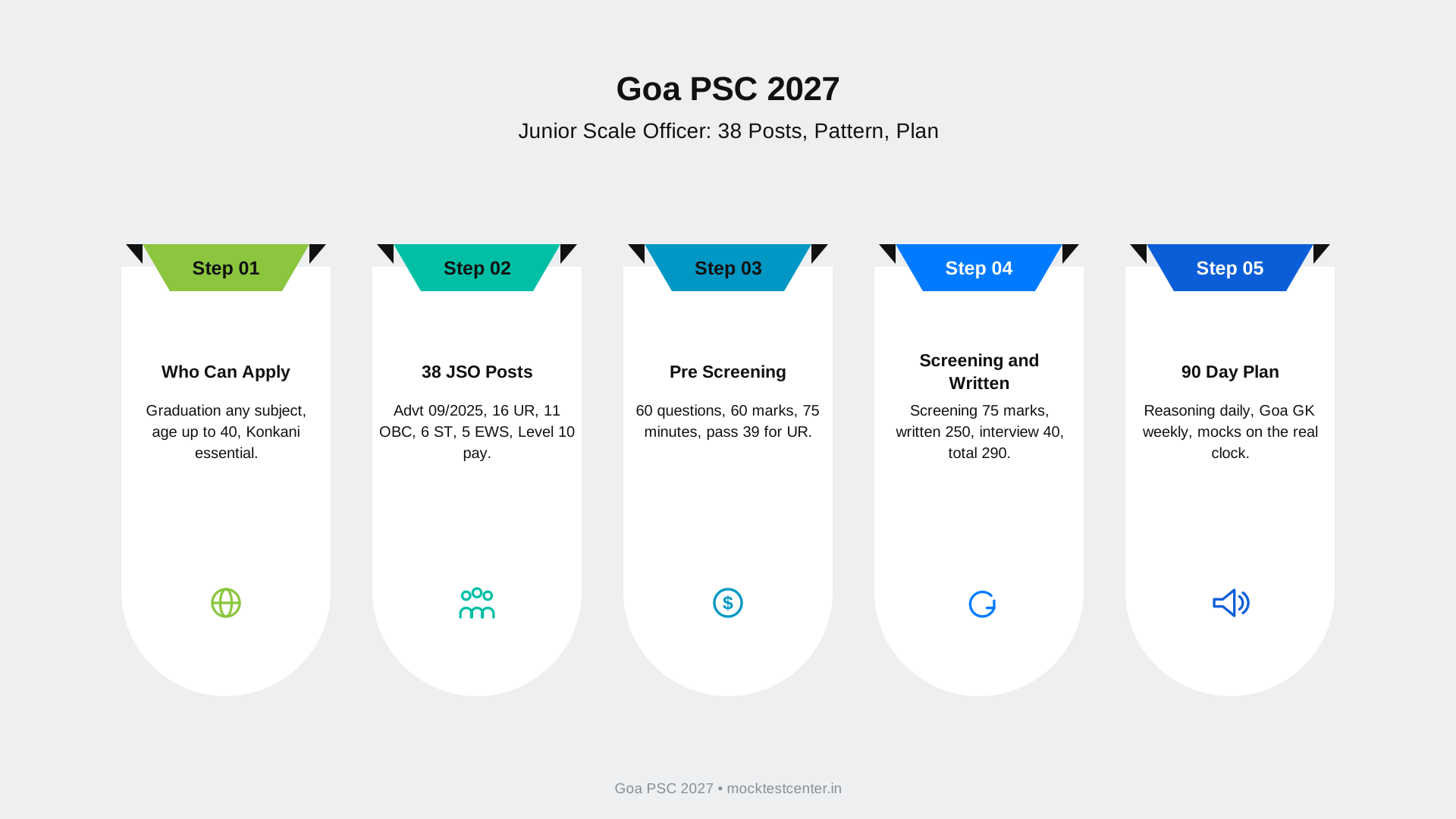
Goa PSC 2027 has one flagship exam for graduates who want a Goa government career. Junior Scale Officer of Goa Civil Service carries 38 posts in Advertisement 09 Year 2025, and it is the post every serious Goa PSC 2027 candidate prepares for first.
The Goa Public Service Commission, known as GPSC, published that advertisement on 5 September 2025. Applications closed on 19 September 2025. The pre screening test took place on 13 and 14 June 2026, and a repeat pre screening test followed on 6 September 2026. Screening and written test dates had not come out by 7 November 2026, so candidates still in the race were waiting for the next notice on gpsc.goa.gov.in.
That waiting period is normal for GPSC. The Commission runs no combined exam each year. Numbered advertisements come out through the year, one post at a time, and each advertisement carries its own dates, its own syllabus and its own selection stages. A candidate who treats Goa PSC 2027 as a single exam with a single date will miss the real structure.
A candidate who reads each advertisement on its own terms will not.
This guide works from the Junior Scale Officer cycle because that cycle has the fullest public record: a named flagship post, a published pattern, cut off marks in print, and a test already held. It also covers the other 2026 advertisements, because most GPSC posts use a shorter route, a Computer Based Recruitment Test plus interview, and a candidate who only knows the Junior Scale Officer route will misunderstand half the Commission's work.
One fact decides more Goa PSC 2027 outcomes than any syllabus topic. Knowledge of Konkani is essential for the Junior Scale Officer post, and GPSC grades it at the interview as Fluent, Working knowledge or No knowledge. Candidates need at least working knowledge. A graduate with strong reasoning scores and no Konkani will not clear the last stage.
Goa PSC 2027 at a glance
| Detail | Junior Scale Officer, the live cycle |
|---|---|
| Conducting body | Goa Public Service Commission, Panaji |
| Flagship post | Junior Scale Officer of Goa Civil Service |
| Advertisement | No. 09 Year 2025, published 5 September 2025 |
| Posts | 38 |
| Application window | 5 September to 19 September 2025 |
| Pre screening test | 13 and 14 June 2026, repeat test 6 September 2026 |
| Screening and written tests | Dates not published by 7 November 2026 |
| Stages | Pre screening, screening, written test, interview |
| Final merit | Written test 250 marks plus interview 40 marks, total 290 |
| Age limit | Not more than 40 years on the last date, relaxations apply |
| Fee | Rs 1000 general, Rs 500 SC, ST, OBC with Goa caste certificate and EWS, Rs 500 ex servicemen, no fee for PwD |
| Pay | Pay Level 10, starting basic pay about Rs 56,100 a month plus allowances |
| Official website | gpsc.goa.gov.in |
There is no single Goa Civil Service exam, and that changes everything
Search results for Goa PSC 2027 often read as if Goa runs a combined competitive examination like other states. It does not. GPSC publishes no recruitment titled Combined Competitive Examination. The Goa Civil Service entry post is Junior Scale Officer, advertised post by post, and the Commission fills other posts through separate advertisements in the same year.
The difference matters for planning. In a combined exam state, one notification covers dozens of services, one prelim filters everyone, and one mains decides ranks. In Goa, the Junior Scale Officer advertisement covers one post and 38 seats. A lecturer advertisement covers lecturer seats.
A Mamlatdar advertisement covers Mamlatdar seats. Each one moves on its own calendar, and a candidate can apply to several in one year if the qualifications fit.
GPSC was formed on 30 May 1988, under the Constitution of India, and it sits at EDC House, Block C, First Floor, Dada Vaidya Road, Panaji, Goa 403001. It recruits for the civil services of Goa, and its advertisements reach from medical college faculty to forest officers to tax officers. The Junior Scale Officer post stands out because it is the generalist administrative entry, the one open to any graduate, and the one with a written test that rewards broad study rather than one professional degree.
Other state commissions publish an annual calendar. GPSC publishes no annual calendar for Junior Scale Officer. It advertises when the Government sends vacancies. The last Junior Scale Officer advertisement before 2025 came in an earlier cycle with 24 posts, advertised in July 2022, and it drew almost 3,000 applications.
Only 141 candidates passed the pre screening test in that cycle, and 55 cleared the screening test. Those numbers show the shape of the competition: a wide entry, a sharp first filter, and a small group left for the written test.
That 2022 cycle also shows why the pre screening test deserves respect. Candidates treat it as a formality because its marks do not count in the final merit. The Commission treats it as a gate. In 2022, about 95 in every 100 applicants fell at that gate.
A candidate who prepares only for the written test and coasts through the pre screening test may never reach the written test at all.
GPSC also changed its scheme of examination with effect from 1 November 2025, through Notice COM/I/54(3)/2025/561 dated 15 July 2025. The new scheme applies to all posts other than Junior Scale Officer and Deputy Superintendent of Police. That detail tells a candidate two things. First, the Junior Scale Officer pattern has its own settled scheme.
Second, other GPSC posts follow a newer common scheme, and the advertisement for each post states which scheme applies.
The 2025 Junior Scale Officer cycle, from advertisement to repeat test
Advertisement 09 Year 2025 came out on 5 September 2025 for 38 posts of Junior Scale Officer of Goa Civil Service. The reservation split was 16 Unreserved, 11 OBC, 6 ST and 5 EWS. Within the 38, 1 post went to Children of Freedom Fighters and 3 posts went to persons with disabilities, with 1 for deaf and hard of hearing and 2 for locomotor disability.
Applications ran online from 5 September to 19 September 2025, a window of 14 days. That short window is typical of GPSC. Candidates who wait for a reminder or an extension lose the cycle. The Commission accepted applications only through its portal and the Government of Goa portal cbes.goa.gov.in, and it required a separate application for each post.
Then came a long gap. The pre screening test took place on 13 and 14 June 2026, about nine months after applications closed, under CBRT 04 of 2026. GPSC held it in batches across two days. A repeat pre screening test followed on 6 September 2026 for borderline candidates, under the September CBRT round.
The screening test and the competitive written test had no published dates by 7 November 2026.
| Event | Date |
|---|---|
| Advertisement 09 Year 2025 published | 5 September 2025 |
| Last date to apply | 19 September 2025 |
| Pre screening test, CBRT 04 of 2026 | 13 and 14 June 2026 |
| Repeat pre screening test | 6 September 2026 |
| Screening test | Not published by 7 November 2026 |
| Competitive written test | Not published by 7 November 2026 |
| Interview | After the written test, date not published |
Two tracker pages print wrong dates for this cycle, and candidates should know which ones to ignore. One page lists the advertisement date as 5 November 2025 and the last date as 19 November 2025. Both dates are two months late. The correct dates are 5 September and 19 September 2025, confirmed by several trackers and by the Commission's own CBRT notices.
Another page lists the written test as 13 and 14 June 2026. Those dates belong to the pre screening test, not the written test. The written test had no date by 7 November 2026.
The long gap between application and test is a planning fact, not a delay to complain about. GPSC cycles run slowly, and a candidate who stops studying after applying will arrive at the test cold. A candidate who treats the gap as preparation time will arrive ready. The Commission publishes hall ticket details by email and on its website, and candidates download hall tickets online.
Who can apply for Junior Scale Officer
Any graduate can apply. The advertisement asks for a degree from a university set up by an Act of Parliament or a State Legislature in India, an institution deemed to be a university under Section 3 of the UGC Act 1956, an approved foreign university, or a qualification recognised by the State or Central Government for admission to the examination. No subject is prescribed. An arts graduate, a science graduate and a commerce graduate sit the same test.
Knowledge of Konkani is essential, and knowledge of Marathi is desirable. GPSC grades Konkani at the interview as Fluent, Working knowledge or No knowledge, and candidates need at least working knowledge. An expert assesses it at the interview. That rule has a sharp edge.
A candidate can clear every written stage and still fail on language at the last step, so Konkani preparation belongs in the weekly plan from the start, not in the last month.
The advertisement states no domicile condition in its text. The Goa specific conditions it does state are the Konkani requirement and the rule that the fee concession for SC, ST and OBC candidates applies only with a caste certificate issued by Goa. Candidates from outside Goa can apply if they hold the degree and the Konkani, but they pay the general fee unless they hold a Goa issued certificate.
Age matters more than most candidates expect. Candidates must not be more than 40 years old on the last date of receipt of applications. The Government can relax the upper limit for notified categories, but the age of a candidate shall not exceed 50 years in any case. For the 2025 cycle, the age cut off fell on 19 September 2025.
| Category | Age relaxation |
|---|---|
| SC and ST | 5 years |
| OBC | 3 years |
| PwD | 10 years |
| PwD plus SC or ST | 15 years |
| PwD plus OBC | 13 years |
| Children of Freedom Fighters | 5 years |
| Government servants and regular employees of aided institutes | 5 years |
| Contractual Government staff | Up to contractual service, maximum 5 years |
| Lecturer basis teachers, teaching posts only | Up to 5 years |
Most GPSC direct recruitment posts carry a higher age limit of 45 years, and the Junior Scale Officer limit of 40 years is the exception. A 42 year old graduate can apply for a GPSC lecturer post and cannot apply for Junior Scale Officer. That distinction catches candidates who read one GPSC advertisement and assume the age rule carries to every post. It does not.
Each advertisement states its own limit.
The fee, and how to apply without losing the form
The fee for Junior Scale Officer is Rs 1000 for general candidates, Rs 500 for SC, ST and OBC candidates holding a caste certificate issued by Goa and for EWS candidates, Rs 500 for ex servicemen, and no fee for PwD candidates. The fee is not refundable. One tracker page prints no fee amounts for this advertisement, and candidates should ignore that gap. The General Instructions updated on 26 May 2026 print the amounts above, and they match the fee for other GPSC posts in the same period.
Payment runs online or offline. Online payment by net banking of other banks or by debit card carries no charge, and the status updates in 24 hours. Credit card payment carries gateway charges, and the status can take up to three days. Offline payment runs by e challan: print it, pay cash at any SBI branch in Goa on a bank working day before the last date, and make sure the stamped e challan reaches the Commission office by the last date.
A payment made after the last date gets rejected and the money does not come back.
The application itself runs in six steps. Register on gpsc.goa.gov.in or cbes.goa.gov.in and note the user ID and password. Fill the form for one post, because applying for several posts needs a separate application for each. Enter marks as a percentage, using GPSC conversion table for CGPA, where 6.25 counts as 55 percent, 7.25 counts as 65 percent and 8.25 counts as 75 percent.
Upload a passport size photograph and signature in the prescribed size. Pay the fee and download the e receipt showing a successful payment, because the form is complete only then and it cannot be edited afterwards. Keep all certificates valid on the date of application, because certificates obtained later do not count. Do not post the printout to GPSC.
Mistakes in the form have one narrow remedy. After the last date, email GPSC within three days and explain the mistake. GPSC then allows one edit within a week of the email deadline. For portal or payment problems, the GPSC helpline is 8530499686, open 9.30 AM to 5.30 PM on working days.
Candidates should save that number before they start the form, not search for it after a payment fails.
Shortlisting for interview follows a ratio of 1 to 5, five candidates per post, when applications far exceed the posts. GPSC shortlists by one or more of a written test or CBRT, marks in the qualifying examination, higher qualifications, preferential experience, or other suitable criteria. Each advertisement also notes that the prescribed qualifications are a minimum, and holding them does not by itself earn an interview call. Shortlisted candidates send self attested copies of educational and experience certificates, proof of birth, caste or medical certificates where they apply, a marriage certificate if the name has changed, and a signed hard copy of the application, by the date GPSC gives them.
Eligibility gets confirmed only after those documents are checked, and passing the CBRT does not by itself guarantee an interview call.
Stage one: the pre screening test, 60 marks in 75 minutes
The pre screening test is one objective paper of 60 marks, answered in 75 minutes, with no negative marking. It has two sections: General Intelligence, Reasoning and Numerical Aptitude for 50 marks, and English Comprehension for 10 marks. Each question carries 1 mark, and a wrong answer scores zero. The marks do not count in the final merit.
The test exists only to cut the field down to a size the Commission can examine in writing.
The cut off is high, and that is the point most candidates miss. Unreserved and EWS candidates need 65 percent, which is 39 out of 60. PwD, Children of Freedom Fighters and OBC candidates need 60 percent, which is 36 out of 60. SC and ST candidates need 55 percent, which is 33 out of 60.
One tracker prints only the first two figures, so candidates in the other categories should use the full set above, which comes from the Commission's General Instructions as reported in the detailed pattern guides.
Speed decides this stage. Sixty questions in 75 minutes leaves 75 seconds per question, and the reasoning section rewards candidates who have practised number series, coding decoding, seating arrangements, blood relations, Venn diagrams, statement and assumption, statement and conclusion, cause and effect, and problems on ages, time and distance. English Comprehension carries only 10 marks, but those 10 marks can decide a borderline result, because the cut off sits at 39 and a candidate at 37 or 38 has no second chance except the repeat test.
The repeat pre screening test is a GPSC feature other commissions do not offer. Candidates who score within three marks below the qualifying mark get a second sitting without a fresh application. In the 2025 cycle, that repeat test took place on 6 September 2026. A candidate at 36 when the cut off is 39 gets another chance.
A candidate at 35 does not. The margin is thin, and it rewards candidates who attempt every question, because there is no negative marking to punish a guess.
Preparation for this stage is simple to state and hard to do. Practise reasoning daily under a timer, keep a notebook of question types that slow you down, and take full 60 question mocks in 75 minutes at least twice a week in the last month. English needs reading comprehension practice, not grammar rules alone, because the section tests comprehension first. Candidates who read one editorial a day in English and answer questions on it will find the 10 marks easier than candidates who memorise rules.
Stage two: the screening test, 75 marks in 90 minutes
Candidates who clear the pre screening test sit the screening test, a Computer Based Recruitment Test of 75 marks in 90 minutes. The Commission's own syllabus for this stage, published for the Junior Scale Officer post, splits the 75 marks across eight subjects. Logical Reasoning and Analytical Ability carries the largest share at 25 marks, a third of the paper. Indian Polity and Governance, Current Affairs and Events of National and International Importance, and General English carry 10 marks each.
History of India and the Indian National Movement, General issues on Environmental Ecology, Biodiversity and Climate Change, Science, Technology and Innovation, and Indian and World Geography carry 5 marks each.
| Subject | Marks |
|---|---|
| Logical Reasoning and Analytical Ability | 25 |
| Indian Polity and Governance, Constitution, Political System, Panchayat Raj, Public Policy, Rights Issues | 10 |
| Current Affairs and Events of National and International Importance | 10 |
| General English, Comprehension including Grammar | 10 |
| History of India and Indian National Movement | 5 |
| Environmental Ecology, Biodiversity and Climate Change, Air and Water Pollution, Forest Conservation | 5 |
| Science, Technology and Innovation, Startups, Seed Funding, Venture Capital, Angel Funding | 5 |
| Indian and World Geography, Physical, Social, Economic | 5 |
| Total | 75 |
The cut off for the screening test is 65 percent for Unreserved and EWS candidates, 60 percent for OBC, PwD and Children of Freedom Fighters, and 55 percent for SC and ST candidates. In marks, that is about 49, 45 and 41 out of 75. The Commission counts the screening test as a qualifying stage in the same way as the pre screening test: it filters, and the written test decides merit with the interview.
Reasoning carries a third of the paper, so it decides the screening test more than any other subject. A candidate who scores 20 out of 25 in reasoning and averages half marks elsewhere will clear the general cut off. A candidate who scores 10 out of 25 in reasoning needs near perfect scores elsewhere, and that rarely happens. Polity and current affairs come next, and both reward steady reading rather than last minute notes.
The 5 mark subjects look small, but five subjects at 5 marks each add up to 25 marks, the same as reasoning. Candidates who skip environment, science and geography give away a third of the paper.
Every CBRT question has a fifth option, none of the above. That option changes guessing strategy. A candidate who can eliminate three options should still answer, because the fifth option exists for questions where none of the four fits. A candidate who guesses blindly on every question will lose marks to the fifth option trap, because the Commission uses it to catch random marking.
After the CBRT, GPSC uploads the question paper on its website on the next working day. Each candidate's response sheet appears on cbes.goa.gov.in from the next day, for two working days. To object to a question, quote its number from the uploaded question paper, not from the response sheet, and pay Rs 100 per question, submitting a hard copy in the Commission's grievance format. The result shown the day after the CBRT is provisional, and the final result comes after the grievance process.
Candidates who raised a grievance earlier can ask for it to be re evaluated after the final result. A notice dated 11 November 2026 shows this in practice: experts re checked five questions from the September CBRT, for Assistant Conservator of Forest and State Tax Officer, and kept the answer keys and results unchanged.
Stage three: the written test, 250 marks across four parts
The competitive written test carries 250 marks, and it is the stage that decides merit with the interview. It has four parts. Part A covers General Intelligence, Reasoning and Numerical Aptitude for 50 marks. Part B covers Basics of Indian Constitution, Governance and Administration for 75 marks.
Part C covers General Knowledge and Current Affairs for 75 marks. Part D covers English Comprehension for 50 marks. The total is 250, and the test runs across two days in the earlier cycles.
One tracker reports the written test duration as 390 minutes in total, with Part A in 60 minutes, Part B in 120 minutes, Part C in 120 minutes and Part D in 90 minutes. That duration comes from a single tracker page, and the Commission's published pattern does not confirm it in the sources this guide could read. Candidates should treat 390 minutes as reported, not confirmed, and check the hall ticket for the real timings when it comes out.
Part B is the Goa paper in disguise. It covers the Constitution, governance and administration with reference to Goa, and it includes good governance, efficiency, transparency, accountability, the Right to Information Act 2005, and the role of Lokayukta and Lokpal. A candidate who knows the Constitution in general but knows nothing about Goa's administration will lose marks here. Part C is the other Goa paper.
It covers general knowledge and current affairs with Goa content: religion, customs and festivals of India and Goa, information and communication technology, biodiversity, environment and climate change, social movements, corruption, environment and women's issues. Goa history, Goa geography, Goa economy and Goa current affairs sit inside both parts, and they reward candidates who read Goa news through the year.
The written test has a minimum qualifying mark as well: 65 percent for Unreserved and EWS, 60 percent for OBC, PwD and Children of Freedom Fighters, and 55 percent for SC and ST, as reported in the detailed pattern guides. A candidate who scores below that mark does not reach the interview, even if the overall competition is weak. The written test is descriptive in the earlier cycles, with objective elements in the reasoning and English parts, so answer writing practice matters. Candidates who only take objective mocks will find the written test harder than they expect, because it asks for connected answers in their own words.
Stage four: the interview, 40 marks that can move ranks
The interview, called the oral interview or personality test, carries 40 marks. Candidates need at least 50 percent in the interview, which is 20 marks, to stay in the race. The final merit comes from the written test plus the interview, a total of 290 marks, and candidates need a combined minimum of 65 percent for Unreserved and EWS, 60 percent for OBC, PwD and Children of Freedom Fighters, and 55 percent for SC and ST, as reported in the pattern guides.
Forty marks can move a candidate many ranks, because the written test scores of the shortlisted group sit close together. A candidate at 170 in the written test and 32 in the interview finishes at 202. A candidate at 180 in the written test and 20 in the interview finishes at 200. The interview decides between them.
GPSC assesses personality, communication, problem solving and general awareness at this stage, and it assesses Konkani through an expert. Candidates should prepare to speak about Goa, about their district, about their degree subject, and about why they want the Goa Civil Service, in clear and simple language.
Konkani deserves a separate note here, because it is the only stage where language gets graded. The General Instructions grade Konkani as Fluent, Working knowledge or No knowledge, and they require at least working knowledge. A candidate who speaks Konkani at home will pass this without effort. A candidate who grew up outside Goa and learned Konkani from books should practise speaking it daily, with a speaker who can correct pronunciation and usage.
Reading Konkani will not help at the interview if speaking it feels stiff.
Other GPSC posts in 2026: the Commission never stops at one exam
Junior Scale Officer is the flagship, but GPSC published eleven advertisements in 2026, and a candidate who watches only one post will miss most of the Commission's work. The latest, Advertisement 11 Year 2026, came out on 13 November 2026 for 48 posts across 18 posts. The largest group is 20 Assistant Public Prosecutors in the Home Department, with 11 Unreserved, 2 ST, 6 OBC and 1 EWS, and 1 post for PwD with blindness and low vision, at Pay Level 10. The rest are medical teaching posts at Goa Medical College, engineering faculty at Goa College of Engineering, and disability welfare posts.
One post, Professor in Surgical Gastroenterology, is by transfer on deputation, and the other 47 are direct recruitment.
The last date for Advertisement 11 Year 2026 was 27 November 2026 for direct recruitment posts and 27 December 2026 for the deputation post. One tracker reports that the advertisement went on hold after publication because of payment gateway issues, with new dates to come through a notice in local newspapers. The tracker page this guide read on 21 November 2026 still listed the advertisement as open with the 27 November date. Candidates should treat the hold report as unverified at that date and check the Commission website before acting on either version.
Advertisement 02 Year 2026, published on 13 February 2026, covered 47 posts and closed on 27 February 2026. It included lecturers in medical and engineering subjects, a Medico Legal Officer, a Dean at Goa College of Veterinary and Animal Sciences, and 6 Mamlatdars and Joint Mamlatdars and Vigilance Officers at Pay Level 7. Mamlatdar needs a degree in Law, knowledge of local revenue laws, law and order and development works, and knowledge of Konkani. The age limit was 45 years.
Mamlatdar is the post candidates ask about most after Junior Scale Officer, because it is the field administration post at the taluka level, and it appears in GPSC advertisements every year or two.
Other 2026 advertisements show the range. Advertisement 10 Year 2026, dated 9 October 2026, covered 25 Tutors at Goa Medical College and nursing faculty, with deputation posts open till 23 November 2026. Advertisement 09 Year 2026, dated 11 September 2026, covered medical officers, assistant engineers and scientific assistants. Advertisement 08 Year 2026, dated 14 August 2026, covered 19 Veterinary Officers.
A separate 2026 notification covered 84 Tutor and Demonstrator posts in medical disciplines, with applications from 20 March to 3 April 2026. A Block Development Officer advertisement, No. 05 Year 2026, drew so many applications that GPSC ordered a pre screening test before the main CBRT, with a 60 question paper in 75 minutes and a pass mark of 50 percent for Unreserved and 45 percent for OBC.
Most of these posts follow the shorter GPSC route. The CBRT is 60 questions for 60 marks in 75 minutes, with a pass mark of 50 percent for General, EWS and ex servicemen, 45 percent for OBC, PwD and Children of Freedom Fighters, and 40 percent for SC and ST, and the interview needs the same minimum. The Commission shortlists at 1 to 5 for interview. That route is simpler than the Junior Scale Officer route, and it suits specialists: doctors, engineers, lecturers and law graduates.
The Junior Scale Officer route is longer because the post is generalist and the competition is wider.
The lesson for a Goa PSC 2027 candidate is to watch the advertisement page every week, not once a year. GPSC publishes through the year, and the post that fits a candidate may appear in February, August or November. A graduate with a law degree should watch for Mamlatdar and Assistant Public Prosecutor. A medical graduate should watch for Tutor and Lecturer.
A general graduate should watch for Junior Scale Officer and Block Development Officer. Each advertisement is a separate chance, and each one needs its own application and its own fee.
A 90 day plan for the Junior Scale Officer test
Ninety days is enough to prepare for the pre screening and screening tests if the days have a fixed shape. The plan below assumes a candidate who works or studies full time and can give three hours a day. Candidates with more time should add a second reasoning session, not more subjects.
Days 1 to 30 build the base. Reasoning gets one hour a day, with number series, coding decoding, seating arrangements, blood relations, Venn diagrams and statement based questions in rotation. English gets 30 minutes, with one comprehension passage and its questions each day. Goa general knowledge gets 30 minutes, with Goa history, geography, rivers, forests, economy, budget and schemes, and one page of notes a day.
Current affairs gets 30 minutes, with one national newspaper and one Goa news source, and five lines of notes a day. Polity gets 30 minutes on alternate days, with the Constitution, Panchayat Raj and public policy in rotation.
Days 31 to 60 add mocks and cut weak topics. Take one full pre screening mock of 60 questions in 75 minutes every Saturday, and one screening mock of 75 marks in 90 minutes every Sunday. Review every wrong answer on the same day, and write the reason for the mistake in one line. Reasoning practice shifts to timed sets of 20 questions in 20 minutes.
Polity and current affairs move to revision of notes, not fresh reading. Konkani speaking practice starts here if it has not started already, 15 minutes a day with a speaker or a recording, because the interview grades speaking and not reading.
Days 61 to 90 are revision and exam simulation. Stop fresh reading. Rework the mock questions that went wrong. Take two full mocks a week on the real clock, with no phone and no breaks.
Practise the fifth option trap in CBRT mocks, and mark questions where none of the above is the right answer. Read the Commission's grievance and answer key process once, so the days after the test hold no surprise. In the last week, revise Goa facts, polity articles and current affairs of the last six months, and sleep on a fixed schedule. A tired candidate loses more marks in 75 minutes than a candidate who missed one topic.
Written test preparation runs in parallel for candidates who clear the screening test, and it needs a different habit. Write one answer a day in Part B or Part C style, in 250 words, on a Constitution or Goa topic, and check it against the syllabus the next day. Answer writing is a muscle, and it grows only by writing. Candidates who read notes for three months and write their first answer in the exam hall will find their hand slow and their structure loose.
Mistakes that cost candidates a year
The first mistake is treating the pre screening test as easy. Its marks stay out of the final merit, but its cut off is 65 percent for general candidates, and in 2022 only 141 of almost 3,000 applicants passed it. Candidates who skip reasoning practice for this stage fail before the real exam starts.
The second mistake is ignoring Konkani until the interview call. Konkani is essential, it gets graded by an expert, and working knowledge is the minimum. A candidate who cannot speak Konkani fluently enough will lose the post at the last step, after clearing every test. Start speaking practice in the first month.
The third mistake is paying by e challan late. The challan must be paid at an SBI branch in Goa and the stamped challan must reach the Commission office by the last date. A candidate who pays on the last date at a branch outside Goa, or who posts the challan after the date, loses the application and the fee.
The fourth mistake is applying for one post and assuming the application covers others. GPSC needs a separate application and a separate fee for each post. A candidate who wants Junior Scale Officer and Block Development Officer must file two forms and pay twice.
The fifth mistake is using the wrong age limit. Junior Scale Officer caps age at 40 years, while most GPSC posts cap it at 45 years. A 42 year old who reads the lecturer advertisement and assumes the same limit applies to Junior Scale Officer will file a form that fails at document check.
The sixth mistake is trusting tracker dates without checking the Commission site. This guide found a tracker that moved the 2025 advertisement by two months and another that called the pre screening dates the written test dates. The Commission website is the only date that counts, and candidates should check it in the week before every stage.
What to check before the next notification
Check the advertisement page on gpsc.goa.gov.in every week, and read each new advertisement in full before deciding to apply. Note the post, the posts count, the age limit, the fee, the last date and the scheme of examination, because each advertisement states its own. Download the General Instructions and the syllabus for the post, and keep them with the application number. Practise reasoning and English under a timer from the first week, and speak Konkani every day.
When the screening and written test dates for the 2025 cycle come out, the candidates who kept studying through the gap will be ready, and the candidates who waited for a date will start late.
Sources
Goa Public Service Commission, gpsc.goa.gov.in, advertisements and CBRT notices, including Advertisement 09 Year 2025 and Advertisement 11 Year 2026, and the scheme of examination notice effective 1 November 2025. Goa Public Service Commission, Syllabus for Screening Test (CBRT) for Junior Scale Officer of Goa Civil Service, Advertisement 8 Year 2021, on gpsc.goa.gov.in. ExamDetail, GPSC Goa Recruitment 2026, tracking advertisements, CBRT dates, fee, age relaxation and application steps, read 21 November 2026. NitiExam, Goa PSC Junior Scale Officer Recruitment, syllabus and pattern, key dates, fee and cut off marks, read 21 November 2026.
Chahal Academy, Goa PSC Exam Pattern and Syllabus, pre screening, screening, written test and interview stages, read 21 November 2026. A2Z Exam Detail, Junior Scale Officer of Goa Civil Service, pattern and vacancy split, read 21 November 2026. FreeJobAlert, GPSC Recruitment 2026, Advertisement 11 Year 2026, 48 posts, read 21 November 2026. Times of India, Goa, 55 of 141 candidates clear second round of JSO exam, 2022 cycle figures, read 21 November 2026.
Government of Goa, Department of Information and Publicity, State Emblem of Goa, design of the Vriksha Deep emblem, on dip.goa.gov.in.