
About Rajasthan Police Sub Inspector 2027 Exam Series
📖 Table of Contents
- Rajasthan Police Sub Inspector 2027 at a glance
- Two recruitments, one name, and why they must stay apart
- 1,015 posts that became 1,076
- Who could apply in the last cycle
- The Rajasthan Police SI exam pattern, two papers and 400 marks
- The physical test that carries 100 marks
- Height, chest and weight
- The 50 mark interview and how the final list forms
- Fee and pay for the Rajasthan Police SI exam pattern
- How the 2025-26 cycle ran, date by date
- The 2021 cycle in full, and what the leak changed
- How to prepare for the Rajasthan Police Sub Inspector 2027 paper
- Traps that end a Rajasthan Police Sub Inspector 2027 run early
- What to watch before the Rajasthan Police Sub Inspector 2027 notice
- Sources
Rajasthan Police Sub Inspector 2027: Complete Exam Guide
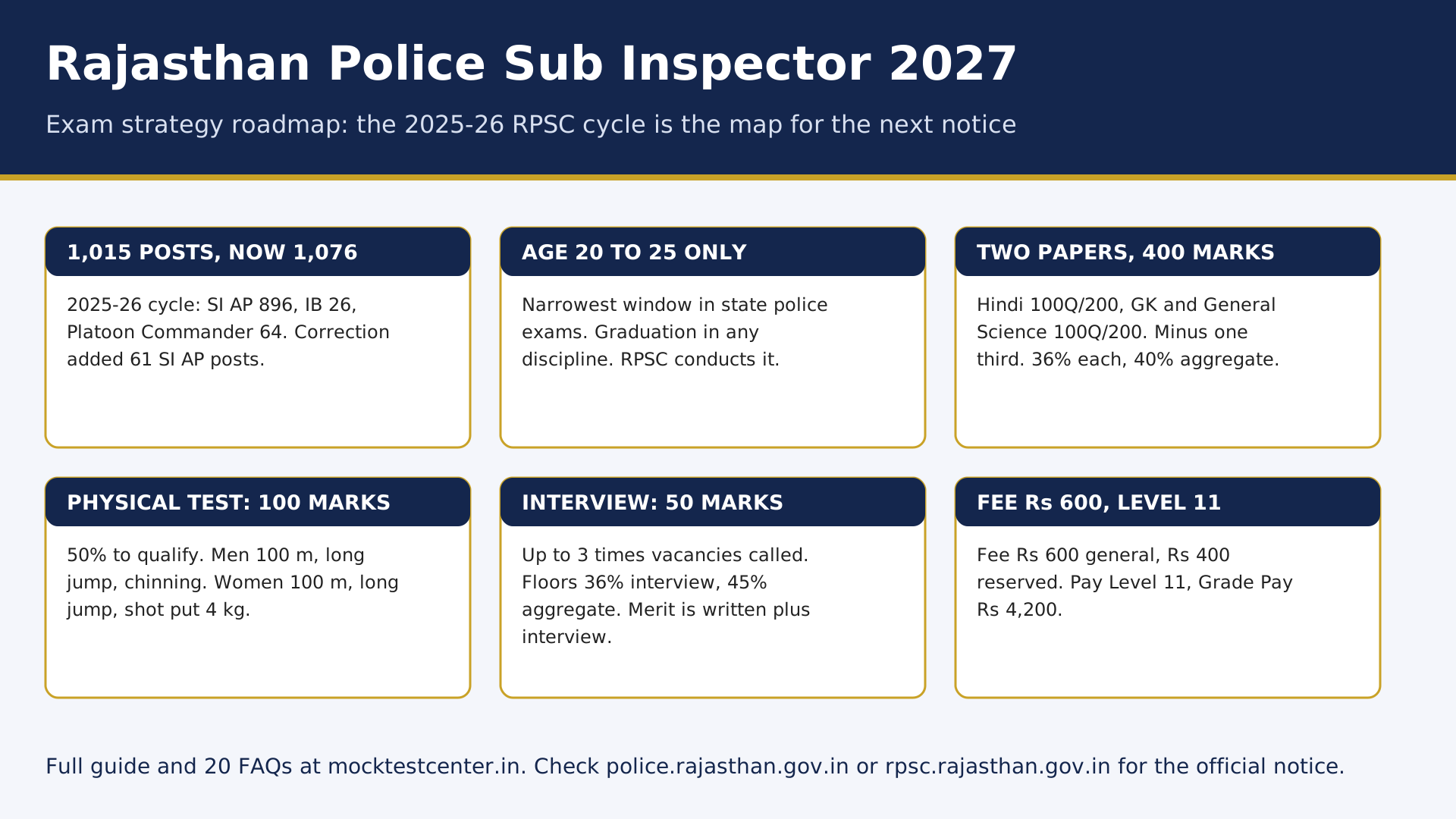
The Rajasthan Police Sub Inspector 2027 notification has not come out yet as of 21 November 2026, so this guide anchors on the last full cycle, the 2025-26 recruitment run by the Rajasthan Public Service Commission, known as RPSC, and marks every 2027 figure as not yet announced. The 2025-26 cycle carried 1,015 posts at notification, raised to 1,076 by a correction in June 2026, and its written exam ran on 5 and 6 April 2026. One fact from that cycle shapes everything else in this guide. The age window ran from 20 to 25 years only, far narrower than most state police exams, and it removed more candidates than any paper could.
Two different SI stories share the same name in Rajasthan right now, and mixing them up is the most common error on tracker sites. The first story is the fresh 2025-26 recruitment, with new applications in August and September 2025, a written exam in April 2026 and interviews in October 2026. The second story is the re-exam of the 2021 recruitment, held on 20 September 2026 for the old candidates only, after the courts cancelled the 2021 process over a paper leak. This guide keeps the two stories apart, covers the 2025-26 cycle in full, the posts and what each service does, the age and education rules, the two 200 mark papers, the 100 mark physical test, the 50 mark interview, the fee and the pay, and a preparation plan built around the real weight of each stage. Where tracker sites disagree with each other, this guide says so.
Rajasthan Police Sub Inspector 2027 at a glance
| Detail | Rajasthan Police Sub Inspector 2027, as last run in the 2025-26 cycle |
|---|---|
| Conducting body | Rajasthan Public Service Commission, RPSC, Ajmer |
| Exam | Sub Inspector and Platoon Commander Competitive Examination |
| Last cycle | 2025-26, Advertisement Number 05/Exam/SI-PC/RPSC/EP-1/2025-26 dated 17 July 2025 |
| Posts in last cycle | 1,015 posts at notification, raised to 1,076 by a correction dated 2 June 2026 |
| 2027 notification | Not published as of 21 November 2026 |
| Age limit | 20 to 25 years as on 1 January 2026, graduation in any discipline |
| Fee in last cycle | Rs 600 for general, EWS and OBC, Rs 400 for SC, ST, OBC non creamy layer and MBC non creamy layer |
| Written exam | Two papers, General Hindi 200 marks and General Knowledge with General Science 200 marks, minus one third per wrong answer |
| Physical test | 100 marks, 50 percent to qualify, plus height, chest and weight checks |
| Interview | Aptitude test and interview, 50 marks, up to 3 times the vacancies called |
| Pay in last cycle | Pay Level 11, Grade Pay Rs 4,200 |
| Official website | rpsc.rajasthan.gov.in |
Two recruitments, one name, and why they must stay apart
Search for Rajasthan Police SI 2026 and the results page mixes two different exams into one story, so the first job of this guide is to pull them apart. The fresh recruitment carries Advertisement Number 05/Exam/SI-PC/RPSC/EP-1/2025-26, dated 17 July 2025. Applications ran from 10 August to 8 September 2025 through the Rajasthan SSO portal, the written exam ran on 5 and 6 April 2026, the result came on 19 June 2026 according to tracker reports, and interviews ran from 21 to 30 October 2026. Any candidate could apply if the age and education rules fit. This is the cycle this guide uses as its anchor.
The re-exam belongs to the 2021 recruitment, and it works under different rules. RPSC notified the 2021 cycle on 3 February 2021 for 859 posts, and the written exam ran on 13, 14 and 15 September 2021. A paper leak then surfaced, the Special Operations Group of Rajasthan Police took over the investigation, and about 149 people faced arrest over the case. A single bench of the Rajasthan High Court ordered the whole recruitment cancelled in August 2025. A division bench upheld that order on 4 April 2026. The Supreme Court then dismissed the special leave petitions against the cancellation, clearing the way for a fresh exam. RPSC held the re-exam on 20 September 2026 in two shifts, General Hindi from 10 in the morning to noon and General Knowledge with General Science from 3 to 5 in the afternoon, across 11 districts.
Only candidates who had appeared in the original 2021 exam could sit the re-exam. No new candidate could apply, and no new form opened. The admit card came out on 17 September 2026, the exam city slip on 13 September 2026, and RPSC published provisional answer keys for both papers after the exam, with objections open till 23 September 2026. The petitioners before the Supreme Court had argued that only about 6.3 percent of candidates stood under suspicion and that more than 838 selected candidates had already served for nearly two years. The court did not accept that argument, and it observed that segregation of tainted and untainted candidates was not possible in this case. The 2021 story ends, for now, with the re-exam result awaited.
The confusion between the two stories causes real harm. A candidate who reads a re-exam date and thinks a fresh SI form has opened will wait for a link that never comes. A candidate who reads the fresh 2025-26 result date and thinks the 2021 re-exam has finished will miss the re-exam result. Tracker pages make the confusion worse by putting both dates in one table under one heading. Keep the advertisement numbers in mind. The 2021 cycle is the leak and re-exam story. The 2025-26 cycle is the fresh recruitment story. The Rajasthan Police Sub Inspector 2027 cycle will be a third story, and it has no advertisement number yet.
1,015 posts that became 1,076
The 2025-26 advertisement opened with 1,015 posts, and a correction notice dated 2 June 2026 raised the count to 1,076. The rise came from a single change. Sub Inspector Armed Police in the non scheduled area went from 896 posts to 957, an addition of 61 posts. Every other post stayed where it was. The post wise table at notification read as follows. Sub Inspector Armed Police, 896 posts. Sub Inspector Armed Police in the scheduled area, 25 posts. Sub Inspector Armed Police in the Sahariya area, 4 posts. Sub Inspector Intelligence Bureau, 26 posts. Platoon Commander in the Rajasthan Armed Constabulary, 64 posts. Add those and you reach 1,015. After the correction, the total stands at 1,076.
One conflict sits inside that table, and it is worth flagging rather than hiding. A widely read tracker page splits the Intelligence Bureau posts into 25 non TSP and 26 TSP posts, which would put the IB total at 51 and push the headline total past 1,015 unless another post loses 25. The post wise table that adds cleanly to 1,015 counts the IB as 26 posts in total, with the 25 belonging to the Armed Police scheduled area. This guide uses the table that adds to 1,015, and it flags the other split as an error that travelled from one tracker page to the next. Candidates should check the advertisement PDF on rpsc.rajasthan.gov.in for the post wise table before they trust any site summary.
The two services in the advertisement do different work, though the pay, the eligibility and the written exam match. Sub Inspector Police is the regular district and city policing cadre, the officer who runs a police station, investigates cases and leads a team of constables. Platoon Commander belongs to the Rajasthan Armed Constabulary, the state reserve force, with a different posting profile and a barracks based life. A candidate applies to both through one form and one exam, and the service allotment follows the merit list and the preference given in the form. The Platoon Commander carries 64 posts, a small share of the total, and it draws candidates who want the armed force rather than the thana.
The 2021 cycle gives a useful comparison for scale. It carried 859 posts, split as Sub Inspector Armed Police 746, Sub Inspector Intelligence Bureau 64, Platoon Commander 38 and Sub Inspector MBC 11. The 2025-26 cycle, at 1,076 posts after correction, is the largest SI intake RPSC has advertised in a single cycle in recent years. The growth from 859 to 1,076 shows that SI hiring in Rajasthan has picked up after the long gap between the two cycles. Even so, no rule fixes the next count, and any site that quotes a 2027 vacancy figure today is guessing. This guide quotes no 2027 figure at all.
Who could apply in the last cycle
The 2025-26 cycle set the age window at 20 to 25 years as on 1 January 2026, and that narrow window is the single most important eligibility fact in this guide. Most state police exams open at 18 and close at 28 or 30. This one opened at 20 and closed at 25. A candidate who finished graduation at 22 had three years to clear the exam. A candidate who finished at 24 had one. A candidate who turned 26 in December 2025 could not apply at all, even with a degree and a strong preparation. Age relaxation applied for SC, ST and OBC candidates under government rules, but the exact relaxation years do not appear in a verified form in the tracker summaries we checked, so this guide does not print a relaxation table. Candidates in a reserved category should read the relaxation clause in the advertisement PDF itself.
Education stayed simple. A bachelor degree in any discipline from a recognised university opened the form. No specific subject was required, and no minimum percentage was fixed in the summaries we checked. Final year students could apply in the 2021 cycle if they could produce proof of passing before the later stages, and the 2025-26 advertisement carried its own rule on that point, which candidates should read in the PDF. Alongside the degree, the advertisement asked for knowledge of Hindi written in Devanagari and knowledge of Rajasthani culture. That condition is not a formality. The written exam tests Hindi as a full paper, and the interview board weighs knowledge of Rajasthan culture when it awards marks.
The 2021 cycle had set the age differently, and the change matters for candidates who prepared under the old rules. The 2021 notification also used a 20 to 25 window, according to the tracker summaries, so the narrow window is not new. What changed between the cycles is the count date and the context, not the window itself. A candidate who missed the 2021 age window by a year could not return for the 2025-26 cycle either, because five years had passed. That is the hard arithmetic of a narrow age window with a five year gap between cycles. Candidates who sit inside the window now should treat the next cycle as their best chance, because the window may close before the cycle after that.
One more eligibility point deserves a plain statement. The SI exam is conducted by RPSC, not by the Rajasthan Staff Selection Board and not by the Rajasthan Police directly. The application ran through the SSO recruitment portal, the paper setting sat with the Commission, and the interview board came from the Commission as well. A tracker page that describes the constable process as the SI process, or that names the wrong body, is a page to distrust. The official site for everything in this cycle is rpsc.rajasthan.gov.in, and the advertisement number is the fastest way to check whether a page is talking about the right exam.
The Rajasthan Police SI exam pattern, two papers and 400 marks
The Rajasthan Police SI exam pattern carries 400 marks across two papers, and both papers matter equally, which is rare in police exams. Paper 1 is General Hindi, 100 objective questions for 200 marks in 2 hours. Paper 2 is General Knowledge and General Science, 100 objective questions for 200 marks in 2 hours. Each question carries 2 marks, and each wrong answer costs one third of a mark. The paper is bilingual in the sense that candidates can answer in English or Hindi, though Paper 1 tests Hindi itself. The qualifying line sits at 36 percent in each paper and 40 percent in the aggregate. SC and ST candidates get a relaxation of up to 5 marks in each paper and in the aggregate.
| Paper | Subject | Questions | Marks | Time |
|---|---|---|---|---|
| Paper 1 | General Hindi | 100 | 200 | 2 hours |
| Paper 2 | General Knowledge and General Science | 100 | 200 | 2 hours |
| Total | Two papers | 200 | 400 | 4 hours |
Paper 1, General Hindi, decides more selections than candidates expect. The Hindi paper is a full merit paper. It carries the same 200 marks as Paper 2, and its marks count in the merit list. The syllabus covers Hindi grammar, vocabulary, comprehension, and the standard topics of a graduate level Hindi paper. A candidate who treats Hindi as a formality and pours all effort into general knowledge gives away 200 marks before the exam starts. The Hindi paper also rewards steady reading. A candidate who reads Hindi newspapers and Hindi literature through the year will find the comprehension and vocabulary questions far easier than a candidate who opens a Hindi grammar book a month before the exam.
Paper 2, General Knowledge and General Science, splits across history, art, culture, literature, tradition and heritage of Rajasthan, Indian history and culture, geography, the Indian Constitution and polity, the economy, science and technology, and current affairs. Rajasthan occupies a large share of this paper, and the syllabus names the history, art, culture, literature, tradition and heritage of Rajasthan as its first block. A candidate who studies national GK and skips Rajasthan will lose the largest block in the paper. The science half covers general science at graduate level, and the current affairs half rewards a daily newspaper habit through the year before the exam.
The negative marking rule needs a clear reading. Each wrong answer costs one third of a mark, which means three wrong answers wipe out one right answer of 2 marks. The cost is lower than in many exams, but it still punishes blind guessing across 200 questions. A candidate who attempts all 200 questions without knowledge will lose marks steadily. The smart rule matches the constable exam. Attempt what you know, attempt what you can narrow down, and leave the questions where all four options look strange. The qualifying line of 36 percent in each paper also changes the strategy. A candidate cannot abandon one paper to save the other. Both papers need 72 marks out of 200, and the aggregate needs 160 out of 400.
The written exam also decides who reaches the physical test. RPSC calls candidates up to 20 times the number of vacancies for the physical efficiency test, on the basis of merit in the written exam. With 1,015 posts, that call could reach about 20,300 candidates. That sounds generous until you count the applicants. SI cycles in Rajasthan draw several lakh applications, so a 20 times call still cuts most of the field. The written exam is the real filter. The physical test and the interview then sort the survivors.
The physical test that carries 100 marks
The physical efficiency test carries 100 marks, and it is the one stage where a strong student can lose to a fit rival. Candidates who clear the written exam appear before a physical efficiency board, and the board scores three events for men and three for women. Men run 100 metres, jump long, and do chinning up on a beam. Women run 100 metres, jump long, and put the shot of 4 kilos. Each event carries marks on a sliding scale, and the total runs to 100. A candidate needs 50 percent in the physical test to qualify for the interview stage.
| Men, event | Best score | Next score | Third score |
|---|---|---|---|
| 100 metre race | 14 seconds, 40 marks | 15 seconds, 25 marks | 16 seconds, 15 marks |
| Long jump | 15 feet and above, 30 marks | 14 feet, 20 marks | 13 feet, 10 marks |
| Chinning up | 7 heaves, 30 marks | 6 heaves, 20 marks | 5 heaves, 10 marks |
| Women, event | Best score | Next score | Third score |
|---|---|---|---|
| 100 metre race | 17 seconds, 40 marks | 18 seconds, 25 marks | 19 seconds, 15 marks |
| Long jump | 10 feet and above, 30 marks | 9 feet, 20 marks | 8 feet, 10 marks |
| Putting the shot, 4 kilos | 16 feet, 30 marks | 15 feet, 20 marks | 14 feet, 10 marks |
The scoring tables come from tracker summaries of the 2025-26 advertisement, and one detail in them needs a flag. The women shot put row in one tracker page prints "16 heaves" where the other rows print feet, which is plainly a copy error, since a shot put is measured in distance, not in heaves. This guide uses feet for the shot put distances, matching the long jump rows and the men events, and flags the tracker error. Candidates should confirm the exact scoring table from the advertisement PDF before they train to a specific number. The structure is solid. The units in one row are not.
The 50 percent qualifying line in the physical test means a candidate needs 50 of the 100 marks to move on. A candidate who scores full marks in the 100 metre race and nothing in the other two events still fails. The test rewards all round fitness, not one strong event. Training should cover all three events from the start. Sprint practice for the 100 metres, jump practice for the long jump, and bar work for chinning up or shot practice for women. A candidate who starts physical training only after the written result has about two months to build sprint speed and upper body strength, which is not enough. The candidates who clear the physical test are usually the ones who trained through the written preparation.
Ex-servicemen face modified events and standards, according to the advertisement summaries, though the exact modified scheme does not appear in the tracker pages we checked. Ex-servicemen candidates should read the advertisement PDF for their own scheme rather than training to the general table. The physical test runs under a board of senior police officers, set up as laid down by the Director General of Police, and its scoring is final for the stage.
Height, chest and weight
The physical standard test measures the body against fixed numbers, and it runs alongside the physical efficiency test. Men need a height of at least 168 cm and a chest of at least 81 cm deflated and 86 cm inflated, which means a minimum expansion of 5 cm. Garhwali and Gurkha candidates face a lower bar, 160 cm in height and a chest of 79 cm deflated and 84 cm inflated. Women need a height of at least 152 cm and a weight of at least 47.5 kg, except Sahariya candidates, for whom the height and weight standard does not apply in the same way. SC and ST candidates who fall up to 5 cm short in height and chest may still pass if not enough candidates meeting the full standard are available.
These numbers match the constable standards for men, and that is no accident. Rajasthan applies the same physical standards across its police recruitments, with small changes for each post. A candidate who clears the constable height and chest will clear the SI height and chest too, and a candidate who fails one will fail the other. The chest expansion test deserves a note. The board measures the chest deflated, then inflated, and the gap must reach 5 cm. A candidate with a large chest and no expansion can fail where a candidate with a smaller chest and a strong expansion passes. Breathing exercises and chest expansion work belong in the training plan, not just running and jumping.
Weight matters only for women in this test, and the 47.5 kg floor surprises candidates who have trained hard and lost weight. A woman candidate who drops below 47.5 kg through intense running can fail the standard test even while passing every event in the efficiency test. Keep an eye on weight through the training months, and eat enough to hold the floor. The Sahariya exception also deserves a mention. Sahariya candidates, a particularly vulnerable tribal group in Baran district, face relaxed standards, and the advertisement sets out their exact figures. Candidates from that community should read the advertisement for their own numbers rather than training to the general table.
The 50 mark interview and how the final list forms
The aptitude test and interview carry 50 marks, and RPSC calls candidates up to 3 times the number of vacancies for this stage of the Rajasthan Police Sub Inspector 2027 selection, from those who cleared both the written exam and the physical test. SC and ST candidates who qualified in both stages may be called beyond that limit. The board weighs personality, address, tact, behaviour, specialised training, aptitude for the post, judgment, leadership qualities and knowledge of Rajasthan culture. A degree or diploma in criminology, an NCC C certificate, or police administration as a degree paper may get weight in the interview. The interview works as a scored assessment of whether the candidate can lead a police station.
Two floors guard the final list. The Commission generally does not recommend a candidate who scores less than 36 percent in the interview and 45 percent in the aggregate. For women candidates and candidates from BC, MBC, SC, ST and EWS categories, the floor can drop to 30 percent in the interview and 40 percent in the aggregate, if the board finds them suitable for appointment. Those floors matter because the interview carries only 50 marks, so 36 percent means 18 marks and 30 percent means 15 marks. A candidate who scores well in the written exam and then scores 12 in the interview can still miss the final list.
The final merit rests on the written exam marks plus the interview marks, according to the advertisement summaries. The physical test marks do not clearly add to that total. The summaries describe the physical test as a qualifying stage with a 50 percent floor, and they describe the recommendation as resting on the combined written and interview marks. This guide states the merit as written plus interview, with the physical test as a qualifying stage, and flags the point as one to confirm from the advertisement, because some tracker pages describe the selection as a simple total of all three stages. The distinction matters. If the physical marks counted in the merit, a fast runner could overtake a strong writer. If they do not, the written exam and the interview decide everything, and the physical test only removes the unfit.
The interview dates for the 2025-26 cycle ran from 21 to 30 October 2026, according to tracker reports, and the reports describe those dates as the second round of interviews. The final result after the interviews had not appeared in the sources we checked as of 21 November 2026. Candidates waiting for the final result should watch rpsc.rajasthan.gov.in, where the Commission publishes the result first. The document verification stage follows the interview, and the medical examination and character verification close the process before appointment.
Fee and pay for the Rajasthan Police SI exam pattern
The 2025-26 application fee ran at Rs 600 for general, EWS and OBC candidates, and Rs 400 for SC, ST, OBC non creamy layer and MBC non creamy layer candidates. The fee was paid online through the SSO portal at the time of application, and an incomplete application without the fee stood rejected. The fee for PwBD candidates appears in one tracker table as a blank line, with no amount printed, so this guide does not state a PwBD fee. Candidates in that category should check the advertisement PDF, where the fee table gives the full break up. The fee is modest beside the pay, and it is non refundable once paid.
The pay sits at Pay Level 11 with a Grade Pay of Rs 4,200, and tracker pages quote a monthly salary range of Rs 67,700 to Rs 2,08,700 for the post. That range reads as the pay scale span rather than a starting salary, and this guide presents it as a tracker reported figure, not as a verified pay slip. What the advertisement fixes is the level and the grade pay, and the allowances follow government rules, with dearness allowance, house rent allowance, travel allowance and other benefits on top of the basic pay. A sub inspector in Rajasthan earns a solid middle class salary from the start, and the post carries the authority of a station house officer and the promotion path to inspector and beyond.
Promotion from sub inspector runs to inspector, then deputy superintendent of police through departmental channels, and the post is the standard entry point for graduate officers in the Rajasthan Police. The constable enters at the bottom of the ladder, and the sub inspector enters in the middle. That difference explains the age window, the degree requirement and the interview. RPSC is choosing future station house officers, not just uniformed staff, and the selection process tests leadership as well as knowledge. A candidate who wants the post for the salary alone will find the interview board a hard audience. A candidate who wants to run a police station will find the interview the most natural stage of all.
How the 2025-26 cycle ran, date by date
The 2025-26 cycle moved in clear steps, and its calendar is the best map for the Rajasthan Police Sub Inspector 2027 cycle. The notification, Advertisement Number 05/Exam/SI-PC/RPSC/EP-1/2025-26, came out on 17 July 2025. Applications opened on 10 August 2025 and closed on 8 September 2025, a window of 30 days. The syllabus for Paper 1 and Paper 2, together with the physical test scheme, came out in late October 2025, several months after the advertisement, which meant candidates applied before they could read the full syllabus. RPSC announced the exam date in a notice dated 30 January 2026, fixing the written exam for 5 and 6 April 2026. The result came on 19 June 2026, according to tracker reports. A correction notice dated 2 June 2026 raised the vacancies from 1,015 to 1,076 before the result. Interviews ran from 21 to 30 October 2026, according to tracker reports.
Two details in that calendar need care. First, the exam ran across two days, 5 and 6 April 2026, with separate master question papers for each day. One tracker account says General Hindi ran from 11 in the morning to 1 in the afternoon and General Knowledge with General Science from 3 to 5 in the afternoon, which reads as a single day schedule, while another account places the two papers on separate days. This guide states the two day window and the two shifts without fixing each paper to a day, and flags the conflict. Second, the syllabus came out months after the advertisement. Candidates who waited for the syllabus before starting to study lost the months between July and October 2025. The smart move is to start on the last published syllabus at once, because the syllabus changes little between cycles.
The gap between the result and the interviews also deserves a note. The result came in June 2026 and the interviews ran in October, a gap of four months. That gap is the physical test window, the document checks and the interview scheduling. Candidates who cleared the written exam used those months to train for the physical test, and the ones who waited for the interview call before training arrived unfit. The lesson is plain. Train for the physical test from the first day of written preparation, not from the day of the written result.
The 2021 cycle in full, and what the leak changed
The 2021 cycle began as a normal recruitment and ended as a court case, and its story still shapes how candidates view the SI exam. RPSC notified the cycle on 3 February 2021 for 859 posts, with applications open till 10 March 2021. The post split ran as Sub Inspector Armed Police 746, Sub Inspector Intelligence Bureau 64, Platoon Commander 38 and Sub Inspector MBC 11. The written exam ran on 13, 14 and 15 September 2021, in two shifts each day, 10 in the morning to noon and 3 to 5 in the afternoon. The written pattern matched the current one, two papers of 200 marks each, with one third negative marking and the same 36 percent and 40 percent qualifying lines.
The leak surfaced after the exam, and the investigation that followed reached deep into the system. The Special Operations Group arrested about 149 people, and reports said several trainee sub inspectors had used dummy candidates. An RPSC member faced arrest in connection with the case, and the Supreme Court later described the matter as institutional level wrongdoing. The Rajasthan High Court, in a single bench order in August 2025, cancelled the entire recruitment. A division bench upheld the cancellation on 4 April 2026, and the Supreme Court dismissed the petitions against it. The court said the ordinary solution would separate tainted candidates from untainted ones, but that separation was not possible here, so the whole process had to go.
The re-exam on 20 September 2026 closed the legal story and opened a practical one. Only the original 2021 candidates could sit it, and the exam ran across 11 districts under tight security. RPSC published provisional answer keys for both papers, with objections open till 23 September 2026, and the final answer key and result follow from that process. The re-exam also changed the security around the SI exam. The 2025-26 cycle ran under the shadow of the 2021 leak, and the Commission applied stricter arrangements to it. Candidates for the next cycle should expect the same, with exam city slips, admit cards and answer keys published on the Commission site in the same order.
One figure from the 2021 split needs a flag. The Armed Police total of 746 breaks into 663 non TSP and 81 TSP posts in one tracker account, which adds to 744, not 746. Another account gives the Armed Police total as 746 without a TSP split. This guide uses 746 for the Armed Police total and 859 for the whole cycle, and flags the TSP split as inconsistent by 2 posts. The Intelligence Bureau split carries a similar wobble, with one account giving 63 non TSP and 1 TSP post and another giving 64 in total. Small errors like these travel from tracker to tracker, and they are the reason this guide checks every split by addition before printing it.
How to prepare for the Rajasthan Police Sub Inspector 2027 paper
Preparation should split across the two papers and the body, and the split should follow the marks. Paper 1 Hindi carries 200 marks, Paper 2 carries 200 marks, and the physical test needs 50 marks to qualify. Give Hindi half the study time. A graduate who reads Hindi daily will find the paper fair, and a graduate who has not read Hindi since school will find it brutal. Work through Hindi grammar systematically, build vocabulary with daily reading, and practise comprehension passages under time. The Hindi paper rewards the candidate who reads Hindi as a living language, not the one who memorises grammar rules in isolation.
Paper 2 needs a map of Rajasthan first and India second. Start with Rajasthan history, art, culture, literature, tradition and heritage, the first block of the syllabus and the largest. Study the forts and the folk traditions, the rivers and the desert, the freedom movement in Rajasthan and the integration of the princely states. Then move to Indian history and culture, geography, the Constitution and polity, the economy, science and technology. Keep a daily newspaper habit for current affairs, and note Rajasthan news separately, because the paper asks about state schemes and state events as often as national ones.
Physical training needs the same daily slot as study. Sprint practice twice a week for the 100 metres, jump practice twice a week for the long jump, and bar work for chinning up or shot practice for women. Time the 100 metres regularly, because the difference between 14 seconds and 16 seconds is 25 marks for men, and the difference between 17 and 19 seconds is 25 marks for women. Those 25 marks can decide the interview call. Measure the long jump on a proper pit, not on grass, because the board measures on a marked pit and a grass jump reads longer than it is.
Mock tests should mirror the real exam. Take both papers in one day, Paper 1 in the morning and Paper 2 in the afternoon, with the same 2 hour limit and the same one third negative marking. Score both papers, check the 36 percent line in each, and check the 40 percent aggregate. A candidate who scores 150 in Hindi and 60 in GK fails the exam, even with a 210 aggregate, because the GK paper falls below 72. The two paper structure punishes imbalance, so fix the weak paper first. A mock every week from the start of preparation will show the imbalance early, while there is still time to fix it.
Traps that end a Rajasthan Police Sub Inspector 2027 run early
The age window tops the list. A candidate who turns 26 before 1 January of the count year cannot apply, and no amount of preparation changes that. Check the age on the count date, not on the notification date, and check it before you spend a year preparing. The second trap is the re-exam confusion. A candidate who sees a 2026 SI exam date and assumes a fresh form has opened will waste weeks looking for a link. The September 2026 re-exam was for 2021 candidates only. The fresh cycle was the 2025-26 one, and its form closed in September 2025.
The third trap is the Hindi paper. Candidates who pour all their time into general knowledge and treat Hindi as a language they already know will lose 200 marks to a paper that tests grammar, vocabulary and comprehension at graduate level. The fourth trap is physical training that starts after the written result. The physical test needs 50 marks, and sprint speed and chinning strength take months to build. Start training on day one, and keep it going through the written preparation. The fifth trap is the tracker table. Post splits, fee figures and salary ranges all carry errors from site to site, and the IB split conflict in this guide is one example. Read the advertisement PDF on rpsc.rajasthan.gov.in, and treat every other page as a summary.
What to watch before the Rajasthan Police Sub Inspector 2027 notice
No 2027 notification has appeared as of 21 November 2026, and no 2027 vacancy figure, fee or exam date exists anywhere official. The signals to watch will come in order. First, the final result of the 2025-26 cycle, after the October 2026 interviews, on rpsc.rajasthan.gov.in. Second, the result of the 2021 re-exam, which the Commission will publish after the final answer key. Third, a fresh advertisement for the next cycle, which will carry its own number, its own post table and its own dates. Until that advertisement appears, every figure about the next cycle is a guess.
While waiting, the best use of time is the two papers and the body. The Hindi and GK papers have held their shape across the 2021 and 2025-26 cycles, and the physical test has stayed the same too. A candidate who masters Hindi, who knows Rajasthan in depth, and who can sprint 100 metres inside the limit will be ready whichever month the notice lands. Keep the degree certificate ready, keep the documents in order, and check the RPSC site every week. The SI cycle rewards the candidate who is ready when the notice appears, not the one who starts when it appears.
Sources
Rajasthan Public Service Commission, Advertisement Number 05/Exam/SI-PC/RPSC/EP-1/2025-26 dated 17 July 2025, on rpsc.rajasthan.gov.in. Adda247, RPSC SI Re-Exam Date 2026, 1,015 posts, fee Rs 600 and Rs 400, PET scoring tables, checked 21 November 2026. CareerPower, Rajasthan Police SI Exam Date 2026, exam 5 and 6 April 2026, result 19 June 2026. Testbook, Rajasthan Police SI Recruitment 2026, revised vacancy 1,076 posts, correction dated 2 June 2026, interviews 21 to 30 October 2026. ExamBharo, RPSC SI and Platoon Commander 2025, physical standards and interview floors, read from the advertisement. Telegraph India, RPSC Conducts Rajasthan Police SI Re-Exam 2021, 20 September 2026, 11 districts, answer keys and objections till 23 September 2026. Pink City Post, Supreme Court upholds Rajasthan High Court order cancelling SI Recruitment 2021, 4 May 2026. NDTV, RPSC SI 2021 Exam Syllabus Released, 859 posts, two papers of 200 marks, one third negative marking. Jagran Josh, RPSC SI Recruitment 2021, exam 13 to 15 September 2021, post wise split.







