


Bihar Exams 2027: Complete Mock Test Guide
📖 Table of Contents
- Bihar Exams 2027 at a glance
- Which Bihar exam fits your qualification
- BSSC CGL 2027: the senior graduate exam
- BSSC Inter Level 2027: the biggest drive in Bihar
- Bihar STET 2027: the teacher eligibility test
- Bihar Forest Guard 2027: the walking exam
- Bihar ANM 2027: the largest nursing drive
- Bihar Staff Nurse GNM 2027: the hospital post
- Bihar Polytechnic DCECE 2027: the diploma door
- Bihar Amin 2027: the land records post
- Bihar Junior Engineer 2027: the diploma engineer exam
- Bihar Panchayat Secretary 2027: the village officer post
- Negative marking across the ten Bihar exams
- Two exams with one preparation
- A 90 day plan that works for most Bihar exams
- Mistakes that cost Bihar candidates their selection
- How mock tests fit Bihar exam preparation
- Sources
Bihar Exams 2027: Complete Mock Test Guide
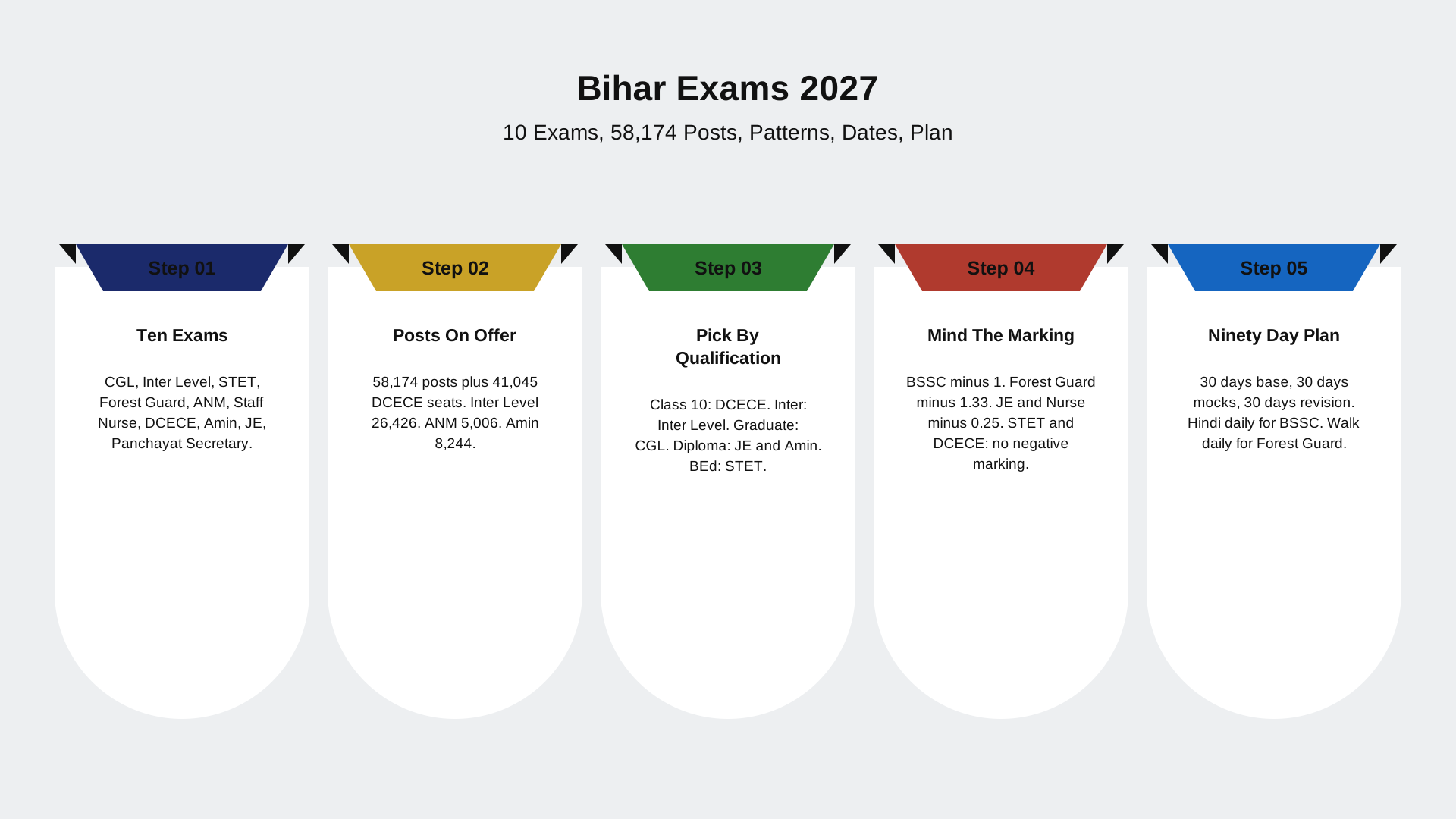
Bihar runs more government recruitment than almost any other state in India, and the Bihar Exams 2027 set gathers the ten exams that matter most into one place. The ten exams in this guide cover 58,174 government posts, plus 41,045 diploma seats through the polytechnic entrance exam. The biggest single drive is the BSSC Inter Level exam with 26,426 posts, and the list runs from Class 10 pass posts to graduate level officer posts. A candidate with any qualification from Class 10 to a postgraduate degree will find an exam here that fits.
The scale hides a trap. These ten exams come from five different bodies, and each body writes its own pattern, its own fee, and its own calendar. The Bihar Staff Selection Commission runs the graduate and inter level exams with negative marking of 1 mark per wrong answer. The Bihar School Examination Board runs the teacher eligibility test with no negative marking at all. The Central Selection Board of Constable runs the forest guard exam with a 25 kilometre walk as the physical test. A candidate who prepares for one pattern and walks into another loses marks before the paper begins.
This guide gives each exam its own section with the latest verified cycle, the pattern, the eligibility, the fee, and the dates. It also gives the total picture: which exam fits which qualification, which exams overlap, and where a candidate can apply for two exams with one preparation. Every figure names its source. Where the notification is silent or two trackers disagree, this guide says so instead of guessing, because a wrong date in a guide costs a candidate a year. The patterns in this guide also shape how a Bihar exams mock test should be built, with the same question count and the same marking rule as the real paper.
Bihar Exams 2027 at a glance
| Exam | Body | Posts or seats | Qualification | Pattern |
|---|---|---|---|---|
| BSSC CGL 2027 | BSSC | 1,883 posts | Graduation | Prelims 150 Qs 600 marks; Mains Hindi gate plus Paper 2 |
| BSSC Inter Level 2027 | BSSC | 26,426 posts | Intermediate, Class 12 pass | Prelims 150 Qs 600 marks; Mains Hindi plus Paper 2 |
| Bihar STET 2027 | BSEB | Eligibility test, no posts | Graduation with BEd or PG with BEd | 150 Qs 150 marks, 2.5 hours, no negative marking |
| Bihar Forest Guard 2027 | CSBC | 2,417 posts | Intermediate, Class 12 pass | 100 Qs 100 marks; walk test after |
| Bihar ANM 2027 | SHSB | 5,006 posts | ANM course or GNM or BSc Nursing | CBT nursing subjects plus experience weightage |
| Bihar Staff Nurse GNM 2027 | BTSC | 11,389 posts | GNM diploma | 100 Qs 100 marks, 2 hours, minus 0.25 |
| Bihar Polytechnic DCECE 2027 | BCECEB | 41,045 seats | Class 10 pass | 90 Qs 450 marks, 2 hours 15 minutes, no negative marking |
| Bihar Amin 2027 | BCECEB | 8,244 posts | Diploma in Civil Engineering, latest cycle | CBT plus document verification |
| Bihar Junior Engineer 2027 | BTSC | 2,809 posts | 3 year diploma in engineering | 100 Qs 100 marks, 2 hours, minus 0.25 |
| Bihar Panchayat Secretary 2027 | BSSC, inside Inter Level | 3,532 posts | Intermediate, Class 12 pass | Same as Inter Level prelims and mains |
The total of 58,174 posts counts each recruitment once: BSSC CGL 1,883, BSSC Inter Level 26,426, Forest Guard 2,417, ANM 5,006, Staff Nurse 11,389, Amin 8,244, and Junior Engineer 2,809. The Panchayat Secretary posts sit inside the Inter Level total of 26,426, so they are not added again. The DCECE figure counts diploma admission seats rather than jobs, so it sits outside the post total and is shown separately. A candidate who adds the table column without reading this note will get the wrong total, and this guide would rather show its working than look bigger.
Which Bihar exam fits your qualification
The fastest way to use this guide is to start from the qualification in hand. A Class 10 pass candidate has one exam here: the Bihar Polytechnic DCECE, which opens diploma admission in engineering and paramedical courses. The DCECE is an entrance exam rather than a job exam, and it leads to a diploma that then opens the Junior Engineer and Amin exams. A Class 10 pass candidate who wants a job directly should look at the Bihar Police Constable exam, which sits outside this set and is covered in its own guide.
An Intermediate pass candidate has the widest choice in this set. The BSSC Inter Level exam is the main door, with 26,426 posts across nine post titles including Lower Division Clerk, Revenue Employee and Panchayat Secretary. The Bihar Forest Guard exam takes Intermediate pass candidates who can walk 25 kilometres in four hours. The Bihar Amin exam took Intermediate pass candidates in its 2019 cycle, but the latest 2024 cycle asks for a diploma in Civil Engineering, so an Intermediate pass candidate should read the current notification before applying.
A graduate has the BSSC CGL exam, which is the senior exam in this set with 1,883 posts and the highest pay. A graduate with a BEd degree has the Bihar STET Paper 1, which certifies eligibility to teach Classes 9 and 10. A postgraduate with a BEd has the STET Paper 2, which certifies eligibility to teach Classes 11 and 12. A candidate can apply for both STET papers in the same cycle if the qualifications fit, and the two papers run on different days.
A diploma holder in engineering has two exams: the Bihar Junior Engineer exam with 2,809 posts and the Bihar Amin exam with 8,244 posts in its latest cycle. Both run through a computer based test with an experience weightage in the merit list. A nursing candidate has the ANM exam with 5,006 posts for ANM course holders and the Staff Nurse exam with 11,389 posts for GNM diploma holders. The nursing exams share much of their syllabus, so a nursing candidate can prepare for both with one plan and a small amount of extra work for each.
BSSC CGL 2027: the senior graduate exam
The BSSC CGL 2027 cycle is the fourth graduate level drive from the Bihar Staff Selection Commission, and it carries 1,883 posts under Advertisement 05/2025. The commission published the notification on 4 August 2025 for 1,481 posts, then raised the count to 1,883 posts on 21 November 2025. Applications ran from 25 August 2025 to 24 November 2025 after an extension and a reopened window. The preliminary exam sits in the commission calendar for July to August 2026, with the mains exam expected in October 2026. The exact dates are not announced yet, and a candidate should check bssc.bihar.gov.in for the admit card notice rather than trust a tracker date.
The post split at notification put Assistant Branch Officer at 392 posts, Secretariat Assistant at 385, Auditor in the Directorate of Audit at 352, Planning Assistant at 125, Auditor in the Cooperative Department at 97, and Malaria Inspector at 30. Those six groups add to 1,381, which is 100 short of the 1,481 total in the same report, so the report did not itemise every group. The revision to 1,883 added 402 posts, including 60 Industrial Extension Officer posts. A plain graduation degree opens most posts, while the Auditor posts ask for commerce, economics, statistics or maths in the degree. Women candidates get 35 percent horizontal reservation across categories.
The pattern has two written stages and then document verification, with no interview. The prelims paper carries 150 questions for 600 marks in 2 hours 15 minutes, split into General Studies, General Science and Mathematics, and Comprehension with Logical Reasoning and Mental Ability at 50 questions each. Each correct answer earns 4 marks and each wrong answer loses 1 mark. The prelims only screens candidates for the mains, and the marks never reach the final merit list.
The mains has two papers of 2 hours 15 minutes each. Paper 1 is Hindi language with 100 questions for 400 marks, and a candidate needs 30 percent in it or Paper 2 is never checked. Paper 2 carries 150 questions for 600 marks across the same three subjects as the prelims, and it decides the merit list. The age window is 21 to 37 years for unreserved men as on 1 August 2025, with higher limits of 40 years for women and BC and EBC candidates. The fee is Rs 540 for general, BC, EBC and EWS men and Rs 135 for SC, ST, PwD and women candidates. The last completed cycle under Advertisement 01/2022 filled 2,187 posts, with prelims in December 2022, a re-exam in March 2023, mains in July 2023, and document verification in October 2023.
Preparation for this exam should treat the Hindi paper as a subject from day one, not as a formality before the mains. Thirty minutes of Hindi grammar and one comprehension passage a day will carry a candidate past the 30 percent gate with room to spare. General Studies needs a daily newspaper habit and a monthly current affairs revision, with extra time for Bihar history, Bihar geography and Bihar government schemes, because Bihar specific questions appear in every paper. Science and maths stay at the Class 10 level, and the NCERT books for Classes 9 and 10 cover them. Reasoning needs daily practice rather than reading, with 30 questions a day for three months.
BSSC Inter Level 2027: the biggest drive in Bihar
The BSSC Inter Level exam is the largest recruitment in this set and one of the largest in India. The second Inter Level Combined Competitive Examination under Advertisement 02/23 carries 26,426 posts. The commission first announced 12,199 posts in September 2023, then revised the count upward several times as new requisitions arrived, and the total reached 26,426 posts by February 2026 according to the trackers that followed each corrigendum. The latest corrigendum notification came on 27 September 2025, and applications ran from 15 October 2025 to 16 February 2026 after extensions as the vacancies grew. The prelims date has not been announced as of November 2026, and this guide will not guess one.
The nine post titles in the advertisement show why this exam draws lakhs of applications. Lower Division Clerk is the largest group by far, spread across more than 60 departments. Revenue Employee carries 3,559 posts in the Revenue and Land Reforms Department. Panchayat Secretary carries 3,532 posts in the Panchayati Raj Department at Pay Level 3, which is one level above the clerk posts. Pashu Sahayak carries 549 posts and needs Biology at the 10+2 level. Junior Statistical Investigator carries 534 posts. Filaria Inspector carries 69 posts at Pay Level 4 and needs a science stream. Bench Clerk, Assistant Instructor for typing, and Typist-cum-Clerk carry the remaining small groups.
The pattern mirrors the graduate level exam at a lower level. The prelims paper carries 150 questions for 600 marks in 2 hours 15 minutes, with General Studies, General Science and Mathematics, and Mental Ability as the three parts. Each correct answer earns 4 marks and each wrong answer loses 1 mark. The mains has two papers: Paper 1 in Hindi language with 100 questions for 400 marks, and Paper 2 with 150 questions for 600 marks covering general awareness, maths and science, and reasoning. The commission calls about five times the vacancies for the mains, so the prelims cutoff sits well above the qualifying percentages.
Eligibility is an Intermediate pass from a recognised board, with a minimum age of 18 years and a maximum of 37 years for unreserved men as on 1 August 2025 in the latest notices. The fee follows the BSSC structure of Rs 540 for general candidates and Rs 135 for SC, ST, PwD and women candidates of Bihar domicile. The pay for most posts sits at Level 2, which is Rs 19,900 to Rs 63,200, while Panchayat Secretary sits at Level 3, which is Rs 21,700 to Rs 69,100, and Filaria Inspector sits at Level 4.
The size of this exam changes how a candidate should prepare. The competition is wide rather than deep, because the syllabus stays at the Intermediate level and the questions test breadth rather than depth. A candidate who covers the full Intermediate syllabus once and revises it twice will beat a candidate who studies graduate level material and skips revision. Current affairs of the last 12 months, Bihar specific facts, and Class 10 maths practice form the core of the score. The candidate should also watch the commission site for the prelims date, because the exam has waited since 2023 and the date will come with a short notice window.
Bihar STET 2027: the teacher eligibility test
The Bihar Secondary Teacher Eligibility Test, known as STET, is the gateway to teaching jobs in Bihar government schools, and it works differently from the other exams in this set. STET gives eligibility rather than a job. A candidate who clears STET can apply for teacher posts in the recruitment that follows, while a candidate who skips STET cannot apply at all. The Bihar School Examination Board conducts the exam in computer based test mode, and it runs in two phases most years.
The exam has two papers. Paper 1 certifies eligibility to teach Classes 9 and 10, and Paper 2 certifies eligibility to teach Classes 11 and 12. Each paper carries 150 multiple choice questions for 150 marks, with a duration of 2 hours 30 minutes. Each correct answer earns 1 mark, and there is no negative marking, so a candidate should attempt every question. The first 100 questions test the chosen subject, 30 test the art of teaching, and 20 test other skills: general knowledge, environmental science, mathematical aptitude, and logical reasoning at 5 marks each.
The 2026 cycle under Advertisement P.R. 183/2026 shows the shape of the exam. The notification came on 14 August 2026, applications ran from 17 August to 22 September 2026, and the computer based test ran from 25 October to 20 November 2026, with one paper moved from 4 November to 21 November 2026 after a clash with other exams. The certificate from this cycle is valid for life, where earlier certificates were valid for seven years. No 2027 dates have been announced yet, and the board announces each cycle separately, so a candidate should watch the board site rather than a fixed annual calendar.
Eligibility for Paper 1 is a bachelor degree in the relevant subject with 50 percent marks and a BEd degree, or a four year integrated BA BEd or BSc BEd course. Eligibility for Paper 2 is a master degree in the relevant subject with 50 percent marks and a two year BEd degree. The age window as on 1 August 2026 is 21 to 37 years for general male candidates, 21 to 40 years for general female and BC and EBC candidates, and 21 to 42 years for SC and ST candidates. The qualifying marks on the normalised score are 50 percent for general candidates, 45.5 percent for BC, 42.5 percent for EBC, and 40 percent for SC, ST, PwD and women candidates. The fee is Rs 960 for one paper and Rs 1,440 for both papers for general candidates, and Rs 760 and Rs 1,140 for SC, ST and PwD candidates. Paper 1 subjects include Hindi, Urdu, Sanskrit, English, Maths, Science, Social Science and other languages. Paper 2 subjects include Physics, Chemistry, Biology, History, Geography, Political Science, Economics, Commerce, Computer Science and the languages.
Preparation for STET is subject first and pedagogy second, because 100 of the 150 marks come from the chosen subject. A candidate should revise the graduation syllabus for Paper 1 and the post graduation syllabus for Paper 2, with previous year papers to fix the level. The teaching section needs the art of teaching topics: teaching and learning, Bloom taxonomy, teaching methods, lesson plans, microteaching, classroom management, and evaluation. The five mark blocks of general knowledge, environmental science, maths aptitude and reasoning are small, and a candidate should not spend more than a week on them combined.
Bihar Forest Guard 2027: the walking exam
The Bihar Forest Guard exam is the most physical exam in this set, and the written paper is only the first half of it. The Central Selection Board of Constable conducts the recruitment for the Environment, Forest and Climate Change Department of Bihar. The current cycle runs under Advertisement 03/2025, dated 26 September 2025, for 2,417 Forest Guard posts: 1,649 direct recruitment, 164 ex Army, and 604 forest quota. Applications ran from 6 October to 5 November 2025 with a fee of Rs 100, and the written exam date has not been announced as of November 2026. The previous cycle ran under Advertisement 03/2020 for 484 Forest Guard posts, with the written exam held on 16 December 2020 and the Forester exam for 236 posts held on 20 December 2020.
The written exam in the 03/2025 cycle is reported as 100 objective questions for 100 marks in 2 hours, with 30 percent needed to qualify. The 2020 cycle used a different paper: 100 questions for 400 marks, each correct answer earning 4 marks and each wrong answer losing one third of the marks, which is 1.33 marks, with four parts: General Studies and current events at 30 questions, General Aptitude and numeracy at 25 questions, General Science with environment and ecology at 25 questions, and Hindi language at 20 questions, and a 40 percent qualifying mark with lower marks of 36.5 percent for BC, 34 percent for EBC, and 32 percent for SC, ST and all women candidates. A candidate should read the 03/2025 advertisement on csbc.bihar.gov.in for the confirmed pattern before finalising a plan, because the two cycles do not match, and the merit rule for the new cycle is not confirmed either.
The physical test is where this exam separates from every other exam in the set. Candidates who qualify in the written exam are called for a physical standard test and a physical efficiency test that carry no marks and work on a pass or fail basis. Male candidates need a height of 165 cm, or 160 cm for SC and ST candidates, with a chest of 81 cm unexpanded and 86 cm expanded, or 79 cm and 84 cm for SC and ST candidates. Female candidates need a height of 160 cm, or 155 cm for SC and ST candidates, in the 2020 table; tracker pages report a female height of 155 cm for the 03/2025 cycle, so a candidate should confirm the standard from the 03/2025 advertisement. The efficiency test is a walk: 25 kilometres in four hours for men and 14 kilometres in four hours for women. The final merit list comes from the written exam marks alone, so the walk cannot improve a rank, but failing it ends the candidacy.
Eligibility is an Intermediate pass from a recognised board, with an age window of 18 to 23 years for unreserved and EWS candidates, 18 to 25 years for BC and EBC candidates, and 18 to 28 years for SC and ST candidates. The age window is narrower than the BSSC exams, and a candidate near the upper limit should apply in the next cycle without waiting. The walk needs training from the start of preparation, not from the admit card. A candidate should walk 5 kilometres a day in the first month, build to 15 kilometres by the third month, and cover 25 kilometres in practice at least twice before the test. The written paper needs daily work on current events, environment and ecology, and Hindi, because those three parts carry 75 of the 100 questions.
Bihar ANM 2027: the largest nursing drive
The Bihar ANM exam is a nursing recruitment run by the State Health Society Bihar for Female Health Worker posts, known as ANM. The current cycle runs under Advertisement 08/2025, dated 12 August 2025, for 5,006 posts: 4,197 in Health Sub Centres, 510 in Rashtriya Bal Swasthya Karyakram, and 299 in the National Urban Health Mission. Applications ran from 14 to 28 August 2025. The post is contractual with a pay of Rs 15,000 a month, and it is open to women candidates only. An earlier BTSC cycle under Advertisement 07/2022 carried 10,709 ANM posts, which is why older guides quote that figure.
Eligibility is a two year ANM diploma from a recognised institution with registration in the Bihar Nurses Registration Council, and both are required. The age window as on 1 August 2025 is a minimum of 21 years and a maximum of 40 years for UR, EWS and BC women and 42 years for SC and ST women. The fee is Rs 500 for general, BC, EBC and EWS candidates and Rs 125 for SC, ST and PwD candidates and for women of Bihar. ANM workers serve in primary health centres, sub centres and community health centres across Bihar, and the post carries a large field component with village level work. This page is a recruitment, not an admission: admission to the two year ANM diploma course is a separate route through the BCECE Board paramedical entrance exam.
The selection runs through a computer based test of 60 questions for 60 marks in 2 hours, with no negative marking. The merit list gives 80 percent weightage to the test score and 20 percent to work experience, at 5 marks per year of experience. The test ran on 17 to 19 December 2025. Some tracker pages print a 100 question paper with negative marking, but the notification based reporting gives 60 questions with no negative marking, and this guide follows the notification. The nursing syllabus covers medical surgical nursing, community health nursing, child health nursing, mental health nursing, midwifery and obstetric nursing, anatomy and physiology, and nursing ethics and management.
Preparation for the ANM exam should start from the ANM course books, because the questions test the course syllabus rather than general knowledge. A candidate should revise each subject with short notes and solve previous year papers from the BTSC nursing exams. Community health nursing deserves extra time, because the ANM post is a community level post and the questions reflect that work. Candidates with work experience in government health facilities should keep their experience certificates ready, because the experience marks need proof at document verification and a missing certificate loses marks that cannot be recovered.
Bihar Staff Nurse GNM 2027: the hospital post
The Bihar Staff Nurse exam fills nursing posts in government hospitals and health institutions across Bihar, and it is the second nursing exam in this set after the ANM drive. The Bihar Technical Service Commission conducts the exam in computer based test mode. The current cycle runs under Advertisement 23 of 2025, released on 24 April 2025, for 11,389 Staff Nurse posts, with applications from 25 April to 23 May 2025. The written exam papers ran on 30 and 31 July and 1 and 3 August 2025, the written result came in December 2025, document verification ran from 17 April to 12 May 2026, and the final result came in August 2026. No 2027 notification has been published as of November 2026.
The written exam carries 100 multiple choice questions for 100 marks in 2 hours, set in Hindi and English. Each correct answer earns 1 mark and each wrong answer loses 0.25 marks. The syllabus follows the GNM course and covers basic sciences, nutrition and dietetics, psychology and mental health nursing, fundamental nursing, medical and surgical nursing, community health nursing, child health nursing, and midwifery. The merit list gives 75 percent weightage to the written exam score and 25 percent weightage to work experience, so a candidate with years of service in a government hospital carries an advantage that a fresh graduate cannot match in the written paper alone.
Eligibility is a diploma in General Nursing and Midwifery from a recognised institution, with registration in the Bihar Nurses Registration Council. A BSc Nursing degree is also accepted. The minimum age is 21 years, and the maximum is 37 years for unreserved men, 40 years for unreserved women and for BC and EBC candidates, and 42 years for SC and ST candidates. The fee is Rs 600 for general, BC, EBC and EWS candidates and Rs 150 for SC, ST, PwD and women candidates of Bihar domicile. The qualifying marks are 40 percent for general candidates, 36.5 percent for BC, 34 percent for EBC, and 32 percent for SC, ST, women and PwD candidates. There is no interview in this selection, and the written exam decides the merit list along with the experience marks. Document verification follows the result, and the registration certificate is checked there, so a candidate should keep the registration current and the certificate ready.
Preparation should follow the GNM syllabus subject by subject, with the largest share of time going to medical surgical nursing and fundamental nursing, because those subjects carry the most questions. A candidate should solve 50 nursing questions a day and keep a register of mistakes by subject, because the same topics repeat across years. The 0.25 negative marking is small enough that a candidate should attempt a question when one option can be eliminated, and large enough that blind guessing across the paper will cost 10 to 15 marks. The experience marks mean a working nurse should apply even with a modest written score, because the combined merit can still clear the cutoff.
Bihar Polytechnic DCECE 2027: the diploma door
The Bihar Polytechnic exam, known as DCECE or the Diploma Certificate Entrance Competitive Examination, is the entrance test for diploma courses in Bihar, and it is the only exam in this set that gives admission rather than a job. The Bihar Combined Entrance Competitive Examination Board conducts the exam every year for admission to polytechnic engineering, paramedical, and part time polytechnic courses in government and private colleges across Bihar. The 2025 cycle offered 41,045 seats, and the exam ran in offline pen and paper mode with OMR sheets.
The exam has separate papers for each course group, and a candidate applies for one group. The Polytechnic Engineering paper, known as PE, carries 90 questions for 450 marks in 2 hours 15 minutes, with Physics, Chemistry and Mathematics at 30 questions and 150 marks each. The Para Medical Intermediate paper, known as PM, carries 90 questions for 450 marks in 2 hours 15 minutes, with General Science at 25 questions, Hindi at 15, English at 15, General Knowledge at 20, and Arithmetic Ability at 15. The Para Medical Secondary paper, known as PMM, carries 90 questions for 450 marks with Physics and Chemistry at 20 questions each and Mathematics, Biology, Hindi, English and General Knowledge at 10 each. Each correct answer earns 5 marks, and there is no negative marking in any paper.
The 2025 cycle shows the calendar a candidate should expect. Applications ran from 2 April to 30 April 2025. Admit cards came on 19 May 2025. The PE exam ran on 31 May 2025 and the PM and PMM exams ran on 1 June 2025. The 2026 and 2027 dates have not been announced yet, and the board announces the cycle in March or April each year. Eligibility for PE is a Class 10 pass with 35 percent marks. Eligibility for PM is a Class 12 pass with Physics, Chemistry and Biology or Maths. Eligibility for PMM is a Class 10 pass. The paper is bilingual in Hindi and English.
Preparation for the PE paper is a Class 10 revision exercise with exam speed. Physics, Chemistry and Mathematics at the Class 10 level carry equal marks, so a candidate who is strong in two subjects and weak in one will lose 150 marks. The maths paper needs daily practice of 20 questions, and the science papers need NCERT revision with numerical practice. The absence of negative marking changes the attempt strategy completely: a candidate should attempt all 90 questions, because a guess costs nothing and a correct guess earns 5 marks. The PM and PMM papers need Hindi and English preparation alongside science, and the general knowledge section rewards a daily reading habit.
The DCECE matters beyond the diploma itself, because the diploma opens the Junior Engineer exam and the Amin exam in later years. A candidate who enters a government polytechnic through DCECE, completes a three year diploma, and then clears the BTSC Junior Engineer exam has a complete path from Class 10 to a Level 7 government post. The diploma route takes longer than the Inter Level route, and it pays better at the end, so a young candidate with time should weigh it seriously.
Bihar Amin 2027: the land records post
The Bihar Amin exam has changed more between cycles than any other exam in this set, and a candidate must know which cycle the guide describes. The 2019 cycle under the Bihar Combined Entrance Competitive Examination Board announced 1,767 Amin posts for the Revenue and Land Reforms Department, with applications from 23 December 2019 to 22 January 2020. Eligibility was a Class 12 pass, the age window started at 18 years, and selection ran through a computer based test. The test carried 75 questions: a first section of 50 marks on General Knowledge, current events, General Science and General Hindi, and a second section of 25 marks on General Mathematics. The duration was 2 hours 15 minutes in the reports from NDTV and Jagran Josh, though the notification text quoted by one tracker gives 2 hours 45 minutes, and this guide flags that conflict rather than hiding it.
The 2024 cycle changed the exam completely. The board announced 8,244 Amin posts, and eligibility moved to a diploma in Civil Engineering from a recognised institution. The selection runs through a computer based test and document verification, with the test split into a Civil Engineering section of 75 questions and a second section of 25 questions, at 4 marks per question. The selected candidates get an honorarium of Rs 31,000 a month. The final result for the 2024 cycle has been released. The age window in the 2024 cycle is 18 to 37 years for male candidates and 18 to 40 years for female candidates. A fresh drive of 2,609 Special Survey Amin posts was announced on 18 November 2026 as part of a 3,310 post drive, with appointments aimed by February 2027, but no advertisement number or dates had been published as of 21 November 2026.
The change from Intermediate pass to diploma means the Amin exam now serves a different candidate pool, and an Intermediate pass candidate who reads an old guide will prepare for the wrong exam. The Civil Engineering syllabus covers mathematics, applied physics, applied chemistry, engineering graphics, building construction, surveying, mechanics of materials, concrete technology, geotechnical engineering, hydraulics, theory of structures, transportation engineering, and estimation and costing. A diploma holder who revises the diploma syllabus subject by subject will find the paper familiar, because the questions test the diploma course rather than general knowledge.
Amin work is field work in land measurement and revenue records. The post sits in the Revenue and Land Reforms Department and in the Forest and Climate Change Department, and the daily work involves survey, measurement, mutation records, and land disputes. A candidate who likes desk work should think twice, because the Amin spends most days in the field. The post suits a diploma holder who wants a government job with outdoor work and a fixed monthly honorarium, and the 8,244 posts in the latest cycle make it one of the largest diploma level drives in Bihar.
Bihar Junior Engineer 2027: the diploma engineer exam
The Bihar Junior Engineer exam is the most recent large drive in this set, and it is the best paid diploma level exam in Bihar. The Bihar Technical Service Commission published the notification in December 2025 under Advertisements 28/2025, 29/2025 and 30/2025 for 2,809 Junior Engineer posts: Civil at 2,653 posts, Mechanical at 70 posts, and Electrical at 86 posts. Applications ran from 12 December 2025 to 12 January 2026. An earlier short notice in October 2025 had put the count at 2,747 posts, and the December notification revised it to 2,809, so this guide uses the December figure and flags the October figure as superseded.
The written exam is a computer based test with 100 objective questions for 100 marks in 2 hours, set in Hindi and English. General Studies carries 20 questions and domain knowledge in the candidate discipline carries 80 questions. Each correct answer earns 1 mark and each wrong answer loses 0.25 marks. The merit list gives 75 percent weightage to the written exam and 25 percent weightage to work experience, followed by document verification. There is no interview. The pay scale is Rs 44,900 to Rs 1,42,400, which is Pay Level 7, and that scale is the reason this exam draws diploma holders from across India.
Eligibility is a three year diploma in the relevant engineering discipline from a recognised institution. Civil diploma holders have the largest share of posts by far, with 2,653 of the 2,809 posts, so a civil diploma is the strongest ticket in this exam. Mechanical and Electrical diploma holders compete for 70 and 86 posts respectively, and the competition in those branches is tighter. The domain syllabus for Civil covers building materials, surveying, structural analysis, concrete technology, soil mechanics, transportation engineering, environmental engineering, water resources engineering, and design of steel and concrete structures. The Mechanical syllabus covers thermodynamics, fluid mechanics, theory of machines, and manufacturing. The Electrical syllabus covers circuits, machines, power systems, and measurements.
Preparation should give 80 percent of the time to the domain subject, because it carries 80 of the 100 marks. A candidate should revise the diploma syllabus subject by subject and solve previous year papers from the BTSC Junior Engineer exams and from the SSC Junior Engineer exam, because the question style is similar. General Studies needs one hour a day: current affairs of the last 12 months, Indian polity, geography, and basic maths and reasoning. The 0.25 negative marking allows a candidate to attempt a question when one option can be eliminated. Work experience in government engineering works should be documented with certificates, because the experience marks can move a candidate several ranks in the final list.
Bihar Panchayat Secretary 2027: the village officer post
The Bihar Panchayat Secretary post deserves its own section even though it sits inside the Inter Level exam, because it is the single most attractive post in that drive for many candidates. The post carries 3,532 vacancies in the Panchayati Raj Department, and it sits at Pay Level 3 with a scale of Rs 21,700 to Rs 69,100, which is one level above the Lower Division Clerk posts in the same exam. A candidate applies through the Inter Level exam and chooses Panchayat Secretary in the post preferences, so there is no separate form and no separate paper. The selection, the pattern, the fee, and the dates are the same as the Inter Level exam described above.
The Panchayat Secretary is the administrative officer of a gram panchayat, and the work is the reason the post carries a higher pay level. The secretary keeps panchayat records, implements rural schemes, records meeting proceedings, and handles the paperwork that central and state rural schemes generate. The post needs a candidate who can work with elected panchayat members, handle public dealing every day, and keep records clean for audit. A candidate who wants a desk in Patna should choose Lower Division Clerk instead, because the Panchayat Secretary works in a village and the posting is rural by definition.
The competition for this post is the sharpest inside the Inter Level exam, because 3,532 posts at Level 3 draw candidates who would otherwise aim for graduate level posts. A candidate who wants Panchayat Secretary should target the top of the Inter Level merit list, not just the qualifying line, because the post fills early in the preference allotment. The preparation is the same as the Inter Level plan: Intermediate level General Studies, Class 10 science and maths, reasoning practice, and Hindi for the mains. The difference is the target score, and the candidate should set it 10 percent higher than the general Inter Level target.
The post also carries a career path worth knowing. A Panchayat Secretary gains experience in rural administration, scheme implementation, and public dealing, and that experience helps in departmental exams for promotion. The post is a stable village level career with a fixed salary, a pension, and a visible role in the community. A candidate from a rural background who knows the panchayat system from home will find the work natural, and the exam rewards that familiarity in the General Studies section, where panchayati raj questions appear in every paper.
Negative marking across the ten Bihar exams
Negative marking is the single biggest difference between these exams, and a candidate who applies one rule to all ten will lose marks. The table below puts the marking rule for each exam in one place, because the attempt strategy follows the rule and not the other way round.
| Exam | Marks per question | Negative marking | Attempt rule |
|---|---|---|---|
| BSSC CGL | 4 | Minus 1 | Attempt only when two options can be eliminated |
| BSSC Inter Level | 4 | Minus 1 | Attempt only when two options can be eliminated |
| Bihar STET | 1 | None | Attempt all 150 questions |
| Bihar Forest Guard | 1 in the 03/2025 reports | Not confirmed for 03/2025; minus 1.33 in the 2020 cycle | Read the advertisement before the exam |
| Bihar Staff Nurse GNM | 1 | Minus 0.25 | Attempt when one option can be eliminated |
| Bihar Polytechnic DCECE | 5 | None | Attempt all 90 questions |
| Bihar Junior Engineer | 1 | Minus 0.25 | Attempt when one option can be eliminated |
| Bihar ANM | 1 | None | Attempt all 60 questions |
| Bihar Amin | 4 in the 2024 cycle | Minus 1 in the 2024 cycle reports | Attempt only when two options can be eliminated |
| Bihar Panchayat Secretary | 4 | Minus 1 | Same as Inter Level |
The Forest Guard paper in the 2020 cycle had the harshest penalty in the set at minus 1.33 per wrong answer, which is one third of the 4 marks a correct answer earns. A candidate who guesses on 30 questions in that paper and gets 10 right and 20 wrong gains 40 marks and loses 26.6, a net of 13.4 marks for 30 attempts. The same candidate skipping those questions keeps the score clean. The 03/2025 cycle reports 100 questions for 100 marks, and its negative marking is not confirmed yet, so a Forest Guard candidate should read the advertisement before fixing an attempt rule. The DCECE and STET papers have no negative marking at all, and a candidate who leaves questions blank in those exams gives away free marks. The attempt rule should be written on the admit card the night before the exam, because the pressure of the hall makes every candidate forget it.
Two exams with one preparation
Several exams in this set share most of their syllabus, and a smart candidate applies for two exams with one preparation plan. The BSSC CGL and the BSSC Inter Level exams share the same three subjects, the same marking scheme, and the same mains structure with a Hindi gate paper. A graduate who prepares for the CGL exam is already 80 percent ready for the Inter Level exam, and the Inter Level paper is easier because the level is Intermediate rather than graduate. The candidate should apply for both, take both, and let the merit lists decide which post comes first.
The nursing exams share their syllabus as well. The ANM and Staff Nurse exams both test nursing subjects from the ANM and GNM courses, and a nursing candidate who prepares the combined syllabus can sit for both exams. The Junior Engineer and Amin exams share the civil engineering syllabus, and a civil diploma holder can prepare for both with one plan. The DCECE and the Junior Engineer exams form a sequence rather than a pair: the DCECE gives the diploma, and the diploma gives the Junior Engineer eligibility, so a Class 10 pass candidate should treat the DCECE as step one of a five year plan.
The STET exam pairs with nothing in this set, because it tests a teaching subject and pedagogy. A BEd graduate who wants a teaching job should prepare for STET alone and give it full attention, because the subject paper carries 100 of the 150 marks and needs deep revision. The Forest Guard exam pairs with the Inter Level exam on the written side, because the General Studies and aptitude syllabus overlaps, but the walk test needs separate physical training that the Inter Level exam never asks for.
A 90 day plan that works for most Bihar exams
Most candidates in this set have about three months between the admit card notice and the exam, and the plan below fits that window for the BSSC exams, the Forest Guard exam, and the nursing exams. It assumes four hours of study a day and a weekly mock test. The plan has three phases of 30 days each, and each phase has one job.
Days 1 to 30 build the base. The candidate finishes one reading of the full syllabus: General Studies from a standard book, science and maths from NCERT, reasoning from a practice book, and the subject paper for the specific exam. The candidate makes short notes for every subject, because the notes are the revision material for the last month. Current affairs start on day one with a daily newspaper and a weekly note. The candidate takes one diagnostic mock test in the first week to find the weakest section, and the weakest section gets an extra hour a day for the rest of the plan.
Days 31 to 60 are the practice phase. The candidate takes one full mock test every week and two sectional tests per subject each week. Each mock test gets a full day of analysis, with every wrong answer logged and every guessed right answer marked as a risk. The candidate revises the short notes from the first phase instead of reading new books. The score should rise by 5 to 8 percent across this phase. A flat score means the analysis is missing, and the candidate should spend more time on the mistake register and less time on new material.
Days 61 to 90 are the revision phase. No new books enter the table. The candidate revises short notes, solves previous year papers, and takes two mock tests a week. The last 15 days are for light revision only: formula sheets, current affairs of the last six months, Bihar facts, and the subject wise short notes. The candidate should sleep eight hours in the last week and avoid any new material. The Forest Guard candidate adds a daily walk in this phase, building to the full 25 kilometre distance twice before the test.
Mistakes that cost Bihar candidates their selection
The first mistake is preparing for the wrong cycle. The Amin exam changed from Intermediate pass to diploma between its 2019 and 2024 cycles, and a candidate who reads an old guide prepares for the wrong paper. The fix is simple: read the latest advertisement on the official board site before starting preparation, and check the eligibility, the pattern, and the fee from that document. The second mistake is ignoring the Hindi gate paper in the BSSC exams. Paper 1 needs 30 percent, and a candidate who fails it never gets a Paper 2 score. Thirty minutes of Hindi a day from the first week prevents that loss.
The third mistake is skipping Bihar specific preparation. Every BSSC and CSBC paper asks about Bihar history, Bihar geography, Bihar culture, and Bihar government schemes, and the questions are easy marks for a candidate who spends two weeks on the state. The fourth mistake is taking mock tests without analysing them. A mock test without analysis is entertainment, and the analysis should take longer than the test. The fifth mistake is changing books mid preparation. Three standard books finished twice beat ten books started once.
The sixth mistake is applying for one exam when two fit the same preparation. A graduate who prepares for the CGL exam and skips the Inter Level exam gives away a second chance at a government post for the price of one more form. The seventh mistake is trusting a tracker date for the exam. The Inter Level prelims date has moved several times since 2023, and the CGL prelims date is a month window rather than a fixed day. The candidate should check the official commission site every week and keep the preparation ready for the earliest date in the window.
How mock tests fit Bihar exam preparation
Mock tests serve three purposes across these exams: they teach time management, they expose weak topics, and they build exam stamina. A good Bihar exams mock test mirrors the real pattern exactly, because practising the wrong pattern teaches the wrong habits. A candidate should take the first mock test before preparation begins, to find the starting score and the weakest section. Weekly mocks should start after 30 days, and the final month should have two mocks a week. Each mock test should mirror the real pattern of the target exam, with the same question count, the same marks, and the same time limit.
The analysis matters more than the score. The candidate should sort every question into four groups: correct and known, correct and guessed, wrong and known, and wrong and unknown. The second group is the danger group, because guessed right answers hide weak topics. The fourth group is the syllabus gap, and the next week of study should fix it first. The candidate should track five numbers across every Bihar exams mock test: total score, accuracy per section, questions attempted, time spent per section, and the score lost to negative marking. A rising total score with falling accuracy is a warning sign, because it means the candidate is guessing more.
A candidate preparing for two exams should take mock tests for both patterns, because the attempt strategy changes with the marking rule. The STET and DCECE papers have no negative marking, so the candidate should attempt every question. The BSSC papers have minus 1 per wrong answer, so the candidate should attempt only when two options can be eliminated. The Forest Guard paper in the 2020 cycle had minus 1.33, so the candidate should attempt only when sure; the 03/2025 marking is not confirmed yet. Practising one pattern and sitting for another is the fastest way to lose marks that the preparation had already earned.
Sources
Times of India, BSSC CGL notification 2025 released for 1,481 vacancies, 5 August 2025. Career Power, BSSC CGL Exam Date 2026 Out for 1,883 vacancies, Advertisement 05/2025. Testbook, BSSC CGL Exam Date 2026, vacancy revised to 1,883 on 21 November 2025. Times of India, BSSC Second Inter Level vacancies doubled to 24,492, last date extended, with post wise split for LDC, Revenue Employee and Panchayat Secretary. Exam Atlas, BSSC Inter Level Posts 2026 and BSSC Inter Level 2026 guide, 26,426 vacancies and post wise pay levels. Times of India, Bihar STET 2024 to start on May 18, exam pattern and shift timings. Oliveboard, Bihar STET Syllabus 2024 and Exam Pattern, Paper 1 and Paper 2 structure. Jagran Josh, Bihar Police 2020 Forester and Forest Guard exam dates, Advertisement 03/2020, 484 Forest Guard posts. Testbook, CSBC Bihar Police Forest Guard syllabus and exam pattern 2020, 100 questions and 400 marks. Jagran Josh, BTSC Bihar Recruitment 2022 for 12,771 ANM and other posts, Advertisement 07/2022, 10,709 ANM posts. Testbook, BTSC Staff Nurse Syllabus and Exam Pattern 2025, 100 questions and 100 marks with 75 percent CBT weightage. Adda247, Bihar BTSC Staff Nurse previous year paper, exam held 1 to 3 August 2025. Job Rasta, DCECE Bihar Polytechnic Admission 2025, 41,045 seats and PE, PM and PMM patterns. Get My Uni, DCECE Exam Pattern 2025, 90 questions and 450 marks with no negative marking. NDTV, Bihar announces 1,767 Amin vacancies, 2019 cycle, 75 question CBT. Testbook, Bihar AMIN Recruitment 2024, 8,244 vacancies and diploma eligibility with Rs 31,000 honorarium. Jagran Josh, BTSC JE Syllabus 2025 and Exam Pattern, 2,747 vacancies in the October 2025 notice. Job Rasta, BTSC Bihar JE Recruitment 2025, Advertisements 28/2025 to 30/2025, 2,809 vacancies and Rs 44,900 to Rs 1,42,400 pay scale. Bihar Staff Selection Commission, bssc.bihar.gov.in. Bihar School Examination Board, biharboardonline.bihar.gov.in. Bihar Technical Service Commission, btsc.bihar.gov.in. Bihar Combined Entrance Competitive Examination Board, bceceboard.bihar.gov.in. Central Selection Board of Constable, csbc.bih.nic.in. State Health Society Bihar, ANM Advertisement 08/2025, 5,006 posts, 12 August 2025. Central Selection Board of Constable, Forest Guard Advertisement 03/2025, 2,417 posts, 26 September 2025. Bihar Technical Service Commission, Staff Nurse Advertisement 23/2025, 11,389 posts. Bihar School Examination Board, STET Advertisement P.R. 183/2026, 14 August 2026.