
JAIIB CAIIB 2027: JAIIB and CAIIB Exam Guide for Bankers
📖 Table of Contents
- What JAIIB and CAIIB are
- Who can sit for JAIIB
- JAIIB papers at a glance
- CAIIB papers at a glance
- Pattern, pass marks, and attempts
- Fees and registration
- Increments and career value
- How to pick your CAIIB elective
- A 90 day plan that fits branch life
- Mistakes that cost papers
- How the exams changed in 2023
- Where this fits in your banking career
- What to do next
- Sources
JAIIB CAIIB 2027: JAIIB and CAIIB Exam Guide for Bankers
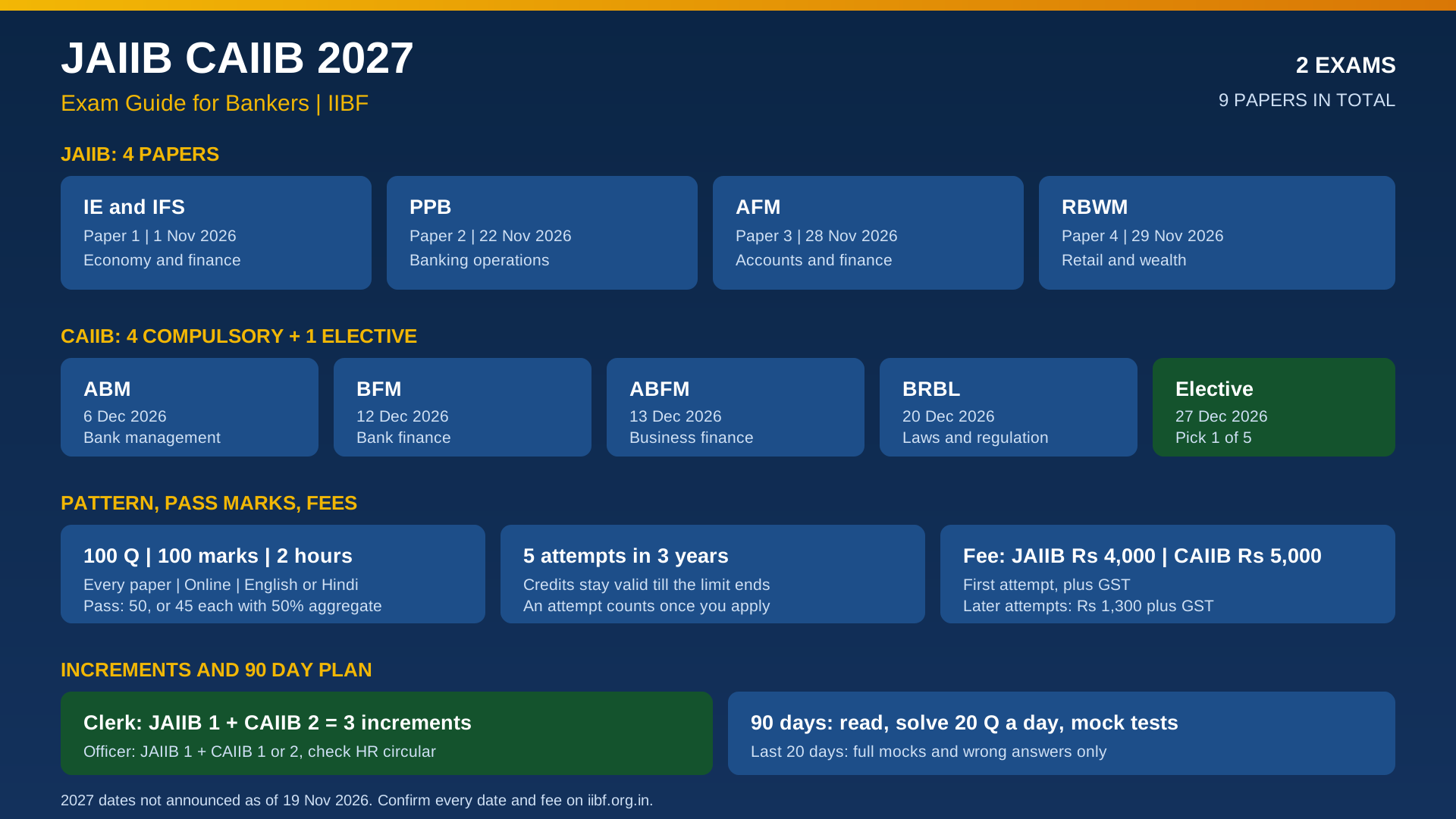
JAIIB and CAIIB are the two professional exams that the Indian Institute of Banking and Finance runs for working bankers. JAIIB comes first. It has four papers. CAIIB comes next. It has four compulsory papers plus one elective paper. A banker who clears JAIIB earns one increment in basic pay. A clerk who then clears CAIIB earns two more increments. An officer who clears CAIIB earns at least one more increment, and one pay document puts the officer figure at two. This guide covers both exams in full: who can sit, the papers, the pattern, the fees, the 2026 dates, the increments, and a 90 day plan.
Read this page if you work in a bank and you want a pay rise that stays on your salary slip for the rest of your service. The exams reward steady study more than long hours. Most bankers who fail do so because they start late, or they treat the papers like a general knowledge quiz. The papers test banking work. Your branch experience counts, but only if you connect it to the syllabus.
What JAIIB and CAIIB are
IIBF stands for the Indian Institute of Banking and Finance. The institute runs JAIIB and CAIIB as its flagship qualifications for bank staff. JAIIB expands to Junior Associate of the Indian Institute of Bankers. CAIIB expands to Certified Associate of the Indian Institute of Bankers. Both exams run twice a year, in a May cycle and a November cycle for JAIIB, and in a June cycle and a December cycle for CAIIB. The exams run online at IIBF centres across India.
JAIIB builds basic banking knowledge. IIBF describes the aim as giving a banker the knowledge needed for day to day work: the role of the financial sector in the economy, the banking and financial services on offer, accountancy and financial management, retail banking and wealth management, digital banking products, banking technology, and customer relations. That list comes from the IIBF JAIIB Rules and Syllabus 2026, as read by SJA Learning in September 2026.
CAIIB builds on JAIIB. It tests advanced bank management, bank financial management, advanced business and financial management, and banking regulations and business laws. A banker who holds CAIIB can handle credit appraisal, treasury work, risk work, and compliance work with more confidence. Banks treat CAIIB as a signal that a person is ready for higher responsibility.
People outside banking often ask whether they can sit for JAIIB. The answer is no. IIBF opens JAIIB only to its ordinary members, and membership is open to people who work in the banking and finance industry whose employer is an institutional member of IIBF. A person who has never worked in a bank cannot register. The equivalent course for people outside banking is the Diploma in Banking and Finance, which IIBF also runs.
The two exams form a ladder. You clear JAIIB first. Then you become eligible for CAIIB. You cannot skip JAIIB and sit for CAIIB directly, unless you hold Part I of the older Associate Examination. That exception matters to very few candidates now. For nearly every working banker, the path runs JAIIB first, then CAIIB.
Who can sit for JAIIB
Three conditions decide JAIIB eligibility. First, you must be an ordinary member of IIBF. Second, you must work in the banking and finance industry, and your employer must be an institutional member of IIBF. Third, you must have passed the 12th standard examination in any discipline, or an equivalent examination.
IIBF allows two exceptions to the 12th pass rule. Clerical or supervisory staff who have not passed the 12th standard may appear on the recommendation of the manager or officer in charge of their office. IIBF decides such cases at its discretion. Subordinate staff of recognised banks or financial institutions in India who are IIBF members may also appear, provided they have passed the 12th standard or its equivalent.
IIBF sets no age limit for JAIIB. A clerk with two years of service and an officer with twenty years of service sit the same papers. The exam tests knowledge, and age plays no part in eligibility. That fact surprises many candidates who assume every banking exam has an age bar.
Register for membership first if you are not yet a member. Membership takes time, so start the process well before the exam registration window opens. The November 2026 cycle showed why timing matters. IIBF delayed the start of registration because of a system migration, and the window ran from 12 August to 6 September 2026. Candidates who waited for the original 1 August start found a changed calendar. Always read the current IIBF notification on the IIBF website before you plan.
Choose your medium at registration. IIBF offers each paper in English or Hindi. Pick the language in which you read fastest and understand best. IIBF does not ordinarily permit a change of medium later, so treat the choice as final. The courseware exists in both languages, published by Macmillan Education India for IIBF.
JAIIB papers at a glance
JAIIB has four compulsory papers. Every candidate sits all four. Each paper carries 100 objective questions for 100 marks. Each paper runs for two hours. IIBF holds the papers on separate days, so you get a gap between papers.
| Paper | Questions | Marks | Time |
|---|---|---|---|
| Indian Economy and Indian Financial System | 100 | 100 | 2 hours |
| Principles and Practices of Banking | 100 | 100 | 2 hours |
| Accounting and Financial Management for Bankers | 100 | 100 | 2 hours |
| Retail Banking and Wealth Management | 100 | 100 | 2 hours |
Paper 1, Indian Economy and Indian Financial System, covers the Indian economy, economic concepts that matter to banking, the Indian financial architecture, and financial products and services. It has four modules. Module A covers the Indian economic architecture. Module B covers economic concepts related to banking. Module C covers the Indian financial architecture. Module D covers financial products and services. This paper rewards candidates who follow the Union Budget, monetary policy, and financial markets through the year.
Paper 2, Principles and Practices of Banking, covers general banking operations, the functions of banks, banking technology, and ethics in banks and financial institutions. This paper sits closest to daily branch work. A banker who has handled deposits, loans, clearing, and customer service already knows much of it. The paper still tests the rules behind the work, and branch habit alone will carry you only part of the way.
Paper 3, Accounting and Financial Management for Bankers, covers accounting principles and processes, financial statements and core banking systems, financial management, and taxation and fundamentals of costing. Many candidates call this the hardest JAIIB paper. It asks for numerical work. You need to practise balance sheet analysis, ratio analysis, and capital budgeting sums until the steps feel automatic.
Paper 4, Retail Banking and Wealth Management, covers an introduction to retail banking, retail products and recovery, and support services with marketing of banking services and products. This paper suits bankers who work in retail branches. It tests product knowledge, recovery methods, and customer service standards. It also tests how banks sell and cross sell products within the rules.
CAIIB papers at a glance
CAIIB has four compulsory papers plus one elective paper. Each paper carries 100 objective questions for 100 marks. Each paper runs for two hours. The compulsory papers test advanced management and law. The elective paper lets you pick a subject that matches your work or your interest.
| Paper | Questions | Marks | Time |
|---|---|---|---|
| Advanced Bank Management | 100 | 100 | 2 hours |
| Bank Financial Management | 100 | 100 | 2 hours |
| Advanced Business and Financial Management | 100 | 100 | 2 hours |
| Banking Regulations and Business Laws | 100 | 100 | 2 hours |
| Elective paper, one of five | 100 | 100 | 2 hours |
Advanced Bank Management tests economic analysis, business mathematics, human resource management, and credit management at an advanced level. Bank Financial Management tests international banking, risk management, treasury management, and balance sheet management. Advanced Business and Financial Management tests advanced topics in business and financial management. Banking Regulations and Business Laws tests the legal framework of banking, including the Reserve Bank of India Act 1934 and the Banking Regulation Act 1949.
CAIIB papers differ from JAIIB papers in one important way. The CAIIB papers include questions based on case studies and caselets. Some numerical questions carry no options. You key in the answer. That format punishes guesswork and rewards candidates who can work a problem to a number. Practise case based questions in your mock tests, and practise typing numbers without options.
The five electives are Rural Banking, Human Resources Management, Information Technology and Digital Banking, Risk Management, and Central Banking. You pick one. Pick the subject that matches your posting if you can. A rural branch officer gains most from Rural Banking. A banker in an IT department gains most from Information Technology and Digital Banking. A banker who plans to move into risk work gains most from Risk Management. Interest matters too, because you will read a full book on the subject.
Pattern, pass marks, and attempts
Every JAIIB and CAIIB paper follows the same pattern. You face 100 objective questions. Each question carries one mark. You get two hours. The exam runs online at an IIBF centre. You choose English or Hindi at registration.
The pass rule has two routes. You pass a paper by scoring 50 marks out of 100 in that paper. You also complete the exam if you score at least 45 marks in each paper and an aggregate of 50 percent across all papers in a single attempt. The second route helps a candidate who scores 45 to 49 in one paper but scores high in the others. It applies only when all papers are taken in one attempt.
Class of pass depends on your first physical attempt only, which means an attempt in which you sat for at least one paper. First Class needs 60 percent or more in aggregate with a pass in every subject. First Class with Distinction needs 70 percent or more in aggregate and 60 or more in each subject. The class of pass appears on your certificate, and banks notice it, so a strong first attempt carries real value.
IIBF gives you five attempts to complete the exam, within a maximum of three years from the date of registration for the first attempt, whichever comes earlier. The five attempts need not be consecutive. An attempt counts once you apply, whether you appear or stay away, so never register for a paper you have no plan to sit. Credits stay valid until the limit expires. A paper you have passed stays passed, and you reappear only in the papers you have yet to clear. If you fail to complete the exam within three years or five attempts, you must re enrol afresh.
Negative marking needs a plain note, because many coaching sites get it wrong. Adda247 and Career Power both report no negative marking in JAIIB and CAIIB, and SJA Learning reports the same, citing the IIBF JAIIB Rules and Syllabus 2026. The official IIBF notice that introduced the revised syllabi, JAIIB/DB&F/SOB/CAIIB Introduction of Revised Syllabi, prescribes negative marking at 25 percent of the marks allotted to the question, for both JAIIB and CAIIB. A wrong answer on a one mark question therefore costs a quarter mark, while a blank answer scores nothing. This guide follows the official IIBF notice. Still, read the latest IIBF notification before your exam, because IIBF can change the rule and the notification is the only source that settles it.
The attempt limit changed over the years, and old advice still circulates. Some older pages quote a limit of four attempts in two years. That rule is old. The current rule, as reported by Adda247, Oliveboard, Career Power, and SJA Learning for the 2026 cycles, is five attempts within three years. Do not plan around the old rule. Plan around five attempts in three years, and aim to finish in two cycles.
Fees and registration
IIBF charges the exam fee by attempt. For JAIIB, the first attempt fee is Rs 4,000 plus GST. The second to fifth attempt fee is Rs 1,300 plus GST per attempt. For CAIIB, the first attempt fee is Rs 5,000 plus GST. The second to fifth attempt fee is Rs 1,300 plus GST per attempt. GST adds 18 percent, so a JAIIB first attempt costs about Rs 4,720 in total, and a CAIIB first attempt costs about Rs 5,900 in total. Pay online by debit card, credit card, net banking, UPI, or wallet. IIBF does not refund the fee once paid.
IIBF also charges a late fee if you register after the normal window. The usual pattern adds Rs 100 in the second week and Rs 200 in the third week. The November 2026 JAIIB cycle broke that pattern. IIBF waived the late fee in the later windows as a special case, and extended the last date to 6 September 2026. Do not count on a waiver in your cycle. Register inside the normal window and skip the late fee entirely.
The JAIIB November 2026 registration window shows how dates can shift. Some trackers first reported a start of 1 August 2026 with a last date of 21 August 2026. IIBF delayed the start because of a system migration. Oliveboard, Guidely, and Career Power report the actual window as 12 August to 6 September 2026, with the normal fee from 12 to 18 August 2026. The exam dates stayed fixed through the delay: 1, 22, 28, and 29 November 2026.
The JAIIB November 2026 exam dates, paper by paper, were 1 November 2026 for Indian Economy and Indian Financial System, 22 November 2026 for Principles and Practices of Banking, 28 November 2026 for Accounting and Financial Management for Bankers, and 29 November 2026 for Retail Banking and Wealth Management. The admit card came out on 28 October 2026 on the IIBF website.
The CAIIB December 2026 exam dates were 6 December 2026 for Advanced Bank Management, 12 December 2026 for Bank Financial Management, 13 December 2026 for Advanced Business and Financial Management, 20 December 2026 for Banking Regulations and Business Laws, and 27 December 2026 for the elective paper. CAIIB registration ran from 13 September 2026, and IIBF extended the last date to 8 October 2026. Adda247 first reported a last date of 1 October 2026, and Bankers Club reports the extension to 8 October 2026. The exam dates did not move.
No 2027 schedule has been announced as of 19 November 2026. IIBF normally publishes the yearly exam calendar early in the year. The 2026 calendar came out on 2 February 2026. Expect the 2027 calendar in a similar window, and check the IIBF website rather than trusting a date you read on a coaching site. This JAIIB CAIIB 2027 guide uses the 2026 cycles as facts and gives no invented 2027 dates.
Increments and career value
Money drives most JAIIB and CAIIB attempts, and the money is real. The increments come from the bipartite settlement for clerical staff and the joint note for officers. The increment joins your basic pay, so it raises your dearness allowance, house rent allowance, and other allowances that link to basic pay. It also raises your pension base. A single increment earned early in service compounds for decades.
Clerks earn one increment for JAIIB and two increments for CAIIB, a total of three increments. Guidely, the IIBF named third party guide, and the HR calculator site all agree on this split. Under the 12th Bipartite Settlement, a clerk starts at a basic pay of Rs 24,050, and the first increment slab is Rs 1,340. A clerk who clears JAIIB moves from Rs 24,050 to Rs 25,390 in basic pay. A clerk who then clears CAIIB gains two more increments. The rupee value of the later increments depends on the stage of the pay scale, so check your own pay slip.
Officers earn one increment for JAIIB. Every source agrees on that. The officer starting basic pay under the current scale is Rs 48,480, and one JAIIB increment adds Rs 2,000, taking basic pay to Rs 50,480. The CAIIB figure for officers is where sources split. Guidely and the IIBF named third party guide say CAIIB adds one increment for officers, giving a total of two. Finploy, citing a bank pay and allowance document, says officers who complete CAIIB get two increments from 1 November 2022, which would give a total of three. The 9th Joint Note governs officer pay, and the 12th Bipartite Settlement governs clerical pay. This guide states both readings and advises you to check your bank HR circular before you count the money. Do not plan a loan around the higher figure until your HR confirms it.
Promotion is the second reward. Banks give weight to JAIIB and CAIIB in internal promotion processes. The exams show that a candidate understands banking beyond the branch counter. A clerk who holds both qualifications stands out in a promotion interview. An officer who holds CAIIB stands out for specialist postings in credit, treasury, risk, and compliance.
The knowledge itself pays off in daily work. A banker who understands the financial system reads a balance sheet faster. A banker who understands the law handles a tricky loan file with more care. A banker who understands retail products sells the right product to the right customer. Branch managers notice that kind of banker. Customers notice it too.
How to pick your CAIIB elective
Pick your CAIIB elective after you clear JAIIB, and pick with your posting in mind. Rural Banking suits officers in rural and semi urban branches, and it covers priority sector lending, microfinance, and rural development programmes in depth. Human Resources Management suits bankers who want to move into HR departments, and it covers manpower planning, training, and industrial relations.
Information Technology and Digital Banking suits bankers in IT cells, digital banking teams, and branches that handle heavy digital traffic. Risk Management suits bankers who want credit risk, market risk, and operational risk roles. Central Banking suits bankers who want a deep understanding of the Reserve Bank of India, monetary policy, and the central bank balance sheet. Central Banking also overlaps with the economics you studied in JAIIB Paper 1, so it can feel like a natural next step.
Do not pick an elective because a friend picked it. Do not pick one because a coaching site calls it easy. Easy changes from cycle to cycle, and a subject you dislike will cost you more hours than a subject you enjoy. Read the first chapter of two elective books before you decide. The book that holds your attention for an hour is the right elective.
A 90 day plan that fits branch life
Ninety days is enough for one JAIIB cycle if you study every day. Branch work will eat some evenings, so the plan uses short daily blocks and longer weekend blocks. It assumes you sit for all four JAIIB papers in one JAIIB CAIIB 2027 cycle. If you sit for CAIIB, use the same shape and swap in the CAIIB papers.
Days 1 to 10 belong to Paper 1, Indian Economy and Indian Financial System. Read Module A and Module B in the first five days. Read Module C and Module D in the next five days. Write one page of notes per chapter. Solve 20 questions per day from a mock test or a question bank. Keep a list of terms you keep getting wrong, and review that list every third day.
Days 11 to 25 belong to Paper 2, Principles and Practices of Banking. Read one module every three or four days. Match each chapter to your branch work. When you read about clearing, recall the last clearing return you handled. When you read about KYC, recall the last account you opened. The match between the book and the branch fixes the facts in memory better than rereading does.
Days 26 to 50 belong to Paper 3, Accounting and Financial Management for Bankers. Give this paper the longest block, because it carries the most numerical work. Learn the formats first: balance sheet, profit and loss account, and funds flow. Then practise ratios, one set per day. Then practise capital budgeting and working capital sums. Solve at least 15 numerical questions per day. If a sum beats you, work it again the next day instead of moving on.
Days 51 to 65 belong to Paper 4, Retail Banking and Wealth Management. Read the product chapters carefully, because the paper asks for product features and limits. Learn the recovery methods and the rules that govern them. Read the marketing chapters with a light touch. They carry fewer questions than the product chapters.
Days 66 to 75 belong to revision round one. Take one full mock test per paper, 100 questions in two hours, under exam conditions. Score each test. List every wrong answer with the reason you got it wrong. Relearn the weak chapters. Do not take a new mock test until you have fixed the errors from the last one.
Days 76 to 85 belong to revision round two. Take a second full mock test per paper. Your score should rise by at least 10 marks per paper. If a paper stays below 50, give it three extra days and cut time from your strongest paper. Read your short notes every morning. Keep the wrong answer list beside you.
Days 86 to 90 belong to final polish. Read only your notes and your wrong answer list. Take one more mock test per paper if you have the energy, but stop taking new tests two days before the first paper. Sleep well the night before each paper. Reach the centre early. Carry your admit card and a valid photo identity card.
Mistakes that cost papers
The first mistake is starting a month before the exam. JAIIB has four papers and 45 units in Paper 1 alone. A month gives you about 30 days for four papers, which is seven days per paper. That pace suits no one who works full time in a branch. Start 90 days out.
The second mistake is reading without solving questions. Reading feels like progress, and it is not. The exam asks questions, so practise questions. Solve at least 2,000 questions across the four papers before the exam. That number sounds large, and it works out to about 22 questions a day over 90 days.
The third mistake is ignoring the aggregate rule. A candidate who scores 48 in one paper and 62 in the others still passes under the aggregate route, provided every paper scores at least 45. Many candidates give up on a weak paper too early. Keep every paper above 45, and let your strong papers carry the aggregate.
The fourth mistake is registering for a paper you have no plan to sit. An attempt counts once you apply, whether you appear or stay away. A wasted attempt eats one of your five attempts inside the three year window. Register only for papers you will sit.
How the exams changed in 2023
IIBF revised both JAIIB and CAIIB in 2023, and the revision still shapes the exams you sit today. JAIIB dropped the old Legal and Regulatory Aspects paper and added Indian Economy and Indian Financial System as Paper 1. The change moved economics to the front of the exam. It also moved the legal content into the other papers and into CAIIB, where Banking Regulations and Business Laws now carries it at an advanced level.
The revision also changed the subject names. Accounting and Financial Management for Bankers replaced the older Accounting and Finance for Bankers paper. Retail Banking and Wealth Management replaced the older Retail Banking paper with a wider wealth management scope. CAIIB kept its four compulsory papers, and the elective list stands at five subjects: Rural Banking, Human Resources Management, Information Technology and Digital Banking, Risk Management, and Central Banking.
Old books still circulate in branch libraries, and they cause real harm. A book from the pre 2023 syllabus teaches the wrong paper order and the wrong topics. Check the edition before you buy or borrow a book. The IIBF course books for the revised syllabus carry a January 2023 edition date from Macmillan Education India. If your book lists Legal and Regulatory Aspects as a JAIIB paper, it belongs to the old syllabus, so set it aside and buy the current edition.
Credits from the old syllabus can transfer under IIBF rules, subject to the time limit. A banker who passed a paper under the old syllabus keeps the credit until the three year or five attempt limit expires. The mapping between old and new papers follows IIBF rules, so check the current notification rather than guessing which old paper matches which new paper.
Where this fits in your banking career
JAIIB and CAIIB sit at the centre of a banking career, and they connect with the exams that brought you into banking. Many JAIIB candidates first entered banking through SBI PO 2027 or IBPS PO 2027, and many clerks entered through IBPS Clerk 2027 or RBI Assistant 2027. Officers who joined through IBPS RRB PO 2027 often sit JAIIB in their first year of service. Bankers who aim higher also watch RBI Grade B 2027 and NABARD Grade A 2027, and some prepare for SEBI Grade A 2027 alongside their CAIIB papers. Insurance officers who joined through LIC AAO 2027 sometimes compare their own professional exams with JAIIB, and economics graduates who cleared UGC NET Economics 2027 often find Paper 1 of JAIIB familiar. Each of those exams has its own guide on this site, and each one rewards the same habit: steady daily study with mock tests.
What to do next
Open the IIBF website and read the latest JAIIB notification. Check your membership status first, then the registration window, then the fee for your attempt number. Pick your medium. Buy the four course books. Start Paper 1 tomorrow morning, and solve 20 questions before you sleep. Ninety days from now, you will know whether the plan worked, and your salary slip will show the answer for years.
Sources
IIBF official website at iibf.org.in, read on 19 November 2026. IIBF JAIIB Rules and Syllabus 2026, as reported by SJA Learning, read on 20 September 2026. Adda247 JAIIB exam guide and CAIIB registration page, retrieved 19 November 2026. Career Power JAIIB CAIIB overview, retrieved 19 November 2026. Oliveboard JAIIB syllabus and JAIIB notification pages, retrieved 19 November 2026. Testbook JAIIB exam date and registration pages, retrieved 19 November 2026. Guidely JAIIB salary increment and JAIIB benefits for bank clerks pages, published 13 and 14 November 2026. Finploy JAIIB salary increment for bank officers page, retrieved 19 November 2026. Bankers Club CAIIB exam dates 2026 page, updated 10 November 2026. SJA Learning CAIIB guide, updated to the IIBF 30 June 2026 cut off.