About RSSB CET Graduate Level 2027 Exam Series
📖 Table of Contents
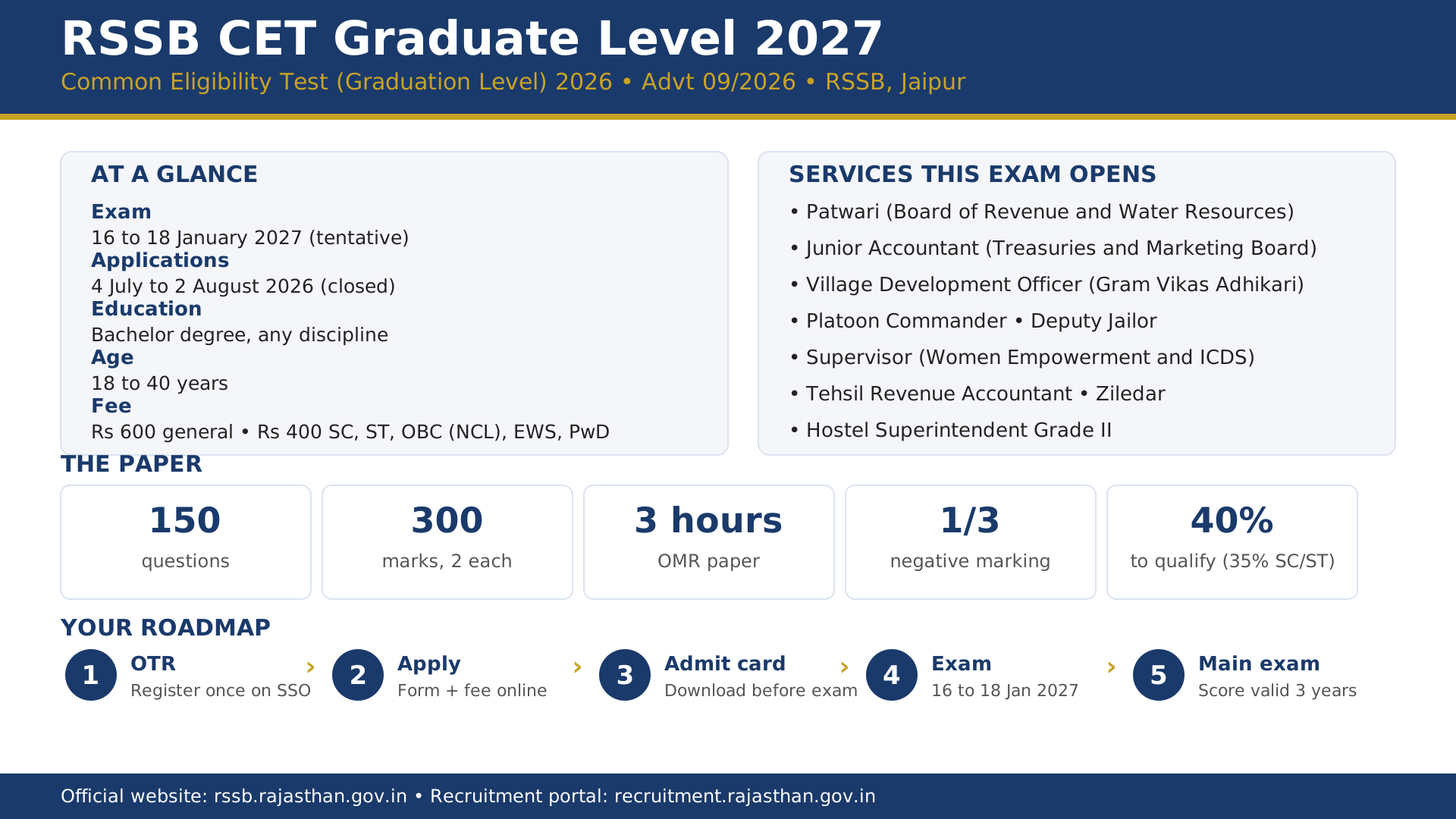
- RSSB CET Graduate Level 2027 at a glance
- The 2026 cycle, and why the exam date moved twice
- What the CET actually is
- The twelve services this one exam opens
- Who can apply
- RSSB CET Graduate Level 2027 exam pattern
- The OMR sheet has a fifth option, and it can end your attempt
- Syllabus, subject by subject
- Qualifying marks and the three year score
- What the 2024 cycle looked like
- A preparation plan that fits the real paper
- Mistakes that cost candidates a year
- Where to check next
- Sources
RSSB CET Graduate Level 2027: Complete Exam Guide
The RSSB CET Graduate Level 2027 cycle is already running, and its exam date has already moved once. The Rajasthan Staff Selection Board, known as RSSB, released the Common Eligibility Test for graduates under Advertisement Number 09/2026 on 1 July 2026. Applications ran from 4 July to 2 August 2026 and closed long ago. The exam first carried dates of 1 to 3 December 2026. A revised press note on 28 September 2026 pushed it to 16 to 18 January 2027, and the board marked those dates as tentative. This guide uses the revised dates and says plainly where a figure still needs a check on the official website.
One paper decides everything at this stage. The RSSB CET Graduate Level 2027 paper carries 150 multiple choice questions for 300 marks, and candidates get three hours on an OMR sheet. Each question carries two marks. A wrong answer costs one third of the marks of that question, which works out to 0.67 marks. A candidate needs 40 percent to qualify, which is 120 marks out of 300, and Scheduled Caste and Scheduled Tribe candidates need 35 percent, which is 105 marks. The score stays valid for three years from the result, so one good score can serve several recruitments.
This guide covers the exam as it actually runs. The twelve services the test opens, the age and education rules, the fee for each category, the full pattern with the fifth option rule that disqualifies careless candidates, the syllabus subject by subject, and a preparation plan built around the real weight of each part. Where the 2026 notification changed during the cycle, this guide says so. Where a figure comes from a tracker rather than the board, this guide says that too.
RSSB CET Graduate Level 2027 at a glance
| Detail | RSSB CET Graduate Level 2027, as notified for the 2026 cycle |
|---|---|
| Conducting body | Rajasthan Staff Selection Board (RSSB), Jaipur, formerly the Rajasthan Subordinate and Ministerial Services Selection Board (RSMSSB) |
| Exam | Common Eligibility Test (Graduate Level) 2026, the cycle behind this 2027 guide |
| Advertisement | Advertisement Number 09/2026, dated 1 July 2026 |
| Applications | 4 July to 2 August 2026, closed |
| Exam date | 16 to 18 January 2027, tentative, two shifts on 16 and 17 January and one morning shift on 18 January |
| Earlier exam date | 1 to 3 December 2026, changed by the press note of 28 September 2026 |
| Paper | One OMR paper, 150 questions, 300 marks, 3 hours |
| Negative marking | One third of the marks of a question, 0.67 marks, for each wrong answer |
| Qualifying marks | 40 percent, 120 marks, for general, OBC and EWS candidates; 35 percent, 105 marks, for SC and ST candidates |
| Score validity | Three years from the date of the result |
| Education | Bachelor degree in any discipline from a recognised university; final year students could apply |
| Age limit | 18 to 40 years, with relaxation as per the rules |
| Fee | Rs 600 for general and OBC creamy layer; Rs 400 for OBC non creamy layer, EWS, SC, ST and persons with disabilities |
| Services covered | Twelve subordinate and ministerial services, including Patwari, Junior Accountant and Village Development Officer |
| Official website | rssb.rajasthan.gov.in |
The 2026 cycle, and why the exam date moved twice
The 2026 cycle opened fast. RSSB released Advertisement Number 09/2026 on 1 July 2026, and the application window opened on 4 July 2026. Candidates had just under a month, with the last date on 2 August 2026 at 11:59 PM. The first press note on exam dates put the graduate level paper on 1 to 3 December 2026. Candidates who planned around December had barely two months to adjust when the board changed the plan.
The revised calendar arrived on 28 September 2026. RSSB moved the graduate level exam to 16 to 18 January 2027 and marked the new dates as tentative. The board said the change followed the Rajasthan State Election Commission calendar, because urban body and Panchayati Raj elections in October 2026 affected examination arrangements. The senior secondary level exam moved too, from 23 to 25 October 2026 to 1 to 3 December 2026, for the same reason. Two shifts run on 16 and 17 January, and a single morning shift runs on 18 January.
That history carries a plain lesson for the next RSSB CET Graduate Level 2027 cycle. RSSB dates shift when the state election calendar or the school examination calendar collides with them, and the board says so in a press note rather than in silence. Candidates who build their revision around a single announced date risk a rebuild. The safer habit is a steady weekly routine that survives a six week postponement, plus a check of rssb.rajasthan.gov.in every week in the last two months before the exam.
One small conflict sits in the notification date itself. One tracker reports the advertisement as dated 1 July 2026, and Jagran Josh reports the notification as released on 2 July 2026. The advertisement number, 09/2026, matches in both. This guide uses 1 July 2026, the date printed on the advertisement as reported by two trackers, and flags the one day difference here so no reader copies the wrong date into a form.
What the CET actually is
The Common Eligibility Test gives no job by itself. It only opens the door to the main examinations of twelve Rajasthan services. A candidate who clears CET earns a score, and that score lets the candidate sit for the main recruitment examination of a service when that service announces its vacancies. The main examination follows the service rules of that department, and the department runs its own selection after that. CET is the common first gate, not the final selection.
The idea behind the RSSB CET Graduate Level 2027 test is simple. Before CET, each department ran its own preliminary examination, so a graduate who wanted five different posts sat five different screening tests with five different syllabi. The CET Rules of 2022 replaced that pile of prelims with one test. One paper, one syllabus, one score, and that score works for every participating service for three years. A candidate prepares once and applies the same score to Patwari, Junior Accountant, Village Development Officer and the rest as their main examinations open.
The three year validity changed the arithmetic for candidates. The Personnel Department notification of 16 January 2025 extended the CET score validity from one year to three years. A score from the 2024 cycle therefore stays usable for recruitments announced well into 2027 and 2028, and a score from the 2026 cycle will stay usable into 2030. That long life is also why the qualifying line matters so much. A candidate who clears 40 percent once can keep applying for main examinations for three years without sitting CET again, while a candidate who falls short by two marks must wait for the next CET cycle.
Under the original 2022 rules, a department shortlisted candidates equal to fifteen times the category wise vacancies from the CET merit list for its main examination. That fifteen times rule comes from a tracker summary of the rules rather than from the 2026 advertisement itself, so candidates should read the main examination notice of their service for the exact shortlisting ratio. The ratio can differ by service, and the department notice is the document that decides it.
CET also changed who sets the paper. The board that runs it was the Rajasthan Subordinate and Ministerial Services Selection Board, RSMSSB, when the test began. The board now works as the Rajasthan Staff Selection Board, RSSB. Old pages still say RSMSSB, and new pages say RSSB, and both names point to the same board in Jaipur. Candidates who search for RSMSSB CET and find nothing new should search for RSSB CET instead.
The twelve services this one exam opens
Twelve subordinate and ministerial services sit under the graduate level CET in the 2026 cycle. The list below follows the department and post table of the 2024 advertisement, which the 2026 trackers reproduce with the same twelve services. Patwari appears twice because two departments recruit it: the Board of Revenue and the Water Resources Department. Junior Accountant appears twice for the same reason, under Treasuries and Accounts and under the Agriculture Marketing Board.
| Department | Post |
|---|---|
| Department of Home Guard | Platoon Commander |
| Department of Water Resources | Ziledar, Patwari |
| Department of Treasuries and Accounts | Junior Accountant |
| Board of Revenue | Tehsil Revenue Accountant, Patwari |
| Women Empowerment Department | Supervisor (Women Empowerment) |
| Integrated Child Development Services | Supervisor |
| Jail Department | Deputy Jailor |
| Social Justice and Empowerment Department | Hostel Superintendent Grade II |
| Rajasthan Panchayati Raj | Village Development Officer (Gram Vikas Adhikari) |
| Rajasthan State Agriculture Marketing Board | Junior Accountant |
Patwari is the post most candidates name first, and the reason is the size of its recruitment when it opens. The Board of Revenue Patwari is the familiar village level revenue post, handling land records, mutations and the daily interface between the state and the farmer. Ziledar and Tehsil Revenue Accountant sit in the same revenue family, with more office and accounts work and less field work. Junior Accountant is the accounts post, and it suits commerce graduates, though the CET itself asks for a degree in any discipline.
Village Development Officer is the Panchayati Raj post, and it draws candidates who like field work in villages. The officer works on development schemes at the village and panchayat level, and the work runs on the same rural vocabulary that the CET syllabus tests: panchayati raj, rural schemes, land and agriculture. Platoon Commander is the Home Guard post, and it carries physical standards that the other posts do not. Deputy Jailor is the prisons post, and Supervisor posts in Women Empowerment and Integrated Child Development Services draw the largest share of women candidates in the list.
No vacancy figure belongs to CET itself, and this point needs stating because tracker pages keep printing one. One tracker page claims the 2024 graduate CET would fill over 40,000 vacancies. That number has no source in the advertisement, and CET carries no vacancy table at all. The vacancies appear later, in the main examination notice of each service, and each service announces its own count. A candidate who reads 40,000 and plans around it is planning around a number nobody official ever printed. This guide prints no vacancy total for CET, because none exists.
Who can apply
The education rule is short. A candidate needs a bachelor degree in any discipline from a recognised university, or an equivalent examination. Final year students could apply in the 2026 cycle, which matters for candidates in their last semester. The degree must be complete before the main examination of the service, and the service notice will fix the exact date by which the degree proof is due. A candidate who clears CET and then fails the final year degree loses the candidature at that stage, which is a hard outcome after a year of preparation.
The age rule in the 2026 cycle was 18 to 40 years. Relaxation applies as per the Rajasthan government rules, with extra years for Scheduled Castes, Scheduled Tribes, Other Backward Classes, Most Backward Classes and Economically Weaker Sections of Rajasthan, and for women, ex-servicemen and persons with disabilities. The exact cut off date for age in the 2026 cycle could not be verified from the retrieved sources, and this guide does not print one. In the 2024 cycle the age counted as on 1 January 2025. Candidates should read the cut off date in the new notification with care, because a wrong assumption about age is the most common reason a form gets rejected after the exam.
The fee for the RSSB CET Graduate Level 2027 cycle had two slabs. General category and OBC creamy layer candidates paid Rs 600. OBC non creamy layer, EBC, EWS, SC, ST and all persons with disabilities paid Rs 400. The fee is paid online through the recruitment portal, and the payment must complete before the closing time. In the 2024 cycle the last date to apply and the last date to pay the fee were the same day, 7 September 2024, and the 2026 cycle followed the same pattern with 2 August 2026.
| Category | Fee in the 2026 cycle |
|---|---|
| General, OBC creamy layer, EBC creamy layer | Rs 600 |
| OBC non creamy layer, EBC, EWS, SC, ST of Rajasthan | Rs 400 |
| All persons with disabilities | Rs 400 |
Applications run through One Time Registration, known as OTR, on the Rajasthan SSO portal. A candidate creates an OTR profile once, with name, date of birth, gender, secondary examination details and an identity proof such as Aadhaar, PAN card, voter card or driving licence, and the portal issues an OTR number. The OTR profile then carries into every RSSB application, so the same details do not need retyping for the next exam. Candidates should fix any mismatch between their Aadhaar card and their Jan Aadhaar card before they start, because the OTR details cannot be changed later. Forms are also accepted through E-Mitra kiosks and Jan Suvidha Kendras across the state, which helps candidates without their own internet access.
A correction window opened after the 2024 cycle, from 23 October to 1 November 2024, with a correction charge of Rs 300. Whether a correction window opens for the 2026 cycle, and what it costs, was not verified from the retrieved sources. Candidates should watch the board website after the application window closes, and treat the correction window as a short chance to fix a photograph, signature or category error, not as a second application.
RSSB CET Graduate Level 2027 exam pattern
The CET Graduate Level exam pattern is one paper and nothing else at this stage. No second paper, no interview, no physical test at the CET stage. The single OMR paper carries 150 multiple choice questions, each worth two marks, for a total of 300 marks, and candidates get three hours. The paper is bilingual in the sense that the board prints it in Hindi and English, and the language questions test Hindi and English themselves. Candidates mark answers with a blue ballpoint pen on the OMR sheet.
| Part | Detail |
|---|---|
| Questions | 150 multiple choice questions |
| Marks | 300, two marks for each question |
| Duration | 3 hours |
| Mode | Offline, OMR sheet |
| Negative marking | One third of the marks of a question, 0.67 marks, for each wrong answer |
| Options per question | Five, A to E, with E for unattempted questions |
| Qualifying marks | 120 marks for general, OBC and EWS; 105 marks for SC and ST |
The negative marking rule changed the character of this exam, and candidates who prepared from old papers sometimes miss the change. The first CET cycles carried no negative marking at all. The 2024 advertisement introduced a deduction of one third of the marks of a question for each wrong answer, and the 2026 advertisement keeps it. One tracker page, Jagran Josh, still prints no negative marking for the 2024 cycle. That page is wrong. The syllabus note printed in the official advertisement says plainly that one third of the marks of a question is deducted for a wrong answer, and the 2026 trackers agree. This guide follows the advertisement.
The arithmetic of the penalty decides how to attempt the paper. A correct answer adds two marks. A wrong answer takes away 0.67 marks. A candidate who guesses at random on a five option question has one chance in five of gaining two marks and four chances in five of losing 0.67, so blind guessing loses marks across a full paper. A candidate who can rule out two options and guess between the remaining three is close to break even. A candidate who can rule out three options should mark the answer. The rule rewards knowledge and punishes lottery play, which is exactly what the board intended when it added the penalty.
One more number belongs in this section. The CET Graduate Level exam pattern gives three hours for 150 questions, which is 72 seconds per question on average. That is generous next to banking and SSC papers, and it is the reason the paper can carry long reasoning sets and long Rajasthan history questions. Candidates who finish in two hours usually leave marks behind by rushing, not by knowing less. The extra hour is for reading the question twice and for the reasoning sets, and the candidates who use it well are the ones who cross 40 percent with a margin.
The OMR sheet has a fifth option, and it can end your attempt
Every question in the CET carries five options, A, B, C, D and E. Option E is the unattempted option. A candidate who does not want to answer a question must darken the E bubble. Leaving the question fully blank is not the same thing, and the difference is expensive.
The rule works like this. A question left fully blank, with no bubble darkened at all, counts as a wrong answer for the purpose of the penalty, so 0.67 marks are deducted. A question marked with option E counts as unattempted, and no marks are deducted. The distinction matters most for candidates who skip twenty or thirty questions. Twenty blank questions cost about 13 marks, which is more than a tenth of the qualifying line. Twenty E marked questions cost nothing.
The board also sets a hard limit. If a candidate leaves more than 10 percent of the questions fully blank, without darkening any bubble, the board declares the candidate disqualified. Ten percent of 150 questions is 15 questions. Sixteen fully blank questions can end the attempt even if the other 134 answers are strong. Candidates should practise the habit in every mock test: never leave a bubble empty, and darken E the moment you decide to skip a question. The habit costs a second per question and removes the single cheapest way to lose a CET cycle.
The CET Graduate Level exam pattern shares this rule with the senior secondary level paper, and the 10 percent limit is the same for both. The two CET papers share the OMR system, the same five option sheet and the same penalty structure. A candidate who appears for both levels, graduate in January and senior secondary in December, should treat the E bubble as part of the exam technique for both.
Syllabus, subject by subject
The official scheme lists thirteen subject groups for the graduate level paper, and it lists them without any question count. History of Rajasthan and India with special emphasis on the Indian National Movement. History, art, culture, literature, tradition and heritage of Rajasthan. Geography of India. Geography of Rajasthan. Indian political system with special emphasis on Rajasthan. Economy of India. Economy of Rajasthan. Science and technology. Logical reasoning and mental ability. General Hindi. General English. Knowledge of computer. Current affairs. The 2026 advertisement adds two more items to the list as reported by trackers: civic duties and public health.
Several tracker pages print a subject split for the paper: 38 questions on general science with Indian history, polity and geography and current affairs, 30 on Rajasthan geography, history, culture and polity, 22 on general English and Hindi, 45 on mental ability and reasoning with basic numerical efficiency, and 15 on basic computer. That split adds up to 150, and it matches the papers of earlier cycles. The board does not fix any such split in the advertisement, and one tracker notes this directly. Treat the table as a guide to past papers, not as a promise about the next paper. A candidate who prepares only the 45 question reasoning block and ignores Rajasthan culture because the table gives it 30 questions is preparing for a table, not for the board.
Rajasthan content is the heart of the RSSB CET Graduate Level 2027 paper, and it is also the part that separates Rajasthan candidates from outsiders. The history section runs from ancient civilisations such as Kalibanga, Ahad, Ganeshwar, Balathal and Bairath, through the medieval period and the Prajamandal movement, to the contribution of Rajasthan in the revolution of 1857 and the tribal and farmer movements. The art and culture section covers folk music, dance, painting schools, fairs, festivals, costumes and the literature of the state. The geography section covers the Thar desert, the Aravalli range, rivers, lakes, soil, climate, minerals and the districts. The polity section covers the state government, panchayati raj, district administration and the state public service institutions.
Indian history in this paper leans on the national movement: social and religious reform movements of the 19th and 20th centuries, the stages of the freedom struggle, contributors from different regions, post independence nation building, national integration, reorganisation of states, institution building in the Nehru era, and the development of science and technology. The economy section splits into the economy of India and the economy of Rajasthan, with agriculture, industry, planning, budgets and the state schemes that keep appearing in the paper. Current affairs runs up to the exam month, and the board asks about state, national and international events, personalities, schemes and policies.
Reasoning and basic numerical efficiency is the largest block in past papers, and it rewards daily practice more than reading. Series, coding, blood relations, clocks and calendars, direction sense, puzzles, number system, percentage, profit and loss, ratio, time and work, geometry, mensuration, basic trigonometry and measures of central tendency all appear. The graduate level paper goes a step beyond the senior secondary paper in mathematics, with geometry, trigonometry and averages. General Hindi covers sandhi, samas, synonyms, antonyms, idioms, grammar and comprehension. General English covers the same ground in English, with vocabulary, grammar, comprehension and error spotting. Basic computer covers hardware, software, internet, MS Office style applications and everyday digital services.
Two newer syllabus items deserve attention because candidates miss them. Civic duties covers fundamental duties and moral values, and the 2026 syllabus summary also lists the Rajasthan Public Examination (Prevention of Unfair Means) Act, 2022. Public health covers everyday science applied to health, diseases, nutrition and sanitation. Both are small blocks, but they are new, and new blocks are where the board asks the easiest questions. A candidate who reads the Act once and revises basic health facts can pick up marks that other candidates leave behind.
Qualifying marks and the three year score
The qualifying line for the RSSB CET Graduate Level 2027 paper is 40 percent for most candidates and 35 percent for Scheduled Caste and Scheduled Tribe candidates. On a 300 mark paper, that is 120 marks for general, OBC, MBC and EWS candidates, and 105 marks for SC and ST candidates. The line is a floor, not a rank. Clearing it makes a candidate eligible for the main examinations. It does not guarantee a call, because each service shortlists from the CET merit list in its own ratio, and a candidate at 121 marks will sit behind a candidate at 240 marks in that list.
The score stays valid for three years from the date of the result, under the Personnel Department notification of 16 January 2025. Earlier the validity was one year, which forced candidates to sit CET every year even when they had already qualified. The three year window changes the strategy. A candidate with a strong score can skip the next CET cycle entirely and focus on the main examinations of the services. A candidate with a weak score, just above the line, faces a choice: sit CET again to raise the score, or spend the time on main examination preparation and accept a lower position in the shortlist.
The result itself arrives months after the exam. In the 2024 cycle, the senior secondary level result came on 17 February 2025, about four months after the October exam, and the marks came on 21 February 2025. The graduate level result followed a similar gap. Candidates should not expect a quick result, and they should start main examination preparation while they wait. The main examination of a service can open within weeks of its vacancy announcement, and a candidate who waits for the CET result before opening the main syllabus loses that time.
What the 2024 cycle looked like
The 2024 cycle is the freshest complete cycle, and it shows how a CET year runs from notification to result. Advertisement Number 09/2024 came out on 6 August 2024. Applications ran from 9 August to 7 September 2024. The fee was Rs 600 for general and OBC creamy layer, and Rs 400 for OBC non creamy layer, EWS, SC, ST and persons with disabilities. The age counted as on 1 January 2025, with the window at 18 to 40 years.
The exam date story of 2024 is worth reading because it repeats the 2026 pattern. The board first announced the graduate level exam for 25 to 28 September 2024. The exam actually ran on 27 and 28 September 2024, in two shifts a day. One tracker still prints the announced window as the exam date, and another prints 25 to 28 September as if all four days carried the exam. The schedule table from Adda247, which lists the exam on 27 and 28 September, matches the admit card data. This guide uses 27 and 28 September 2024 as the exam dates and flags the announced window separately.
The advertisement number for the 2024 cycle carries its own small conflict. The task brief for this guide said Advertisement Number 07/2024. The retrieved sources say 09/2024, dated 6 August 2024. ExamGarh lists the latest advertisement as 09/2024, and the 2026 advertisement is also 09/2026, which fits a numbering sequence where 09 is the graduate CET slot. This guide uses 09/2024 and flags the 07/2024 figure as unverified.
A correction window opened after the 2024 applications closed, from 23 October to 1 November 2024, with a correction charge of Rs 300. The window let candidates fix errors in the form after submission. The 2024 paper followed the same pattern as the RSSB CET Graduate Level 2027 paper: 150 questions, 300 marks, three hours, OMR, one third negative marking. The subject split seen in the 2024 papers matches the 38, 30, 22, 45 and 15 table given above, which is why trackers keep printing it.
A preparation plan that fits the real paper
The plan below assumes six months of preparation for the RSSB CET Graduate Level 2027 exam, which is the honest minimum for a graduate starting from scratch on the Rajasthan syllabus. A candidate who has already attempted CET or a Rajasthan service examination can compress it. A candidate with three months should cut the reading list, not the mock tests.
Months one and two belong to the base. Read Rajasthan history from the ancient civilisations to the Prajamandal movement, Indian history from the freedom movement to independence, the Indian Constitution with its parts and schedules, and the geography of India and Rajasthan with maps. Keep a notebook of Rajasthan facts: the districts and their headquarters, the rivers and their tributaries, the main crops and their seasons, the minerals and where they are found, the fairs and festivals and where they are held. These facts return in CET and in every main examination after it, so learning them once pays several times.
Months three and four belong to depth and the start of timed practice. Finish the standard books for polity, economy and modern history, and add a daily newspaper habit. The newspaper matters more for this exam than for most, because the current affairs block and the Rajasthan polity questions reward candidates who follow state news. From month three onward, take one full mock test a week, 150 questions in three hours, matching the CET Graduate Level exam pattern exactly, on an OMR style sheet if possible. Review every wrong answer and every guessed answer, and keep a list of weak topics. Reasoning needs its own daily practice: twenty questions a day, timed, from series, coding, blood relations and arithmetic.
Months five and six belong to revision and mock tests. Take a full mock every week, in the same order and timing as the real exam, and add a second mock in the last fortnight. The target is a safe margin above 40 percent, not a bare pass. A candidate who scores 45 percent in mocks can still fall below 40 on a hard paper, so the practice target should be 55 percent or higher. Language papers need two hours a week each, Hindi and English, from the start. A candidate who writes Hindi only in the last fortnight will find the grammar slower than expected.
Two subjects deserve special attention because candidates underrate them. The first is Rajasthan specific content. The CET paper asks about Rajasthan history, culture, geography and current affairs in a proportion that no national examination matches. A candidate who knows Indian history well and Rajasthan history poorly will lose marks that their competitors gain. The second is basic computer. It is a small block in past papers, but it is the easiest block to master, and fifteen questions of computer can be the difference between 38 percent and 42 percent.
Mistakes that cost candidates a year
The first mistake is treating the RSSB CET Graduate Level 2027 exam as a job examination. It is only a gate. Candidates who celebrate clearing CET and then rest for two months lose the main examination that follows. The main examination has its own syllabus, often deeper in the service subject, and it opens on its own notice. Start the main syllabus the week after CET, before the result arrives.
The second mistake is ignoring the fifth option. Candidates who leave questions blank instead of darkening E lose 0.67 marks per question, and candidates who leave more than fifteen questions blank lose the whole attempt. Practise the E bubble in every mock test until it is automatic.
The third mistake is blind guessing. With one third negative marking, a random guess on a five option question loses marks across a full paper. Guess only when you can rule out at least two options. Mark E for the rest.
The fourth mistake is trusting tracker dates. The graduate exam was first announced for 1 to 3 December 2026 and then moved to 16 to 18 January 2027. Candidates who built their revision around December had to rebuild it. Follow rssb.rajasthan.gov.in for dates, and treat every other date as a rumour until the board confirms it.
The fifth mistake is preparing for the subject split table instead of the syllabus. The board lists thirteen subject groups and fixes no question count for any of them. A candidate who spends all their time on reasoning because a tracker table gives it 45 questions, and ignores Rajasthan art and culture, is preparing for a table that the board never printed.
Where to check next
Three places matter for this examination, and only three. The RSSB website at rssb.rajasthan.gov.in carries the notification, the syllabus, the admit card, the answer key and the result. The recruitment portal at recruitment.rajasthan.gov.in carries the application form, the exam city slip and the admit card download, through the SSO login. The Rajasthan SSO portal at sso.rajasthan.gov.in carries the One Time Registration profile that every application starts from. Everything else is a copy, and copies introduce errors, like the no negative marking line that still circulates for a cycle whose advertisement prints a one third deduction.
When the next notification lands, read four things before you pay the fee: the advertisement number and date, the cut off date for age, the fee for your category, and the examination pattern. If the pattern differs from the one in this guide, this page will be updated and the mock tests rebuilt to match. Until then, the work is the same. Rajasthan history every day, polity and economy alongside it, reasoning every day, Hindi and English every week, and a mock test every week. The 2026 cycle shows what the RSSB CET Graduate Level 2027 examination offers: one paper, twelve services, and a score that stays alive for three years. The candidate who treats the waiting time as preparation time is the one who benefits when the main examinations open.
Mock tests for other civil service and graduate level examinations on this site include UPPSC PCS 2027, KPSC KAS 2027, JKAS 2027, Goa PSC 2027, UPSC CSE Prelims 2027, SSC CGL 2027, IBPS PO 2027, RRB NTPC 2027, Punjab PCS 2027, Punjab Police Constable 2027.
Sources
Rajasthan Staff Selection Board, Common Eligibility Test (Graduation Level) 2026, Advertisement Number 09/2026 dated 1 July 2026, applications 4 July to 2 August 2026, on rssb.rajasthan.gov.in. Rajasthan Staff Selection Board, press note of 28 September 2026, revised exam calendar, CET Graduation Level 2026 moved from 1 to 3 December 2026 to 16 to 18 January 2027, tentative, two shifts on 16 and 17 January and one morning shift on 18 January. Jagran Josh, Rajasthan CET Graduate Level 2026 notification, applications 4 July to 2 August 2026, fee Rs 600 and Rs 400, age 18 to 40 years, final year students eligible. GovtJobsAlert, RSSB CET Graduate Level 2026 exam date revised to 16 to 18 January 2027, Advertisement Number 09/2026, 150 questions, 300 marks, 3 hours, one third negative marking, five options with option E, more than 10 percent blank questions means disqualification, qualifying 40 percent and 35 percent for SC and ST. FreeJobAlert, RSSB CET Graduate Level 2026 notification, Advertisement Number 09/2026, 12 services including Patwari, Platoon Commander, Junior Accountant and Gram Vikas Adhikari. KadamSetu, RSSB CET Graduate Level 2026, score valid for three years, syllabus list including civic duties and public health. Rajasthan Staff Selection Board, Common Eligibility Test (Graduation Level) 2024, Advertisement Number 09/2024 dated 6 August 2024, applications 9 August to 7 September 2024, fee Rs 600 and Rs 400, age 18 to 40 years as on 1 January 2025, correction window 23 October to 1 November 2024. Adda247, Rajasthan CET Exam Date 2024, graduate level exam 27 and 28 September 2024, senior secondary level exam 22 to 24 October 2024, negative marking one third. Jagran Josh, Rajasthan CET Graduation Level Syllabus 2024, 150 questions, 300 marks, subject split 38, 30, 22, 45 and 15. ExamGarh, Rajasthan CET Graduation Level, CET Rules 2022, qualifying 40 percent and 35 percent for SC and ST, scorecard validity three years, fifteen times shortlisting under the original rules. ExamSyllabusHub, CET Graduation Level Syllabus, board does not fix subject splits, option E rule, more than 10 percent unshaded questions means disqualification. The Times of India, RSSB exam calendar 2026 revised, CET Senior Secondary Level 1 to 3 December 2026 and CET Graduation Level 16 to 18 January 2027. Prepnity, Rajasthan CET 12th Level 2026, score validity three years from the result under the Personnel Department notification of 16 January 2025.