
About KPSC KAS 2027 Exam Series
📖 Table of Contents
- KPSC KAS 2027 and the 2026-27 cycle in numbers
- What the posts actually are
- Who can apply for KPSC KAS 2027
- The exam in three stages
- Prelims, paper by paper
- Mains: seven papers and the 35 percent trap
- The interview carries only 25 marks
- Where Karnataka sits in the syllabus
- What to study first
- A 90 day plan that fits around a job
- Mistakes that cost marks
- Sources
KPSC KAS 2027: Gazetted Probationers Exam Guide
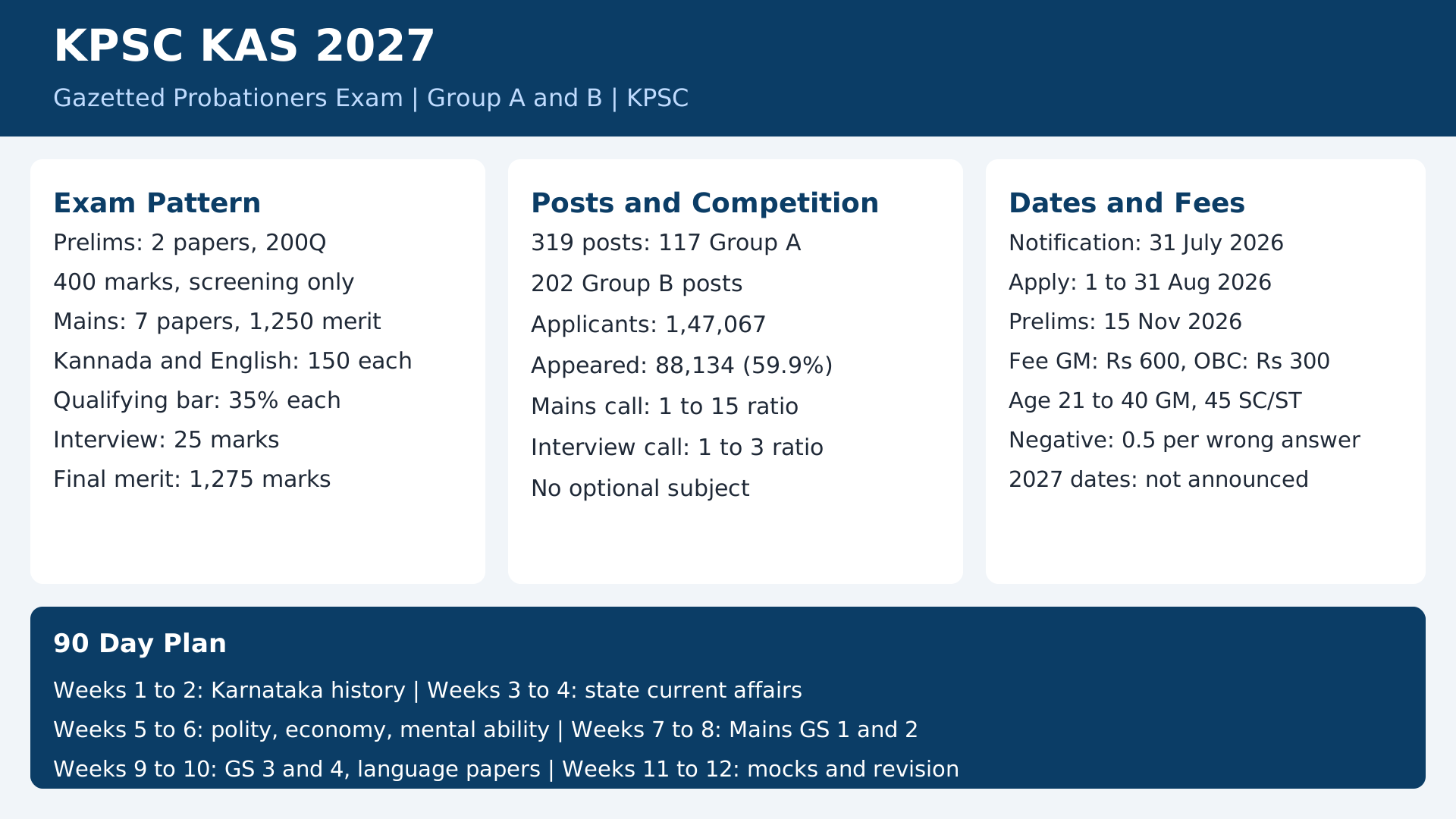
The latest real cycle of this exam drew 1,47,067 applicants for 319 posts. The Karnataka Public Service Commission issued the notification for that cycle on 31 July 2026 and held the Prelims on 15 November 2026. KPSC KAS 2027 has no notification yet as of 19 November 2026, so every fact in this guide comes from the 2026-27 cycle and the rules that govern it. If you plan to sit for the 2027 cycle, that last cycle is the closest picture you have of the posts, the pattern, the age limits and the fees.
KAS stands for Karnataka Administrative Service, and the exam carries the formal name Gazetted Probationers Examination. It fills Group A and Group B gazetted posts across Karnataka government departments. The posts include Assistant Commissioner, Assistant Commissioner of Commercial Taxes, Tahsildar Grade 2 and Commercial Tax Officer. A degree in any subject makes you eligible. The exam runs in three stages, Prelims, Mains and a Personality Test, and only the Mains and the interview count in the final merit. Prelims works as a screen and nothing more.
KPSC KAS 2027 and the 2026-27 cycle in numbers
| Item | Detail |
|---|---|
| Conducting body | Karnataka Public Service Commission (KPSC) |
| Exam name | Gazetted Probationers Examination, known as KAS |
| Latest notification | 31 July 2026, number KPSCKA/EXA1/EXMF/9/2026-EXAM-1/I/251710/2026 |
| Posts in the latest cycle | 319, with 117 in Group A and 202 in Group B |
| Application window | 1 August 2026 to 31 August 2026, online only |
| Prelims date | 15 November 2026, morning and afternoon sessions |
| Applicants | 1,47,067 |
| Hall tickets downloaded | 1,14,406 |
| Average attendance | 88,134, which is 59.9 percent of applicants |
| Exam centres | 15 district centres, 345 sub-centres, 6,192 halls |
| 2027 notification | Not issued as of 19 November 2026 |
Those numbers tell you how steep the climb is. Divide 1,47,067 applicants by 319 posts and you get about 461 applicants for each post. Use the 88,134 who actually sat for the exam and the figure drops to about 276 per post. That still sounds brutal, and it is, but the Prelims cut works in your favour if you prepare with the cut in mind. KPSC calls candidates for Mains at 15 times the number of vacancies, so about 4,785 candidates from the 2026-27 cycle move to Mains. That means roughly one in 18 of those who appeared clears Prelims. The interview call runs at 3 times the vacancies, about 957 candidates. Your first job is to land inside that 4,785. Everything else comes after.
The attendance figure carries a lesson of its own. Only 59.9 percent of applicants turned up on 15 November 2026, and the Times of India reported that 1,14,406 of the 1,47,067 applicants had downloaded hall tickets. A large share of applicants never reach the hall, and a large share of those who reach it have not prepared for the Karnataka part of the paper. The exam rewards the candidate who shows up ready, and the Karnataka sections are where ready candidates pull ahead, because that is where most others leave marks on the table.
One more number deserves attention. The Prelims ran in 6,192 halls across 15 district centres, from Kalaburagi and Raichur in the north to Mysuru and Bengaluru in the south, with Ballari, Bagalkot, Vijayapura, Dharwad, Belagavi, Uttara Kannada, Shivamogga, Dakshina Kannada, Hassan, Davanagere and Tumakuru in between. KPSC runs this exam across the whole state, and the Karnataka questions in the paper reflect that spread. History, geography and current affairs from every region of the state can appear, and a candidate who studies only Bengaluru and Mysuru leaves gaps.
What the posts actually are
The 319 posts in the 2026-27 cycle split into 117 Group A posts and 202 Group B posts, with a further split between the Residual Parent Cadre and the Hyderabad-Karnataka region. Group A carries five posts. Assistant Commissioner in the Junior Scale, in the Department of Personnel and Administrative Reforms, has 39 posts. Assistant Commissioner of Commercial Taxes, in the Commercial Taxes Department, has 50 posts, the largest single share in Group A. Executive Officer or Assistant Secretary in the Rural Development and Panchayat Raj Department has 15 posts. Assistant Director Grade 1 in the Social Welfare Department has 11 posts. Assistant Director in the Treasuries Department has 2 posts.
Group B carries thirteen posts. Commercial Tax Officer leads with 74 posts, the largest single share in the whole cycle. Tahsildar Grade 2 in the Revenue Department has 25 posts. Assistant Registrar of Co-operative Societies has 21 posts. Chief Officer Grade 1 in the Urban Development Department has 20 posts. Assistant Director of Agricultural Marketing has 12 posts. Assistant Treasury Officer has 12 posts. Assistant Director Grade 2 in the Social Welfare Department has 11 posts. Assistant Superintendent in the Prisons Department has 6 posts. Deputy Superintendent of Excise has 5 posts. Section Officer in the Karnataka Government Secretariat has 5 posts. Assistant Director in the Food, Civil Supplies and Consumer Affairs Department has 4 posts. Section Officer in the Karnataka Public Service Commission has 4 posts. Employment Officer in the Skill Development, Entrepreneurship and Livelihood Department has 3 posts.
Read that list twice before you fix your target in your mind. Two facts in it surprise most first time aspirants. First, the Commercial Taxes Department dominates the cycle, with 50 Group A posts and 74 Group B posts, a total of 124 of the 319 posts. Second, the 2026-27 list has no Deputy Superintendent of Police post. Older guides list Deputy Superintendent of Police as a KAS Group A post, and it has appeared in earlier cycles, but the 2026-27 notification carries no such post. If you joined KAS preparation with the police service in mind, check the post list in the 2027 notification when it comes out, because the list changes from cycle to cycle and the 2026-27 list is the only firm evidence you have right now.
Pay is the one detail the notification leaves blank. FreeJobAlert, reporting on the 2026 cycle, states plainly that the notification gives no post-wise salary or pay scale, and that exact pay details come in the appointment order after the recruitment process. This guide gives no pay figures for that reason. Any blog that quotes a salary for a 2026-27 KAS post is guessing, and a guess about pay is the kind of error that spreads fast because every tracker copies it from the last one.
Who can apply for KPSC KAS 2027
Eligibility rests on three things: a degree, an age inside the limit, and knowledge of Kannada. A bachelor's degree from a recognised university qualifies you, in any discipline. The degree subject plays no part in selection. A final year student can apply too, and the Indian Express reports that such a candidate must submit the passing certificate before the Mains examination. That detail matters for planning. You can sit for Prelims in your final year, but you need the degree in hand before Mains, so a final year student who clears Prelims has a hard deadline to meet.
The age limits for the 2026-27 cycle include a one-time 5-year relaxation announced by the Commission, and you must read them with that relaxation in mind. The minimum age is 21 years for every category. The maximum age is 40 years for General Merit, 43 years for OBC categories 2A, 2B, 3A and 3B, and 45 years for SC, ST and Category 1. Older sources quote lower limits, 35 years for General Merit, 38 for OBC and 40 for SC and ST, and the Indian Express eligibility page gives 21 to 38 years for General Merit. Those older figures come from cycles before the one-time relaxation, and they still circulate in guides that nobody updated. The 2026-27 figures above are the ones that match the latest notification, and the 2027 notification may or may not carry the same relaxation, so check it when it appears.
| Category | Maximum age, 2026-27 cycle | Attempts allowed |
|---|---|---|
| General Merit | 40 years | 5 |
| OBC, categories 2A, 2B, 3A and 3B | 43 years | 7 |
| SC, ST and Category 1 | 45 years | No limit |
The attempt limits come from the Indian Express eligibility page: 5 attempts for General Merit, 7 for OBC, and no limit for SC, ST and Category 1. Attempts and age work together, and the age limit usually bites first. A General Merit candidate who starts at 30 has five attempts in theory but only ten years of age room, and each cycle takes more than a year from notification to final list. Treat every attempt as precious even when the count looks generous on paper.
Kannada is a condition of the exam, and it shows up twice. First, knowledge of Kannada is mandatory for the posts, and the Kannada qualifying paper in Mains tests it at SSLC first language standard. Second, the Prelims papers come in Kannada and English, and Mains papers can be answered fully in Kannada or fully in English, except for the qualifying papers themselves. A candidate who grew up outside Karnataka and never studied Kannada faces a real barrier here, and the honest advice is to start Kannada early, because the qualifying paper can end a run that is otherwise strong. The fee for the 2026-27 cycle was Rs 600 for General Merit, Rs 300 for categories 2A, 2B, 3A and 3B, Rs 50 for ex-servicemen, and nil for SC, ST, Category 1 and persons with disability. Fees change between cycles, so treat these as the last known figures and confirm them in the 2027 notification.
The exam in three stages
| Stage | Type | Marks | Counts in final merit |
|---|---|---|---|
| Preliminary Examination | Objective, 2 papers | 400 | No, screening only |
| Main Examination | Descriptive, 7 papers | 1,250 | Yes |
| Qualifying language papers | Descriptive, Kannada and English | 150 each | No, must clear 35 percent in each |
| Personality Test | Interview | 25 | Yes |
| Final merit | Mains plus Personality Test | 1,275 | Yes |
The scheme follows the Karnataka Recruitment of Gazetted Probationers Rules, with the Mains and Personality Test scheme last amended on 12 April 2022. Three facts in that table decide how you prepare. Prelims marks stay out of the final merit, so a high Prelims score earns you nothing beyond a Mains seat. Mains carries 1,250 of the 1,275 merit marks, so the descriptive papers decide your rank almost entirely. The interview carries 25 marks, which looks small until you see how tightly Mains scores bunch near the cut off. The task brief for this guide first described Mains as nine papers, but the current pattern has seven papers in total, two qualifying language papers plus five merit papers, and no optional subject. KPSC removed the optional subjects in the revised scheme, and any guide that still lists optional subjects or nine papers is out of date.
The ratios between stages matter as much as the marks. KPSC admits candidates to Mains at 15 times the vacancies, category-wise, and calls candidates for the Personality Test at 3 times the vacancies, based on Mains marks and category-wise reservation. Those ratios turn the 319 posts into about 4,785 Mains seats and about 957 interview seats. The Mains ratio is the generous one. The interview ratio is the tight one. A candidate who scrapes into Mains still has a real chance, because Mains starts everyone at zero again, but a candidate who scrapes into the interview list faces a field where 25 marks must separate 957 people chasing 319 posts.
Prelims, paper by paper
Prelims has two objective papers. Each paper carries 100 questions of 2 marks each, runs for 2 hours, and the two papers together total 400 marks. KPSC sets both papers in Kannada and English. General Mental Ability questions come at Class 10 SSLC level, and every other Prelims topic comes at degree level. Science and environment questions need no subject specialisation. KPSC sets them at the level expected of a well-educated person, so a science graduate holds no real edge there.
| Paper | Section | Questions | Marks |
|---|---|---|---|
| Paper 1 | General Studies, national and international importance | 40 | 80 |
| Paper 1 | Humanities | 60 | 120 |
| Paper 1 total | 100 | 200 | |
| Paper 2 | General Studies, state importance | 40 | 80 |
| Paper 2 | General Science and Technology, Environment and Ecology | 30 | 60 |
| Paper 2 | General Mental Ability | 30 | 60 |
| Paper 2 total | 100 | 200 | |
| Both papers | 200 | 400 |
Paper 1 splits into current events of national and international importance, worth 40 questions, and humanities, worth 60. Humanities covers history of India with its social, economic, cultural and political aspects, with focus on the Indian national movement and special emphasis on Karnataka, world geography and geography of India with focus on Karnataka, and Indian polity and economy, including the political system, rural development, planning, economic reforms, sustainable development, poverty alleviation, demographics and social sector initiatives. Paper 2 splits three ways: current events of state importance and important state government programmes, worth 40 questions, general science and technology with environment and ecology, worth 30, and general mental ability, worth 30. General mental ability covers comprehension, logical reasoning and analytical ability, decision making and problem solving, basic numeracy, and data interpretation through charts, graphs, tables and data sufficiency.
Negative marking follows the Gazetted Probationers 10th Amendment Rules of 2013, and the rule is one-fourth of the marks allotted to a question. A question carries 2 marks, so a wrong answer costs 0.5 marks. Prepp states this plainly in its marking table: a correct answer earns plus 2, a wrong answer earns minus 0.5, marking more than one option counts as wrong with minus 0.5, and a blank answer earns zero. FreeJobAlert writes the deduction as 0.25 marks in its overview table while also quoting the one-fourth rule, and that 0.25 figure is the one that confuses candidates. One-fourth of 2 marks is 0.5 marks, and the Prepp table shows the arithmetic. Treat the deduction as 0.5 marks per wrong answer and plan your attempts around it. With 100 questions in 120 minutes, you have 72 seconds per question, and the penalty means a guess between two options still pays over a full paper while a blind guess does not.
Two sections deserve extra weight in your plan. State current affairs carries 40 questions in Paper 2, and humanities carries 60 questions in Paper 1. Together those two sections hold half the Prelims paper. A candidate who reads national news daily and ignores Karnataka government programmes, the state budget, and state schemes walks into the hall with half the paper underprepared. The Karnataka Economic Survey and the state budget feed questions on the state economy, development indicators, agriculture, employment and government initiatives in both Prelims and Mains, so read them as source documents and not as summaries alone.
Mains: seven papers and the 35 percent trap
| Paper | Subject | Marks | Duration |
|---|---|---|---|
| Qualifying Paper 1 | Kannada, SSLC first language standard | 150 | 2 hours |
| Qualifying Paper 2 | English, SSLC first language standard | 150 | 2 hours |
| Paper 1 | Essay | 250 | 3 hours |
| Paper 2 | General Studies 1 | 250 | 3 hours |
| Paper 3 | General Studies 2 | 250 | 3 hours |
| Paper 4 | General Studies 3 | 250 | 3 hours |
| Paper 5 | General Studies 4, Ethics | 250 | 3 hours |
| Total counted for merit | Essay plus General Studies 1 to 4 | 1,250 |
Mains is a conventional descriptive exam, and every paper is compulsory. The two language papers are qualifying only. You must score at least 35 percent in each, which is 52.5 marks out of 150, and those marks stay out of the merit total. Fail either paper and you lose the Personality Test seat, however strong your General Studies and Essay scores are. That rule is the trap in the title of this section. Candidates pour months into General Studies and treat the language papers as a formality, then discover that a weak Kannada paper ended the run. The language papers sit at SSLC first language standard, which sounds easy until you sit down to write a precis, translate both ways, and produce a short essay under time pressure in a language you have not written since school.
The Kannada paper covers comprehension, precis writing and short essay, vocabulary and grammar, and translation from English to Kannada and from Kannada to English. The English paper covers comprehension, precis writing and short essay, usage and vocabulary, and translation. Both papers test whether you can read carefully and write clearly, and both reward regular practice more than last minute cramming. A candidate who writes one precis and one translation each week from the start of preparation will clear 35 percent without stress. A candidate who opens a grammar book a week before Mains will not.
The Essay paper carries 250 marks in 3 hours and asks for two essays: one on national or international issues and one on Karnataka or regional issues. The Karnataka essay is where state preparation pays a second time. A candidate who followed Karnataka current affairs for Prelims already holds the facts for this essay, and only needs the structure: a clear stand, facts that support it, a counterpoint, and a close that follows from the facts. The four General Studies papers each carry 250 marks in 3 hours, and papers 2 to 5 have three sections each. You can answer a Mains paper fully in Kannada or fully in English, except for the qualifying papers, so pick the language you write fastest in and stay with it across papers.
The interview carries only 25 marks
The Personality Test carries 25 marks, and KPSC calls candidates for it in a 1 to 3 ratio against vacancies, based on total Mains marks and category-wise reservation. Older guides quote 50 marks or even 200 marks for the interview, and those figures belong to older schemes. The current figure under the rules amended on 12 April 2022 is 25 marks, and the grand total for ranking is 1,275. Written and Personality Test marks come out with the 1 to 1 select list, so you see exactly where the interview moved your rank.
Twenty-five marks sounds too small to bother with, and that is the wrong way to read it. Mains scores near the cut off bunch tightly, because thousands of candidates write the same papers from the same books. A gap of 10 marks in Mains can cover hundreds of ranks near the line, and the interview can open or close exactly that gap. Prepp lists what the test checks: leadership qualities and decision making, range and depth of interests, ability to work in a group, motivation skills and logical thinking. None of that comes from a book. It comes from reading the news with an opinion, knowing your district and your subject, and answering plainly instead of reciting prepared lines. Prepare for it the way you prepared for Mains, with facts and a view, and treat the last weeks after Mains as interview time, because the gap between Mains and the interview is short and the board will test what you know about Karnataka first.
Where Karnataka sits in the syllabus
Karnataka is the thread that runs through every paper, and that is what sets KPSC apart from UPSC. Prelims Paper 1 gives special emphasis to Karnataka inside Indian history and geography. Prelims Paper 2 gives 40 questions to state current events and state government programmes. The Essay paper gives one full essay to Karnataka or regional issues. General Studies 1 in Mains covers the cultural heritage of India, modern Indian history from the 19th century, the Kadambas to the Hoysalas, the Vijayanagara Empire, Modern Mysore, the Karnataka freedom movement and unification, post-independence Karnataka, social change and modernisation, the political system, decentralisation of power, the rural social system, and planning and the economy with rural development initiatives. General Studies 2 covers the physiographic divisions and urban land use of Karnataka alongside the Indian Constitution, public administration and international relations. A candidate who treats Karnataka as a side topic will feel it in every paper.
General Studies 3 covers science and technology, natural, life and agricultural sciences, and environment and ecology. The agriculture topics read like a Karnataka field guide: sericulture, horticulture, biotechnology, animal husbandry covering dairy, fishery and veterinary work, agricultural policies and trade, and hygiene and health. Karnataka leads India in silk, and sericulture appears in the syllabus for that reason, not by accident. General Studies 4 covers ethics, integrity and aptitude, with determinants and consequences of ethics, ethics in public administration, accountability, the Right to Information and the idea of public service, human values such as integrity, impartiality, objectivity and non-partisanship, foundational values for civil service, emotional intelligence, the contribution of social thinkers, and case studies. Prepp confirms that case studies form part of the General Studies 4 syllabus, so practise them as answers, not as reading.
Two cautions belong here. First, the detailed Mains syllabus sits on a separate KPSC page, and the 2026-27 notification confirms the paper structure without spelling out every Mains topic. FreeJobAlert notes this plainly and tells candidates to verify the exact topic list from the official page rather than trusting unofficial sources, because General Studies content can change between cycles. Second, KPSC publishes no official cut off marks in the notification, and the figures that circulate as cut offs are estimates from third-party portals. This guide states no cut off numbers. A tracker estimate from one cycle tells you nothing reliable about the next cycle, because the paper, the applicants and the vacancies all change. Use the ratios instead: 1 in 18 clears Prelims, 1 in 3 of the Mains cohort reaches the interview, and 1 in 3 of those takes a post.
What to study first
Start with the books that cover the most marks per page. Prepp lists the standard set, and it matches what toppers have used for years. For Indian history, use Spectrum for modern India and NCERT history for the base. For Karnataka history and culture, use the Karnataka state textbooks, because the state specific questions come from that material more than from any national book. For polity, use Indian Polity by M. Laxmikanth. For the economy, use Indian Economy by Ramesh Singh with NCERT economics. For geography, use Certificate Physical and Human Geography by G.C. Leong with NCERT geography. For environment, use the Shankar IAS material. For science, use NCERT science from classes 6 to 10. For general mental ability, use Quantitative Aptitude by R.S. Aggarwal and a modern reasoning book. For ethics, use Lexicon for Ethics, Integrity and Aptitude. For Kannada and English, use standard grammar books with comprehension and translation practice.
Books alone will not clear Prelims. Previous year papers will tell you how KPSC asks what it asks, and that matters more than how much you have read. KPSC repeats themes even when it never repeats a question: Karnataka unification, the Vijayanagara Empire, the physiography of the state, the state budget, and the big welfare schemes return year after year in new forms. Solve the last five years of Prelims papers under time, 100 questions in 120 minutes, with the 0.5 negative marking applied to your score. A mock score without negative marking is a lie you tell yourself. Track your score by section, not just in total, because a total of 240 that hides a Paper 2 state section of 30 out of 80 is a warning that your state preparation is thin.
Current affairs need two separate notebooks, one for national and international events and one for Karnataka. The paper splits them that way, so your notes should split them that way too. The Karnataka notebook holds state government programmes, the state budget, the Karnataka Economic Survey, appointments, welfare schemes, infrastructure projects, and developments in agriculture, water, and industry in the state. Update it weekly. A monthly current affairs magazine gives you national coverage, but no national magazine covers Karnataka schemes in the depth that 40 questions in Paper 2 demand. Read the state government releases and the Karnataka budget speech itself for that part.
Answer writing starts before Prelims, not after it. The gap between the Prelims result and Mains is short, and a candidate who has never written a 250-mark descriptive paper in 3 hours cannot learn the skill in that gap. Write one General Studies answer a day from the second month of preparation, in the language you will use in Mains, with a timer. An answer needs a short opening that states your stand, two or three points with facts, and a close that follows from the points. Karnataka examples belong in the points wherever the question allows them, because the examiner reads hundreds of answers and the ones with state facts stand out. The essay needs the same habit at a longer length: one essay a week, one national and one Karnataka by turns.
A 90 day plan that fits around a job
| Weeks | Focus | Daily time |
|---|---|---|
| 1 to 2 | Paper 1 humanities, Karnataka history from Kadambas to unification, plus one Prelims mock | 2 hours |
| 3 to 4 | Paper 2 state current affairs and state programmes, plus science and environment notes | 2 hours |
| 5 to 6 | Paper 1 polity and economy, plus daily General Mental Ability practice | 2 to 3 hours |
| 7 to 8 | Mains General Studies 1 and 2, with one descriptive answer a day | 2 to 3 hours |
| 9 to 10 | Mains General Studies 3 and 4, ethics case studies, plus Kannada and English qualifying practice | 2 to 3 hours |
| 11 | Essay practice, two full Prelims mocks, and one full Mains paper under time | 3 hours |
| 12 | Full mock tests, revision of notes, and no new topics | 2 hours |
| Last 3 days | Karnataka facts, dates, schemes, and one light mock test | 1 hour |
The plan assumes two hours a day, which is realistic for a working candidate, and it puts Karnataka first because Karnataka carries the most marks that other candidates skip. Weeks 1 to 4 build the Prelims base, with humanities and state current affairs taking the largest share. Weeks 5 to 6 add polity, economy and mental ability, the sections where steady practice adds marks fastest. Weeks 7 to 10 shift to Mains, because a Prelims-only plan wastes the months before the exam and leaves the descriptive papers to chance. Week 11 tests the whole plan under exam conditions. Week 12 is revision only. New topics in the last week cost more marks than they gain, because they displace revision of material you already know.
Mock tests deserve a fixed slot, not leftover time. Take one full 200-question Prelims mock every Sunday from week 3 onward, in two sessions of 2 hours each, without pausing, and review every wrong answer the same evening. Track your score by section, because a total that looks safe can hide a weak section that the cut off will expose. From week 7, add one Mains answer a day and one full Mains paper every fortnight. The last three days are for Karnataka facts, dates, schemes, the 35 percent language papers, and one light mock test. Sleep matters more than one more chapter in those three days, and the candidates who reach the hall rested answer better than the ones who studied through the night.
Mistakes that cost marks
The first mistake is treating Prelims as a formality. Roughly one in 18 of those who appeared in the 2026-27 cycle moves to Mains, and that cut falls on candidates who read widely but never practised under time with negative marking. The second mistake is ignoring the Kannada qualifying paper. A 35 percent bar sounds low until you face translation and precis in a language you have not written since school, and failing it ends the run whatever your General Studies score is. The third mistake is guessing blindly. A wrong answer costs 0.5 marks, so a guess with no elimination loses marks across a full paper, while a guess between two options still pays. Learn the difference and apply it in every mock.
The fourth mistake is reading only national current affairs. Paper 2 gives 40 questions to state importance, and the state budget and the Karnataka Economic Survey feed both Prelims and Mains. The fifth mistake is trusting an old pattern. Optional subjects are gone, the interview carries 25 marks and not 200, Mains merit totals 1,250 and not 800, and the qualifying papers run for 2 hours each. Any guide that still lists the old figures will mislead your plan. The sixth mistake is leaving answer writing till after Prelims. Mains is 1,250 marks of descriptive writing, and that skill takes months to build. The seventh mistake is trusting tracker cut offs and tracker vacancy counts from older cycles. The 2025 cycle figures disagree across trackers: one reports a notification on 7 March 2025 with Prelims on 14 June 2025, another reports 384 posts with Prelims on 7 July 2025 and gives two different vacancy totals in the same page. This guide uses the 2026-27 cycle for every number because that cycle is the one with a notification number, a post-wise list, and a published Prelims result trail behind it.
KPSC KAS aspirants often prepare for other state and national exams alongside this one. The UPPSC PCS 2027, UPPSC RO ARO 2027, UPPSC PCS J 2027, RBI Grade B 2027, NABARD Grade A 2027, UGC NET Paper 1 2027, UGC NET Economics 2027, SBI PO 2027, IBPS PO 2027 and SSC GD 2027 pages on this site carry the same style of mock test guide, and the pattern habit you build here transfers directly to them.
Sources
Prepp KPSC syllabus and exam pattern pages, for the 2026-27 Prelims and Mains pattern, the paper-wise question and marks split, the 0.5 negative marking rule, the 35 percent qualifying bar, the 1 to 15 Mains ratio and the 1 to 3 interview ratio, the Mains syllabus topics, and the book list. FreeJobAlert KPSC KAS syllabus and exam pattern page, for the notification number KPSCKA/EXA1/EXMF/9/2026-EXAM-1/I/251710/2026, the notification date of 31 July 2026, and the post-wise vacancy list of 117 Group A and 202 Group B posts. FreeJobAlert KPSC KAS exam date page, for the application window of 1 August to 31 August 2026, the age limits including the one-time 5-year relaxation, the fee of Rs 600 for General Merit, Rs 300 for OBC categories, Rs 50 for ex-servicemen, and the absence of any post-wise salary in the notification. The Times of India report of 15 November 2026, for the 1,47,067 applicants, the 1,14,406 hall tickets, the 88,134 average attendance, the 59.9 percent figure, and the 15 district centres with 345 sub-centres and 6,192 halls. The Indian Express KPSC KAS eligibility page, for the attempt limits of 5 for General Merit, 7 for OBC and no limit for SC, ST and Category 1, the final year eligibility rule, and the older 21 to 38 year age figure. The Karnataka Public Service Commission site at kpsc.kar.nic.in, the official source for the notification, the syllabus page and the exam calendar, which could not be reached during preparation on 19 November 2026, so the facts above rest on the tracker pages listed here and should be checked against the official notification before you apply.







