
About RSSB Patwari 2027 Exam Series
📖 Table of Contents
- RSSB Patwari 2027 at a glance
- What a Patwari actually does
- The 2025 cycle, date by date
- The vacancy story: 2,020 became 3,705
- The CET gate: qualify first, apply second
- Who can apply: education and computer qualification
- Age limit: 18 to 40, plus 3 years
- Patwari exam pattern: one paper, 300 marks
- The syllabus, section by section
- Fee and how to apply
- Pay and probation
- Cutoffs: what the 2025 numbers actually say
- A 90 day plan that fits the real paper
- Mistakes that cost candidates marks
- Where to check next
- Sources
RSSB Patwari 2027: Complete Exam Guide
RSSB Patwari 2027 is the next Patwari recruitment by the Rajasthan Staff Selection Board for the Revenue Department of Rajasthan. No notification for the 2027 cycle has appeared as of 22 November 2026, so this guide anchors on the last complete cycle, Patwari Direct Recruitment 2025 under Advertisement 02/2025. That cycle advertised 3,705 posts, held its written exam on 17 August 2025, and declared its final result on 31 December 2025. Every date and figure below comes from that cycle, and every 2027 figure is marked as not yet announced.
The Patwari post is one of the most wanted government jobs in Rajasthan for a simple reason. It is a village level revenue post with real authority, a fixed place of work, and a career that runs from the patwar circle up to Naib Tehsildar and beyond. It is also a post with a hard gate that surprises first time candidates. You cannot apply for Patwari directly. You must first qualify the Common Eligibility Test at graduation level, the CET, and only then does the Patwari form open for you. Candidates who prepare for the RSSB Patwari 2027 paper without checking their CET status prepare for an exam they cannot enter.
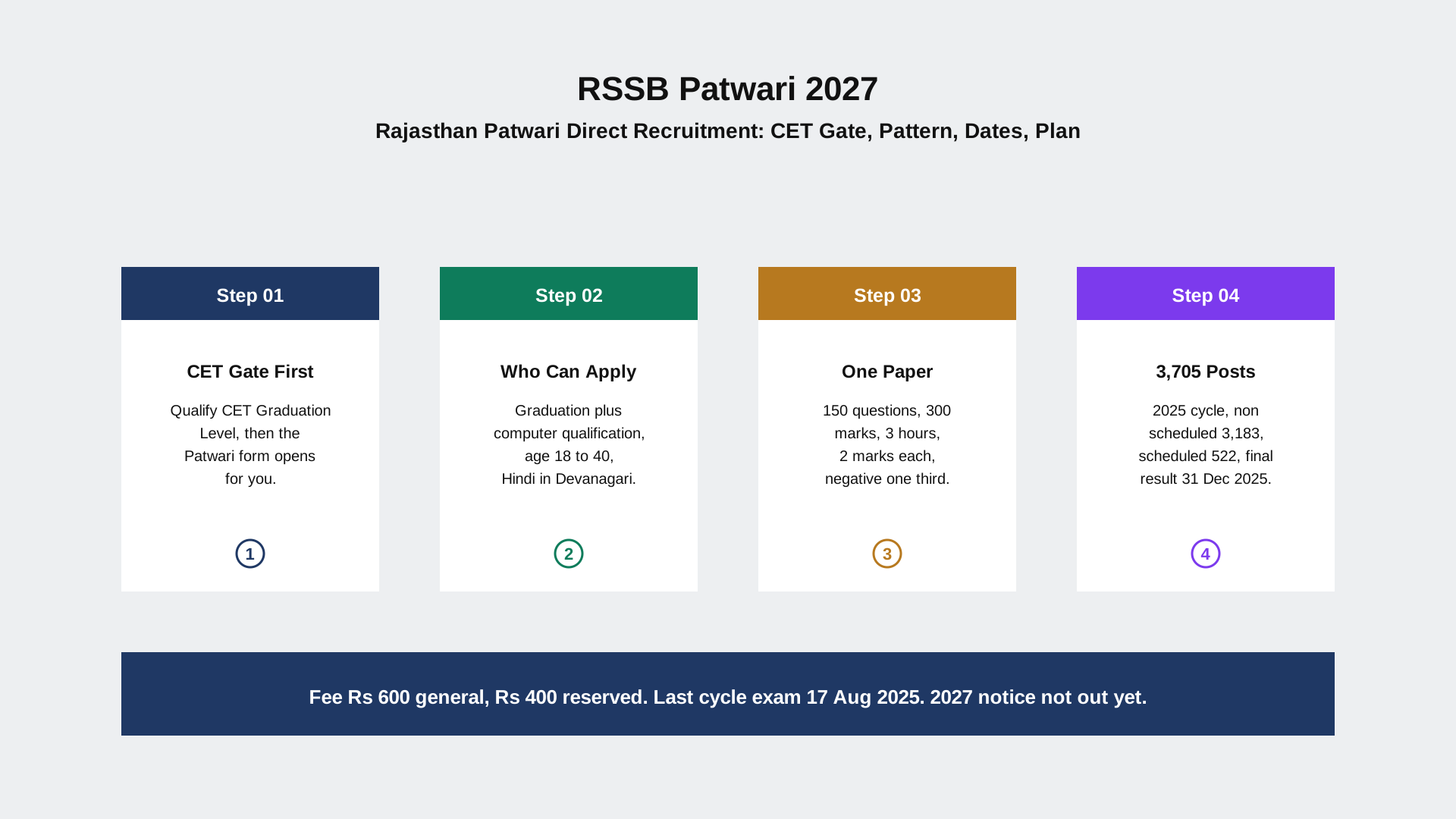
Here is the short version. One written paper, 150 questions for 300 marks, three hours, OMR based. Each question carries two marks. A wrong answer loses one third of the question marks. The paper splits into five sections, with mental ability and reasoning carrying the most weight at 45 questions. Graduation plus a computer qualification is the education rule, the age limit was 18 to 40 years in the last cycle, and the fee followed the one time registration system at Rs 600 for general category and Rs 400 for most reserved categories. The pay is Pay Matrix Level 5.
RSSB Patwari 2027 at a glance
| Detail | RSSB Patwari 2027, as last run in the 2025 cycle |
|---|---|
| Conducting body | Rajasthan Staff Selection Board (RSSB), Jaipur |
| Department | Revenue Department, Government of Rajasthan, through the Board of Revenue, Ajmer |
| Post | Patwari, direct recruitment |
| Last cycle | Patwari Direct Recruitment 2025, Advertisement 02/2025 dated 20 February 2025 |
| Posts in last cycle | 3,705, raised from 2,020 by an amendment dated 20 June 2025 |
| 2027 notification | Not published as of 22 November 2026 |
| Prerequisite | Qualified in CET Graduation Level 2024 |
| Written exam | One paper, 150 questions, 300 marks, 180 minutes, OMR based |
| Negative marking | One third of the question marks per wrong answer |
| Age limit in last cycle | 18 to 40 years as on 1 January 2026, plus 3 years for the recruitment gap |
| Fee in last cycle | One time registration Rs 600 general, Rs 400 reserved categories, correction Rs 300 |
| Pay | Pay Matrix Level 5, Seventh Pay Commission |
| Official website | rssb.rajasthan.gov.in |
What a Patwari actually does
A Patwari keeps the land records of a village or a group of villages, and that job touches almost every rural family in Rajasthan. The Patwari maintains the record of rights, records mutations when land changes hands, measures fields when boundaries are disputed, and prepares the girdawari, the crop inspection record that decides what grew on which field in which season. When a farmer needs a land record for a loan, a sale, or a dispute, the Patwari is the first official they meet.
The work is outdoors as much as it is at a desk. A Patwari walks the fields of the patwar circle, checks crops, verifies boundaries with the village map, and settles small disputes on the spot before they reach the Tehsildar. The post carries authority because the record the Patwari keeps is the record the courts and the banks accept. A mistake in a mutation can cost a family its land claim, so the job rewards care and local knowledge as much as speed.
That local knowledge is why the recruitment tests Rajasthan so heavily. Thirty of the 150 questions cover Rajasthan geography, history, culture and polity. The board wants a Patwari who knows the state, not only a candidate who can solve reasoning questions. A candidate from outside Rajasthan can apply, but the paper gives a clear edge to candidates who know Rajasthan districts, rivers, folk culture and the revenue system itself.
The career path runs upward through the revenue service. A Patwari who completes the training and the service requirements can rise to Kanungo, the supervisor of a group of Patwaris, and from there to Naib Tehsildar and Tehsildar. The post is a starting point, not a ceiling. Many senior revenue officers in Rajasthan began as Patwaris, and the promotion path is one reason the exam draws graduates who could aim at other posts too.
The 2025 cycle, date by date
The 2025 cycle began on 20 February 2025, when RSSB published Advertisement 02/2025 for Patwari Direct Recruitment. The advertisement carried 2,020 posts. Applications opened on 22 February 2025 and closed on 23 March 2025. The board first planned the written exam for 11 May 2025, and that date still appears on many tracker pages. It is the planned date, not the date the exam was held.
On 20 June 2025 the board amended the recruitment. The post count rose from 2,020 to 3,705, an increase of 1,685 posts. The board reopened applications from 23 to 29 June 2025 so that candidates who had missed the first window, and candidates newly covered by the larger vacancy count, could apply. The exam date moved with the amendment. RSSB held the written exam on 17 August 2025 in two shifts, morning and evening, across Rajasthan.
Two shifts meant two papers of the same pattern, and the board normalised the scores with an equi percentile formula. Candidates should understand what that means. Your raw score in a two shift exam is not your final score. The board adjusts scores so that a hard morning paper and an easy evening paper count the same. The cutoffs that followed are normalised cutoffs, and comparing your mock raw score with a normalised cutoff is a rough guide at best.
The result came in stages. RSSB issued a first result list on 3 December 2025. Document verification ran from 8 to 15 December 2025, and about 58,981 candidates who had qualified in the written exam went through it. The final result came out on 31 December 2025, with a final selection list for the non scheduled area and a separate list for the scheduled area. The board chairman announced the approval of the final results through a post on X, and the Times of India reported the release the same day.
One date in this cycle still confuses tracker pages. Some pages list 11 May 2025 as the exam date without noting that it was only the planned date. Others list 17 August 2025 correctly. The result notice from RSSB confirms the exam took place on 17 August 2025 in morning and evening shifts, and that confirmation settles the question. The 11 May date belongs to the revised examination calendar issued on 7 March 2025, which the amendment later superseded.
The vacancy story: 2,020 became 3,705
The jump from 2,020 to 3,705 posts is the most important fact in the 2025 cycle, and it is also the most misreported. Many pages still show 2,020 as the vacancy count, because they copied the February advertisement and never updated it. Others show 3,705 without explaining where the extra posts came from. The amendment dated 20 June 2025 explains it. RSSB raised the count by 1,685 posts, and the final advertised total was 3,705.
The split is 3,183 posts for the non scheduled area and 522 for the scheduled area, the Tribal Sub Plan area. That split matters for cutoffs, because the two areas have separate lists and separate cutoffs. A candidate from a TSP district competes in the scheduled area list. A candidate from elsewhere competes in the non scheduled list. The form itself asks for the area, so a wrong area choice gets caught at the form stage, and understanding the split helps you read the cutoff tables correctly.
The final selection tells a second story. The final result provisionally selected 2,858 candidates from the non scheduled area and 462 from the scheduled area, a total of 3,320 against 3,705 advertised posts. That leaves 385 posts unaccounted for in the final lists. No source checked for this guide explains the gap. It may reflect candidates who failed document verification, posts held back for later lists, or a further result still to come. This guide flags the gap rather than guessing at it. Quote 3,320 only as the number provisionally selected in the final result of 31 December 2025, not as the number of Patwaris appointed.
For the RSSB Patwari 2027 cycle, the vacancy count is unknown. One media report says the creation of around 1,035 new Patwari posts has been proposed under Budget Announcement 177, which could lead to a future recruitment drive. That is a budget proposal, not a notification, and no advertisement, date or exam pattern follows from it. Treat it as a sign that the state wants more Patwaris, and wait for RSSB to publish the actual advertisement before planning around any number.
The CET gate: qualify first, apply second
The CET, the Common Eligibility Test, is the gate in front of the Patwari form. RSSB runs the CET at graduation level, and only candidates declared qualified in the CET of the relevant year can apply for Patwari. In the 2025 cycle the qualifying CET was the CET Graduation Level 2024. The application system checked the CET application number against the candidate SSO ID before the Patwari form would even open.
This rule changes the preparation order for every RSSB Patwari 2027 aspirant. The CET comes first in time and in importance. A candidate who scores well in Patwari mocks but never sat the CET cannot apply at all. A candidate who qualified the CET in 2024 could apply for Patwari in 2025, and the same structure should hold for the next cycle: qualify the CET of the applicable year, then watch for the Patwari advertisement.
One tracker page lists the CET Graduation Level 2026 application window as 4 July to 2 August 2026, with the exam on 1 to 3 December 2026. That listing is tracker reported, and this guide has not verified it against an RSSB notice. It is included here because the CET is the practical first step for the next Patwari cycle, and candidates who miss the CET window miss the Patwari cycle that follows. Check rssb.rajasthan.gov.in for the CET dates rather than trusting any tracker page, including this guide, on a date that decides your eligibility.
The CET itself is a separate exam with its own pattern and its own qualifying mark. The Patwari advertisement does not print the CET pass mark. One exam hub gives it as at least 40 percent marks, with up to 5 percent relaxation for SC and ST candidates, but that figure is tracker reported and should be confirmed from the CET notification. What is certain is the structure. CET first, Patwari second, and no shortcut between them.
Who can apply: education and computer qualification
The education rule has three parts, and all three must hold. First, a bachelor degree in any stream from a university established by law, or an equivalent examination recognised by the government. There is no subject bar. An arts graduate, a science graduate and a commerce graduate stand equal at this step.
Second, a computer qualification from the list in the advertisement. The accepted routes include NIELIT or DOEACC O Level or higher, the COPA or DPCS trade qualification, a recognised diploma or degree in Computer Science or Computer Application, a three year polytechnic diploma in Computer Science and Engineering, RS-CIT, an engineering degree in any branch, or Senior Secondary with Computer Science or Computer Application as a subject. The list is broad on purpose. Most graduates already hold one of these qualifications, often RS-CIT, and many do not realise it counts until they read the list.
Third, knowledge of Hindi in Devanagari script and of the culture of Rajasthan. This condition appears in the advertisement as a requirement, and it is tested in the paper itself through the Hindi section and the Rajasthan section. A candidate who cannot read Devanagari will struggle with the Hindi questions and with the form itself, which is published in Hindi and English.
Check your computer qualification early. RS-CIT takes weeks to complete if you do not hold it, and the O Level takes longer. Candidates who discover the computer condition in the last week of the application window cannot fix it in time. The degree, the computer certificate and the CET qualification are the three documents the form asks for, and document verification later checks each of them. A candidate who clears the written exam and then fails document verification over a missing computer certificate loses everything.
Age limit: 18 to 40, plus 3 years
The 2025 cycle set the age limit at 18 to 40 years as on 1 January 2026. The reference date is worth noting. The advertisement came out in February 2025, but the age was counted as on 1 January 2026, the January of the year after the advertisement. Candidates who turned 40 during 2025 still fell inside the limit if they were under 40 on that January date.
On top of the 40 year ceiling, the notification gave an additional relaxation of up to 3 years in the upper age limit. The reason was written into the notice. Patwari recruitment had not been held in the preceding three years, so the board added three years for all applicants. That took the effective ceiling to 43 years for candidates who used the full relaxation. The relaxation applied because of the gap, and a future cycle may not carry it if recruitments run on time. Do not plan your RSSB Patwari 2027 attempt around the 3 year addition. Plan around 18 to 40, and treat any gap relaxation as a bonus the notification may or may not repeat.
Age relaxation under the Rajasthan rules also applies by category, as in other RSSB recruitments, but the exact table for the Patwari cycle should be read from the advertisement itself. This guide does not print a category relaxation table, because no verified table for the 2025 cycle was found in the sources checked. Tracker pages print several versions, and they disagree. The 18 to 40 base limit and the 3 year gap relaxation are the two figures the notification sources agree on, and those are the figures this guide prints.
Patwari exam pattern: one paper, 300 marks
The Patwari exam pattern is one paper, and the whole selection rides on it. There is no second paper, no interview, and no physical test. The written exam decides the merit order, and document verification decides who among the qualified candidates actually gets the post. That shape is what makes the Patwari exam pattern so unforgiving: one paper, one day, one score.
| Section | Questions | Marks |
|---|---|---|
| General Science, History, Polity and Geography of India, General Knowledge, Current Affairs | 38 | 76 |
| Geography, History, Culture and Polity of Rajasthan | 30 | 60 |
| General English and Hindi | 22 | 44 |
| Mental Ability and Reasoning, Basic Numerical Efficiency | 45 | 90 |
| Basic Computer | 15 | 30 |
| Total | 150 | 300 |
Each question carries two marks, so the paper totals 300 marks in 180 minutes. That gives you 72 seconds per question, which is tighter than it looks. The reasoning section alone has 45 questions, and reasoning questions eat time. The candidates who finish the paper are the ones who move fast through the sections they know and return to the hard questions only at the end.
Negative marking applies. Each wrong answer loses one third of the question marks, which is two thirds of a mark per wrong question at two marks each. A guess has an expected value that depends on how many options you can eliminate. With four options and no elimination, a guess loses marks on average. With two options eliminated, a guess gains. The rule for the hall is simple. Answer when you know it. Answer when you can eliminate two options. Skip with option E when you cannot eliminate anything.
The fifth option rule applies here as well. Each question has five circles, A to D for the answer and E for not attempted. Leaving all five blank costs the same as a wrong answer, one third of the question marks, and leaving more than 10 percent of the questions blank disqualifies the candidate. Ten percent of 150 is 15 questions. Darken E for every question you choose not to answer. Never leave a question entirely blank.
One tracker page prints a different pattern for this exam: 130 questions for 260 marks in two hours, with current affairs as a separate 10 question section. That table is wrong against the advertisement. The official scheme is 150 questions for 300 marks in three hours, with the five sections shown above. The wrong table appears to copy an older or a different exam, and it still circulates because trackers copy each other. The scheme in this guide follows Advertisement 02/2025 as reported by the sources that read the notification itself.
The syllabus, section by section
General Science, History, Polity and Geography of India, General Knowledge and Current Affairs carries 38 questions for 76 marks. The science part covers basic elements of everyday science, the human body, food and nutrition, and health care. The history part covers the main features of ancient and medieval Indian history and important events from the mid 18th century to the present. The polity part covers the Indian Constitution, the political system, the system of governance, and constitutional development. Geography covers India physical features and environmental and ecological change. Current affairs covers national events. This is the broadest section in the paper, and it rewards steady newspaper reading more than any single book.
Rajasthan Geography, History, Culture and Polity carries 30 questions for 60 marks. It covers the physical features of Rajasthan, its rivers and districts, its history from the princely states to the present, its folk culture, fairs and festivals, and the structure of its government. This section is where Rajasthan candidates earn their edge. A candidate who has read a Rajasthan general knowledge book twice will score here. A candidate who has not opened one will drop 60 marks that others collect easily. Spend a fixed 30 minutes every day on Rajasthan alone, and this section becomes your safest 60 marks.
General English and Hindi carries 22 questions for 44 marks. Hindi covers sandhi and sandhi viched, prefixes and suffixes, samas, and differences in meaning between similar words. English covers synonyms and antonyms, tenses, and sentence correction. The section is small, but it is the section where a prepared candidate loses nothing. The questions follow fixed patterns, and the same grammar rules repeat every cycle. Revise the rules, practise 22 questions a day, and the section becomes routine.
Mental Ability and Reasoning with Basic Numerical Efficiency carries 45 questions for 90 marks, the largest section in the paper. It covers number series, coding and decoding, blood relations, direction sense, seating arrangements, analogies, and basic arithmetic: percentages, ratio, averages, time and work, and simple interest. Ninety marks is 30 percent of the paper. A candidate who is strong here can carry a weak general knowledge score. A candidate who is weak here cannot make it up elsewhere, because no other section is large enough. Give this section the largest share of your practice time, and practise it under a timer from the first week.
Basic Computer carries 15 questions for 30 marks. It covers computer fundamentals, MS Office, the internet, email, and simple concepts of software and hardware. Fifteen questions is a small section, but the questions are direct and the marks are cheap. A candidate who has done RS-CIT or an O Level course already knows most of this syllabus. A candidate who has not should spend one week on a basic computer book and bank the 30 marks. No other section gives marks this cheaply.
Fee and how to apply
The 2025 cycle used Rajasthan one time registration system, the OTR fee. General category, creamy layer OBC and creamy layer MBC candidates paid Rs 600. Rajasthan non creamy layer OBC, MBC, EWS, SC and ST candidates paid Rs 400. All persons with disability applicants paid Rs 400. Candidates from outside Rajasthan were treated as general category and paid Rs 600. The correction charge was Rs 300. Once the OTR fee is paid, the candidate does not pay an application fee again for future exams under the same registration.
Applications ran online through the Rajasthan SSO portal, sso.rajasthan.gov.in, linked from the RSSB website. The original window ran from 22 February to 23 March 2025. The reopened window ran from 23 to 29 June 2025, after the vacancy amendment. The form asked for the CET application number first, verified it against the SSO ID, and only then opened the Patwari application. Candidates who had not qualified the CET could not proceed past that check.
When the RSSB Patwari 2027 notification comes, expect the same shape: OTR fee, SSO portal, CET check first, then the form. The fee figures may change, so check the new advertisement rather than assuming Rs 600 and Rs 400 will hold. What will not change is the order. CET qualification comes before the Patwari form, and the form checks it automatically. Keep your SSO ID, your CET details and your computer qualification certificate ready before the window opens, because the window is short and the portal slows down in the last two days.
Pay and probation
The Patwari post carries Pay Matrix Level 5 under the Seventh Pay Commission of the Rajasthan government. One tracker page gives the minimum basic pay as Rs 20,800 per month, and that figure is tracker reported rather than verified from the notification text, which states the pay level without printing the basic figure. The gross salary adds allowances on top of the basic pay, and the exact in hand figure depends on the posting and the allowances in force at the time of joining. This guide prints the pay level as fact and the basic figure as a tracker figure, because the distinction matters to candidates comparing posts.
Probation has its own rule. During the probation period, the board pays a fixed remuneration at the rate decided by the state government, and the regular pay scale of the post starts only after probation. The notification states this clearly. Candidates who join should expect the fixed remuneration in the probation years and the full Level 5 pay after it. The training that follows selection is part of the same structure. A Patwari learns the record keeping, the survey work and the girdawari process in training before taking charge of a circle.
Compare this with the neighbouring state. A Punjab Patwari starts at Pay Matrix Level 2 with Rs 19,900, a lower level than Rajasthan Level 5. The comparison is useful only to show that the same post name carries different pay in different states. It does not change the Rajasthan figure, and candidates should compare posts within Rajasthan when they choose between exams.
Cutoffs: what the 2025 numbers actually say
The 2025 cutoffs are normalised scores out of 300, and they vary by category and by area. The shortlisting cutoffs for the non scheduled area, published with the written result, were 249.238 for general category, 235.2158 for general female, 241.5566 for general EWS, 226.7963 for SC, and 223.595 for ST. The final cutoffs reported with the final result were higher: 253.45 for general category and 250.09 for OBC. The two sets of numbers describe different stages. The shortlisting cutoff is the line to reach document verification. The final cutoff is the line to get selected. Quoting one set as the other is the most common cutoff error on tracker pages.
These numbers are high, and they tell you something about the paper. A general category candidate needed about 249 out of 300, which is 83 percent, just to reach document verification. The paper was not easy, and the competition was not thin. About 58,981 candidates reached document verification from a much larger written exam entry, and 3,320 were provisionally selected in the final result. The selection ratio is brutal, and it is the reason the reasoning section matters so much. At cutoffs above 80 percent, the paper is decided by the questions other candidates get wrong, and those questions sit in reasoning and Rajasthan general knowledge.
Do not use the 2025 cutoffs as a target for RSSB Patwari 2027. Cutoffs move with the paper difficulty, the vacancy count and the number of applicants. A larger vacancy count pulls cutoffs down. A harder paper pulls cutoffs down. A smaller vacancy count pushes them up. The 2025 cutoffs are useful for one thing only: they show the standard the paper sets. Prepare to score above 250 out of 300 in mocks, and you prepare at the level the real paper demands.
A 90 day plan that fits the real paper
Ninety days is enough for the RSSB Patwari 2027 paper if the days follow the weight of the sections. The first 30 days belong to reasoning and Rajasthan general knowledge, the two sections that together carry 150 of the 300 marks. Reasoning needs 45 questions a day under a timer, with the timer set to 50 minutes for the set. Rajasthan needs a general knowledge book read twice, with a notebook for districts, rivers, folk culture and the revenue system. Do these two sections first every day, while your mind is fresh.
Days 31 to 60 belong to general science, India history, polity and geography, plus the language section. Read the newspaper every day for current affairs and keep a one page note of national events. The science and history questions come from school level books, so NCERT Class 6 to 10 science and history cover most of the syllabus. The language section needs 22 questions a day, with the grammar rules revised once a week.
Days 61 to 75 belong to mocks and to the computer section. Sit one full paper every second day, 150 questions in 180 minutes, with negative marking applied in scoring, so the Patwari exam pattern becomes habit rather than a surprise on exam day. Score each mock with the real rules: two marks per correct answer, two thirds of a mark lost per wrong answer, one third of a question lost per blank. Then spend the day after each mock on the questions you got wrong. The computer section needs one week of a basic book in this phase, and it will bank 30 marks that many candidates leave behind.
Days 76 to 90 belong to revision and to speed. Revise reasoning formulas and Rajasthan facts twice in this phase, because they fade fastest and they carry the most marks. Sit two full papers in the last ten days, and practise the guessing rule until it is automatic: answer when you know it, answer when you can eliminate two options, darken E when you cannot eliminate anything. In the last week, stop learning new topics. Revise what you know, sleep properly, and arrive at the hall with the OMR rules clear in your head.
Mistakes that cost candidates marks
The first mistake is guessing blindly under the Patwari exam pattern. The paper punishes wrong answers, and a blind guess loses two thirds of a mark. Candidates who carry the REET habit of guessing everything into this paper lose marks on every question they do not know. The rule is different here. Guess only when you can eliminate two options. Otherwise darken E.
The second mistake is leaving questions blank. A blank costs the same as a wrong answer, and 16 blanks disqualify the paper. Darken E for every question you choose not to answer. The E bubble exists so that a deliberate skip costs nothing. An empty bubble is the only expensive choice.
The third mistake is ignoring Rajasthan. Thirty questions and 60 marks sit in the Rajasthan section, and candidates who revise only national general knowledge give away a fifth of the paper. Rajasthan general knowledge is also the section where revision pays fastest, because the facts repeat across cycles: districts, rivers, folk deities, fairs, and the revenue system itself.
The fourth mistake is treating the computer section as unimportant. Fifteen questions is a small section, but the questions are direct and the marks are cheap. Candidates who skip computer revision lose 30 marks that their competitors collect with one week of reading.
The fifth mistake is applying without a CET qualification. The form checks the CET application number before it opens, and a candidate without it cannot apply at any fee. Check your CET status before the Patwari notification comes, not after it. The CET window closes months before the Patwari window opens, and no late CET can save a missed one.
Where to check next
The next Patwari notification, for RSSB Patwari 2027, will appear on rssb.rajasthan.gov.in, the RSSB website, and the application will run through the Rajasthan SSO portal. Check the RSSB website directly. Tracker pages will carry the news within hours, but they will also carry the old 2,020 vacancy figure in headlines copied from the February advertisement, because many of them never updated it after the June amendment. When a new notification appears, read the advertisement number first. Patwari 2025 was Advertisement 02/2025. The next cycle will carry its own number, and that number is the only reliable way to tell a new cycle from a recycled old article.
The CET dates matter just as much as the Patwari dates. The CET Graduation Level exam is the gate, and its application window opens months before the Patwari form. Watch the RSSB website for the CET notification as well, and keep your CET qualification valid for the cycle you want to enter. A candidate who qualifies the CET in the wrong year, or who misses the CET window entirely, waits another year for a Patwari form that will not open.
Until the RSSB Patwari 2027 notification lands, the 2025 cycle in this guide is the best map of the exam. The pattern has been stable, the section weights have been stable, and the CET gate has been stable. A new notification may change the vacancy count or the fee. It is unlikely to change the shape of the paper. Prepare on the shape in this guide, and adjust the dates when the board publishes them.
Sources
Rajasthan Staff Selection Board, Advertisement 02/2025, Patwari Direct Recruitment 2025, detailed advertisement dated 20 February 2025, on rssb.rajasthan.gov.in. Pariksha Saathi, Rajasthan Patwari 2025 exam pattern, syllabus and age limit, verified 15 November 2026, with the amended notice of 20 June 2025. Shishya, Rajasthan Patwari exam hub, pattern 150 questions for 300 marks in 180 minutes and exam held 17 August 2025, read 27 October 2026. CareerPower, Rajasthan Patwari Notification 2025, 3,705 vacancies and exam date 17 August 2025. CareerPower, RSSB Patwari Final Result 2025, final result 31 December 2025, document verification 8 to 15 December 2025, 2,858 non scheduled and 462 scheduled candidates provisionally selected. Times of India, RSSB Patwari result 2025, final result approved, final cutoffs general 253.45 and OBC 250.09. ExamDetail, Rajasthan Patwari Vacancy 2026, official status as on 1 October 2026, vacancy split 3,183 non scheduled and 522 scheduled, shortlisting cutoffs, age 18 to 40 as on 1 January 2026, OTR fee Rs 600 and Rs 400. The Finance Base, RSSB Patwari Recruitment 2025, original 2,020 posts, amendment 20 June 2025, exam 17 August 2025, first result list 3 December 2025. KadamSetu, RSSB Patwari 2025 result, OTR fee table, age limit and pay matrix Level 5. A2Z Exam Detail, RSSB Patwari recruitment syllabus, pattern and exam date, CET Graduation Level 2026 dates and minimum basic pay Rs 20,800. Aavedan, Rajasthan Patwari 2025, vacancy 3,705 with non scheduled 3,183 and scheduled 522.







