
Punjab Exams 2027: Complete Guide to 10 Punjab Government Exams
📖 Table of Contents
- Punjab Exams 2027 at a glance
- The Punjabi rule that runs through every Punjab exam
- Punjab PCS 2027
- Punjab Police Constable 2027
- Punjab Police SI 2027
- Punjab TET 2027
- Punjab Patwari 2027
- Punjab Clerk 2027
- Punjab High Court 2027
- Punjab Junior Engineer 2027
- Punjab Forest Guard 2027
- Punjab Staff Nurse 2027
- What each examination charges and how it selects
- How to pick your exam from the ten
- A 90 day plan that works across the set
- Mistakes that cost candidates a year
- Where to check next
- Sources
Punjab Exams 2027: Complete Guide to 10 Punjab Government Exams
Punjab Exams 2027 is not one examination. It is ten different recruitments run by six different bodies, and the candidate who treats them as one exam prepares for the wrong paper. The Punjab Public Service Commission runs the PCS. The Punjab Police runs its own Constable and Sub Inspector recruitments. The Subordinate Services Selection Board, known as PSSSB, runs Clerk, Patwari, Junior Engineer and Forest Guard. The Society for Centralized Recruitment of Staff in Subordinate Courts, known as SSSC, runs the High Court Clerk recruitment. Baba Farid University of Health Sciences, known as BFUHS, runs the Staff Nurse recruitment. The State Council of Educational Research and Training, known as SCERT Punjab, runs the Punjab Teacher Eligibility Test. One state, six doors, and each door has its own form, its own fee and its own paper.
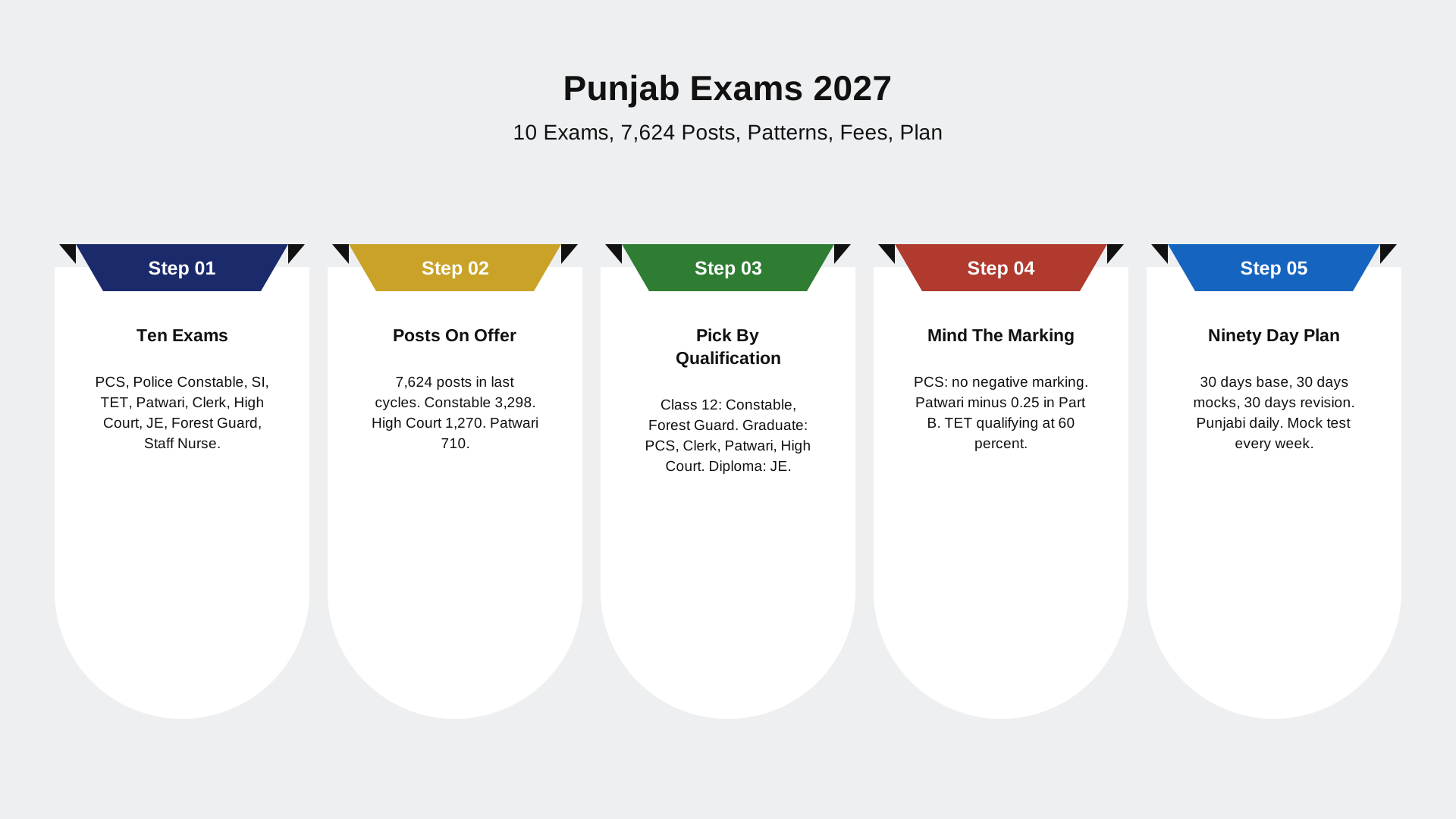
This guide puts all ten on one page, with the last verified cycle for each. Together the ten examinations offered 7,624 posts in their last cycles, leaving out the Teacher Eligibility Test, which is an eligibility test and carries no posts of its own. That total mixes cycles from different years, because the examinations do not run on the same calendar. The Police Constable last ran in 2026 with 3,298 posts, the High Court Clerk notification came in October 2026 with 1,270 posts, the Staff Nurse ran in 2026 with 672 posts, the Clerk ran in 2026 with 589 posts, the PCS last ran in 2025 with 331 posts, and the Patwari and Sub Inspector last ran in 2023. The guide says the year for every figure, so a reader can see which numbers are fresh and which are waiting for a new notification.
As of 21 November 2026, no 2027 notification has been published for most of these examinations. The High Court Clerk applications closed on 4 November 2026 and the written test date is still awaited. The Junior Engineer form windows ran through November 2026. The Teacher Eligibility Test examination of the 2026 cycle was held on 15 March 2026. This guide anchors on those last cycles and says plainly where the next notice is still awaited, because a guide that invents 2027 dates helps no one.
One thread runs through all ten examinations, and it is the first thing a new candidate should check. Every Punjab government post asks for Punjabi at matriculation level, either as a subject passed in Class 10 or as a qualifying language paper in the examination itself. The PCS demands it before the prelims. The Patwari, Clerk and Forest Guard papers test it as a qualifying Part A. The Staff Nurse recruitment adds a Punjabi language test with a 50 percent pass mark. A candidate who has not passed Punjabi at matriculation level needs to clear that test first, and the rest of this guide assumes that box is ticked.
Punjab Exams 2027 at a glance
| Exam | Body | Last cycle | Posts | Who can apply |
|---|---|---|---|---|
| Punjab PCS 2027 | PPSC | 2025, Advt 20251 | 331 | Graduate, age 21 to 37 |
| Punjab Police Constable 2027 | Punjab Police | 2026, Advt 01 of 2026 | 3,298 | Class 12 pass, age 18 to 28 |
| Punjab Police SI 2027 | Punjab Police | 2023, Advt 01 of 2023 | 288 | Graduate, age 18 to 28 |
| Punjab TET 2027 | SCERT Punjab | 2026, exam 15 March 2026 | Eligibility test, no posts | D.El.Ed or B.Ed, no age limit |
| Punjab Patwari 2027 | PSSSB | 2023, Advt 02 of 2023 | 710 | Graduate plus computer course, age 18 to 37 |
| Punjab Clerk 2027 | PSSSB | 2026, Advt 02 of 2026 | 589 | Graduate plus computer course, age 18 to 37 |
| Punjab High Court 2027 | SSSC | 2026, Notice 37C of 2026 | 1,270 clerks | Graduate, age 18 to 37 |
| Punjab Junior Engineer 2027 | PSSSB | 2026, Advt 07 of 2026 | 262 | Diploma or degree in engineering, age 18 to 37 |
| Punjab Forest Guard 2027 | PSSSB | 2022, Advt 07 of 2022 | 204 | Class 12 pass, age 18 to 37 |
| Punjab Staff Nurse 2027 | BFUHS | 2026, Advt BFU-26/06 | 672 | GNM or B.Sc Nursing, age 18 to 37 |
The table hides one useful fact. Two of the ten examinations are open to Class 12 pass candidates: Police Constable and Forest Guard. Five more are open to any graduate: PCS, Sub Inspector, Patwari, Clerk and High Court Clerk. The Junior Engineer needs a diploma or degree in engineering. The Staff Nurse needs a nursing diploma or degree with registration. The Teacher Eligibility Test needs a teaching diploma or degree. A candidate with a Class 12 certificate can aim at the Constable and the Forest Guard today, while a graduate can sit for five examinations with one preparation base.
The Punjabi rule that runs through every Punjab exam
No other state in India ties its government recruitment so tightly to its own language, and Punjab does it on purpose. The rule takes different shapes in different examinations, and each shape has its own trap. In the PCS, Punjabi at matriculation level is an eligibility condition, checked before the prelims. A candidate who has not passed it can still apply conditionally, but must pass it one day before the prelims date, or the candidature ends. In the Patwari, Clerk and Forest Guard examinations, Punjabi is Part A of the written paper itself: 50 questions at matriculation standard, qualifying in nature, with a minimum of 50 percent needed before Part B is even checked. In the Staff Nurse recruitment, a Punjabi language test with a 50 percent pass mark sits alongside the matriculation condition. In the High Court Clerk recruitment, Punjabi as a subject in matriculation is part of the eligibility list, alongside the degree and computer proficiency.
The practical advice is the same in every case. If you studied in Punjab, check your Class 10 certificate for Punjabi as a subject. If you studied outside Punjab, or in a board that did not offer Punjabi, find out how to pass the Punjabi language examination at matriculation standard before you fill any form. The PSSSB and PPSC websites publish the list of recognised Punjabi examinations, and the test itself is held by the Punjab School Education Board and other recognised bodies. Treat it as a separate small examination with its own date, and clear it early. Candidates lose whole years not because they failed a paper, but because they discovered the language rule after the application window closed.
The language papers in the examinations themselves deserve respect too. The PCS mains has a compulsory Punjabi paper of 100 marks at 10+2 standard, and a candidate needs at least 25 percent in each mains paper to reach the interview. The Patwari Part A is qualifying, but it is not easy: 50 questions of matriculation Punjabi, and a candidate who scores 24 out of 50 has their Part B answer sheet left unchecked, whatever their general knowledge score. A daily half hour of Punjabi reading, writing and grammar, kept up from the start of preparation, removes a risk that no amount of general studies can cover.
Punjab PCS 2027
The Punjab PCS is the top of this set, and its last cycle explains why. The Punjab State Civil Services Combined Competitive Examination of 2025, Advertisement Number 20251 dated 3 January 2025, offered 322 posts at notification and 331 after an addendum dated 3 September 2025. It was the first PCS examination in Punjab since 2020, a five year gap that filled the applicant pool with candidates who had waited through their twenties. Applications ran from 3 January to 31 January 2025, and the prelims were held on 7 December 2025 after two changes of date.
The ten services in the examination cover the whole of Punjab administration. The largest share goes to Excise and Taxation Officers, with 121 posts. The Punjab Civil Service (Executive Branch) had 49 posts after the addendum, Block Development and Panchayat Officers had 49, Tehsildars had 33 after the addendum, Deputy Superintendents of Police had 17, Food and Civil Supply Officers had 13, Assistant Registrars of Cooperative Societies had 21, Labour-cum-Conciliation Officers had 3, Employment Generation, Skill Development and Training Officers had 12, and Deputy Superintendents of Jails Grade 2 and District Probation Officers had 13.
The pattern is the most candidate friendly of any state civil service examination in one respect, and the most demanding in another. Prelims has two papers of 200 marks each, General Studies with 100 questions and CSAT with 80 questions, and there is no negative marking in either paper. CSAT is qualifying at 40 percent, and the prelims merit list rests on the General Studies paper alone. Mains has seven compulsory papers for 1350 marks: Punjabi and English at 10+2 standard for 100 marks each, Essay for 150 marks, and four General Studies papers of 250 marks each. The interview carries 150 marks, taking the total to 1500. A candidate needs 45 percent in the mains aggregate, 40 percent for Scheduled Castes and Scheduled Tribes, and at least 25 percent in each paper to reach the interview.
Age in the 2025 cycle was 21 to 37 years as on 1 January 2025, with Deputy Superintendent of Police limited to 21 to 28 years. The fee was Rs 1500 for general category candidates, Rs 750 for Scheduled Castes, Scheduled Tribes and Backward Classes of Punjab, and Rs 500 for ex-servicemen, Economically Weaker Sections, persons with disabilities and lineal descendants of ex-servicemen of Punjab. The 2027 notification has not been published as of 21 November 2026. The detailed guide for this examination, with the full post table, the mains syllabus and a twelve month plan, is the Punjab PCS 2027 page in this set.
Punjab Police Constable 2027
The Police Constable recruitment is the biggest uniformed examination in Punjab, and its 2026 cycle is the freshest in the whole set. Advertisement Number 01 of 2026, published on 6 March 2026, offered 3,298 Constable posts: 2,522 in the District Police Cadre, with 825 reserved for women, and 776 in the Armed Police Cadre, with 259 reserved for women, excluding sports quota posts. Applications ran from 10 March 2026 at 7 pm to 30 March 2026 at 11.55 pm, and the computer test started from 1 July 2026 onwards. The cycle before it, in 2025, had offered 1,746 posts, so the 2026 count nearly doubled in a single year.
The entry ticket is a Class 12 pass, and the age window is 18 to 28 years as on 1 January 2026. The fee in the 2026 cycle was Rs 1200 for general category candidates, Rs 700 for SC, ST, Backward Classes and EWS of Punjab, and Rs 500 for ex-servicemen of Punjab and their lineal descendants. The pay is Rs 19,900 a month for the first three years from the date of joining. Selection runs through a computer based test, a physical screening test and physical measurement test, document scrutiny, and a medical examination that includes a substance abuse test.
The written test has two papers. Paper 1 has 100 questions for 100 marks in 2 hours and decides the merit: General Awareness 35, Quantitative Aptitude and Numerical Skills 20, Mental Ability and Logical Reasoning 20, English Language Skills 10, Punjabi Language Skills 10, and Digital Literacy and Awareness 5. Paper 2 has 50 Punjabi questions for 50 marks in 1 hour, qualifying only, with 50 percent needed after normalisation. There is no negative marking in either paper. The minimum mark in Paper 1 after normalisation is 40 percent for general category candidates and 35 percent for SC, BC, EWS and ex-servicemen.
The physical tests are qualifying only, but they remove candidates who cleared the written paper and did not train for the run. Men run 1,600 metres in 6 minutes 30 seconds, with a long jump of 3.80 metres and a high jump of 1.10 metres. Women run 800 metres in 4 minutes 30 seconds, with a long jump of 3.00 metres and a high jump of 0.95 metres. The height standard is 170.2 centimetres for men and 157.5 centimetres for women. District Cadre candidates give 15 district preferences, and a selected candidate is not posted in their home district. A candidate who prepares only for the written paper is preparing for half the examination.
Punjab Police SI 2027
The Sub Inspector recruitment is the graduate entry to the Punjab Police, and its last full cycle is older than the Constable cycle. Advertisement Number 01 of 2023, published on 31 January 2023, offered 288 Sub Inspector posts: 144 in the District Police Cadre and 144 in the Armed Police Cadre, excluding sports quota posts. Applications ran from 7 February to 28 February 2023. The 2022 cycle before it had offered 560 posts across four cadres, but the Common computer based tests of August 2022 were scrapped after reports of cheating and malpractices, so the vacancy count fell by almost half between the two cycles.
The entry ticket is a bachelor degree, and the age window is 18 to 28 years as on 1 January 2023. The pay is Rs 35,400 a month for the first three years from joining, at Level 6 of the pay matrix. The written test has three papers. Paper 1 has 100 questions for 400 marks in 2 hours: General Awareness 50, Quantitative Aptitude and Numerical Skills 30, Punjabi Language Skills 20. Paper 2 has 100 questions for 400 marks in 2 hours: Logical and Analytical Reasoning and Data Interpretation 50, Digital Literacy and Computer Awareness 30, English Language Skills 20. Paper 3 has 50 Punjabi questions for 50 marks in 1 hour, qualifying only, with 50 percent needed. Merit comes from Paper 1 and Paper 2 combined after normalisation.
Unlike the Constable paper, the Sub Inspector papers carry negative marking: 1 mark cut for each wrong answer in Paper 1 and Paper 2, which is 25 percent of the 4 marks per question. There is no negative marking in Paper 3. The minimum mark after normalisation is 40 percent in each of Paper 1 and Paper 2 separately for general category candidates, and 35 percent for SC, BC, EWS and ex-servicemen. The physical tests are qualifying only: men run 1,600 metres in 7 minutes, women run 800 metres in 5 minutes, with long jump and high jump standards for both. There was no interview in the 2023 notification. The 2025 cycle has not been notified as of 21 November 2026, so candidates preparing now are working on the 2023 pattern.
One caution is needed here, because web searches for Punjab Police Sub Inspector return a large volume of results about the Punjab Public Service Commission of Pakistan, which advertised 300 Sub Inspector posts in September 2025 under its own Advertisement Number 36 of 2025. That is a different country, a different commission and a different examination. The Indian Punjab Police recruitment runs through punjabpolice.gov.in, and the figures in this guide come from that recruitment only. In August 2026 Punjab also notified rules for direct recruitment of Assistant Sub Inspectors, with about 300 to 350 ASI posts expected as per media reports, but no ASI notification or pattern has been published yet.
Punjab TET 2027
The Punjab Teacher Eligibility Test is the odd one out in this set, because it gives no job by itself. PSTET is an eligibility test. Passing it makes a candidate eligible to apply for teacher posts in Punjab government and aided schools for Classes 1 to 8, and the actual appointment comes from a separate teacher recruitment. Candidates who treat PSTET as a job notification misunderstand the examination, and candidates who skip it find the teacher recruitment door closed when it opens.
The 2026 cycle was conducted by the State Council of Educational Research and Training, Punjab, known as SCERT Punjab. The notification came on 6 February 2026, online applications ran from 6 February to 20 February 2026, with a correction window from 21 to 23 February 2026, and the examination was held on 15 March 2026 in offline pen and paper mode. The provisional answer key came on 16 March 2026, objections were taken from 17 to 21 March 2026, the final answer key was published on 28 March 2026, and the result came in April 2026. The 2024 cycle was conducted by the Punjab School Education Board instead, with the examination on 1 December 2024, so the conducting body has changed between cycles and candidates should check the current notice rather than assuming it.
There are two papers. Paper 1 covers eligibility for teaching Classes 1 to 5: Child Development and Pedagogy 30, Language 1 Punjabi 30, Language 2 English 30, Mathematics 30, Environmental Studies 30. Paper 2 covers eligibility for teaching Classes 6 to 8: Child Development and Pedagogy 30, Language 1 Punjabi 30, Language 2 English 30, and the chosen stream for 60 marks, in Mathematics and Science or Social Studies or another specialist subject. Each paper has 150 questions for 150 marks in 2 hours 30 minutes, with 1 mark per question and no negative marking.
The qualifying mark is 60 percent, or 90 out of 150, for general category candidates, and 55 percent, or 82 out of 150, for SC, ST and OBC candidates, with no separate per-section qualifying mark. The certificate is valid for a lifetime under current NCTE guidelines, replacing the earlier seven year rule. There is no age limit, and non Punjab domicile candidates are treated as General category candidates. The fee in the 2026 cycle was Rs 1100 for one paper and Rs 2200 for both papers for general and OBC candidates, Rs 550 and Rs 1100 for SC, ST and differently abled candidates, and free for ex-servicemen. In the 2026 result, 28,243 candidates qualified in Paper 1 out of 53,474 who appeared, about 53 percent, which shows that the paper is passable but not easy.
Punjab Patwari 2027
The Patwari recruitment is the most popular PSSSB examination, and its last cycle is well documented. Advertisement Number 02 of 2023 offered 710 Revenue Patwari posts in the Department of Revenue and Rehabilitation, with 251 reserved for women. The short advertisement came on 13 December 2022 and the detailed notification on 23 February 2023. Applications ran from 23 February to 20 March 2023, reopened to 2 April 2023, and the written examination was held on 14 May 2023. Press reports through September 2026 have put the next recruitment at about 1,001 posts, but PSSSB has not published the advertisement as of 21 November 2026, so this guide uses the 2023 figures and treats the 1,001 post figure as an unverified press report.
The pattern is a single OMR paper of 150 questions for 150 marks, to be finished in 2 hours 30 minutes. Part A is a 50 question Punjabi test at matriculation standard, qualifying in nature, with no negative marking. A candidate must score at least 25 marks in Part A, or Part B is never checked. Part B is the 100 question merit paper: General Knowledge and Current Affairs about 25 percent, Logical Reasoning and Mental Ability about 25 percent, Punjab History and Culture about 16 percent, Punjabi about 13 percent, English about 12 percent, and ICT about 9 percent. Each question carries 1 mark, and each wrong answer in Part B loses 0.25 marks.
The entry ticket is a bachelor degree in any stream, a 120 hour computer course or NIELIT O Level, and Punjabi passed at matriculation level. The age window is 18 to 37 years as on 1 January 2023 in the last cycle. The fee in 2023 was Rs 1000 for general category candidates, Rs 250 for SC and BC, Rs 200 for ex-servicemen and dependents, and Rs 500 for persons with disabilities. The pay is Level 2 of the pay matrix, with initial pay of Rs 19,900 a month. Selection is through the written examination, then document verification, with no interview.
Two points about the Patwari paper deserve attention. The first is the Part A gate. A candidate who is strong in general knowledge and weak in Punjabi can lose the whole examination in the first 50 questions, and the fix is a daily half hour of Punjabi, not a last week crash course. The second is the weight of Punjab History and Culture: about 16 questions in Part B, plus the Punjab content inside the general knowledge section. A candidate who knows the Sikh Gurus, the Misls, Maharaja Ranjit Singh, the freedom movement in Punjab and the folk culture of the state picks up marks that a general studies candidate misses. The Patwari post also leads somewhere: promotion runs from Patwari to Kanungo, then Naib Tehsildar, then Tehsildar, through departmental examinations and seniority. One tracker page prints a different pattern of 120 questions for 120 marks with maths and agriculture sections. That table does not match the official 2023 pattern of 150 questions, so this guide does not use it.
Punjab Clerk 2027
The PSSSB Clerk recruitment is the standard graduate clerk post of the Punjab government, and its 2026 cycle is the freshest PSSSB cycle in this set. Advertisement Number 02 of 2026 offered 531 Clerk (Common Cadre) posts across 29 departments and offices. The largest shares went to the Excise and Taxation field offices with 145 posts plus 5 at head office, the Mandi Board with 90 posts, and the Deputy Commissioner offices at Gurdaspur with 36, Barnala with 24 and Moga with 21. The short notice came on 5 February 2026 and the notification on 13 February 2026. The first application window ran from 13 February to 6 March 2026, the forms reopened from 25 August to 7 September 2026, and the written test was held on 11 October 2026.
A second drive ran alongside it. Advertisement Number 12 of 2026 offered 58 specialised clerk posts, with 13 Legal, 34 Accounts and 11 IT, plus 3 Drivers, 6 Translators and 1 Field Artist. Applications for that drive ran from 25 September to 19 October 2026, with a correction window from 2 to 4 November 2026. The specialised posts add a law degree for Legal, a graduation with statistics, mathematics or accounts for Accounts, or a graduation, BTech, BCA or PGDCA in computer science or IT for the IT posts.
The entry ticket for the common Clerk post is a bachelor degree in any discipline, matriculation with Punjabi, and a 120 hour computer course or DOEACC O Level. The age window is 18 to 37 years as on 1 January 2026. The fee was Rs 1000 for general category candidates, Rs 250 for SC, BC and EWS, Rs 200 for ex-servicemen and dependents, and Rs 500 for physically handicapped candidates. The pay is Rs 19,900 a month at Level 2, a regular Group C post.
The pattern follows the PSSSB common design. Part A is a Punjabi qualifying paper of 50 questions for 50 marks at matriculation standard, with 50 percent needed to pass and no negative marking. Part B is the merit paper of 100 questions for 100 marks, with the two parts together running 2 hours 30 minutes, and 0.25 marks cut for each wrong answer in Part B only. Part B splits as General Knowledge and Current Affairs 25, Punjab History and Culture 17, Logical Reasoning and Mental Ability 25, Punjabi 13, English 12, and ICT 8. Merit rests on Part B alone, with ties broken by the older candidate, then higher educational percentage, then higher Matric marks. After the written paper comes a qualifying typing test: Punjabi in Raavi font with Inscript layout and English, 10 minutes each, at least 30 words a minute gross speed with no more than 8 percent mistakes. The Clerk post is the one to watch for candidates who want a desk job without the physical tests of the police examinations, and it overlaps heavily with the Patwari paper, so a candidate preparing for both can use one set of notes for general knowledge, reasoning, Punjabi and computers.
Punjab High Court 2027
The High Court Clerk recruitment is the newest large drive in this set, and it is the only one run by a court body. Employment Notice Number 37C/SSSC/PB/2026, dated 3 October 2026, offered 1,270 Clerk posts in the District Courts of Punjab through direct recruitment, run by the Society for Centralized Recruitment of Staff in Subordinate Courts, known as SSSC. The split is 793 posts available as on 31 August 2026 plus 450 anticipated posts up to 28 February 2027. Applications ran from 7 October 2026 at 4 pm to 4 November 2026 at 4 pm on sssc.gov.in, and the written test date had not been announced as of 21 November 2026.
The entry ticket is a bachelor degree in Arts, Science or equivalent from a recognised university, Punjabi as a subject in matriculation, and computer proficiency, all held by the closing date of applications. The age window is 18 to 37 years as on 1 January 2026, with relaxation of 5 years for SC and BC of Punjab, 10 years for persons with benchmark disabilities of Punjab, service period plus 3 years for ex-servicemen of Punjab, and up to 45 years for in-service employees. The fee was Rs 550 as an online facilitation charge plus an examination fee in every slab: SC, BC, OBC, ex-servicemen and EWS of Punjab paid Rs 160 as examination fee for a total of Rs 710, persons with benchmark disabilities of Punjab paid Rs 325 for a total of Rs 875, and all other categories paid Rs 650 for a total of Rs 1200. The pay is Rs 29,200 a month at Level 5 of the pay matrix.
The pattern is the most distinctive in this set. The computer based test carries 100 marks over 2 hours: General Knowledge objective with 50 questions for 50 marks, English Composition objective with 20 questions for 20 marks, and English Composition subjective for 30 marks, with an essay of 150 words for 10 marks, a letter for 5 marks, a precis for 5 marks, and translation from Punjabi to English for 10 marks. Negative marking of 0.25 applies in the objective section only. The qualifying marks are 33 percent in each subject and 40 percent in aggregate, and the subjective paper is checked only for candidates who score 33 percent or more in General Knowledge. After the written test comes a qualifying Computer Proficiency Test, with a spreadsheet test in MS Excel for 10 marks over 10 minutes, needing at least 4 marks, and an English computer typing test at 30 words a minute. The typing and spreadsheet marks do not count in the merit list.
One confusion must be avoided. A sister drive, Employment Notice 36C/SSSC/HR/2026, offered 1,265 Clerk posts in the subordinate courts of Haryana, with its computer based test held from 24 August to 7 September 2026. The Punjab drive has 1,270 posts and the Haryana drive has 1,265, and tracker pages mix the two. Candidates should apply on the Punjab notice only, and check sssc.gov.in for the Punjab test date. The High Court establishment at Chandigarh also ran separate 2026 drives for 25 Senior Scale Stenographers and 25 Steno Typists, with shorthand at 100 words a minute, which are different posts from the District Court Clerk drive.
Punjab Junior Engineer 2027
The Junior Engineer recruitment is the engineering door in this set, and its 2026 cycle is live as this guide is written. Advertisement Number 07 of 2026, notified on 13 March 2026, offered 262 Junior Engineer posts after a corrigendum on 11 November 2026 raised the total from 158. The split is Civil 228, Electrical 32 and Mechanical 2, with 83 posts for women. The posts sit in the Water Resources, Public Works (Buildings and Roads), Rural Development and Panchayats, Local Government and other Punjab government departments. The form windows ran from 13 March to 6 April 2026, reopened from 1 to 15 September 2026, from 12 to 27 October 2026, and from 11 to 17 November 2026, and candidates who had already applied did not need to apply again.
The entry ticket is a degree or three year diploma in Civil, Mechanical or Electrical Engineering from a recognised institute, in the discipline of the post, plus Punjabi at matriculation level. B.E., B.Tech and M.Tech holders in the relevant discipline are eligible. The age window is 18 to 37 years as on 1 January 2026, with relaxation to 42 years for SC and BC, 45 years for Punjab government employees, 47 years for persons with disabilities, 40 years for widows and divorcees, and ex-servicemen per Punjab government rules. The fee was Rs 1500 for general category candidates, Rs 750 for SC and BC, and Rs 500 for EWS, ex-servicemen and persons with disabilities. The pay is Pay Level 6, with starting basic pay of Rs 35,400 a month plus allowances.
The examination is a single objective paper of 120 multiple choice questions for 120 marks in 2 hours. Part A has 40 general questions and Part B has 80 technical questions in the discipline of the post. Each right answer earns 1 mark and each wrong answer loses 0.25 marks, with no cut for an unattempted question. Selection runs through the written examination, document verification and medical examination, with no interview. The previous cycle, Advertisements 15 and 16 of 2025, offered 157 posts with the same 120 question pattern. The Punjab State Power Corporation recruits its own Junior Engineers through separate advertisements, so this package covers the PSSSB drive only. For an engineering graduate, this is the best paid post in the set after the PCS and the Sub Inspector, and the technical paper means a candidate with a strong diploma can beat a general graduate who knows no engineering.
Punjab Forest Guard 2027
The Forest Guard recruitment is the outdoor post in this set, and its last full cycle is the oldest of the ten. Advertisement Number 07 of 2022, notified on 19 May 2022, offered 204 posts in all: Forest Guard 200, with 134 for men and 66 for women, Forester 2 and Deputy Ranger 2. Applications ran from 19 May to 8 July 2022, extended from 28 June. The Forest Guard written examination was held on 13 November 2022, the Forester paper on 20 November 2022 and the Deputy Ranger paper on 26 November 2022. The written result came on 2 January 2023, and the physical efficiency and measurement test ran from 29 April to 3 May 2023.
The entry ticket is Senior Secondary Part II, a Class 12 pass, or equivalent from a recognised board or university, in any stream, plus Punjabi at matriculation level. The age window was 18 to 37 years as on 1 January 2022. The written paper has 120 multiple choice questions for 120 marks in 2 hours at Class 12 level: General Knowledge and Current Affairs 30, Logical Reasoning, Mental Ability and Basic Maths 30, Punjab History and Culture 20, English 15, Punjabi 15, and ICT 10. Each right answer earns 1 mark and each wrong answer loses 0.25 marks. Selection runs through the written examination, physical efficiency and measurement test, document verification and medical examination.
The physical test is the part that sets this examination apart. The height standard is 167 centimetres for men and 150 centimetres for women, with a chest standard for men of 79 centimetres unexpanded and 84 centimetres expanded. The walk is 13 kilometres for men and 8 kilometres for women, to be finished in 90 minutes. The pay starts at Rs 21,700 a month for Forest Guard, with Forester at Rs 25,500 and Deputy Ranger at Rs 35,400 in the same advertisement. A more recent round ran in 2025: a 500 post Forest Department drive with 29 Forest Guard posts, 451 Clerk posts and 20 Warden posts, with forms from 30 July to 24 August 2025. The fee for the 2022 cycle was not verified from any retrieved source, so this guide does not print one. Candidates should check the height and walk standards in the first week of preparation, because the walk is the stage that removes the most candidates who cleared the written paper.
Punjab Staff Nurse 2027
The Staff Nurse recruitment is the health post in this set, and its 2026 cycle is the largest nursing drive Punjab has run. Advertisement Number BFU-26/06, released on 13 March 2026, offered 672 Staff Nurse posts, with applications from 13 March to 2 April 2026 and the examination on 19 April 2026. The cycle before it, in 2025, offered 406 posts under Advertisement Number BFU-25/20, with 167 fresh posts and 239 backlog posts. The recruitment is run by Baba Farid University of Health Sciences, known as BFUHS, and the two cycles together show a department hiring in volume after years of backlog.
The entry ticket is Senior Secondary Part 2, a Class 12 pass, plus a GNM diploma or a B.Sc Nursing degree, with registration as Nurse and Midwife with the Punjab Nursing Registration Council under the Punjab Nurses Registration Act, 1932. Post Basic B.Sc and M.Sc Nursing holders are also eligible. The age window is 18 to 37 years as on 1 January of the recruitment year. Punjabi as a subject in matriculation is required, and candidates must also pass a Punjabi language test with at least 50 percent marks. The pay is Rs 29,200 a month at Pay Level 5, a permanent Group C post.
Selection is different from every other examination in this set. There is no interview. The total is 100 marks: a written test for 90 marks plus experience marks up to 10. Experience earns 1 mark per completed year, and 1.5 marks per year for COVID-19 service from March 2020 to June 2021, capped at 10, only for contract or outsource service in the same post in the Punjab Health Department or the UT Administration of Chandigarh without a break. The minimum qualifying mark in the written test is 33 percent as reported by tracker summaries of the notice. The fee in the 2026 cycle was Rs 2,360 for all categories except SC, for whom it was Rs 1,180, with GST included in both figures. Two parallel 2026 drives ran alongside the main one: BFU-26/04 for 200 Staff Nurse posts at the Dr B R Ambedkar State Institute in Mohali, and BFU-26/02 for 59 Staff Nurse posts in BFUHS affiliated hospitals, each needing its own application and fee. In December 2025 the Finance Minister approved 1,568 NHM posts, with 729 ANM posts and 839 Staff Nurse posts, but no advertisement had appeared as of 21 November 2026.
What each examination charges and how it selects
The fees in this set range from Rs 500 to Rs 2,360, and the selection stages range from a single written paper to a four stage process with physical tests. A candidate applying for three or four examinations in one year should budget for the fees together, because the total crosses Rs 4,000 quickly. The table below lists the fee and the selection stages for each examination from its last verified cycle. Where the fee was not verified from the sources used for this guide, the table says so rather than printing a tracker figure.
| Exam | Fee in last cycle | Selection stages |
|---|---|---|
| Punjab PCS | Rs 1500 general, Rs 750 SC ST and BC Punjab, Rs 500 ESM EWS and PwD Punjab | Prelims, mains, interview |
| Police Constable | Rs 1200 general, Rs 700 SC ST BC and EWS, Rs 500 ESM Punjab | Computer based test, physical screening and measurement, document scrutiny, medical examination |
| Police SI | Not verified in the sources used | Computer based test, physical measurement and screening, document scrutiny |
| Punjab TET | Rs 1100 one paper, Rs 2200 both papers, general and OBC; Rs 550 and Rs 1100 for SC ST and differently abled; free for ex-servicemen | Written examination only, qualifying at 60 percent |
| Patwari | Rs 1000 general, Rs 250 SC and BC, Rs 200 ESM, Rs 500 PwD | Written examination, document verification |
| PSSSB Clerk | Rs 1000 general, Rs 250 SC BC and EWS, Rs 200 ESM, Rs 500 physically handicapped | Written examination, typing test, document verification |
| High Court Clerk | Rs 1200 general, Rs 710 SC BC OBC ESM and EWS Punjab, Rs 875 PwBD Punjab | Computer based test, computer proficiency test |
| Junior Engineer | Rs 1500 general, Rs 750 SC and BC, Rs 500 EWS ESM and PwD | Written examination, document verification, medical examination |
| Forest Guard | Not verified in the sources used | Written examination, physical efficiency and measurement, document verification, medical examination |
| Staff Nurse | Rs 2360 general, Rs 1180 SC, GST included | Written test for 90 marks plus experience up to 10, no interview |
The pattern behind the table is simple. The examinations with physical tests cost more in preparation time, not in fees: running practice, the measurement standards and the medical check. The examinations with a single written paper cost less in time but carry more competition per post, because every graduate in the state can apply. The PCS costs the most in time, with mains and interview stretching the selection over a year or more. The Teacher Eligibility Test costs the least in stages, with one written examination, and it is the only one where the fee buys eligibility rather than a job.
Six bodies run the ten examinations, and each has its own website, its own application portal and its own calendar. The Punjab Public Service Commission at ppsc.gov.in runs the PCS. The Punjab Police at punjabpolice.gov.in runs the Constable and Sub Inspector recruitments. The Subordinate Services Selection Board at sssb.punjab.gov.in runs the Clerk, Patwari, Junior Engineer and Forest Guard recruitments, four examinations that share one common paper pattern. The Society for Centralized Recruitment of Staff in Subordinate Courts at sssc.gov.in runs the High Court Clerk recruitment. Baba Farid University of Health Sciences runs the Staff Nurse recruitment. The State Council of Educational Research and Training runs the Teacher Eligibility Test. A candidate tracking all ten examinations needs to watch six websites, and the habit of checking them every Sunday takes ten minutes and saves a missed deadline.
How to pick your exam from the ten
The honest way to pick is by qualification first, then by age, then by the number of posts. A Class 12 pass candidate has two doors: Police Constable at 3,298 posts and Forest Guard at 204 posts in its last full cycle. Of the two, the Constable post has the most posts and a physical test, and the Forest Guard post has the fewest posts and the toughest walk test, at 13 kilometres for men and 8 kilometres for women. A Class 12 candidate who can also clear the physical standards should apply for the Constable post first, because the two preparations overlap on general knowledge and reasoning, and the Constable paper has no negative marking.
A graduate has five doors: PCS at 331 posts, Sub Inspector at 288 posts, Patwari at 710 posts, Clerk at 589 posts, and High Court Clerk at 1,270 posts. The High Court Clerk has the most vacancies and a written test with an English composition section that rewards candidates who write well. The Patwari post has the simplest selection, a single written paper. The PCS has the highest prestige but the longest selection, with mains and interview. The Sub Inspector post pays well and needs physical standards. A graduate who wants the best chance of a job in the next two years should prepare for Patwari, Clerk and High Court Clerk together, because the three papers share most of their syllabus, and add the PCS as the long term target.
Age decides more than candidates admit. The Police Constable and Sub Inspector examinations close at 28 years. A candidate who is 29 cannot apply for either uniformed post, but can still apply for PCS, Clerk, Patwari, High Court Clerk, Junior Engineer, Forest Guard and Staff Nurse, which run to 37 years. A candidate who is 30 and has spent years preparing for the police examinations has lost the uniformed door and should move at once to the PSSSB and court papers, where the same general knowledge and reasoning preparation still counts. The PCS has its own age trap: Deputy Superintendent of Police closes at 28, while the other nine PCS services run to 37.
Money matters too, and the pay table is worth reading before choosing. The PCS services, the Sub Inspector and the Junior Engineer start at Level 6, with Rs 35,400 a month. The High Court Clerk and the Staff Nurse start at Level 5, with Rs 29,200 a month. The Forest Guard starts at Rs 21,700 a month. The Clerk and Patwari start at Level 2, with Rs 19,900 a month, and the Constable starts at Rs 19,900 a month for the first three years. A candidate choosing between the Sub Inspector and the Patwari is choosing between Rs 35,400 with physical standards and a longer selection, and Rs 19,900 with a single written paper. Both are honest choices, but they should be made with the numbers in front of you, not with a vague idea of which post sounds better.
A 90 day plan that works across the set
The ten examinations share so much syllabus that one 90 day plan covers most of them, with small additions for each paper. The shared base is Punjabi, general knowledge and current affairs, reasoning and mental ability, English, Punjab history and culture, and computers. The PCS adds polity, economy and essay writing. The police examinations add physical training. The Junior Engineer paper adds 80 technical questions. The Staff Nurse paper adds nursing subjects and experience marks. The High Court paper adds English composition and a computer proficiency test. The Teacher Eligibility Test adds child development and pedagogy. A candidate who builds the shared base first can branch into any of the ten with four weeks of paper specific work.
Days 1 to 30 belong to the base. Read Punjab history from the Sikh Gurus to 1947, Indian history from the freedom movement to independence, the Indian Constitution with its parts and schedules, and the geography of India and Punjab with maps. Keep a notebook of Punjab facts: the five rivers, the districts and their headquarters, the main crops and their seasons, the major industries of Ludhiana, Jalandhar, Amritsar and Mohali, and the population and literacy figures from the latest census. Add a daily half hour of Punjabi reading and writing, and a daily newspaper habit. For police and forest candidates, start running practice in week one, because physical fitness cannot be built in the last month.
Days 31 to 60 belong to mocks and weak topics. Take a full mock test every week for the paper you are targeting, and review every wrong answer. For the Patwari, Clerk and Forest Guard papers, practise the Part A Punjabi paper under time pressure, because the 50 percent gate in Part A ends more attempts than any other single rule in the set. For the PCS, start essay writing now, one essay a week, and two mains answers a week. For the Clerk and Patwari papers, practise the computer section, which is 8 to 9 questions of easy marks for a candidate who has used a computer. For the Junior Engineer paper, revise the technical subjects every day, because 80 of the 120 questions come from the discipline. For the High Court paper, practise essay, letter, precis and translation every week, because the subjective section is checked only for candidates who clear the General Knowledge cut.
Days 61 to 90 belong to revision and the final mocks. Stop adding new books. Revise the notebook, solve the previous papers of the last cycle for your examination, and take two full mocks a week in the last fortnight. For the Teacher Eligibility Test, solve both papers in one sitting to build stamina for 300 questions. For the PCS, write two essays in the last week and read the Commission syllabus document once more, line by line. For the police and forest examinations, keep the running practice going through the last week, and check the height, chest and eyesight standards against the notification, not against a tracker page.
Mistakes that cost candidates a year
The first mistake is applying for the wrong examination because of a tracker headline. The Punjab Police Sub Inspector results on the internet are dominated by the Pakistan commission, the High Court Clerk drive is confused with the Haryana drive of 1,265 posts, and the Patwari pattern is printed as 120 questions on one site and 150 on the official pattern. The fix is simple and dull: read the notification PDF on the official site before you believe any number in this guide or any other. The official sites are ppsc.gov.in for the PCS, punjabpolice.gov.in for the Constable and Sub Inspector, sssb.punjab.gov.in for the Clerk, Patwari, Junior Engineer and Forest Guard, sssc.gov.in for the High Court Clerk, and the BFUHS and SCERT sites for the Staff Nurse and Teacher Eligibility Test.
The second mistake is ignoring the Punjabi gate. It takes different forms, but it ends attempts in every examination in this set. The PCS checks it before the prelims, the Patwari, Clerk and Forest Guard papers test it as a qualifying Part A, the Staff Nurse recruitment adds a Punjabi language test at 50 percent, and the High Court Clerk recruitment asks for it as an eligibility condition. A daily half hour of Punjabi from the first day of preparation removes the risk entirely, and it is the cheapest insurance in the whole plan.
The third mistake is preparing for the written paper and forgetting the physical tests. The Constable, Sub Inspector and Forest Guard examinations all have physical measurement and physical screening tests after the written paper. Candidates who clear the written paper and then fail the run, the jump or the walk lose a year, and the failure is avoidable. Check the standards in the first week, start running in the first week, and keep it going through the whole preparation.
The fourth mistake is trusting a vacancy count to repeat. The Sub Inspector count fell from 560 to 288 between 2022 and 2023. The Junior Engineer count rose from 158 to 262 inside a single cycle by corrigendum. The Constable count nearly doubled from 1,746 to 3,298 between 2025 and 2026. The PCS count rose from 322 to 331 by addendum. A candidate who plans on a count repeating will be disappointed half the time. Prepare as if the count will be small, and be glad if it is large.
The fifth mistake is waiting for the notification before starting. The PCS waited five years between 2020 and 2025. The Patwari notification has been awaited since 2023, with press reports of about 1,001 posts and no advertisement yet. The candidate who starts on the last cycle pattern is ready when the notice lands. The candidate who waits for the notice starts months behind. The shared base of Punjabi, general knowledge, reasoning and Punjab history stays useful across all ten examinations, so the time is never wasted.
Where to check next
Six official sites cover all ten examinations. The Punjab Public Service Commission at ppsc.gov.in carries the PCS notification, syllabus, admit card and result. The Punjab Police at punjabpolice.gov.in carries the Constable and Sub Inspector recruitments. The Subordinate Services Selection Board at sssb.punjab.gov.in carries the Clerk, Patwari, Junior Engineer and Forest Guard recruitments. The Society for Centralized Recruitment of Staff in Subordinate Courts at sssc.gov.in carries the High Court Clerk recruitment. Baba Farid University of Health Sciences carries the Staff Nurse recruitment. The State Council of Educational Research and Training, Punjab, carries the Teacher Eligibility Test cycle on its official site for the year.
When a new notification lands for any of the ten, read four things before you pay the fee: the post table, the cut off date for age, the fee for your category, and the examination pattern. If the pattern differs from the one in this guide, this page will be updated and the mock tests rebuilt to match. Until then, the work is the same across the set. Punjabi every day, Punjab history and general knowledge alongside it, reasoning and computers every week, and a mock test every week. The 7,624 posts in the last cycles show what Punjab offers a prepared candidate, and the candidate who treats the waiting time as preparation time is the one who benefits when the next notice appears.
Sources
Punjab Public Service Commission, Advertisement Number 20251 dated 3 January 2025 and Addendum dated 3 September 2025, on ppsc.gov.in, 322 posts raised to 331. Adda247, Punjab PCS Notification 2025. Drishti IAS, Punjab PCS Exam Pattern. Indian Express, January 2025, PPSC notification for 322 posts and last PCS examination held in 2020. Punjab Police, Constable Recruitment 2026, Advertisement Number 01 of 2026, 3,298 posts, notification 6 March 2026, applications 10 March to 30 March 2026, computer test from 1 July 2026, on punjabpolice.gov.in, as verified in the Punjab Police Constable 2027 package in this set. Punjab Police, Sub Inspector Recruitment 2023, Advertisement Number 01 of 2023, 288 posts, applications 7 February to 28 February 2023, as verified in the Punjab Police SI 2027 package in this set. Punjab Subordinate Services Selection Board, Clerk Recruitment 2026, Advertisement Number 02 of 2026, 531 posts, notification 13 February 2026, written test 11 October 2026, and Advertisement Number 12 of 2026, 58 specialised clerk posts, on sssb.punjab.gov.in, as verified in the Punjab Clerk 2027 package in this set. Punjab Subordinate Services Selection Board, Patwari Recruitment 2023, Advertisement Number 02 of 2023, 710 posts, examination 14 May 2023, as verified in the Punjab Patwari 2027 package in this set. Society for Centralized Recruitment of Staff in Subordinate Courts, Employment Notice Number 37C/SSSC/PB/2026 dated 3 October 2026, 1,270 Clerk posts in the District Courts of Punjab, applications 7 October to 4 November 2026, on sssc.gov.in, as verified in the Punjab High Court 2027 package in this set. Punjab Subordinate Services Selection Board, Junior Engineer Recruitment 2026, Advertisement Number 07 of 2026, 262 posts after corrigendum, on sssb.punjab.gov.in, as verified in the Punjab Junior Engineer 2027 package in this set. Punjab Subordinate Services Selection Board, Forest Guard Recruitment 2022, Advertisement Number 07 of 2022, 204 posts, examination 13 November 2022, and the 2025 Forest Department drive of 500 posts, as verified in the Punjab Forest Guard 2027 package in this set. Baba Farid University of Health Sciences, Staff Nurse Recruitment 2026, Advertisement Number BFU-26/06, 672 posts, examination 19 April 2026, as verified in the Punjab Staff Nurse 2027 package in this set. SCERT Punjab, Punjab Teacher Eligibility Test 2026, notification 6 February 2026, examination 15 March 2026, on pstet2025.org, as verified in the Punjab TET 2027 package in this set.