
Agriculture Exams 2027: IBPS AFO, ICAR AO, ICAR Technician and Bank AFO
📖 Table of Contents
- The four exams in one page
- Why agriculture graduates have a distinct exam track
- The banking route: IBPS AFO
- The research administration route: ICAR AO
- The technical route: ICAR IARI Technician
- The bank specific route: Bank of Maharashtra AFO
- How the four exams compare
- Related exams outside this set
- Salary: what is verified and what is not
- Which exam should you prepare for first
- The Agriculture Exams 2027 90 day plan
- Mistakes that cost marks across agriculture exams
- Before you apply, check these things on the official sites
- Where Agriculture Exams fit in your exam plan
- Sources
Agriculture Exams 2027: IBPS AFO, ICAR AO, ICAR Technician and Bank AFO
An agriculture graduate in India does not compete in the same exam pool as everyone else. A separate set of exams exists for this degree, and it runs on its own logic. Banks hire Agriculture Field Officers. Research councils hire Administrative Officers.
Institutes hire technicians. Each of these posts asks for agriculture knowledge and then tests it. A general graduate cannot apply for most of them, however strong their reasoning or quant score may be. That degree gate is the whole story of this category.
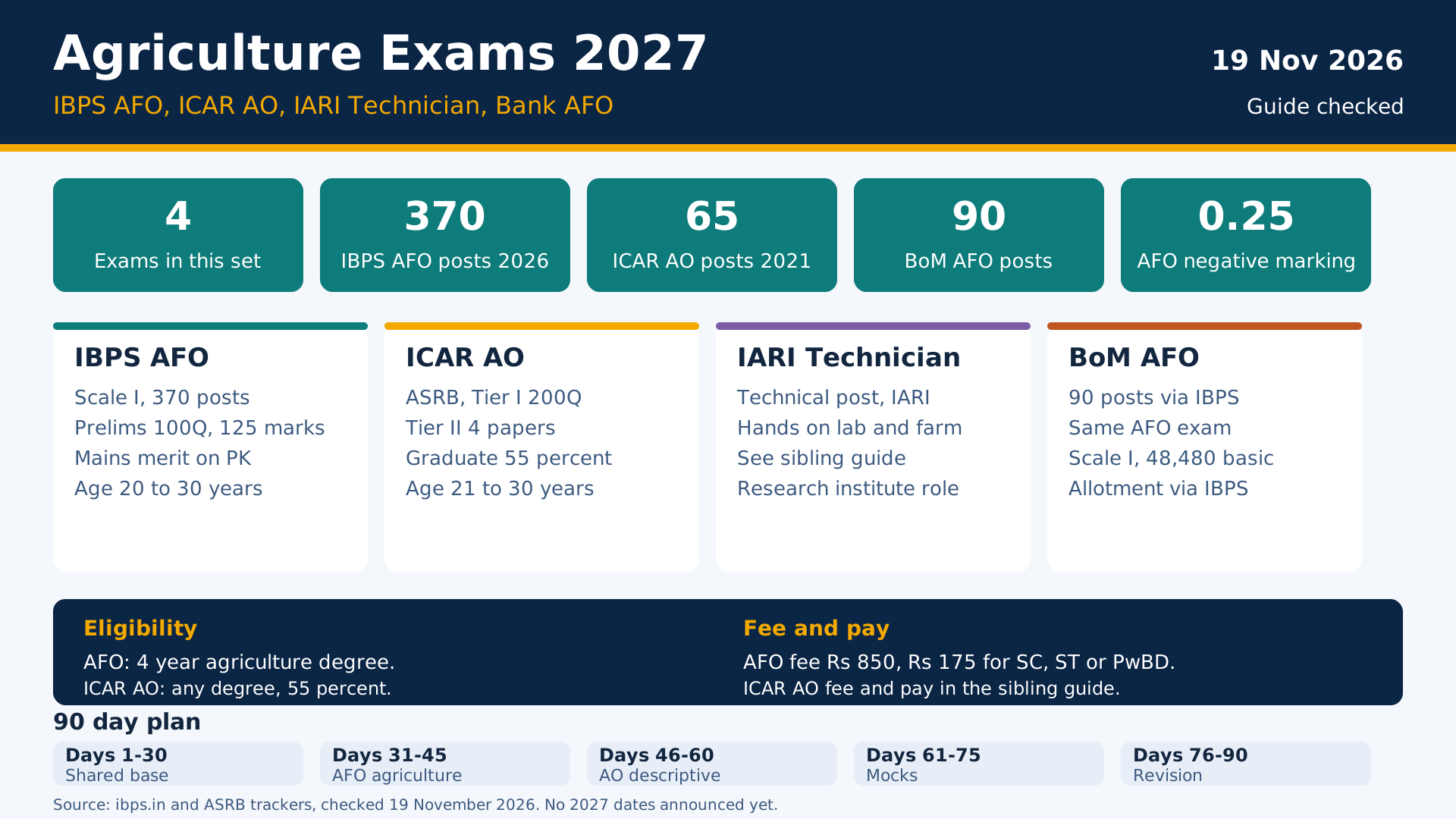
This page covers the four exams in the Agriculture Exams set on this site. IBPS AFO 2027 is the banking route, with 370 posts in the 2026 cycle under CRP SPL-XVI. ICAR AO 2027 is the research administration route, run by the Agricultural Scientists Recruitment Board for the Indian Council of Agricultural Research. ICAR IARI Technician 2027 is the technical route at the Indian Agricultural Research Institute.
Bank of Maharashtra AFO 2027 is the bank specific route, and its 90 posts in the 2026 cycle came through the IBPS process. Each exam has its own full guide on this site, and this page shows how the four fit together so a candidate can pick the right one first.
No 2027 notification has been announced for any of these four exams as of 19 November 2026. Every date and vacancy figure on this page comes from the latest real cycle, and the page says so wherever a figure belongs to 2026. Do not plan leave or book travel on the basis of a tracker page alone. Check the official site named in each section before you apply.
The four exams in one page
| Exam | Body | Post | Who can apply |
|---|---|---|---|
| IBPS AFO 2027 | IBPS, CRP Specialist Officers | Agriculture Field Officer, Scale I | 4 year degree in Agriculture or an allied subject |
| ICAR AO 2027 | ASRB, for ICAR | Administrative Officer | Any graduate with at least 55 percent, plus computer knowledge |
| ICAR IARI Technician 2027 | ICAR, Indian Agricultural Research Institute | Technician | See the sibling guide for the exact qualification |
| Bank of Maharashtra AFO 2027 | Bank of Maharashtra, through IBPS | Agriculture Field Officer, Scale I | 4 year degree in Agriculture or an allied subject |
The table shows the first decision a candidate must make. IBPS AFO and Bank of Maharashtra AFO need the agriculture degree. ICAR AO needs any degree with 55 percent, so an agriculture graduate can apply, and so can a graduate in any other subject. ICAR IARI Technician is a technical post at one institute, and its qualification is different again.
A candidate who holds the agriculture degree can apply for all four. A candidate without the degree can apply only to the exams that skip the degree gate. That single fact decides most preparation plans.
Why agriculture graduates have a distinct exam track
Most government exams are open to any graduate. A BCom graduate, a BA graduate and a BSc Agriculture graduate all sit for the same IBPS PO paper, and the paper tests no subject that any of them studied. Agriculture exams break that pattern.
They ask for the degree and then they test the degree. IBPS AFO tests agriculture in Prelims and makes it the whole Mains merit list. That is a different kind of exam, and it rewards a different kind of preparation.
The degree gate also changes the competition. A general banking exam draws lakhs of candidates from every stream in the country. An agriculture exam draws only the agriculture stream, which is a far smaller pool. The 370 AFO posts of the 2026 cycle went to candidates from that smaller pool.
The 65 Administrative Officer posts of the 2021 ASRB cycle went to a wider pool, because any graduate could apply, but the paper still tested general knowledge of the ICAR system, which agriculture graduates know better. The pool is smaller and the syllabus is closer to what the candidate already studied. That is the advantage, and it is a real one.
The advantage has a limit. A small pool does not mean an easy paper. The AFO Prelims cut off in 2026 was 63.50 out of 125 for general candidates, which is about 51 percent of the total, and Professional Knowledge had the highest sectional minimum of the four tests. The ASRB AO Tier I paper has 200 questions in 3 hours with negative marking of one third of a mark per wrong answer.
A candidate who treats the degree as a guarantee will fail. The degree opens the door. Preparation decides who walks through it.
The banking route: IBPS AFO
IBPS AFO is the largest exam in this set, and for most agriculture graduates it is the first one to prepare for. IBPS runs it under the Common Recruitment Process for Specialist Officers, and the 2026 cycle was CRP SPL-XVI. The notification came out on 1 July 2026, the Preliminary exam was held on 29 August 2026, and the Main exam was held on 1 November 2026. The post is Agriculture Field Officer, Scale I, in 11 participating public sector banks.
The vacancy story of 2026 shows why candidates must read the annexure and not only the notification. The notification announced 190 posts, with Bank of Baroda reporting 100 and Bank of Maharashtra reporting 90. On 20 July 2026, IBPS released an updated Annexure I and the total rose to 370, because Indian Bank had joined with 180 posts. A candidate who skipped applying because 190 posts looked small missed the real number.
The pattern changed in 2026, and this is the most important fact in the whole set. Prelims now has 100 questions for 125 marks in 80 minutes, with English 25 questions, Reasoning 25, Quantitative Aptitude 25, and Professional Knowledge 25 questions for 50 marks. Mains now has 150 objective questions for 200 marks in 125 minutes, plus a descriptive English paper of 2 questions for 25 marks in 30 minutes, and only the Professional Knowledge objective score counts for the Mains merit list.
The interview carries 100 marks, and the final merit combines Mains and interview in the ratio 80 to 20. Negative marking is one fourth of the marks assigned to the question, in Prelims and in Mains. A wrong Professional Knowledge answer in Prelims costs half a mark, because the question carries 2 marks.
The pay scale for Scale I is Rs 48,480 to Rs 85,920 basic, plus dearness allowance, house rent allowance and other allowances as per the rules of the bank joined. The starting basic pay is Rs 48,480 per month. The job is field work.
The officer visits villages, appraises crop loans, handles the Kisan Credit Card, follows up on recovery, and runs the government schemes that pass through the branch. The full guide for this exam sits on the IBPS AFO 2027 page on this site, with the syllabus topic by topic, the official cut offs, and the 90 day plan.
The research administration route: ICAR AO
ICAR AO is the administration route into the research system. The Agricultural Scientists Recruitment Board, ASRB, runs the exam for Administrative Officer and Finance and Accounts Officer posts in the Indian Council of Agricultural Research and its institutes. The work is administration inside research institutes, not field banking, and it suits a candidate who wants a desk role in the agriculture system rather than a field role in a bank.
The pattern, as reported by trackers that quote the ASRB notification, has two written tiers and an interview. Tier I is objective, with 200 questions for 200 marks in 3 hours, in four sections of 50 questions each: General Knowledge; General Intelligence and Reasoning; Arithmetical and Numerical Ability; Language Comprehension in Hindi or English. Negative marking is one third of a mark per wrong answer.
Tier II is descriptive, with 4 papers of 150 marks each, each running for 3 hours, covering general awareness and the Constitution, plus polity and related areas. The interview follows Tier II.
Eligibility is wider than AFO. The candidate must be a graduate of a recognised university with at least 55 percent in the final degree examination, and must have a working knowledge of computers. The age limit is 21 to 30 years.
The 2021 cycle had 65 vacancies, and its Tier I exam was held on 10 May 2022. The next notification had not been released as of the tracker check in November 2026, and no 2027 dates have been announced as of 19 November 2026. The full guide for this exam sits on the ICAR AO 2027 page on this site, and the figures here are tracker based, so confirm them on the ASRB site before you apply.
The technical route: ICAR IARI Technician
ICAR IARI Technician is the technical route at the Indian Agricultural Research Institute, which is the oldest and best known agricultural research institute in the country. The post is a technician post, which means hands on work in laboratories and farms, plus field stations, supporting the scientists who run the research. It suits a candidate who likes practical work and wants to stay close to the science, rather than a candidate who wants an officer desk or a bank branch.
The detail of this exam, its qualification and its pattern, plus its vacancies and its dates, sits in the sibling guide on this site, and this page does not repeat figures it has not verified. The point of naming it here is the choice it gives. An agriculture graduate who does not want the AFO field job and does not want the AO desk job has a third option, which is technical work inside the research system itself. The three routes are different jobs, and a candidate should pick the job first and the exam second.
The bank specific route: Bank of Maharashtra AFO
Bank of Maharashtra AFO is the bank specific route in this set. In the 2026 IBPS cycle, Bank of Maharashtra reported 90 Agriculture Field Officer posts, with a category split of 38 UR, 13 SC, 6 ST, 24 OBC, 9 EWS. Those 90 posts were filled through the IBPS CRP SPL-XVI process, not through a separate Bank of Maharashtra notification that this guide could find. No separate Bank of Maharashtra AFO notification was found in research for 2026.
That fact matters for preparation. A candidate who wants a Bank of Maharashtra posting prepares for the IBPS AFO exam, because that is the exam that fills those posts. The bank specific guide on this site covers the Bank of Maharashtra angle in full, including what the bank is, where its branches sit, and how allotment works.
The exam itself is the IBPS AFO exam, and the pattern and syllabus, plus the cut offs, are the ones in the IBPS AFO 2027 guide. Do not prepare for a separate Bank of Maharashtra paper that does not exist.
How the four exams compare
| Item | IBPS AFO | ICAR AO | ICAR IARI Technician | Bank of Maharashtra AFO |
|---|---|---|---|---|
| Conducting body | IBPS | ASRB for ICAR | ICAR, IARI | IBPS process, Bank of Maharashtra posts |
| Latest cycle | CRP SPL-XVI, 2026 | 2021 cycle, Tier I May 2022 | See sibling guide | CRP SPL-XVI, 2026 |
| Latest vacancies | 370 | 65 in 2021 | See sibling guide | 90, inside the 370 |
| Degree needed | 4 year agriculture or allied degree | Any graduate, 55 percent | See sibling guide | 4 year agriculture or allied degree |
| Age | 20 to 30 years | 21 to 30 years | See sibling guide | 20 to 30 years |
| Written stages | Prelims plus Mains plus interview | Tier I plus Tier II plus interview | See sibling guide | Prelims plus Mains plus interview |
| Negative marking | One fourth of the question marks | One third of a mark in Tier I | See sibling guide | One fourth of the question marks |
| Fee, latest cycle | Rs 850, Rs 175 for SC, ST or PwBD | See sibling guide | See sibling guide | Rs 850, Rs 175 for SC, ST or PwBD |
The comparison shows two pairs. IBPS AFO and Bank of Maharashtra AFO are the same exam with different post counts, because the bank posts are filled through IBPS. ICAR AO and ICAR IARI Technician are the research system pair, with AO as the administration post and Technician as the technical post.
A candidate who prepares for IBPS AFO is automatically preparing for the Bank of Maharashtra posts, because they are the same paper. A candidate who prepares for ICAR AO is preparing for a different paper with a different syllabus, and the two preparations share only the general awareness base.
Fees and salaries differ by body, and this page states only the figures it has verified. The IBPS AFO fee was Rs 850 for most candidates and Rs 175 for SC, ST or PwBD in 2026, inclusive of GST. The IBPS AFO pay scale is Scale I, Rs 48,480 to Rs 85,920 basic.
The ICAR AO fee and pay sit in the sibling guide, and this page does not guess them. A candidate who reads a salary figure for ICAR AO on a tracker page should check it against the ASRB notification, because tracker pages mix the AO and F and AO scales.
Related exams outside this set
Agriculture graduates have options beyond these four, and three of them already have guides on this site. NABARD Grade A and NABARD Grade B are the development finance route, and NABARD is the apex institution for rural credit. Its officers work on agricultural finance and rural development, plus supervision of cooperative banks and regional rural banks, which is the policy side of the same ground that an AFO works on in the field.
IBPS SO is the parent process of AFO, and its guide covers all six specialist streams, including IT Officer and Law Officer, plus HR and Marketing, so a candidate can see where AFO sits among the streams. CAIIB Rural Banking is the elective paper that bankers take after joining, and it covers priority sector lending, NABARD, the SHG bank linkage programme and the Kisan Credit Card, which are the same topics an AFO meets in the branch.
At the state level, the UPSSSC Agriculture Technical Assistant is another route for agriculture graduates, with a state posting and a different syllabus. A candidate in Uttar Pradesh should look at it alongside the national exams, because a state post can be closer to home and the competition is limited to the state. The choice between a national post and a state post is a life choice as much as an exam choice, because it decides where you live for years.
Salary: what is verified and what is not
The only salary figure this page states as verified is the IBPS AFO pay scale, because IBPS prints it in the notification. Scale I runs from Rs 48,480 to Rs 85,920 basic, with annual increments, plus dearness allowance, house rent allowance and other allowances as per the rules of the bank joined. The starting basic pay is Rs 48,480 per month. The total in hand figure of about Rs 52,000 to Rs 55,000 per month is a tracker estimate, not an IBPS figure, and it varies by place of posting.
ICAR posts follow central government pay levels, and the exact level for Administrative Officer sits in the sibling guide with its source. IARI Technician pay also sits in the sibling guide. This page does not state those figures, because stating a pay figure from a tracker page as if it were official would mislead a candidate who is choosing between a bank post and a research post. The choice between the routes should rest on the job, the place, and the career path, and the pay figure should come from the notification itself.
One comparison is safe to make without a figure. A bank Scale I officer and a central government officer at a similar level earn comparable basic pay, and the difference lies in the allowances and the career path. A bank officer moves through the Scale I to Scale VII ladder inside the bank.
A research council officer moves through the council grades. Neither path is obviously richer than the other. The better question is which work you want to do every day.
Which exam should you prepare for first
Start with the exam that matches your degree and your calendar. If you hold a 4 year agriculture degree and the IBPS cycle is open or near, start with IBPS AFO, because it has the most posts, the clearest pattern, and the most frequent cycle. IBPS runs the Specialist Officer process every year, and the AFO post has appeared in every recent cycle.
That regularity is worth a lot. A candidate can plan a year around it.
If you hold any degree with 55 percent and you want a desk role in the research system, start with ICAR AO, but check the notification first, because the ASRB cycle is not annual in the way IBPS is. The 2021 cycle ran its Tier I exam in May 2022, and the next notification had not been released as of November 2026. Preparing for a cycle that has no date is a different kind of preparation. It needs a longer horizon and a backup exam, and IBPS AFO is the natural backup for an agriculture graduate.
If you want technical work inside a research institute, look at ICAR IARI Technician, and read the sibling guide before you decide, because the qualification and the pattern are different from the officer posts. If you want a posting in Maharashtra, note that the Bank of Maharashtra posts come through IBPS, so the preparation is the IBPS AFO preparation, and the choice of bank happens at allotment, not at the exam.
A candidate can prepare for IBPS AFO and ICAR AO together for the first two months, because both need general awareness and reasoning, plus quant. The split comes after that. AFO needs agriculture depth, and AO needs descriptive writing and the Constitution and polity.
Do not try to prepare for both at full depth in the same weeks. Pick the primary exam, give it 70 percent of the time, and give the other exam 30 percent until its notification arrives.
The Agriculture Exams 2027 90 day plan
Ninety days is enough to build the shared base for these exams, and the plan below assumes two hours on working days and four hours on holidays. The first 30 days are common to all four exams. Read agriculture basics, agronomy and soil science, plus horticulture, for one hour a day, and practise reasoning and quant for one hour a day.
The agriculture reading serves AFO directly and serves AO indirectly, because general awareness of the ICAR system rests on the same facts. The reasoning and quant practice serves every exam in the set.
Days 31 to 60 split by route. An AFO candidate spends this phase on animal husbandry, seed technology, agricultural economics, irrigation and plant protection, plus government schemes, with 30 agriculture questions a day. An AO candidate spends this phase on descriptive writing and the Constitution, plus polity and general awareness of economic and social development, with one essay a week. A candidate preparing for both gives the morning to agriculture and the evening to descriptive writing, and accepts that both will move slower.
Days 61 to 90 are for mock tests and revision, whatever the route. Take two mocks per week under real timing, review every wrong answer the same day, and revise the one page notes. For AFO, take the mocks with the real sectional timing, four tests of 20 minutes in Prelims and the Mains blocks.
For AO, practise the descriptive papers under the 3 hour limit, because writing for 3 hours is a skill of its own. In the last week, revise the breed lists, the soil table, the scheme list and the cost ladder, because those are the facts that fade first.
Mistakes that cost marks across agriculture exams
The first mistake is preparing from an old pattern. IBPS changed the AFO pattern in 2026, and many tracker pages still show the old tables. A candidate who practises Prelims with 50 Reasoning questions is practising a paper that no longer exists. Check the pattern on the official site when the 2027 notification comes out, and practise the pattern that is actually in force.
The second mistake is choosing the exam by the vacancy number alone. A candidate who picks ICAR AO because it sounds prestigious, without checking whether the notification is even out, can spend a year preparing for a cycle that does not arrive. A candidate who picks AFO because it has 370 posts, without checking whether their degree is on the eligible list, can clear the exam and fail document verification. Check the notification, the degree list, and the dates before you choose.
The third mistake is ignoring negative marking. AFO deducts one fourth of the marks assigned to the question. ASRB AO Tier I deducts one third of a mark.
Guess only when you can rule out at least two options, and leave the rest blank. A blank answer scores nothing, and that is better than a wrong answer that takes marks away. Blind guessing adds almost nothing after the penalty, and it adds risk.
The fourth mistake is studying agriculture from a general book. The AFO syllabus asks for the crop, the season, the soil, the nutrient, the breed and the disease, plus the scheme, and a general book gives the story without the facts. Use the degree notes, a standard agriculture book, and a question bank, and test yourself every day. Reading without questions is the slowest way to prepare for a fact heavy paper.
Before you apply, check these things on the official sites
First, confirm the notification and the registration window for your cycle on the official site. For IBPS AFO, that is the IBPS official website. For ICAR AO, that is the ASRB site and the ICAR official website.
For Bank of Maharashtra posts, that is the Bank of Maharashtra official website and the IBPS site, because the posts are filled through IBPS. The 2027 schedule was not announced for any of these exams as of 19 November 2026.
Second, confirm the vacancy annexure, because the number can rise after the notification, as it did from 190 to 370 in the 2026 AFO cycle. Third, confirm the fee for your category. Fourth, confirm your degree is on the eligible list and your result was declared on or before the date in the notification.
Fifth, confirm the age window and the relaxation that applies to you. Sixth, confirm the pattern, because IBPS changed it in 2026 and may change it again. Keep your registration receipt and your admit card safe, and check the admit card details as soon as it is available.
Where Agriculture Exams fit in your exam plan
Agriculture exams sit beside the general banking exams, and a candidate with an agriculture degree can use both. The parent process is IBPS SO 2027, which covers all six specialist streams and shows where AFO sits among them. The development finance route is NABARD Grade A 2027 and NABARD Grade B 2027, which work on rural credit and agriculture policy from the apex institution.
The banking knowledge route is CAIIB Rural Banking 2027, which covers the same rural credit ground from inside the bank, and JAIIB RBWM 2027, which covers retail banking and wealth management for bankers who want the JAIIB qualification. The economics route is UGC NET Economics 2027, which suits a candidate with an economics background who wants to teach or research.
The generalist route is IBPS PO 2027, which takes graduates from any stream and tests no agriculture. The regulatory route is RBI Grade B 2027 and SEBI Grade A 2027, which are the central bank and markets regulator posts. The state route is UPPSC PCS 2027, which is the Uttar Pradesh civil services exam. A candidate who maps these ten exams against the four in this set can see the whole field, and can pick the two or three that fit the degree and the place, plus the life they want.
Sources
IBPS official website, ibps.in, checked 19 November 2026. Oliveboard IBPS AFO notification 2026 and IBPS AFO syllabus 2026, CRP SPL-XVI, 370 vacancies and the new Prelims and Mains pattern, plus the eligibility degree list and the pay scale of Rs 48,480 to Rs 85,920. Testbook IBPS AFO notification 2026, vacancy split Bank of Baroda 100 and Bank of Maharashtra 90.
CareerPower IBPS AFO recruitment 2026, Prelims 29 August 2026, Mains 1 November 2026, vacancy 370. Agriprep IBPS AFO cut off 2026, official Prelims cut off 63.50, posts allotted 674 in SPL-XIII and 946 in SPL-XIV.
ToppersExam ASRB AO vacancy and syllabus 2026, Tier I 200 questions and 200 marks in 3 hours, negative marking one third, Tier II 4 papers of 150 marks, age 21 to 30, graduate 55 percent. Testbook ASRB AO recruitment 2024, 65 vacancies in the 2021 cycle, Tier I held 10 May 2022. ICAR official website, icar.gov.in, ICAR Group B Administrative Posts Recruitment Rules First Amendment 2026.
Bank of Maharashtra official website, bankofmaharashtra.in. NABARD official website, nabard.org.