
Karnataka Exams 2027: A Complete Guide for First Time Aspirants
📖 Table of Contents
- Karnataka Exams 2027: who runs which exam
- KAS: the Gazetted Probationers exam
- Karnataka PSI: Police Sub-Inspector
- Karnataka Police Constable: the largest entry gate
- KPTCL AE, JE and Junior Assistant
- Karnataka PWD AE and JE
- FDA and SDA: the big Group C round
- Kannada: the test that sits outside merit
- Eligibility at a glance
- Fees, pay and what the job gives you
- How to track notifications without missing one
- A 90 day plan for a first time aspirant
- Mistakes that cost marks
- Sources
Karnataka Exams 2027: A Complete Guide for First Time Aspirants
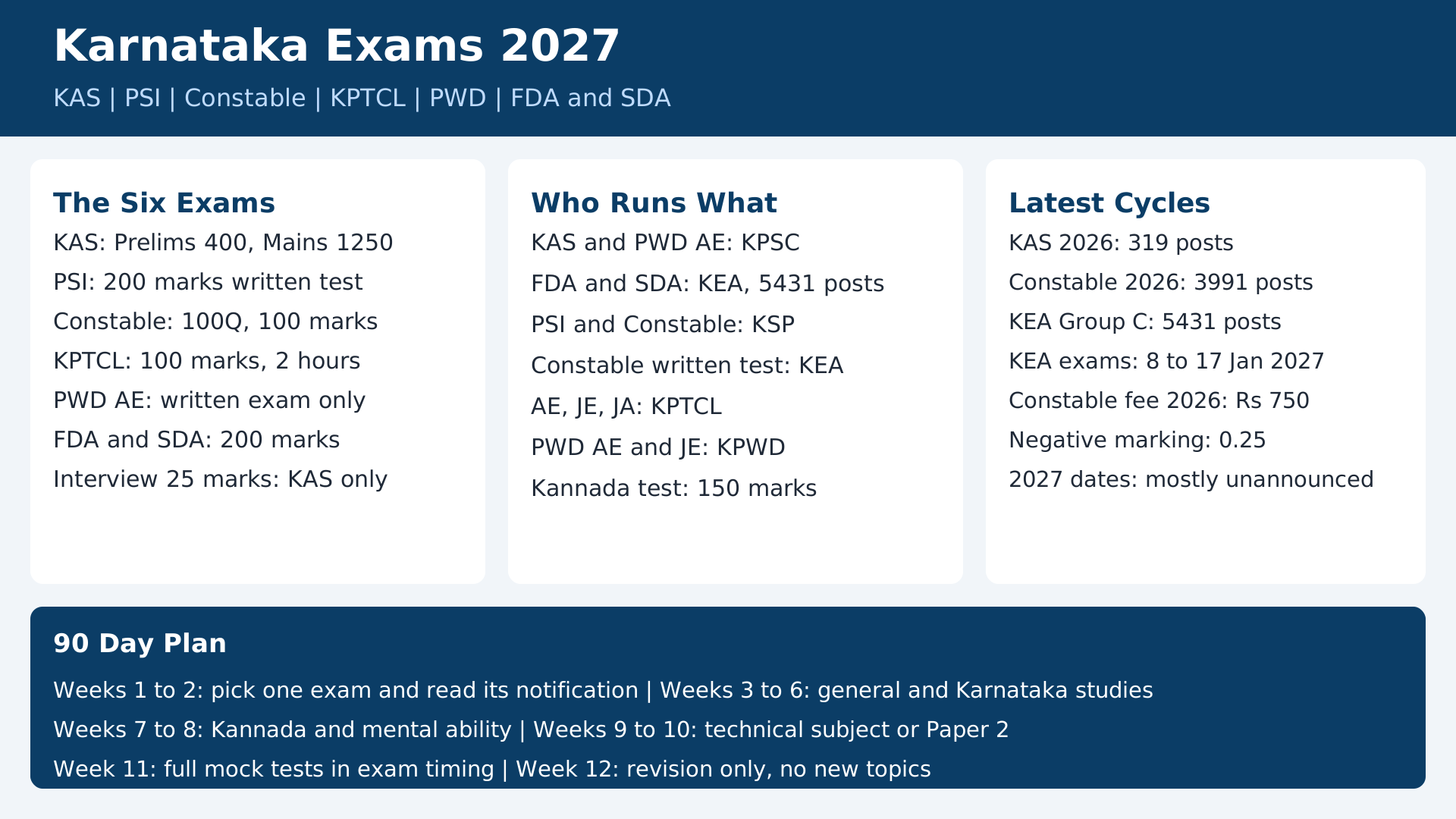
The 2026 notification for the Karnataka Administrative Service listed 319 Gazetted Probationer posts, 117 in Group A and 202 in Group B, and applications closed on 7 September 2026. That single number tells you why Karnataka Exams 2027 matter. One state runs a full ladder of government jobs, from a constable who needs only a PUC pass to an Assistant Commissioner who clears three stages of the KAS exam. This guide covers that whole ladder. It explains who conducts each exam, what each stage asks, who can apply, and how a first time aspirant can plan 90 days of study without guessing.
Karnataka does not run its exams through one body. Five different bodies share the work, and each one has its own portal, its own calendar, and its own rules. A candidate who watches only one portal will miss half the openings. The Karnataka Public Service Commission runs the Gazetted Probationers exam and several departmental exams. The Karnataka Examinations Authority runs the big Group C rounds for First Division Assistants and Second Division Assistants. The Karnataka State Police runs police recruitment through its own recruitment wing, with the written exam often conducted by the Karnataka Examinations Authority. The Karnataka Power Transmission Corporation runs its own engineering recruitment. The Public Works Department recruits through the Commission and the Authority. Learn which body runs your exam first, because that decides where the notification appears and where you apply.
No 2027 schedule had been announced for most of these exams as of 19 November 2026. The dates in this guide are the latest completed or announced cycles, and every one of them is labelled with its year so you can tell a fact from a forecast. Where sources disagree, this guide says so and gives both figures. Check the official notification for your cycle before you apply, because a notification can change a fee, an age limit, or a paper pattern, and the notification is the only document that counts.
Karnataka Exams 2027: who runs which exam
Start with the map. The Karnataka Public Service Commission, known as KPSC, sits in Bengaluru and recruits for Group A and Group B posts across state departments. Its best known exam is the Gazetted Probationers exam, usually called KAS. KPSC also recruits Assistant Engineers for the Public Works Department and other departmental posts. Its portal is kpsc.kar.nic.in, and its Gazetted Probationers page carries the KAS notification and syllabus.
The Karnataka Examinations Authority, known as KEA, runs the large Group C recruitments that cover many departments at once. Its 2026 round covered 5,431 posts, including First Division Assistants, Second Division Assistants, and other Group C posts across 33 departments. KEA also conducts the written exam for Karnataka Police Constable recruitment. Its portal is cetonline.karnataka.gov.in, and the KEA section of that portal carries its notifications.
The Karnataka State Police, known as KSP, recruits Police Sub-Inspectors and Police Constables. Its recruitment portal is ksp.karnataka.gov.in, and applications for police posts run through the KSP recruitment sites. The written exam for constables is conducted and evaluated by KEA, which is why a constable candidate needs to watch both portals.
The Karnataka Power Transmission Corporation, known as KPTCL, recruits Assistant Engineers, Junior Engineers, and Junior Assistants for the power transmission network and the associated electricity supply companies. Its portal is kptcl.karnataka.gov.in. The Public Works Department, known as KPWD, recruits Assistant Engineers and Junior Engineers for roads, buildings, and public works, and its portal is kpwd.karnataka.gov.in. Its Assistant Engineer posts have been recruited through KPSC in recent cycles, so a PWD aspirant watches both portals.
Other Karnataka bodies recruit on their own calendars too. The Karnataka State Road Transport Corporation, the Karnataka Forest Department, the Rural Development and Panchayat Raj Department, and the Commercial Taxes Department all appear in KEA Group C rounds or run their own notifications. This guide covers the six exams that draw the most candidates, and it names the smaller rounds where they fit, so a first time aspirant can see the full field before choosing one exam.
KAS: the Gazetted Probationers exam
KAS is the top Karnataka state exam. The Karnataka Public Service Commission conducts it to fill Group A and Group B Gazetted Probationer posts in state departments. The posts include Assistant Commissioner, Deputy Superintendent of Police, Tahsildar, Commercial Tax Officer, and other gazetted posts. The 2026 notification, dated 31 July 2026, listed 319 posts, with 117 in Group A and 202 in Group B. Applications closed on 7 September 2026 after an extension from 31 August, and the Preliminary exam was scheduled for 15 November 2026. The 2023 to 24 cycle, which listed 384 posts, finished its interviews on 10 June 2026, and its final result had not been published as of 6 October 2026. KAS runs when the Commission notifies vacancies, roughly once every one to two years, with no fixed annual date.
The selection has three stages. The Preliminary exam screens candidates for the Main exam. The Main exam is a descriptive written exam. The Personality Test, or interview, closes the process. The Preliminary exam has two objective papers. Each paper has 100 questions, each question carries 2 marks, each paper runs for 2 hours, and the two papers together carry 400 marks. Paper I covers General Studies of national and international importance in 40 questions and Humanities in 60 questions. Paper II covers General Studies of state importance in 40 questions, General Science and Technology with Environment and Ecology in 30 questions, and General Mental Ability in 30 questions. Each wrong answer loses 0.25 marks, which is one fourth of the 2 marks the question carries. The Preliminary marks only decide who reaches the Main exam, and they play no part in final merit.
The Main exam has seven papers. Two of them are qualifying papers, Kannada and English, each carrying 150 marks and running for 2 hours. A candidate must score at least 35 percent, which is 52.5 marks, in each qualifying paper, and the marks in these two papers do not count toward merit. The five merit papers are the Essay and General Studies I to IV, each carrying 250 marks and running for 3 hours, for a total of 1,250 marks. The Essay paper asks for two essays, one on a national or international issue and one on a state or local issue, each worth 125 marks. General Studies I covers history and cultural heritage, social and political perspective, and the Indian economy with planning and rural development. General Studies II covers physical features and natural resources, the Indian Constitution, public administration and management, and international relations. General Studies III covers science and technology in Indian development, information technology in the public domain, and development challenges for ecology and the environment. General Studies IV covers ethics, integrity, and aptitude. Candidates may answer a merit paper in Kannada or English, except for the qualifying papers, which test each language on its own.
The Personality Test carries 25 marks. The Commission adds those marks to the Main exam marks, so the final merit total is 1,275 marks. That figure matters because it shows how small the interview is in the final total. A candidate cannot rescue a weak Main exam with a strong interview, and a candidate with a strong Main exam cannot lose the list through a poor interview alone. The Main exam decides the result. The interview confirms it.
Eligibility for KAS is a bachelor degree or a master degree from a university set up by law in India, or an equal qualification. Candidates awaiting the result of a qualifying exam can also apply for the Preliminary exam under the Gazetted Probationers Rules. The minimum age is 21 years. The maximum age for general category candidates is 38 years under the rules reported by Drishti IAS, with 41 years for 2A, 2B, 3A and 3B categories and 43 years for SC, ST and Category 1 candidates. Other trackers report a general limit of 21 to 40 years for the 2026 to 27 cycle, which includes a one time relaxation, and one tracker reports 21 to 45 years on 31 August 2026. The age limit differs across sources, so this guide gives the rule based figure of 38 years for general candidates and flags the higher figures as cycle specific relaxations that the notification states. Read the age clause in the notification for your cycle before you count yourself in or out. Attempts are also limited by category: 5 attempts for general category, 7 attempts for OBC categories, and no fixed attempt limit for SC and ST candidates up to the age limit.
Kannada is not an optional extra in KAS. The Kannada qualifying paper in the Main exam tests Kannada at first language SSLC level, and the state importance paper in the Preliminary exam tests Karnataka history, geography, economy, and schemes. A candidate who knows national general studies but knows nothing about Karnataka will lose marks in both stages. The Karnataka part of the syllabus is the part that separates a KAS candidate from a UPSC candidate, and it rewards a candidate who reads Karnataka news, Karnataka history, and Karnataka government schemes as a daily habit.
Karnataka PSI: Police Sub-Inspector
The Police Sub-Inspector post, known as PSI, is the officer entry point into the Karnataka State Police. PSI posts cover Civil Police, Armed Reserve Police, the Karnataka State Reserve Police, Excise, and Wireless, and each stream has its own notification. The KSP Draft Recruitment Rules 2025, reported by Testbook, covered 92 Sub-Inspector vacancies and set 60 percent of Sub-Inspector posts for direct recruitment. No full 2026 PSI notification had been released as of the research for this guide, and the vacancy figure for the next cycle was not announced. Treat any 2026 PSI vacancy number you see on a tracker site as an expectation, not a notification.
The selection has three parts, and the order matters. The Endurance Test and Physical Standard Test come first in the current pattern, then the written exam, then a medical exam. A candidate who fails the physical tests does not reach the written exam, so physical preparation comes first for PSI, before any written study.
The physical standards for direct male candidates are a height of 168 cm and a chest of 86 cm with a minimum expansion of 5 cm. For women the height is 157 cm with a minimum weight of 45 kg. The endurance test for men is a 1,600 metre run in 7 minutes for Civil PSI and 6 minutes 30 seconds for Reserve Inspector posts, plus a long jump of 3.80 metres or a high jump of 1.20 metres in three chances. For women, in service candidates, and ex-servicemen the run is 400 metres in 2 minutes, plus a long jump of 2.50 metres or a high jump of 0.90 metres. Some trackers report different run times for men, such as 1,600 metres in 6 minutes 30 seconds for all PSI posts, and some report a shot put event as well. The notification for the stream you apply to states the exact events and times, and that notification is the only version that counts on the day.
The written exam has two papers with a total of 200 marks. Paper I is descriptive and carries 50 marks in 90 minutes. It asks for an essay of up to 600 words for 20 marks, translation from English to Kannada and from Kannada to English for 20 marks, and precis writing for 10 marks. For KSRP and KSISF Sub-Inspector posts there is no precis writing, and the essay carries 30 marks. Paper II is objective and carries 150 marks in 90 minutes. It has 100 questions of 1.5 marks each, and each wrong answer loses 0.25 marks, which is 25 percent of the marks of the question. Paper II covers current affairs, general knowledge, general studies, the Indian freedom struggle, the Indian Constitution, history, geography, science, arts, literature, mental ability, and policy education. Some older trackers describe a different PSI pattern with a 200 mark objective paper in two parts, and some describe a 50 mark interview. Those older patterns do not match the current two paper pattern reported by the 2025 and 2026 trackers, so this guide follows the current pattern and flags the older ones as out of date.
Eligibility for PSI is a bachelor degree from a university recognised by the University Grants Commission, or an equal qualification. Final year students and diploma holders are generally not eligible, because the degree must be complete with the final mark sheet at the time of application. The age limit for general category candidates is 21 to 28 years in the pattern reported by the 2026 trackers, with up to 31 years for OBC categories and up to 33 years for SC, ST and Category 1 candidates. Other trackers report a general limit of 21 to 30 years. The two figures differ, so check the notification. Ex-servicemen get relaxation up to 45 years in one tracker report. A candidate must be a citizen of India.
PSI suits a graduate who wants an officer post in uniform and who can clear a physical test. The written paper rewards general studies and language skill in equal measure, because Paper I tests writing and translation while Paper II tests knowledge. A candidate who studies only objective questions will drop the 50 marks of Paper I. A candidate who ignores running will not reach the written exam at all. Both parts need a place in the weekly plan.
Karnataka Police Constable: the largest entry gate
The Civil Police Constable post is the largest single entry gate into the Karnataka State Police. The 2026 recruitment notified 3,991 Civil Police Constable posts, with 3,395 posts in the Residual Cadre and 596 posts in the Kalyana Karnataka cadre, under notifications 02 and 01 of Nemakati 4 for 2026 to 27. The recruitment drew 3,90,715 applications, which is close to 98 applications for each post. The written exam was held on 2 August 2026, offline on an OMR sheet, and the KEA released the merit list for Kalyana Karnataka posts on 26 September 2026. No 2027 constable notification had been announced as of 19 November 2026.
The selection has a written exam, a Physical Standard Test, an Endurance Test, and a medical exam. The written exam is the only stage that counts toward merit. The physical tests carry no marks, but a candidate must pass them to stay in the race. The written exam has 100 objective questions for 100 marks in 90 minutes, with 1 mark per question and 0.25 marks deducted for each wrong answer. A candidate must score at least 30 marks to qualify for the physical tests. The paper is one undivided General Studies booklet, printed in Kannada and English on the same page, and it covers general knowledge, science, geography, history, the Indian Constitution, the national freedom movement, mental ability, and moral education. The paper declares no sections and prints no per subject counts, so a tracker table that splits it into a 25 mark language block and a 20 mark English block describes a paper that does not exist.
One 2026 change costs marks for candidates who miss it. The OMR sheet has a fifth circle that means not attempted. A question left fully blank loses 0.25 marks unless that fifth circle is shaded. A candidate who skips questions without shading the fifth circle loses a quarter mark for every blank. That rule also applies in the KEA FDA and SDA exams, and it is the kind of small rule that decides a borderline result.
Eligibility for constable is a PUC pass, which is Class 12 or an equal qualification from a recognised board, including CBSE, ICSE, and NIOS. Some trackers also accept ITI and diploma qualifications. The age limit in the 2026 notification is 18 to 33 years for general merit candidates, with relaxations for reserved categories and a one time five year relaxation under a Government Order dated 29 January 2026. Older trackers report 19 to 25 years for general candidates with SC and ST relaxation up to 5 years, and those figures belong to earlier cycles. This guide follows the 2026 notification figure of 18 to 33 years. The application fee in the 2026 cycle was Rs 750 for general and other such categories, as reported by Testbook.
The physical standards for men are a height of 168 cm and a chest of 86 cm with 5 cm expansion, with a lower height of 160 cm for Category 1, SC and ST candidates and 155 cm for tribal candidates. For women the height is 157 cm, or 150 cm for reserved and tribal candidates, with a minimum weight of 45 kg. The endurance test is a 1,600 metre run in 6 minutes 30 seconds for men and a 400 metre run in 2 minutes for women, plus long jump and shot put events. Candidates who did not study Kannada as a first or second language up to SSLC, or in Kannada medium, must also clear a separate qualifying Kannada Language Test.
Constable is the right first exam for a candidate who has just finished PUC and wants a government job without waiting for a degree. The paper is short, 90 minutes, and the syllabus is general studies only, so a candidate can prepare for it alongside PUC or a degree. The competition is steep, close to 98 applicants per post in 2026, so a candidate needs a score well above the 30 mark qualifying line. The qualifying line only opens the door to the physical tests. The merit list decides the job.
KPTCL AE, JE and Junior Assistant
The Karnataka Power Transmission Corporation Limited, known as KPTCL, runs the power transmission network of the state. Its recruitment covers Assistant Engineers, Junior Engineers, and Junior Assistants, and it draws engineering graduates and diploma holders who want a technical government job. The last large cycle reported 1,492 posts, with 533 Assistant Engineer posts, 599 Junior Engineer posts, and 360 Junior Assistant posts. The Assistant Engineer cycle of 2025 to 26 listed 533 posts, with about 416 in Electrical and 24 in Civil, and applications closed in March 2025. No 2026 KPTCL notification had been released as of the research for this guide, and no 2026 vacancy figure was announced. The figures in this section come from the last notified cycles and the standing pattern, and the next notification can change them.
Assistant Engineer needs a full time B.E. or B.Tech degree in the relevant branch from a university recognised by AICTE or UGC. Electrical posts need Electrical or Electrical and Electronics Engineering, and Civil posts need Civil Engineering. A pass in AMIE India in the relevant branch is also accepted. General category candidates typically need a minimum of 60 percent aggregate in the degree, while SC, ST and Category 1 candidates need 50 percent. Junior Engineer needs a diploma in Electrical or Civil Engineering from a recognised polytechnic in Karnataka. Junior Assistant needs a PUC pass, and some trackers list a diploma in accountancy and auditing as an accepted qualification for the post. The age limit is 18 to 35 years for general candidates, with 38 years for Category 2A, 2B, 3A and 3B candidates and 40 years for SC, ST and Category 1 candidates in the pattern reported by the trackers. Knowledge of Kannada is required.
The KPTCL selection is an online Aptitude Test, followed by document verification and a medical test. The Aptitude Test carries 100 marks in 2 hours, with 100 objective questions of 1 mark each and 0.25 marks deducted for each wrong answer. For Assistant Engineer and Junior Engineer posts, 75 questions come from the technical subject and 25 questions come from General Awareness and Aptitude. For Junior Assistant, the paper has 20 questions on computer literacy, 40 questions on General Awareness and Aptitude, and 40 questions on General English or General Kannada. Candidates must score a minimum of 35 marks out of 100 in the Aptitude Test to qualify. Candidates who did not study Kannada in school must also clear a Kannada Language Test of 150 marks, with 50 marks needed to pass, before they can appear in the Aptitude Test. Some trackers describe a personal interview after the written test, with 50 to 100 marks, but the standing pattern reported by Testbook and Prepp lists only the Aptitude Test, document verification, and a medical test. This guide follows the standing pattern and flags the interview claim as unconfirmed.
The pay reported for these posts gives a sense of the scale. Assistant Engineer pay is reported at Rs 41,130 to Rs 72,920 per month, Junior Engineer at Rs 26,270 to Rs 65,020, and Junior Assistant at Rs 20,220 to Rs 51,640. Those figures come from tracker summaries of the last cycles and will change with pay revision, so treat them as a guide and confirm the pay scale in the notification. KPTCL suits an engineering graduate or diploma holder who wants a technical post with a clear syllabus. The technical subject carries 75 percent of the paper, so the degree or diploma syllabus decides the result far more than general awareness does.
Karnataka PWD AE and JE
The Public Works Department of Karnataka, known as KPWD, builds and maintains roads, bridges, and government buildings across the state. Its recruitment covers Assistant Engineers and Junior Engineers, mostly in Civil Engineering, with some Electrical posts. The department recruits through the Karnataka Public Service Commission for Assistant Engineer posts and through the Karnataka Examinations Authority for Junior Engineer posts in some cycles, so a PWD aspirant watches the Commission portal, the Authority portal, and the department portal at kpwd.karnataka.gov.in.
One tracker reports that KPWD announced 870 vacancies in 2026, with 570 Assistant Engineer posts and 300 Junior Engineer posts, and a notification expected in the last week of April 2026. That figure could not be matched to an official notification in the research for this guide, and the department had not released an official notice about the start of the process at the time of that report. This guide records the 870 figure as an unconfirmed tracker report and does not treat it as a notified vacancy count. A firmer figure comes from the KPSC Assistant Engineer Civil recruitment, which listed 188 Assistant Engineer Civil posts in the Public Works Department, with 59 posts for the Hyderabad Karnataka region, and applications closed on 30 September 2025. That cycle is the most recent confirmed PWD Assistant Engineer recruitment in the research.
Assistant Engineer in PWD needs a B.E. or B.Tech degree in Civil Engineering, or an equal qualification, from a recognised university. Some trackers also list Electrical Engineering for Assistant Engineer posts in the department. Junior Engineer needs a B.E. or B.Tech degree in Civil Engineering, Construction Technology, or Material Engineering in the pattern reported by one tracker, while other trackers list a diploma in Civil Engineering for Junior Engineer posts. The two versions differ because PWD Junior Engineer posts have been recruited with different qualifications in different cycles. The age limit is 18 to 35 years for general candidates, with 40 years for SC, ST and Category 1 candidates and 38 years for 2A, 2B, 3A and 3B candidates. One tracker reports a lower upper limit of 28 years for 2A, 2B, 3A and 3B candidates, which conflicts with the 38 year figure, so check the notification. The pay scale reported for PWD Assistant Engineer is Rs 43,100 to Rs 83,900, and the pay reported for Junior Engineer is Rs 33,450 to Rs 62,600 per month. Both figures come from tracker summaries and need confirmation in the notification.
Selection for PWD Assistant Engineer is based on a written exam only in the KPSC cycle, with no interview. The Junior Engineer selection reported by one tracker is a written exam carrying 85 percent of the marks, with the rest from other stages that the tracker does not name clearly. The application fee reported for Junior Engineer is Rs 300 for general, 2A, 2B, 3A and 3B candidates, with no fee for SC, ST, PWD, and ex-serviceman candidates. PWD suits a civil engineering graduate who wants field work on roads and buildings rather than a desk post. The syllabus is the civil engineering degree syllabus, so a candidate who has just finished the degree has the freshest preparation.
FDA and SDA: the big Group C round
First Division Assistant and Second Division Assistant, known as FDA and SDA, are the Group C clerical posts that run the daily work of Karnataka government departments. The Karnataka Examinations Authority took over these recruitments from KPSC in 2024, and KPSC last notified the cadres in 2020. The 2026 round is the largest Karnataka Group C recruitment in recent years. KEA issued four notifications on 29 October 2026, numbered 14, 15, 16 and 17 of 2026, for 5,431 posts across 33 departments, boards, and corporations, split between the Residual Parent Cadre and the Kalyana Karnataka cadre under Article 371J. Applications ran from 30 October to 25 November 2026. The degree level posts, which include FDA, cover 2,421 posts, and the PUC level posts, which include SDA, cover 2,062 posts in the earlier KEA note of 31 August 2026, with the rest of the 5,431 posts in other Group C roles such as Accounts Assistant, Hostel Warden, and Gram Panchayat Secretary.
The selection has no interview. It has a compulsory Kannada Language Test, a competitive written exam, document verification, online counselling, and option entry. The Kannada Language Test carries 150 marks and runs for 2 hours, and a candidate must score at least 50 marks to stay in the race. It is qualifying only, and its marks do not count toward merit. Candidates who studied Kannada as a first or second language up to SSLC, or in Kannada medium, or who have passed such a test before, are exempt. The competitive exam has two papers, each with 100 questions for 100 marks in 2 hours, for a total of 200 marks. Paper 1 is General Knowledge, covering current affairs, general science, geography, Indian and Karnataka history, the Constitution, economics, and mental ability. Paper 2 is General Kannada, General English, and Computer Knowledge. Each wrong answer loses 0.25 marks, and a candidate needs at least 35 percent to qualify. The OMR sheet has a fifth circle for not attempted questions, and a question left fully blank loses 0.25 marks unless that circle is shaded. The merit list is drawn on the total of the two competitive papers.
The exam dates for the 2026 round show how KEA staggers a large recruitment. The Kannada Language Test was scheduled for 8 January 2027 from 3 pm to 5 pm. The degree level competitive exam was scheduled for 9 and 10 January 2027, and the PUC level competitive exam for 16 and 17 January 2027. On each exam day Paper 1 runs from 10.30 am to 12.30 pm and Paper 2 runs from 2.30 pm to 4.30 pm. The age limit is 18 to 35 years, with relaxations for reserved categories. FDA needs a degree from a recognised university, and SDA needs a PUC pass. The pay reported for an FDA post such as Assistant or Accountant is Rs 49,050 to Rs 92,500 per month, as reported in the 2026 notification coverage.
FDA and SDA suit the largest number of Karnataka aspirants, because the qualification is a degree or a PUC pass, the posts number in the thousands, and there is no interview. The paper is general knowledge, language, and computer knowledge, so a candidate can prepare for it without a technical degree. The Kannada test is the gate that many candidates forget. A candidate who prepares only for the two competitive papers and ignores the Kannada test can be stopped before the merit papers begin.
Kannada: the test that sits outside merit
Kannada appears in almost every Karnataka exam, and it appears in three different forms. In KAS it is a qualifying paper in the Main exam, worth 150 marks with a 35 percent pass mark, and it also shapes the state importance paper in the Preliminary exam. In KPTCL, KEA, and police recruitment it is a separate Kannada Language Test of 150 marks with a 50 mark pass line, taken before the competitive papers. In the constable exam it is a qualifying test for candidates who did not study Kannada up to SSLC. The marks never count toward merit, and the pass line is the only thing that matters, but failing it ends the attempt.
The exemption rule is the same across most exams. A candidate who studied Kannada as a first or second language up to SSLC, or who studied in Kannada medium, or who has already passed a Kannada language test for a government exam, is exempt. A candidate who studied outside Karnataka, or in an English medium school without Kannada as a language subject, is not exempt and must take the test. The test itself is objective, and it covers Kannada grammar, comprehension, and vocabulary at SSLC level. A candidate who speaks Kannada at home but has never studied it as a subject should not assume the test is easy. Spoken Kannada and written Kannada at SSLC level are different skills, and the test checks the written one.
The practical step is simple. Check the exemption clause in your notification on the day you apply. If you are not exempt, put Kannada into your daily plan from week one, not from the last week. One hour a day of Kannada grammar and reading for 12 weeks clears the 50 mark line for most candidates. One week of cramming does not, because language skill does not cram well.
Eligibility at a glance
| Exam | Conducting body | Qualification | Age, general category | Written exam |
|---|---|---|---|---|
| KAS Gazetted Probationers | KPSC | Bachelor degree, any discipline | 21 to 38 years, see note | Prelims 400 marks, Mains 1250 marks, interview 25 marks |
| Karnataka PSI | KSP | Bachelor degree, any discipline | 21 to 28 years, see note | Paper I 50 marks, Paper II 150 marks, plus physical tests |
| Karnataka Police Constable | KSP, written exam by KEA | PUC pass, Class 12 | 18 to 33 years, 2026 cycle | 100 questions, 100 marks, 90 minutes |
| KPTCL Assistant Engineer | KPTCL | B.E. or B.Tech, Electrical or Civil | 18 to 35 years | Aptitude Test 100 marks, 2 hours |
| KPTCL Junior Engineer | KPTCL | Diploma, Electrical or Civil | 18 to 35 years | Aptitude Test 100 marks, 2 hours |
| KPTCL Junior Assistant | KPTCL | PUC pass | 18 to 35 years | Aptitude Test 100 marks, 2 hours |
| Karnataka PWD Assistant Engineer | KPSC | B.E. or B.Tech, Civil | 18 to 35 years | Written exam only |
| Karnataka PWD Junior Engineer | KEA or KPSC, by cycle | Degree or diploma in Civil, by cycle | 18 to 35 years | Written exam, 85 percent weight in one report |
| FDA | KEA | Bachelor degree, any discipline | 18 to 35 years | Two papers, 200 marks, plus Kannada test |
| SDA | KEA | PUC pass | 18 to 35 years | Two papers, 200 marks, plus Kannada test |
Two notes sit under that table. First, the KAS age limit is reported as 38 years for general candidates under the Gazetted Probationers Rules, and as 40 years for the 2026 to 27 cycle with a one time relaxation. The PSI age limit is reported as 28 years for general candidates by most 2026 trackers and as 30 years by others. The notification for your cycle settles both figures. Second, every age limit in the table has relaxations for SC, ST, Category 1, and OBC categories, and for ex-servicemen and persons with disabilities where the rules allow it. The relaxation is usually 3 to 5 years, and the notification states the exact figure for each category.
The pattern across the table is the real lesson. A PUC pass opens constable, SDA, and Junior Assistant posts. A degree opens PSI, FDA, and KAS. An engineering degree or diploma opens KPTCL and PWD posts. A candidate with a PUC pass has three live options right now. A candidate with a degree has five. A candidate with an engineering degree has seven, because the technical posts sit alongside the general posts. Choose the exam that matches the qualification you already hold, not the qualification you wish you held.
Fees, pay and what the job gives you
Fees in Karnataka exams are modest, and they vary by category in every notification. The constable fee in the 2026 cycle was Rs 750 for general and other such categories. The PWD Junior Engineer fee reported by one tracker is Rs 300 for general, 2A, 2B, 3A and 3B candidates, with no fee for SC, ST, PWD, and ex-serviceman candidates. The KAS fee is reported as Rs 0 to Rs 600 by category in one tracker summary, which is a wide range that this guide does not treat as a firm figure. The KEA FDA and SDA fee was not stated clearly in the notification coverage used for this guide, so this guide does not print a fee for that round. Check the fee table in the notification before you pay, because the fee is set per cycle and per category, and a tracker figure from last year can be wrong for this year.
Pay is easier to state as a range, because the pay scale is printed in the notification. KPTCL Assistant Engineer pay is reported at Rs 41,130 to Rs 72,920 per month, Junior Engineer at Rs 26,270 to Rs 65,020, and Junior Assistant at Rs 20,220 to Rs 51,640. PWD Assistant Engineer pay is reported at Rs 43,100 to Rs 83,900, and Junior Engineer at Rs 33,450 to Rs 62,600 per month. FDA pay for posts such as Assistant and Accountant is reported at Rs 49,050 to Rs 92,500 per month. These figures come from tracker summaries of the last notified cycles, and pay revision can move them. The notification for your cycle prints the pay scale for the post, and that figure is the one that counts.
Pay is only part of what a Karnataka government job gives you. The posts in this guide carry job security, a pension or a contributory pension scheme as per current rules, medical benefits, and a posting inside Karnataka, usually in the district or region you opt for. KAS officers move across departments and districts through a career, while constables, FDA staff, and Junior Engineers usually serve in one district or one department for long stretches. A candidate who wants a transferable career with promotion to senior posts should aim for KAS. A candidate who wants a stable posting near home should aim for constable, SDA, or a Junior Engineer post in the home district.
How to track notifications without missing one
Karnataka notifications do not arrive on one calendar. KAS runs roughly once every one to two years. Police constable recruitment ran in 2026 with 3,991 posts, and the next round has no announced date. KPTCL runs when the corporation has vacancies, and its last large cycle closed in March 2025. KEA runs Group C rounds when departments send their vacancy lists, and its 2026 round opened on 30 October 2026. A candidate who checks the portals once a month will miss a 25 day application window. A candidate who checks once a week will not.
Set a weekly routine. Every Sunday, open the five portals in order: the Karnataka Public Service Commission site, the Karnataka Examinations Authority portal, the Karnataka State Police recruitment site, the KPTCL site, and the Public Works Department site. Read the notifications page on each one, not the home page, because a notification can sit two clicks deep. Save the notification PDF for every exam you plan to apply for, and read the age clause, the fee table, and the exam pattern in that PDF before you trust any tracker summary. Trackers are useful for preparation, but the notification is the document that decides eligibility.
Two traps catch candidates every year. The first is the cadre trap in KEA rounds. The 2026 Group C round split posts between the Residual Parent Cadre and the Kalyana Karnataka cadre, and each cadre had its own notification number, its own exam date, and its own application. A candidate who applies under the wrong cadre applies for the wrong posts. The second is the language trap. A candidate who is not exempt from the Kannada test and does not notice the test date will be stopped before the merit papers. Read the notification in full, not just the vacancy table, and mark the Kannada test date, the exam dates, and the last date to apply in a calendar on the day the notification appears.
Keep your documents ready before a notification appears. A degree certificate or PUC mark sheet, a caste certificate where it applies, a Kannada study certificate where it applies, a photo and a signature in the size the portal asks for, and a payment method that works on a government portal. A 25 day window is short, and a candidate who spends five days finding a certificate loses a fifth of the window. Prepare the documents once, and every notification after that is a one hour application.
A 90 day plan for a first time aspirant
| Weeks | Focus | Daily time |
|---|---|---|
| 1 to 2 | Pick one exam, read its notification and syllabus, and build a Karnataka notes file | 2 hours |
| 3 to 4 | General studies core: history, polity, geography, economy, science | 3 hours |
| 5 to 6 | Karnataka studies: history, geography, schemes, current affairs | 3 hours |
| 7 to 8 | Kannada language test preparation and mental ability practice | 3 hours |
| 9 to 10 | Technical subject for KPTCL or PWD, or Paper 2 practice for FDA and SDA | 3 hours |
| 11 | Full mock tests in exam timing, with error review the same day | 3 hours |
| 12 | Revision of notes only, one light mock test, and no new topics | 2 hours |
| Last 3 days | Formula sheets, Karnataka facts, and rest | 1 hour |
The plan starts with a choice, because a first time aspirant who prepares for four exams at once prepares for none of them. Pick one exam as the main target and one exam as a backup that shares the syllabus. KAS and FDA share general studies and Karnataka studies. Constable and SDA share general studies and the Kannada test. KPTCL Junior Engineer and PWD Junior Engineer share the civil engineering syllabus. A shared syllabus is the only sensible backup. A backup with a different syllabus doubles the work and halves the score in both exams.
Weeks 1 to 2 are for reading, not for memorising. Read the notification for your exam in full, read the syllabus, and read one previous year paper. Write down the paper pattern, the negative marking rule, the qualifying marks, and the Kannada rule on one page. That page is the plan. Build a Karnataka notes file in the same two weeks, with one page each for Karnataka history, Karnataka geography, Karnataka schemes, and Karnataka current affairs. Add to it every week, and revise it every Sunday.
Weeks 3 to 6 carry the general studies core. History, polity, geography, economy, and science take four weeks at 3 hours a day, with Karnataka studies in weeks 5 to 6. The Karnataka part deserves two full weeks because it is the part that most national level books skip. Learn the Karnataka schemes by department, the rivers and districts of the state, the history of Mysore and the freedom movement in Karnataka, and the current affairs of the last 12 months. A candidate who knows national polity but cannot name Karnataka schemes will lose the state importance paper in KAS and the Karnataka questions in every other exam.
Weeks 7 to 8 are for Kannada and mental ability. Kannada needs daily practice, one hour a day, with grammar and reading at SSLC level. Mental ability needs practice, not reading, so solve questions every day and time yourself. Weeks 9 to 10 are for the part that differs by exam: the technical subject for KPTCL and PWD candidates, or Paper 2 practice for FDA and SDA candidates, or essay and translation practice for PSI candidates. Week 11 is for full mock tests in exam timing, with the error review on the same day, because a mock test without review teaches nothing. Week 12 is for revision only. New topics in the last week cost more marks than they gain, because they displace revision of material you already know.
Physical preparation runs alongside the study plan for PSI and constable candidates, not after it. Run three mornings a week from week 1, and add long jump practice from week 5. A candidate who starts running in the last month will not reach the qualifying time. A candidate who runs from week 1 will. The physical test is a qualifying gate, and a gate needs steady practice, not a last minute effort.
Mistakes that cost marks
The first mistake is preparing for the wrong exam. A candidate with a PUC pass who spends six months on KAS general studies has prepared for an exam he cannot apply for. A candidate with a degree who spends six months on constable papers has aimed too low. Match the exam to the qualification first, then start studying. The second mistake is ignoring the Kannada test. It carries no merit marks, so candidates treat it as unimportant, and it ends more attempts than any paper in the merit list. Put Kannada in the plan from week one.
The third mistake is leaving blank questions unshaded on the OMR sheet. In the constable exam and the KEA exams, a blank question loses 0.25 marks unless the fifth circle is shaded. A candidate who skips 20 questions without shading loses 5 marks, which is enough to drop below the merit line in a close list. Shade the fifth circle for every question you do not attempt. The fourth mistake is trusting a tracker table that splits a paper into sections the real paper does not have. The constable paper is one undivided General Studies booklet. Study it as one paper, not as a set of sections with fixed marks.
The fifth mistake is studying from an old pattern. PSI had a different pattern in older cycles, KPTCL had an interview in some tracker descriptions, and PWD Junior Engineer has used different qualifications in different cycles. The notification for your cycle is the only pattern that counts. Read it on the day it appears, and change your plan to match it. The sixth mistake is applying under the wrong cadre in a KEA round. The Residual Parent Cadre and the Kalyana Karnataka cadre have separate notifications, separate dates, and separate posts. Apply under the cadre you belong to, and check the notification number before you pay the fee.
The seventh mistake is waiting for a 2027 notification to start studying. No 2027 schedule had been announced for KAS, PSI, constable, KPTCL, or PWD as of 19 November 2026. The only 2027 dates announced are the KEA FDA and SDA exam dates in January 2027, which belong to the 2026 round. A candidate who waits for a 2027 notification will start months behind a candidate who started with the last cycle syllabus. The syllabus changes slowly. The notification changes the dates. Start with the last cycle, and adjust when the new notification appears.
Candidates who clear one Karnataka exam often prepare for other government exams alongside it. The SBI PO 2027, IBPS PO 2027, IBPS Clerk 2027, SSC GD 2027, UP Police Sub-Inspector 2027, UP Police Constable 2027, UPPSC PCS 2027, UGC NET Paper 1 2027, RBI Assistant 2027 and IBPS RRB PO 2027 pages on this site carry the same style of mock test guide, and the study habit you build here transfers directly to them.
Sources
Drishti IAS KPSC exam pattern page, for the KAS Preliminary and Main exam pattern, the 35 percent qualifying mark, the 25 mark Personality Test, the 1,275 mark final total, the age limits of 38, 41 and 43 years, and the attempt limits of 5, 7 and unlimited. Tuition KPSC KAS page, for the 2026 notification dated 31 July 2026 with 319 posts, 117 Group A and 202 Group B, applications extended to 7 September, and the Preliminary exam scheduled for 15 November 2026. TaiyarHo KPSC KAS guide, for the 2026 to 27 cycle details, the 384 post 2023 to 24 cycle finishing interviews on 10 June 2026, and the 21 to 40 year age report. Shishya KPSC KAS page, for the 21 to 45 year age report and the Rs 0 to Rs 600 fee report, both flagged as conflicts. Shikarat Karnataka PSI syllabus page, for the PSI Paper I and Paper II pattern, the 50 and 150 mark split, the physical test events and times, and the essay, translation and precis marks. Testbook Karnataka SI exam pattern page, for the KSP Draft Recruitment Rules 2025 with 92 vacancies, the 60 percent direct recruitment figure, and the expected 402 vacancy report. Testbook KSP Constable page, for the 3,991 vacancies, the 3,395 Residual Cadre and 596 Kalyana Karnataka split, the 2 August 2026 exam date, the 26 September 2026 merit list, the 18 to 33 year age limit, the Rs 750 fee, and the 30 mark qualifying line. Shishya KSP Constable page, for the 100 question, 100 mark, 90 minute pattern, the 0.25 negative marking, and the 19 to 25 year age report from earlier cycles. Quiz4Exam Karnataka Civil Police Constable page, for the 3,90,715 applications, the fifth OMR circle rule, and the one time five year relaxation under the Government Order of 29 January 2026. Prepp KPTCL recruitment page, for the KPTCL Aptitude Test pattern, the 75 and 25 question split, the 100 mark, 2 hour, 0.25 negative marking scheme, and the 150 mark Kannada test with a 50 mark pass line. Testbook KPTCL syllabus page, for the Aptitude Test, document verification, and medical test selection, with no interview in the standing pattern. ToppersExam KPTCL AE page, for the 100 question, 120 minute, 100 mark pattern. Jobs Watchung Chamber KPTCL page, for the 533 Assistant Engineer posts, the 416 Electrical and 24 Civil split, the March 2025 application close, and the pay ranges for AE, JE and Junior Assistant. CollegeDisha Karnataka PWD page, for the unconfirmed 870 vacancy report with 570 AE and 300 JE posts. GovtJobOnline KPSC PWD page, for the 188 Assistant Engineer Civil posts with 59 for the Hyderabad Karnataka region, applications closed 30 September 2025, the 18 to 35 year age limit, the 40 and 38 year relaxations, and the Rs 43,100 to Rs 83,900 pay scale. ToppersExam Karnataka PWD JE page, for the Rs 300 fee, the Rs 33,450 to Rs 62,600 pay report, and the 85 percent written exam weight report. BrollyExamPrep Karnataka FDA and SDA page, for the KEA note of 31 August 2026 with 2,421 degree level and 2,062 PUC level posts and the September notification with November to December exams. JobCareerUpdates KEA FDA SDA page, for the four notifications dated 29 October 2026, the 5,431 posts, the 8, 9, 10, 16 and 17 January 2027 exam dates, and the two paper pattern with the 150 mark Kannada test. SarkariJob KEA FDA SDA page, for the application window of 30 October to 25 November 2026 and the Rs 49,050 to Rs 92,500 FDA pay report. The official portals named in this guide are the Karnataka Public Service Commission at kpsc.kar.nic.in, the Karnataka Examinations Authority at cetonline.karnataka.gov.in, the Karnataka State Police at ksp.karnataka.gov.in, KPTCL at kptcl.karnataka.gov.in, and the Public Works Department at kpwd.karnataka.gov.in.