About RPSC School Lecturer 2027 Exam Series
📖 Table of Contents
- RPSC School Lecturer 2027 at a glance
- Two cycles in two years, and why pages mix them up
- The subjects and the posts
- Who can apply
- RPSC School Lecturer exam pattern
- Paper I, part by part
- Paper II: your subject at three levels
- Fee, pay and the job itself
- A preparation plan that respects the 40 percent rule
- RPSC School Lecturer 2027: what to check before the next notification
- Sources
RPSC School Lecturer 2027: Complete Exam Guide
RPSC School Lecturer 2027 is the name candidates use for the next recruitment of first grade teachers by the Rajasthan Public Service Commission in Ajmer. The latest cycle is already over. It advertised 3,225 School Lecturer and Coach posts in July 2025, held its written exam from 31 May to 11 June 2026, and published subject wise results in August 2026. No notification for the next cycle has appeared on rpsc.rajasthan.gov.in as of November 2026. This guide anchors on the 2025 cycle, the freshest complete map of the exam, and marks every 2027 figure as not yet announced.
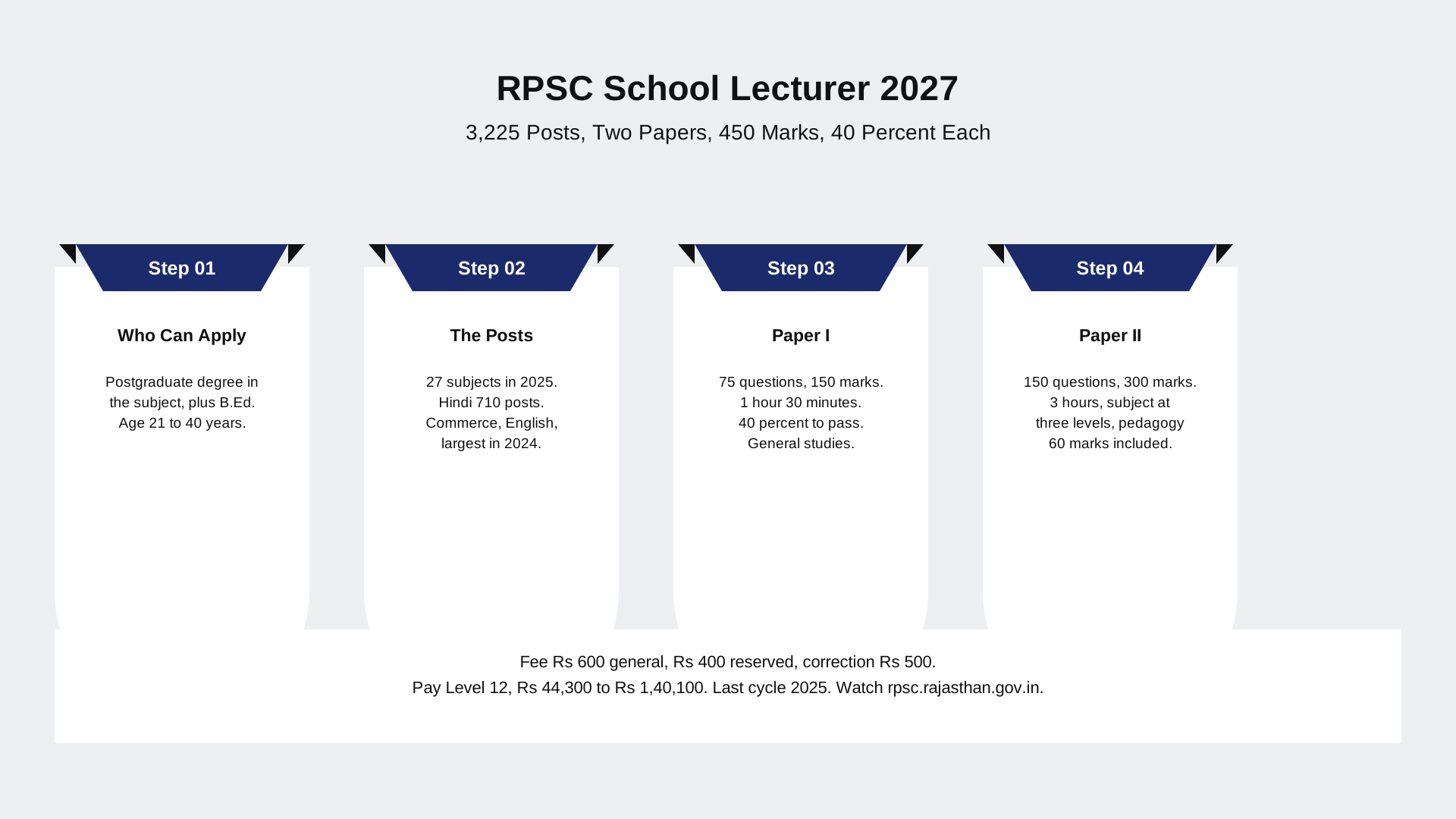
The post is a first grade teacher, known in Rajasthan as a School Lecturer, teaching Classes 11 and 12 in government senior secondary schools. It needs a postgraduate degree in the subject plus a B.Ed, and it pays at Level 12. The exam has two papers for 450 marks, and both papers must be passed at 40 percent. That second rule is the one that shapes everything. A candidate can know the subject well and still fail the exam by scoring 38 percent in the general studies paper.
This guide covers the exam as it actually runs. The two recent cycles and how they differ, the subjects and their post counts, the education and age rules, both papers with their part wise marks, the fee for each category, and a preparation plan built around the 40 percent rule in each paper. Where tracker sites disagree, this guide says so and names the figure it uses.
RPSC School Lecturer 2027 at a glance
| Detail | RPSC School Lecturer 2027, as last run in the 2025 cycle |
|---|---|
| Conducting body | Rajasthan Public Service Commission (RPSC), Ajmer |
| Exam | School Lecturer and Coach Competitive Examination, School Education |
| Last cycle | 2025, Advertisement Number 06 of 2025-26, notified 17 July 2025 |
| Posts in last cycle | 3,225 School Lecturer and Coach posts across 27 subjects |
| 2027 notification | Not published as of November 2026 |
| Education | Postgraduate degree in the relevant subject, plus B.Ed or DELEd |
| Age limit | 21 to 40 years as on 1 January 2026 in the last cycle |
| Fee in last cycle | Rs 600 for general category, Rs 400 for reserved categories, Rs 500 for corrections |
| Paper I | General awareness and general studies, 75 questions, 150 marks, 1 hour 30 minutes |
| Paper II | Subject concerned, 150 questions, 300 marks, 3 hours |
| Marking | 2 marks per right answer, one third of a mark cut per wrong answer |
| Qualifying marks | 40 percent in each paper, separately |
| Selection | Written exam plus document verification, no interview |
| Pay | Pay Level 12, grade pay Rs 4,800, Rs 44,300 to Rs 1,40,100 |
| Official website | rpsc.rajasthan.gov.in |
Two cycles in two years, and why pages mix them up
Most pages about this exam mix two cycles together, and the mix costs candidates real marks. The two cycles ran almost back to back, with similar names and the same pattern, but different post counts, different dates and different subject lists. Keep them apart.
The 2024 cycle came first. Advertisement Number 19 of 2024-25 advertised 2,202 School Lecturer posts across 24 subjects. Applications ran from 5 November to 4 December 2024. The exam ran from 23 June to 4 July 2025, subject by subject, in four groups. Group A covered 23 to 25 June, with general studies and Hindi on the first day, Geography and English on the second, Sanskrit and Mathematics on the third. Group B covered 26 June to 2 July, with Political Science, History, Biology, Chemistry, Commerce, Physics, Sociology, Economics, Urdu, Punjabi, Drawing and Home Science. Groups C and D covered Physical Education and Coach posts on 3 and 4 July. The final answer key and the merit list came on 16 April 2026, almost ten months after the exam. That long wait is normal for RPSC. Results arrive subject by subject, and the last subject can trail the first by months.
The 2025 cycle came next, and it was bigger. Advertisement Number 06 of 2025-26, dated 17 July 2025, advertised 3,225 School Lecturer and Coach posts across 27 subjects. Applications ran from 14 August to 12 September 2025 through the SSO portal, after one time registration. The exam ran from 31 May to 11 June 2026. The admit card came on 28 May 2026, and the exam city details came on 24 May 2026. Results began in August 2026, subject by subject, with Hindi on 7 August and Political Science on 17 August 2026. One tracker page prints 3,325 posts for this cycle in a single line, and another prints an exam end date of 16 June 2026. Both look like typing errors, because every other source, including the result pages, agrees on 3,225 posts and an exam ending on 11 June 2026. This guide uses 3,225 and 11 June, and flags the other two figures as conflicts.
The confusion between the cycles shows up everywhere. Pages titled for the 2025 exam carry the 2024 dates. Pages titled for the 2024 exam carry the 2025 post count. One syllabus page lists the application window as August to September 2025 under a heading that says 2025, which is right for the 2025 cycle, while its vacancy table still shows 2,202, which belongs to 2024. The rule for reading any page about this exam is simple. Match the post count to the advertisement number. If it says 2,202, it is the 2024 cycle, Advertisement 19. If it says 3,225, it is the 2025 cycle, Advertisement 06. If it says neither, close the page.
One earlier cycle deserves a line because candidates ask about it. The 2022 cycle is reported to have carried 6,000 School Lecturer posts, the largest ever. This guide could not verify that figure from the sources it retrieved, and it flags it as an unverified lead rather than a fact. What is certain is that RPSC has run this recruitment in 2022, 2024 and 2025, which makes it one of the most regular large recruitments in Rajasthan. A candidate who misses one cycle waits about a year, not five.
The subjects and the posts
The post count changes with the subject, and the subject decides the competition. In the 2024 cycle, the largest subjects were Hindi with 350 posts, Commerce with 340, English with 325, Political Science with 225 and Geography with 210. Mathematics had 153 posts and Physics had 147. History had 90, Biology had 67, Sanskrit had 64, Economics had 35, Urdu had 26, Punjabi had 11 and Rajasthani had 7. The remaining posts sat in Chemistry, Sociology, Drawing, Home Science, Music, Physical Education and the Coach posts. The 2025 cycle raised the total to 3,225 across 27 subjects, and the one subject figure this guide could verify for that cycle is Hindi at 710 posts, more than double its 2024 count. The full subject wise table for the 2025 cycle was not reproduced consistently across the sources retrieved, so this guide does not print a table it cannot stand behind. Candidates should read the subject table from the next advertisement itself.
The subject spread matters because it changes the odds. Rajasthani had 7 posts in 2024. Hindi had 350. A Hindi postgraduate and a Rajasthani postgraduate sit different exams in practice, even though the pattern is the same. The Hindi paper draws thousands of candidates for hundreds of posts. The Rajasthani paper draws a small field for a handful of posts. Neither is easy. The large subject needs a high score to clear a crowded merit list. The small subject needs a high score because a single wrong answer moves the candidate several ranks.
Coach posts sit inside the same recruitment, and they confuse candidates every cycle. The 2025 advertisement covers School Lecturer and Coach together, and the Coach exam runs in its own group with its own subject papers in sports like Football, Hockey, Kho Kho and Wrestling. A Coach candidate needs the sports qualification the advertisement names, not a postgraduate degree in an academic subject. The two tracks share the advertisement number and the application portal, and little else. Check which track you belong to before you fill the form.
Agriculture deserves its own warning. RPSC advertised 500 School Lecturer Agriculture posts separately, and tracker pages mix that drive with the main School Lecturer recruitment. The Agriculture posts are a separate notification with their own dates. Do not add 500 to the 3,225 total. The two drives are separate, and the Agriculture result pages carry their own advertisement number.
Who can apply
The education rule has two parts, and both must be met. First, a postgraduate degree in the relevant subject from a university recognised by the University Grants Commission. The subject must match the post. A postgraduate degree in History does not qualify a candidate for the English lecturer post, however good their English is. Second, a degree or diploma in education, a B.Ed or a DELEd. The teaching qualification is not optional, and it is the condition that removes the most otherwise eligible postgraduates. Candidates in the final year of the postgraduate degree or the B.Ed should read the notification for the exact position on appearing candidates, because RPSC states it afresh each time and the document check at the end is strict.
The age rule in the last cycle was 21 to 40 years as on 1 January 2026. Relaxation applied under the Rajasthan rules, reported as five years for men of the SC, ST, OBC, MBC and EWS categories of Rajasthan, ten years for women of those categories, and five years for women of the general category. Those relaxation figures come from tracker summaries of the notification, and candidates should confirm them from the next advertisement. The age limit is the same for every subject, which is one less thing to worry about when choosing between two subjects.
There is no interview in this recruitment. Selection runs through the written exam and document verification. That shape suits candidates who write well under time pressure, and it means the two papers carry the whole selection. A candidate with strong subject knowledge and weak general studies fails at the first paper. A candidate with strong general studies and weak subject knowledge fails at the second. Both papers must be passed at 40 percent, and the final merit comes from the total of 450 marks.
RPSC School Lecturer exam pattern
The RPSC School Lecturer exam pattern is two papers, one morning of general studies and one long paper in the subject. The exam is objective, OMR based, and held subject by subject over several days, so candidates for different subjects sit on different dates. Each candidate sits Paper I once and Paper II once, in the same cycle, on the dates fixed for their subject.
Paper I is general awareness and general studies. It has 75 questions for 150 marks, to be finished in 1 hour 30 minutes. Paper II is the subject concerned. It has 150 questions for 300 marks, to be finished in 3 hours. The total is 225 questions for 450 marks. Every question carries 2 marks in both papers. Every wrong answer loses one third of the marks of the question, which works out to two thirds of a mark per wrong answer. A blank answer loses nothing.
The negative marking changes the arithmetic of guessing. A candidate who guesses on ten questions and gets three right gains 6 marks and loses about 4 and two thirds, a net gain of just over 1 mark. A candidate who guesses on ten and gets two right gains 4 and loses about 5 and a third, a net loss. The line sits near three right out of ten. Guesses where two options can be ruled out are worth taking. Blind guesses across the whole paper are not. The candidates who top this exam are not the ones who attempt every question. They are the ones who attempt the questions they can narrow down and leave the rest blank.
The 40 percent rule applies to each paper separately. Paper I needs 60 marks out of 150. Paper II needs 120 marks out of 300. A candidate who scores 130 in Paper II and 55 in Paper I fails the exam, even though the total of 185 out of 450 would look respectable on its own. That is the trap of this exam, and it is the reason the preparation plan in this guide spends as much time on general studies as on the subject. The subject paper carries twice the marks, but the general studies paper carries the same power to fail a candidate.
The exam runs in groups because 27 subjects cannot be examined in one sitting. In the 2024 cycle, Group A ran from 23 to 25 June 2025, Group B from 26 June to 2 July, Group C on 3 July for Physical Education, and Group D on 4 July for Coach posts. Paper I runs separately for each group, with the same syllabus but a different paper. A candidate cannot sit Paper I for one group and Paper II for another. The admit card names the group, the date, the shift and the centre, and the exam city details come about a week before the admit card.
Paper I, part by part
Paper I has five parts, and the marks are spread unevenly enough to plan around. History of Rajasthan and India, with the freedom struggle, carries 15 questions for 30 marks. General science, Indian polity and the geography of Rajasthan carries 15 questions for 30 marks. Current affairs carries 10 questions for 20 marks. Educational management, the state education system and the Right to Education, carries 15 questions for 30 marks. Mental ability, statistics and mathematics at secondary level, with Hindi and English language ability, carries 20 questions for 40 marks. The last part is the largest single block in the paper, and it is the one candidates neglect most often.
History in this paper means Rajasthan first and India second. Ancient and medieval Rajasthan, the relations between Maharana Pratap and the Mughals, the revolt of 1857 in the state, and the peasant and tribal movements all appear regularly. A candidate who knows the national freedom movement but not the Rajasthan movements will drop marks here. The state movements have their own names, leaders and dates, and the paper asks for them directly. Fifteen questions is a small block, but the answers are either known or not, and there is no partial credit for a half remembered movement.
The general science, polity and Rajasthan geography part mixes three subjects in one block. General science sits at secondary level. Polity covers the Constitution, the Parliament, the state legislature, the judiciary and local government. Rajasthan geography covers the Aravalli range, the Thar desert, rivers and lakes, soils, minerals, forests and the districts. The mix rewards breadth. A candidate who reads only polity will answer five of the fifteen questions well and guess the rest.
Current affairs carries 10 questions for 20 marks, and it is the cheapest block to prepare if the habit is daily. A newspaper every morning, with a notebook for Rajasthan news in particular, covers most of it. State government schemes, new appointments, awards, sports results and national events from the last year all appear. The block punishes candidates who start reading the news a month before the exam, because a year of news cannot be learned in four weeks.
Educational management is the part that surprises first timers. It covers the management of education, the school education system in Rajasthan, and the Right of Children to Free and Compulsory Education Act. Candidates with a B.Ed have seen this material, and that is the point. The paper tests whether the teaching qualification left anything behind. A B.Ed holder who revises the education management notes from the degree will score here. A candidate who treats Paper I as a general knowledge paper will not.
The mental ability and language block carries 40 marks, more than any other part, and it is the most mechanical part of the paper. Mental ability questions, statistics and mathematics at secondary level, and language ability in Hindi and English. The mathematics is school level, percentages, averages, ratios, simple interest, time and work, and the language questions test grammar and comprehension. This block rewards practice sets over reading. Twenty questions a day for a month lifts this block more than any other preparation, because the question types repeat and speed matters. Ninety minutes for 75 questions allows 72 seconds per question, and the mental ability block is where slow candidates run out of time.
Paper II: your subject at three levels
Paper II tests the subject at three levels, and the split is published in the syllabus. Senior secondary level content, Classes 11 and 12, carries 55 questions for 110 marks. Graduation level content carries 55 questions for 110 marks. Postgraduate level content carries 10 questions for 20 marks. Educational psychology, pedagogy, teaching learning material and information technology in teaching carries 30 questions for 60 marks. The total is 150 questions for 300 marks in 3 hours, which allows 72 seconds per question, the same pace as Paper I but sustained for twice as long.
The split tells a candidate where the marks live. Senior secondary and graduation content together carry 220 of the 300 marks. Postgraduate content carries only 20. A candidate who spends months on postgraduate seminars and skips the Class 11 and 12 textbooks has the plan backwards. The school textbooks for Classes 11 and 12 in the subject are the first books to read, and the graduation textbooks are the second. The postgraduate syllabus matters for 10 questions, and it should be revised, not mastered at the cost of the other 110 questions.
The pedagogy block carries 60 marks, and it is the part that separates subject experts from future teachers. Educational psychology, how students learn, teaching methods, teaching aids, and the use of computers and information technology in teaching and learning. A postgraduate who has never thought about how to teach will find this block hard. A B.Ed holder who revises the pedagogy notes will find it straightforward. Thirty questions is a large block, and it is the same for every subject, which means a good pedagogy score lifts every candidate equally.
The subject syllabus itself is published separately for each subject on the RPSC website. Hindi Paper II covers Hindi literature and language at senior secondary, graduation and postgraduate levels, with prescribed texts that change between cycles. English, History, Geography, Political Science, Physics, Chemistry, Mathematics, Biology, Commerce, Economics, Sanskrit and the rest each have their own detailed syllabus. Candidates should download the syllabus for their own subject from rpsc.rajasthan.gov.in and check the prescribed books list, because the books named in the syllabus are the books the paper is set from.
Fee, pay and the job itself
The application fee in the last two cycles stayed the same. General category, BC and EBC creamy layer candidates paid Rs 600. Reserved category candidates, SC, ST, BC and EBC non creamy layer, EWS, Sahariya tribe and persons with disabilities, paid Rs 400. The fee for corrections to the form was Rs 500. Payment ran online through UPI, credit card, debit card and net banking, and the fee had to be paid by the last date for applications, 12 September 2025 in the latest cycle. RPSC uses one time registration through the SSO portal, so candidates who had already registered could use their existing details.
Pay sits at Level 12 of the Pay Matrix, with grade pay of Rs 4,800, and the monthly scale runs from Rs 44,300 to Rs 1,40,100 under the Seventh Pay Commission, plus the usual allowances. That is the highest starting pay among the school teaching posts in Rajasthan, and it is the reason the exam draws postgraduates who could have taken private college jobs. A School Lecturer teaches Classes 11 and 12 in a government senior secondary school, prepares students for the board examinations, and carries the academic load of the senior classes. The posting can be anywhere in the state, and the transfer rules of the Education Department apply over a career.
The job carries one condition candidates should understand before they apply. The post is a state government teaching post, and the posting depends on vacancies in schools across Rajasthan. A candidate from Jaipur may be posted in a district far from home. That is normal for a state level recruitment, and the merit list decides the order in which postings are offered. The candidates who top the list choose first.
A preparation plan that respects the 40 percent rule
The plan starts with a number. Paper I needs 60 marks out of 150. That is 30 right answers out of 75, after negative marking is counted. A candidate who scores 55 in Paper I fails, whatever the subject score. So the first month of preparation belongs to Paper I, not to the subject. Read the Rajasthan history notes, the polity notes, the education management notes from the B.Ed, and start the daily newspaper habit. Solve 20 mental ability questions a day. By the end of the first month, a mock Paper I should be crossing 60 marks. If it is not, the subject can wait. The subject paper carries 300 marks, but it cannot rescue a failed Paper I.
The subject needs the second and third months, built on the textbooks. Start with the Class 11 and 12 books in the subject, chapter by chapter, with a notebook for facts, dates, definitions and formulae. Then move to the graduation books for the same topics at greater depth. The postgraduate level needs a revision pass, not a deep study, because it carries only 20 marks. The pedagogy block needs a separate week, revising the B.Ed notes on educational psychology, teaching methods and information technology in teaching. Candidates who skip pedagogy give away 60 marks that every other candidate is collecting.
Mock tests deserve a fixed slot from the second month onward. One Paper I mock a week, 75 questions in 90 minutes, and one Paper II mock a week, 150 questions in 3 hours. The Paper II mock is a long sitting, and that is the point. Three hours of concentration is a skill, and it is built by sitting for three hours. Check every mock against the answer key, and keep a notebook of wrong answers by topic. The notebook shows the pattern within three weeks. Most candidates find that two or three topics cause most of their losses, and fixing those topics lifts the score faster than studying everything again.
Previous papers are the best mock tests of all. The 2024 cycle papers from 23 June to 4 July 2025 and the 2025 cycle papers from 31 May to 11 June 2026 are the freshest real papers, and the provisional answer keys for the 2024 cycle came out in June 2026 with the final answer key and merit list in April 2026. Solve the Paper I of your own group first, because the group paper is the one that matches your subject dates, then solve the Paper II of your subject. The questions repeat in type even when the facts change, and the paper shows what RPSC actually asks rather than what coaching books guess.
Time management inside the paper follows the negative marking rule. In Paper I, 72 seconds per question is tight, so the order matters. Answer the sure questions first, mark the doubtful ones, and return to them after the sure ones are done. Leave a question blank when all four options look equally likely. In Paper II, the same rule holds over three hours, with one difference. The pedagogy block sits at the end of the paper for most subjects, and tired candidates rush it. Save time for it deliberately. Sixty marks is too much to lose to fatigue.
RPSC School Lecturer 2027: what to check before the next notification
The next notification will appear on rpsc.rajasthan.gov.in first, under the recruitment section, and nowhere else counts as an announcement. Check the RPSC website once a week, and read four things when the notification appears: the advertisement number, the subject wise vacancy table, the age cut off date, and the last date to apply. The subject table decides whether your subject has posts at all in that cycle, because the list of subjects changes. The 2024 cycle had 24 subjects. The 2025 cycle had 27. A subject with posts in one cycle can have none in the next.
One more check saves candidates from a common mistake. RPSC runs several teacher recruitments, and their names sound alike. School Lecturer is the first grade teacher for Classes 11 and 12. Senior Teacher is the second grade teacher for Classes 9 and 10. Teacher is the third grade teacher for primary classes. The three exams have different qualifications, different patterns and different commissions in some cycles. The School Lecturer exam needs a postgraduate degree and a B.Ed. If a page asks for only a graduation degree, it is not this exam.
Prepare on the 2025 pattern, keep Paper I above 60 marks in every mock, and watch rpsc.rajasthan.gov.in for the next RPSC School Lecturer 2027 notification. The exam rewards a postgraduate who can also pass a general studies paper, and a teacher who knows the subject at school level as well as at university level. When the notification comes, the candidates who are already ready will file the form on the first day and spend the waiting time revising instead of starting.
Sources
Rajasthan Public Service Commission, official website rpsc.rajasthan.gov.in. FreeJobAlert, RPSC School Lecturer first grade exam pattern 2025, Advertisement Number 19 of 2024-25, 2,202 posts. IndGovtJobs, RPSC School Lecturer recruitment 2024, 2,202 posts, applications 5 November to 4 December 2024. ExamSyllabusHub, RPSC first grade syllabus, Paper I and Paper II part wise marks. ShikshaExpress, RPSC first grade syllabus 2025, Paper I and Paper II patterns. GuruSevika, RPSC syllabus for Lecturer in School Education, Hindi Paper II. AdmitCards, RPSC School Lecturer exam date 2025, 23 June to 4 July 2025. OB News, RPSC School Lecturer exam 2025, subject wise schedule. Testbook, RPSC School Lecturer exam analysis 2025, result and exam schedule for the 2025 cycle. GovtJobGuru, RPSC School Lecturer 2025 result, Advertisement Number 06 of 2025-26, 3,225 posts. GovtJobGuru, RPSC School Lecturer and Coach 2024 final answer key and result, 16 April 2026. SarkariDatabase, RPSC School Lecturer and Coach recruitment 2025-26, 3,225 vacancies, dates and fee. RajkiyaResult, RPSC School Lecturer and Coach recruitment 2025, 3,225 posts, age relaxation. ResultBharat, RPSC first grade teacher 2025 result, Advertisement Number 06 of 2025-26, exam 31 May to 11 June 2026. ExamKhiladi, RPSC School Lecturer admit card 2026, 3,225 posts, 27 subjects.