
About RSSB LDC Grade II 2027 Exam Series
📖 Table of Contents
- RSSB LDC Grade II 2027 at a glance
- The 2026 cycle is the map for 2027
- Who can apply
- RSSB LDC exam pattern: two written papers
- The typing test decides more ranks than candidates expect
- Pay, probation and the work itself
- What changed since the 2024 cycle
- A preparation plan built on the real marks
- Five mistakes that cost candidates a seat
- What to watch next
- Sources
RSSB LDC Grade II 2027: Complete Exam Guide
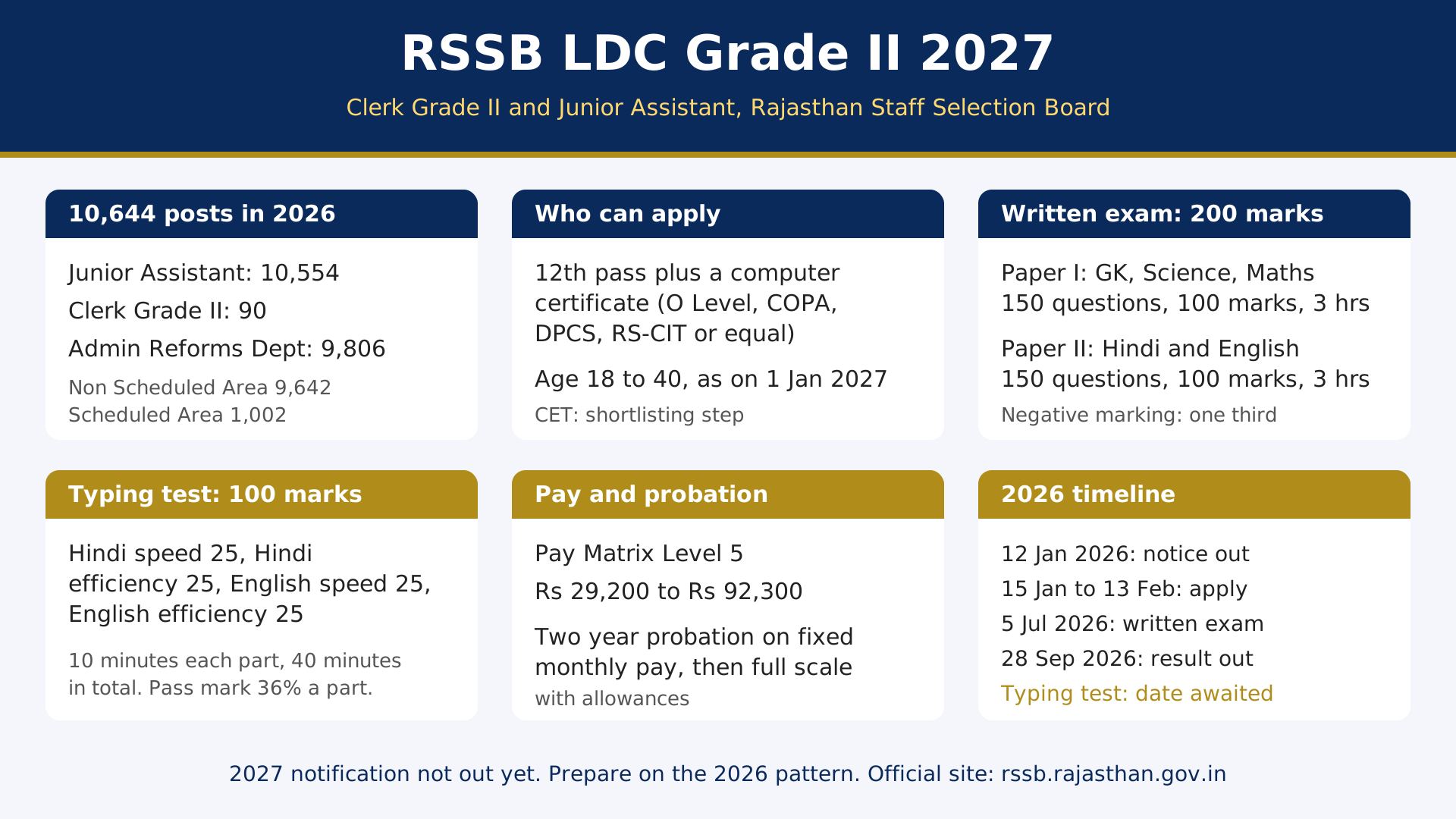
The RSSB LDC Grade II 2027 cycle has no notification yet, and that single fact shapes this whole guide. The Rajasthan Staff Selection Board, known as RSSB, ran its freshest LDC cycle in 2026 under Advertisement 04/2026, with 10,644 posts for Clerk Grade II and Junior Assistant. The written exam took place on 5 July 2026, and the board published the written result on 28 September 2026. The typing test comes next. Until RSSB publishes a fresh advertisement, the 2026 cycle gives the truest picture of the exam, and this guide builds on it.
A 12th pass candidate can aim at this exam, and that is exactly why the competition runs into lakhs. The post needs Senior Secondary plus a computer certificate, the age window runs from 18 to 40, and the written stage carries only 200 marks across two papers. Small gaps decide ranks here. A candidate who scores 40 percent in each paper clears the written bar, but the typing test then adds 100 marks of its own, and the final merit counts both stages together. Anyone who treats typing as an afterthought gives away a third of the total marks.
This guide covers the exam as it actually runs. The 2026 vacancy split across six departments, the CET shortlisting step that many candidates miss, the age and education rules with the extra years for some departments, the two written papers with exact marks and the negative marking rule, the four part typing test, the pay on Level 5, and a preparation plan built on the real weight of each paper. Where a figure comes from a tracker rather than the board, this guide says so. Where two trackers disagree, this guide names the disagreement instead of picking one quietly.
RSSB LDC Grade II 2027 at a glance
| Detail | RSSB LDC Grade II 2027, as last run in the 2026 cycle |
|---|---|
| Conducting body | Rajasthan Staff Selection Board (RSSB), Jaipur, earlier called RSMSSB |
| Exam | Clerk Grade II and Junior Assistant Combined Direct Recruitment Examination |
| Last cycle | 2026, Advertisement 04/2026, digitally signed 12 January 2026 |
| Posts in last cycle | 10,644, with 90 Clerk Grade II posts and 10,554 Junior Assistant posts |
| 2027 notification | No notification has appeared as of 22 November 2026 |
| Education | Senior Secondary (12th pass) plus a recognised computer qualification |
| Age limit | 18 to 40 years as on 1 January 2027, with relaxations and extra years for some departments |
| Fee in last cycle | Rs 600 for general and creamy layer OBC and EBC, Rs 400 for non creamy OBC and EBC, EWS, SC, ST and persons with disabilities, paid through One Time Registration |
| Written exam | Two papers of 100 marks each, 150 questions each, 3 hours each, on 5 July 2026 |
| Typing test | Four parts of 25 marks each, 100 marks in total, 10 minutes each part |
| Pay | Pay Matrix Level 5, Rs 29,200 to Rs 92,300, with a two year probation on fixed pay |
| Official website | rssb.rajasthan.gov.in |
The 2026 cycle is the map for 2027
The 2026 notification arrived on 12 January 2026, and the board opened online applications three days later. The window ran from 15 January to 13 February 2026, and candidates had to finish their One Time Registration by 11:59 PM on the last day, because the board accepted no application without a valid registration. The exam city details came out on 26 June 2026, the admit card followed on 1 July 2026, and both written papers took place on 5 July 2026, Paper I in the morning from 9:30 AM to 12:30 PM and Paper II in the afternoon from 3:00 PM to 6:00 PM. The answer key appeared on 24 July 2026, the result on 28 September 2026, and the score card on 7 October 2026, according to tracker reports of the board site.
The vacancy count deserves a second look, because 10,644 is the largest LDC drive Rajasthan has seen. The Administrative Reforms Department alone accounts for 9,806 Junior Assistant posts in state subordinate departments and offices, which is more than nine out of every ten posts in the whole drive. The Directorate of Agricultural Marketing adds 600 Junior Assistant posts in mandi committees, the Rajasthan State Agricultural Marketing Board adds 98, and the Rajasthan State Pollution Control Board adds 50.
Clerk Grade II posts number only 90 in total, with 84 at the Board of Secondary Education, Rajasthan, and 6 at the Rajasthan Public Service Commission. A candidate who dreams of a secretariat desk should know that the secretariat share is tiny. The bulk of the selected candidates will work in district and subordinate offices.
| Department | Post | Non Scheduled Area | Scheduled Area | Total |
|---|---|---|---|---|
| Administrative Reforms Department, subordinate departments and offices | Junior Assistant | 8,827 | 979 | 9,806 |
| Directorate of Agricultural Marketing, mandi committees | Junior Assistant | 581 | 19 | 600 |
| Rajasthan State Agricultural Marketing Board | Junior Assistant | 98 | 0 | 98 |
| Rajasthan State Pollution Control Board | Junior Assistant | 46 | 4 | 50 |
| Board of Secondary Education, Rajasthan | Clerk Grade II | 84 | 0 | 84 |
| Rajasthan Public Service Commission | Clerk Grade II | 6 | 0 | 6 |
| Total | 9,642 | 1,002 | 10,644 |
The split between Non Scheduled Area and Scheduled Area matters at the application stage. A candidate applies against one area, and the merit list for that area decides the outcome. The Scheduled Area share, 1,002 posts, sits almost entirely in the Administrative Reforms Department, which holds 979 of them. The other departments carry four or zero Scheduled Area posts each. Candidates from tribal areas should read the area wise break up in the notice before they fill the form, because the choice cannot change later.
One date in this cycle needs a warning. A Hindi section of one tracker page mentions the exam on 5 and 6 July 2026, while the same page carries a table that says 5 July 2026 only, and the Times of India, Testbook and other trackers all report a single day, 5 July 2026, with both papers on that day. This guide follows the single day version. The two day mention looks like a copy error, and the package notes flag it.
Who can apply
The education rule has two halves, and candidates who read only the first half get rejected at document verification. The first half is simple. A candidate must have passed Senior Secondary, the 12th class, from a recognised board.
The second half asks for a computer qualification, and the notice accepts several routes. An O level or higher level certificate from DOEACC or NIELIT works, as does a certificate course on computer concepts from NIELIT, a COPA or DPCS certificate under the National or State Council for Vocational Training, a degree or diploma or certificate in Computer Science or Computer Applications from a recognised university, or an RS-CIT certificate. A candidate who passed 12th with Computer Science as a subject also meets the rule. Final year students of the qualifying computer course could apply in the 2026 cycle, but they had to show proof of passing before the typing test.
The notice also asks for working knowledge of Hindi written in the Devanagari script and familiarity with the culture of Rajasthan. This is a condition of the service rules, and candidates should treat it as a real requirement rather than a line in the form. The written papers test Hindi directly, and the typing test runs in Hindi as well, so a candidate weak in Hindi loses marks at every stage.
Age runs from 18 to 40 years as on 1 January 2027 for the 2026 cycle. That date surprises some candidates, because the notification came out in January 2026 while the age cut off points at January 2027. The notice then adds extra years for particular departments.
Candidates who applied for the Rajasthan Public Service Commission and Administrative Reforms Department posts received one extra year, and candidates who applied for the Pollution Control Board and Board of Secondary Education posts received up to three extra years, because those departments had seen no recruitment for three years. On top of that, the usual relaxations apply. SC, ST, OBC, MBC and EBC candidates of Rajasthan and general category women receive up to 5 years, SC, ST and OBC women receive up to 10 years, ex servicemen receive up to 15 years, and persons with disabilities receive 5 more years. A candidate should add the department extra years and the category relaxation together only after reading the notice, because the two sit in different paragraphs and trackers often merge them into one wrong number.
The CET step is the part that many summaries bury at the bottom, and it is the part that can end a candidacy before the written exam begins. The 2026 recruitment used the CET Senior Secondary Level 2024 as a shortlisting step. Tracker reports describe a CET pass as a condition to apply, and the board shortlisted candidates for the written exam on the basis of CET scores.
This guide could not verify the exact CET rule from the text of the official notice itself, so it flags the point plainly. A candidate who plans for the RSSB LDC Grade II 2027 cycle should treat the CET as a gate, not an optional test. Clearing the 12th level CET in the year the board names is the first task, and the written exam preparation is the second.
RSSB LDC exam pattern: two written papers
The RSSB LDC exam pattern has stayed the same in shape across cycles, and that stability helps candidates plan. Phase I is a written exam with two objective papers. Each paper carries 150 questions for 100 marks and runs for 3 hours.
Paper I covers General Knowledge, Everyday Science and Mathematics. Paper II covers General Hindi and General English, with 75 questions in each language. Both papers use OMR sheets, and candidates answer with a blue ballpoint pen.
| Paper | Subjects | Questions | Marks | Time |
|---|---|---|---|---|
| Paper I | General Knowledge, Everyday Science, Mathematics | 150 | 100 | 3 hours |
| Paper II | General Hindi (75 questions), General English (75 questions) | 150 | 100 | 3 hours |
| Total, Phase I | 300 | 200 | 6 hours |
Paper I mixes three subjects that reward different kinds of study. General Knowledge leans hard on Rajasthan, with its history, culture, geography, schemes and organisations, alongside current events of national importance and the standard topics of Indian polity, history, geography and economy. Everyday Science covers the science of daily life, from physical and chemical changes to metals and their compounds, vitamins and deficiency diseases, and the use of biotechnology in medicine and agriculture. Mathematics stays at the 12th pass level, with number systems, ages, LCM and HCF, algebra, geometry and trigonometry. A candidate who ignores Rajasthan GK gives away the largest single block of Paper I, because the state portion runs through the GK section and through the current affairs questions as well.
Paper II splits exactly in half, and that split shapes the scoring. General Hindi covers sandhi, samas, upsarg and pratyay, synonyms and antonyms, words with more than one meaning, word pairs, formation of adjectives from nouns, and idioms. General English covers tenses, active and passive voice, direct and indirect narration, transformation of sentences, articles and determiners, prepositions, translation of simple sentences between Hindi and English, correction of sentences including subject verb agreement, degrees of adjectives, connectives, words wrongly used, official and technical terms with their Hindi versions, and formation of new words with prefixes and suffixes. Hindi grammar rewards a candidate who studied the language in school, while English rewards steady practice with error spotting and voice and narration, which carry a heavy share of the 75 questions.
Negative marking applies at one third of a question value for each wrong answer. With 150 questions for 100 marks, each question carries two thirds of a mark, so a wrong answer costs about 0.22 marks. The OMR sheet adds a twist that many first timers miss. Each question carries five options, A, B, C, D and E.
A candidate who wants to leave a question unanswered must darken option E. Tracker summaries of the notice say that a question left blank without marking E also loses one third of a mark, exactly like a wrong answer. That rule makes blind guessing and careless skipping equally costly. A candidate should mark E deliberately for every question left out, and should guess only when the odds beat the penalty.
The qualifying bar sits at 40 percent in each paper separately, with a 5 percent relaxation for SC and ST candidates, which brings their bar to 35 percent in each paper. Clearing both bars is only the first step. The board calls candidates for the typing test in the ratio of about three times the number of vacancies, ranked on the written marks.
In the 2026 cycle that meant roughly 32,000 candidates reached the typing test from a field far larger. A score just above 40 percent in each paper may clear the bar and still miss the typing call, because the call goes by rank. The result of 28 September 2026 also carried provisional cut off marks for the written exam, published separately for Tribal Sub Plan and Non Tribal Sub Plan areas, and candidates should read those cut offs on the board site rather than trust tracker tables.
The typing test decides more ranks than candidates expect
Phase II is a computer typing test, and it carries 100 marks across four parts of 25 marks each. Each part runs for 10 minutes, so the whole test takes 40 minutes. Hindi typing has a speed test and an efficiency test, and English typing has the same two parts. The speed test measures how fast and how accurately a candidate types a passage. The efficiency test measures practical computer work in the same language, such as formatting text, using tables, and applying bold and italic styles, with justification and layout counted as part of the score.
| Part | Language | Marks | Time |
|---|---|---|---|
| Speed test | Hindi | 25 | 10 minutes |
| Efficiency test | Hindi | 25 | 10 minutes |
| Speed test | English | 25 | 10 minutes |
| Efficiency test | English | 25 | 10 minutes |
| Total | 100 | 40 minutes |
The qualifying bar for the typing test sits at 36 percent in each part, with a 5 percent relaxation that brings the bar to 31 percent for SC and ST candidates. Candidates with benchmark disabilities receive their Phase I average marks in place of the typing test, under the notice rules. The final merit counts Phase I and Phase II together, which gives the typing test a full third of the total 300 marks. A candidate who scores 130 out of 200 in the written exam and 50 out of 100 in typing finishes behind a candidate who scores 120 in writing and 75 in typing. That arithmetic is the reason typing practice belongs in the daily plan from the first week, not in the last fortnight after the written result.
Typing speed figures need a caution, because trackers disagree on them. One tracker reports Hindi at 25 words per minute and English at 30 words per minute, while another reports Hindi at 25 and English at 20. The marks and the time for each part are consistent across sources, but the speed targets are tracker reported, and this guide does not present either figure as board text. The safe approach is to practise until Hindi typing crosses 25 words per minute and English typing crosses 30, because the higher target covers both versions of the claim. Hindi typing uses the Kruti Dev or Devlys font in most centres, so candidates should practise in that font rather than in a Unicode font that behaves differently under exam conditions.
No typing test date has appeared on the board site as of 22 November 2026. One tracker page says the typing test is scheduled for January 2027, while another tracker, updated later, says the board has announced that the typing test details will follow in a separate notice and that no date is available yet. This guide follows the second version. Candidates who qualified in the written exam should watch rssb.rajasthan.gov.in for the typing notice and keep their typing practice warm in the meantime, because a sudden date leaves no room to build speed from zero.
Pay, probation and the work itself
Selected candidates join Pay Matrix Level 5 under the 7th Pay Commission, with a pay scale of Rs 29,200 to Rs 92,300. The first two years run as probation, and during probation the government pays a fixed monthly remuneration set by the state government, without dearness allowance, house rent allowance or other allowances. After probation, the full pay scale applies with allowances under the government rules, including dearness allowance, house rent allowance, urban compensation allowance and special pay where admissible.
One older pay figure still circulates on tracker pages, and it needs a clear correction. Several older pages quote Rs 20,800 to Rs 65,900 as the Level 5 scale for this post. The 2026 cycle summaries quote Rs 29,200 to Rs 92,300, which matches the revised Level 5 scale. This guide uses the 2026 figure. Candidates who read the older figure in an old video or an old article should treat it as out of date.
The work of a Clerk Grade II or Junior Assistant is the daily paperwork of government. A clerk drafts letters and notes, keeps files in order, enters data, prepares statements, handles receipts and dispatch, and answers the public at the counter. A Junior Assistant in a district office does the same work at the cutting edge of the administration, where files move between the collectorate, the tehsil and the block.
In the secretariat, a Clerk Grade II works closer to policy files and senior officers. The post carries no field duty of the kind a police constable or a patwari faces, but it does carry a steady load of typing, and that is why the board tests typing before it appoints anyone. Promotion runs through the ministerial cadre, from Junior Assistant and Clerk Grade II upward to senior clerk and office superintendent posts, under the service rules of each department.
What changed since the 2024 cycle
The 2024 cycle gives the best sense of how fast this exam grows. Advertisement 06/2024 carried 4,197 posts for Clerk Grade II and Junior Assistant, with applications open from 20 February to 20 March 2024 and the written exam held on 11 August 2024. The split ran 584 Clerk Grade II posts in the Government Secretariat, 61 Clerk Grade II posts at the Rajasthan Public Service Commission, and 3,552 Junior Assistant posts in state subordinate departments and offices, with 2,788 in the Non Scheduled Area and 761 in the Scheduled Area. Readers who add the Junior Assistant area figures will find 3,549, three short of the 3,552 total, a small arithmetic gap in the tracker table that this guide flags rather than hides. The total of 4,197 still adds up cleanly across the three post groups.
The jump from 4,197 posts in 2024 to 10,644 in 2026 is more than two and a half times, and it changed the character of the drive. The 2024 cycle drew its Junior Assistant posts almost entirely from subordinate departments, while the 2026 cycle added mandi committees, the marketing board and the pollution control board as separate recruiting departments. The age rule also shifted its reference date, from 1 January 2025 in the 2024 cycle to 1 January 2027 in the 2026 cycle, and the 2026 notice added the department wise extra years that the 2024 notice did not carry. The fee stayed the same in both cycles, at Rs 600 for general category and Rs 400 for the concessional categories, paid through One Time Registration.
The 2018 cycle sits further back, and its post count is the one figure in this guide that two sources state differently. The task research for this package records 11,255 posts for the 2018 cycle, while a tracker page that follows the exam year by year records 12,456 posts for the same cycle. This guide does not choose between them, because neither figure could be checked against the 2018 notice text during research. The 2018 cycle matters mainly as proof that the board runs this recruitment in large waves, with long gaps between waves. A candidate who waits for the next wave should use the gap to prepare, because the notice, once published, gives only about a month to apply and a few months to sit the exam.
The pattern itself has not changed across these cycles. Two written papers of 100 marks each, a typing test of 100 marks, document verification at the end. The 2026 cycle added the CET shortlisting step in front of the written exam, which is the one structural change candidates must respect.
Everything else in the 2026 pattern matches the 2024 pattern, down to the paper timings and the qualifying bars. That match is good news for the RSSB LDC Grade II 2027 cycle. A candidate who prepares on the 2026 pattern prepares on the right exam, even while the 2027 notice is still awaited.
A preparation plan built on the real marks
The written exam gives 100 marks to Paper I and 100 to Paper II, and the typing test gives 100 more. A plan that spends all its time on General Knowledge and none on typing throws away a third of the total. The plan below splits the week across all three scoring blocks for RSSB LDC Grade II 2027, and it treats Paper II as the scoring paper it is. Hindi and English grammar reward revision more reliably than any other part of this exam, because the questions test rules that stay fixed from year to year.
Paper I needs three daily habits. Rajasthan GK deserves the first hour, with the state history, culture, geography, districts, rivers, fairs and festivals, and the schemes of the Rajasthan government read from a standard state GK book and revised weekly. Current affairs need a short daily note, with national news and Rajasthan news kept in separate columns, because the paper asks both.
Everyday Science and Mathematics need problem practice rather than reading, with 20 science questions and 20 maths questions a day from previous papers. The 2024 and 2026 papers are the best source of questions, because they show which topics the board repeats. A candidate who finishes the Rajasthan GK book twice and solves the last two cycles of papers will cover most of Paper I.
Paper II needs a different rhythm. Hindi grammar takes one hour a day, with sandhi and samas, synonyms and antonyms, idioms and error spotting practised in sets of 50 questions. English grammar takes the same hour on alternate days, with tenses, voice, narration, prepositions and sentence correction in sets of 50. Translation between Hindi and English deserves a weekly slot, because the paper tests it directly and few candidates practise it. The vocabulary work in both languages should come from the previous papers rather than from word lists, because the board repeats its favourite words.
Typing needs 30 minutes a day from the first week. Hindi typing in Kruti Dev at 25 words per minute is the floor to aim at, and English typing at 30 words per minute covers the higher of the two tracker figures. A candidate should type one passage in each language every day and keep a log of speed and errors, because speed without accuracy loses marks in the efficiency test as well. The efficiency test also needs practice with formatting, so a weekly session on tables, bold and italic text, and page layout in a word processor pays off directly. Candidates who type only on a phone keyboard will find the computer test unfamiliar, so all typing practice should happen on a real keyboard.
Mock tests tie the plan together. A full mock of both papers every Sunday under exam timing, with Paper I in the morning and Paper II in the afternoon, builds the stamina for a six hour exam day. The mock score matters less than the review. Every wrong answer should go into a notebook with the rule behind it, and the notebook should be revised before the next mock. A candidate who takes ten full mocks and reviews each one properly will walk into the exam hall knowing the paper, while a candidate who takes thirty mocks without review will walk in knowing only the score.
The last month before the exam belongs to revision and to the OMR habit. Candidates should practise darkening bubbles on a printed OMR sheet, marking E for every question they skip, and checking the time after every 50 questions. The board gives 10 extra minutes after each paper for verification of the OMR sheet, and candidates should use that time to check that no question is left blank without an E. A single missed E costs a third of a mark, and a handful of them across 300 questions can cost a rank.
Five mistakes that cost candidates a seat
The first mistake is to skip the CET. Candidates who prepare for the RSSB LDC Grade II 2027 written papers and ignore the CET Senior Secondary Level test can find themselves shut out of the 2027 cycle before it begins. The CET has its own notification, its own dates and its own syllabus, and the board used the 2024 CET scores to shortlist the 2026 written exam. A candidate should clear the CET in the year the board names and keep the score card safe.
The second mistake is to leave questions blank on the OMR sheet without marking E. The notice gives five options for a reason, and the fifth option exists so that a candidate can say plainly that a question is unanswered. A blank bubble counts as a wrong answer for penalty purposes, according to tracker summaries of the notice. The fix costs nothing. Mark E, move on, and save the third of a mark.
The third mistake is to study Rajasthan GK from an all India book. The paper leans on the state, and a general book gives the state a chapter where the paper gives it a paper. A Rajasthan specific book, plus the state government schemes of the last two years, covers the ground the paper actually tests.
The fourth mistake is to treat the typing test as a formality. The test carries 100 marks, the same as a whole written paper, and it has its own qualifying bar of 36 percent in each part. Candidates who type slowly fail the speed test even when their written score is high. Daily typing from the first week is the only cure, and it is a cheap one.
The fifth mistake is to trust tracker cut off tables. The board published provisional cut off marks with the 2026 result, separately for Tribal Sub Plan and Non Tribal Sub Plan areas, and those official figures are the only ones that matter. Tracker tables that quote cut offs before the result, or that mix the 2024 cut offs with the 2026 ones, mislead candidates about the score they need. A candidate should aim for 140 out of 200 in the written exam and 70 out of 100 in typing, and let the official cut off fall where it falls.
What to watch next
Three things deserve attention before the 2027 cycle opens. The first is the typing test notice for the 2026 cycle, which matters to every RSSB LDC Grade II 2027 aspirant, and which the board has said will come separately. Candidates who qualified in the written exam should check rssb.rajasthan.gov.in every week for the date, the centre list and the admit card, and should keep typing practice going so that a short notice does not catch them cold. The second is the final result of the 2026 cycle, which will follow document verification after the typing test. The third is the CET Senior Secondary Level notification for the next round, because the CET is the gate to the 2027 written exam.
When the RSSB LDC Grade II 2027 notification does appear, candidates should check five things in it before they apply. The advertisement number and the post count, the application window and the One Time Registration deadline, the CET condition and the year of CET score it accepts, the age cut off date and the department wise extra years, and the exam date. Any of those five can change from the 2026 cycle, and the notice is the only source that counts. Until then, the 2026 pattern in this guide is the best preparation map available, and a candidate who follows it will be ready the day the notice lands.
Sources
Rajasthan Staff Selection Board, Advertisement 04/2026, Clerk Grade II and Junior Assistant Combined Direct Recruitment 2026, digitally signed 12 January 2026, on rssb.rajasthan.gov.in, as reported in the official notice summary on aspirantdesk.com. Adda247, Rajasthan LDC Recruitment 2026, vacancy split, dates, fee, pattern and salary. Testbook, RSSB LDC Recruitment 2026 and RSSB LDC Result 2026, result date 28 September 2026 and typing test schedule. Times of India, RSSB LDC Result 2026, result released 28 September 2026 with typing test as the next stage. Oliveboard, RSMSSB LDC Junior Assistant Syllabus 2024, Advertisement 06/2024, 4,197 vacancies and OMR fifth option rule. CareerDec, RSMSSB LDC 2024 Exam Summary, application window 20 February to 20 March 2024, exam 11 August 2024, vacancy split. Exam Syllabus Hub, Rajasthan LDC Syllabus and Exam Pattern, two papers, negative marking of one third. FreeJobAlert, RSSB Clerk Grade II and Junior Assistant Recruitment 2026, selection process, typing test parts and qualifying marks. 9Curry, Rajasthan LDC and Junior Assistant, 2024 cycle as the last cycle held, no 2026 notification on record at the time of its check on 21 November 2026.







