
About RSSB CET Senior Secondary Level 2027 Exam Series
📖 Table of Contents
- RSSB CET Senior Secondary Level 2027 at a glance
- Exam city slip out, admit card next: what each document shows
- How to check your exam district and download the admit card
- The 2026 cycle, and why the exam moved from October to December
- What the CET actually is
- The posts this one exam opens
- Who can apply
- RSSB CET Senior Secondary Level 2027 exam pattern
- The fifth option rule
- Syllabus, subject by subject
- Qualifying marks and the three year score
- What the 2024 cycle looked like
- A preparation plan that fits the real paper
- Mistakes that cost candidates a year
- Where to check next
- Sources
RSSB CET Senior Secondary Level 2027: Complete Exam Guide
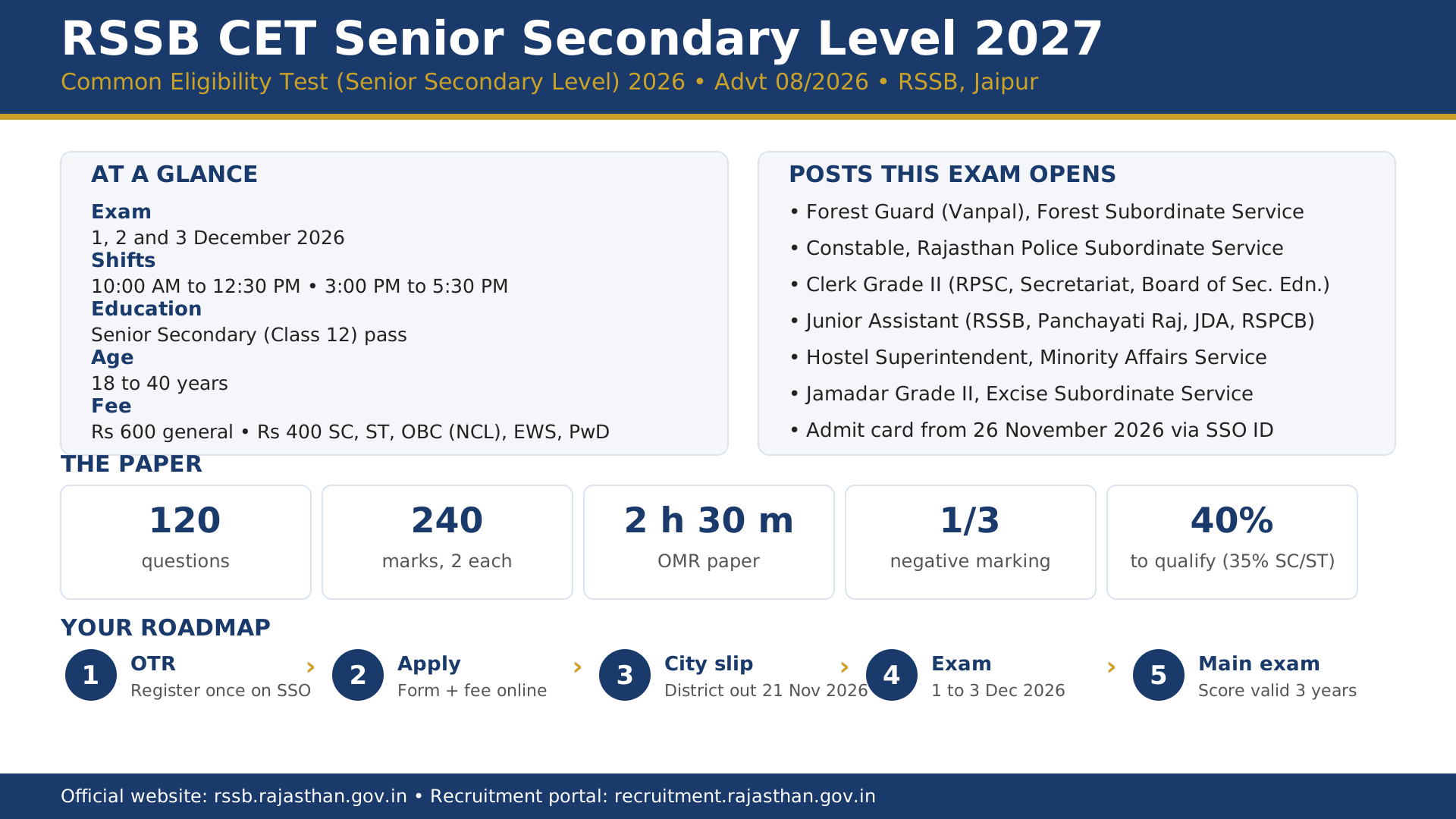
The RSSB CET Senior Secondary Level 2027 cycle reaches its exam in December 2026, and the first document is already out. The Rajasthan Staff Selection Board, known as RSSB, released the exam city intimation on 21 November 2026 for the Common Eligibility Test (Senior Secondary Level) 2026, the cycle behind this guide. Candidates can see their allotted district now through their SSO login. The provisional e-admit card follows from 26 November 2026. The exam runs on 1, 2 and 3 December 2026, two shifts each day, morning 10:00 AM to 12:30 PM and afternoon 3:00 PM to 5:30 PM, offline on OMR sheets across 38 districts of Rajasthan.
The paper itself changed this cycle. The RSSB CET Senior Secondary Level 2027 paper carries 120 multiple choice questions for 240 marks, and candidates get two hours and thirty minutes. Each question carries two marks. A wrong answer costs one third of the marks of that question, which works out to 0.67 marks. A candidate needs 40 percent to qualify, which is 96 marks out of 240, and Scheduled Caste and Scheduled Tribe candidates need 35 percent, which is 84 marks. The score stays valid for three years from the result, so one good score can serve several recruitments.
This guide covers the exam as it actually runs. The difference between the city slip and the admit card, how to download each one, the twelve services the test opens, the age and education rules, the fee for each category, the full pattern with the fifth option rule that disqualifies careless candidates, the syllabus subject by subject, and a preparation plan built around the real weight of each part. Where the 2026 notification changed during the cycle, this guide says so. Where a figure comes from a tracker rather than the board, this guide says that too.
RSSB CET Senior Secondary Level 2027 at a glance
| Detail | RSSB CET Senior Secondary Level 2027, as notified for the 2026 cycle |
|---|---|
| Conducting body | Rajasthan Staff Selection Board (RSSB), Jaipur, formerly the Rajasthan Subordinate and Ministerial Services Selection Board (RSMSSB) |
| Exam | Common Eligibility Test (Senior Secondary Level) 2026, the cycle behind this 2027 guide |
| Advertisement | Advertisement Number 08/2026, dated 23 June 2026 |
| Applications | 24 June to 23 July 2026, closed |
| Exam city intimation | Out from 21 November 2026, shows the allotted district only |
| Provisional e-admit card | From 26 November 2026, through SSO ID or the recruitment portal |
| Exam date | 1, 2 and 3 December 2026, two shifts each day |
| Shift timings | Morning 10:00 AM to 12:30 PM, afternoon 3:00 PM to 5:30 PM |
| Earlier exam date | 23 to 25 October 2026, changed by the revised calendar of 28 September 2026 |
| Paper | One OMR paper, 120 questions, 240 marks, 2 hours 30 minutes |
| Negative marking | One third of the marks of a question, 0.67 marks, for each wrong answer |
| Qualifying marks | 40 percent, 96 marks, for general, OBC and EWS candidates; 35 percent, 84 marks, for SC and ST candidates |
| Score validity | Three years from the date of the result |
| Education | Senior Secondary, Class 12 pass, from a recognised board |
| Age limit | 18 to 40 years, with relaxation as per the rules |
| Fee | Rs 600 for general and OBC creamy layer; Rs 400 for OBC non creamy layer, EWS, SC, ST and persons with disabilities |
| Posts covered | Forest Guard, Hostel Superintendent, Jamadar Grade II, Constable, Clerk Grade II, Junior Assistant |
| Official website | rssb.rajasthan.gov.in |
Exam city slip out, admit card next: what each document shows
Two documents arrive before this exam, and candidates keep mixing them up. The exam city intimation slip came first, on 21 November 2026. The provisional e-admit card comes second, from 26 November 2026. The city slip is not the admit card, and the admit card is not the city slip. Each one does a different job, and each one appears on a different date.
The city slip shows one thing only: the district where the candidate will sit the exam. Rajasthan has 38 districts in this allotment, and the slip names one of them. It does not show the exact centre, the school or college name, the room number, or the reporting time. Candidates who open the slip expecting a full centre address will not find one. The slip exists so that candidates who must travel can book a train or a bus and arrange a stay in the right district a week early, instead of learning the district two days before the exam.
The admit card shows everything else. The exact examination centre, the centre address, the shift, the reporting time, the roll number and the instructions for the day. Candidates download it from 26 November 2026 through their SSO ID or from the recruitment portal at recruitment.rajasthan.gov.in. The board sends no admit card by post. A candidate who waits for a paper admit card in the post will wait forever, because the board issues it only online.
The board issued the notice for both documents on 19 November 2026. That notice gives the exam programme, the district release date and the admit card release date in one place. Candidates should read that notice rather than a tracker summary, because tracker pages keep calling the city slip an admit card, and the confusion has already spread. Jagran Josh runs a live page titled city intimation slip, and it states the distinction clearly: the slip displays the city where the test centre is situated, while the admit card arrives separately. The distinction matters on exam day, because the city slip alone does not admit anyone into a centre.
One practical point belongs here. The district on the slip is final for this cycle. Candidates cannot ask the board to change it, and no tracker page can change it either. A candidate allotted a far district should plan travel now, not after the admit card arrives. The admit card will confirm the centre inside that same district, and the centre will sit somewhere in that district, not in the home district.
How to check your exam district and download the admit card
Checking the district takes three things: the application number, the date of birth, and the captcha on the form. The board put the district check on the official portal at recruitment.rajasthan.gov.in, under a form called Know Your Center District Location. Candidates open that form, enter the application number and date of birth, solve the captcha, and submit. The district appears on the screen. Candidates can also check it through their own SSO ID, by logging in at sso.rajasthan.gov.in and opening the recruitment portal from the citizen apps.
Downloading the admit card from 26 November 2026 follows a similar path. Candidates open the recruitment portal, open the Get Admit Card page, select Common Eligibility Test (Senior Secondary Level) 2026, enter the application number and date of birth, and download the provisional e-admit card. The same download works through the SSO login. Candidates should take a printout at once and check every line on it: name spelling, photograph, signature, centre name, centre address, shift, reporting time and the instructions printed below. An error in the name or photograph should go to the board helpline immediately, not on the morning of the exam.
Three things travel to the centre on exam day, according to the tracker summary of the board notice. The printed provisional e-admit card, one original photo identity proof, and one recent colour photograph of 2.5 cm by 2.5 cm, not older than one month, to paste on the attendance sheet. The identity proof should be the Aadhaar card with the date of birth printed on it. A PAN card, passport, driving licence or voter identity card works only in special circumstances. Candidates should also carry one transparent ballpoint pen with blue ink, because the OMR sheet needs a blue pen.
Entry follows a fixed routine. Reporting runs two hours before the exam starts, and the gate closes exactly one hour before the exam starts. No candidate enters after the gate closes. Entry involves photo identity verification, frisking, biometrics and face recognition, and then the candidate sits in the allotted room. Candidates who arrive ninety minutes early and still miss the gate have only themselves to blame, because the one hour rule is printed on the admit card and repeated in the notice. The morning shift starts at 10:00 AM, so the gate closes at 9:00 AM. The afternoon shift starts at 3:00 PM, so the gate closes at 2:00 PM.
The 2026 cycle, and why the exam moved from October to December
The 2026 cycle opened in June. RSSB released Advertisement Number 08/2026 on 23 June 2026, and applications ran from 24 June to 23 July 2026. The fee was Rs 600 for general and OBC creamy layer, and Rs 400 for OBC non creamy layer, EWS, SC, ST and persons with disabilities. The fee payment last date was the same day as the application last date, 23 July 2026.
The first exam date notice put the paper on 23 to 25 October 2026. A press note on 17 June 2026 carried those dates, and tracker pages printed them for months. Then the revised calendar of 28 September 2026 moved the exam to 1 to 3 December 2026. The board said the change followed the Rajasthan State Election Commission calendar, because urban body and Panchayati Raj elections in October 2026 affected examination arrangements. The graduate level exam moved in the same calendar, from 1 to 3 December 2026 to 16 to 18 January 2027.
The move changed the preparation calendar for lakhs of RSSB CET Senior Secondary Level 2027 candidates. A candidate who had peaked for October had to hold the peak for five more weeks, and a candidate who had planned a slow finish suddenly had extra time. Both groups faced the same test: the paper stayed the same, only the date moved. The lesson for the next cycle is the same as for the graduate level. RSSB dates shift when the state election calendar collides with them, and the board says so in a press note. Candidates who build their revision around a single announced date risk a rebuild, while candidates who keep a steady weekly routine survive a postponement without damage.
The notice of 19 November 2026 fixed the last pieces: district from 21 November 2026, admit card from 26 November 2026, exam on 1, 2 and 3 December 2026. The board will upload the master question paper and its answer key on its website after the exam. No date for the answer key or the result has been announced yet, and this guide prints none.
What the CET actually is
The Common Eligibility Test gives no job by itself. It only opens the door to the main examinations of the services under it. A candidate who clears CET earns a score, and that score lets the candidate sit for the main recruitment examination of a service when that service announces its vacancies. The main examination follows the service rules of that department, and the department runs its own selection after that. CET is the common first gate, not the final selection.
The idea behind the RSSB CET Senior Secondary Level 2027 test is simple. Before CET, each department ran its own preliminary examination, so a Class 12 pass candidate who wanted four different posts sat four different screening tests with four different syllabi. The CET Rules of 2022 replaced that pile of prelims with one test. One paper, one syllabus, one score, and that score works for every participating service for three years. A candidate prepares once and applies the same score to Forest Guard, Constable, Clerk Grade II, Junior Assistant and the rest as their main examinations open.
The three year validity changed the arithmetic for candidates. The Personnel Department notification of 16 January 2025 extended the CET score validity from one year to three years. A score from the 2024 cycle therefore stays usable for recruitments announced well into 2027 and 2028, and a score from the 2026 cycle will stay usable into 2029 and 2030. That long life is also why the qualifying line matters so much. A candidate who clears 40 percent once can keep applying for main examinations for three years without sitting CET again, while a candidate who falls short by two marks must wait for the next CET cycle.
Under the original 2022 rules, a department shortlisted candidates equal to fifteen times the category wise vacancies from the CET merit list for its main examination. That fifteen times rule comes from a tracker summary of the rules rather than from the 2026 advertisement itself, so candidates should read the main examination notice of their service for the exact shortlisting ratio. The ratio can differ by service, and the department notice is the document that decides it.
CET also changed who sets the paper. The board that runs it was the Rajasthan Subordinate and Ministerial Services Selection Board, RSMSSB, when the test began. The board now works as the Rajasthan Staff Selection Board, RSSB. Old pages still say RSMSSB, and new pages say RSSB, and both names point to the same board in Jaipur. Candidates who search for RSMSSB CET and find nothing new should search for RSSB CET instead.
The posts this one exam opens
Six post groups sit under the senior secondary level CET in the 2026 cycle, across several departments and boards. The list below follows the post table of the 2026 cycle as reported by trackers, with the department for each post. One tracker says the 2026 advertisement covers fourteen services, and another says the 2024 advertisement covered twelve cadres. The count differs because one tracker counts services and the other counts post groups, and because a single post such as Junior Assistant appears in several departments. This guide lists the posts by name and flags the count difference here rather than printing a service count that no two sources agree on.
| Service | Post |
|---|---|
| Rajasthan Forest Subordinate Service | Forest Guard (Vanpal) |
| Rajasthan Minority Affairs Subordinate Service | Hostel Superintendent |
| Rajasthan Excise Subordinate Service | Jamadar Grade II |
| Rajasthan Police Subordinate Service | Constable |
| RPSC, Secretariat, Board of Secondary Education | Clerk Grade II |
| Subordinate Offices, RSSB, Panchayati Raj, JDA, RSPCB, Marketing Board | Junior Assistant |
Constable is the post most candidates name first, and the reason is the size of its recruitment when it opens. The Rajasthan Police Constable is the largest single post under this CET, and its main examination carries its own physical tests after the written paper. Forest Guard is the second most named post, and it also carries physical tests: height, chest and a walking test, as per the Forest Department rules. Clerk Grade II and Junior Assistant are the office posts, and they suit candidates who want desk work in the Secretariat, the Board of Secondary Education, the Panchayati Raj Department or the boards. Hostel Superintendent is the Minority Affairs post, and Jamadar Grade II is the Excise Department post.
No vacancy figure belongs to CET itself, and this point needs stating because tracker pages keep printing one. One tracker page says the 2024 senior secondary CET would fill over 5,000 vacancies including Forester, Police Constables and more. That number is a tracker estimate of the downstream posts, not a figure from the advertisement, and CET carries no vacancy table at all. The vacancies appear later, in the main examination notice of each service, and each service announces its own count. A candidate who reads 5,000 and plans around it is planning around a number nobody official ever printed for CET. This guide prints no vacancy total for CET, because none exists.
Who can apply
The education rule is short. A candidate needs to have passed the Senior Secondary examination, Class 12, or an equivalent examination from a recognised board. No subject stream is prescribed, so science, commerce and arts students all sit the same paper. The Class 12 certificate must be complete before the main examination of the service, and the service notice will fix the exact date by which the proof is due.
The age rule in the 2026 cycle was 18 to 40 years. Relaxation applies as per the Rajasthan government rules, with extra years for Scheduled Castes, Scheduled Tribes, Other Backward Classes, Most Backward Classes and Economically Weaker Sections of Rajasthan, and for women, ex-servicemen and persons with disabilities. One tracker summary puts the age cut off date at 1 January 2027 for the 2026 cycle. That date could not be verified from the official advertisement in the retrieved sources, so this guide prints the age window and flags the cut off date as tracker reported. Candidates should read the cut off date in the notification with care, because a wrong assumption about age is the most common reason a form gets rejected after the exam.
The fee for the RSSB CET Senior Secondary Level 2027 cycle had two slabs. General category and OBC creamy layer candidates paid Rs 600. OBC non creamy layer, EBC, EWS, SC, ST and all persons with disabilities paid Rs 400. The fee is paid online through the recruitment portal, and the payment must complete before the closing time. In the 2026 cycle the last date to apply and the last date to pay the fee were the same day, 23 July 2026.
| Category | Fee in the 2026 cycle |
|---|---|
| General, OBC creamy layer, EBC creamy layer | Rs 600 |
| OBC non creamy layer, EBC, EWS, SC, ST of Rajasthan | Rs 400 |
| All persons with disabilities | Rs 400 |
Applications run through One Time Registration, known as OTR, on the Rajasthan SSO portal. A candidate creates an OTR profile once, with name, date of birth, gender, secondary examination details and an identity proof such as Aadhaar, PAN card, voter card or driving licence, and the portal issues an OTR number. The OTR profile then carries into every RSSB application, so the same details do not need retyping for the next exam. Candidates should fix any mismatch between their Aadhaar card and their Jan Aadhaar card before they start, because the OTR details cannot be changed later. Forms are also accepted through E-Mitra kiosks and Jan Suvidha Kendras across the state, which helps candidates without their own internet access.
RSSB CET Senior Secondary Level 2027 exam pattern
The RSSB CET Senior Secondary Level 2027 exam pattern is one paper and nothing else at this stage. No second paper, no interview, no physical test at the CET stage. The single OMR paper carries 120 multiple choice questions, each worth two marks, for a total of 240 marks, and candidates get two hours and thirty minutes. The paper is bilingual in the sense that the board prints it in Hindi and English, and the language questions test Hindi and English themselves. Candidates mark answers with a blue ballpoint pen on the OMR sheet.
| Part | Detail |
|---|---|
| Questions | 120 multiple choice questions |
| Marks | 240, two marks for each question |
| Duration | 2 hours 30 minutes |
| Mode | Offline, OMR sheet |
| Negative marking | One third of the marks of a question, 0.67 marks, for each wrong answer |
| Options per question | Five, A to E, with E for unattempted questions |
| Qualifying marks | 96 marks for general, OBC and EWS; 84 marks for SC and ST |
The paper is shorter than it used to be, and that change is the most important fact in this section. The RSSB CET 12th Level exam pattern changed in 2026 in two ways: fewer questions and less time. The 2022 and 2024 cycles carried 150 questions for 300 marks in three hours. The 2026 cycle cut the paper to 120 questions for 240 marks in two hours and thirty minutes. The cut is real and it comes from the 2026 advertisement itself, as reported by several trackers. Candidates who practise with old 150 question papers should know that the real paper now has thirty fewer questions and thirty fewer minutes, which changes the pace. Two hours and thirty minutes for 120 questions is 75 seconds per question on average, close to the old pace, but the shorter paper leaves less room to recover from a bad section.
The negative marking rule changed the character of this exam too. The first CET cycles carried no negative marking at all. The 2024 advertisement introduced a deduction of one third of the marks of a question for each wrong answer, and the 2026 advertisement keeps it. Jagran Josh states the rule plainly for the 2026 cycle: one third of the marks allotted to a question is deducted for every incorrect answer, and a wrong answer on a two mark question costs 0.67 marks. The board added the penalty to make the test harder, and the board has said it expects only around three to four lakh candidates to qualify. The arithmetic of the penalty decides how to attempt the paper.
A correct answer adds two marks. A wrong answer takes away 0.67 marks. A candidate who guesses at random on a five option question has one chance in five of gaining two marks and four chances in five of losing 0.67, so blind guessing loses marks across a full paper. A candidate who can rule out two options and guess between the remaining three is close to break even. A candidate who can rule out three options should mark the answer. The rule rewards knowledge and punishes lottery play, which is exactly what the board intended when it added the penalty.
One more number belongs in this section. The RSSB CET 12th Level exam pattern gives two hours and thirty minutes for 120 questions, and the paper runs in two shifts a day across three days. That means six shifts in total, and the board uses different question sets across the shifts. Candidates in different shifts answer different papers, and the board normalises the scores across shifts. A candidate should not compare raw marks with a friend in another shift, because the papers differ and the normalisation decides the final score.
The fifth option rule
Every question in the CET carries five options, A, B, C, D and E. Option E is the unattempted option. A candidate who does not want to answer a question must darken the E bubble. Leaving the question fully blank is not the same thing, and the difference is expensive.
The rule works like this. A question left fully blank, with no bubble darkened at all, counts as a wrong answer for the purpose of the penalty, so 0.67 marks are deducted. A question marked with option E counts as unattempted, and no marks are deducted. The distinction matters most for candidates who skip twenty or thirty questions. Twenty blank questions cost about 13 marks, which is more than a tenth of the qualifying line. Twenty E marked questions cost nothing.
The board also sets a hard limit. If a candidate leaves more than 10 percent of the questions fully blank, without darkening any bubble, the board declares the candidate disqualified. Ten percent of 120 questions is 12 questions. Thirteen fully blank questions can end the attempt even if the other 107 answers are strong. Candidates should practise the habit in every mock test: never leave a bubble empty, and darken E the moment you decide to skip a question. The habit costs a second per question and removes the single cheapest way to lose a CET cycle.
The RSSB CET 12th Level exam pattern shares this rule with the graduate level paper, and the 10 percent limit is the same for both. The two CET papers share the OMR system, the same five option sheet and the same penalty structure. A candidate who appears for both levels, senior secondary in December and graduate in January, should treat the E bubble as part of the exam technique for both.
Syllabus, subject by subject
The official scheme for the senior secondary level paper lists ten subject groups, and it lists them without any question count. History, art and culture, literature, tradition and heritage of Rajasthan. Geography of India and Geography of Rajasthan. Indian political system with special reference to Rajasthan. Economy of Rajasthan. Everyday science. Logical reasoning and mental ability. General Hindi. General English. Computer knowledge. Current affairs. The 2026 syllabus summary adds three more items as reported by trackers: civic duties, public health, and the Rajasthan Public Examination (Prevention of Unfair Means) Act, 2022.
One tracker page prints a subject split for the 120 question paper: 30 questions on general awareness, 30 on Rajasthan general knowledge, 20 on general English and Hindi, 30 on reasoning and basic numerical efficiency, and 10 on basic computer. That split adds up to 120, and it looks tidy. The board does not fix any such split in the advertisement. Treat the table as a guide to what past papers looked like, not as a promise about the next paper. A candidate who prepares only the 30 question reasoning block and ignores Rajasthan culture because the table gives it 30 questions is preparing for a table, not for the board.
Rajasthan content is the heart of the RSSB CET Senior Secondary Level 2027 paper, and it is also the part that separates Rajasthan candidates from outsiders. The history section runs from ancient civilisations such as Kalibanga, Ahad, Ganeshwar, Balathal and Bairath, through the medieval period and the Prajamandal movement, to the contribution of Rajasthan in the revolution of 1857 and the tribal and farmer movements. The art and culture section covers folk music, dance, painting schools, fairs, festivals, costumes and the literature of the state. The geography section covers the Thar desert, the Aravalli range, rivers, lakes, soil, climate, minerals and the districts. The polity section covers the state government, panchayati raj, district administration and the state public service institutions.
Everyday science is the science block of this paper, and it stays at Class 10 level. Basic physics, chemistry and biology, human health and diseases, environment and biodiversity, agriculture and allied fields, and information and communication technology all appear. The graduate level paper goes further into science and technology, while this paper keeps the science close to daily life. Candidates who revise their Class 10 science book will find most of this block familiar, and candidates who skip it will lose marks that need no special study.
Reasoning and basic numerical efficiency rewards daily practice more than reading. Series, coding, blood relations, clocks and calendars, direction sense, puzzles, number system, percentage, profit and loss, ratio, time and work, and measures of central tendency all appear. General Hindi covers sandhi, samas, synonyms, antonyms, idioms, grammar and comprehension. General English covers the same ground in English, with vocabulary, grammar, comprehension and error spotting. Basic computer covers hardware, software, internet, MS Office style applications and everyday digital services.
Current affairs runs up to the exam month, and the board asks about state, national and international events, personalities, schemes and policies, fundamental duties and moral values. The Rajasthan Public Examination (Prevention of Unfair Means) Act, 2022 appears in the 2026 syllabus summary, and it is a small block that candidates miss. A candidate who reads the Act once, and revises basic health facts under public health, can pick up marks that other candidates leave behind. New blocks are where the board asks the easiest questions.
Qualifying marks and the three year score
The qualifying line for the RSSB CET Senior Secondary Level 2027 paper is 40 percent for most candidates and 35 percent for Scheduled Caste and Scheduled Tribe candidates. On a 240 mark paper, that is 96 marks for general, OBC, MBC and EWS candidates, and 84 marks for SC and ST candidates. The line is a floor, not a rank. Clearing it makes a candidate eligible for the main examinations. It does not guarantee a call, because each service shortlists from the CET merit list in its own ratio, and a candidate at 97 marks will sit behind a candidate at 200 marks in that list.
The score stays valid for three years from the date of the result, under the Personnel Department notification of 16 January 2025. Earlier the validity was one year, which forced candidates to sit CET every year even when they had already qualified. The three year window changes the strategy. A candidate with a strong score can skip the next CET cycle entirely and focus on the main examinations of the services. A candidate with a weak score, just above the line, faces a choice: sit CET again to raise the score, or spend the time on main examination preparation and accept a lower position in the shortlist.
The result itself arrives months after the exam. In the 2024 cycle, the senior secondary level result came on 17 February 2025, about four months after the October exam, and the marks came on 21 February 2025. Candidates should not expect a quick result, and they should start main examination preparation while they wait. The main examination of a service can open within weeks of its vacancy announcement, and a candidate who waits for the CET result before opening the main syllabus loses that time.
What the 2024 cycle looked like
The 2024 cycle is the freshest complete cycle, and it shows how a CET year runs from notification to result. Advertisement Number 11/2024 came out on 29 August 2024. Applications ran from 1 September to 1 October 2024, though one tracker says the window opened on 2 September. The fee was Rs 600 for general and OBC creamy layer, and Rs 400 for OBC non creamy layer, EWS, SC, ST and persons with disabilities. The age counted as on 1 January 2025, with the window at 18 to 40 years.
The exam dates of the 2024 cycle carry a conflict that this guide flags rather than hides. Adda247 and Jagran Josh say the exam ran on 22, 23 and 24 October 2024, in two shifts a day, morning 9:00 AM to 12:00 PM and evening 3:00 PM to 6:00 PM, across 25 districts. Admit card data and Moneycontrol say the exam ran from 23 to 26 October 2024. Both versions agree that the paper was 150 questions for 300 marks in three hours, which is the old pattern, and both agree the admit card came on 14 October 2024. The answer key came on 5 December 2024, the result on 17 February 2025, and the marks on 21 February 2025. This guide uses the 22 to 24 October dates as the exam dates, because the schedule table with shift timings supports them, and flags the 23 to 26 October version here.
The 2024 paper followed the old pattern, which the RSSB CET Senior Secondary Level 2027 paper has now changed: 150 questions, 300 marks, three hours, OMR, one third negative marking. The subject split seen in the 2024 papers matches the 38, 30, 22, 45 and 15 table that trackers print for the 150 question paper. That table is now history for this level, because the 2026 paper cut to 120 questions. Candidates who practise with 2024 papers should solve them in two hours and thirty minutes and stop at 120 questions, or the practice will teach the wrong pace.
A preparation plan that fits the real paper
The plan below assumes six months of preparation for the RSSB CET Senior Secondary Level 2027 exam, which is the honest minimum for a Class 12 pass candidate starting from scratch on the Rajasthan syllabus. A candidate who has already attempted CET can compress it. A candidate with three months should cut the reading list, not the mock tests.
Months one and two belong to the base. Read Rajasthan history from the ancient civilisations to the Prajamandal movement, Indian history from the freedom movement to independence, the Indian Constitution with its parts and schedules, and the geography of India and Rajasthan with maps. Keep a notebook of Rajasthan facts: the districts and their headquarters, the rivers and their tributaries, the main crops and their seasons, the minerals and where they are found, the fairs and festivals and where they are held. These facts return in CET and in every main examination after it, so learning them once pays several times.
Months three and four belong to depth and the start of timed practice. Finish the standard books for polity, economy and modern history, and add a daily newspaper habit. The newspaper matters more for this exam than for most, because the current affairs block and the Rajasthan polity questions reward candidates who follow state news. From month three onward, take one full mock test a week, 120 questions in two hours and thirty minutes, matching the RSSB CET 12th Level exam pattern exactly, on an OMR style sheet if possible. Review every wrong answer and every guessed answer, and keep a list of weak topics. Reasoning needs its own daily practice: twenty questions a day, timed, from series, coding, blood relations and arithmetic.
Months five and six belong to revision and mock tests. Take a full mock every week, in the same order and timing as the real exam, and add a second mock in the last fortnight. The target is a safe margin above 40 percent, not a bare pass. A candidate who scores 45 percent in mocks can still fall below 40 on a hard paper, so the practice target should be 55 percent or higher. Language papers need two hours a week each, Hindi and English, from the start. A candidate who writes Hindi only in the last fortnight will find the grammar slower than expected.
Two subjects deserve special attention because candidates underrate them. The first is Rajasthan specific content. The CET paper asks about Rajasthan history, culture, geography and current affairs in a proportion that no national examination matches. A candidate who knows Indian history well and Rajasthan history poorly will lose marks that their competitors gain. The second is everyday science. It is a small block, but it is the easiest block to master, and it sits at Class 10 level, so a candidate who revises the school book can pick up marks that need no new study.
Mistakes that cost candidates a year
The first mistake is treating the RSSB CET Senior Secondary Level 2027 exam as a job examination. It is only a gate. Candidates who celebrate clearing CET and then rest for two months lose the main examination that follows. The main examination has its own syllabus, often deeper in the service subject, and it opens on its own notice. Start the main syllabus the week after CET, before the result arrives.
The second mistake is ignoring the fifth option. Candidates who leave questions blank instead of darkening E lose 0.67 marks per question, and candidates who leave more than twelve questions blank lose the whole attempt. Practise the E bubble in every mock test until it is automatic.
The third mistake is blind guessing. With one third negative marking, a random guess on a five option question loses marks across a full paper. Guess only when you can rule out at least two options. Mark E for the rest.
The fourth mistake is trusting tracker dates. The senior secondary exam was first announced for 23 to 25 October 2026 and then moved to 1 to 3 December 2026. Candidates who built their revision around October had to rebuild it. Follow rssb.rajasthan.gov.in for dates, and treat every other date as a rumour until the board confirms it.
The fifth mistake is confusing the city slip with the admit card. The slip shows only the district. The admit card shows the centre, and it arrives on 26 November 2026. A candidate who travels to the district on the slip and then cannot find the centre has read the wrong document. Download the admit card, print it, and read the centre address before leaving home.
Where to check next
Three places matter for this examination, and only three. The RSSB website at rssb.rajasthan.gov.in carries the notification, the syllabus, the admit card, the answer key and the result. The recruitment portal at recruitment.rajasthan.gov.in carries the application form, the exam city slip and the admit card download, through the SSO login. The Rajasthan SSO portal at sso.rajasthan.gov.in carries the One Time Registration profile that every application starts from. Everything else is a copy, and copies introduce errors, like the admit card date that some pages still print as October for an exam that moved to December.
When the next notification lands, read four things before you pay the fee: the advertisement number and date, the cut off date for age, the fee for your category, and the examination pattern. If the pattern differs from the one in this guide, this page will be updated and the mock tests rebuilt to match. Until then, the work is the same. Rajasthan history every day, polity and economy alongside it, reasoning every day, Hindi and English every week, and a mock test every week. The 2026 cycle shows what the RSSB CET Senior Secondary Level 2027 examination offers: one paper, six post groups, and a score that stays alive for three years. The candidate who treats the waiting time as preparation time is the one who benefits when the main examinations open.
Mock tests for other police, constable and graduate level examinations on this site include Bihar Police Constable 2027, UP Police Constable 2027, SSC GD 2027, JK Police Constable 2027, Punjab Police SI 2027, Punjab TET 2027, Bihar Amin 2027, UPPSC RO ARO 2027, IBPS Clerk 2027, Goa Police Constable 2027.
Sources
Rajasthan Staff Selection Board, Common Eligibility Test (Senior Secondary Level) 2026, Advertisement Number 08/2026 dated 23 June 2026, applications 24 June to 23 July 2026, on rssb.rajasthan.gov.in. Rajasthan Staff Selection Board, notice of 19 November 2026, exam programme, exam district from 21 November 2026, provisional e-admit card from 26 November 2026, exam 1 to 3 December 2026, two shifts a day, morning 10:00 AM to 12:30 PM and afternoon 3:00 PM to 5:30 PM, offline OMR, 38 districts. Jagran Josh, RSSB CET 12th Level City Intimation Slip 2026 Live, city slip out 21 November 2026, admit card from 26 November 2026, 120 questions, 240 marks, 2 hours 30 minutes, negative marking one third, 0.67 marks per wrong answer, option E for unattempted, district allotment across 38 districts. Jagran Josh, Rajasthan CET 12th City Slip 2026 Out, exam district from 21 November 2026, admit card from 26 November 2026, exam 1 to 3 December 2026. GovtJobsAlert, RSSB CET 12th Level Admit Card 2026, notice of 19 November 2026, reporting two hours before the exam, gate closes one hour before, documents to carry, admit card download through SSO ID. Jai Hind Result, RSSB CET 12th Level Admit Card Notice 2026, Advertisement Number 08/2026, applications 24 June to 23 July 2026, age 18 to 40 years, posts Forest Guard, Hostel Superintendent, Jamadar Grade II, Constable, Clerk Grade II, Junior Assistant, pattern 120 questions, 240 marks, 2 hours 30 minutes, negative marking one third. Sarkari Data, RSSB CET 12th Level Exam City Slip and Admit Card 2026, city slip 21 November 2026, admit card 26 November 2026, exam 1 to 3 December 2026. The Times of India, RSSB exam calendar 2026 revised, CET Senior Secondary Level 1 to 3 December 2026 and CET Graduation Level 16 to 18 January 2027. The Telegraph, RSSB announces CET 2026 exam dates, senior secondary level 1 to 3 December 2026, graduation level 16 to 18 January 2027. Jagran Josh, RSSB Exam Calendar 2026, tentative exam dates announced 28 September 2026, senior secondary level 1 to 3 December 2026, graduation level 16 to 18 January 2027. Rajasthan Staff Selection Board, Common Eligibility Test (Senior Secondary Level) 2024, Advertisement Number 11/2024 dated 29 August 2024, applications 1 September to 1 October 2024, exam 22 to 24 October 2024, admit card 14 October 2024, answer key 5 December 2024, result 17 February 2025, marks 21 February 2025. Adda247, Rajasthan CET Exam Date 2024, senior secondary level exam 22, 23 and 24 October 2024, shifts 9:00 AM to 12:00 PM and 3:00 PM to 6:00 PM, 150 questions, 300 marks, negative marking one third. Moneycontrol, RSMSSB CET 2024 registration, senior secondary level exam 23 to 26 October 2024, 150 questions, 300 marks, three hours, over 5,000 downstream vacancies. Prepnity, Rajasthan CET 12th Level 2026, Advertisement Number 08/2026, fourteen services, qualifying 40 percent and 35 percent for SC and ST, score validity three years from the result under the Personnel Department notification of 16 January 2025. Sarkari Pariksha, Rajasthan CET Senior Secondary Level, 120 questions, 240 marks, 150 minutes, negative marking 0.66, subject split 30, 30, 20, 30 and 10. ExamGarh, Rajasthan CET Senior Secondary Level, CET Rules 2022, scorecard validity three years, qualifying 40 percent and 35 percent for SC and ST. Adda247, Negative Marking Introduced in Rajasthan CET Exam, one third negative marking, 40 percent qualifying, validity extended to three years, board expects three to four lakh candidates to qualify.







