
About JKAS 2027 Exam Series
📖 Table of Contents
- JKAS 2027 and the 2025 cycle in numbers
- What the three services actually are
- Who can apply for JKAS 2027
- The exam in three stages
- Prelims Paper I: General Studies, 100 questions, 200 marks
- Prelims Paper II: CSAT, 80 questions, 200 marks, qualifying only
- Mains: eight papers and the 25 percent trap
- The optional subjects
- The interview carries 250 marks
- A 90 day plan that fits a three stage exam
- Mistakes that cost candidates this exam
- Other exams worth preparing alongside JKAS 2027
- Sources
JKAS 2027: J&K Combined Competitive Examination Guide
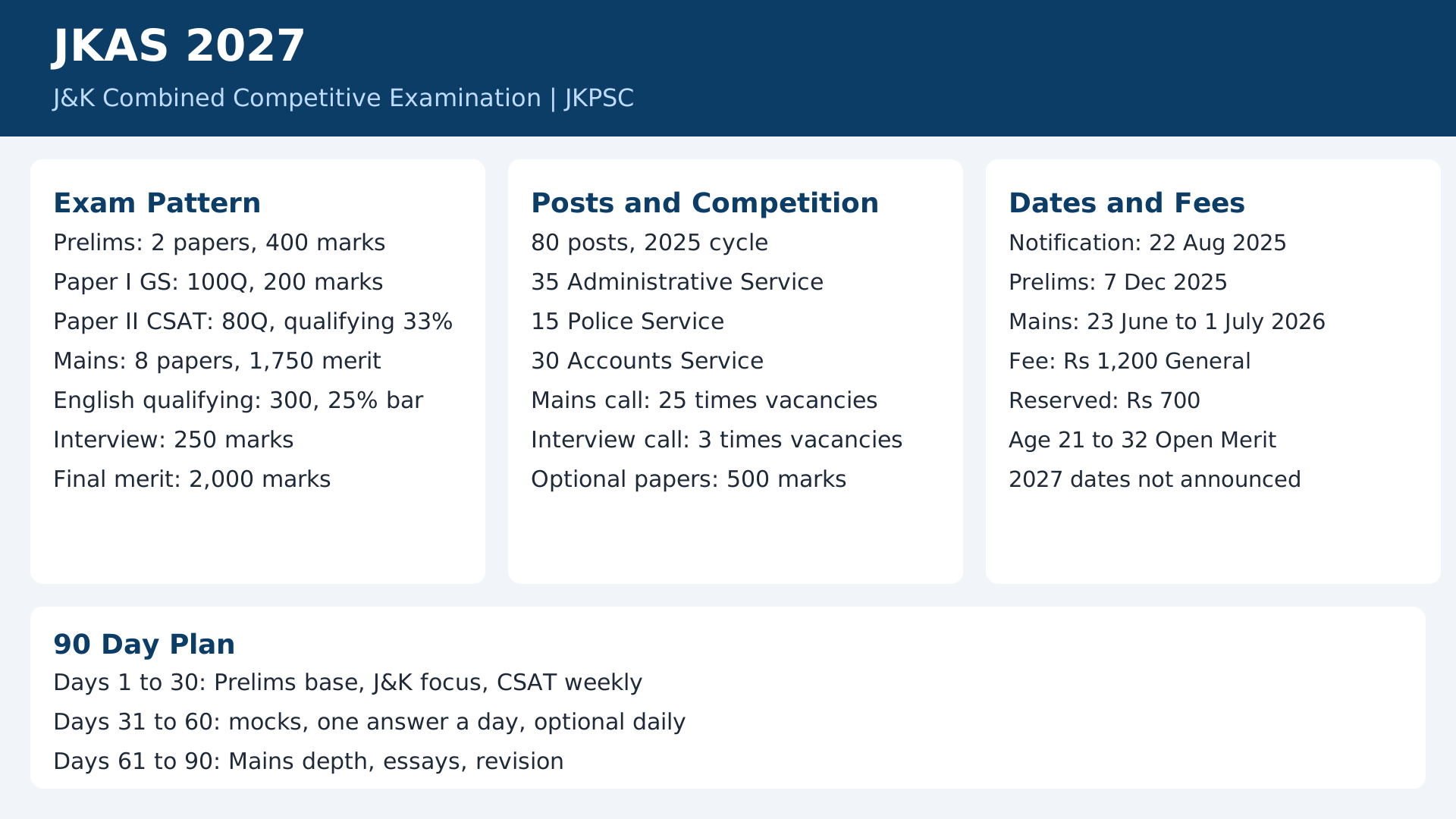
The Jammu and Kashmir Combined Competitive Examination, known to every aspirant as JKAS, is the Union Territory's civil service examination. The Jammu and Kashmir Public Service Commission conducts it to fill Junior Scale posts in the Jammu and Kashmir Administrative Service, the Jammu and Kashmir Police Service, and the Jammu and Kashmir Accounts Service. The latest cycle, notified on 22 August 2025, offered 80 posts, 35 in the Administrative Service, 15 in the Police Service and 30 in the Accounts Service, and its Preliminary Examination was held on 7 December 2025 with the Main Examination held from 23 June to 1 July 2026. JKAS 2027 has no notification yet as of 20 November 2026, so every fact in this guide comes from that 2025 cycle and the rules that govern it, the Jammu and Kashmir Combined Competitive Examination Rules of 2018, known as SRO 103.
One decision about this page needs stating up front. Paper I and Paper II of the Preliminary Examination are two papers of a single examination, the Combined Competitive Examination, and they are sold on this site as one combined guide for that reason. A candidate who prepares for Paper I without Paper II fails the qualifying bar, and a candidate who prepares for Paper II without Paper I fails the merit cut. The examination has three stages, Prelims, Mains and interview, and the guide below covers all three in one place, because that is how the Commission runs them.
JKAS 2027 and the 2025 cycle in numbers
| Item | Detail |
|---|---|
| Conducting body | Jammu and Kashmir Public Service Commission (JKPSC) |
| Exam name | Jammu and Kashmir Combined Competitive Examination, known as JKAS or KAS |
| Governing rules | Jammu and Kashmir Combined Competitive Examination Rules, 2018 (SRO 103) |
| Latest notification | 22 August 2025 |
| Posts in the latest cycle | 80 in total: 35 Jammu and Kashmir Administrative Service, 15 Jammu and Kashmir Police Service, 30 Jammu and Kashmir Accounts Service, all Junior Scale |
| Application window | 25 August to 24 September 2025, online only |
| Prelims date | 7 December 2025, morning session 10 am to 12 pm and afternoon session 2 pm to 4 pm |
| Admit card | 1 December 2025 |
| Mains dates | 23 June to 1 July 2026 |
| Fee, 2024 cycle | Rs 1,200 General Category, Rs 700 Reserved Category, physically handicapped exempted |
| Age as on 1 January 2025 | 21 to 32 years for Open Merit, 34 for reserved category and in-service candidates, 35 for physically challenged candidates |
| 2027 notification | Not issued as of 20 November 2026 |
Two naming traps catch candidates every cycle, so clear them now. First, the examination is called the Combined Competitive Examination in the rules, JKAS by aspirants, and sometimes KAS in tracker pages. Those are three names for one examination, not three examinations. Second, the cycles are named by their notification year, and two recent cycles are easy to mix up. The CCE 2024 cycle, notified in July 2024, held its Prelims on 23 February 2025 and its Mains from 23 July to 1 August 2025. The CCE 2025 cycle, notified in August 2025, held its Prelims on 7 December 2025 and its Mains from 23 June to 1 July 2026. This guide uses the 2025 cycle as its latest cycle throughout, and dates every fact to the notification or the examination it belongs to. A tracker page that prints the 7 December 2025 Prelims date against the 2024 cycle has mixed the two cycles up.
The post count also needs a correction. The task brief for this guide suggested the latest cycle offered 268 posts. It did not. The 2025 notification offered 80 posts, 35 in the Administrative Service, 15 in the Police Service and 30 in the Accounts Service, and that figure is confirmed by JagranJosh, StudyIQ and the Mains notification summaries. The 268 figure does not appear in any tracker page for this cycle. The previous cycle, CCE 2024, offered 90 posts, 30 in each service. One tracker page swaps the Police and Accounts figures for 2025, printing 30 Police and 15 Accounts; the majority of sources give 15 Police and 30 Accounts, and this guide follows the majority and flags the swap. The older 2021 cycle, notified in January 2025 in some tracker listings, is a separate and confusing entry: one page reports 257 posts for it with an application window that never opened on the dates given. That cycle is not used for any fact in this guide.
What the three services actually are
The Combined Competitive Examination fills Junior Scale posts in three services, and the service you join decides your first decade of work. The Jammu and Kashmir Administrative Service is the general administration cadre. Its officers start as Sub-Divisional Magistrates, Tehsildars in senior roles, and Assistant Commissioners in district administration, and they rise through the district and secretariat hierarchy. The Jammu and Kashmir Police Service is the state police cadre. Its officers start as Deputy Superintendents of Police and serve in district policing, crime, traffic and armed police units. The Jammu and Kashmir Accounts Service is the finance cadre. Its officers start in treasuries, audit and accounts wings of government departments, and they handle the financial control of the Union Territory government.
All three services are Junior Scale posts in the same examination, and every candidate sits the same papers. Service allocation follows the final merit list and the preferences a candidate records, subject to reservation and vacancy. A candidate who ranks high enough can choose. A candidate who ranks lower takes what remains. That is why the optional subject choice matters as much as the General Studies preparation. The optional papers carry 500 of the 1,750 merit marks, which is more than a quarter of the written total, and the difference between a good optional and a bad one is often the difference between the Administrative Service and the Accounts Service.
One fact about the services is easy to misunderstand. JKAS differs from the Jammu and Kashmir Administrative Service examination of the old state, and it also differs from the Kashmir Administrative Service that older guides describe. After the Jammu and Kashmir Reorganisation Act of 2019, the examination runs under the Union Territory rules, with domicile as a condition of eligibility. A valid domicile certificate issued by a competent authority is mandatory, under SRO 530 and the Reorganisation Act. Candidates from outside Jammu and Kashmir cannot apply, and no all-India quota exists in this examination.
Who can apply for JKAS 2027
Eligibility rests on three things: a degree, an age inside the limit, and domicile of Jammu and Kashmir. A bachelor's degree from a recognised university qualifies you, in any discipline. The degree subject plays no part in selection, except through the optional subject you choose in Mains, where a degree in the subject helps but is not required. Final year students can apply for Prelims, but they must hold the degree before Mains, and the notification is the authority on the exact date.
The age limits for the 2025 cycle use 1 January 2025 as the reference date. The minimum age is 21 years for every category. The maximum age is 32 years for Open Merit candidates, 34 years for reserved category candidates and in-service candidates, and 35 years for physically challenged candidates. That means an Open Merit candidate must have been born not earlier than 1 January 1993 and not later than 1 January 2004. Those figures come from the notification summaries for both recent cycles, and they are the latest-cycle figures used in this guide.
| Category | Maximum age, 2025 cycle |
|---|---|
| Open Merit | 32 years |
| Reserved category and in-service candidates | 34 years |
| Physically challenged candidates | 35 years |
Two other figures circulate and both are flagged here rather than stated as fact. The Indian Express education page lists the upper age limit as 37 years in its highlights table, without a category split and without a reference date. That figure does not match the Adda247 table, which gives 32, 34 and 35 by category, and this guide follows the category-wise figures. The same Indian Express page also mentions six attempts for the examination, with no attempt limit for Scheduled Caste and Scheduled Tribe candidates, but the sentence carrying that figure is garbled in the source and no second source confirms an attempt limit for this cycle. This guide therefore states no attempt limit as a verified fact. Check the 2027 notification for both the age limits and the attempt rules, because both can change.
The fee figures in this section are from the 2024 cycle, and they are a point of conflict. The 2025 cycle fee was not separately verified in the sources retrieved, so confirm it in the 2027 notification. Adda247 and Chegg both give Rs 1,200 for General Category candidates, Rs 700 for Reserved Category candidates, and exemption for physically handicapped candidates. The Indian Express application form page gives Rs 1,000 for General and Rs 500 for Scheduled Caste, Scheduled Tribe and Other Backward Classes, without a date, and one tracker page gives Rs 1,005 and Rs 505 for a different cycle, including a five rupee service charge for Jammu and Kashmir Bank. The 1,200 and 700 figures are used in this guide because two sources agree on them for the 2024 cycle, and the others are flagged. Fees change between cycles, so confirm them in the 2027 notification.
The exam in three stages
| Stage | Type | Marks | Counts in final merit |
|---|---|---|---|
| Preliminary Examination | Objective, 2 papers | 400 | No, screening only |
| Main Examination | Descriptive, 8 papers | 1,750 merit, plus 300 qualifying English | Yes, 1,750 |
| Personality Test | Interview | 250 | Yes |
| Final merit | Mains plus Personality Test | 2,000 | Yes |
The scheme follows SRO 103 of 2018, and three facts in that table decide how you prepare. Prelims marks stay out of the final merit, so a high Prelims score earns you nothing beyond a Mains seat. Mains carries 1,750 of the 2,000 merit marks, so the descriptive papers decide your rank almost entirely. The interview carries 250 marks, which is an eighth of the final merit, and that is large enough to move a candidate across service boundaries. A candidate who treats the interview as a formality after Mains is giving away 250 marks that the candidates around them are fighting for.
The ratios between stages matter as much as the marks. The rules quoted by tracker pages state that the number of candidates admitted to Mains shall be, as far as practicable, one-third of the total number of candidates who appeared in Prelims or twenty-five times the total number of vacancies, whichever is lower. With 80 vacancies, twenty-five times is 2,000 Mains seats. The interview call is capped at three times the vacancies, which is 240 candidates. Those ratios come from the rules as quoted, not from a Commission notice for the 2024 cycle, and this guide flags them as rule text rather than confirmed cycle figures. The Commission has discretion to fix qualifying marks in any or all papers, and it exercises that discretion every cycle.
Prelims Paper I: General Studies, 100 questions, 200 marks
Paper I is the paper that decides whether you reach Mains. It carries 100 multiple choice questions of 2 marks each, runs for 2 hours, and its marks count only for shortlisting. The paper is set in English. Negative marking is one-third of the marks assigned to a question, which works out to 0.67 marks deducted for each wrong answer on a 2 mark question. Marking more than one option counts as wrong. No penalty applies to questions left blank. With 100 questions in 120 minutes, you have 72 seconds per question, and the penalty means a guess between two options still pays over a full paper while a blind guess does not.
The syllabus for Paper I covers current events of national and international importance, history of India and the Indian National Movement, Indian and world geography, Indian polity and governance, economic and social development, general science, the Jammu and Kashmir Reorganisation Act of 2019, and the history, geography and economy of Jammu and Kashmir. The Jammu and Kashmir portion is the part that separates this paper from the Union Public Service Commission Prelims, and it is the part most candidates underprepare. The Reorganisation Act itself is examinable: the constitutional changes of 2019, the reorganisation of the state into two Union Territories, the applicability of central laws, and the domicile rules that followed. Read the Act as a document, not as a summary, and keep a note of the dates and the key provisions.
History and geography carry the largest weight after current affairs. History covers ancient, medieval and modern India with focus on the national movement, and Jammu and Kashmir history from the Dogra period through accession and the post-independence decades. Geography covers physical geography, Indian geography with focus on the Himalayan region, and the geography of Jammu and Kashmir: the Pir Panjal and the Great Himalayas, the Jhelum, Chenab and Indus river systems, the Kashmir Valley, Jammu plains, Ladakh plateau, climate, agriculture, horticulture, and the transport corridors. Economy covers the Indian economy, development indicators, government schemes, and the economy of Jammu and Kashmir: horticulture, tourism, handicrafts, hydroelectric power, and the fiscal position of the Union Territory. General science is set at the level expected of a well-educated person, so a science graduate holds no real edge there.
Prelims Paper II: CSAT, 80 questions, 200 marks, qualifying only
Paper II is the paper that ends runs quietly. It carries 80 multiple choice questions of 2.5 marks each, runs for 2 hours, and it is a qualifying paper with minimum qualifying marks fixed at 33 percent. That is 66 marks out of 200. Its marks stay out of the Prelims merit and the final merit. Failing it still means losing the Mains seat, however strong the Paper I score is. The paper is set in English. Negative marking is one-third of the marks assigned to a question, which works out to 0.83 marks deducted for each wrong answer on a 2.5 mark question.
The syllabus for Paper II covers comprehension, interpersonal skills including communication skills, logical reasoning and analytical ability, decision making and problem solving, general mental ability, basic numeracy including numbers and their relations, orders of magnitude and data interpretation through charts, graphs, tables and data sufficiency, at Class 10 level. That list looks easy, and that is the danger. Candidates pour months into Paper I and treat Paper II as a formality, then discover that a weak comprehension section or a slow numeracy section cost them the 33 percent bar. The 2025 cycle ran Paper I in the morning and Paper II in the afternoon on the same day, 7 December 2025, so a candidate who is tired after Paper I still has to clear 66 marks in the afternoon.
Three habits keep Paper II safe. First, practise comprehension under time pressure, because the passages are long and the questions test whether you read carefully rather than whether you know the subject. Second, keep numeracy warm through the whole preparation, with one set of Class 10 level questions a week, because the skill decays fast when it is not used. Third, attempt Paper II mock tests as full papers, so you know your score against the 66 mark bar before the real day. A candidate who scores 70 in every Paper II mock is safe. A candidate who has never taken a full Paper II mock is guessing.
Mains: eight papers and the 25 percent trap
| Paper | Subject | Marks | Duration |
|---|---|---|---|
| Qualifying Paper | English, matriculation standard | 300 | 3 hours |
| Paper I | Essay | 250 | 3 hours |
| Paper II | General Studies I | 250 | 3 hours |
| Paper III | General Studies II | 250 | 3 hours |
| Paper IV | General Studies III | 250 | 3 hours |
| Paper V | General Studies IV, Ethics | 250 | 3 hours |
| Paper VI | Optional Subject, Paper I | 250 | 3 hours |
| Paper VII | Optional Subject, Paper II | 250 | 3 hours |
| Merit total | Essay plus General Studies I to IV plus two optional papers | 1,750 |
Mains is a conventional descriptive examination, and every paper is compulsory. The English paper is qualifying only. It is set at matriculation or equivalent standard, and you must secure at least 25 percent in it, which is 75 marks out of 300, for your other papers to be taken into account. The rules state the position plainly: the Essay, General Studies and Optional papers of only such candidates will be taken cognizance of who obtain 25 percent marks in English as minimum qualifying standard. Fail English and the Commission sets your other papers aside unread. That rule is the trap in the title of this section. Candidates pour months into General Studies and treat the English paper as a formality, then discover that a weak English paper ended the run before it began.
The English paper covers comprehension, precis writing, usage and vocabulary, short essays, and translation, at matriculation standard. Matriculation standard sounds easy until you sit down to write a precis and a short essay under time pressure in a language you have not written since school. A candidate who writes one precis and one short essay each week from the start of preparation will clear 25 percent without stress. A candidate who opens a grammar book a week before Mains will not. The qualifying bar is low, but it is absolute, and the Commission has discretion to fix qualifying marks in any or all papers besides.
The Essay paper carries 250 marks in 3 hours and asks for two essays. The General Studies papers each carry 250 marks in 3 hours. General Studies I covers Indian heritage and culture, history and geography of the world and society. General Studies II covers governance, constitution, polity, social justice and international relations. General Studies III covers technology, economic development, biodiversity, environment, security and disaster management. General Studies IV covers ethics, integrity and aptitude. The four papers follow the Union Public Service Commission pattern closely, and the syllabus overlap is large, but the Jammu and Kashmir content is not optional. General Studies I expects Jammu and Kashmir history and society. General Studies II expects the constitutional position of the Union Territory after 2019. General Studies III expects the economy, environment and disaster profile of the Himalayan region. A candidate who prepares only the national syllabus will score in the middle of the field and no higher.
The optional papers carry 500 marks between them, and they are the highest weight decision in the whole examination. You choose one subject from the list below and sit two papers in it, each worth 250 marks. The choice should follow three tests: you have studied the subject before, or you can build it from zero in the time available; the syllabus overlaps with the General Studies papers, so the same reading pays twice; and the subject has stable, available material, including previous year papers. A subject that fails any of those tests will cost you marks that no amount of General Studies preparation can recover.
The optional subjects
The list below comes from SRO 103 of 2018 as quoted by tracker pages, and it is long enough that the choice itself needs a method. Do not choose by popularity. Choose by the three tests above, and choose early, because the optional papers need as much time as the General Studies papers and they are attempted after a full day of written papers.
| Group | Subjects |
|---|---|
| Sciences | Agriculture, Animal Husbandry and Veterinary Science, Botany, Chemistry, Geology, Mathematics, Medical Science, Physics, Statistics, Zoology |
| Engineering | Civil Engineering, Electrical Engineering, Mechanical Engineering |
| Humanities and social sciences | Anthropology, Economics, Geography, History, Law, Management, Philosophy, Political Science and International Relations, Psychology, Public Administration, Sociology |
| Commerce and language | Commerce and Accountancy, English Literature, Hindi Literature, and literature of Arabic, Dogri, Kashmiri, Persian, Punjabi, Sanskrit and Urdu |
Two conflicts in the list are flagged here. One tracker page adds Education, Kashmiri Language and Urdu Literature as separate optional subjects, while the SRO 103 list quoted by other pages covers Kashmiri and Urdu under the literature group. The two lists group the same subjects differently, but the 2027 notification is the authority on the exact list. Another point to note is that some older pages list a different Mains structure altogether, with six papers of 150 marks and a Personality Test of 150 marks, for a grand total of 1,050. That structure belongs to an older scheme and is not the current one. The current scheme is eight papers, 1,750 merit marks, and a 250 mark interview, for a final merit of 2,000. Any guide that still lists 150 mark papers or a 150 mark interview is out of date.
The most useful fact about the optional choice is the overlap. Public Administration overlaps with General Studies II. Geography overlaps with General Studies I and III. History overlaps with General Studies I. Political Science overlaps with General Studies II. Economics overlaps with General Studies III. Sociology and Anthropology overlap with General Studies I and IV. A candidate who chooses an overlapping optional gets a second return on the same reading, and that is worth more than the small scoring differences between subjects that tracker pages argue about. The second most useful fact is the syllabus length. Mathematics and the engineering optionals have long, technical syllabi that reward a degree in the subject and punish a beginner. Literature optionals reward a candidate who has read the language seriously. Choose the subject you can finish, not the subject that looks scoring on a forum.
The interview carries 250 marks
The Personality Test is the final stage, and it carries 250 marks with no minimum qualifying marks prescribed in the rules. Candidates are called for it in a ratio of not more than three times the vacancies, based on Mains marks and category-wise reservation. With 80 vacancies, that is at most 240 candidates. The final merit is Mains plus interview, for a grand total of 2,000 marks, so the interview is an eighth of the final score. That is large enough to move a candidate across service boundaries and small enough that a bad interview cannot rescue a weak Mains.
The interview tests what the written papers cannot: mental alertness, analytical ability, clarity of thought, and awareness of Jammu and Kashmir specific issues. Expect questions on the Union Territory itself: the Reorganisation Act, the domicile rules, the economy, horticulture and tourism, hydroelectric power, the security situation, and the working of the district administration. Expect questions on your own degree, your hometown, your optional subject, and why you want to join the service you have put first. A candidate who cannot explain why the Administrative Service comes before the Police Service, or the other way round, looks unprepared in front of a panel that has heard the same answer a hundred times.
Prepare for the interview the way you would prepare for a job, not an exam. Read the Union Territory budget and the Economic Survey summary, follow the work of the district administration in your own district, know the current Lieutenant Governor and the Chief Secretary, and be ready to discuss one issue in depth rather than ten issues shallowly. The panel will probe the one issue you claim to know, and a shallow answer there costs more than silence on ten topics you never claimed.
A 90 day plan that fits a three stage exam
| Phase | Focus | Daily work |
|---|---|---|
| Days 1 to 30 | Prelims foundation | Two hours of General Studies, one hour of current affairs with Jammu and Kashmir focus, 30 minutes of CSAT practice, one Paper I mock every week |
| Days 31 to 60 | Prelims mocks and Mains writing | One full Prelims mock every third day with review, one General Studies answer a day, one English precis a week, optional subject reading daily |
| Days 61 to 90 | Mains depth and revision | Two descriptive answers a day, one essay a week, one optional paper mock a week, daily revision of notes, two full Prelims mocks in the final week |
The plan above assumes the examination is at least 90 days away, which is likely but not guaranteed. If the Commission announces Prelims sooner, compress the first phase, never the mock test phase. Mock tests are where the score comes from, and the review matters more than the test. For every wrong answer in Paper I, write down why you got it wrong, whether it was a concept gap, a fact gap, or a time pressure error, and revisit that note before the next mock. For every Paper II mock, check your score against the 66 mark bar, because the bar is absolute and the rank is not.
Four habits decide the Prelims score. First, give Jammu and Kashmir the largest share of time, because it carries marks in Paper I, in General Studies I and II, and in the interview, while most other candidates leave it underprepared. Second, keep CSAT warm from the first week, with one full Paper II mock a month, so the 33 percent bar never becomes a surprise. Third, practise with a timer on every set, because speed is a skill and it only grows under timed conditions. Fourth, revise current affairs every day in the last month, because the current affairs marks decay faster than any other section.
For Mains, the single highest value habit is daily answer writing. One General Studies answer a day from the second month, written by hand in the time the real paper allows, builds the speed and structure that no amount of reading can replace. The second habit is the weekly essay. The Essay paper is 250 marks, and a candidate who has written ten essays before Mains will write the eleventh calmly. The third habit is the weekly English precis. The qualifying bar is only 25 percent, but it is absolute, and a candidate who has not written a precis since school will find 75 marks harder than they look. The fourth habit is the optional subject mock. One full optional paper a week in the last month, timed at three hours, is the only way to know whether you can finish the paper.
Mistakes that cost candidates this exam
The first mistake is treating Paper II as a formality. The 33 percent bar is absolute, and it has ended runs that were strong in every other respect. Take full Paper II mocks and check the score against 66, not against a feeling. The second mistake is ignoring the English qualifying paper in Mains. The 25 percent bar is absolute too, and the Commission will not read your other papers if you miss it. Write one precis a week from the start. The third mistake is choosing the optional subject late. The optional papers carry 500 marks, and a subject chosen two months before Mains cannot be finished. Choose in the first month and stay with it.
The fourth mistake is preparing only the national syllabus. The Jammu and Kashmir content carries marks in Paper I, in General Studies, and in the interview, and the candidates who score highest are the ones who know the Union Territory best. The fifth mistake is believing a tracker cut off. No official cut off from the 2025 cycle was retrieved during preparation, and a made-up cut off tells you nothing about the cut off you will face. The sixth mistake is confusing the cycles. The 2024 notification, the February 2025 Prelims, and the July to August 2025 Mains are one cycle, the CCE 2024 cycle. The CCE 2025 cycle is separate: notification August 2025, Prelims 7 December 2025, Mains June to July 2026. Tracker pages that mix the two cycles, or a 257 post cycle, are describing something else, and a candidate who plans around those figures will prepare for an examination that does not exist.
Other exams worth preparing alongside JKAS 2027
Many candidates prepare for other civil service and regulatory exams alongside this one. The UPPSC PCS 2027, UPPSC RO ARO 2027, UPPSC PCS J 2027, KPSC KAS 2027, UGC NET Paper 1 2027, RBI Grade B 2027, NABARD Grade A 2027, SEBI Grade A 2027, SBI PO 2027 and IBPS PO 2027 pages on this site carry the same style of mock test guide, and the pattern helps because the General Studies syllabus overlaps heavily with every state civil service examination in the country. The difference is the Jammu and Kashmir content and the optional subject structure. No other state examination gives the Union Territory this much weight, and no other state examination keeps two optional papers at 250 marks each. Use the overlap for General Studies, and prepare the Jammu and Kashmir specifics and the optional subject separately.
Sources
Drishti IAS page on the Jammu and Kashmir Public Service Commission, checked 20 November 2026, which sets out the three stages, the Preliminary Examination structure, the Main Examination structure of eight papers, and the Personality Test of 250 marks. Chahal Academy JKPSC syllabus and exam pattern 2026 page, checked 20 November 2026, which gives the Paper I and Paper II question counts, the 33 percent qualifying rule, the Mains paper table, and the optional subject list. Indian Kanoon, Section 20(2) of the Jammu and Kashmir Combined Competitive Examination Rules 2018, checked 20 November 2026, which gives the Preliminary Examination scheme, the Main Examination scheme, the 25 percent English qualifying standard, and the merit rules. Adda247 JKPSC KAS notification 2025 page, checked 20 November 2026, which gives the 90 vacancies, the notification date of 26 July 2024, the Prelims date of 23 February 2025, the age limits of 32, 34 and 35, and the fee of Rs 1,200 and Rs 700. Chegg India JKPSC 2025 page, checked 20 November 2026, which confirms the 90 vacancies, the Prelims date, and the fee. Indian Express education JKPSC CCE exam 2025 page, checked 20 November 2026, which gives the Mains dates of 23 July to 1 August 2025 and the admit card date of 15 February 2025. CareerPower JKPSC CCE syllabus 2025 page, checked 20 November 2026, which confirms the 90 vacancies, the Prelims and Mains totals, and the optional subject list including literature subjects. JagranJosh JKPSC CCE Admit Card 2025 page, checked 20 November 2026, which gives the 80 vacancies, the notification number 11-PSC (DR-P) of 2025 dated 22 August 2025, and the Prelims date of 7 December 2025. StudyIQ JKPSC CCE Notification 2025 page, checked 20 November 2026, which gives the 80 vacancies, the application window of 25 August to 24 September 2025, and the tentative Prelims date of 30 November 2025. Kashmir Student Alerts JKPSC CCE Mains 2025 date sheet page, checked 20 November 2026, which gives the Mains dates of 23 June to 1 July 2026 under Notification No. 03-PSC (DR-P) of 2026 dated 13 February 2026. GovtJobGuru JKPSC CCE Mains 2025 page, checked 20 November 2026, which gives the service split of 35 Administrative, 15 Police and 30 Accounts. The official JKPSC site at jkpsc.nic.in could not be reached from this workspace during preparation, so no fact in this package rests on a direct read of the official notification or the SRO 103 PDF. The upload pre-check must open the official notification and the SRO 103 PDF and confirm posts, pattern, fee, age limits and the optional subject list before publishing.







