
Gujarat Exams Mock Test: Complete Guide to 10 Exams
📖 Table of Contents
- Gujarat Exams 2027: the 25,000 post total
- Which examination fits which candidate
- GPSC Class 1-2, 244 posts in the 2025 cycle
- GPSC DySO, 102 posts in the 2025 cycle
- GSSSB Clerk, 4,304 posts in Advt 212/202324
- GPSSB Junior Clerk, 1,181 posts in Advt 12/2021-22
- Gujarat Police Constable, 12,733 posts in the 2025-26 cycle
- Gujarat Police SI, 858 posts in the 2025-26 cycle
- Gujarat TET, the eligibility test with no posts
- Gujarat High Court, 1,318 posts in the 2024 drive
- GPSSB Talati cum Mantri, 3,437 posts in the 2022 cycle
- GPSSB Junior Clerk, 1,181 posts in Advt 12/2021-22
- Gujarat Forest Guard, 823 posts in the 2022 cycle
- Preparation habits that work across all ten examinations
- What to check before the next notification
- Sources
Gujarat Exams Mock Test: Complete Guide to 10 Exams
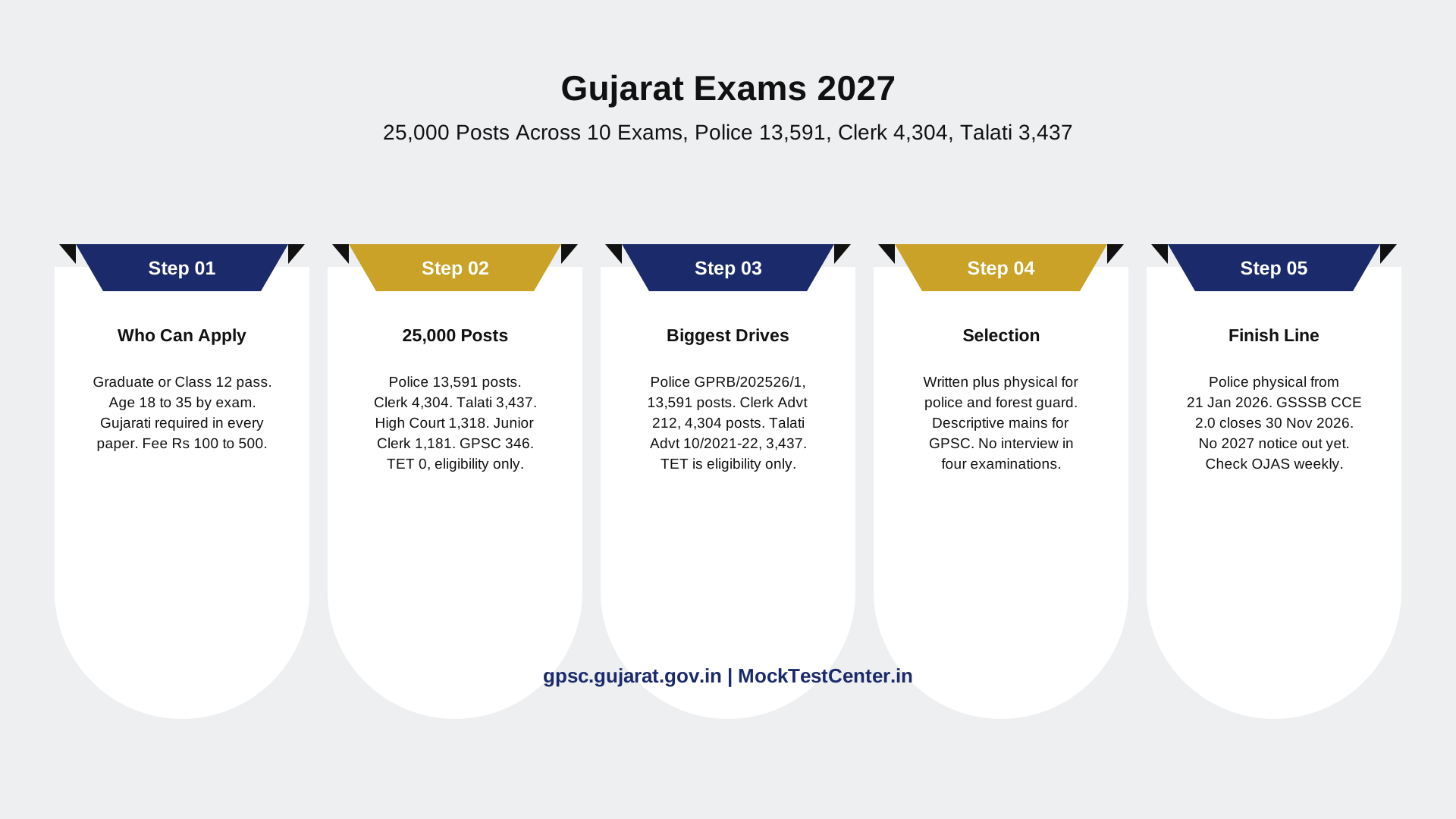
Gujarat Exams 2027 brings together ten recruitments that run through five different bodies, and the ten together carry 25,000 posts in their last verified cycles. The Gujarat Public Service Commission runs the two gazetted examinations. The Gujarat Subordinate Service Selection Board and the Gujarat Panchayat Service Selection Board run the clerk and village level posts. The Gujarat Police Recruitment Board runs the biggest single drive in the set, 13,591 posts of constables and sub inspectors in one advertisement. The State Examination Board runs the teacher eligibility test, which carries no posts at all. The Gujarat High Court runs its own combined drive through the National Testing Agency. A candidate who understands which body runs which examination will never apply on the wrong portal, and a candidate who knows the last verified cycle of each examination will never prepare for a pattern that no longer exists.
The 25,000 figure is the sum of the ten anchor cycles, and every figure in it comes from a notification or a result that the sub guides on this site have already verified. The police drive alone carries 13,591 of those posts, and the clerk drive carries 4,304. The village post of Talati carries 3,437. The High Court drive carries 1,318. The panchayat Junior Clerk carries 1,181. The Forest Guard carries 823. The two GPSC examinations carry 244 and 102. The teacher eligibility test carries none, because it is a certificate and not a recruitment. The total is exact, and the table below shows the arithmetic, so a reader can check it rather than take it on trust.
No 2027 notification is out for any of the ten examinations as of 22 November 2026, and this guide says so plainly for each one. The page title carries 2027 because the next cycles are expected in that year and because this site groups its examination pages by that year. Two cycles are live right now in a different sense: the GSSSB clerk drive under Advertisement 468/202627 opened applications on 5 November 2026 and closes them on 30 November 2026, and the police physical tests for the 13,591 post drive run from 21 January 2026. A candidate reading this guide in late November 2026 should check those two dates first, because one of them closes within days.
Gujarat Exams 2027: the 25,000 post total
| Examination | Live cycle | Posts |
|---|---|---|
| Gujarat Police Constable | 2025-26, Advt GPRB/202526/1 | 12,733 |
| GSSSB Clerk | Advt 212/202324 | 4,304 |
| GPSSB Talati cum Mantri | 2022, Advt 10/2021-22 | 3,437 |
| Gujarat High Court | 2024, Advt HCG/NTA/01/2024 | 1,318 |
| GPSSB Junior Clerk | Advt 12/2021-22 | 1,181 |
| Gujarat Police SI | 2025-26, Advt GPRB/202526/1 | 858 |
| Gujarat Forest Guard | 2022, Advt FOREST/2022-23/1 | 823 |
| GPSC Class 1-2 | 2025, Advt 240/2024-25 | 244 |
| GPSC DySO | 2025, Advt 08/2025-26 | 102 |
| Gujarat TET | TET-I 2025 | 0, eligibility only |
| Total | 25,000 |
Three figures sit outside the total and belong in a note rather than in the sum. The High Court also ran a separate Assistant drive of 1,778 posts and has a Civil Judge drive of 237 posts under a short notification, and both are covered in the High Court section below, but they are separate advertisements and are not added to the 1,318. The Talati PwBD special drive carries 238 posts and the Junior Clerk PwBD drive carries 102 posts, and both are separate special recruitments for persons with benchmark disabilities, so they are not added to the general cycle totals either. The GSSSB clerk set also has two newer cycles after the 212 anchor, one with a disputed post count and one with 1,237 posts and applications open until 30 November 2026, and neither is added because the anchor cycle is the one with a complete verified result. A total that mixes anchor cycles with live drives and special drives would look bigger and mean less, so this guide keeps them apart and says which is which.
The ten examinations also differ in how they select. Four of them have no interview at all: GSSSB Clerk, Talati, Junior Clerk and DySO all end at the written examination plus document verification. The police examinations add a physical stage before the written papers, and the physical stage is qualifying only, which means it removes candidates without adding marks. The GPSC Class 1-2 examination is the only one in the set with a full interview that carries real weight, 150 marks on a merit of 1,250. The Forest Guard adds a walking test after the physical efficiency test, 25 kilometres for men and 14 kilometres for women in 4 hours. The High Court adds skill tests that differ by post, from stenography to typing to a computer aided test. The TET has no selection at all, because passing it only gives a certificate. A candidate who picks an examination by its post count alone will miss all of this, and the choice of examination should follow the selection stages as much as the vacancies.
Which examination fits which candidate
A graduate with a bachelor degree in any discipline has the widest choice in this set. The GPSC Class 1-2 examination takes any graduate between 20 and 35 years. The DySO examination takes any graduate between 20 and 35 years and ends without an interview, which makes it the shortest route to a secretariat post. The PSI examination takes any graduate between 21 and 35 years and adds the physical stage. The GSSSB Clerk examination takes any graduate between 20 and 35 years and runs the largest non police recruitment in the set. The High Court DSO and Computer Operator posts take graduates too, inside the 1,318 post drive. A graduate who is 33 or 34 should check the age as on date of each advertisement carefully, because the GPSC examinations count age as on the last date of application while the police examinations use their own reference dates, and a candidate who is eligible for one may already be over age for another.
A candidate who has passed Class 12 has three examinations in this set. The Police Constable examination takes a Class 12 pass between 18 and 33 years, and it is the biggest door in the set at 12,733 posts. The Talati examination takes a Class 12 pass between 18 and 36 years, and it is the village revenue post that every district in Gujarat recruits for. The Junior Clerk examination takes a Class 12 pass, with Accounts stream candidates needing Mathematics or Accounts in Class 12, and it runs a single 100 mark paper. The Forest Guard examination also takes a Class 12 pass between 18 and 34 years, and it adds the physical and walking tests. A Class 12 candidate who can run and walk has four examinations to choose from, and a candidate who cannot should look at Talati and Junior Clerk, where the written paper decides everything.
A candidate with a teaching qualification has one examination, and it is different from all the rest. The Gujarat TET takes a candidate with HSC plus a two year teacher training diploma for TET-I, or a graduation plus B.Ed for TET-II, and it gives a lifetime certificate rather than a post. Passing it does not give a right to selection, and the notification says so in plain words. The certificate is the entry ticket for teacher recruitment in government and grant in aid schools, and a candidate who passes TET-I in December 2025 with 12.03 percent of candidates passing holds a certificate that never expires. The pass rate itself is the warning: only 11,027 of 91,628 candidates passed TET-I 2025, and only 37,450 of 2,37,700 passed TET-II in 2023. A candidate who treats the TET as a formality will join the 88 percent who fail it.
A candidate who wants the highest pay in the set should look at the GPSC Class 1-2 examination, where Class 1 posts sit at Pay Matrix Level 10, Rs 56,100 to Rs 1,77,500, and Class 2 posts sit at Level 8, Rs 44,900 to Rs 1,42,400. The PSI examination pays Rs 49,600 a month fixed for the first five years. The High Court Court Manager post pays Rs 56,100 as reported, and the Civil Judge drive pays Rs 77,840 to Rs 1,36,520, which is the highest scale in the set, though it needs a law degree and practice at the Bar. The clerk, Talati, Junior Clerk and Forest Guard posts all start on fixed pay of Rs 19,950 to Rs 26,000 a month for the first five years, and the regular pay scale begins only after that period. The fixed pay rule is the single most important salary fact in Gujarat recruitments, and a candidate who reads only the pay scale will overestimate the first five years of salary by a wide margin.
GPSC Class 1-2, 244 posts in the 2025 cycle
The Gujarat Public Service Commission notified the Class 1 and 2 combined examination on 7 March 2025 under Advertisement Number 240/2024-25, for 244 posts. Applications ran from 7 to 23 March 2025. The 244 posts split into 207 regular posts and 37 posts under a special recruitment for Divyang candidates. The post wise list of the 207 runs from the Gujarat Administrative Service Junior Scale with 5 posts, through Deputy Superintendent of Police with 10, Mamlatdar with 40, State Tax Officer with 35, Taluka Development Officer with 30, Section Officer in the Sachivalaya with 26, and smaller numbers for District Registrar, Assistant Commissioner of State Tax, Assistant Director of Food and Civil Supply, Inspector of Registration and Assistant Director of Information. The category split of the 207 is general 90, SC 16, ST 23, SEBC 55 and EWS 23, with 68 posts reserved for women. The fee was Rs 100 for general and OBC candidates, and nil for SC, ST and female candidates.
The Preliminary examination was held on 20 April 2025, a single General Studies paper of 200 questions for 200 marks in 3 hours, with negative marking of one third per wrong answer. Seventeen questions were cancelled, so the paper was scored at 1.093 marks per correct answer and 0.328 deducted per wrong answer. The result came on 5 July 2025, with 6,893 candidates qualifying for the mains. The general cut off was 89.51 marks, and the general female cut off was 81.42. The mains were scheduled for 20, 21, 27 and 28 September 2025 under the notification, and they run on a new pattern that changed the examination completely. The new pattern has seven papers: Gujarati 300 and English 300, both qualifying at 25 percent, Essay 250, and General Studies I to IV at 250 each, for a merit total of 1,250. The interview carries 150 marks, up from 100 under the old pattern, and the final merit is 1,400. The old pattern had six papers and a written total of 800, with Gujarati 100, English 100, Essay 150 and three General Studies papers of 150 each. A candidate who prepares from an old guide will prepare for the wrong papers, and the new pattern is the single most important fact in this examination.
One conflict in the Class 1-2 story could not be resolved from the sources read for this guide. The tracker pages disagree on whether the mains held in September 2025 used the new 1,400 mark pattern or the old 900 mark pattern, because the rule change came on 4 March 2025, only days before the notification. This guide follows the new pattern, since the notification itself is dated after the rule change, and it flags the question for the upload pre check to confirm from the GPSC notice. A second conflict concerns the 2026-27 cycle, Advertisement Number 05/2026-27, where one tracker reports 71 Class 1 posts from the advertisement PDF and another reports 213 posts for the same advertisement. The prelims result for that cycle was reported on 30 July 2026 with 6,099 candidates qualifying for the mains, and a High Court case was reported against the cycle. The 2026-27 cycle is not the anchor of this guide, and its figures are recorded here only so that a reader does not confuse them with the 244 of the 2025 cycle.
The age rule is 20 to 35 years for the general category, counted as on the last date of application, with relaxation for reserved categories, women and PwD up to a maximum of 45 years. The education rule is a bachelor degree from a recognised university, with post wise conditions for some posts, such as the Finance and Accounts posts. The salary is the highest in the set for a general graduate examination: Class 1 at Pay Matrix Level 10, Rs 56,100 to Rs 1,77,500, and Class 2 at Level 8, Rs 44,900 to Rs 1,42,400. The earlier cycles on the old pattern, Advertisement 20/2022-23 and Advertisement 47/2023-24, have both reached final results, and the 2025 cycle is the first to run on the new descriptive mains. A candidate who clears the prelims in this examination faces seven descriptive papers and an interview, and the preparation that wins is answer writing, not multiple choice practice.
GPSC DySO, 102 posts in the 2025 cycle
The Deputy Section Officer examination is the shortest route to the Gujarat secretariat, and it is also the only GPSC examination in this set with no interview at all. The Commission notified it on 25 June 2025 under Advertisement Number 08/2025-26, for 102 posts: Deputy Section Officer in the Secretariat with 92, in the Vidhansabha with 1, and in the GPSC office with 9. Applications ran from 25 June to 9 July 2025, with fee payment to 10 July 2025. The fee was Rs 100 for general candidates and nil for reserved categories, ex-servicemen and PwD. The Preliminary examination was held on 7 September 2025, one paper of 200 questions for 200 marks in 2 hours, with negative marking of 0.30 per wrong answer and no penalty for unattempted questions. The merit list came on 5 November 2025.
The mains ran from 20 to 22 February 2026 as four descriptive papers of 100 marks each, 3 hours each, for a total of 400 marks: Paper I Gujarati Language, Paper II English Language, Paper III General Studies I and Paper IV General Studies II. The final result came on 18 July 2026 under Notification Number APE-08/2025-26-Main-CNF. Merit rests on the 400 mains marks alone under Rule 14(1) of the 2018 Rules, and there is no waiting list under Rule 14(4). A candidate who misses the mains or any single paper is not eligible under Rule 16. The salary is about Rs 38,090 a month for the first five years on fixed pay, as reported by Testbook. The age rule is 20 to 35 years as on 9 July 2025, with relaxation of 5 years for SC, ST and SEBC male candidates, 10 years for SC, ST and SEBC female candidates, 5 years for general female candidates and 10 years for PwD, up to a maximum of 45 years. The education rule is a bachelor degree in any discipline from a recognised university, with no experience required and no fixed number of attempts, limited in practice only by the age limit.
The earlier cycles show that the DySO examination runs almost every year, which is rare for a GPSC examination. The 2023 cycle, Advertisement Number 42/2023-24, carried 127 posts, with prelims on 15 October 2023, mains from 8 to 11 September 2024, and the final result on 10 March 2025, with 56 reserved category candidates recommended on unreserved posts. The 2024 cycle, Advertisement Number 67/2024-25, carried 40 posts. The 2025 cycle is the largest of the three, and it is the anchor of this guide because it is the only one with a complete result from prelims to final selection. One caution belongs here: the 102 post figure is sometimes confused with a 102 post figure in the Class 1-2 examination, and the two are different examinations. Another caution is that a tracker page wrongly claims a law degree is needed for DySO and an upper age of 36, and both are wrong. The degree can be in any discipline, and the upper age is 35 for the general category.
GSSSB Clerk, 4,304 posts in Advt 212/202324
The Gujarat Subordinate Service Selection Board clerk recruitment is the largest non police recruitment in the set, and it is also the most complicated, because one advertisement covers many different clerk posts across two groups. Advertisement Number GSSSB/202324/212 was notified on 3 January 2024 for 4,304 posts. Applications ran from 4 to 31 January 2024. The break up is Junior Clerk 2,018 plus Junior Clerk in collector offices 590, making 2,608 Junior Clerks in all, Senior Clerk 532, Head Clerk 169, Office Assistant 210, Collector Office Clerk 160, Assistant and Assistant Depot Manager 372, Sub Registrar Grade 1 with 45 and Grade 2 with 53, Stamp Inspector 23, Social Welfare Inspector 46 plus 102, Assistant Social Welfare Officer 13 plus 7, Assistant Tribal Development Officer 65, Depot Manager 26, Junior Assistant 8, Office Superintendent 2 plus 3, Gruhmata 6 and Gruhpita 14. The fee was Rs 500 for unreserved candidates and Rs 400 for women and reserved categories, as reported by Adda247. The age rule is 20 to 35 years as on 31 January 2024, with relaxation for reserved categories. The education rule is a bachelor degree from a recognised university, with adequate knowledge of Gujarati or Hindi and basic computer knowledge under the Gujarat Civil Service Classification and Recruitment (General) Rules of 1967.
The Preliminary examination ran from 1 April to 8 May 2024, with the papers of 20, 21, 27 and 28 April postponed. It was 100 questions for 100 marks in 60 minutes: Reasoning 40, Quantitative Aptitude 30, English 15 and Gujarati 15, with minus 0.25 per wrong answer, screening only. The result came on 6 September 2024, and the final answer key on 30 July 2024. The Group B mains were held on 8 June 2025 as a single objective paper of 200 marks in 120 minutes, with a 40 percent minimum qualifying mark, and 16,517 candidates qualified while 2,928 did not. The Group A mains are three descriptive papers for 350 marks: Gujarati Language Skill 100, English Language Skill 100 and General Studies 150, 3 hours each, with choice filling from 3 July 2025. Selection runs through prelims, mains and document verification, with no interview. The pay is Rs 26,000 a month fixed for the first five years for Junior Clerk, Senior Clerk, Office Assistant and Collector Office Clerk, Rs 40,800 for Head Clerk and Rs 49,600 for Office Superintendent.
Two newer cycles sit after the 212 anchor, and a candidate should know both. Advertisement 378/202526 took applications from 5 to 20 February 2026, ran the prelims as a computer based test from 16 to 29 September 2026, published the final answer key and the prelims result on 3 November 2026, and has Group A mains tentatively set for 28 and 29 November 2026, with Group B mains reported for January 2027. Its post count is disputed: the Times of India reports 5,370 while tracker sites report 7,338, and this guide does not add either figure to the set total. Advertisement 468/202627, called CCE 2.0, was notified on 3 November 2026 for 1,237 posts, with Group A 243 and Group B Junior Clerk 994, and applications open from 5 to 30 November 2026, with fee payment to 2 December 2026. That window is live as this guide is written, and it closes on 30 November 2026. A candidate who misses it will wait for the next cycle, and a candidate who applies should read the fee and age as on date in that advertisement, Rs 500 and Rs 400, and 20 to 35 years as on 30 November 2026.
GPSSB Junior Clerk, 1,181 posts in Advt 12/2021-22
The Gujarat Panchayat Service Selection Board Junior Clerk is the district panchayat clerk post, and it must not be confused with the GSSSB clerk posts, which belong to a different board and a different service. Advertisement Number 12/2021-22 was notified on 17 February 2022 for 1,181 posts: Open Category 585, EWS 104, SEBC 285, SC 59 and ST 148. Applications ran from 18 February to 8 March 2022, with fee payment to 10 March 2022. The written examination was held on 9 April 2023, after the first set date of 29 January 2023 was postponed. It was a single paper of 100 questions for 100 marks in 60 minutes: General Awareness and General Knowledge 50 in Gujarati, Gujarati Language and Grammar 20 in Gujarati, English Language and Grammar 20 in English, and General Mathematics 10 in Gujarati, with minus 0.33 per wrong answer, and the single paper decides the merit. The result came on 17 June 2023, and a second additional provisional merit list was reported on 9 February 2024, with a conflicting report of 21 October 2023.
The education rule is a Higher Secondary School Certificate, a 12th pass, with Accounts stream candidates needing Mathematics or Accounts in Class 12, plus basic knowledge of computer applications and knowledge of Hindi and Gujarati. The age rule is not more than 36 years, with relaxation for reserved categories, and a minimum age of 18 years is reported by one tracker. The fee was Rs 100 for general candidates, with no fee for SC, ST, SEBC, PH and ex-servicemen, as reported by Testbook. The pay is Rs 19,950 a month fixed for the first five years. Selection is the written examination followed by document verification, though one tracker page reports an interview and other tracker pages contradict it, and this guide records the conflict rather than inventing an interview stage. Two newer cycles exist: Advertisement 13/2024-25 ran a computer based test on 18 February 2025, with the post count unverified, and Advertisement 13/2025-26 is a special recruitment drive for persons with benchmark disabilities with 102 Junior Clerk posts inside a 1,251 post drive, notified on 25 March 2025, requiring a bachelor degree and paying Rs 26,000 a month. Two different advertisements share the number 13, and a candidate should check the year before quoting either one.
Gujarat Police Constable, 12,733 posts in the 2025-26 cycle
The biggest recruitment in the set is the Gujarat police drive of 2025-26, and it is also the freshest, with applications closing only days before this guide was written. The Gujarat Police Recruitment Board announced it on 29 November 2025 through its chairperson, IPS Niraja Gotru, and notified it on 3 December 2025 under Advertisement Number GPRB/202526/1. The advertisement carries 13,591 posts in all, and the constable share is 12,733 Lokrakshak posts: Unarmed Police Constable 6,942, Armed Police Constable 2,458, Armed Police Constable in the State Reserve Police Force 3,002, Jail Sepoy male 300 and Jail Sepoy female, called Matron, 31. Women hold 2,291 of the 6,942 Unarmed posts and 811 of the 2,458 Armed posts, and the SRPF posts are for men only. Applications ran from 3 December 2025 at 2 pm to 23 December 2025 at 11.59 pm, online on OJAS only, with fee payment to 26 December 2025. The fee was Rs 100 for Lokrakshak alone and Rs 200 for both PSI and Lokrakshak, exempt for SC, ST, SEBC, EWS and ex-servicemen.
The education rule is a Higher Secondary pass, Class 12, plus basic computer knowledge and adequate knowledge of Gujarati or Hindi or both. The age rule is 18 to 33 years, with relaxation for reserved categories and women. The physical stage comes first, from 21 January 2026, before the written examination. The physical standards test asks men for a height of 165 cm, 162 cm for ST candidates of Gujarat origin, and a chest of 79 cm unexpanded and 84 cm expanded, with a minimum expansion of 5 cm. Women need a height of 155 cm, 150 cm for ST candidates of Gujarat origin. The physical efficiency test asks men to run 5,000 metres in 25 minutes and women to run 1,600 metres in 9 minutes 30 seconds, with ex-servicemen running 2,400 metres in 12 minutes. The physical stage is qualifying only and carries no marks, which means a candidate who fails the run is out whatever the written score would have been.
The written examination is scheduled for 14 June 2026, and it carries 300 marks across two papers. Paper 1 is objective, 200 marks, 200 questions, 3 hours, OMR based, with negative marking of 0.25 per wrong answer. Part A carries 80 marks: Reasoning and Data Interpretation 30, Quantitative Aptitude 30 and Gujarati Comprehension 20. Part B carries 120 marks: Constitution 30, Current Affairs, Science and Technology and General Knowledge 40, and History, Cultural Heritage and Geography 50. Paper 2 is descriptive, 100 marks, 3 hours: Gujarati essay of 350 words 30, precis 10, comprehension 10, report 10 and letter 10, plus English precis 10, comprehension 10 and translation from Gujarati to English 10. Paper 2 is evaluated only for candidates who score at least 40 percent in Part A and in Part B of Paper 1, so a candidate who fails either part of Paper 1 never reaches the descriptive paper. The fixed pay is Rs 26,000 a month for the first five years, as the advertisement states.
The previous cycle shows how long the process takes. Advertisement Number LRB/202122/2 carried 10,459 posts, with applications from 23 October to 9 November 2021, physical tests from 3 December 2021 to 29 January 2022, the written examination on 10 April 2022, and the final selection of 9,810 candidates on 25 October 2022. The old written paper was a single paper of 100 questions for 100 marks, which the new cycle has replaced with the 300 mark two paper structure. A candidate who prepares from the old 100 mark pattern will prepare for the wrong examination. The open flags for the new cycle are the age cut off date, reported as both 10 November 2025 and 23 December 2025, and the salary, reported as Rs 26,000 in the advertisement and Rs 21,700 on tracker pages, and this guide uses the advertisement figures for both.
Gujarat Police SI, 858 posts in the 2025-26 cycle
The Police Sub Inspector examination shares the same advertisement, the same dates and the same fee as the constable examination, and the two should be read together. Advertisement Number GPRB/202526/1, notified on 3 December 2025, carries 858 PSI posts inside the combined 13,591: Unarmed Police Sub Inspector 659, Armed Police Sub Inspector 129 and Jailer Group 2 with 70. The education rule is a bachelor degree in any discipline from a recognised university, plus adequate knowledge of Gujarati and Hindi and basic knowledge of computers. The age rule is 21 to 35 years, with relaxation for reserved categories and women. The fee is Rs 100 for PSI alone and Rs 200 for both PSI and Lokrakshak, exempt for SC, ST, SEBC, EWS and ex-servicemen. The physical stage runs from 21 January 2026 on the same standards as the constable examination, men 5,000 metres in 25 minutes and women 1,600 metres in 9 minutes 30 seconds, qualifying only, with no marks.
The written examination has the same two paper shape as the constable examination but a different Paper 1. Paper 1 is objective, 200 marks, 3 hours, OMR based, with negative marking of 0.25 per wrong answer. Part A carries 100 marks: Reasoning and Data Interpretation 50 and Quantitative Aptitude 50. Part B carries 100 marks: Constitution and Public Administration 25, History, Geography and Cultural Heritage 25, Current Affairs and General Knowledge 25, and Environment, Science and Technology and Economics 25. Paper 2 is the same descriptive language paper as the constable examination, 100 marks in 3 hours, and it is evaluated only for candidates who score at least 40 percent in each of the two sections of Paper 1. The total written examination is 300 marks. The marks were released on 8 October 2026, as reported by Testbook. The fixed pay is Rs 49,600 a month for the first five years, as the advertisement states.
The previous cycle shows a different structure, and the change matters. Advertisement Number PSIRB/202021/1 carried 1,382 posts, of which PSI posts alone were 372, with the rest made up of Assistant Sub Inspector posts and Intelligence Officer posts. It ran a prelims on 6 March 2022, a mains on 12 June 2022 as four objective papers of 100 marks each, and a running test that carried up to 50 marks counted in the final aggregate, with extra marks for NCC C certificate, sports and widow applicants. The 2025-26 cycle has dropped the ASI and IO posts entirely, dropped the prelims, and made the physical stage qualifying only. A candidate who prepares from the 2021 pattern will prepare for the wrong papers. One open flag belongs here: the written examination date for the main PSI cadre is not firmly verified, because the 23 August 2026 date on one tracker page belongs to a PSI Technical examination, and this guide does not use it as the main PSI date. The PSI category split also conflicts across trackers, with one page reporting 616 Unarmed and 242 Armed against the 659, 129 and 70 used here, and the SC and ST shares sit in the advertisement PDF and could not be verified from tracker pages.
Gujarat TET, the eligibility test with no posts
The Gujarat Teacher Eligibility Test is the only examination in this set that recruits nobody, and that is exactly why candidates misunderstand it. Passing it gives a certificate and no appointment, and the notification states in plain words that passing does not give a right to selection. The certificate is the entry ticket for teacher recruitment in government and grant in aid schools, and it is valid for a lifetime under the national extension of 3 June 2021, with retrospective effect from 2011, and the Gujarat resolution PRE/112021/Si.Fa.-07/K of 10 September 2025. The State Examination Board in Gandhinagar runs it, authorised by Education Department resolution PRE-1111-711-K of 27 April 2011, and the test is organised through District Education Officers.
The last TET-I cycle ran in late 2025. The notification came on 14 October 2025, and an amendment on 8 November 2025 extended registration to 18 November 2025 and moved the probable examination date to 21 December 2025. The examination was held on 21 December 2025 from 12 noon to 2 pm at Ahmedabad city, Ahmedabad rural, Vadodara, Surat and Rajkot. The result came on 30 January 2026: 11,027 of 91,628 candidates present qualified, a pass rate of 12.03 percent. The last full TET-II cycle ran in 2023, with the examination on 23 April 2023 and the result on 15 June 2023: 37,450 of 2,37,700 candidates qualified, 15.76 percent, with Science and Maths at 31.14 percent. No TET-II notification for 2025 was found, and no 2027 notification exists for either paper as of 22 November 2026.
The paper is one paper of 150 multiple choice questions for 150 marks in 120 minutes, with no negative marking. TET-I has five sections of 30 marks each. TET-II has Part 1 of 75 questions and Part 2 of 75 questions under the resolution of 8 October 2025. The pass mark is 60 percent, 90 marks, for general candidates, and 55 percent, 82 marks, for SC, ST, SEBC, PH and EWS candidates. The fee is Rs 350 for general candidates and Rs 250 for SC, ST, SEBC, PH and EWS candidates, plus a service charge, paid by ATM card or net banking, and not refunded. The medium is Gujarati, English or Hindi, one medium only, and the candidate applies in the medium of the educational qualification. TET-I needs at least an HSC pass plus a two year PTC or D.El.Ed, a four year B.El.Ed, or a two year Diploma in Education in Special Education, and final year training students were allowed from the November 2025 amendment. TET-II needs a BA or BSc or final year plus a B.Ed or equivalent, with a minimum of 45 to 50 percent as per the qualification route. There is no limit on attempts, and a passed candidate may sit again to improve the score. The duration is one open flag in this package: one source reports 120 minutes and an older report says 90 minutes, and this guide uses 120.
Gujarat High Court, 1,318 posts in the 2024 drive
The Gujarat High Court runs its own recruitments, and the anchor drive in this guide is a combined direct recruitment of 1,318 posts under Advertisement Number HCG/NTA/01/2024, dated 22 May 2024, with the examinations run by the National Testing Agency. Applications ran from 22 May to 15 June 2024, extended to 18 June 2024, with a correction window from 17 to 19 June 2024, extended to 20 to 22 June 2024. The post break up is Gujarati Stenographer Grade III 307, Gujarati Stenographer Grade II 214, Process Server or Bailiff 210, Court Attendant 208, Computer Operator 148, Deputy Section Officer 122, English Stenographer Grade II 54, Driver 34 and Court Manager 21. The fee was Rs 1,500 for general candidates and Rs 700 for reserved candidates for most posts, Rs 1,000 and Rs 500 for Driver and Court Attendant, and Rs 2,500 and Rs 1,250 for Court Manager. The age was 18 to 40 years as reported, with relaxation under government rules.
Selection differs by post, and a candidate must read the pattern for the exact post applied for. The English Stenographer Grade II runs a descriptive mains of 40, a stenography or skill test of 40 and a viva voce. The Deputy Section Officer runs an elimination test of 100 plus a mains of 100. The Computer Operator runs an elimination test of 100 plus a computer aided test of 100. The Court Manager runs an elimination test of 100, a mains of 60 and a viva of 40. Gujarati Stenographer Grade II and III run an elimination test of 100, a stenography test of 70 and a viva of 30. The Process Server runs an objective test of 100 plus a mains of 100. The Court Attendant runs a single objective paper of 100. The pay runs from Court Attendant at Rs 14,800 to Rs 47,100, through Computer Operator, Driver and Process Server at Rs 19,900 to Rs 63,200, Deputy Section Officer at Rs 39,900 as reported, English Stenographer Grade II and Gujarati Stenographer Grade III at Rs 39,900 to Rs 1,26,600, Gujarati Stenographer Grade II at Rs 44,900 to Rs 1,42,400, and Court Manager at Rs 56,100 as reported. The outcomes so far include the DSO Stage II examination on 18 May 2025 with the NTA final answer key, and select lists for the DSO and English Stenographer Grade II posts.
Two other High Court drives belong in this section because candidates confuse them with the 1,318. The Assistant drive carried 1,778 Assistants under Advertisement Number RC/1434/2022(II), notified on 27 April 2023, with applications from 28 April to 19 May 2023, a fee of Rs 1,000 for general candidates and Rs 500 for reserved candidates, and a pay of Rs 19,900 to Rs 63,200. Its selection ran an elimination test of 100 multiple choice questions in one and a half hours with negative marking of 0.33, a descriptive main written examination of 60 marks in 90 minutes, and a practical typing test of 5,000 key depressions, with the select list drawn on the aggregate of mains and skill test only. The elimination test was held on 25 June 2023, the mains on 12 May 2024, the skill test on 25 August 2024, document verification from 5 January 2025, and a centralised wait list allotment of 146 candidates on 23 April 2025. The Civil Judge drive carries 237 Civil Judges under Advertisement Number RC/0719/2026, with a short notification on 24 April 2026 and the detailed advertisement awaited, at a pay of Rs 77,840 to Rs 1,36,520 plus allowances. Its established pattern is a prelims of 100 marks in 2 hours with negative marking of 0.33, qualifying at 50 percent for general candidates and 45 percent for reserved candidates, a Gujarati Language Test of 50 marks for candidates who did not study Gujarati at SSC or HSC, mains of two papers of 100 marks each in 3 hours, and a viva voce of 50 marks, with final merit on mains plus interview at 250 marks. The Civil Judge application dates and fees conflict across trackers, and only the short notification facts are treated as verified here. No 2027 notification exists for the High Court as of 22 November 2026.
GPSSB Talati cum Mantri, 3,437 posts in the 2022 cycle
The Talati cum Mantri is the village revenue officer of Gujarat, and the post is the most searched panchayat post in the state. Advertisement Number 10/2021-22 was notified in January 2022 for 3,437 posts: Unreserved 1,557, SEBC 851, ST 439, EWS 331 and SC 259. Applications ran from 28 January to 15 February 2022 on OJAS. The written examination was held on 7 May 2023, OMR based, 100 questions for 100 marks in 1 hour, with a provisional answer key on 11 May 2023, the result on 16 June 2023 and the final select list on 11 August 2023. The pattern is General Awareness and General Knowledge 50, Gujarati Language and Grammar 20, English Language and Grammar 20 and General Mathematics 10, in Gujarati medium except the English section in English. Negative marking was 0.33 per wrong answer in the 2023 OMR cycle, with blank answers at 0.5, multiple options at 0.7, and option E for Not Attempted avoiding the penalty. Selection is the written examination only, then document verification and district allotment, with no interview. The final cut offs for 2023 were male General 43.176, EWS 39.018, SEBC 38.988, SC 38.684 and ST 29.316, with female cut offs lower across categories.
The education rule is a Higher Secondary School Certificate, a 12th pass, or equivalent, with basic computer knowledge under the Gujarat Civil Services Classification and Recruitment (General) Rules of 1967 and adequate knowledge of Gujarati or Hindi or both. The age rule is 18 to 36 years for unreserved males as on 15 February 2022, with relaxation of 5 to 20 years for women of the unreserved category and reserved categories, up to a maximum age of 45 years. The fee was Rs 100 for the general category, payable online or by challan at a post office. The salary is a fixed pay of Rs 19,950 a month for the first five years, with a post probation pay scale of Rs 19,900 to Rs 63,200 at Pay Matrix Level 2 under the 7th Pay Commission. The latest cycle is a special drive for persons with disabilities under Advertisement Number 14/2025-26, with 238 posts, notified on 25 March 2025, a computer based test on 18 February 2026, a provisional merit list reported on 11 May 2026 and a final select list with district allotment on 22 October 2026.
Three confusions belong in this section because they cost candidates attempts. First, one tracker page claims graduation is needed for Talati, and that is wrong: the post needs a 12th pass. Second, the age limit is reported as 18 to 34, 18 to 35 and 18 to 42 on different tracker pages, against 18 to 36 in the advertisement, and this guide uses the advertisement figure. Third, the Revenue Talati post under GSSSB Notification Number 301/2025-26, with 2,389 posts and graduation required, is a different post under a different board, and a candidate who applies for it thinking it is the panchayat Talati will sit the wrong examination. The 9.53 lakh application figure that circulates for Talati is also wrong as a Talati figure: it covers Talati and Junior Clerk combined. No general Talati notification exists as of 22 November 2026.
GPSSB Junior Clerk, 1,181 posts in Advt 12/2021-22
The Junior Clerk post sits beside Talati in the panchayat service, and the two examinations share a pattern, a board and a year, which is why candidates prepare for both together. Advertisement Number 12/2021-22 was notified on 17 February 2022 for 1,181 posts: Open Category 585, EWS 104, SEBC 285, SC 59 and ST 148. Applications ran from 18 February to 8 March 2022, with fee payment to 10 March 2022. The written examination was held on 9 April 2023, after the first set date of 29 January 2023 was postponed. It was a single paper of 100 questions for 100 marks in 60 minutes, with the same split as Talati: General Awareness and General Knowledge 50 in Gujarati, Gujarati Language and Grammar 20 in Gujarati, English Language and Grammar 20 in English and General Mathematics 10 in Gujarati, with minus 0.33 per wrong answer, and the single paper decides the merit. The result came on 17 June 2023. The education rule is a 12th pass, with Accounts stream candidates needing Mathematics or Accounts in Class 12, plus basic knowledge of computer applications and knowledge of Hindi and Gujarati. The age rule is not more than 36 years, with relaxation for reserved categories, and a minimum age of 18 years is reported by one tracker. The fee was Rs 100 for general candidates, with no fee for SC, ST, SEBC, PH and ex-servicemen, as reported by Testbook. The pay is Rs 19,950 a month fixed for the first five years.
Two newer cycles exist, and both need care. Advertisement 13/2024-25 ran a computer based recruitment test on 18 February 2025 in the afternoon shift from 2 pm to 3 pm, with the call letter available from 1 February 2025, but its post count could not be verified. Advertisement 13/2025-26 is a special recruitment drive for persons with benchmark disabilities with 102 Junior Clerk posts inside a 1,251 post drive, notified on 25 March 2025, with applications from 15 April to 15 May 2025, requiring a bachelor degree and paying Rs 26,000 a month. Two different advertisements share the number 13, and the 2025-26 drive needs a degree while the 2022 cycle needed only a 12th pass. A candidate who reads the wrong advertisement will prepare with the wrong qualification in mind. Selection is the written examination followed by document verification, though one tracker page reports an interview and other tracker pages contradict it, and this guide records that conflict rather than inventing a stage. No general Junior Clerk notification exists as of 22 November 2026.
Gujarat Forest Guard, 823 posts in the 2022 cycle
The Forest Guard post, called Vanrakshak in Gujarat as in Maharashtra, is the field post of the Forest Department, and its selection is the most physical in this set after the police examinations. The short notice came on 20 October 2022 under Advertisement Number FOREST/2022-23/1, for 823 posts across 29 districts, with the largest shares in Amreli at 70, Bhavnagar at 61 and Banaskantha at 32. Applications ran from 1 to 15 November 2022 on OJAS, with the fee last date on 18 November 2022. The written examination ran from 8 to 27 February 2024 as a computer based test of 100 questions, 2 marks each, 200 marks in 2 hours, in Gujarati medium, with negative marking of 0.25 per wrong answer and a passing mark of 40 percent, which is 80 marks. The subject weightage is General Knowledge 25 percent or 50 marks, General Mathematics 12.5 percent or 25 marks, General Gujarati 12.5 percent or 25 marks, and technical forest and environment subjects 50 percent or 100 marks. The fee was Rs 100 plus a Rs 12 postal charge for the general category. The education rule is a 12th pass or equivalent, with knowledge of Gujarati and Hindi, both, and basic computer knowledge. The age rule is 18 to 34 years as on 15 November 2022, with relaxation under Gujarat rules, including five years for unreserved women. The salary is a fixed pay of Rs 19,950 a month for the first five years.
The physical stage has three parts, and each removes candidates on its own terms. The physical standards ask men for a height of 163 cm, 155 cm for ST candidates, a chest of 79 cm unexpanded and 84 cm expanded with 5 cm expansion, and a weight of 50 kg. Women need a height of 150 cm, 145 cm for ST candidates, and a weight of 45 kg. The physical efficiency test asks men to run 1,600 metres in 6 minutes, with ex-servicemen allowed 6 minutes 30 seconds, high jump 4 feet 3 inches, long jump 15 feet, a minimum of 8 pull ups and rope climbing of 18 feet. Women run 800 metres in 4 minutes, with ex-servicemen allowed 4 minutes 20 seconds, high jump 3 feet and long jump 9 feet. The walking test asks men to walk 25 kilometres in 4 hours and women to walk 14 kilometres in 4 hours. The sequence is the written test, then the physical test, then the walking test, followed by document verification and a medical test. The previous cycle, Advertisement Number FOREST/201819/1 from 2018, carried 334 posts, with the written examination on 27 March 2022 and the final result on 19 April 2022, and more than 1 lakh forms were filed for it. No fresh general Forest Guard notification was open as of 20 August 2026. One caution belongs here: the Vanpal post, with 15 posts notified in June 2026 and graduation required, is a different post, and a candidate who applies for it thinking it is the Forest Guard will sit the wrong examination.
Preparation habits that work across all ten examinations
Gujarati is the highest value subject in this set, and it is the one most candidates from outside the state underestimate. Every examination in the set tests Gujarati, and most of them test it twice: once as a scored section and once as the medium of the paper. The Talati and Junior Clerk papers carry 20 marks of Gujarati grammar each, and the Forest Guard paper carries 25 marks of General Gujarati. The GPSC mains carry a full Gujarati language paper of 300 marks in Class 1-2 and 100 marks in DySO. The police Paper 2 carries a Gujarati essay of 350 words for 30 marks, plus precis, comprehension, report and letter writing. The TET is conducted in Gujarati, English or Hindi, but the candidate applies in the medium of the educational qualification, and most Gujarat candidates sit it in Gujarati. A candidate who reads Gujarati daily and works through the grammar list will pick up marks that other candidates leave behind, and a candidate who cannot read Gujarati will lose marks before the paper begins.
Negative marking is the second habit that decides results, because it differs by examination and a candidate who assumes one rule will lose marks on another. The GPSC Class 1-2 prelims deduct one third per wrong answer. The DySO prelims deduct 0.30 per wrong answer, with no penalty for unattempted questions. The GSSSB Clerk prelims deduct 0.25. The Talati and Junior Clerk papers deduct 0.33, with the Talati CBRT cycle at 0.25. The Forest Guard paper deducts 0.25. The police papers deduct 0.25. The TET has no negative marking at all, and the High Court Assistant elimination test deducts 0.33. The mock tests on this site follow the pattern of each examination, so a candidate should practise with the penalty of the examination being attempted, and should learn the cost of guessing before the real paper teaches it.
The third habit is to prepare for the descriptive papers by writing, not by reading. Five examinations in this set carry descriptive papers: GPSC Class 1-2 with seven papers, DySO with four papers of 100 marks each, GSSSB Clerk Group A with three papers of 350 marks, the police examinations with a 100 mark language paper, and the High Court Assistant mains with a 60 mark descriptive paper. A candidate who prepares only with multiple choice practice will reach the mains unprepared for the writing it demands. One answer written by hand every day, on a question from a previous year paper, with a timer set to the word limit, builds the stamina that the mains need. Diagrams, flowcharts and point wise technical recommendations earn marks that plain paragraphs do not, and a candidate who practises them will use them without thinking under time pressure.
The fourth habit is physical preparation, and it applies to the three examinations with a physical stage. The police run asks men for 5 kilometres in 25 minutes and women for 1.6 kilometres in 9 minutes 30 seconds, and the Forest Guard run asks men for 1,600 metres in 6 minutes and women for 800 metres in 4 minutes. The Forest Guard walking test asks men for 25 kilometres in 4 hours and women for 14 kilometres in 4 hours, and no amount of reading builds the ability to walk that distance. A candidate should start running and walking training in the same week as the study starts, not when the result arrives, because the body needs months to adapt and the gap between the written result and the physical stage is often shorter than the training needs. The physical stage in the police examinations is qualifying only, which means it removes candidates without adding marks, and a candidate who fails it loses an attempt that the written paper had already won.
The fifth habit is to check the official portal once a week from application to result. The bodies in this set are the Gujarat Public Service Commission at gpsc.gujarat.gov.in, the Gujarat Subordinate Service Selection Board at gsssb.gujarat.gov.in, the Gujarat Panchayat Service Selection Board at gpssb.gujarat.gov.in, the Gujarat Police Recruitment Board through OJAS at ojas.gujarat.gov.in, the State Examination Board at sebexam.org, the Gujarat High Court at gujarathighcourt.nic.in, and the Forest Department at forests.gujarat.gov.in. The 2025-26 police cycle shows why that matters: the advertisement was announced on 29 November 2025, notified on 3 December 2025, and applications closed on 23 December 2025, a window of twenty days. The GSSSB CCE 2.0 window runs from 5 to 30 November 2026, twenty five days. A candidate who checks the portal once a month will miss windows like these, and a candidate who checks once a week will never miss one.
What to check before the next notification
Every figure in this guide comes from the sub guides on this site, and each sub guide lists the conflicts it could not resolve. The most important ones for a reader to carry forward are these. In GPSC Class 1-2, confirm whether the September 2025 mains used the new 1,400 mark pattern, and resolve the 71 versus 213 post conflict in the 2026-27 advertisement. In DySO, confirm the prelims mode, computer based or OMR, and the regular pay scale after the five year fixed pay period. In GSSSB Clerk, resolve the 5,370 versus 7,338 post count for the 378 cycle and the fee of Rs 500 versus Rs 100. In the police examinations, confirm the age cut off date, the salary figures, and the written examination date for the main PSI cadre, which is not firmly verified. In the TET, confirm the paper duration, 120 minutes against an older report of 90 minutes, and the certificate validity resolution text. In the High Court, resolve the Gujarati Stenographer Grade III total of 307 against the corrigendum figure of 258, and the Civil Judge application dates and fees. In Talati, confirm the age limit and the reserved category fee. In Junior Clerk, resolve the interview question and the post count of the 13/2024-25 cycle. In Forest Guard, confirm the salary, the physical standards table and the duration of the paper. No 2027 notification is out for any of the ten examinations as of 22 November 2026, and the first place to check for each one is the official portal listed in the section above.
Start with the examination that fits the qualification in hand, check the portal for the next notice, and build the preparation on the last verified cycle while the wait lasts. Gujarat has run these ten examinations before at a scale of 25,000 posts, and the next rounds will follow the same shapes. A candidate who knows the pattern, the syllabus, the qualifying line and the physical standards is already ahead of the candidates who are waiting for the advertisement to start.
Sources
Gujarat Public Service Commission, Advertisement Number 240/2024-25 dated 7 March 2025, Gujarat Administrative Service Class 1 and 2, 244 posts, prelims 20 April 2025, result 5 July 2025, 6,893 qualified, mains 20, 21, 27 and 28 September 2025, new pattern merit 1,250 plus interview 150, on gpsc.gujarat.gov.in. Gujarat Public Service Commission, Advertisement Number 08/2025-26 dated 25 June 2025, Deputy Section Officer, 102 posts, prelims 7 September 2025, mains 20 to 22 February 2026, final result 18 July 2026, on gpsc.gujarat.gov.in. Gujarat Subordinate Service Selection Board, Advertisement Number GSSSB/202324/212 dated 3 January 2024, 4,304 clerk posts, prelims 1 April to 8 May 2024, Group B mains 8 June 2025, on gsssb.gujarat.gov.in. Gujarat Subordinate Service Selection Board, Advertisement Number 468/202627, CCE 2.0, 1,237 posts, applications 5 to 30 November 2026, on gsssb.gujarat.gov.in. Gujarat Police Recruitment Board, Advertisement Number GPRB/202526/1 dated 3 December 2025, 13,591 posts, Lokrakshak 12,733 and PSI 858, applications 3 to 23 December 2025, physical tests from 21 January 2026, written 14 June 2026, on ojas.gujarat.gov.in. State Examination Board Gujarat, Gujarat TET-I 2025, notification 14 October 2025, examination 21 December 2025, result 30 January 2026, 11,027 of 91,628 qualified, on sebexam.org. State Examination Board Gujarat, Gujarat TET-II 2022-23, examination 23 April 2023, result 15 June 2023, 37,450 of 2,37,700 qualified, on sebexam.org. Gujarat High Court, Advertisement Number HCG/NTA/01/2024 dated 22 May 2024, combined direct recruitment 1,318 posts, on gujarathighcourt.nic.in. Gujarat High Court, Advertisement Number RC/1434/2022(II), Assistant recruitment 1,778 posts, notified 27 April 2023, on gujarathighcourt.nic.in. Gujarat High Court, Advertisement Number RC/0719/2026, Civil Judge short notification 24 April 2026, 237 posts, on gujarathighcourt.nic.in. Gujarat Panchayat Service Selection Board, Advertisement Number 10/2021-22, Talati cum Mantri 3,437 posts, examination 7 May 2023, on gpssb.gujarat.gov.in. Gujarat Panchayat Service Selection Board, Advertisement Number 12/2021-22, Junior Clerk 1,181 posts, examination 9 April 2023, on gpssb.gujarat.gov.in. Gujarat Forest Department, Advertisement Number FOREST/2022-23/1, Forest Guard 823 posts, applications 1 to 15 November 2022, computer based test 8 to 27 February 2024, on forests.gujarat.gov.in and ojas.gujarat.gov.in. Full sourced facts, post wise break ups, cut offs and open conflicts for each examination are recorded in the ten sub guides on this site: GPSC Class 1-2 2027, GSSSB Clerk 2027, Gujarat Police Constable 2027, Gujarat Police SI 2027, Gujarat TET 2027, Gujarat High Court 2027, GPSSB Talati cum Mantri 2027, GPSSB Junior Clerk 2027, Gujarat Forest Guard 2027 and GPSC DySO 2027.