
About Gujarat Police SI 2027 Exam Series
📖 Table of Contents
- Gujarat Police SI 2027 at a glance
- The 858 posts, and the three jobs inside them
- Who can apply, what it costs, and the age rule
- The physical tests come first, and the run no longer carries marks
- Gujarat Police SI exam pattern: Paper 1, the 200 mark objective paper
- Paper 2, the descriptive paper that graduates underestimate
- The 2021 cycle, and the old pattern it ran
- Salary, fixed pay, and the three jobs after selection
- A preparation plan that fits the numbers
- The mistakes that cost candidates a year
- Sources
Gujarat Police SI 2027: Complete Exam Guide
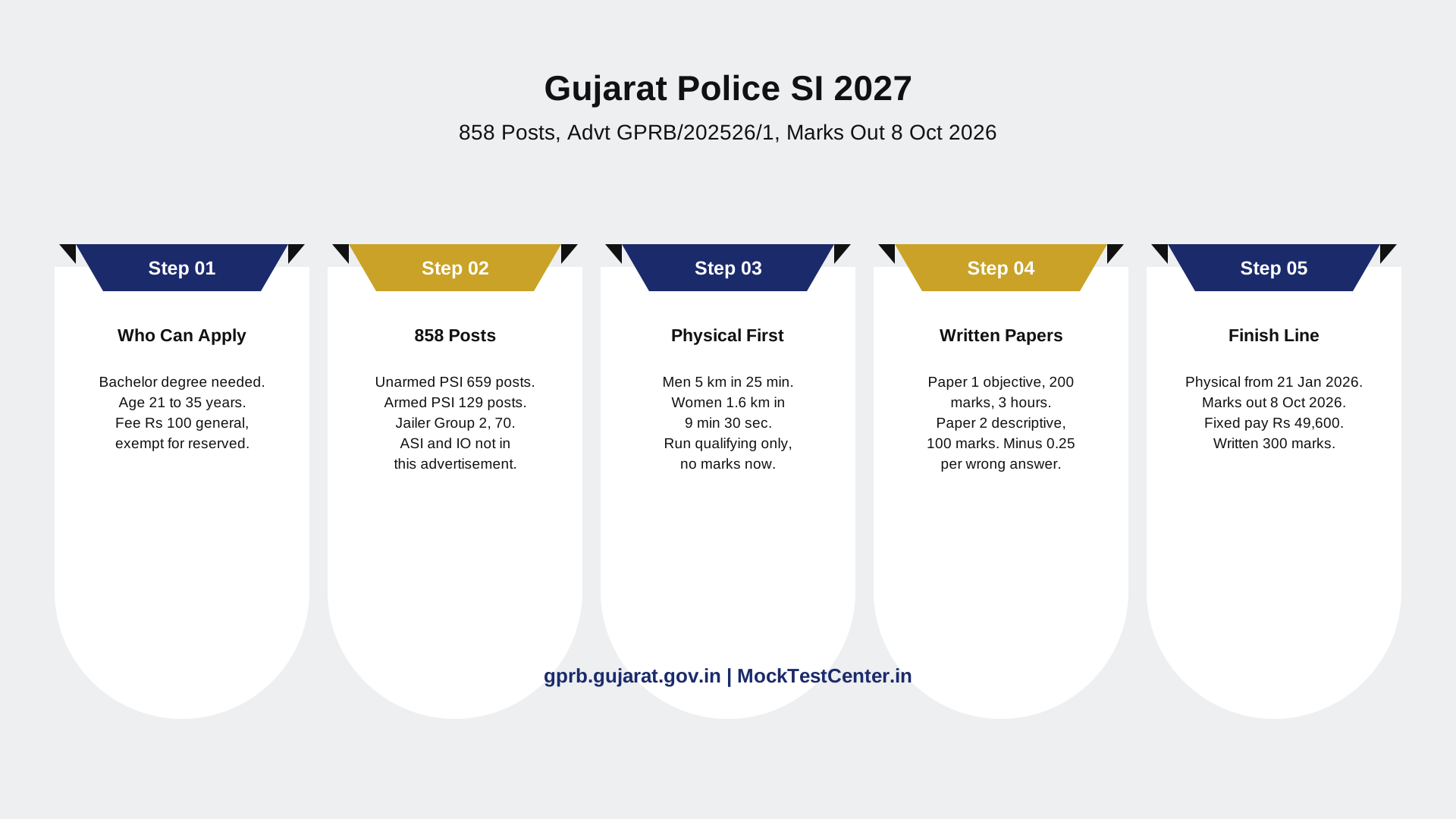
The Gujarat Police SI 2027 page on this site follows the live cycle of the Gujarat Police Sub Inspector recruitment, and the live cycle carries Advertisement Number GPRB/202526/1. The Gujarat Police Recruitment Board, known as GPRB, opened applications on 3 December 2025 for 858 PSI posts and closed the window on 23 December 2025. The same advertisement carried 12,733 Lokrakshak posts beside the PSI posts, which takes the combined total to 13,591. Physical tests began on 21 January 2026, and the board released the PSI marks on 8 October 2026. No separate 2027 notification exists as of 22 November 2026, so this guide anchors on the 2025-26 cycle and labels every figure with the cycle it belongs to.
That anchoring matters more here than in most state examinations, because Gujarat changed the PSI written pattern between the last two cycles. The 2021 cycle ran a 100 mark prelims and a four paper mains of 100 marks each, all objective, with the running test itself carrying up to 50 marks. The 2025-26 cycle runs a single written stage of 300 marks, with a 200 mark objective paper and a 100 mark descriptive language paper, and the running test only qualifies. A candidate who prepares from 2022 papers alone will expect a prelims that no longer exists, a mains that no longer exists, and running marks that no longer count. This guide keeps the two patterns apart, gives the new pattern the most space, and uses the old cycle only where it shows what changed.
The selection runs in a fixed order. Physical tests come first, with a running test and height and chest measurement. Candidates who clear the physical tests sit Paper 1, an objective paper of 200 marks in general studies. Candidates who score at least 40 percent in each of the two sections of Paper 1 get their Paper 2 checked, and Paper 2 tests Gujarati and English writing for 100 marks. Document verification and a medical examination close the process. The written papers decide the merit list, and the physical tests only filter the field.
Gujarat Police SI 2027 at a glance
| Detail | Gujarat Police SI 2027, as run in the 2025-26 cycle |
|---|---|
| Conducting body | Gujarat Police Recruitment Board (GPRB), Gandhinagar |
| Exam | Police Sub Inspector (PSI) recruitment, Class 3, Gujarat Police Department |
| Live cycle | 2025-26, Advertisement Number GPRB/202526/1, notified 3 December 2025 |
| Posts in live cycle | 858 PSI posts, inside a combined 13,591 post advertisement with Lokrakshak |
| Applications | 3 December 2025, 2 pm, to 23 December 2025, 11.59 pm, online on OJAS only |
| Fee payment last date | 26 December 2025 |
| Fee | Rs 100 for general category, Rs 200 for both PSI and Lokrakshak, exempt for SC, ST, SEBC, EWS and ex-servicemen |
| Education | Bachelor degree from a recognised university, plus Gujarati, Hindi and computer knowledge |
| Age limit | 21 to 35 years, with relaxation for reserved categories and women |
| Physical tests | From 21 January 2026, run first, then height and chest |
| Written examination | Paper 1 objective 200 marks, Paper 2 descriptive 100 marks, 3 hours each |
| Marks | Released 8 October 2026, as reported by Testbook |
| Fixed pay | Rs 49,600 per month for the first five years, as the advertisement states |
| 2027 notification | Not published as of 22 November 2026 |
The 858 posts, and the three jobs inside them
The PSI cadre covers three different jobs, and the advertisement splits the 858 posts across them. Unarmed Police Sub Inspector carries 659 posts, the largest block by far. Armed Police Sub Inspector carries 129 posts. Jailer Group 2 carries 70 posts. The three numbers add to 858 exactly, and the addition deserves a check because one tracker page on this same recruitment prints a different split in its own questions section.
The three jobs differ in daily work. An Unarmed PSI works at a police station, leads investigation, handles complaints, manages law and order in an area, supervises constables on duty. An Armed PSI works as a platoon commander, leads armed police units, guards sensitive places, handles situations that need armed strength rather than investigation. A Jailer Group 2 works in prison administration, manages jail staff, supervises prisoners, and runs the daily routine of a jail. The same examination feeds all three, and the board allots the post by merit and preference, so a candidate should know which of the three jobs they want before they fill the form, because the preference order shapes the posting for years.
One tracker page, Maru Gujarat, prints a conflicting split in its FAQ section: 616 Unarmed PSI posts and 242 Armed PSI posts, with no mention of Jailer Group 2. Those two numbers also add to 858, which makes the conflict harder to spot. Three other tracker pages, Govt Jobs Alert, Sarkari Job Portal and Sarkari Exam Center, print the 659, 129 and 70 split in their vacancy tables, and Gujarat Govt Job prints the same three numbers with a category break up attached. This guide uses 659, 129 and 70, because four pages agree on them and only the one FAQ line gives the other pair. The 616 and 242 figures may come from an earlier draft of the advertisement or a misreading of the category table, and this guide flags them so that a candidate who reads both versions knows which one carries more support.
The category break up inside the PSI posts follows the Gujarat reservation roster, and the tracker pages print part of it. Unarmed PSI splits as General 274; EWS 65; SEBC 177, with the SC and ST shares printed in the advertisement PDF. Armed PSI splits as General 50; EWS 18; SEBC 33. Jailer Group 2 splits as General 31; EWS 7; SEBC 18. The General figures alone show where the open competition sits: 274 open posts in Unarmed PSI against 50 in Armed PSI and 31 in Jailer. Candidates should read the full category table in the advertisement PDF on ojas.gujarat.gov.in for their own category, because this guide could not verify the SC and ST splits for the PSI posts from the tracker pages, and guessing a category figure is worse than leaving it out.
The PSI posts in this cycle look small beside the 12,733 Lokrakshak posts in the same advertisement, and that gap tells a story about the two cadres. Lokrakshak takes Class 12 pass candidates and fills the constable ranks in bulk. PSI takes graduates and fills the officer rank in smaller numbers, with a higher starting pay and a faster promotion line. The 2021 cycle carried 372 PSI posts inside a 1,382 post advertisement that also covered Assistant Sub Inspector and Intelligence Officer posts. The 2025-26 cycle carries 858 PSI posts and no ASI or IO posts at all, which means the board more than doubled the PSI intake while dropping the other two cadres from this advertisement. A graduate who missed the 2021 cycle gets a much larger PSI intake this time, and a much harder written paper with it.
The same advertisement also explains a number that confused candidates in the news. Deputy Chief Minister Harsh Sanghvi spoke on 22 November 2025 of about 14,507 police posts, and the advertisement covers 13,591. The gap of 916 posts belongs to the technical cadre, which the minister's figure included and this advertisement excludes. The board announced the PSI and Lokrakshak recruitment on 29 November 2025 through its chairperson, IPS Niraja Gotru, and the technical cadre sits in a separate recruitment. Candidates who saw the 14,507 figure and then found 13,591 in the advertisement can stop hunting for the missing posts.
Who can apply, what it costs, and the age rule
The education rule asks for a bachelor degree from a recognised university, or a deemed university set up under a Central or State Act in India, or a degree the government declares equivalent. The degree can sit in any discipline, which is why PSI draws graduates from engineering, commerce, arts, science and law into the same hall. The advertisement adds two conditions that candidates often miss. It asks for adequate knowledge of Gujarati and Hindi, and it asks for basic knowledge of computers. A graduate who studied outside Gujarat should check the language condition first, because Paper 2 tests Gujarati writing for 70 marks and English writing for 30 marks, and a candidate who cannot write Gujarati at all will lose those marks before the examination even starts.
The age rule runs from 21 to 35 years for the PSI cadre. The minimum age of 21 reflects the degree requirement, because few candidates finish a degree before 21, and the upper age of 35 gives graduates a long window. The tracker reports disagree on the date the board counts the age from, and the disagreement matters for candidates near the edge. Two tracker reports, Rojgar Warrior and Government Daily Jobs, give 10 November 2025 as the cut off date. Two others, Govt Jobs Alert and Exam Notify, give 23 December 2025, the last date of application, and Exam Notify prints the PSI birth window as 23 December 1990 or later. This guide records both dates and flags the conflict rather than picking one, because the advertisement PDF settles it and no tracker page quotes the PDF line on this point. A candidate within a few months of either edge should read the advertisement PDF on ojas.gujarat.gov.in before paying the fee.
Relaxation follows the Gujarat government rules. Exam Notify reports the relaxation as five years for general category women, which takes the upper age to 40, five years for reserved category men, which takes it to 38, and ten years for reserved category women, which takes it to 45. Those figures come from a tracker report, and this guide labels them as such, because the other tracker pages for this cycle state the 21 to 35 rule without printing a relaxation table. The 2021 cycle used a similar shape, with five years for SC and ST candidates, three years for OBC candidates, five years for women, and ten years for women from reserved categories, so the shape will look familiar to repeat candidates.
The fee stays low. General category candidates pay Rs 100 for the PSI cadre alone, and Rs 200 if they apply for both PSI and Lokrakshak in the same advertisement. Candidates from SC, ST, SEBC and EWS categories pay nothing, and ex-servicemen pay nothing. The fee goes through the online payment gateway on OJAS, and the last date for fee payment ran to 26 December 2025, three days after the application window closed. An application without the fee counts as incomplete, and the board accepts no application by post, courier or email.
Applications ran only on OJAS, the Online Job Application System at ojas.gujarat.gov.in. Candidates used a One Time Registration number to log in, filled personal, educational and communication details, uploaded a photo and signature in the prescribed format, and clicked Confirm to generate a confirmation number. The Maru Gujarat guide warns that no edit is possible after confirmation, and that warning deserves attention. A wrong category, a wrong post preference or a wrong date of birth after confirmation stays wrong, and the board will not reopen the form. A graduate who also qualifies for the Lokrakshak cadre can apply for both cadres in the same advertisement, and the Rs 200 combined fee covers both applications.
The physical tests come first, and the run no longer carries marks
Gujarat runs its physical tests before the written examination, and the 2025-26 cycle followed that order. Physical tests began on 21 January 2026, and only candidates who cleared them sat the written papers. The same order held in the 2021 cycle, where physical tests ran from 3 December 2021 and the prelims followed on 6 March 2022. Candidates should plan their year around that order, because the physical test removes candidates before they ever see a question paper, and a candidate who studies for six months and runs for six days will fail at the first stage.
The Physical Standard Test measures height and chest, and the standards differ by category and sex. For men, the height bar sits at 165 cm for most candidates and 162 cm for Scheduled Tribe candidates of Gujarat origin. The chest bar sits at 79 cm unexpanded and 84 cm expanded, which means the chest must expand by at least 5 cm, and the same chest figures apply to both height groups. For women, the height bar sits at 155 cm for most candidates and 150 cm for Scheduled Tribe candidates of Gujarat origin. The board measures chest for men only. One tracker page, Rojgar Warrior, prints the male ST height as "as per rules" without a figure, and another prints 162 cm for SC candidates as well as ST, so this guide uses the figures that Jagran Josh, Testbook and the Government Daily Jobs page all agree on: 162 cm for ST Gujarat origin, 165 cm for others.
| Physical Standard Test | Men | Women |
|---|---|---|
| Height, other candidates | 165 cm | 155 cm |
| Height, ST Gujarat origin | 162 cm | 150 cm |
| Chest unexpanded | 79 cm | Not measured |
| Chest expanded | 84 cm, minimum 5 cm expansion | Not measured |
The Physical Efficiency Test is a run, and the run is the same for PSI and Lokrakshak candidates. Men run 5,000 metres inside 25 minutes. Women run 1,600 metres inside 9 minutes 30 seconds. Ex-servicemen run 2,400 metres, and the time limit for that run carries a small conflict in the sources. Jagran Josh gives 12 minutes for the 2025-26 cycle, while the Testbook PSI page gives 12 minutes 30 seconds, the same figure the 2021 cycle guides give. This guide records both figures and flags the conflict, because the two pages tied to the new advertisement disagree on this one detail, and an ex-serviceman should train to the stricter 12 minute limit to stay safe on either reading.
| Physical Efficiency Test | Distance | Time limit |
|---|---|---|
| Men | 5,000 metres | 25 minutes |
| Women | 1,600 metres | 9 minutes 30 seconds |
| Ex-servicemen | 2,400 metres | 12 minutes per Jagran Josh, 12 minutes 30 seconds per Testbook PSI page |
The biggest change in the physical stage sits in what the run is worth. In the 2021 cycle, the board awarded marks for the run, up to 50 marks, with a man who finished 5,000 metres in 20 minutes or less taking the full 50, and counted those marks in the final aggregate with the mains marks. In the live cycle, the run is a qualifying test only, which means it carries no marks and only decides who moves to the written papers. Testbook states the qualifying nature plainly on its PSI page for the new cycle. A fast runner gains nothing over a candidate who finishes inside the limit by a second, and both sit the same written paper. Training should aim at clearing the time with something in reserve, because a candidate who arrives at the line exhausted has spent the fitness that the written paper then demands in a different form.
That change matters for preparation, because it moves the whole contest into the written papers. In the 2021 cycle, a strong runner could bank up to 50 marks before the written stage began, and a slow runner started the mains at a disadvantage. In the live cycle, every candidate who clears the run starts the written stage at zero, and the 300 written marks decide everything. The run still filters the field, and it filters hard, but it no longer ranks it. Candidates who spent months chasing a faster run time in the old pattern should spend those months on the written papers in the new one, once they can clear the time limit comfortably.
Gujarat Police SI exam pattern: Paper 1, the 200 mark objective paper
Paper 1 is the paper that decides the merit list, and the Gujarat Police SI exam pattern gives it 200 marks across two parts. The paper runs in OMR mode, with objective questions and 3 hours on the clock. Each question carries 1 mark, and each wrong answer costs 0.25 marks. The board sets the paper in Gujarati and English. Paper 1 splits into Part A of 100 marks and Part B of 100 marks, and the split matters because the board uses it as a gate for Paper 2.
| Paper 1 | Subject | Marks |
|---|---|---|
| Part A | Reasoning and Data Interpretation | 50 |
| Part A | Quantitative Aptitude | 50 |
| Part A total | 100 | |
| Part B | The Constitution of India and Public Administration | 25 |
| Part B | History, Geography, Cultural Heritage | 25 |
| Part B | Current Affairs and General Knowledge | 25 |
| Part B | Environment, Science and Technology and Economics | 25 |
| Part B total | 100 | |
| Paper 1 total | Objective questions | 200 |
Part A carries half the paper, which tells candidates where the weight sits. Reasoning and Data Interpretation covers data interpretation from graphs, tables, charts; logical reasoning; data sufficiency; seating arrangements; syllogism; blood relations; direction and distance; Venn diagrams; puzzles; coding and decoding; input and output; series completion. Quantitative Aptitude covers arithmetic; algebra; quadratic equations; geometry; trigonometry; number systems; HCF and LCM; percentage; profit and loss; ratio and proportion; time, speed, distance; average; simple and compound interest; probability; mensuration. A graduate who prepared for banking or SSC examinations will find Part A familiar, because the topics overlap heavily with those papers, and the difference sits in the time pressure rather than the syllabus.
Part B spreads 100 marks across four sections of 25 marks each, which rewards breadth rather than depth. The Constitution and Public Administration section covers fundamental rights; directive principles; fundamental duties; the President; the Prime Minister and the Council of Ministers; Parliament; the judiciary; state governments; union territories; emergency provisions; the amendment procedure; the Preamble; citizenship; the Election Commission; administrative theories; bureaucracy; public policy; public personnel administration; organisation theory; decentralisation and local governance; ethics in public administration; public private partnerships; governance and development; e-governance. History, Geography and Cultural Heritage covers ancient, medieval, modern Indian history; world history; Indian geography with emphasis on Gujarat; physical features; biosphere reserves; deserts; natural resources; soil, climate, crops; Indian cultural heritage with emphasis on Gujarat; art and architecture of ancient India, particularly Gujarat; the national movement; socio-economic and cultural history of India; historical geography; archaeology; folk culture; religions; social reform and the freedom movement in Gujarat; art, culture, literature of Gujarat. Current Affairs and General Knowledge covers state, national, international events; government schemes and policies; sports; awards; honours; important days; books and authors; major organisations and headquarters. Environment, Science and Technology and Economics covers climate change and mitigation; biodiversity conservation; renewable energy; science in everyday life; pollution control; waste management; disaster management; sustainable development goals; environmental laws; artificial intelligence; economic indices; economic reforms; computer basics; internet; social media; email.
The 40 percent gate is the rule that catches candidates who score well in one part and badly in the other. Testbook reports that Paper 1 needs a minimum of 40 percent marks in each of the two sections before the board evaluates Paper 2. Forty percent of 100 is 40 marks in Part A and 40 marks in Part B. A candidate with 80 in Part A and 35 in Part B clears neither the spirit nor the letter of the rule, because Part B falls short, and the board will not check their Paper 2 at all. The gate forces balanced preparation, and it punishes the common habit of mastering reasoning and quant while leaving the Constitution, Gujarat history and environment for the last month.
Negative marking shapes the guessing strategy. Four wrong answers cancel one correct answer, because each wrong answer costs 0.25 marks against a 1 mark question. The paper rewards accuracy under time pressure, and it punishes both slow perfection and fast guessing. Candidates who score best in this paper mark the answer and move on when a question resists them, and they return only if time remains. Blind guessing across the whole paper loses marks steadily, while informed guessing, where two options can be eliminated, usually pays.
One conflict on the Testbook PSI page deserves a direct note, because it confuses candidates who read the whole page. The top of the page says the prelims will run for 100 marks and the mains for 400 marks, which is the 2021 pattern. The exam pattern table on the same page says Paper 1 carries 200 marks and Paper 2 carries 100 marks, 3 hours each, 300 marks in all, which is the live pattern for Advertisement Number GPRB/202526/1. This guide follows the table, because the table matches the notification date, the Paper 2 structure, and the Jagran Josh constable page for the same advertisement, which prints the same 200 plus 100 split. Candidates who find the 100 plus 400 figures on another site should treat them as the 2021 pattern, which the next sections describe.
Paper 2, the descriptive paper that graduates underestimate
Paper 2 is the part of the Gujarat Police SI exam pattern that graduates underestimate, and it tests writing rather than ticking boxes. The paper carries 100 marks, runs for 3 hours, and splits into Part A in Gujarati and Part B in English. Only candidates who clear the 40 percent gate in each section of Paper 1 get their Paper 2 evaluated, so the descriptive paper rewards candidates who survive the objective paper with their language skills intact. A graduate who prepared only from objective question banks will find Paper 2 waiting with a third of the total marks.
| Paper 2 | Topic | Marks |
|---|---|---|
| Part A, Gujarati | Essay, 350 words | 30 |
| Part A, Gujarati | Precis writing | 10 |
| Part A, Gujarati | Comprehension | 10 |
| Part A, Gujarati | Report writing | 10 |
| Part A, Gujarati | Letter writing | 10 |
| Part B, English | Precis writing | 10 |
| Part B, English | Comprehension | 10 |
| Part B, English | Translation, Gujarati to English | 10 |
| Paper 2 total | 100 |
The Gujarati essay carries 30 marks, nearly a third of the paper, and the advertisement sets it at 350 words. An essay of that length needs a clear structure: an introduction, two or three points with examples, a closing line, all inside the word limit. Candidates who write 600 words on the first question will run out of time for the precis, the comprehension, the report, the letter, four tasks that together carry 40 marks in Part A. The precis tests the ability to shrink a passage to its bones without losing its meaning. The report and the letter test formal writing, the kind of writing a Sub Inspector does every week at a police station, in crime reports, in letters to senior officers, in daily diaries. Those three tasks, report, letter, precis, test the daily writing of the job itself. The English part tests the same skills at a smaller scale, with precis, comprehension and a translation from Gujarati to English.
The same Paper 2 structure appears on the Lokrakshak side of this advertisement, which tells candidates something useful. The board set one descriptive language paper for both cadres in this cycle, with the same essay, precis, comprehension, report, letter, translation tasks. A PSI candidate and a constable candidate in the same house can prepare the language paper together, and the same essay practice serves both. The difference sits in Paper 1, where the PSI paper weights reasoning and quant at 100 marks against 60 in the constable paper, and adds public administration, environment and economics to Part B. The language paper is the shared ground, and it is also the ground where graduates compete directly with Class 12 candidates, which should humble any graduate who assumes a degree guarantees a better essay.
Preparation for Paper 2 looks nothing like preparation for Paper 1. Paper 1 rewards question banks and timed tests. Paper 2 rewards a notebook and a pen. One essay a week, one precis a week and one translation a week, each timed and each checked against the word limit, will build the skill faster than reading about essay writing for a month. The 350 word essay limit deserves special practice, because most candidates either write 200 words and stop, which leaves marks on the table, or write 500 words and run out of time, which costs marks in the next four tasks. A candidate who can land within 20 words of the limit without counting every word has the skill this paper tests.
The 2021 cycle, and the old pattern it ran
The previous PSI cycle ran under Advertisement Number PSIRB/202021/1, and it gives candidates the clearest picture of how the board worked before the pattern change. Applications ran from 16 March to 31 March 2021 for 1,382 posts. The break up was Unarmed PSI male 202 and female 98, Armed PSI male 72, Intelligence Officer male 18 and female 9, and Unarmed Assistant Sub Inspector male 659 and female 324. The PSI posts alone numbered 372, which is less than half the 858 PSI posts in the live cycle, and the ASI posts, 983 of them, made up most of the advertisement. The live cycle drops ASI and IO entirely and more than doubles the PSI intake, which changes the character of the examination from a bulk ASI recruitment with a PSI stream into a PSI recruitment in its own right.
The 2021 selection ran in three stages, and the order differed from the live cycle. Physical tests came first, with the running test and the measurement, and candidates who cleared them sat the prelims on 6 March 2022. The prelims was a single objective paper of 100 questions for 100 marks in 2 hours, in Gujarati, with negative marking of 0.25 per wrong answer and a pass mark of 40 percent. The syllabus covered general knowledge, current affairs, psychology, history, geography, social science, science and technology, and general mental ability, at degree level. Candidates who cleared the prelims sat the mains on 12 June 2022. One tracker page, Indi Result, prints a different set of dates for this cycle, with a notification on 5 October 2021, a last date of 3 November 2021 and a written examination in February 2023, and this guide flags those dates as conflicting and does not use them, because Rijadeja and Engg Recruit both print the March 2021 application window under the same advertisement number.
The 2021 mains was four objective papers of 100 marks each, which is the part of the old pattern that surprises candidates most. Paper 1 tested Gujarati language, Paper 2 tested English language, Paper 3 tested general knowledge, and Paper 4 tested legal matters, covering the Constitution of India; the Criminal Procedure Code 1973; the Indian Penal Code 1860; the Evidence Act 1872; the Gujarat Police Act 1951; the Gujarat Prohibition Act 1949; the Prevention of Corruption Act 1988; the Scheduled Castes and Scheduled Tribes Atrocities Prevention Act 1989; the Motor Vehicles Act 1988. Engg Recruit gives each paper 1 hour 30 minutes, with negative marking of 0.25 and a pass mark of 40 percent, and sets the Gujarati and English papers at HSC level and the general knowledge paper at graduate level. Teaching Ninja prints a different mains, with three descriptive papers of 100 marks each in Gujarati, English and general knowledge, and this guide flags that version as conflicting and follows the four paper objective version, because Rijadeja and Engg Recruit agree on it under the same advertisement number.
The old pattern also carried extra marks that the live pattern does not mention. The board awarded 2 marks for an NCC C certificate, 5 percent of the obtained marks for sports at international, national, inter-university or All India School level, and 5 percent of the obtained marks for widow applicants. Village, taluka and district level sport did not qualify for the sports marks. The board added the running test marks, up to 50, to the mains marks for the final aggregate, which meant a strong runner entered the mains with a lead. None of those extras appear in the tracker pages for the live cycle, and this guide records them as 2021 cycle rules only. Candidates should not count on extra marks in the live cycle unless the advertisement PDF for GPRB/202526/1 says so.
The pay in the 2021 cycle also looked different. Indi Result prints a pay scale of Rs 38,090 per month for PSI in that cycle, which is a tracker figure and should be treated as such. The live cycle fixes PSI pay at Rs 49,600 per month for the first five years, which is a large rise on the 2021 figure even allowing for pay revisions between the cycles. The gap shows why candidates should not carry old salary figures into a new cycle, because the fixed pay rules change with each advertisement and the tracker pages rarely update the old numbers.
Salary, fixed pay, and the three jobs after selection
The Gujarat Police SI 2027 advertisement fixes the PSI pay at Rs 49,600 per month for the first five years. Gujarat pays its new Class 3 recruits a fixed monthly amount for five years, and the regular pay scale starts after that period. The figure comes from the advertisement itself, as reported by Gujarat Govt Job, and this guide uses it as the primary figure. A second tracker page, Government Daily Jobs, prints a different figure, Rs 44,900 fixed pay with a Level 6 pay scale of Rs 35,400 to Rs 1,12,400 after five years. The two figures conflict, and this guide flags the conflict rather than hiding it, because a candidate choosing between PSI and another job needs the honest range. The advertisement figure of Rs 49,600 carries more weight, because the tracker page attributes it directly to Advertisement Number GPRB/202526/1.
The five year fixed pay rule shapes the early career more than the starting figure does. A PSI joins on fixed pay, serves five years, and then moves to the regular scale with increments, allowances and the benefits that come with a permanent post. The Lokrakshak cadre in the same advertisement starts lower, at Rs 26,000 fixed per month for five years, which gives graduates a clear financial reason to aim for PSI rather than settling for the constable post. The pay gap is only part of the choice, because PSI brings investigation duties, charge of a police station, and a faster promotion line, while the constable post brings earlier entry with a lower qualification.
Promotion from PSI runs upward through Police Inspector and beyond, and the speed of that line depends on seniority, vacancies and departmental examinations. An Unarmed PSI who performs well can expect charge of a police station within a few years, which is the post that most candidates picture when they think of the job. An Armed PSI rises through the armed units toward command of larger formations. A Jailer Group 2 rises through the prison department toward superintendent posts. The three lines differ, and a candidate should weigh them when filling preferences, because a posting preference made in a hurry can shape a decade.
Beyond pay, the PSI post carries the standard Gujarat government benefits after the fixed pay period, including medical facilities, leave, pension under the new pension rules, and uniform and duty allowances as the department orders prescribe. Candidates should treat allowance figures on tracker sites with care, because allowances change with government orders and tracker pages rarely date their figures. The advertisement and the appointment letter are the only sources that bind the department, and this guide does not print allowance figures that no source in this research dated.
A preparation plan that fits the numbers
The Gujarat Police SI 2027 plan starts from the marks. Paper 1 carries 200 marks and Paper 2 carries 100 marks, so the written total is 300. Part A of Paper 1 carries 100 marks, half the objective paper, which means reasoning and quant deserve the largest single block of study time. Part B spreads 100 marks across four sections of 25 each, which means no single Part B section deserves more than a week of focused study at a time. Paper 2 carries 100 marks, a third of the total, and Gujarati writing deserves a daily slot from the first week, because the essay alone carries 30 marks and the Gujarati part carries 70.
Running deserves a slot beside the books from the first week, because the physical test comes first in the cycle. A candidate who starts running only after the physical call letter arrives has about a month to build 5 km fitness, and a month is not enough for a candidate starting from zero. Three runs a week, building distance slowly, will carry most candidates inside 25 minutes within two months. Women training for 1,600 metres in 9 minutes 30 seconds need speed work rather than long distance, with intervals of 400 metres at target pace. The run only qualifies in the live cycle, so the training goal is to clear the time comfortably, not to set a record, and the fitness built for the run also helps a candidate sit a 3 hour paper without fading in the last hour.
Mock tests have a specific job in this examination, and it is not to predict the rank. Their job is to expose the habits that cost marks. In Paper 1, the habits are blind guessing, slow reading, and leaving the Constitution and Gujarat history for the last month. In Paper 2, the habits are writing too much on the essay and too little on the rest, and never finishing a paper in 3 hours. A candidate should take a mock test, spend an hour on the mistakes, and change one habit before the next test. A candidate who takes twenty mock tests and changes nothing has bought twenty confirmations of the same errors.
Current affairs need a Gujarat filter. National and international events matter, but the paper gives weight to Gujarat in history, geography, culture, current affairs, and the Part B sections reward candidates who follow Gujarat government schemes, Gujarat festivals, Gujarat geography, Gujarat personalities. A candidate who reads only national current affairs will score well on half the paper and poorly on the other half. The habit that pays is a daily note of one Gujarat fact, one national fact, one international fact, kept in a single notebook and revised weekly. After six months that notebook holds more than 500 facts, and the revision of it takes an hour.
Law deserves a note, because the old mains tested it heavily and the new pattern does not. The 2021 mains Paper 4 tested nine Acts, from the Constitution to the Motor Vehicles Act, for 100 marks. The live Paper 1 folds the Constitution and public administration into 25 marks of Part B, and the rest of the law syllabus has no separate paper. Candidates who buy old PSI books will find long chapters on the Evidence Act and the Criminal Procedure Code, and those chapters now earn little. The Constitution still matters, and the Gujarat Police Act still matters for the job, but the marks have moved to reasoning, quant and language. A candidate should check the chapter against the live syllabus before spending a week on it.
The mistakes that cost candidates a year
The first Gujarat Police SI 2027 mistake is preparing from the 2021 pattern. The old examination had a 100 mark prelims, a four paper mains and running marks worth 50. The live examination has a 200 mark objective paper, a 100 mark descriptive paper and a qualifying run. Candidates who buy old question banks and never write an essay will find a third of the marks sitting in a paper they never practised. The 2021 papers still help for general knowledge and current affairs, but they say nothing about Paper 2, and Paper 2 is where the new cycle separates candidates.
The second mistake is ignoring Part B of Paper 1. The 40 percent gate in each section means a candidate with 80 marks in Part A and 35 marks in Part B will never get a Paper 2 score at all. Reasoning and quant feel productive because every question has a right answer and a timer, while the Constitution and environment feel slow. The paper rewards the slow subjects as well, because Part B carries 100 marks against 100 in Part A, and the gate makes both parts compulsory in practice.
The third mistake is treating the run as a formality. The physical test comes first, and it removes candidates before they ever see a question paper. A candidate who studies for six months and runs for six days will fail at the first stage, and the six months of study will count for nothing. Running three times a week from the start costs little study time and protects the whole attempt.
The fourth mistake is trusting a single tracker site for dates and post counts. This one recruitment produced two different PSI splits on one site, two different age cut off dates, two different ex-serviceman run times, and two different salary figures. The official sites, gprb.gujarat.gov.in and ojas.gujarat.gov.in, are the only sources for dates, and the advertisement PDF is the only source for post counts. Tracker sites explain the pattern well, and they are not a source for facts that decide an attempt.
The fifth mistake is waiting for the result before starting the next stage. The 2021 cycle took about three months between the physical tests and the prelims, and the 2025-26 cycle took about five months between the physical tests and the written papers. Candidates who keep moving during those gaps arrive at the written paper ready. Candidates who wait arrive and start from zero. The examination rewards the candidate who treats waiting time as study time, because in this examination waiting time is most of the calendar.
Sources
Maru Gujarat, Gujarat Police Recruitment 2025, Advertisement Number GPRB/202526/1, 13,591 posts; 858 PSI and 12,733 Lokrakshak; applications 3 December 2025 to 23 December 2025; Unarmed PSI 659; Armed PSI 129; Jailer Group 2 70; graduate for PSI and Class 12 for Lokrakshak; OJAS portal; FAQ section prints 616 Unarmed and 242 Armed PSI posts. Govt Jobs Alert, Gujarat Police Recruitment 2025, 13,591 vacancies; Lokrakshak 12,733; PSI 858; applications 3 December 2025 to 23 December 2025; fee payment to 26 December 2025; PSI age 21 to 35. Bhaskar English, Gujarat Police announces recruitment for 13,591 posts, 858 PSI and 12,733 Lokrakshak; applications 3 to 23 December 2025; announcement 29 November 2025 by IPS Niraja Gotru; Deputy Chief Minister Harsh Sanghvi spoke of about 14,507 posts including technical cadre on 22 November 2025. Sarkari Job Portal, Gujarat PSI and Police Constable 13,591 Posts Online Form 2025, Advertisement Number GPRB/202526/1; PSI 858; Lokrakshak 12,733; applications 3 to 23 December 2025. Gujarat Govt Job, Gujarat Police Recruitment 2025, Advertisement Number GPRB/202526/1, PSI category break up Unarmed General 274, EWS 65, SEBC 177; Armed General 50, EWS 18, SEBC 33; Jailer General 31, EWS 7, SEBC 18; fee Rs 100 per cadre and Rs 200 for both; PSI age not more than 35; constable age 18 to 33; height 165 cm and chest 79 to 84 cm; PSI fixed pay Rs 49,600 and Lokrakshak fixed pay Rs 26,000 for the first five years. Testbook, Gujarat Police SI Syllabus and Exam Pattern, selection in three stages, prelims 100 marks and mains 400 marks in the header, Paper 1 objective 200 marks and Paper 2 descriptive 100 marks in the pattern table, 3 hours each, Part A Reasoning 50 and Quant 50, Part B Constitution and Public Administration 25, History and Geography 25, Current Affairs 25, Environment and Science 25, minimum 40 percent in each of the two sections of Paper 1, negative marking 0.25, run 5,000 metres in 25 minutes, 1,600 metres in 9 minutes 30 seconds, ex-servicemen 2,400 metres in 12 minutes 30 seconds, PSI marks released 8 October 2026, PSI Technical written examination 23 August 2026. Testbook, Gujarat PSI Exam Date 2026, selection through physical test, written examination and document verification, fee Rs 100 general, exempt for SC, ST, SEBC, EWS, ex-servicemen. Jagran Josh, Gujarat Police Constable Syllabus 2026, Paper 2 Gujarati essay 30, precis 10, comprehension 10, report 10, letter 10, English precis 10, comprehension 10, translation 10, height 165 cm and 162 cm ST, chest 79 and 84 cm, women height 155 cm and 150 cm ST, run 5,000 metres in 25 minutes, 1,600 metres in 9 minutes 30 seconds, ex-servicemen 2,400 metres in 12 minutes. Rijadeja, Gujarat Police Bharti 2021 for 1382 PSI, ASI, IO and AIO, Advertisement Number PSIRB/202021/1, applications 16 March to 31 March 2021, Unarmed PSI male 202 and female 98, Armed PSI male 72, Intelligence Officer male 18 and female 9, Assistant Intelligence Officer male 659 and female 324, prelims 100 questions for 100 marks in 2 hours, negative marking 0.25, pass mark 40 percent, mains four papers of 100 marks each in Gujarati, English, general knowledge and law. Engg Recruit, Gujarat Police Bharti 2021 for PSI, ASI and Intelligence Officer, 1382 posts, Unarmed PSI male 202 and female 98, Armed PSI male 72, Intelligence Officer male 18 and female 9, Unarmed ASI male 659 and female 324, bachelor degree, age 21 to 35, relaxation SC and ST five years, OBC three years, women five years and ten years for reserved women, applications 16 March to 31 March 2021, mains Gujarati, English, general knowledge and law at 100 marks each in 1 hour 30 minutes, negative marking 0.25, pass mark 40 percent, extra marks NCC C certificate 2 marks, sports 5 percent, widow applicants 5 percent. Gujarat Jobs, Gujarat PSI Syllabus 2021, 1382 posts, physical test first, prelims second, mains third, run 5,000 metres in 25 minutes for men with up to 50 marks, 1,600 metres in 9 minutes 30 seconds for women, ex-servicemen 2,400 metres in 12 minutes 30 seconds, prelims 100 marks objective with negative marking 0.25, mains 400 marks, document verification on aggregate of physical efficiency test and mains marks. Teaching Ninja, Gujarat Police SI Previous Year Papers 2025, prelims 6 March 2022, mains 12 June 2022, run 5,000 metres in 25 minutes, 1,600 metres in 9 minutes 30 seconds, ex-servicemen 2,400 metres in 12 minutes 30 seconds, prelims 100 questions for 100 marks, mains three descriptive papers of 100 marks each in Gujarati, English and general knowledge. Indi Result, Gujarat PSI Syllabus 2023, notification 5 October 2021, last date 3 November 2021, written examination February 2023, pay scale Rs 38,090 per month, 1382 posts. Rojgar Warrior, Gujarat Police Recruitment 2025, age as on 10 November 2025; PSI 21 to 35; Lokrakshak 18 to 33; fee Rs 100 general, exempt for SC, ST, EWS, EBC, ex-servicemen. Government Daily Jobs, Gujarat Police 13,591 SI and Constable Recruitment 2025, age as on 10 November 2025, Lokrakshak 18 to 33, PSI 21 to 35, fixed pay Lokrakshak Rs 21,700 and PSI Rs 44,900; Level 3 scale Rs 21,700 to Rs 69,100; Level 6 scale Rs 35,400 to Rs 1,12,400; fee Rs 100 general and exempt for reserved categories. Exam Notify, Gujarat Police Recruitment 2025, age as on 23 December 2025, relaxation general women 5 years to 40, reserved men 5 years to 38, reserved women 10 years to 45, fee payment to 26 December 2025, fee Rs 100 plus bank charges, height 165 cm and 162 cm SC and ST, chest 79 and 84 cm, women height 155 cm and 150 cm SC and ST.







