
About GSSSB Clerk 2027 Exam Series
📖 Table of Contents
- GSSSB Clerk 2027 at a glance
- The 4,304 posts, and where the clerks sit
- Three cycles, and why they must not be mixed
- The GSSSB Clerk exam pattern starts with 60 minutes
- Group B mains, the 200 mark paper Junior Clerk candidates actually sit
- Group A mains, three descriptive papers worth 350 marks
- Who can apply, and what the board asks for
- How the pattern rewards preparation
- What to check before you apply
- Where this page stands
- Sources
GSSSB Clerk 2027: Complete Exam Guide
The GSSSB Clerk 2027 page on this site follows the Gujarat Subordinate Service Selection Board, known as GSSSB, and its Combined Competitive Examination for Class 3 clerk posts. The board has published no separate 2027 notification as of 22 November 2026, so this guide anchors on the last completed cycle, Advertisement Number 212/202324, and says so wherever a 2027 figure would otherwise be guessed. That cycle opened on 3 January 2024 with 4,304 posts, took applications from 4 January to 31 January 2024, ran its prelims between 1 April and 8 May 2024, and reached its Group B mains on 8 June 2025. Two newer cycles are already running behind it, and this guide tracks those separately so no reader mixes their dates with the 212 cycle.
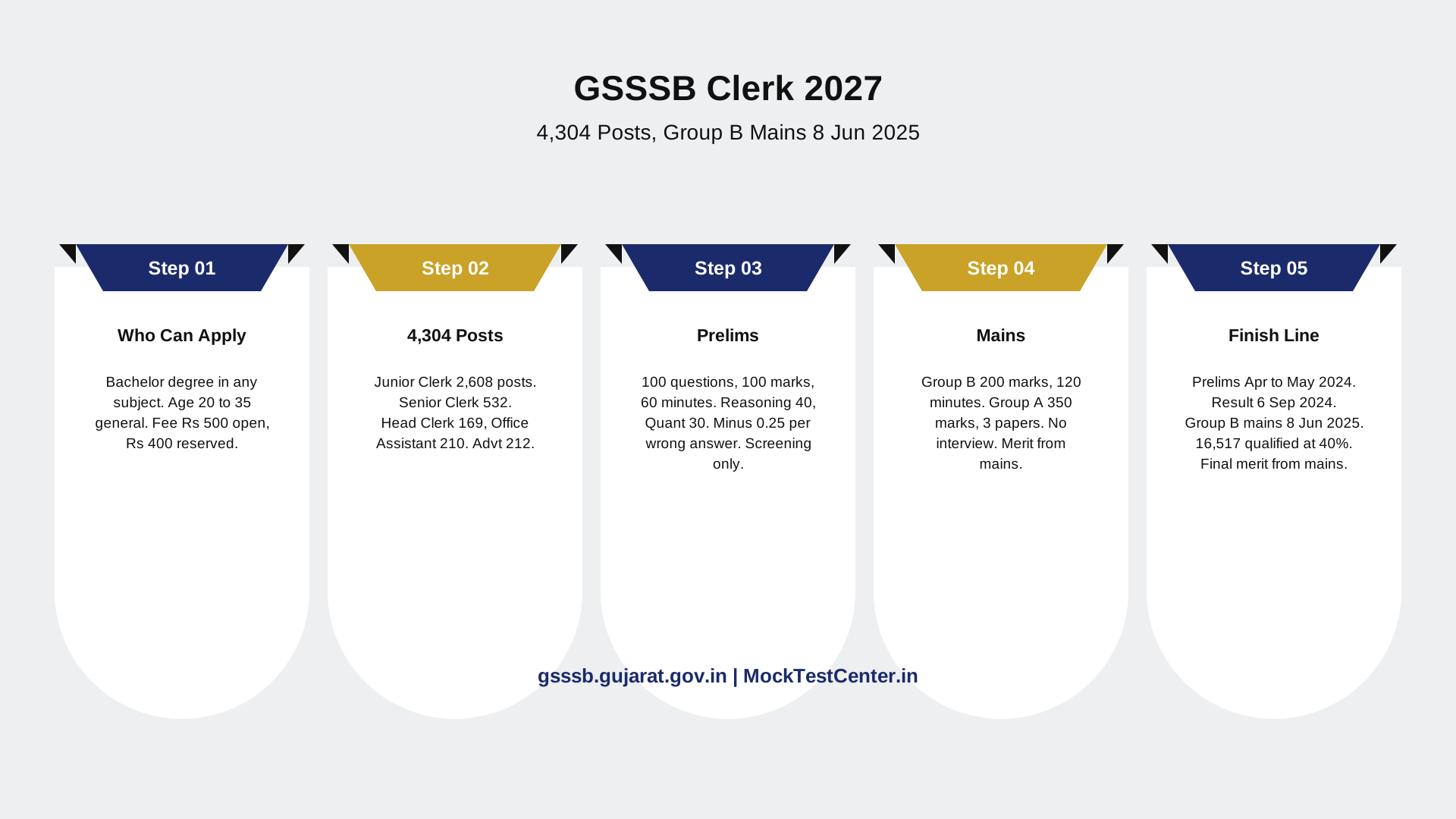
The first thing to understand is that GSSSB Clerk covers many posts under one combined examination, the CCE, that fills clerk posts across many departments of the Gujarat government in a single advertisement. Junior Clerk carries the largest share, 2,018 posts in the 212 cycle plus 590 more Junior Clerk posts in collector offices, which makes 2,608 Junior Clerk posts in all. Senior Clerk carries 532 posts, Head Clerk 169, and Office Assistant 210, with the rest spread across posts such as Sub Registrar, Stamp Inspector, Social Welfare Inspector and Depot Manager. A candidate applies once, sits one prelims, and then sits a mains paper set by the group the post belongs to. Group A posts lead to three descriptive mains papers worth 350 marks. Group B posts, which include Junior Clerk, lead to a single objective mains paper worth 200 marks.
That split decides how a candidate should prepare. A Junior Clerk aspirant faces two objective papers and no descriptive writing at all. A Senior Clerk or Head Clerk aspirant faces the same prelims and then three long descriptive papers in Gujarati, English and General Studies. Both routes start from the same 60 minute prelims, and the prelims is a screening test only. Its marks do not count in the final merit. The mains decides the rank, and document verification closes the selection.
GSSSB Clerk 2027 at a glance
| Detail | GSSSB Clerk 2027, as run in the 212/202324 cycle |
|---|---|
| Conducting body | Gujarat Subordinate Service Selection Board (GSSSB), Gandhinagar |
| Exam | Gujarat Subordinate Services, Class 3, Combined Competitive Examination (CCE), Group A and Group B |
| Live cycle | Advertisement Number GSSSB/202324/212, notification dated 3 January 2024 |
| Posts in live cycle | 4,304, including Junior Clerk 2,608, Senior Clerk 532, Head Clerk 169, Office Assistant 210 |
| Applications | 4 January to 31 January 2024, closed, through ojas.gujarat.gov.in |
| Fee | Rs 500 for unreserved candidates, Rs 400 for women and reserved categories, as reported by Adda247 |
| Prelims | 1 April to 8 May 2024, 100 questions, 100 marks, 60 minutes, minus 0.25 per wrong answer |
| Prelims result | 6 September 2024 |
| Group B mains | 8 June 2025, single objective paper, 200 marks, 120 minutes |
| Group B mains result | Provisional lists published, 16,517 qualified at 40 percent, 2,928 not qualified |
| Group A mains | Three descriptive papers, 350 marks, choice filling from 3 July 2025 |
| Selection | Prelims, mains, document verification |
| Education | Bachelor degree from a recognised university, basic computer knowledge, Gujarati or Hindi |
| Age limit | 20 to 35 years as on 31 January 2024, relaxation for reserved categories |
| Pay | Rs 26,000 per month fixed for the first five years for Junior Clerk and Senior Clerk |
| 2027 notification | Not published as of 22 November 2026; newer cycles 378/202526 and 468/202627 are running |
The 4,304 posts, and where the clerks sit
The 212 notification opened with 4,304 posts, and Adda247 publishes a post wise table that adds to 4,304 exactly, so this guide uses that table. Junior Clerk stands first with 2,018 posts in state departments, and a second Junior Clerk line of 590 posts sits in collector offices, which brings the Junior Clerk total to 2,608 posts, or just over 60 percent of the whole advertisement. Senior Clerk follows with 532 posts. Head Clerk carries 169 posts. Office Assistant carries 210 posts. Collector Office Clerk carries 160 posts. Assistant and Assistant Depot Manager posts carry 372 posts, the single largest block after the clerk posts. Sub Registrar Grade 1 carries 45 posts and Grade 2 carries 53. Stamp Inspector carries 23. Social Welfare Inspector carries 46 posts in one line and 102 in another, with Assistant Social Welfare Officer at 13 and 7 in two lines. Assistant Tribal Development Officer carries 65. Depot Manager carries 26. Junior Assistant carries 8. Office Superintendent carries 2 posts in one line and 3 in another. The table also lists 6 Gruhmata and 14 Gruhpita posts, which are residential caretaker posts in government hostels.
The spread matters because the advertisement covers many different jobs. A Junior Clerk in a secretariat department in Gandhinagar does different daily work from a Junior Clerk in a district collector office, and a Depot Manager in a government godown does different work again. The board runs one prelims for all of them, then sorts candidates into Group A and Group B mains by the post they applied for. Group B holds the Junior Clerk posts and the other clerical posts that take the single objective mains paper. Group A holds the supervisory posts that take the descriptive mains papers. A candidate who applies for a Group B post and then prepares for descriptive papers has prepared for the wrong examination.
One tracker figure needs a warning. A site called GovtJobGuru reports the same recruitment as 4,304 plus 898 plus 352, a total of 5,554 posts, and lists a further Junior Clerk line of 898 plus 340, or 1,238 posts, under Group B. No other source retrieved for this guide supports that addition, and the Adda247 table adds to 4,304 without it. This guide uses 4,304 and records the 5,554 figure as an unverified tracker claim. A corrigendum that added posts after the notification would explain the gap, but the sources read for this guide contain no such corrigendum, so the higher figure stays flagged rather than printed as fact.
The scale of the examination is large even by Gujarat standards. The prelims ran across more than five weeks, from 1 April to 8 May 2024, in shifts across the state, and the board postponed four dates in that window, 20, 21, 27 and 28 April, and rescheduled them. The final answer key came out on 30 July 2024 and the prelims result on 6 September 2024, five months after the first prelims shift. The Group B mains followed on 8 June 2025, more than a year after applications closed. A candidate who treats this as a three month process will be caught out by the calendar. The honest way to read it is that a GSSSB cycle takes about 17 months from notification to mains result, and preparation has to survive that whole stretch.
Three cycles, and why they must not be mixed
Most pages about this examination print one table of dates and leave the reader to guess which cycle it belongs to. That is the gap this guide fills first, because three GSSSB cycles now overlap and their numbers look alike. The 212/202324 cycle is the completed one, and it is the anchor for every figure in the tables above. The 378/202526 cycle is the running one, with its prelims already held and its mains still ahead. The 468/202627 cycle is the newest one, with applications open right now. A candidate who takes the 378 post count and the 212 exam pattern and the 468 last date and builds one plan from all three will prepare from a mixture that matches no real examination.
The 212 cycle is the one this guide describes in full. Notification 3 January 2024, applications 4 to 31 January 2024, prelims 1 April to 8 May 2024, final answer key 30 July 2024, prelims result 6 September 2024, Group B mains 8 June 2025, Group B provisional result with 16,517 candidates qualified and 2,928 not qualified at a 40 percent minimum, and Group A choice filling from 3 July 2025 with office allocation following it. The board held the Group A mains itself before that choice filling, but the sources retrieved for this guide give no exact dates for the Group A mains papers, so this guide flags them rather than stating them.
The 378/202526 cycle opened with applications from 5 February to 20 February 2026, fee payment to 23 February 2026, and a prelims held as a computer based test from 16 to 29 September 2026 across multiple shifts. The provisional answer key came out on 5 October 2026, objections closed on 12 October 2026, and the final answer key and the prelims result came out together on 3 November 2026. The board normalised marks by the equi percentile method because the prelims ran in many shifts, and the result lists normalised marks rather than raw marks. The board has tentatively set the Group A mains for 28 and 29 November 2026, and tracker sites report the Group B mains for January 2027 from the GSSSB calendar. Both mains dates are tentative, so confirm them on gsssb.gujarat.gov.in before booking any travel.
Tracker sites dispute the post count for the 378 cycle, and the dispute is worth stating plainly. The Times of India reports 5,370 posts, split as 2,365 in Group A and 3,005 Junior Clerk posts in Group B. Other tracker sites report 7,338 posts, split as 2,942 in Group A and 4,396 Junior Clerk posts in Group B. Both splits add up internally, so arithmetic cannot settle it. This guide uses the Times of India figure of 5,370 in its running update because it is the more established publication, and it records the 7,338 figure as a conflicting tracker report. The Times of India also reports that the 378 prelims carries 150 marks, against 100 marks in the 212 cycle, which would be a pattern change. No official paper read for this guide confirms that change, so this guide states it as a Times of India report only.
The board notified the 468/202627 cycle, called CCE 2.0 by tracker sites, on 3 November 2026 with 1,237 posts, split as 243 in Group A and 994 Junior Clerk posts in Group B. Applications run from 5 November to 30 November 2026, with fee payment to 2 December 2026. The fee is Rs 500 for unreserved candidates and Rs 400 for women of all categories and for SEBC, SC, ST, EWS, PwD and ex servicemen candidates. The age limit is 20 to 35 years as on 30 November 2026, with relaxations printed in the notice. Pay is fixed for the first five years, Rs 49,600 a month for Sub Registrar Grade 1, Office Superintendent and Assistant Tribal Development Officer, Rs 40,800 for Sub Registrar Grade 2, Social Welfare Inspector and Head Clerk, and Rs 26,000 for Senior Clerk, Office Assistant and Junior Clerk. The board has not announced the prelims and mains dates for this cycle. A reader who finds this page while the 468 window is still open should treat 30 November 2026 as the date that matters most, and should apply only through ojas.gujarat.gov.in.
One smaller cycle sits alongside these three. Advertisement 271/202425 was a special recruitment drive for Divyangjan candidates in Group A. Its mains ran from 18 to 20 December 2025, and its provisional result came out on 12 August 2026 with 110 candidates successful and 391 unsuccessful. It is a separate drive with its own lists, and its figures belong nowhere near the general cycles.
The GSSSB Clerk exam pattern starts with 60 minutes
The GSSSB Clerk exam pattern opens with a prelims that is short, fast and unforgiving. One hundred multiple choice questions carry 100 marks in 60 minutes, which allows 36 seconds per question on average. Reasoning Ability carries 40 questions and 40 marks. Quantitative Aptitude carries 30 questions and 30 marks. English Language carries 15 questions and 15 marks. Gujarati carries 15 questions and 15 marks. Each correct answer earns 1 mark. Each wrong answer loses 0.25 marks. The prelims is a screening test, so its marks do not count in the final merit, but a candidate who fails it never reaches the mains at all.
Seventy of the hundred marks sit in Reasoning and Quantitative Aptitude, so the prelims is really a speed test in those two sections with two language sections attached. A candidate who is strong in Gujarati and English and weak in reasoning starts the paper 40 marks behind the field before the language sections can help. The arithmetic is plain. Reasoning at 40 marks is worth more than English and Gujarati combined at 30 marks. Preparation time should follow the same split, with the largest share going to reasoning and quantitative aptitude, and the language sections kept warm with daily practice rather than treated as the main event.
The negative marking shapes how the paper should be attempted. Four wrong answers cancel one correct answer, so blind guessing across the paper loses marks steadily. Informed guessing, where two options can be ruled out, is a different matter and usually pays over a full paper. The practical habit is to answer the questions that are certain first, mark the ones where two options survive, and return to those only after the certain ones are done. A candidate who spends three minutes on one hard reasoning question has already spent the time of five other questions, and the paper does not reward that trade.
The 212 prelims ran in shifts from 1 April to 8 May 2024, and four dates, 20, 21, 27 and 28 April, were postponed. Candidates in different shifts sat different papers, which is why the 378 cycle normalises marks by the equi percentile method. The 212 cycle published its final answer key on 30 July 2024 and its prelims result on 6 September 2024. The gap between the last prelims shift and the result was about four months. Candidates who waited for the result before starting mains preparation lost that whole period, and the sensible habit is to start mains work the week after the prelims, while the result is still months away.
One detail in a tracker page deserves a warning rather than repetition. Adda247 states that the board announced the prelims result on www.rmc.gov.in, which is the site of the Rajkot Municipal Corporation and has nothing to do with this examination. The official sites for this recruitment are gsssb.gujarat.gov.in and ojas.gujarat.gov.in, and candidates should check results only there. Tracker pages copy each other, and a wrong link in one of them can travel a long way before anyone notices.
Group B mains, the 200 mark paper Junior Clerk candidates actually sit
Junior Clerk is a Group B post, so the mains that matters most to most readers of this page is the Group B mains. It is a single objective paper of 200 marks in 120 minutes, which allows 36 seconds per question if the paper holds 200 questions, and the same pace as the prelims if it holds fewer. The paper is the final merit test for Group B posts, which means the prelims only opens the door and this paper decides the rank. Document verification follows it, and no interview is part of the selection for these posts.
| Topic | Marks |
|---|---|
| English | 20 |
| Gujarati | 20 |
| Polity, Public Administration, RTI, CPS, PCA | 30 |
| History, Geography, Culture Heritage | 30 |
| Economics, Environment, Science and Technology | 30 |
| Current Affairs and Current Affairs with Reasoning | 30 |
| Reasoning | 40 |
| Total | 200 |
Reasoning carries 40 marks here too, the largest single block, and current affairs with reasoning carries another 30, so 70 of the 200 marks reward the same skills the prelims tested. The rest of the paper is knowledge rather than speed. Polity and public administration carry 30 marks, including the Right to Information Act and the Gujarat Civil Services conduct and discipline rules that the abbreviations CPS and PCA point to. History, geography and cultural heritage carry 30 marks, with weight to Gujarat. Economics, environment, science and technology carry 30 marks. English and Gujarati carry 20 marks each, which is a smaller share than in many state examinations, and that is good news for a candidate whose languages are ordinary but whose reasoning and general studies are strong.
The 212 Group B mains was held on 8 June 2025. The provisional result that followed applied a 40 percent minimum qualifying mark, which a General Administration Department notification dated 18 May 2023 sets. Appendix A listed 16,517 candidates who reached that mark and were provisionally qualified. Appendix B listed 2,928 candidates who did not reach it. Appendix C listed candidates whose cases are pending before the High Court in Special Civil Applications numbered 933 of 2024, 16139 of 2024 and 16283 of 2024, and the decision of the court will decide their final outcome. The board adds additional marks for candidates in the widow and sports quota categories after document verification, when the final selection list is prepared. The board has said document verification will follow, and it publishes the schedule on the official sites.
The 40 percent rule is the part of the mains that surprises candidates most. Think of it as a floor. Clearing it does not guarantee selection, because selection follows the merit list against the number of posts, and the merit list is drawn from the mains marks of candidates who clear the floor. A candidate who scores 41 percent has cleared the paper and still sits far down the merit list. The target to aim at is the score that the last selected Junior Clerk carried in the final list, and that figure comes out only when the final selection list is published.
Group A mains, three descriptive papers worth 350 marks
Group A posts take a different mains, and it is a much longer examination. Three descriptive papers carry 350 marks, and each paper runs for 3 hours, which makes 9 hours of writing spread across the mains schedule. Gujarati Language Skill carries 100 marks. English Language Skill carries 100 marks. General Studies carries 150 marks. The papers are descriptive, which means the candidate writes essays and long answers rather than ticking options, and that changes the preparation completely. Speed matters less than structure, and handwriting under time pressure becomes a real skill rather than an afterthought.
| Paper | Subject | Marks | Time |
|---|---|---|---|
| Paper 1 | Gujarati Language Skill | 100 | 3 hours |
| Paper 2 | English Language Skill | 100 | 3 hours |
| Paper 3 | General Studies | 150 | 3 hours |
| Total | Three papers | 350 | 9 hours |
The language papers test writing rather than grammar alone. The English paper asks for an essay of 250 to 300 words chosen from a list of five topics, along with the other language skills the board sets. A candidate who can read English but cannot write a structured essay in it will lose marks in both language papers, because the Gujarati paper asks for the same skills in Gujarati. The two language papers together carry 200 of the 350 marks, which is more than half the mains, so a candidate who treats them as a formality has misunderstood the examination.
The General Studies paper covers a wide syllabus that tracker sites reproduce from the official paper. History of India, including the Indus Valley Civilisation, the Vedic age, Jainism and Buddhism, the Maurya and Gupta empires, the Vijayanagara dynasty, the dynasties of Gujarat, the arrival of Europeans, British rule and the land revenue system, the freedom struggle, the Mahagujarat movement and the role of Sardar Patel. Cultural heritage, including the art forms, literature, sculpture and architecture of India, Gujarati theatre, folk culture and the coastal and tribal culture of Gujarat. Geography of Gujarat and India, with economic and social geography, sustainable development, natural disasters and climate change. Science and technology, including information and communication technology, e governance, cyber security, space programmes and energy policy. The constitution and the Indian state system, public administration and governance, discipline in public service, ethics, emotional intelligence, the Lokpal and Lokayukta, and the Indian economy and planning. It is a broad paper, and the only way to cover it is to read steadily for months rather than to revise in a final rush.
After the Group A mains in the 212 cycle, the board opened offline choice filling for office and department preferences from 3 July 2025, and published an allocation link that shows the office allotted to each qualified candidate, with the list of vacant seats updated daily. Only candidates who qualified for document verification after the mains could take part. The board issues final posting letters after successful document verification and the completion of allocation. A candidate who clears the mains but skips choice filling has no office to be posted to, so the administrative steps after the examination matter as much as the papers themselves.
Who can apply, and what the board asks for
The eligibility conditions for the 212 cycle are the same across most of its posts, with post wise additions for a few. The age limit is 20 to 35 years as on 31 January 2024, with relaxation for reserved categories under the government rules. The educational qualification is a bachelor degree from a recognised university, in any discipline for the clerk posts. The board requires adequate knowledge of Gujarati or Hindi, or proficiency in both languages. The Gujarat Civil Service Classification and Recruitment (General) Rules, 1967, require basic computer knowledge, which in practice means a CCC certificate or an equivalent computer qualification. A candidate should read the post wise conditions in the advertisement before applying, because a few posts add their own requirements, and the board checks eligibility at document verification, after the mains, when a failure costs the whole cycle.
The application runs online through the OJAS portal at ojas.gujarat.gov.in, and the steps are the same across the cycles. The candidate registers on OJAS, selects the GSSSB advertisement, fills personal details, uploads a photograph of 5 cm by 3.6 cm and a signature of 2.5 cm by 7.5 cm, each under 15 KB, pays the fee online, and submits. Once OJAS confirms the application, no change of any kind is possible, by the candidate or by the board, so the details should be checked before the final submit rather than after it. The photograph and signature sizes are small, and the portal rejects a file that is too large at upload, so prepare them before opening the form.
Adda247 reports the fee for the 212 cycle as Rs 500 for unreserved candidates and Rs 400 for women of all categories and for SC, ST and disabled candidates. Another tracker site reports the fee as Rs 100 plus postal charges. This guide uses the Rs 500 and Rs 400 figures because the same fee appears in the 468 cycle notification, which makes it the consistent figure across the newer cycles, and it records the Rs 100 figure as a conflicting tracker report. Tracker sites also report that the fee is refunded to candidates who appear in the prelims in the newer cycles. No source verified that refund for the 212 cycle itself, so this guide states it as a tracker report about the newer cycles only.
The Gujarat government fixes pay for the first five years, which is the pattern for Class 3 posts. Junior Clerk, Senior Clerk, Office Assistant and Collector Office Clerk carry Rs 26,000 a month in the 212 cycle. Head Clerk carries Rs 40,800 in the 212 cycle under the tracker tables, and Office Superintendent carries Rs 49,600. The regular pay scale applies after the first five years. A candidate who compares this pay with a central government clerk post should remember that the fixed pay period is five years, and the comparison that matters is the pay after that period, not the first month.
How the pattern rewards preparation
The pattern rewards a candidate who can work fast in reasoning and quantitative aptitude, read Gujarati and English steadily, and write long answers in both languages if the post is in Group A. That is a wide set of skills, and the preparation plan should follow the marks rather than the subjects a candidate likes. Reasoning carries 40 marks in the prelims and 40 marks in the Group B mains, which makes it the single most valuable subject in the whole examination for a Junior Clerk aspirant. Quantitative aptitude carries 30 marks in the prelims and then disappears as a separate head in the mains, where its place is taken by general studies. A candidate who spends equal time on every subject is spending too much time on the 15 mark language sections of the prelims and too little on the 40 mark reasoning section.
Gujarati deserves more attention than its 15 prelims marks suggest, because it returns in the mains. It carries 20 marks in the Group B mains and 100 marks as a descriptive paper in the Group A mains, and the board also requires adequate knowledge of Gujarati or Hindi as an eligibility condition. A candidate who grew up speaking Gujarati at home but never wrote it formally will find the descriptive paper harder than expected, because writing an essay in Gujarati under time pressure is a different skill from speaking it. Weekly essay practice in Gujarati, even one essay a week, pays more in the Group A mains than another round of multiple choice practice.
Current affairs needs a Gujarat focus. The Group B mains gives 30 marks to current affairs and current affairs with reasoning, and the history and geography section gives weight to Gujarat. National current affairs are common to every state examination and every serious candidate covers them, so they do not separate candidates. Gujarat specific current affairs, the state budget, state schemes, district news and the history of the Mahagujarat movement, are the part of the paper where a candidate who reads Gujarat newspapers pulls away from one who reads only national material. The prelims reasoning section also rewards practice rather than reading, and the fastest improvement most candidates can make is to practise reasoning sets against a timer until 36 seconds per question feels normal.
Mock tests help most when they copy the real conditions. Practise a 60 minute paper with 100 questions and minus 0.25 per wrong answer as a 60 minute paper, not as an untimed set of questions. Practise a Group B mains paper of 200 marks in 120 minutes in one sitting of two hours. The habit that pays off fastest is the habit of marking an answer and moving on, then returning only if time remains. The second habit is to keep a record of which questions were guessed and which were known, because the score on guessed questions tells a candidate whether guessing is helping or hurting. A candidate who guesses well should guess more. A candidate who guesses badly should guess less.
One more practical point comes from the calendar. The 212 cycle took 17 months from notification to the Group B mains result, and the 378 cycle took about nine months from application to prelims result. Preparation has to survive gaps of months with no news from the board, and then a sudden call letter with a few weeks to the examination. The candidates who clear usually kept a steady routine through the quiet months, rather than the ones who studied hard for a month, stopped, and tried to restart when the call letter arrived.
What to check before you apply
The official sites are gsssb.gujarat.gov.in for notifications and results and ojas.gujarat.gov.in for applications. Everything else is a tracker, and tracker pages help with reading the pattern but should never serve as the source for a date or a fee. The board publishes its notices as PDFs on its own site, and the advertisement number is the key to every search. For this examination the numbers to know are 212/202324 for the completed cycle, 378/202526 for the running cycle, 468/202627 for the newest cycle, and 271/202425 for the Divyangjan special drive. A notice that carries none of these numbers belongs to a different recruitment.
Three checks should be done before the application is submitted. First, the age on the date the advertisement specifies, 31 January 2024 for the 212 cycle and 30 November 2026 for the 468 cycle, because the board calculates age on that date and no other. Second, the computer qualification, because basic computer knowledge is an eligibility condition, not a skill to pick up after selection. Third, the post group, because Group A and Group B lead to different mains papers, and the choice of post decides the examination a candidate will sit a year later.
After the examination, the checks continue. The board releases the provisional answer key first, with a window for objections, and the final answer key follows it. In cycles where the prelims ran in many shifts, the result lists normalised marks, so the raw marks a candidate remembers from the examination will not match the result. The mains result comes as appendices, with qualified and not qualified lists, and candidates in court cases appear in a separate appendix whose outcome depends on the court. Choice filling and office allocation follow for Group A, and document verification follows for both groups. The board issues its own notice for each of these steps on its site, and missing one of them costs the same as failing a paper.
Candidates should also know that the board has faced court cases in this recruitment, with Special Civil Applications numbered 933 of 2024, 16139 of 2024 and 16283 of 2024 pending before the High Court for the 212 cycle. Those cases sit in a separate appendix of the Group B mains result, and their outcome will decide the fate of the candidates listed there. This guide does not take a view on the cases. It records them because a candidate who finds their roll number in Appendix C needs to know why it is there.
Where this page stands
This page carries the year 2027 because the cycles it tracks conclude in 2027, with the Group B mains of the 378 cycle reported for January 2027 and the 468 cycle running through the end of 2026 into 2027. The board has published no separate 2027 notification as of 22 November 2026. The figures in this guide belong to the cycles named beside them, and a new notification will change the post count, the dates and possibly the pattern. When it comes, the board will publish it on gsssb.gujarat.gov.in, and this page will need to be read again from the new advertisement number. Until then, the 212 cycle is the best record of how this examination actually runs, the 378 cycle is the best record of where it stands now, and the 468 cycle is the one with its application window still open. A candidate who prepares from the 212 pattern, watches the 378 mains dates, and applies to the 468 cycle before 30 November 2026 has the full picture in one place, which is what this guide was built to give.
Sources
Adda247, GSSSB CCE Mains Exam Date 2024, Prelims Result, Answer Key: Advertisement Number GSSSB/202324/212, 4,304 vacancies, post wise table adding to 4,304, notification 3 January 2024, applications 4 to 31 January 2024, prelims 1 April to 8 May 2024 with 20, 21, 27 and 28 April postponed, final answer key 30 July 2024, prelims result 6 September 2024, fee Rs 500 unreserved and Rs 400 women and reserved, age 20 to 35 as on 31 January 2024, bachelor degree, Gujarati or Hindi and basic computer knowledge, prelims 100 questions 100 marks 60 minutes with minus 0.25, Reasoning 40, Quantitative Aptitude 30, English 15, Gujarati 15, Group A mains 350 marks in three descriptive papers, Group B mains 200 marks in 120 minutes with topic wise marks, salary Rs 26,000 to Rs 49,600.
MaruGujarat, GSSSB CCE Group B Recruitment 2025, Advertisement Number 212/202324: Group B mains held 8 June 2025, provisional lists with 16,517 qualified at 40 percent minimum under the General Administration Department notification dated 18 May 2023, 2,928 not qualified, court cases SCA 933 of 2024, 16139 of 2024 and 16283 of 2024 in Appendix C, widow and sports quota marks added after document verification.
MaruGujarat, GSSSB CCE Group A Main Exam 2025, Advertisement Number 212/202324: office and department allocation link released 3 July 2025, offline choice filling from 3 July 2025, allocation under paragraph 8 of the instructions dated 1 July 2025.
Times of India, Gujarat GSSSB CCE Group A and Group B notification 2026 for 5,370 posts, Advertisement Number 378/202526: applications 5 to 20 February 2026, fee payment to 23 February 2026, Group A 2,365 posts, Group B 3,005 Junior Clerk posts, age 20 to 35, fixed pay Rs 26,000 to Rs 49,600, prelims 150 marks with negative marking, Group A mains three descriptive papers, Group B mains single objective paper, fee refundable for candidates who appear in the prelims.
Jobshouter, GSSSB CCE Result 2026: Advertisement Number 378/202526, 7,338 vacancies, prelims 16 to 29 September 2026, provisional answer key 5 October 2026, objections to 12 October 2026, final answer key and prelims result 3 November 2026, equi percentile normalisation, Group A mains tentative 28 and 29 November 2026, Group A 2,942 vacancies.
Examera, GSSSB CCE Result 2026: Advertisement Number 378/202526, prelims result 3 November 2026, Group A mains tentative 28 and 29 November 2026, Group B mains reported for January 2027 from the GSSSB calendar, Group B Junior Clerk 4,396 posts at Rs 19,950 fixed pay.
SarkariResult App and PlacementStore, GSSSB CCE 2.0 Recruitment 2026, Advertisement Number 468/202627: notification 3 November 2026, 1,237 posts, Group A 243 and Group B Junior Clerk 994, applications 5 to 30 November 2026, fee payment to 2 December 2026, fee Rs 500 unreserved and Rs 400 women and reserved categories, age 20 to 35 as on 30 November 2026, pay Rs 26,000 Junior Clerk, Rs 40,800 Head Clerk, Rs 49,600 Sub Registrar Grade 1.
AI Exam Radar, GSSSB CCE Group A Mains Result 2026: Advertisement Number 271/202425, special recruitment drive for Divyangjan candidates, mains 18 to 20 December 2025, provisional result 12 August 2026, 110 successful and 391 unsuccessful.
GovtJobGuru, GSSSB Clerk Recruitment 2024: 4,304 plus 898 plus 352, total 5,554 posts, Junior Clerk Group B 898 plus 340, total 1,238 posts, age 20 to 35 as on 31 January 2024, pay Rs 25,000 Junior Clerk, Rs 21,000 Senior Clerk, Rs 40,800 Head Clerk, recorded here as an unverified conflicting figure.
Ojas Bharti, GSSSB Junior Clerk Bharti 2024: 4,304 posts, Junior Clerk 2,018, Senior Clerk 532, Head Clerk 169, Office Assistant 210, Junior Clerk 590, fee Rs 100 plus postal charges, recorded here as a conflicting fee figure, applications 4 January to 31 January 2024.
Oliveboard, GSSSB Clerk Exam Syllabus 2024: 4,304 vacancies, Advertisement Number GSSSB/202324/212, applications 4 January to 31 January 2024, prelims 100 questions 100 marks 60 minutes, Group A mains 350 marks, Group B mains 200 marks.
Testbook, GSSSB Senior Clerk Syllabus and Exam Pattern 2024: prelims Reasoning, Aptitude, English and Gujarati, 100 marks, Group A mains Gujarati 100, English 100, General Studies 150, Group B mains 200 marks.







