
About Gujarat TET 2027 Exam Series
📖 Table of Contents
- Gujarat TET 2027 at a glance
- No posts, only a pass mark, and why that changes the whole game
- TET-I 2025, the live cycle, from notification to result
- TET-II 2023, the last full upper primary cycle
- Who can sit the test, TET-I and TET-II
- The Gujarat TET exam pattern, question by question
- The pass mark and the certificate
- How to apply on OJAS, and the form traps
- What passing does not do
- A preparation plan that fits 150 questions in 120 minutes
- The mistakes that cost candidates a cycle
- Sources
Gujarat TET 2027: Complete Exam Guide
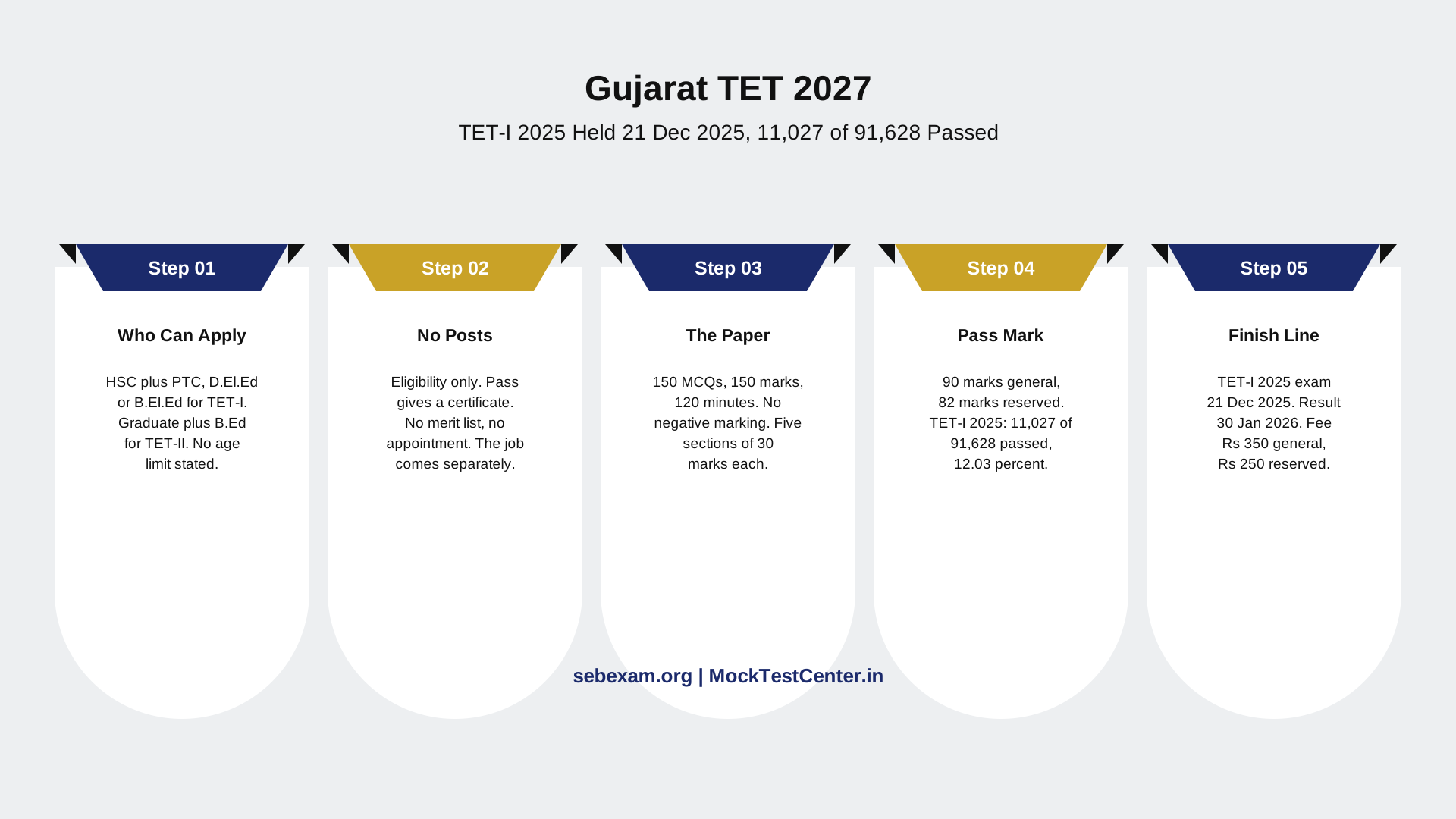
The Gujarat TET 2027 page on this site follows the live cycle of the Gujarat Teacher Eligibility Test, and the live cycle is TET-I 2025. The State Examination Board, Gujarat State, at Gandhinagar published the TET-I 2025 notification on 14 October 2025, held the examination on 21 December 2025, and declared the result on 30 January 2026. In that result 11,027 of 91,628 candidates present qualified, a pass rate of 12.03 percent. No separate 2027 notification has come out as of 22 November 2026, so this guide anchors on the TET-I 2025 cycle and on the last full TET-II cycle, held on 23 April 2023, and says so wherever a 2027 figure would otherwise be guessed.
One fact shapes everything else on this page. Gujarat TET carries no posts. The Board announces no vacancies, runs no merit list for jobs, and gives no appointment to anyone who passes. Passing the test gives a candidate a certificate, and that certificate counts as one qualification for appointment as a primary teacher or Vidyasahayak in classes 1 to 5 through TET-I, or in classes 6 to 8 through TET-II. The actual teaching job comes later, through a separate recruitment run by the Education Department or the district authorities, and that recruitment checks the certificate along with every other eligibility condition. A candidate who treats a TET pass as a job offer will wait for a letter that never arrives.
The test itself is short and sharp. One paper, 150 multiple choice questions, 150 marks, 120 minutes, no negative marking. Every question carries one mark. The pass mark is 60 percent for general category candidates, which is 90 marks, and 55 percent for SC, ST, SEBC, PH and EWS candidates, which is 82 marks. The fee in the latest cycle is Rs 350 for general category candidates and Rs 250 for reserved category candidates. The Board holds the test in Gujarati, English or Hindi, and each candidate takes it in one medium only.
Gujarat TET 2027 at a glance
| Detail | Gujarat TET 2027, as run in the live cycles |
|---|---|
| Conducting body | State Examination Board (Rajya Pariksha Board), Gujarat State, Sector 21, Gandhinagar |
| Exam | Teacher Eligibility Test, TET-I for classes 1 to 5 and TET-II for classes 6 to 8 |
| Live cycle | TET-I 2025, notification dated 14 October 2025, Notification No. RAPBO/TET-I/2025/12028-12140 |
| TET-I 2025 exam | 21 December 2025, 12 noon to 2 pm, at Ahmedabad city, Ahmedabad rural, Vadodara, Surat and Rajkot |
| TET-I 2025 result | 30 January 2026, 11,027 of 91,628 candidates present qualified, 12.03 percent |
| Last TET-II cycle | TET-II 2022-23, exam 23 April 2023, result 15 June 2023, 37,450 of 2,37,700 qualified, 15.76 percent |
| Posts | None, eligibility only, passing gives a certificate and no appointment |
| Paper | One paper, 150 multiple choice questions, 150 marks, 120 minutes, no negative marking |
| Pass mark | 60 percent (90 marks) general, 55 percent (82 marks) SC, ST, SEBC, PH and EWS |
| Fee | Rs 350 general, Rs 250 SC, ST, SEBC, PH and EWS, plus service charge |
| Medium | Gujarati, English or Hindi, one medium only |
| Certificate validity | Lifetime under the national extension of 2021, Gujarat validity follows Education Department resolution PRE/112021/Si.Fa.-07/K dated 10 September 2025 |
| Official website | sebexam.org, applications on ojas.gujarat.gov.in |
| 2027 notification | Not published as of 22 November 2026 |
No posts, only a pass mark, and why that changes the whole game
Every other examination on this site fills a stated number of posts. Gujarat TET fills none. The TET-I 2025 notification states it in plain words. Passing TET-I counts as a qualification for appointment as Prathmik Shikshak or Vidyasahayak in classes 1 to 5, and passing it gives no right to selection for the post. The Board repeats the point because candidates keep reading the test as a recruitment drive. It is a gate, and the recruitment drive stands on the other side of it, run by different authorities, on a different calendar, with its own advertisement and its own merit list.
That split changes how a candidate should think about the score. In a recruitment examination the rank decides the post, so every extra mark moves the candidate up the list. In Gujarat TET the score matters only against the pass mark. A candidate with 150 marks and a candidate with 90 marks both hold the same certificate, and the recruitment that follows treats the certificate as a tick in a box. The recruitment merit comes from other things, such as academic marks and the separate selection rules of the recruiting authority. A candidate who already holds a TET certificate can sit again to improve the score, and the recruitment considers the certificate the candidate submits. For a first attempt, though, the only target that matters is 90 marks for general category candidates and 82 for reserved category candidates.
The split also changes the risk. A candidate can pass TET and still wait years for a teacher recruitment, because the Board holds TET on its own cycle and the Education Department advertises teacher posts on another. The TET-I 2025 cycle ran from notification in October 2025 to result in January 2026, and it produced 11,027 newly qualified candidates for primary classes. Those candidates now hold a certificate that stays valid, and they wait for the next Vidyasahayak or primary teacher recruitment to use it. The certificate does not expire while they wait, which is the one piece of good news in the arrangement. The Union Education Ministry extended TET certificate validity from seven years to lifetime with retrospective effect from 2011, and the National Council for Teacher Education amended its 2011 guidelines to match on 9 June 2021. Adda247 reports that the Gujarat Board has applied the same lifetime validity. The Gujarat notification itself ties validity to Education Department resolution PRE/112021/Si.Fa.-07/K dated 10 September 2025, and this guide could not read the text of that resolution, so the lifetime figure rests on the national extension and the tracker report rather than on the resolution text itself.
The low pass rate deserves a straight look. In TET-I 2025 only 12.03 percent of candidates present qualified. In TET-II 2023 only 15.76 percent qualified. Those are hard numbers, and they sit far below the pass rates of most state eligibility tests. Part of the reason is the crowd. TET draws every graduate with a teaching diploma in the state, including many who sit without serious preparation because the fee is low and the attempt count is unlimited. Part of the reason is the paper itself. Five sections of 30 marks each leave no place to hide a weak subject, and the 120 minute limit gives 48 seconds per question. A candidate who reads the 12 percent figure and decides the paper is luck has the wrong lesson. The figure says the paper rewards steady preparation across all five sections and punishes the candidate who prepares four sections and hopes the fifth stays easy.
There is no limit on attempts. A candidate who fails can sit the next cycle, and a candidate who passes can sit again to raise the score. That rule sounds generous, and it is, but it also removes the urgency that a limited attempt count creates. Candidates drift across cycles, sitting each time with the same half finished preparation, and the pass rate stays low partly because the same unprepared crowd returns. The better way to use the rule is to treat the first attempt as the only attempt, prepare for 90 marks with a margin, and keep the retake option as insurance rather than as the plan.
TET-I 2025, the live cycle, from notification to result
The TET-I 2025 notification came out on 14 October 2025 as Notification No. RAPBO/TET-I/2025/12028-12140. The Board opened online applications on 29 October 2025 at 2 pm through ojas.gujarat.gov.in, with the last date first set at 12 November 2025 and the fee payment window closing on 14 November 2025. An amendment notification dated 8 November 2025 then extended the dates and moved the probable examination date to 21 December 2025. The last date for online registration moved to 18 November 2025 and the last date for fee payment by net banking moved to 20 November 2025. The examination ran on 21 December 2025 from 12 noon to 2 pm at five centres, Ahmedabad city, Ahmedabad rural, Vadodara, Surat and Rajkot. The result came out on 30 January 2026.
The amendment matters for more than the dates. It also changed who could apply. The 8 November 2025 amendment allowed students in the final year of their training qualification to apply, with the application depending on the final year result. That change opened the test to a whole class of candidates who would otherwise have waited a full cycle, and it shows why reading the amendment matters as much as reading the notification. The original notification set the rules, and the amendment rewrote two of them, the dates and the final year eligibility, within a month. A candidate who applied from the original notification alone would have missed both changes.
The result itself tells a story in one line. Of 91,628 candidates present, 11,027 qualified. The Board issues a certificate with marks only to qualified candidates, so the other 80,601 candidates left with nothing to show for the attempt except the experience. The 12.03 percent pass rate is the lowest figure in the recent history of this test that this guide could verify, lower than the 15.76 percent of TET-II 2023. The Board did not publish a section wise break up in the sources read for this guide, so no one can say from public data which section pulled the rate down. The five sections carry equal marks, so a weak section costs the same as any other, and the preparation plan in this guide treats them as equals for that reason.
The examination ran at only five centres, all in the big cities. Ahmedabad city and Ahmedabad rural count as two centres, with Vadodara, Surat and Rajkot making up the rest. That is a small footprint for a state wide test with more than 91,000 candidates present, and it meant long travel for candidates from Kutch, Saurashtra districts beyond Rajkot, and north Gujarat beyond Ahmedabad. The Board organises the test through District Education Officers in the districts it fixes, under a structure authorised by Education Department resolution PRE-1111-711-K of 27 April 2011. Candidates should expect the centre list to change between cycles, and should check the notification rather than assume the last cycle list will repeat.
The fee in this cycle stayed at the level of earlier cycles. General category candidates paid Rs 350, and SC, ST, SEBC, PH and EWS candidates paid Rs 250, plus a service charge, by ATM card or net banking. The fee is not refunded. The notification gives a helpline for payment trouble. If the fee is debited but no e-receipt is generated, the candidate writes to the Board, and the Board runs a toll free helpline on 1800 233 7963. Small detail, but a candidate whose fee is stuck needs that number more than any syllabus note.
TET-II 2023, the last full upper primary cycle
TET-II covers classes 6 to 8, and its last full cycle ran in 2023. The State Examination Board held the TET-II 2022-23 examination on 23 April 2023 from 3 pm to 5 pm, and declared the result on 15 June 2023. Around 2.50 lakh candidates sat the test, and the Board put the exact figure at 2,37,700 candidates present. Of those, 37,450 qualified, which is 15.76 percent. The subject wise figures show where the marks went. In Science and Maths, 20,135 of 64,669 candidates passed, a pass rate of 31.14 percent. The other subject groups fared worse, and the Board published the full subject table with the result.
The TET-II paper differs from TET-I in shape. Both papers carry 150 questions for 150 marks, but TET-II splits into two parts. Part 1 carries 75 questions, and Part 2 carries 75 questions, where the candidate takes Maths and Science, Languages, or Social Science as per qualification. The 8 October 2025 resolution revised the syllabus for both TET-I and TET-II, and it restated the TET-II split as Part 1 of 75 questions and Part 2 of 75 questions. The older 2022 pattern described the same 150 marks differently, with 30 marks each for Child Development and Pedagogy, Language I and Language II, and 60 marks for the chosen subject group. The totals match, and the section labels differ, so a candidate preparing from old papers should map the old sections onto the new split rather than assume the paper changed in substance.
The TET-II 2023 result also carried a rechecking window. Candidates could apply for rechecking of the answer sheet on or before 30 June 2023 with a payment of Rs 100, uploading the hall ticket with the request. That window closed within a fortnight of the result, and it is the kind of date that a candidate learns about only by reading the result notice itself. The result notice also matters for the certificate. Qualified candidates download the marksheet and certificate by logging in with the confirmation number and date of birth on sebexam.org, and the Board issues the certificate with marks to qualified candidates only.
One date conflict needs a flag. Some tracker pages report the TET 2023 examinations as held on 16 April and 24 April 2023, while the TET-II result reports give 23 April 2023 for TET-II. The 23 April 2023 date comes from the result reports of JagranJosh and TechUFO, which agree with each other and give the time as 3 pm to 5 pm. The 16 April and 24 April dates appear on a page that mixes TET-I and TET-II dates without separating them. This guide uses 23 April 2023 for TET-II and does not state a TET-I 2023 examination date, because the sources read for this guide do not settle it. The 2025 cycle is the anchor for TET-I, and the 2023 cycle is the anchor for TET-II, and the two should not be mixed.
No TET-II notification has come out in the 2025 cycle covered by this guide. The Times of India reported after the TET-I 2025 schedule announcement that the notification for TET-II for upper primary teachers was also expected soon. As of the sources read for this guide, that expectation had not turned into a dated notification. Candidates waiting for TET-II should watch sebexam.org rather than trust a tracker date, because the TET-I 2025 cycle itself moved its examination date by amendment within a month of notification.
Who can sit the test, TET-I and TET-II
TET-I asks for two things, schooling and training. The candidate needs at least an HSC pass, and needs a training qualification from the list the State Government fixes for primary teachers in classes 1 to 5. The list in the TET-I 2025 notification covers a two year PTC or D.El.Ed, a four year B.El.Ed degree, or a two year Diploma in Education in Special Education. The Times of India report on the TET-I schedule describes the same list in the same words, with a two year primary teacher certificate, a four year bachelor of elementary education degree, or a two year diploma in education. The 8 November 2025 amendment added final year students of the training qualification, with the application depending on the final year result. That is the whole eligibility rule for TET-I, and it has no age limit in the sources read for this guide.
TET-II asks for a degree and a teaching qualification. The 2022 eligibility reports describe it as a BA or BSc, or the final year of BA or BSc or D.Ed with at least 45 percent marks, or appearing in B.Ed, or a 12th pass with at least 50 percent aggregate and a four year B.Ed or BSc.Ed, or a BA.Ed or four year B.El.Ed or B.Ed in Special Education with at least 50 percent marks in BA or BSc. Those figures come from tracker reports of the 2022 cycle rather than from a notification read for this guide, so a candidate should check the exact percentages in the TET-II notification when it comes out. The shape of the rule is stable across cycles, a graduation plus a B.Ed or equivalent, and the percentages are the part that moves.
| Condition | TET-I (classes 1 to 5) | TET-II (classes 6 to 8) |
|---|---|---|
| Schooling | At least HSC pass | Graduation, BA or BSc, or final year of graduation |
| Training | Two year PTC or D.El.Ed, four year B.El.Ed, or two year Diploma in Education (Special Education) | B.Ed or equivalent, four year B.Ed or BSc.Ed, BA.Ed, four year B.El.Ed, or B.Ed Special Education |
| Final year students | Allowed from the 8 November 2025 amendment, subject to the final year result | Allowed in earlier cycles, subject to the notification for the cycle |
| Minimum marks in qualifying exam | No percentage stated in the TET-I 2025 notification summary | 45 to 50 percent as per the qualification route, tracker reports of the 2022 cycle |
| Age limit | None stated in the sources read for this guide | None stated in the sources read for this guide |
| Attempts | No limit, a passed candidate may sit again to improve the score | No limit, a passed candidate may sit again to improve the score |
| Certificates needed | Caste certificate for SC and ST, caste plus non creamy layer for SEBC, competent authority certificate for PH and EWS | Same certificate set as per category, as per the notification for the cycle |
The certificate set matters at the application stage, not at the result stage. SC and ST candidates need a caste certificate from the competent authority. SEBC candidates need a caste certificate and a non creamy layer certificate. PH and EWS candidates need the certificate of the competent authority. The Board lets every candidate who has paid the fee sit the test, and the recruitment selection committee verifies the qualifications later, with its decision final. That means a candidate with a doubtful qualification can sit the test and pass it, and then fail the verification at recruitment. The money and the effort are spent before the check happens, so the check should happen before the application, not after the result.
The medium rule trips candidates every cycle. The candidate applies for the test in the same medium in which they hold the educational qualification, and the test runs in Gujarati, Hindi and English. The application form is filled in English, and the candidate selects the medium in the form. A candidate who picks a medium that does not match the qualification medium can face trouble at verification, even with a pass in hand. The safe choice is the medium of the training qualification, and the form should be read twice before confirmation, because no correction is possible after the application is confirmed. The Board will not later correct name, surname, date of birth or category, and that warning sits in the notification in plain words.
The Gujarat TET exam pattern, question by question
The Gujarat TET exam pattern is the same skeleton for both papers, and the sections are where the papers differ. Each paper carries 150 multiple choice questions, one mark each, four options each, with no negative marking. A wrong answer costs nothing, and a blank answer costs the same as a wrong one, which is nothing. That rule has one blunt consequence. A candidate should answer every question. There is no penalty for guessing, so a blank is a mark thrown away, and a guess has a one in four chance of landing. The candidates who leave questions blank in a no negative marking paper are giving away marks for free.
TET-I splits into five sections of 30 marks each. Child Development and Pedagogy carries 30 marks. Gujarati as Language I carries 30 marks. English as Language II carries 30 marks. Mathematics carries 30 marks. Environment, General Knowledge and current trends in education carries 30 marks. The older syllabus described the fifth section as Environment Studies, and the 2025 cycle describes it as Environment, General Knowledge and current trends in education. The mark count is the same, 30, and the label is wider. A candidate preparing from old papers should add general knowledge and current trends in education to the environment studies material, because the new label says the section now covers them.
| TET-I section | Questions | Marks |
|---|---|---|
| Child Development and Pedagogy | 30 | 30 |
| Gujarati (Language I) | 30 | 30 |
| English (Language II) | 30 | 30 |
| Mathematics | 30 | 30 |
| Environment, General Knowledge and current trends in education | 30 | 30 |
| Total | 150 | 150 |
TET-II keeps the same total and changes the mix. Part 1 carries 75 questions, and Part 2 carries 75 questions, where the candidate takes Maths and Science, Languages, or Social Science as per qualification. Under the older description, the compulsory part carried 30 marks each for Child Development and Pedagogy, Language I and Language II, a total of 90, and the chosen subject group carried 60 marks, Maths and Science for maths and science teachers, Social Studies for social studies teachers, with any other teacher taking either group. The two descriptions add to the same 150 marks. The 8 October 2025 resolution revised the syllabus for both papers, and it is the resolution that sets the current section labels. A candidate should read that resolution from sebexam.org before starting preparation, because the tracker summaries of it differ in wording.
| TET-II part | Questions | Marks |
|---|---|---|
| Part 1, compulsory, Child Development and Pedagogy, Language I, Language II | 75 | 75 |
| Part 2, chosen group, Maths and Science, or Languages, or Social Science | 75 | 75 |
| Total | 150 | 150 |
The duration needs a flag, because the sources disagree. The TET-I 2025 cycle ran the paper in 120 minutes, from 12 noon to 2 pm, and AglaSem records 120 minutes for TET-I. The 2022 pattern pages from JagranJosh record 90 minutes for each paper. The 2023 TET-II examination ran from 3 pm to 5 pm, which is 120 minutes. The weight of the recent evidence points to 120 minutes, and this guide uses 120 minutes for both papers, with the 90 minute figure flagged as the older report. A candidate should confirm the duration from the admit card, because the difference between 90 and 120 minutes changes the per question time from 36 seconds to 48 seconds, and that changes the whole pacing plan.
Child Development and Pedagogy is the section that decides the paper for most candidates. It carries 30 marks in TET-I and sits inside Part 1 of TET-II, and it is the section that candidates with no teaching background find hardest. It covers how children learn, how they grow, how a teacher handles a classroom of mixed ability, and how learning is assessed. The questions are short and practical, and they punish rote reading. A candidate who reads the theory once and then practises 500 questions on it will score higher than a candidate who reads the theory three times and practises none. The languages carry 60 marks together in TET-I, which is 40 percent of the paper, and they are the sections where a candidate who reads Gujarati and English daily has a head start that no crash course can close in a month.
The pass mark and the certificate
The pass mark is fixed and public, and it has not moved across the cycles covered by this guide. General category candidates need 60 percent, which is 90 marks out of 150. SC, ST, SEBC, PH and EWS candidates need 55 percent, which is 82 marks out of 150. Those are the qualifying marks, not a cut off that moves with the crowd. There is no merit list, no normalisation reported in the sources read for this guide, and no interview. The candidate either crosses the line or does not, and the line is the same for every candidate in the category.
Only qualified candidates receive a certificate with marks from the Board. The certificate is the whole product of the test. It carries the marks, and it serves as the eligibility proof at recruitment. The Board issues it through sebexam.org, where the candidate logs in with the confirmation number and date of birth. A candidate who passes should download and save the certificate at once, and keep a printed copy with the recruitment documents, because the recruitment verification will ask for it and will not wait while a candidate hunts for a login.
The validity question has a long history. The original NCTE guidelines of 11 February 2011 set TET certificate validity at seven years from the date of passing. The NCTE decided at its 50th General Body meeting on 29 September 2020 to extend the validity to lifetime, and the Union Education Ministry announced on 3 June 2021 that the validity period would extend from seven years to lifetime with retrospective effect from 2011. The NCTE issued a notice on 9 June 2021 amending the 2011 guidelines to replace seven years with valid for life. State governments were told to revalidate or issue fresh certificates for candidates whose seven year period had already lapsed. Adda247 reports that the Gujarat Board has applied lifetime validity to the Gujarat TET certificate. The Gujarat TET-I 2025 notification ties validity to Education Department resolution PRE/112021/Si.Fa.-07/K dated 10 September 2025, and this guide could not read the resolution text, so the lifetime figure is stated here on the strength of the national extension and the tracker report, with the resolution number given so a candidate can check it.
That history carries a warning for holders of old certificates. A certificate issued under the seven year rule may show an expiry date that no longer applies, and the recruitment authority may or may not have updated its records. A candidate with a certificate dated before 2021 should carry the 2021 extension notice and the Gujarat resolution number to the verification, and should check with the Board if the certificate needs revalidation. The extension has retrospective effect from 2011, so the law is on the candidate side, but the paperwork is the candidate job to carry.
How to apply on OJAS, and the form traps
Applications run only online on ojas.gujarat.gov.in. The TET-I 2025 window opened on 29 October 2025 at 2 pm and, after the amendment, closed for registration on 18 November 2025, with fee payment by net banking to 20 November 2025. The form is filled in English. The candidate selects the medium in the form, uploads a photo 5 cm high and 3.6 cm wide and a signature 2.5 cm high and 7.5 cm wide, both in JPG and not over 10 kb each. The fee is Rs 350 for general category candidates and Rs 250 for SC, ST, SEBC, PH and EWS candidates, plus service charge, paid by ATM card or net banking. The fee is not refunded.
The form has three traps, and all three are in the notification. First, no correction is possible after the application is confirmed. The Board will not later correct name, surname, date of birth or category. A candidate should print the form before confirmation and check every field against the school leaving certificate. Second, the photo and signature sizes are small, 10 kb each, and a candidate who uploads a phone photo without resizing will watch the form reject it. Resize before starting the form, not during it. Third, the fee receipt matters. If the fee is debited but no e-receipt is generated, the notification asks the candidate to write to the Board, and the toll free helpline is 1800 233 7963. A candidate should save the e-receipt and the confirmation number in two places, because the result login needs the confirmation number and date of birth.
The Board lets every candidate who has paid the fee sit the test, and the recruitment selection committee verifies the qualifications later, with its decision final. That rule is generous at the test stage and strict at the recruitment stage. A candidate who is unsure about a qualification should settle the doubt before paying the fee, by reading the notification and, if needed, asking the Board. Paying the fee and passing the test does not cure a qualification defect, and the recruitment committee will not accept the argument that the Board allowed the candidate to sit.
What passing does not do
Passing Gujarat TET does not give a job, does not give a posting, and does not give a rank. The notification says so, and the structure of Gujarat teacher recruitment says so again. The Vidyasahayak and primary teacher recruitments run separately, with their own advertisements, their own merit rules, and their own document verification. The TET certificate is one document in that file. Academic marks, the training qualification, the category certificate, and the recruitment merit rules decide the selection, and the TET score itself may count for nothing beyond the pass. A candidate who scores 140 and a candidate who scores 90 stand equal at the recruitment gate, and the difference between them is decided by other marks.
That fact should change how a candidate spends preparation time. The TET paper deserves enough preparation to cross 90 marks with a margin, and it does not deserve a year of preparation aimed at 150. Once the candidate can score 100 or more in mock tests across all five sections, the extra marks buy nothing, and the time is better spent on the recruitment that follows, on the academic record, and on the teaching practice that the recruitment may test. The candidates who spend a year chasing a perfect TET score are polishing a certificate that the recruitment treats as a tick in a box.
The Board also conducts separate aptitude tests, TAT for Secondary and TAT for Higher Secondary, which have their own 2026 notifications. Those tests are not TET, and a TET certificate does not substitute for them. A candidate aiming at secondary school teaching needs TAT, and a candidate aiming at primary teaching needs TET. The two tracks run side by side, and confusing them wastes a cycle. Check which track the target post needs before choosing the test.
A preparation plan that fits 150 questions in 120 minutes
The plan starts from the clock. One hundred and fifty questions in 120 minutes gives 48 seconds per question, and that is the whole plan in one number. A candidate who spends two minutes on a hard pedagogy question has borrowed time from three other questions. The mock test habit that pays fastest is the habit of answering in order, marking the hard ones, and returning only if time remains. The paper has no negative marking, so the last five minutes belong to guessing every unanswered question rather than to polishing one answer.
The five sections deserve equal time in the timetable, because they carry equal marks. Child Development and Pedagogy needs daily question practice rather than rereading theory. Gujarati and English need daily reading, because language marks come from habit rather than from a crash course. Mathematics needs a formula sheet and 20 questions a day, because the maths in TET-I is school level and the marks come from speed rather than from depth. Environment, General Knowledge and current trends in education needs a daily note of one Gujarat fact, one national fact and one education fact, kept in a single notebook and revised weekly. After three months that notebook holds more than 250 facts, and the revision of it takes half an hour.
Mock tests have a specific job in this test, and it is not to predict the score. Their job is to expose the section that leaks marks. A candidate should take a full 150 question test every week, score it section by section, and spend the next week on the weakest section only. A candidate who takes ten mock tests and studies the same strong sections each time has bought ten confirmations of the same strength. The weakest section is the only one that moves the total, because the pass mark is 90 and the weakest section is usually the one sitting below 15 out of 30.
The last fortnight belongs to the clock, not to new material. Two full papers under timed conditions, with the answer sheet filled as in the real test, teach more than two weeks of new reading. The candidate should practise the medium of the paper as well, because a candidate who prepares in Gujarati and sits in English will read slower and lose the time margin. The medium is chosen in the form, and the preparation should follow the same medium from the first day.
The mistakes that cost candidates a cycle
The first mistake is treating the test as a recruitment drive and waiting for a posting after the result. The certificate is a qualification, and the job comes from a separate recruitment. A candidate who passes and then waits for a letter wastes the months in which the recruitment advertisement could have been tracked and prepared for. The result day is the day to start watching the Education Department advertisements, not the day to stop studying.
The second mistake is preparing four sections and hoping the fifth stays easy. Five sections of 30 marks each leave no hiding place. The 12.03 percent pass rate of TET-I 2025 says that most candidates had a weak section, and the weak section is usually Child Development and Pedagogy or one of the languages. Equal time across sections is the only plan that fits a paper built in equal parts.
The third mistake is leaving questions blank. The paper has no negative marking, so a blank is a mark given away. Every question deserves an answer, and the last five minutes belong to the unanswered ones. A candidate who leaves ten questions blank has left ten marks on the table, and ten marks is the gap between 82 and 92.
The fourth mistake is trusting a single tracker site for dates. The TET-I 2025 cycle moved its examination date by amendment within a month of notification, and the TET-II 2023 dates are reported differently across tracker pages. The official site, sebexam.org, is the only source for dates, and the notification PDF is the only source for eligibility. Tracker sites are useful for explanation, and they are not a source for facts that decide an attempt.
The fifth mistake is filing the form in a hurry and getting a field wrong. No correction is possible after confirmation, and the Board will not later correct name, surname, date of birth or category. A wrong category in the form can cost the 55 percent pass mark, and a wrong date of birth can block the result login. Print the form before confirmation, check it against the school leaving certificate, and confirm it only then.
Check sebexam.org for the next notification, keep the certificate safe once it is issued, and start watching the teacher recruitment advertisements the day the result comes out. The test is a gate, and the gate is only worth crossing if the candidate walks through it toward the recruitment on the other side.
Sources
AglaSem, Gujarat TET 2025, TET-I Result, Eligibility, Pattern, Fee, notification No. RAPBO/TET-I/2025/12028-12140 dated 14 October 2025, amendment notification dated 8 November 2025, exam 21 December 2025 from 12 noon to 2 pm at Ahmedabad city, Ahmedabad rural, Vadodara, Surat and Rajkot, result 30 January 2026, 11,027 of 91,628 candidates present qualified, 12.03 percent, fee Rs 350 general and Rs 250 SC, ST, SEBC, PH and EWS, pass mark 60 percent general and 55 percent reserved, resolution PRE-1111-711-K of 27 April 2011, revised syllabus resolution of 8 October 2025, certificate validity resolution PRE/112021/Si.Fa.-07/K dated 10 September 2025, helpline 1800 233 7963. Times of India, Schedule announced for TET-1 for primary teachers, applications from 29 October, exam 14 December as first announced, fee Rs 250 reserved and Rs 350 general, PTC, BElEd or Diploma in Education, 150 questions in 120 minutes, TET-2 notification expected soon. Gujarat Samachar, TET-1 exam on December 14, new rules, revised timings and updated syllabus, applications 29 October to 12 November, fee payment to 14 November. JagranJosh, Gujarat TET 2 Result 2023 Declared, exam 23 April 2023, result 15 June 2023, 2,37,700 candidates appeared, 37,450 qualified, 15.76 percent, qualifying marks 90 out of 150 general and 82 out of 150 reserved, Science and Maths 20,135 of 64,669 passed at 31.14 percent, rechecking to 30 June 2023 for Rs 100. TechUFO, Gujarat TET 2 Result 2023, exam 23 April 2023 from 3 pm to 5 pm, result 15 June 2023, 37,450 qualified. JagranJosh, Gujarat TET Exam Pattern 2022, 150 questions in each paper, no negative marking, qualifying marks 60 percent general and 55 percent reserved, TET-I sections of 30 marks each, TET-II compulsory 30 each plus 60 for the chosen group, duration reported as 90 minutes. JagranJosh, Gujarat TET Eligibility Criteria 2022, applications 21 October to 5 November 2022, TET-I Senior Secondary with at least 45 percent marks, TET-II BA or BSc or final year with at least 45 percent marks or B.Ed routes with 50 percent marks. Adda247, Gujarat TET Certificate Validity 2023, certificate initially valid 7 years general and 5 years reserved, now lifetime. Press Information Bureau, 3 June 2021, TET certificate validity extended from 7 years to lifetime with retrospective effect from 2011. Shiksha, NCTE notice of 9 June 2021 amending the 2011 guidelines to replace seven years with valid for life.







