About GPSSB Junior Clerk 2027 Exam Series
📖 Table of Contents
- GPSSB Junior Clerk 2027 at a glance
- The 1,181 posts, and who they were for
- GPSSB Junior Clerk is not GSSSB Clerk
- Three cycles, and two advertisements both numbered 13
- The GPSSB Junior Clerk exam pattern is one paper
- General Awareness carries half the paper
- Gujarati, English and Mathematics share the other half
- Who can apply, and what the board asks for
- How the pattern rewards preparation
- What to check before you apply
- Where this page stands
- Sources
GPSSB Junior Clerk 2027: Complete Exam Guide
The GPSSB Junior Clerk 2027 page on this site follows the Gujarat Panchayat Service Selection Board, known as GPSSB, and its Junior Clerk (Admin and Accounts) Class 3 recruitment for district panchayat offices across Gujarat. No separate 2027 notification has been published as of 22 November 2026, so this guide anchors on the last completed general cycle, Advertisement Number 12/2021-22, and says so wherever a 2027 figure would otherwise be guessed. That cycle opened with 1,181 posts, took applications from 18 February to 8 March 2022, and held its written examination on 9 April 2023 after a postponement. Two newer Junior Clerk cycles have run since, and this guide tracks those separately so no reader mixes their dates with the 2022 cycle.
The examination itself is short. One written paper carries 100 multiple choice questions for 100 marks in 60 minutes, and that paper decides the merit. General Awareness and General Knowledge carry 50 marks, half the paper. Gujarati Language and Grammar carry 20 marks. English Language and Grammar carry 20 marks. General Mathematics carries 10 marks. Each wrong answer loses 0.33 marks. The board then prepares a merit list from the written examination marks, and document verification follows it. Some tracker pages add an interview stage, and others do not, and this guide records that conflict rather than choosing a side without evidence.
The post is a district panchayat post, and that shapes the job. A Junior Clerk in the panchayat service works in a district panchayat office or a taluka panchayat office, handling administration and accounts for village level bodies. The pay is Rs 19,950 a month fixed for the first five years in the 2022 cycle. The qualification in that cycle was a pass in the Higher Secondary School Certificate examination, which is the 12th standard, and that is what sets this examination apart from the GSSSB Clerk examination, which asks for a bachelor degree. A candidate who has finished 12th standard can apply here, and a graduate can apply too, but the paper is set for a 12th pass candidate and the competition is with other 12th pass candidates.
GPSSB Junior Clerk 2027 at a glance
| Detail | GPSSB Junior Clerk 2027, as run in the 12/2021-22 cycle |
|---|---|
| Conducting body | Gujarat Panchayat Service Selection Board (GPSSB), Gandhinagar |
| Exam | Junior Clerk (Admin and Accounts), Class 3, district panchayat service |
| Live cycle | Advertisement Number 12/2021-22, notification dated 17 February 2022 |
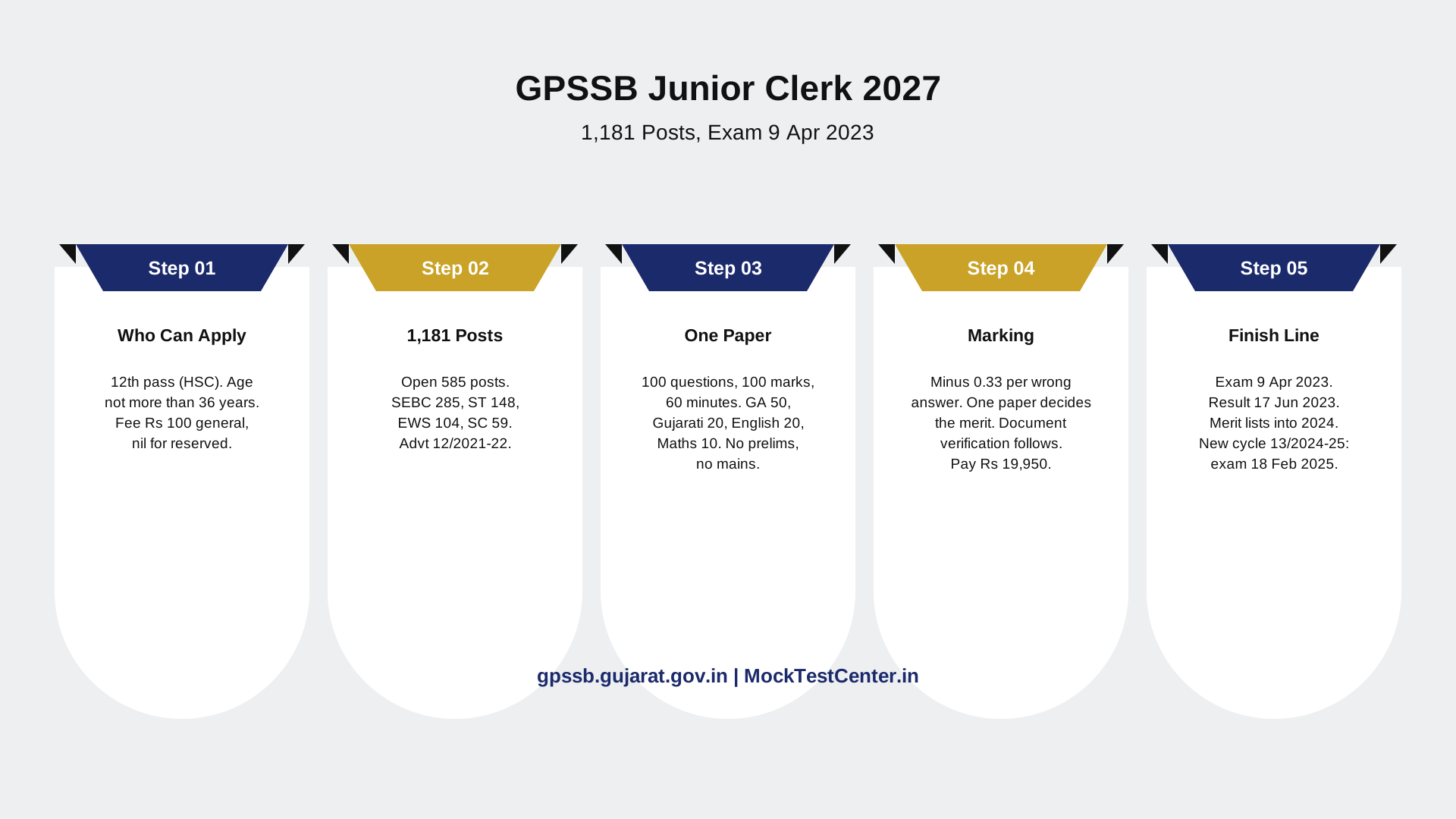
| Posts in live cycle | 1,181, split as OC 585, EWS 104, SEBC 285, SC 59, ST 148 |
| Applications | 18 February to 8 March 2022, closed, through ojas.gujarat.gov.in |
| Fee | Rs 100 for general candidates, no fee for SC, ST, SEBC, PH and ex servicemen, as reported by Testbook |
| Written exam | 9 April 2023, 100 questions, 100 marks, 60 minutes, minus 0.33 per wrong answer |
| Exam first set | 29 January 2023, postponed, moved to 9 April 2023 |
| Result | 17 June 2023 |
| Merit lists | Second additional provisional merit list reported 9 February 2024, with a conflicting report of 21 October 2023 |
| Selection | Written examination, then document verification, with an interview reported by some tracker sites |
| Education | Higher Secondary School Certificate, 12th pass, with Maths or Accounts for the Accounts stream |
| Age limit | Not more than 36 years, with relaxation for reserved categories |
| Pay | Rs 19,950 per month fixed for the first five years |
| 2027 notification | Not published as of 22 November 2026; newer cycles 13/2024-25 and 13/2025-26 are running |
The 1,181 posts, and who they were for
The 2022 notification opened with 1,181 Junior Clerk (Admin and Accounts) Class 3 posts, and Testbook publishes a category wise break up that adds to 1,181 exactly, so this guide uses that table. Open category carries 585 posts, just under half the total. SEBC carries 285 posts. ST carries 148 posts. EWS carries 104 posts. SC carries 59 posts. Those five numbers add to 1,181, and the addition is worth checking because it is the only way to tell whether a category table is complete.
The posts sit in the panchayat service, which means the posting is in a district panchayat or a taluka panchayat office somewhere in Gujarat, not in a secretariat department in Gandhinagar. The work is administration and accounts for the panchayat bodies that run village level government. A Junior Clerk in the Admin stream handles files, correspondence and office administration. A Junior Clerk in the Accounts stream handles the accounts work of the panchayat office, and the notification asks Accounts stream candidates to have passed 12th standard with Mathematics or Accounts as one of the subjects. That single condition is easy to miss and expensive to get wrong, because the board checks it at document verification, after the examination, when a failure costs the whole cycle.
The scale of the competition is large for a 12th pass examination. The board received applications in February and March 2022 and then took more than a year to hold the examination, which first stood scheduled for 29 January 2023 and then moved to 9 April 2023. The result came on 17 June 2023, and provisional merit lists continued into 2024, with a second additional provisional merit list reported on 9 February 2024 by one Testbook page and on 21 October 2023 by another. Both dates come from the same tracker, so this guide records both and flags the conflict. The cycle took about two years from notification to the last merit list, which is the honest length of a GPSSB cycle, and preparation has to survive that whole stretch.
GPSSB Junior Clerk is not GSSSB Clerk
The two clerk examinations of Gujarat share a word and little else, and candidates confuse them every year. This page is about the GPSSB Junior Clerk, run by the Gujarat Panchayat Service Selection Board for panchayat offices. The other examination is the GSSSB Clerk, run by the Gujarat Subordinate Service Selection Board for state government departments, and it has its own page on this site. The boards are different, the posts are different, the qualifications are different, and the papers are different. A candidate who prepares for one and sits the other will sit the wrong examination.
| Detail | GPSSB Junior Clerk | GSSSB Clerk |
|---|---|---|
| Board | Gujarat Panchayat Service Selection Board | Gujarat Subordinate Service Selection Board |
| Posting | District and taluka panchayat offices | State secretariat, directorates, collector offices |
| Live cycle | Advt 12/2021-22, 1,181 posts | Advt 212/202324, 4,304 posts |
| Education in live cycle | 12th pass (HSC) | Bachelor degree |
| Age in live cycle | Not more than 36 years | 20 to 35 years |
| Exam stages | Single written paper, then verification | Prelims, then mains, then verification |
| Written paper | 100 marks, 60 minutes, minus 0.33 | Prelims 100 marks, mains 200 or 350 marks |
| Pay, first five years | Rs 19,950 a month | Rs 26,000 a month |
| Fee in live cycle | Rs 100 general, nil for reserved | Rs 500 general, Rs 400 reserved |
The qualification gap is the sharpest difference. GPSSB asked for 12th pass in the 2022 cycle, while GSSSB asked for a bachelor degree in the 212 cycle. That gap has narrowed since, because the 2025 PwBD cycle of GPSSB Junior Clerk asks for a bachelor degree, and this guide covers that change in the cycles section below. But the anchor cycle for this page, the 2022 cycle, is a 12th pass examination, and the paper is set at that level. General Mathematics carries only 10 marks here, against 30 marks of quantitative aptitude in the GSSSB prelims, and that tells a candidate what the board expects from a 12th pass applicant.
The pay gap follows the qualification gap. GPSSB pays Rs 19,950 a month fixed for the first five years, while GSSSB pays Rs 26,000 a month fixed for the same period. The posting gap matters too. A GPSSB Junior Clerk works in the panchayat system, close to village level administration, while a GSSSB Junior Clerk works in a state department or a collector office. A candidate who wants a district level posting in the panchayat system should apply to GPSSB. A candidate who wants a secretariat posting should apply to GSSSB. Both are Class 3 government posts in Gujarat, and both are worth applying for, but they are not interchangeable.
The fee gap is worth noting because it catches candidates out. GPSSB charged Rs 100 for general candidates in the 2022 cycle, with no fee for SC, ST, SEBC, PH and ex servicemen candidates. GSSSB charged Rs 500 for general candidates in the 212 cycle. A candidate who pays the wrong fee on the wrong portal has paid for the wrong examination, and the OJAS portal lists both boards side by side, so the advertisement number should be checked before any payment is made.
Three cycles, and two advertisements both numbered 13
Most pages about this examination print one table of dates and leave the reader to guess which cycle it belongs to. That is the gap this guide fills first, because three GPSSB Junior Clerk cycles now overlap and two of them share the advertisement number 13. The 12/2021-22 cycle is the completed general cycle, and it is the anchor for every figure in the tables above. The 13/2024-25 cycle is the newer general cycle, with its examination already held in February 2025. The 13/2025-26 cycle is a special recruitment drive for persons with benchmark disabilities, with 102 posts and a bachelor degree requirement. A candidate who takes the 2022 post count and the 2025 exam date and the PwBD qualification and builds one plan from all three will prepare from a mixture that matches no real examination.
The 12/2021-22 cycle is the one this guide describes in full. The board published the notification on 17 February 2022, although one tracker reports the announcement on 12 February 2022, and applications ran from 18 February to 8 March 2022, with fee payment to 10 March 2022. The written examination first stood scheduled for 29 January 2023 and then moved to 9 April 2023. The admit card came out on 31 March 2023 at 1 pm according to the Testbook admit card page, which also says it could be downloaded till 9 April 2023, while a dates table on another Testbook page gives 17 January 2023 as the admit card date. Both dates come from the same tracker, so this guide records both and flags the conflict. The result came on 17 June 2023, and provisional merit lists followed into 2024.
The 13/2024-25 cycle is the newer general cycle for Junior Clerk (Vahivat and Hisab), which is the Admin and Accounts stream under its Gujarati name. The board held its computer based recruitment test on 18 February 2025, with the Junior Clerk paper in the afternoon shift from 2 pm to 3 pm, sharing the day with the Talati cum Mantri paper in the morning shift from 10 am to 11 am. Call letters could be downloaded from 1 February 2025 at 8 pm. The number of posts in this cycle was not verified from the sources retrieved for this guide, so this guide states no post count for it rather than repeating a number it cannot support. The examination mode changed in this cycle, from the pen and paper pattern of 2022 to a computer based test, and that change matters for preparation, because a computer based paper needs practice on screen rather than on paper.
The 13/2025-26 cycle is a special recruitment drive for persons with benchmark disabilities, and it is the easiest of the three to confuse with the general cycles. It carries 102 Junior Clerk (Admin and Accounts) posts as part of a wider 1,251 post PwBD drive that also covers Staff Nurse, Female Health Worker, Village Panchayat Secretary and other posts. The board published the notification on 25 March 2025, although one tracker reports the notification on 4 April 2025 and another on 2 April 2025, and applications ran from 15 April to 15 May 2025. The GPSSB examination calendar for 2025-26 lists the examination for November 2025 and the result for December 2025, but those are tentative calendar entries, and this guide could not verify from the sources retrieved whether the examination was held on that schedule.
The PwBD cycle changed the qualification. It asks for a bachelor degree from a recognised university, where the 2022 cycle asked for 12th pass, and it pays Rs 26,000 a month, where the 2022 cycle paid Rs 19,950. A candidate who reads the PwBD notification and assumes the next general cycle will also ask for a degree is guessing. The board has not published a general cycle with a degree requirement, and the qualification for the next general cycle will be whatever its own notification says. The same caution applies to the examination calendar, which lists a future Junior Clerk (Admin and Accounts) advertisement with notification in November 2025, examination in May 2026 and result in June 2026. That is a tentative calendar entry, not a notification, and this guide records it as tentative only.
The GPSSB Junior Clerk exam pattern is one paper
The GPSSB Junior Clerk exam pattern has a single written paper, and that simplicity is the first thing a candidate should understand. There is no prelims and mains split. One paper of 100 multiple choice questions carries 100 marks in 60 minutes, which allows 36 seconds per question on average. Each correct answer earns 1 mark. Each wrong answer loses 0.33 marks. The paper is the merit test, which means the score in this one hour decides the rank, and document verification follows it.
| Subject | Marks | Medium |
|---|---|---|
| General Awareness and General Knowledge | 50 | Gujarati |
| Gujarati Language and Grammar | 20 | Gujarati |
| English Language and Grammar | 20 | English |
| General Mathematics | 10 | Gujarati |
| Total | 100 | 60 minutes |
General Awareness carries half the paper, so it decides the result more than any other section. A candidate who scores 40 out of 50 in General Awareness and average marks elsewhere will finish ahead of a candidate who scores 25 in General Awareness and full marks in the language sections. The arithmetic is plain. Fifty marks in one section outweigh 20 marks in each of the two language sections, and preparation time should follow the same split, with the largest share going to General Awareness, and the language sections kept warm with daily practice rather than treated as the main event.
The negative marking shapes how the paper should be attempted. Three wrong answers cancel one correct answer, because 0.33 times three is 0.99, so blind guessing across the paper loses marks steadily. Informed guessing, where two options can be ruled out, is a different matter and usually pays over a full paper. The practical habit is to answer the questions that are certain first, mark the ones where two options survive, and return to those only after the certain ones are done. A candidate who spends three minutes on one hard question has already spent the time of five other questions, and the paper does not reward that trade.
One tracker claim about the marking needs a warning. A Testbook admit card page states that 0.33 marks will be deducted for blank responses, and the same deduction for one or more marked responses. Deducting marks for a blank answer would be unusual, and no other source retrieved for this guide supports it. The standard reading, which the Testbook syllabus page also gives, is that 0.33 marks are deducted for each wrong answer. This guide uses the standard reading and records the blank answer claim as an unverified tracker statement.
The selection process after the paper is where the sources disagree. Testbook states that selection runs through a written test followed by an interview, and its syllabus page repeats that the selection process comprises a written test and an interview. Other tracker pages state that selection runs through a written examination and document verification, with a final merit list, and the 2025 computer based test pages describe the same two steps, test then verification, with no interview. The 2022 notification itself was not read directly for this guide, so the conflict cannot be settled here. This guide presents the written examination as the decisive stage, which every source agrees on, and records the interview as a tracker report that other trackers contradict.
General Awareness carries half the paper
General Awareness and General Knowledge carry 50 marks, and the syllabus the board published is wide rather than deep. General mental ability and general intelligence open the list, which means reasoning questions sit inside the General Awareness section as well as in the mathematics section. History of India and history of Gujarat follow, with the cultural heritage of India and Gujarat beside them. Geography of India and geography of Gujarat come next, with current affairs of regional, national and international importance closing the list. Daily news, countries and capitals, states and capitals, culture, economic scene, art and culture, scientific research, sports, currencies, famous personalities, the Indian Constitution and sports and games all appear in the tracker reproductions of the syllabus.
Gujarat specific material is the part of this section where a well prepared candidate pulls away from the rest, because national level material is common to every state examination and every serious candidate covers it. The history of Gujarat, its cultural heritage, its geography and its current affairs are the questions that separate a candidate who reads Gujarat newspapers from one who reads only national material. The Mahagujarat movement, the formation of the state, its districts and rivers, its folk culture and its administrative history all belong in the preparation, and they should be read from Gujarat sources rather than from a national general knowledge book that gives the state a single chapter.
The section is set in Gujarati, which matters for candidates who studied in English medium. A candidate who knows the facts in English but reads Gujarati slowly will lose time on the largest section of the paper, and time is the scarcest resource in a 60 minute examination. Reading Gujarati newspapers daily does two jobs at once. It builds the current affairs knowledge the section tests, and it builds the reading speed the medium demands. A candidate who reads only English material and then sits a Gujarati medium paper has prepared for a different examination.
Gujarati, English and Mathematics share the other half
Gujarati Language and Grammar carry 20 marks, and the section tests the language a candidate will use every day in a panchayat office. Translation of sentences, fill in the blanks, antonyms, synonyms, grammar and error detection, comprehension passages and vocabulary fill the section. The questions are set in Gujarati, and the standard is that of the 12th standard examination. A candidate who speaks Gujarati at home but never studied its grammar formally will find the error detection and synonym questions harder than expected, because spoken Gujarati and examination Gujarati follow different rules.
English Language and Grammar carry 20 marks, and the section tests reading and grammar at the same level. Unseen passages, meanings, antonyms, grammar, sentence rearrangement, sentence corrections, articles, phrase replacement, error spotting, para jumbles, reading comprehension, word formation, cloze tests, subject verb agreement, idioms and phrases, and fill in the blanks fill the section. The questions are set in English, and the passages reward a candidate who reads English regularly. A candidate who memorises grammar rules but never reads an English passage will struggle with the comprehension questions, which carry the largest share of the section.
General Mathematics carries 10 marks, the smallest section, and the syllabus covers the mathematics of the 12th standard level with a reasoning flavour. The tracker reproductions list general mathematics alongside reasoning, and the questions test arithmetic and basic quantitative skill rather than advanced mathematics. Ten marks cannot decide the paper on their own, but they can decide a rank, because the merit list is drawn from a single paper of 100 marks and a difference of two or three marks can move a candidate past hundreds of others. A candidate should not ignore the section, but should not spend a month on it either. A week of steady practice on arithmetic and reasoning questions is enough to secure most of the 10 marks.
The balance across the four sections tells a candidate how to split the preparation week. Half the time goes to General Awareness, because it carries half the marks. A quarter of the time goes to the two language sections together, because they carry 40 marks between them. The remaining time goes to mathematics and to timed practice of full papers. A candidate who spends equal time on every section is spending too much time on the 10 mark mathematics section and too little on the 50 mark General Awareness section.
Who can apply, and what the board asks for
The eligibility conditions for the 2022 cycle are simple, and that simplicity is part of why the examination draws so many candidates. The candidate shall have passed the Higher Secondary School Certificate examination from the Secondary or Higher Secondary Education Board, or an equivalent qualification recognised by the government. For the Accounts stream, the candidate shall have passed 12th standard with Mathematics or Accounts as one of the subjects. Basic knowledge of computer applications is required, and knowledge of Hindi and Gujarati is also required. The age limit is that the candidate shall not be more than 36 years, with relaxation as per government rules for reserved categories. One tracker reports the minimum age as 18 years, and the age calculated as on 1 January 2022, while another reports the age calculated on 8 March 2022, the last date of application. Both calculation dates come from tracker pages, so this guide records both and flags the conflict.
The application runs online through the OJAS portal at ojas.gujarat.gov.in, and the steps are the same across the GPSSB cycles. The candidate registers on OJAS, selects the GPSSB advertisement, fills personal details, uploads a photograph and signature, pays the fee online, and submits. Once the application is confirmed on OJAS, no change of any kind is possible, by the candidate or by the board, so the details should be checked before the final submit rather than after it. The fee in the 2022 cycle was Rs 100 for general candidates, with no fee for SC, ST, SEBC, PH and ex servicemen candidates. One tracker page reports a different fee table, with Rs 100 for every category including SC and ST, and this guide uses the Testbook table, which exempts the reserved categories, and records the other table as a conflicting tracker report.
Pay is fixed for the first five years, which is the Gujarat pattern for Class 3 posts. Junior Clerk carries Rs 19,950 a month in the 2022 cycle. The regular pay scale applies after the first five years. A candidate who compares this pay with the GSSSB Clerk pay of Rs 26,000 a month should remember that the GPSSB post asks for 12th pass while the GSSSB post asks for a degree, and the pay follows the qualification. The 2025 PwBD cycle pays Rs 26,000 a month, which matches its degree requirement, and that pairing of pay with qualification is the pattern to watch when a new notification comes out.
How the pattern rewards preparation
The pattern rewards a candidate who reads Gujarat news daily, knows the state well, writes Gujarati and English correctly, and works fast. That is a wide set of skills for a 100 mark paper, and the preparation plan should follow the marks rather than the subjects a candidate likes. General Awareness carries 50 marks, so it deserves half the preparation time. The two language sections carry 40 marks between them, so they deserve a steady daily slot rather than a final week of revision. Mathematics carries 10 marks, so it deserves a short daily slot and no more.
Speed is the skill the paper tests hardest, because 100 questions in 60 minutes allows 36 seconds per question on average. A candidate who knows the answers but reads slowly will leave questions unattempted, and unattempted questions score nothing. The fastest improvement most candidates can make is to practise full papers against a timer until 36 seconds per question feels normal. Mock tests help most when they copy the real conditions. A 100 mark paper should be practised as a 60 minute paper, not as an untimed set of questions. The habit that pays off fastest is the habit of marking an answer and moving on, then returning only if time remains. The second habit is to keep a record of which questions were guessed and which were known, because the score on guessed questions tells a candidate whether guessing is helping or hurting.
Current affairs need a Gujarat focus and a daily routine. The General Awareness section gives weight to current affairs of regional, national and international importance, and the regional part is where a candidate who reads Gujarat newspapers pulls away from one who reads only national material. The state budget, state schemes, district news, panchayat news and the work of the district panchayats themselves all belong in the preparation, and they should be read from Gujarat newspapers rather than from a monthly magazine that covers the state in a page. A notebook of Gujarat facts, updated weekly, is worth more than a thick general knowledge book read once.
One more practical point comes from the calendar. The 2022 cycle took about two years from notification to the last merit list, and the examination itself moved once, from 29 January 2023 to 9 April 2023. Preparation has to survive gaps of months with no news from the board, and then a sudden call letter with a few weeks to the examination. The candidates who clear are usually the ones who kept a steady routine through the quiet months, rather than the ones who studied hard for a month, stopped, and tried to restart when the call letter arrived. The 2025 cycle shows the same pattern in a shorter form, with the call letter coming a little over two weeks before the examination on 18 February 2025.
What to check before you apply
The official sites are gpssb.gujarat.gov.in for notifications and results and ojas.gujarat.gov.in for applications. Everything else is a tracker, and tracker pages are useful for reading the pattern but should never be the source for a date or a fee. The board publishes its notices as PDFs on its own site, and the advertisement number is the key to every search. For this examination the numbers to know are 12/2021-22 for the completed general cycle, 13/2024-25 for the newer general cycle, and 13/2025-26 for the PwBD special drive. A notice that carries none of these numbers belongs to a different recruitment, and a notice that carries the number 13 needs its year checked, because two different cycles share it.
Three checks should be done before the application is submitted. First, the stream, Admin or Accounts, because the Accounts stream asks for Mathematics or Accounts in 12th standard and the board checks it at document verification. Second, the age on the date the advertisement specifies, because the board calculates age on that date and no other, and the tracker pages disagree on whether the 2022 date was 1 January 2022 or 8 March 2022. Third, the qualification, because the 2022 cycle asked for 12th pass and the 2025 PwBD cycle asked for a degree, and the next general cycle will ask for whatever its own notification says.
After the examination, the checks continue. The provisional answer key comes first, with a window for objections, and the final answer key follows it. The result comes as a list, and provisional merit lists follow it, sometimes more than one, as the 2022 cycle showed with its second additional provisional merit list. Document verification follows the merit list, and the board publishes the schedule on its own site. Each of these steps has its own notice, and missing one of them costs the same as failing the paper.
Candidates should also know that the board moved the 2022 examination once, from 29 January 2023 to 9 April 2023, and that the admit card dates reported by tracker pages disagree. A candidate who plans travel or leave around a tracker date rather than the board notice risks missing the examination. The call letter is the document that matters, and it is downloaded from the OJAS portal, not from a tracker site.
Where this page stands
This page carries the year 2027 because the cycles it tracks conclude in 2027, with the PwBD cycle examination set for November 2025 and its result for December 2025 under the tentative calendar, and the next general cycle listed for 2026 under the same calendar. No separate 2027 notification has been published as of 22 November 2026. The figures in this guide belong to the cycles named beside them, and a new notification will change the post count, the dates and possibly the qualification. When it comes, the board will publish it on gpssb.gujarat.gov.in, and this page will need to be read again from the new advertisement number. Until then, the 2022 cycle is the best record of how this examination actually runs, the 13/2024-25 cycle is the best record of where it stands now, and the 13/2025-26 cycle is the warning that the qualification can change between cycles. A candidate who prepares from the 2022 pattern, watches the board site for the next general notification, and checks the advertisement number before applying has the full picture in one place, which is what this guide was built to give.
Sources
Testbook, GPSSB Junior Clerk Syllabus and Exam Pattern 2022: written examination 100 objective questions for 100 marks in 60 minutes, General Awareness and General Knowledge 50, Gujarati Language and Grammar 20, English Language and Grammar 20, General Mathematics 10, negative marking 0.33 per wrong answer, selection through written test and interview.
Testbook, GPSSB Junior Clerk Recruitment 2023: Advertisement Number 12/2021-22, 1,181 vacancies, category break up OC 585, EWS 104, SEBC 285, SC 59, ST 148, applications 18 February to 8 March 2022, written examination 9 April 2023, result 17 June 2023, second additional provisional merit list 9 February 2024, fee Rs 100 general with no fee for ST, SC, SEBC, PH and ex servicemen, age not more than 36 years, Higher Secondary School Certificate, salary Rs 19,950 fixed for five years.
Testbook, GPSSB Junior Clerk Admit Card 2023: admit card released 31 March 2023 at 1 pm, downloadable till 9 April 2023, written examination 9 April 2023, negative marking 0.33 per wrong answer, 0.33 deducted for blank responses as stated on that page, recorded here as an unverified tracker statement.
TrickGujarati, GPSSB Junior Clerk Class 3 Recruitment 2022: Advertisement Number 12/2021-22, 1,181 Junior Clerk (Admin and Accounts) Class 3 posts, applications 18 February to 8 March 2022, salary Rs 19,950 fixed for five years, selection through written examination and document verification, syllabus table with General Awareness 50, Gujarati 20, English 20, Mathematics 10, duration 60 minutes.
Jobschat, GPSSB Junior Clerk Recruitment 2022: notification 12 February 2022, applications 18 February to 8 March 2022, minimum age 18 years, maximum age 36 years, age calculated as on 1 January 2022, HSC or equivalent, Accounts Clerk needs 12th standard with Mathematics or Accounts, basic computer knowledge, fee Rs 100 general, nil for reserved categories.
Universal Gujarat, GPSSB Recruitment Junior Clerk 1181 Post: applications 18 February to 8 March 2022, Higher Secondary School Certificate, age not more than 36 years, age calculated on 8 March 2022, salary Rs 19,950 fixed for five years, fee Rs 100 unreserved, nil for SEBC, EWS, ST, SC and PwD.
Notopedia, GPSSB Junior Clerk and Account Clerk 2022: applications 18 February 2022 at 1 pm to 8 March 2022 at 11.59 pm, fee payment to 10 March 2022, examination first set 29 January 2023 and postponed, new examination date 9 April 2023, provisional answer key released.
MaruGujarat, GPSSB Talati cum Mantri and Junior Clerk CBRT Exam Date 2025: Advertisement Numbers 17/2024-25 and 13/2024-25, computer based recruitment test 18 February 2025, Junior Clerk afternoon shift 2 pm to 3 pm, call letter download from 1 February 2025 at 8 pm, selection through computer based test and document verification.
SabhiNaukri and GovNokri, GPSSB Jobs Notification 2025: Advertisement Number 13/2025-26, 102 Junior Clerk (Admin and Accounts) posts, bachelor degree, salary Rs 26,000 a month, notification 25 March 2025, applications 15 April to 15 May 2025.
ExamGuru and Government Daily Jobs, GPSSB Recruitment 2025: 1,251 vacancies across posts including Junior Clerk, notification 4 April 2025, applications 15 April to 15 May 2025, Junior Clerk (Admin and Accounts) 102 posts, special recruitment drive for persons with benchmark disabilities.
MaruGujarat, GPSSB Exam Calendar 2025-26: Advertisement Number 13/2025-26, Junior Clerk (Admin and Accounts) PwBD, 102 posts, notification 25 March 2025, examination November 2025 tentative, result December 2025 tentative, future Junior Clerk advertisement with notification November 2025, examination May 2026, result June 2026, all tentative.
GovtJobGuru, GPSSB Clerk Recruitment 2022: Advertisement Number 12/2021-22, 1,181 Junior Clerk and Accounts Clerk posts, Higher Secondary, age 36 years, last date 8 March 2022.