
About GPSC Class 1-2 2027 Exam Series
📖 Table of Contents
- GPSC Class 1-2 2027 at a glance
- The 244 posts, and why two totals circulate
- The prelims paper, and the 17 cancelled questions
- The mains papers, old pattern and new pattern side by side
- The interview, and how the final list is made
- Who can apply, what it costs, and the age rule
- The 2026-27 cycle is already running, and it changes the maths
- A preparation plan that fits the numbers
- The mistakes that cost candidates a year
- Sources
GPSC Class 1-2 2027: Complete Exam Guide
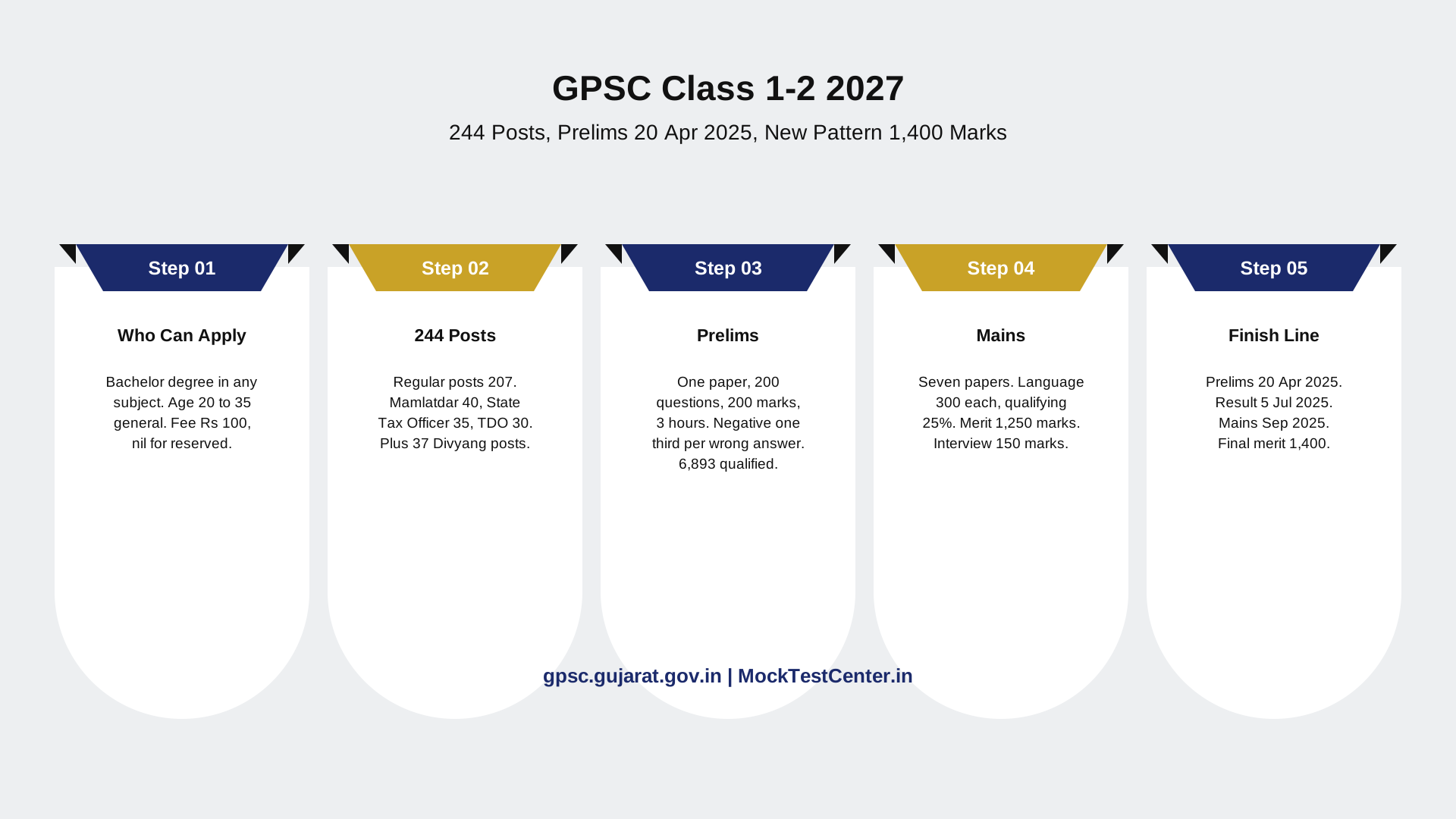
The GPSC Class 1-2 2027 page on this site follows the live cycle of the Gujarat Administrative Service and Gujarat Civil Services examination, and the live cycle is the 2025 examination. The Gujarat Public Service Commission, known as GPSC, published the notification for 244 posts on 7 March 2025 under Advertisement Number 240/2024-25. Applications ran from 7 March to 23 March 2025. The Preliminary Examination was held on 20 April 2025, and 6,893 candidates qualified for the mains. No separate 2027 notification has been published as of 22 November 2026, so this guide anchors on the 2025 cycle and says so wherever a 2027 figure would otherwise be guessed.
That anchoring matters because GPSC runs its examinations on a calendar that slips across years, and because the examination pattern itself changed in March 2025. The cycle called 2025 began in March 2025 and its mains was scheduled for September 2025. A newer cycle, the 2026-27 cycle under Advertisement Number 05/2026-27, is already under way, with its prelims result out in July 2026. A candidate who mixes the two cycles will prepare from the wrong post count and the wrong pattern. This guide keeps the 2025 cycle as the anchor, uses the 2026-27 cycle as a running update, and labels each figure with the cycle it belongs to.
The examination has three stages. An objective prelims screens candidates. A descriptive mains decides most of the merit. An interview closes the selection. Under the new rules announced in March 2025, final merit comes from mains merit marks of 1,250 plus interview marks of 150, a total of 1,400 marks. Prelims marks count for nothing beyond the shortlist. That single fact shapes every sensible preparation plan, and this guide returns to it more than once.
GPSC Class 1-2 2027 at a glance
| Detail | GPSC Class 1-2 2027, as run in the 2025 cycle |
|---|---|
| Conducting body | Gujarat Public Service Commission (GPSC), Gandhinagar |
| Exam | Gujarat Administrative Service Class 1, Gujarat Civil Services Class 1 and 2, Gujarat Municipal Chief Officer Service Class 2, combined competitive examination, commonly called GPSC Class 1-2 |
| Live cycle | 2025, notification dated 7 March 2025, Advertisement Number 240/2024-25 |
| Posts in live cycle | 244 in all, 207 regular posts plus 37 posts under special recruitment for Divyang candidates |
| Applications | 7 March to 23 March 2025, closed |
| Fee | Rs 100 for general and OBC candidates, nil for SC, ST and female candidates |
| Prelims | 20 April 2025, 12 noon to 3 pm, one General Studies paper, 200 marks |
| Prelims result | 5 July 2025, 6,893 candidates qualified for mains |
| Mains | Scheduled 20, 21, 27 and 28 September 2025 under the notification, see the mains date note in this guide |
| Interview | 150 marks under the new pattern, up from 100 marks under the old pattern |
| Final merit | Mains merit 1,250 plus interview 150, total 1,400 marks under the new pattern |
| Education | Bachelor degree from a recognised university, with post wise conditions for some posts |
| Age limit | 20 to 35 years for general category, relaxation for reserved categories and women |
| 2027 notification | Not published as of 22 November 2026 |
The 244 posts, and why two totals circulate
The notification of 7 March 2025 opened with 244 posts, and two smaller totals circulate beside it, 207 and 102, so the arithmetic needs a plain statement. The post wise list published by Testbook from the notification adds to 207. The category wise split in the same report adds to 207 as well, with 90 general, 16 Scheduled Caste, 23 Scheduled Tribe, 55 SEBC and 23 EWS posts, and 68 of the 207 reserved for women. The remaining 37 posts are a special recruitment for Divyang candidates, and 207 plus 37 gives the notified 244. A candidate who sees only the 207 figure is looking at the regular posts. A candidate who sees only the 244 figure is looking at the full advertised total.
The 102 figure belongs to a different examination and should not be mixed into this one. Several coaching pages report 102 vacancies for GPSC Class 1-2 in 2025, but that figure matches the Deputy Section Officer recruitment of the same year, Advertisement Number 08/2025-26, which also carries 102 posts. The Class 1-2 notification is Advertisement Number 240/2024-25 with 244 posts. The two examinations share a year and a commission, and tracker pages that list both in one table invite the mix up. This guide uses 244 for Class 1-2 and keeps the DySO figure on its own page.
| Post | Posts |
|---|---|
| Gujarat Administrative Service, Junior Scale, Class 1 | 5 |
| Deputy Superintendent of Police, Class 1 | 10 |
| District Registrar, Cooperative Societies, Class 1 | 7 |
| Deputy Director, Developing Castes, Class 1 | 1 |
| Assistant Commissioner, Tribal Development, Class 1 | 4 |
| Assistant Commissioner of State Tax, Class 1 | 12 |
| Section Officer, Sachivalay, Class 2 | 26 |
| Mamlatdar, Class 2 | 40 |
| State Tax Officer, Class 2 | 35 |
| Assistant Director, Food and Civil Supply, Class 2 | 12 |
| Taluka Development Officer, Class 2 | 30 |
| Inspector of Registration, Class 2 | 13 |
| Assistant Director of Information, Administrative, Class 2 | 12 |
| Regular posts, total | 207 |
| Special recruitment for Divyang candidates | 37 |
| Notified total | 244 |
The posts themselves cover the senior administration of Gujarat. Deputy Collector in the Gujarat Administrative Service, Deputy Superintendent of Police, District Registrar of Cooperative Societies, Superintendent of Prohibition and Excise, Assistant Commissioner of State Tax, Mamlatdar, Taluka Development Officer, State Tax Officer, Section Officer in the Secretariat at Gandhinagar, Chief Officer in municipalities and District Inspector of Land Records sit across the Class 1 and Class 2 lists. A candidate fills service preferences after the mains result, and the rank in the final list decides which preference is granted. The Mamlatdar post carries the largest single block at 40, followed by State Tax Officer at 35 and Taluka Development Officer at 30. Those three Class 2 posts together carry 105 of the 207 regular posts, just over half the regular total.
Pay follows the Gujarat pay matrix. Class 1 posts sit at Pay Matrix Level 10, Rs 56,100 to Rs 1,77,500. Class 2 posts sit at Pay Matrix Level 8, Rs 44,900 to Rs 1,42,400. Those are the figures reported by Testbook and Avision for the 2025 cycle. Allowances sit on top of the basic pay under Gujarat government rules, and the exact in hand figure depends on the posting and the allowance rates in force at the time of joining. A candidate should treat the pay matrix level as the fixed fact and the in hand figure quoted on coaching pages as an estimate.
The prelims paper, and the 17 cancelled questions
The GPSC Class 1-2 exam pattern starts with a single objective paper, and that single paper design is the first thing that separates this examination from UPSC and from MPSC. The prelims is one General Studies paper of 200 marks, held in one sitting of 3 hours, from 12 noon to 3 pm on 20 April 2025 in the live cycle. The paper covers History, Cultural Heritage, Constitution, Polity, Social Justice and International Relations in one half, and Indian Economy and Planning, Geography, Science and Technology and Current Events of regional, national and international importance in the other half, with general mental ability woven through it. The standard is graduation level. The medium is Gujarati and English.
The marking rule in the notification is negative marking of one third of a mark for each wrong answer. The actual evaluation of the 2025 prelims tells a more detailed story, and it is worth reading because it changed the value of every question. The Commission cancelled 17 questions in the final answer key, then spread the marks of the cancelled questions across the remaining 183 questions on a pro rata basis. Each correct answer carried 1.093 marks. Each wrong answer, each multiple encoded answer and each blank answer cost 0.328 marks. The Free Press Journal report of the result quotes the Commission order in those exact terms. A blank answer costing marks is unusual, and a candidate who left questions blank in this prelims lost marks for them in the same way as a candidate who answered wrongly. That detail is easy to miss and expensive to learn after the result.
The prelims result came out on 5 July 2025, with the cut off list published alongside it. A total of 6,893 candidates qualified for the mains. The cut off for general common, EWS common, SEBC common and SC common all stood at 89.51 marks. The general female cut off stood at 81.42. The Scheduled Tribe common cut off stood at 82.19 and the Scheduled Tribe female cut off at 69.73. Ex servicemen closed at 64.48. The persons with disabilities groups closed far lower, at 20.21 for Group A, 20.54 for Group B, 61.53 for Group C and 23.60 for Group D. Four categories sharing one cut off at 89.51 looks odd until the pro rata scoring is understood. The 17 cancelled questions and the pro rata redistribution compressed the score scale, and the shared cut off follows from that compression rather than from identical performance across categories.
The scale of the competition is large. The Commission shortlists about 15 times the advertised vacancies for the mains under the new rules, and 6,893 qualified candidates against 244 posts is about 28 times the post count, which is far above the 15 times figure. The gap follows from the Divyang special recruitment and from category wise shortlisting, but the plain reading is that the prelims filter was generous in this cycle. A candidate who cleared it by a narrow margin should not read the shortlist as a sign that the mains will be easy. The mains is a different examination with a different skill, and the prelims shortlist says nothing about mains readiness.
Speed matters as much as knowledge in a single paper of 200 questions in 180 minutes. That allows 54 seconds per question on average. A candidate who spends three minutes on a single hard question has already borrowed time from three other questions. The mock test habit that pays off fastest is the habit of marking an answer and moving on, then returning only if time remains. Blind guessing across the whole paper is a losing strategy because of the one third deduction, and in this cycle even a blank answer cost marks, so the usual advice to leave a question blank rather than guess did not hold. Informed guessing, where two options can be eliminated, is a different matter and usually pays.
The mains papers, old pattern and new pattern side by side
The biggest event in the history of this examination arrived in March 2025, three days before the notification. The Gujarat Administration Department changed the rules for Class 1 and Class 2 of the Gujarat Civil Service examinations, and Gujarat Samachar reported the change on 4 March 2025. The old pattern had six written papers and an interview, totalling 900 marks. The new pattern has seven written papers and an interview, totalling 1,400 marks. The change is large enough that a candidate who prepares from pre 2025 mains papers will prepare for the wrong examination.
| Stage | Old pattern, before March 2025 | New pattern, from March 2025 |
|---|---|---|
| Prelims | One General Studies paper, 200 marks, screening only | One objective paper, 200 marks, screening only, about 15 times the vacancies called for mains |
| Mains Paper I | Gujarati language, 100 marks | Gujarati language, 300 marks, qualifying only, 25 percent needed |
| Mains Paper II | English language, 100 marks | English language, 300 marks, qualifying only, 25 percent needed |
| Mains Paper III | Essay, 150 marks | Essay, 250 marks, counts for merit |
| Mains Paper IV | General Studies I, 150 marks | General Studies I, 250 marks, counts for merit |
| Mains Paper V | General Studies II, 150 marks | General Studies II, 250 marks, counts for merit |
| Mains Paper VI | General Studies III, 150 marks | General Studies III, 250 marks, counts for merit |
| Mains Paper VII | None | General Studies IV, Ethics, 250 marks, counts for merit |
| Written total | 800 marks | 1,850 marks, of which 1,250 count for merit |
| Interview | 100 marks | 150 marks |
| Final merit total | 900 marks | 1,400 marks |
The language papers are gatekeepers under the new pattern, and the bar is low but real. A candidate must score at least 25 percent in each, which is 75 marks out of 300. Failing either language paper makes the rest of the mains count for nothing. That rule has ended more than one strong candidacy in state service examinations, because candidates who can write a good General Studies answer sometimes write weak Gujarati or weak English under time pressure. The language papers deserve a weekly slot in the timetable, not a last minute revision. Knowledge of Gujarati is mandatory in practice even though no Gujarati certificate is demanded at the application stage, because the Gujarati paper alone can end a candidacy.
The essay paper carries 250 marks under the new pattern, up from 150, and rewards structure more than vocabulary. General Studies I covers History, Cultural Heritage and Geography. General Studies II covers Indian Polity and Constitution, Public Administration and Governance, and Ethics in Public Service under the old syllabus headings. General Studies III covers Science and Technology, Indian Economy and Planning, and Current Events of regional, national and international importance. General Studies IV is the new paper, covering Ethics, and Gujarat Samachar lists it as the fourth General Studies paper in the new scheme. The four General Studies papers together carry 1,000 marks, which is 80 percent of the merit total, so a candidate who is average in all four papers and strong in none will finish in the middle of the list.
One uncertainty in the record should be stated plainly rather than smoothed over. The mains for the live cycle was scheduled for 20, 21, 27 and 28 September 2025 in the notification as reported by Testbook, while the Gujarat Samachar annual schedule published in the same period lists the mains as 20, 21, 27 and 28 August 2025. The month differs and the days match, so one of the two reports carries a wrong month. This guide uses September because Testbook ties the dates to the notification itself, and flags August as the conflicting schedule report. MaruGujarat reports that GPSC released the mains question papers for Advertisement Number 240/2024-25, which shows the mains was held, but the sources read for this guide do not state which paper count the held mains used, old or new. A candidate preparing for the next cycle should prepare for the new 1,400 mark pattern as the pattern in force, and check gpsc.gujarat.gov.in for the mains syllabus PDF of the cycle they apply under.
The interview, and how the final list is made
The interview is a personality test of 150 marks under the new pattern, up from 100 marks under the old pattern. It tests awareness, judgement, suitability for administrative posts and the ability to hold a view under questioning. Candidates who clear the mains cut off are called for interview in a ratio to the posts set by the Commission. Under the old pattern the ratio was about three times the vacancies. The new rules do not state a fresh ratio in the sources read for this guide, so the ratio for the next cycle should be read from the advertisement itself. There is no fixed syllabus for the interview, which is why candidates who prepare only from books arrive unprepared. The interview panel reads the detailed application form first, so every hobby, every posting preference and every gap in education on that form is a possible opening question.
Final merit equals mains merit marks out of 1,250 plus interview marks out of 150, a total of 1,400. A candidate with 700 in the mains and 100 in the interview finishes at 800 out of 1,400. Posts are then allotted by merit, category and the preferences the candidate stated. Prelims marks play no part in this calculation. The arithmetic has one practical consequence. The interview is 150 marks out of 1,400, about 11 percent of the total, so it can move a candidate up or down by a few dozen ranks but it cannot rescue a weak mains score. The mains is where the list is made, and the interview is where the list is settled.
The earlier cycle shows what the old pattern produced. The final result for Advertisement Number 20/2022-23, based on the combined mains and interview, was declared by GPSC and reported by MaruGujarat. The final result for Advertisement Number 47/2023-24 of the Gujarat Administrative Service Class 1 and 2 was also declared. Those two cycles ran on the old 900 mark pattern. The 2025 cycle is the first cycle notified after the rule change, and it is the bridge between the old pattern and the new one. Candidates who prepare from the 2022-23 or 2023-24 mains papers should use them for subject coverage only, never for paper weight or marks.
Who can apply, what it costs, and the age rule
The education rule is a bachelor degree from a recognised university. Most posts accept a degree in any discipline. Final year students could apply in earlier cycles subject to producing proof of passing before the mains examination, and the 2025 advertisement keeps the same structure of eligibility. The degree rule is the reason this examination draws candidates from engineering, medicine, law, commerce and arts into the same hall. Some posts add conditions beyond a degree, and the advertisement PDF is the only reliable source for those conditions, so a candidate should read the post wise eligibility table in the notification rather than rely on a summary.
The age rule is 20 to 35 years for the general category. The minimum age is 20 years and the maximum is 35 years, counted as on the last date of application. For the 2026-27 cycle the advertisement states the rule as not less than 20 years and not more than 35 years as on 16 April 2026, the last date of that application window, and the 2025 cycle uses the same 20 to 35 frame. Reserved categories get relaxation under Gujarat government rules. The figures reported for these cycles are 40 years for SEBC and OBC candidates, 40 years for Scheduled Caste and Scheduled Tribe candidates, plus 5 years for women, and 45 years for persons with disabilities. One tracker page reports the minimum age as 21 years instead of 20, and that figure conflicts with the advertisement wording quoted for the 2026-27 cycle. This guide uses 20 years because the advertisement wording is the stronger source.
The fee in the 2025 cycle is Rs 100 for general and OBC candidates, and nil for SC, ST and female candidates. The fee is paid online through the GPSC OJAS portal, and the application is filed on gpsc-ojas.gujarat.gov.in after registration. An application filed without the fee is rejected, and the Commission does not reopen the window. The application window for the live cycle ran from 7 March 2025 at 1 pm to 23 March 2025 at 11.59 pm, a window of 17 days. A candidate who waits for the last day risks a server rush and a failed payment, and the Commission has no record of extending this window.
There is no rule that bars candidates from outside Gujarat from applying, but Gujarat domicile decides who gets the state reservations. A candidate from another state can apply and compete, but will be assessed as general category for reservation purposes, and will not get SEBC or EWS benefit. Knowledge of Gujarati is required in practice. The examination itself is bilingual, Gujarati and English, and the mains Paper I tests Gujarati for 300 marks as a qualifying paper. A candidate who cannot write Gujarati at all will struggle with Paper I, which is a practical barrier even though no Gujarati certificate is demanded at the application stage.
The 2026-27 cycle is already running, and it changes the maths
The 2026-27 cycle began while the 2025 cycle was still in its mains stage. GPSC published Advertisement Number 05/2026-27, with applications from 2 April to 16 April 2026. The prelims result was reported on 30 July 2026, with 6,099 candidates qualifying for the main written examination according to MaruGujarat. The mains for this cycle was reported as to be notified, with one tracker page noting a High Court case holding the mains. As of the sources available for this guide, no mains date and no final result for the 2026-27 cycle has been published.
The post count for the 2026-27 cycle is the one figure in this guide that could not be settled. One tracker page that quotes the advertisement PDF directly reports 71 posts of Gujarat Administrative Service Class 1 in Advertisement Number 05/2026-27. Another tracker page reports 213 posts across Gujarat Administrative Service Class 1 and Class 2 posts in the same advertisement number. The two figures may describe different scopes, one the GAS Class 1 stream only and the other the full combined list, but the sources read for this guide do not state that plainly. This guide records both figures as a conflict and does not use either as the anchor total. The anchor total stays 244 from the 2025 cycle.
Two lessons sit in that short history. The first is that the post count in a GPSC cycle is never final at notification in the sense that a later advertisement can carry a very different total for a different set of posts. The 2025 cycle carried 244 posts across three services. The 2026-27 advertisement, on the figures available, carries a smaller list centred on the Gujarat Administrative Service. The second lesson is that dates move and courts intervene. The 2025 mains dates already carry a month long conflict between two reports, and the 2026-27 mains is held up. A preparation plan that depends on a fixed date will break, and a plan that depends on a fixed post count will mislead. The plan should depend on the syllabus and on daily answer writing, because those two things do not move.
One more claim in circulation needs a direct answer because it looks official and is not verified. A low quality tracker page reports a GPSC Class 1 and 2 recruitment for 293 vacancies with applications till 8 September 2025 and a prelims on 3 December 2025. That claim conflicts with the verified 2025 cycle, which closed applications on 23 March 2025 and held its prelims on 20 April 2025, and no advertisement number is given for the 293 figure. This guide does not use the 293 figure anywhere. Candidates should treat any post count without an advertisement number as unverified.
A preparation plan that fits the numbers
The plan starts from the marks. The prelims carries 200 marks and decides nothing beyond the shortlist. The mains carries 1,250 merit marks and decides almost everything. The interview carries 150 marks and settles the order. A candidate who spends 70 percent of the year on prelims and 30 percent on mains has the ratio backwards. The working split that fits the numbers is about 40 percent of study time on prelims material in the first months, moving to 80 percent on mains writing once the prelims syllabus is covered. The prelims material and the mains material overlap heavily in General Studies, so the split is about the form of practice, not the subject. Prelims practice is multiple choice questions under time. Mains practice is written answers under time.
Answer writing should start early and stay small. One answer a day, 150 words, in 11 minutes, is enough in the first month. The point is the habit, not the volume. By the third month the candidate should be writing two answers a day and one essay a fortnight. By the sixth month the candidate should be writing a full three hour paper every week, with the language papers getting a weekly slot of their own. The 25 percent qualifying bar in Gujarati and English looks easy until a candidate tries to write 300 marks of Gujarati in 3 hours after months of ignoring it. The language papers are the cheapest marks in the examination to lose and the cheapest to protect.
The new pattern raises the value of the essay and of General Studies IV. The essay moved from 150 marks to 250 marks, and the new Ethics paper adds a fourth General Studies paper of 250 marks. Together the essay and the four General Studies papers carry the full 1,250 merit marks. A candidate who prepares only the old three General Studies papers will arrive at the mains missing a whole paper. Ethics needs its own reading, with case studies from Gujarat administration, because the paper rewards applied judgement rather than memorised definitions. A candidate should practise at least one ethics case study a week from the third month onward.
Gujarat specific preparation pays more in this examination than national material alone. The prelims paper and the mains General Studies papers both give weight to Gujarat, its history, its social reform movements, its geography, its economy and its administration. The Sardar Sarovar project, the cooperative movement, the dairy cooperatives, the ports of Gujarat, the tribal districts of the east and the desert districts of Kutch all recur in past papers. A candidate who reads only national current affairs will score well on half the paper and poorly on the other half. The habit that pays is a daily note of one Gujarat fact, one national fact and one international fact, kept in a single notebook and revised weekly. After six months that notebook holds more than 500 facts, and the revision of it takes an hour.
Mock tests have a specific job in this examination, and it is not to predict the rank. Their job is to expose the habits that cost marks. In the prelims, the habits are blind guessing, slow reading, and treating the single paper as if it were two papers. In the mains, the habits are writing too much on the first answer and too little on the last, skipping the language papers in practice, and never finishing a paper in 3 hours. A candidate should take a mock test, spend an hour on the mistakes, and change one habit before the next test. A candidate who takes twenty mock tests and changes nothing has bought twenty confirmations of the same errors.
The mistakes that cost candidates a year
The first mistake is preparing for the prelims as if it were the examination. The prelims is a gate. Candidates who clear it by a wide margin and then discover they have never written a mains answer lose the months between the prelims and the mains to learning a skill they should have built a year earlier. The mains is the examination. The prelims is the ticket to sit it.
The second mistake is preparing from the old pattern. The rule change of March 2025 moved the total from 900 marks to 1,400 marks, added a fourth General Studies paper, raised the language papers from 100 marks to 300 marks each, and raised the interview from 100 marks to 150 marks. A candidate who studies the old six paper mains will prepare for an examination that no longer exists. The first check before buying any book or test series should be whether it follows the new pattern.
The third mistake is ignoring Gujarati. The 25 percent qualifying bar in the Gujarati paper looks low, and it is low, but every year strong General Studies candidates fail a language paper. The reason is simple. They never write a timed Gujarati paper until the last month, and then they discover that writing 300 marks of Gujarati in 3 hours is a skill, not knowledge. One timed Gujarati paper a fortnight from the start of preparation is enough to keep the skill alive.
The fourth mistake is trusting a single tracker site for dates and post counts. The 2025 cycle alone produced two different mains months, September and August, and two different post totals in circulation, 244 and 102, with the 102 belonging to a different examination. The 2026-27 cycle produced two different post totals, 71 and 213, for the same advertisement number. A candidate who plans from one site will plan from one error. The official site, gpsc.gujarat.gov.in, is the only source for dates, and the advertisement PDF is the only source for post counts. Tracker sites are useful for explanation, and they are not a source for facts that decide an attempt.
The fifth mistake is waiting for the result before starting the next stage. The 2025 prelims result took more than two months, from 20 April to 5 July 2025. The 2026-27 mains is held up by a court case. The candidates who keep moving during those gaps are the ones who arrive at the next stage ready. The candidates who wait arrive at the next stage and start from zero. The examination rewards the candidate who treats waiting time as study time, because in this examination waiting time is most of the calendar.
Check gpsc.gujarat.gov.in for the next advertisement before you change anything in this plan, and read the advertisement PDF line by line when it appears. The pattern, the post count and the dates in the next cycle will be the ones that decide your attempt, not the figures in any guide.
Sources
Testbook, GPSC Class 1 and 2 Notification 2025 Out, notification 7 March 2025, Advertisement Number 240/2024-25, 244 vacancies, applications 7 March to 23 March 2025, prelims 20 April 2025, mains 20, 21, 27 and 28 September 2025, post wise list totalling 207, category split 90 general, 16 SC, 23 ST, 55 SEBC, 23 EWS, 68 women, fee Rs 100 general and OBC, nil SC, ST and female, negative marking one third, salary Class 1 Level 10 Rs 56,100 to Rs 1,77,500, Class 2 Level 8 Rs 44,900 to Rs 1,42,400. Gujarat Samachar, GPSC revises exam pattern for Class 1-2, total score increased to 1400, published 4 March 2025, prelims 200 marks screening, about 15 times vacancies for mains, mains seven papers, Gujarati 300 and English 300 qualifying at 25 percent, Essay 250, General Studies I to IV 250 each, merit 1,250, interview 150, total 1,400, old pattern six papers and interview totalling 900, Gujarati 100, English 100, Essay 150, General Studies I to III 150 each, interview 100. Gujarat Samachar, GPSC exam schedule 2025 released, Class 1 and 2 prelims 20 April 2025, mains 20, 21, 27 and 28 August 2025, Deputy Section Officer prelims 7 September 2025, mains February 2026. Free Press Journal, GPSC Civil Services Prelims Result 2025, result 5 July 2025, 6,893 shortlisted, prelims 20 April 2025, 17 questions cancelled, 1.093 marks per correct answer, 0.328 deducted per wrong, multiple encoded or blank answer, cut offs general common 89.51, general female 81.42, ST common 82.19, ST female 69.73, ex servicemen 64.48, PwD Group A 20.21, Group B 20.54, Group C 61.53. MaruGujarat, GPSC Class 1 and 2 Result 2025 declared, prelims 20 April 2025, 12 noon to 3 pm, Advertisement Number 240/2024-25, 6,893 qualified, detailed form for mains, final results for Advertisement Number 20/2022-23 and Advertisement Number 47/2023-24, Advertisement Number 5/2026-27 provisional results qualifying 6,099 candidates for mains, mains question papers 2025 for Advertisement Number 240/2024-25. Avision Institute, GPSC Exam 2025, 102 vacancies in Gujarat Administrative Service, Civil Services and Municipal Chief Officer Service, applications 7 March to 23 March 2025, fee Rs 100, salary Class 1 Rs 56,100 to Rs 1,77,500, Class 2 Rs 44,900 to Rs 1,42,400. Testbook, GPSC Class 1-2 Syllabus and Exam Pattern, prelims single paper 200 marks, 3 hours, about 15 times vacancies for mains, mains six papers under the old pattern. Liberty Group, GPSC Syllabus 2025, Class 1 and 2 posts list, prelims 200 marks per paper, mains 150 marks per paper, interview 100 marks. Praajasv Foundation, GPSC Class 1 2 Eligibility, bachelor degree, age 20 to 35 general, SEBC 40, SC and ST plus 5 years, Gujarati knowledge required. TaiyarHo, GPSC Class 1 and 2 2026, prelims result 30 July 2026, mains to be notified, High Court case, age 20 to 35, counted as on 16 April 2026, language papers qualifying 25 percent, no optional subject. GovtExamCheck, GPSC Class 1-2 2026, Advertisement Number 5/2026-27, applications 2 April to 16 April 2026, 71 posts of Gujarat Administrative Service Class 1, age 20 to 34 as on 1 January 2027 in one reading and 20 to 35 as on 16 April 2026 in the advertisement quote. CitizenNest, GPSC Class 1 and 2 Eligibility 2026, age 20 to 35 general, 213 posts under Advertisement Number 05/2026-27. Nalanda Open University, GPSC Prelims Call Letter 2025, 293 vacancies, applications till 8 September 2025, prelims 3 December 2025, figures not used in this guide as unverified and conflicting with Advertisement Number 240/2024-25.







