
About Gujarat High Court 2027 Exam Series
📖 Table of Contents
- Gujarat High Court 2027 at a glance
- The 1,318 posts, post by post
- The Assistant drive that came first, 1,778 posts
- Civil Judge, 237 posts, and a short notification
- The Gujarat High Court exam pattern, post by post
- Who can apply, what it costs, and the age rule
- What happened after the applications closed
- A preparation plan that fits the post
- The mistakes that cost candidates a cycle
- Sources
Gujarat High Court 2027: Complete Exam Guide
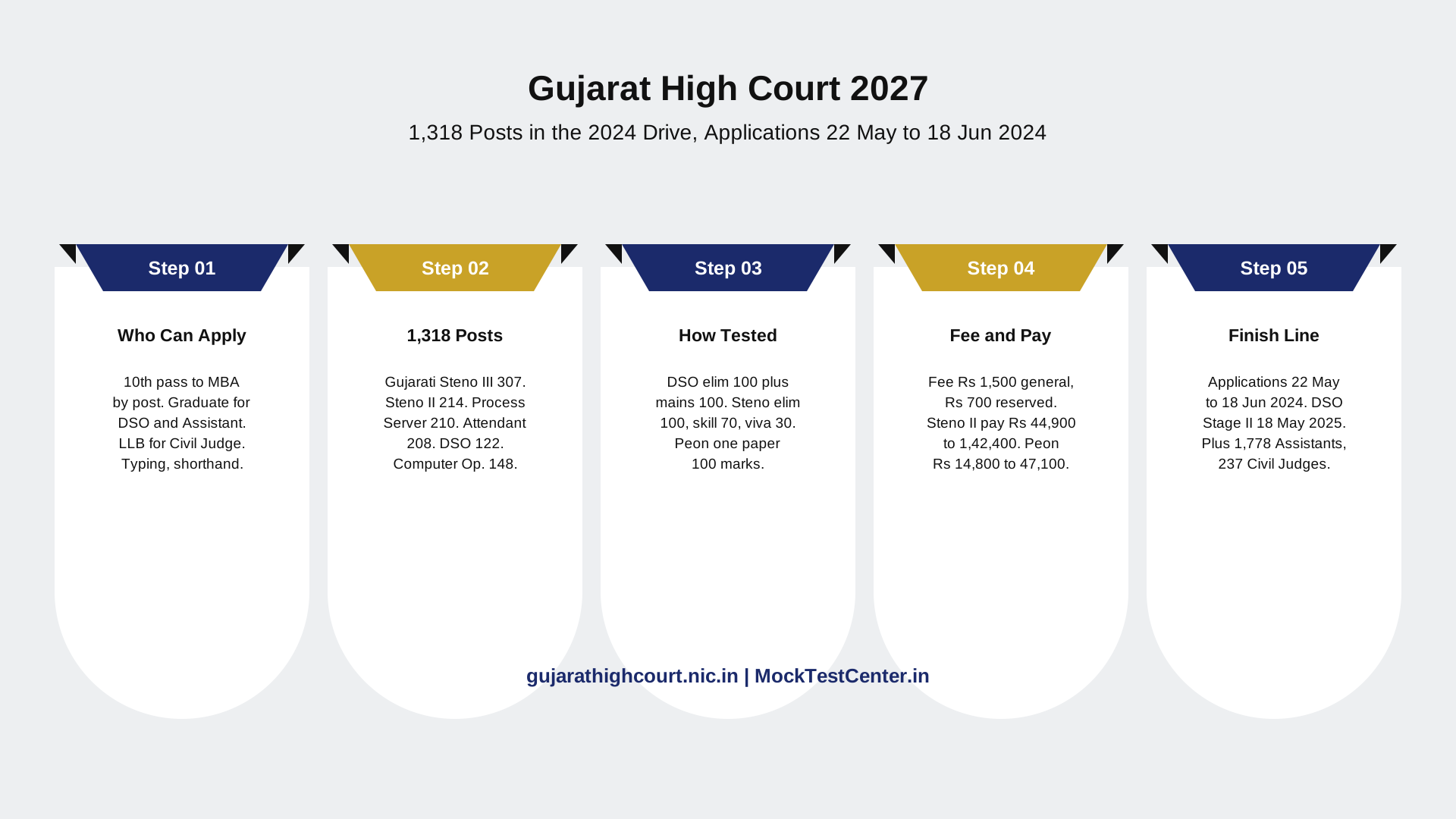
The Gujarat High Court 2027 page on this site follows the largest recent recruitment drive of the High Court of Gujarat, and that drive is the combined direct recruitment of 1,318 posts announced on 22 May 2024 under Advertisement Number HCG/NTA/01/2024. Applications ran from 22 May to 15 June 2024, extended to 18 June 2024, and the National Testing Agency ran the examinations for the High Court. The drive covers nine posts, from Gujarati Stenographer Grade III with 307 posts to Court Manager with 21 posts, across the High Court and the district judiciary of Gujarat. No separate 2027 notification has come out as of 22 November 2026, so this guide anchors on the 1,318 post drive of 2024 and says so wherever a 2027 figure would otherwise be guessed.
The 1,318 post drive is not the only recent High Court recruitment, and a candidate who reads only one advertisement will miss the shape of the court hiring. Before it, the High Court ran the centralised recruitment of 1,778 Assistants for the subordinate courts under Advertisement Number RC/1434/2022(II), notified on 27 April 2023, with applications from 28 April to 19 May 2023. After it, the High Court issued a short notification on 24 April 2026 under Advertisement Number RC/0719/2026 for 237 Civil Judges, with the detailed advertisement still awaited. This guide covers all three drives, keeps the 1,318 post drive as the anchor, and labels each figure with the drive it belongs to, because the three drives have different posts, different fees, different age limits and different selection stages.
The first thing to grasp is that the High Court does not run one examination. It runs a different selection for each post, and the post decides the test. A Deputy Section Officer faces an elimination test of 100 marks and a main written examination of 100 marks. A Gujarati Stenographer faces an elimination test, a stenography test of 70 marks and a viva voce of 30 marks. A Court Attendant or Peon faces a single objective written examination of 100 marks. A Civil Judge faces a preliminary examination, a descriptive mains and a viva voce of 50 marks. The fee, the age limit and the pay all change with the post as well. The candidate who picks the post first and then reads the pattern for that post will prepare the right test. The candidate who prepares a generic High Court pattern will prepare the wrong one.
Gujarat High Court 2027 at a glance
| Detail | Gujarat High Court 2027, as run in the live drives |
|---|---|
| Conducting body | High Court of Gujarat, Sola, Ahmedabad, examinations through the National Testing Agency for the 2024 drive |
| Anchor drive | Combined direct recruitment, 1,318 posts, Advertisement Number HCG/NTA/01/2024, dated 22 May 2024 |
| Anchor applications | 22 May to 15 June 2024, extended to 18 June 2024, correction window 17 to 19 June 2024, extended to 20 to 22 June 2024 |
| Posts in anchor drive | Gujarati Stenographer Grade III 307, Process Server or Bailiff 210, Gujarati Stenographer Grade II 214, Court Manager 21, Court Attendant 208, Driver 34, Computer Operator 148, Deputy Section Officer 122, English Stenographer Grade II 54 |
| Assistant drive | 1,778 Assistants, Advertisement Number RC/1434/2022(II), notified 27 April 2023, applications 28 April to 19 May 2023 |
| Civil Judge drive | 237 Civil Judges, Advertisement Number RC/0719/2026, short notification 24 April 2026, detailed advertisement awaited |
| Fee, anchor drive | Rs 1,500 general and Rs 700 reserved for most posts, Rs 1,000 and Rs 500 for Driver and Court Attendant, Rs 2,500 and Rs 1,250 for Court Manager |
| Age, anchor drive | 18 to 40 years as reported, with relaxation under government rules |
| Official website | gujarathighcourt.nic.in, applications on the HC-OJAS portal |
| 2027 notification | Not published as of 22 November 2026 |
The 1,318 posts, post by post
The advertisement of 22 May 2024 opened nine posts in one drive, and the numbers add to 1,318 exactly. Gujarati Stenographer Grade III carries the largest share at 307 posts. Gujarati Stenographer Grade II follows with 214 posts. Process Server or Bailiff carries 210 posts. Court Attendant carries 208 posts. Computer Operator in the IT Cell carries 148 posts. Deputy Section Officer carries 122 posts. English Stenographer Grade II carries 54 posts. Driver carries 34 posts. Court Manager carries 21 posts. The nine figures add to 1,318, and the addition is worth checking, because the drive is reported in pieces across tracker sites and the total is the only figure that ties the pieces together.
The posts sit on two establishments. Some posts sit on the establishment of the High Court itself at Sola, Ahmedabad, and most sit on the establishments of the district judiciary across the state, with the Industrial Courts and Labour Courts taking a share of the stenographer posts. The district wise break up runs through an annexure to the advertisement, and the court allots the selected candidates to districts from a centralised list. A candidate applies for the post, not for a district, and the posting comes after selection. That matters for candidates who want a posting near home, because the court decides the district and the candidate takes the posting the list gives.
One corrigendum changed the numbers after the advertisement, and it needs a flag rather than a quiet edit. The High Court issued a corrigendum dated 14 July 2025 for the Gujarati Stenographer Grade III vacancies, restating the district judiciary totals at 258 posts against the 307 in the original vacancy table. The corrigendum covers the district judiciary establishment, and the original 307 may include posts on other establishments, so the two figures may not describe the same set. This guide keeps the advertised 1,318 total and the 307 figure from the vacancy table, and records the 258 figure as a corrigendum that could not be reconciled from the sources read for this guide. A candidate should read the corrigendum on gujarathighcourt.nic.in before quoting a post count.
The education rule changes with the post, and the advertisement lists it post by post. Stenographer and Process Server posts ask for a 12th pass with shorthand and typing skills in the relevant language. Computer Operator asks for a graduate degree with computer knowledge. Deputy Section Officer asks for a graduate degree. Court Manager asks for a Master degree in Business Administration or an Advance Diploma in General Management. Driver asks for a 10th pass with a valid light motor vehicle driving licence. Court Attendant asks for a 10th pass. The exact qualification for each post, including the shorthand speed and the typing speed, sits in the detailed advertisement, and this guide does not restate speeds it could not verify from the advertisement text. The safe rule is simple. Read the qualification line for the one post being applied for, and apply only if every condition in that line is met on the last date of application.
The pay also changes with the post, and the spread is wide. Gujarati Stenographer Grade II carries Rs 44,900 to Rs 1,42,400 per month. English Stenographer Grade II and Gujarati Stenographer Grade III carry Rs 39,900 to Rs 1,26,600. Deputy Section Officer carries Rs 39,900, as reported by the tracker summary, and the full pay matrix for that post should be checked in the advertisement. Computer Operator, Driver and Process Server or Bailiff carry Rs 19,900 to Rs 63,200. Court Attendant or Peon carries Rs 14,800 to Rs 47,100. Court Manager carries Rs 56,100, as reported. The stenographer posts pay the most among the 2024 drive, and the Class IV attendant post pays the least, and the gap between them is the reason the stenographer posts draw the largest crowds.
The Assistant drive that came first, 1,778 posts
The Assistant drive is the largest single post recruitment the High Court has run in recent years, and it predates the 1,318 post drive by a year. The High Court published Advertisement Number RC/1434/2022(II) on 27 April 2023 for the centralised recruitment of Assistants for the subordinate courts in the state. The advertisement invited online applications for 1,778 vacancies in the pay matrix of Rs 19,900 to Rs 63,200. Applications ran from 28 April 2023 at 12 noon to 19 May 2023 at 11.59 pm. The category wise break up was General 786, SC 112, ST 323, SEBC 402 and EWS 155, which adds to 1,778.
The Assistant selection has three stages, and the merit comes from the last two. The Elimination Test is an objective paper of 100 multiple choice questions, each of one mark, in one and a half hours, with negative marking of 0.33 marks for every wrong or multiple answer. The language of the paper is English except for questions in Gujarati. The syllabus covers English language, Gujarati language, general knowledge, arithmetic, current affairs, Indian history and geography, basics of computer applications, sports, analytical reasoning and mental ability. The Main Written Examination is descriptive, 60 marks in 90 minutes, with the question paper in English and answers in English unless instructed otherwise. The Practical or Skill Test is a typing test, and the select list and centralised wait list are prepared on the aggregate marks of the Main Written Examination and the Practical or Skill Test. The elimination test screens, and it does not count for merit.
The dates ran long, and the length of the drive is itself a lesson. The elimination test was scheduled for 25 June 2023. The Main Written Examination was set for August 2023 in the advertisement, and the tracker record puts the mains on 12 May 2024. The skill test followed on 25 August 2024. Document verification began on 5 January 2025. The High Court later operated the centralised waiting list, allotting 146 candidates from the list dated 23 April 2025 to postings. From notification in April 2023 to wait list allotment in April 2025, the drive took two full years. A candidate who joined it in 2023 and waited for the final list waited through two calendar years, and that wait is normal for a drive of this size.
The Assistant eligibility is a bachelor degree from a recognised university, plus typing skill at 5,000 key depressions on a computer in English or Gujarati, as the tracker summaries report the requirement. The age limit is 21 to 35 years as on 19 May 2023, the last date of application, with relaxation under the rules, and the upper age limit does not exceed 45 years in any case while availing relaxation. The fee is Rs 1,000 for general category candidates and Rs 500 for SC, ST, SEBC, EWS, PH and ex servicemen, plus bank charges, paid through SBI e-Pay on the HC-OJAS portal. The typing requirement is the part candidates underestimate. Five thousand key depressions is a speed test, not a knowledge test, and it needs daily practice on a keyboard rather than reading about typing.
The Assistant drive matters to the 2027 page for a practical reason. It is the post most candidates mean when they say Gujarat High Court recruitment, because it is the largest drive, it is open to any graduate, and it repeats in some form in most hiring rounds. The 1,318 post drive of 2024 has no Assistant post in it, so a candidate who waits for the next Assistant advertisement should not confuse the 2024 drive with it. The two drives are separate, with separate advertisement numbers, separate fees and separate patterns, and the next Assistant cycle will carry its own advertisement when it comes.
Civil Judge, 237 posts, and a short notification
The newest High Court recruitment is also the most senior post on this page. The High Court issued a short notification on 24 April 2026 under Advertisement Number RC/0719/2026 for 237 Civil Judges in the Gujarat Judicial Service. The detailed notification was awaited at the time the tracker reports were written, and the category wise break up was to come with the detailed advertisement. The pay scale reported for the post is Rs 77,840 to Rs 1,36,520 per month plus allowances. The short notification is the only official fact this guide could verify, and everything else in this section is either the established pattern of the Civil Judge examination or a tracker report that conflicts with another tracker report.
The established pattern has three stages. The Preliminary Examination is an elimination test, objective, 100 marks in 2 hours, with negative marking of 0.33 marks for each wrong answer. Candidates who secure 50 percent and above qualify for the mains, with 45 percent for SC, ST, SEBC, EWS and PwBD candidates in the 2025 pattern reports. A separate Gujarati Language Test of 50 marks in one and a half hours applies to candidates who have not passed Secondary and Higher Secondary examinations with Gujarati as a subject. The Main Written Examination is descriptive, with Paper I on criminal law and Paper II on civil law. The widely reported pattern puts each mains paper at 100 marks in 3 hours, a total of 200 marks, and the viva voce at 50 marks, a total of 250 marks for merit. LawBhoomi reports a different mains shape, Paper I Criminal at 75 marks in two and a half hours, Paper II Civil at 75 marks in two and a half hours, and Paper III Gujarati Language at 50 marks in one and a half hours. The two versions cannot both be the current pattern, and this guide uses the 100 plus 100 plus 50 version as the main figure and flags the 75 plus 75 plus 50 version as the conflict. The final merit comes from the mains plus the interview only, and the prelims marks do not count.
The eligibility for Civil Judge is a law degree and practice at the Bar, with the practice rule itself in flux. The established rule asks for a degree in law from a university recognised by law in India, and practice as an advocate in courts of civil or criminal jurisdiction on the last date of application. The Supreme Court restored a mandatory three year practice requirement in its judgment of 20 May 2025, and then modified it in a judgment in August 2026, so that fresh law graduates can apply for Civil Judge examinations notified up to 31 March 2027 without the three year practice requirement. The RC/0719/2026 notification of 24 April 2026 falls inside that window. The age limit reported is 35 years for general category candidates and 38 years for reserved category candidates, with proficiency in Gujarati mandatory, and law graduates from the 2009-2010 academic year onwards must also have passed the All India Bar Examination. All of those conditions come from tracker reports of the 2026 cycle, and the detailed advertisement will settle them.
The dates and the fee for the Civil Judge drive are the least settled facts on this page, and this guide will not present a tracker guess as a date. One tracker page puts the last date of application at 27 May 2026 with a fee of Rs 2,000 general and Rs 1,000 reserved, and prelims in January to February 2027. Other tracker pages say the online application has not started, the detailed notification is awaited, and the prelims is expected in October or November 2026. The two sets of dates contradict each other, and the short notification itself gives no application dates. This guide records the short notification date, the advertisement number and the 237 posts as verified, and flags the application dates, the fee and the examination dates as unverified until the detailed advertisement comes out on gujarathighcourt.nic.in.
The Gujarat High Court exam pattern, post by post
The Gujarat High Court exam pattern tests each post differently, and the table below is the heart of this guide. Every post starts with an objective test except the stenographer posts, which add a skill test, and the Court Manager post, which adds a main written examination and a viva voce. The elimination test carries 100 marks wherever it appears, and it is the first gate. The main written examination carries different marks by post, and the viva voce carries different marks by post. A candidate should read the row for the post applied for and ignore the rest, because the rows do not mix.
| Post | Posts | Selection stages |
|---|---|---|
| English Stenographer Grade II | 54 | Main Written Test descriptive 40 marks, Stenography or Skill Test 40 marks, Viva Voce Test |
| Deputy Section Officer | 122 | Elimination Test objective MCQs 100 marks, Main Written Examination 100 marks |
| Computer Operator, IT Cell | 148 | Elimination Test objective MCQs 100 marks, Computer Aided Test 100 marks |
| Court Manager | 21 | Elimination Test objective MCQs 100 marks, Main Written Examination 60 marks, Viva Voce Test 40 marks |
| Gujarati Stenographer Grade II and III | 214 plus 307 | Elimination Test 100 marks, Stenography Test 70 marks, Viva Voce Test 30 marks |
| Process Server or Bailiff | 210 | Objective Written Exam 100 marks, Main Written Exam 100 marks |
| Driver | 34 | Objective test and driving test as per the advertisement, check the detailed notice |
| Court Attendant or Peon, Class IV | 208 | Objective Written Exam 100 marks |
The stenographer tests deserve a closer look, because they decide the highest paid posts in the drive. The Gujarati Stenographer Grade II and III selection runs an elimination test of 100 marks, then a stenography test of 70 marks, then a viva voce of 30 marks, a total of 200 marks. The English Stenographer Grade II selection runs a descriptive main written test of 40 marks, a stenography or skill test of 40 marks, and a viva voce, with the viva marks set by the advertisement. Shorthand speed is the skill that decides these posts, and it is a skill that takes months of daily dictation practice. A candidate who can type fast but cannot take shorthand at speed will clear the elimination test and fail the skill test, and that is the most common way to lose a stenographer post.
The Deputy Section Officer test is the most academic in the drive. An elimination test of 100 objective marks comes first, and a main written examination of 100 marks follows. The DSO select list came out in the tracker record under Advertisement Number HCG/NTA/01/2024/[I]2, and the National Testing Agency released the final answer key for the DSO Stage II examination held on 18 May 2025. The gap between the application date of June 2024 and the Stage II examination of May 2025 is eleven months, and it shows the pace of this drive. A candidate who applies in June and then stops studying will find the examination a year later and the preparation gone cold.
The Computer Operator test is the most practical in the drive. An elimination test of 100 objective marks comes first, and a computer aided test of 100 marks follows. The computer aided test checks what the candidate can do on a machine, not what the candidate can recall about computers. Daily practice on the actual applications matters more than reading a computer book, and the candidate who practises on a keyboard every day will beat the candidate who memorises definitions.
The Court Attendant post has the simplest selection in the drive, a single objective written examination of 100 marks. That simplicity is also the trap. A single paper means a single score decides everything, and the competition is the largest per post in the drive, because the qualification is a 10th pass and the fee is the lowest. The Process Server or Bailiff post adds a main written examination of 100 marks after the objective paper, so it gives a candidate a second paper to recover a weak first paper. The Court Manager post, with only 21 posts, has the longest selection, an elimination test, a main written examination of 60 marks and a viva voce of 40 marks, a total of 200 marks, and the MBA qualification narrows the field before the test begins.
The Driver row in the table carries a gap, and the gap is honest. The tracker summary lists the Driver selection only in outline, and the detailed advertisement sets the driving test. This guide does not invent a driving test pattern. A Driver candidate should read the advertisement for the practical test, the licence condition, and the medical standard, because a driving post is tested on the road as well as on paper.
Who can apply, what it costs, and the age rule
The age limit for the 2024 drive is 18 to 40 years as reported by the tracker summary, with relaxation for SC, ST, OBC, PwD and PH candidates under government rules. That range is wider than the Assistant drive, which runs 21 to 35 years, and wider than the Civil Judge drive, which runs to 35 years for general category candidates. The range differs because the 2024 drive covers posts from Class IV attendant to Court Manager, and the age rule is set post by post in the advertisement. A candidate near either edge of the range should read the age line for the specific post, because the 18 to 40 figure is the tracker summary of the drive and the advertisement is the authority.
The fee for the 2024 drive is also set post by post. For English Stenographer Grade II, Deputy Section Officer, Computer Operator, Gujarati Stenographer Grade II and III, and Process Server or Bailiff, the fee is Rs 1,500 for general category candidates and Rs 700 for SC, ST, SEBC, EWS, PwD and ex servicemen of Gujarat. For Driver and Court Attendant the fee is Rs 1,000 general and Rs 500 reserved. For Court Manager the fee is Rs 2,500 general and Rs 1,250 reserved. The fee is the highest among the drives on this page, and the Court Manager fee of Rs 2,500 is the highest single fee in the set. The fee is paid online, and the application is filed through the HC-OJAS portal and the NTA examination portal linked from gujarathighcourt.nic.in.
| Post group | Fee general | Fee reserved |
|---|---|---|
| Stenographers, DSO, Computer Operator, Process Server | Rs 1,500 | Rs 700 |
| Driver, Court Attendant | Rs 1,000 | Rs 500 |
| Court Manager | Rs 2,500 | Rs 1,250 |
| Assistant, 2023 drive | Rs 1,000 | Rs 500 |
| Civil Judge, 2026 drive | Unverified, tracker reports differ | Unverified, tracker reports differ |
The education rule for the 2024 drive runs from a 10th pass to a management degree, and the post decides the level. Court Attendant and Driver ask for a 10th pass, with the Driver also needing a valid light motor vehicle licence. Stenographer and Process Server posts ask for a 12th pass with the relevant shorthand and typing skill. Computer Operator and Deputy Section Officer ask for a graduate degree. Court Manager asks for a Master degree in Business Administration or an Advance Diploma in General Management. Basic knowledge of computers is listed across the posts, and the advertisement states the exact computer condition per post. A candidate should check the qualification as on the last date of application, because a degree completed after that date does not count.
What happened after the applications closed
The 2024 drive moved slowly, and the tracker record shows the pieces rather than a single finish line. The DSO Stage II examination ran on 18 May 2025, and the National Testing Agency released its final answer key after it. The DSO select list followed under Advertisement Number HCG/NTA/01/2024/[I]2. The English Stenographer Grade II select list came out under Advertisement Number HCG/NTA/01/2024/[I]1. The Gujarati Stenographer Grade III viva voce and document verification schedule came out, with the corrigendum of 14 July 2025 restating the district judiciary vacancies at 258. The Process Server or Bailiff corrigendum on vacancy numbers came out with a document verification list under Advertisement Number HCG/NTA/01/2024/[II]3. Each post moved on its own timetable, and no single result date covers the drive.
That staggered finish is normal for a multi post drive run through the National Testing Agency. Each post has its own test dates, its own answer keys, its own result and its own select list, and the High Court publishes them post by post on gujarathighcourt.nic.in. A candidate should track the post applied for, not the drive as a whole, and should check the recruitment page of the High Court site rather than wait for a tracker site to carry the list. The select list is the document that matters, and the wait list behind it matters almost as much, because the Assistant drive showed that the court operates the centralised wait list and allots candidates from it months after the select list.
The Assistant drive gives the clearest picture of the full arc, from notification to posting. Notification on 27 April 2023, applications to 19 May 2023, elimination test on 25 June 2023, mains on 12 May 2024, skill test on 25 August 2024, document verification from 5 January 2025, and wait list allotment of 146 candidates on 23 April 2025. Two years from start to finish. A candidate who treats a High Court application as a three month affair will misread the calendar by a factor of eight. The preparation should assume a long gap between stages, and the candidate should keep the skill warm across the gap, because the skill test can come a year after the written test.
A preparation plan that fits the post
The plan starts by picking one post and reading only its row in the pattern table. A DSO candidate needs objective practice and descriptive writing. A stenographer candidate needs shorthand dictation every day. A Computer Operator candidate needs time on a machine every day. A Court Attendant candidate needs one strong objective paper. A Civil Judge candidate needs the law, and nothing else will substitute for it. The candidate who prepares for all nine posts at once prepares for none of them, because the tests share only the elimination format and little else.
For the objective papers, the habit that pays is a timed test every week, scored and reviewed the same day. The elimination test carries negative marking of 0.33 marks per wrong answer in the Assistant pattern, and the 2024 drive papers follow the same objective tradition, so blind guessing costs marks. A candidate should answer the questions they know, mark the ones they can narrow to two options, and leave the pure guesses for the last five minutes. The arithmetic of 0.33 is forgiving compared with a full mark deduction, but twenty blind guesses still cost more than six marks, and six marks can decide a shortlist.
For the descriptive papers, the habit that pays is writing, not reading. The DSO main written examination is 100 marks, the Assistant mains is 60 marks in 90 minutes, and the Civil Judge mains is two papers of 100 marks each. All three reward a candidate who can write a clear answer in limited time. One answer a day, written by hand or typed as the test demands, in the time the paper allows, builds the skill faster than a month of reading model answers. The language of the question paper is English in the mains, and the answers may be given in English or Gujarati as the advertisement allows, so the candidate should practise in the language they will actually write in.
For the skill tests, the habit that pays is daily practice on the exact skill. Shorthand needs dictation at increasing speed, week by week, until the target speed holds for the full test duration. Typing needs 5,000 key depressions practised until the speed is comfortable rather than strained, because a strained speed collapses under test pressure. The computer aided test needs practice on the machine, with the applications the test uses. None of these skills can be built in the fortnight before the test, and all of them can be lost in a month without practice, so the candidate should keep the skill slot in the timetable across the long gaps between stages.
Mock tests have a specific job in this recruitment, and it is not to predict the rank. Their job is to expose the habit that costs marks. In the objective papers the habits are blind guessing, slow reading, and ignoring the Gujarati section until the last month. In the descriptive papers the habits are writing too much on the first answer and too little on the last, and never finishing a paper in the time allowed. In the skill tests the habit is practising at a comfortable speed and never testing at the target speed. A candidate should take a mock test, spend an hour on the mistakes, and change one habit before the next test.
The mistakes that cost candidates a cycle
The first mistake is applying for the wrong post, or for every post at once. The nine posts in the 2024 drive have different qualifications, different fees and different tests, and the advertisement charges a fee per post. A candidate who applies for three posts pays three fees and prepares for three different tests, and usually clears none. Pick the post that fits the qualification and the skill, and prepare for that one test.
The second mistake is ignoring the skill test until the written result comes out. The stenographer and typing tests decide the highest paid posts in the drive, and the skill needs months. The DSO Stage II examination came eleven months after the applications closed, and the Assistant skill test came fourteen months after the elimination test. A candidate who starts shorthand or typing only after the written result has already lost the race to the candidate who practised through the gap.
The third mistake is trusting a single tracker site for dates and post counts. The 2024 drive alone produced two different Gujarati Stenographer Grade III totals, 307 and 258, and the Civil Judge drive produced two different sets of application dates. The official site, gujarathighcourt.nic.in, is the only source for dates, and the advertisement PDF is the only source for post counts. Tracker sites are useful for explanation, and they are not a source for facts that decide an attempt.
The fourth mistake is stopping study between stages. The High Court drives run for one to two years from notification to final list, and the gaps between stages are measured in months. The candidates who keep moving during those gaps are the ones who arrive at the next stage ready. The candidates who wait arrive at the next stage and start from zero, and the skill they built a year ago is gone.
The fifth mistake is filing the form without reading the post wise conditions. A degree completed after the last date of application does not count, a driving licence that lapses before the test does not count, and a shorthand speed that falls short does not count. The advertisement states each condition with a date, and the verification checks the condition against that date. Read the line for the one post, check every condition against the date, and apply only then.
Check gujarathighcourt.nic.in for the next advertisement, pick the post before picking the books, and keep the skill warm across the long gaps. The court hires slowly, post by post, and the candidate who prepares for one post, one test and one skill at a time is the one who reaches the select list.
Sources
PlacementStore, Gujarat High Court Recruitment 2024, 1,318 posts, applications 22 May to 15 June 2024 extended to 18 June 2024, correction 17 to 19 June 2024 extended to 20 to 22 June 2024, fee Rs 1,500 general and Rs 700 reserved for most posts, Rs 1,000 and Rs 500 for Driver and Court Attendant, Rs 2,500 and Rs 1,250 for Court Manager, vacancy table Gujarati Stenographer Grade III 307, Process Server 210, Gujarati Stenographer Grade II 214, Court Manager 21, Court Attendant 208, Driver 34, Computer Operator 148, Deputy Section Officer 122, English Stenographer 54, pay scales as listed in the article. High Court of Gujarat, corrigendum No. HCG/NTA/01/2024/[II] 1 and 2, dated 14 July 2025, Gujarati Stenographer Grade III district judiciary vacancies restated at 258. MaruGujarat, High Court of Gujarat updates, DSO select list under Advertisement Number HCG/NTA/01/2024/[I]2, English Stenographer Grade II select list under Advertisement Number HCG/NTA/01/2024/[I]1, Process Server corrigendum under Advertisement Number HCG/NTA/01/2024/[II]3, Gujarati Stenographer Grade III viva voce and document verification schedule, Assistant centralised wait list allotment of 146 candidates dated 23 April 2025, DSO Stage II final answer key for the examination of 18 May 2025. Testbook, Gujarat High Court Assistant 2024, 1,778 vacancies, category break up General 786, SC 112, ST 323, SEBC 402, EWS 155, applications 28 April to 19 May 2023, mains 12 May 2024, skill test 25 August 2024, document verification from 5 January 2025, age 21 to 35 years, bachelor degree, pay Rs 19,900 to 63,200. FastJobSearchers and Scribd, Gujarat High Court Assistant Recruitment 2023, Advertisement Number RC/1434/2022(II), notified 27 April 2023, elimination test 25 June 2023, mains August 2023, skill test October 2023, fee Rs 1,000 general and Rs 500 reserved, typing 5,000 key depressions, elimination test 100 MCQs in one and a half hours with negative marking 0.33, mains descriptive 60 marks in 90 minutes. CareerPower, Gujarat High Court Civil Judge Recruitment 2026, short notification Advertisement Number RC/0719/2026 for 237 posts. LawPrep Tutorial, Gujarat Judiciary Notification 2026, 237 vacancies, short notification out, detailed notification awaited, pay Rs 77,840 to Rs 1,36,520. TopRankers, Gujarat Judiciary 2026, vacancy notice RC/0719/2026 dated 24 April 2026, detailed advertisement awaited, Supreme Court August 2026 ruling allowing fresh graduates for recruitments notified up to 31 March 2027. Rajasthali, Gujarat Judiciary Syllabus 2024, prelims 100 marks in 2 hours with negative marking 0.33, Gujarati language test 50 marks in one and a half hours, mains Paper I and II 100 marks each in 3 hours, viva voce 50 marks. VakilSaheb, Gujarat Civil Judge Exam Complete Analysis, prelims qualifying 50 percent general and 45 percent reserved, mains 200 marks, viva voce 50 marks with 40 percent needed, final merit mains plus interview 250 marks. LawBhoomi, Gujarat State Judicial Service Civil Judge Exam, mains Paper I Criminal 75 marks in two and a half hours, Paper II Civil 75 marks in two and a half hours, Paper III Gujarati Language 50 marks in one and a half hours, qualifying 50 percent general and 45 percent SC and ST in mains with 40 percent in each paper.







