About GPSSB Talati 2027 Exam Series
📖 Table of Contents
- GPSSB Talati 2027 at a glance
- The 3,437 posts, and how they split across Gujarat
- What a Talati actually does all day
- Who can apply for the GPSSB Talati examination
- GPSSB Talati exam pattern: one paper, one hour, 100 marks
- The syllabus, subject by subject
- How to apply on OJAS, step by step
- Fee, salary, and what the first five years look like
- The dates that mattered in the 2022 cycle
- The 2023 cut offs, and what they say about the paper
- The 2025-26 special drive, and why it matters for the next cycle
- Revenue Talati is a different post, and the name fools people
- How to prepare for a 100 mark paper in 60 minutes
- What to check before the next notification
- Sources
GPSSB Talati 2027: Complete Exam Guide
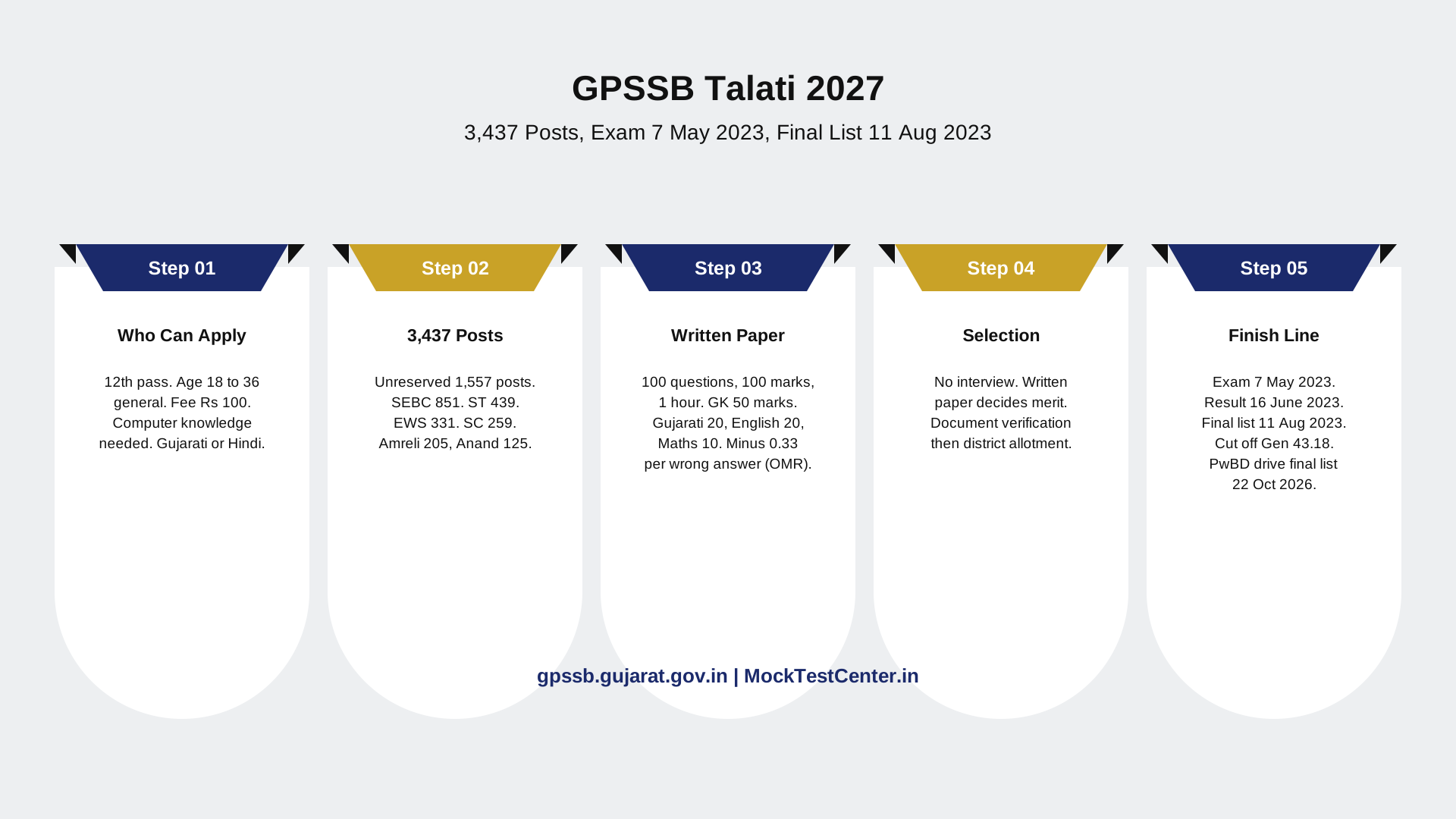
The GPSSB Talati 2027 page on this site follows the last general recruitment of the Gujarat Panchayat Service Selection Board, and that cycle carried 3,437 posts of Village Panchayat Secretary, called Talati cum Mantri in Gujarat. GPSSB published the notification for that cycle in January 2022 under Advertisement Number 10/2021-22. Applications ran from 28 January to 15 February 2022 on the OJAS portal. The written examination took place on 7 May 2023. The result came out on 16 June 2023, and the final select list followed on 11 August 2023. No general Talati notification for 2027 has appeared as of 22 November 2026, so this guide anchors on the 2022 cycle and says so wherever a 2027 figure would otherwise be guessed.
One newer cycle does exist, and it changes the picture in a useful way. GPSSB ran a special recruitment drive for persons with disabilities under Advertisement Number 14/2025-26 for 238 Talati posts. That drive used a computer based test on 18 February 2026 and reached its final select list with district allotment on 22 October 2026. It was a special drive, not a general one. The last general recruitment, the one most candidates will face next, remains the 3,437 post cycle of 2022. This guide keeps the 2022 cycle as the anchor, uses the 2025-26 special drive as a running update, and labels each figure with the cycle it belongs to.
The examination itself is short and sharp. One objective paper of 100 questions carries 100 marks, and candidates get one hour. General Awareness and General Knowledge alone carry 50 of those 100 marks. Gujarati carries 20, English carries 20, and General Mathematics carries 10. There is no interview. Selection rests on the written paper, then document verification and district allotment. That shape makes the Talati paper one of the fastest state recruitment tests in India, and it also makes it unforgiving. Sixty minutes for 100 questions leaves 36 seconds per question, and the negative marking punishes wild guesses.
GPSSB Talati 2027 at a glance
| Detail | GPSSB Talati 2027, as run in the 2022 cycle |
|---|---|
| Conducting body | Gujarat Panchayat Service Selection Board (GPSSB), Gandhinagar |
| Post | Village Panchayat Secretary (Talati cum Mantri), Class 3, Panchayat Department |
| Live general cycle | 2022, notification January 2022, Advertisement Number 10/2021-22 |
| Posts in live general cycle | 3,437 |
| Applications | 28 January to 15 February 2022, online on OJAS, closed |
| Written examination | 7 May 2023, OMR based, 100 questions, 100 marks, 1 hour |
| Answer key | Provisional answer key 11 May 2023 |
| Result | 16 June 2023 |
| Final select list | 11 August 2023 |
| Fee | Rs 100 for the general category |
| Education | Higher Secondary School Certificate (12th pass) or equivalent, plus basic computer knowledge |
| Age limit | 18 to 36 years for unreserved males as on 15 February 2022, relaxation for reserved categories and women |
| Salary | Fixed pay Rs 19,950 per month for the first five years |
| Interview | None, selection by written examination and document verification |
| Latest cycle | Advertisement Number 14/2025-26, special drive for persons with disabilities, 238 posts, computer based test 18 February 2026, final select list 22 October 2026 |
| 2027 notification | Not published as of 22 November 2026 |
The 3,437 posts, and how they split across Gujarat
The 2022 notification opened 3,437 Talati posts across the districts of Gujarat. The board filled these posts district by district, and each candidate applied for a district and took a place in that district merit list. That detail matters more than it looks. A candidate does not compete against every applicant in Gujarat. The candidate competes against applicants for the same district, so the cut off in a district with 205 posts can sit far below the cut off in a district with a handful of posts. Amreli carried the largest district share in the tracker tables at 205 posts. Anand followed with 125 posts, and Ahmedabad carried 105 posts. Candidates who picked districts with care, and who read the district wise vacancy table before applying, gave themselves a real edge before the paper even started.
The category split of the 3,437 posts adds up cleanly, and the numbers come from the official break up carried by Testbook. Unreserved candidates held 1,557 posts. SEBC candidates held 851 posts. Scheduled Tribe candidates held 439 posts. EWS candidates held 331 posts. Scheduled Caste candidates held 259 posts. Add those five figures and the total lands exactly on 3,437. That clean arithmetic is worth noting because tracker pages often garble category tables, and this one checks out. Women candidates drew their share from within these category figures under the Gujarat reservation rules, with separate male and female cut offs in the final result.
The scale of the response explains why the Talati paper draws so much attention in Gujarat. JagranJosh reported that the board published results for 9.53 lakh candidates across the Talati and Junior Clerk examinations together in June 2023. That figure covers both examinations, not the Talati paper alone, so treat it as a combined number. Even so, it shows the size of the crowd. A single paper of one hour decided the fate of lakhs of applicants for a few thousand village posts. The final select list of 11 August 2023 named the candidates who cleared document verification and took the posts.
Compare that with the 2025-26 special drive and the contrast is stark. The special drive for persons with disabilities carried only 238 posts, and it ran on a computer based test rather than an OMR sheet. The board published its final select list with district allotment on 22 October 2026. The small size of that drive tells its own story. GPSSB uses special drives to fill backlog vacancies for one category at a time, while the general drives open the post to everyone at once. Candidates waiting for the next general notification should watch for a fresh advertisement number in the 2026-27 series, not for another special drive number.
What a Talati actually does all day
The Talati cum Mantri works as the secretary of a Gram Panchayat, the village council, and the job mixes revenue work with panchayat administration. The Talati keeps land and revenue records for the village, collects land revenue and panchayat taxes, and keeps the accounts of the Gram Panchayat. The Talati also issues certificates that villagers need for everyday life, keeps the minutes of panchayat meetings, and carries out the orders of the Panchayat Department at the village level. In practice the Talati is the first government officer a villager meets, and often the only one the villager ever meets.
That breadth explains the odd shape of the examination. The paper tests general awareness for half its marks because the Talati needs to know the state, its history, its schemes, and its panchayat system. It tests Gujarati for 20 marks because the Talati writes panchayat records in Gujarati. It tests English for 20 marks because government correspondence and computer work use English. It tests mathematics for 10 marks because revenue and tax work runs on arithmetic. Every subject in the paper maps to a task on the desk, and candidates who see that link study with more purpose than candidates who treat the syllabus as a random list.
The posting itself is a village posting. The Talati lives in or near the village and works from the panchayat office. The first five years run on fixed pay, and the board confirms the candidate as a regular employee after that period, with the full pay scale of Rs 19,900 to Rs 63,200 at Pay Matrix Level 2 under the 7th Pay Commission. District allotment follows the final select list, so a candidate's home district is not guaranteed. Candidates should apply with that in mind and read the district wise vacancy table before choosing a district, because the allotment sticks.
One more point about the job deserves a plain statement. The Talati post is a Class 3 post, and it asks for a 12th pass, not a degree. Graduates apply in large numbers anyway, and that pushes the cut off up. The 2023 final cut off for unreserved males landed at 43.176 marks out of 100. That figure looks low until you remember the negative marking and the one hour limit. A paper where half the marks sit in general awareness, and where a wrong answer costs a third of a mark, keeps scores bunched in the 30s and 40s. The cut off tells the real story of the paper better than any coaching advertisement.
Who can apply for the GPSSB Talati examination
The education bar sits low on paper and high in practice. A candidate needs a Higher Secondary School Certificate, the 12th pass, or an equivalent qualification from a recognised board. The candidate also needs basic knowledge of computer applications, as laid down in the Gujarat Civil Services Classification and Recruitment (General) Rules, 1967, and adequate knowledge of Gujarati or Hindi or both languages. That is the whole education list. No degree, no diploma, no special certificate beyond the computer knowledge requirement. The 12th pass rule is the point most tracker pages get wrong. LK Academy lists graduation as the education for this post, and one job portal lists a graduate degree for a supposed 2026 general notification. Both are wrong for the live cycle. CareerIndia, JagranJosh, Testbook, and the Maru Gujarat syllabus page all agree on the 12th pass, and the official advertisement carries the same rule.
The age rule needs the same care because tracker pages quote three different upper limits. The official advertisement sets the age at 18 to 36 years for unreserved males, counted as on the last date of application, 15 February 2022. Women of the unreserved category and men and women of the reserved categories get relaxation under Gujarat government rules, with relaxation of 5 to 20 years and a maximum age of 45 years. TheMaruGujarat syllabus page quotes 18 to 34 years. LK Academy quotes 18 to 35 years. JagranJosh quotes 18 to 42 years. This guide uses 18 to 36 because the advertisement and the detailed tracker pages agree on it, and it flags the other figures as tracker errors. Candidates should always read the age clause in the advertisement itself, because the relaxation for their own category changes the number.
Nationality follows the standard Gujarat pattern. The candidate must be a citizen of India, or a citizen of Nepal or Bhutan, or a person of Indian origin from the countries named in the advertisement who has settled in India for good. The application runs online only, through the OJAS portal at ojas.gujarat.gov.in. GPSSB does not take offline forms for this post. Candidates apply for one district, pay the fee online or by challan at a post office, and keep the application number safe, because the board uses it for the call letter, the result, and the document verification.
Computer knowledge deserves a short note of its own. The rule asks for basic knowledge of computer applications, and the board checks the certificate at document verification, not in the written paper. Candidates who hold a CCC certificate, or a computer subject in their 12th standard, or an equivalent qualification, clear this condition. Candidates who lack any such proof should get one before applying, because a candidate who tops the written paper and fails document verification loses the post. The document verification stage has ended the run of more than one high scorer, and the board publishes the verification list separately from the merit list.
GPSSB Talati exam pattern: one paper, one hour, 100 marks
The GPSSB Talati exam pattern is the simplest part of this guide, and the part where tracker pages disagree the most. The pattern has one written paper. The paper carries 100 objective questions, each worth one mark, for a total of 100 marks. Candidates get 60 minutes. The paper runs in Gujarati, except for the English language section, which runs in English. The 2023 cycle used an OMR sheet. The 2025-26 special drive used a computer based test, called CBRT, and the board now uses CBRT for its Class 3 examinations. Candidates should expect a computer based paper next time, and prepare for on screen reading rather than a paper booklet.
| Subject | Questions | Marks | Medium |
|---|---|---|---|
| General Awareness and General Knowledge | 50 | 50 | Gujarati |
| Gujarati Language and Grammar | 20 | 20 | Gujarati |
| English Language and Grammar | 20 | 20 | English |
| General Mathematics | 10 | 10 | Gujarati |
| Total | 100 | 100 | 1 hour |
The subject split above comes from the official advertisement, and Testbook and the Shishya tracker both carry the same table. It settles a long running confusion. Some tracker pages show a different split, with General Awareness at 35 marks and a reasoning section at 25 marks. That split belongs to the general GPSSB pattern for other posts, like Staff Nurse and Divisional Accountant, where the paper runs for 90 minutes. The Talati paper is its own paper, with General Awareness at 50 marks and mathematics at 10 marks. PW Live carries both tables on the same page, one for other posts and one for Talati, and readers who skim the page pick the wrong one. This guide uses the Talati table only.
Negative marking is where the two cycles differ, and the difference matters for strategy. In the 2023 OMR cycle, each wrong answer cost 0.33 marks, a third of a mark. A blank answer cost 0.5 marks, and marking more than one option cost 0.7 marks. The candidate could pick option E, Not Attempted, and escape the penalty. That E option system is the Gujarat OMR pattern, and it rewards honesty about what you do not know. In the 2025-26 CBRT cycle, the GPSSB notice of 6 November 2025 sets the penalty at 0.25 marks per wrong answer. One Testbook page quotes 0.3 marks, which looks like a rounding of 0.33. This guide uses 0.33 for the 2023 cycle and 0.25 for the CBRT cycle, and it flags the 0.3 figure as a rounding. Candidates should read the penalty clause in their own advertisement, because the board has changed it between cycles.
The arithmetic of the penalty shapes how to attempt the paper. At 0.33 per wrong answer, three wrong answers wipe out one right answer. At 0.25, four wrong answers wipe out one right answer. Guessing across the whole paper loses marks in both systems. The sensible line is simple. Answer what you know, mark option E or leave the question where you know nothing, and guess only where you can rule out two of the four options. The 2023 cut offs show that toppers did not score 80 or 90. They scored in the 40s and 50s, because the paper punishes the guesser and rewards the steady candidate who banks the easy marks first.
There is no second paper and no interview. The written paper shortlists candidates for document verification, and the board draws the final select list from the written marks. CareerPower claims an interview round for Talati, and that claim is wrong. Testbook, LK Academy, and the advertisement all agree that selection rests on the written examination alone. The board verifies documents, checks the computer knowledge certificate, checks caste and disability certificates where claimed, and allots districts. That is the whole selection process. Candidates should not spend a day preparing for an interview that does not exist.
The syllabus, subject by subject
General Awareness and General Knowledge carries half the paper, so it deserves half the preparation time. The syllabus covers general mental ability and general intelligence, history of India and history of Gujarat, cultural heritage of India and Gujarat, geography of India and geography of Gujarat, sports, Indian polity and the Constitution of India, Panchayati Raj, welfare schemes of Gujarat and the Union government, Indian economy and planning, general science, environment, and information and communication technology, and current affairs of regional, national, and international importance. That list is long, and the only way to cover it is to read Gujarat first. Gujarat history, Gujarat geography, Gujarat schemes, and Panchayati Raj return year after year, because the post serves Gujarat villages. National current affairs fill the rest. Candidates who read a Gujarat yearbook and a daily newspaper in Gujarati cover most of this section without touching a dozen books.
Gujarati Language and Grammar carries 20 marks, and it tests the language the Talati will write in every day. The syllabus covers samas, alankar, sangana, krudant, sandhi, chhodo jodo, kartari and karmani vakya, chhand, kahevat and rudhiprayog, jodani, nipat, and vibhakti. Those topics come from the Gujarati grammar of the secondary and higher secondary classes, and the paper tests them at that level. Candidates who studied in Gujarati medium hold an edge here, and candidates from English medium schools need to put real hours into Gujarati grammar. The 20 marks in this section are the easiest marks in the paper for a Gujarati medium candidate, and the hardest for anyone who skips them.
English Language and Grammar also carries 20 marks, and it tests the language at a similar level. The syllabus covers tenses, articles, prepositions, voice, narration, vocabulary, synonyms and antonyms, error spotting, and comprehension. The paper sets this section in English, the only part of the paper that runs in English. Candidates who read English newspapers and practise error spotting pick up most of these marks. The section does not ask for essays or letters. It asks for grammar and vocabulary, and the questions stay close to the standard patterns that repeat across Gujarat recruitment papers.
General Mathematics carries only 10 marks, and that small weight fools candidates into skipping it. Ten marks decide the merit list when the cut offs sit in the 40s. The syllabus covers arithmetic at the secondary level, including percentages, ratio and proportion, averages, profit and loss, time and work, time and distance, and simple interest. Candidates should also practise mental ability items, because the General Awareness syllabus lists general mental ability as its first topic, and reasoning questions sit close to mathematics in style. A candidate who banks all 10 mathematics marks starts the paper with a cushion that most rivals lack.
The syllabus level is the 12th standard of the Gujarat Secondary and Higher Secondary Education Board. That sentence matters because it caps the difficulty. The paper does not ask graduate level questions. It asks school level questions under time pressure, and the pressure is the real test. One hour for 100 questions means the candidate reads, decides, and moves on in seconds. Mock tests help more than extra books at this stage, because the skill the paper tests is speed with accuracy, not depth of knowledge.
How to apply on OJAS, step by step
Applications for the Talati post run through the OJAS portal at ojas.gujarat.gov.in, and the board takes no offline form. The candidate opens the OJAS site, picks the Talati advertisement, and reads the notification in full before touching the form. The form asks for personal details, education, district choice, category, and the computer knowledge certificate. The candidate uploads a photograph and signature in the sizes the portal asks for, pays the fee, and submits the form. The portal issues an application number, and the candidate should save it, because the board uses it for the call letter and the result. The last date in the 2022 cycle was 15 February 2022, and the portal closed on that date. Late forms do not exist in this system.
The district choice is the one field that candidates should think about before submitting. The board draws a separate merit list for each district, so the same score can select in one district and fail in another. The vacancy table in the notification shows the posts district by district, and the candidate should compare the posts with the likely competition. Home district feels safe, but a neighbouring district with more posts can offer a better chance. The allotment follows the final select list, and the board does not entertain requests to change districts later. Candidates should also check the spelling of their name, date of birth, and category in the form, because a mismatch at document verification can cost the post even after selection.
The call letter comes out on the OJAS portal and on gpssb.gujarat.gov.in, and the board does not send it by post. Candidates download it, check the centre, date, and time, and reach the centre early with a photo identity card. The 2023 examination ran on 7 May 2023 as an OMR paper. The 2026 special drive ran as a computer based test on 18 February 2026, with the Talati paper from 10 in the morning to 11. Candidates for the next cycle should expect a computer based test, and should practise on a screen rather than on paper, because reading 100 questions on a screen under a one hour clock feels different from reading a booklet.
Fee, salary, and what the first five years look like
The application fee in the 2022 cycle was Rs 100 for the general category, paid online or by challan at a nearby post office. The tracker pages agree on the Rs 100 figure, and the detailed pages carry it as the fee for unreserved candidates. This guide does not state a fee for the reserved categories in the 2022 cycle, because the sources retrieved for this guide do not agree on it. One job portal lists SC and ST candidates as free and female candidates as free, but that page describes a different, unverified 2026 notification, so its fee table cannot be borrowed for the 2022 cycle. Candidates should read the fee clause in their own advertisement before paying.
The salary runs on the Gujarat fixed pay pattern. Selected candidates draw a fixed pay of Rs 19,950 per month for the first five years. The figure appears across CareerIndia, LK Academy, TheMaruGujarat, and Testbook, and it matches the fixed pay for Class 3 posts in Gujarat. After five years, the board confirms the candidate in the pay scale of Rs 19,900 to Rs 63,200 at Pay Matrix Level 2 under the 7th Pay Commission, with allowances as per the rules. LK Academy puts the in hand salary after probation at about Rs 25,000 to Rs 35,000 per month after deductions, and that estimate depends on allowances and posting, so treat it as a range, not a promise. The fixed pay years are the hard part of the deal, and candidates should know the number before they apply, not after they join.
The five year fixed pay period also shapes the career. The Talati works under the Panchayat Department, and the post carries the usual Gujarat government benefits after confirmation, including leave, medical facilities, and pension under the rules that apply to the cadre. Promotion runs through the panchayat service channel, and the Talati can rise to higher panchayat posts with seniority and departmental examinations. The post is a village post, so the career stays close to the ground, in the panchayat system, rather than in a secretariat office. Candidates who want a desk in Gandhinagar should look at other examinations. Candidates who want to work in their district and serve their own villages will find this post suits them.
The dates that mattered in the 2022 cycle
| Event | Date |
|---|---|
| Notification, Advertisement Number 10/2021-22 | January 2022 |
| Applications open on OJAS | 28 January 2022 |
| Applications close | 15 February 2022 |
| Written examination, OMR, 100 marks, 1 hour | 7 May 2023 |
| Provisional answer key | 11 May 2023 |
| Result | 16 June 2023 |
| Final select list | 11 August 2023 |
The gap between the application date and the examination date tells its own story. Candidates applied in January and February 2022 and sat the paper in May 2023, more than a year later. The board took its time, and candidates who stopped preparing in 2022 paid for it in 2023. The lesson for the next cycle is plain. Apply early, then keep preparing until the call letter arrives, because the board does not announce the examination date with much lead time, and the gap between the notification and the paper can stretch past a year. The 2025-26 special drive moved faster. Its notification came on 25 March 2025, its computer based test ran on 18 February 2026, and its final select list came on 22 October 2026. Even that faster drive took nineteen months from notification to final list.
The answer key dates matter too. The provisional answer key for the 2023 paper came out on 11 May 2023, four days after the paper. Candidates could check their answers, raise objections within the window the board set, and estimate their scores before the result. The final answer key came with the result on 16 June 2023. The special drive followed the same pattern, with its provisional answer key and response sheet on 21 February 2026, three days after its test. Candidates should download the response sheet when it appears, because it shows exactly what they marked, and it is the only proof they have if a question goes wrong.
The 2023 cut offs, and what they say about the paper
The board published category wise cut offs with the 2023 result, and JagranJosh carries the full table. The male cut offs ran from 43.176 marks for the general category down to 29.316 marks for the Scheduled Tribe category. EWS males closed at 39.018, SEBC males at 38.988, and SC males at 38.684. The female cut offs ran lower across the board. General females closed at 36.236, EWS females at 32.048, SEBC females at 32.088, SC females at 32.756, and ST females at 26.170. The gap between the male and female cut offs, about 7 marks in the general category, reflects the separate merit lists the board draws for men and women.
| Category | Male cut off | Female cut off |
|---|---|---|
| General | 43.176 | 36.236 |
| EWS | 39.018 | 32.048 |
| SEBC | 38.988 | 32.088 |
| SC | 38.684 | 32.756 |
| ST | 29.316 | 26.170 |
Read those numbers with care, because they carry two warnings. First, the cut offs sit in the 40s for the general category, which means the paper was hard, or the negative marking bit hard, or both. A candidate who scores 50 marks in a mock test under exam conditions is already above the general cut off, and a candidate who scores 60 is comfortably clear. Second, the cut offs are the final cut offs after document verification, as reported by the trackers, and they reflect the district wise lists, not one state list. A district with few posts can close far above the state figure, and a district with many posts can close far below it. The table gives the shape of the competition, not a promise for any one district.
The special drive cut offs tell a different story again. MaruGujarat reports the category wise minimum marks for the PwBD drive as 45.70691 for category A, 41.16141 for category B, 68.93923 for category C, and 44.94924 for categories D and E. Category C closed near 69 marks, far above the general cycle cut offs, which shows how a small drive with few posts can push the cut off up. Candidates should not compare cut offs across drives without noting the post count. A 238 post drive and a 3,437 post drive are different examinations in all but name.
The 2025-26 special drive, and why it matters for the next cycle
The special drive under Advertisement Number 14/2025-26 is the newest Talati cycle, and it matters for two reasons. First, it shows the board moving to computer based tests. The GPSSB notice of 6 November 2025 sets the Talati paper as a CBRT, a computer based response test, with 100 questions, 100 marks, 60 minutes, and 0.25 marks deducted for each wrong answer. The subject split stays the same: General Awareness and General Knowledge 50, Gujarati 20, English 20, General Mathematics 10. The medium stays the same too, Gujarati except for the English section. Candidates who prepare for the next cycle should practise on a computer, because the OMR sheet of 2023 is gone, and the screen is the paper now.
Second, the drive shows the board clearing backlog vacancies for persons with disabilities. The notification came on 25 March 2025 for 238 posts. The board set the examination programme by a notice dated 21 January 2026, and the test ran on 18 February 2026 from 10 in the morning to 11. The provisional answer key and response sheet came on 21 February 2026. The provisional merit list followed, reported on 11 May 2026. The final select list with recommendation and district allotment came on 22 October 2026. The drive took nineteen months from notification to final list, and it ended with district allotment, which means the selected candidates know their districts already. The board noted that vacancies left unfilled for want of suitable candidates would carry forward to the next drive.
The special drive also carried a trap for careless readers. Several job portals wrote about the drive as if it were a general Talati recruitment, and one portal listed a general 2026 notification under Advertisement Number GPSSB/202526/12 with a graduate degree as the education and an examination date of 20 April 2026. That notification does not appear on the GPSSB website, and the Shishya tracker, which reads the GPSSB site directly, states that no new general Talati advertisement stood on the board website as of 27 October 2026, and that the general advertisement planned for January 2026 had slipped. This guide treats the GPSSB/202526/12 claim as unverified and does not use its dates or its graduation rule. Candidates should check gpssb.gujarat.gov.in before trusting any portal that announces a new Talati notification.
Revenue Talati is a different post, and the name fools people
Gujarat has two posts with Talati in the name, and candidates mix them up every year. The post in this guide is the Talati cum Mantri, the Village Panchayat Secretary, run by GPSSB for the Panchayat Department. The other post is the Revenue Talati, run by the Gujarat Subordinate Service Selection Board, GSSSB, for the Revenue Department. The Revenue Talati notification, Number 301/2025-26, carried 2,389 posts, asked for graduation, and closed applications on 10 June 2025. The GPSSB Talati asks for a 12th pass. The boards differ, the departments differ, the education differs, and the examination differs. A candidate who prepares for one and applies for the other wastes a year.
Maharashtra adds a third lookalike. The Maharashtra Talathi, run by MPSC, is the village revenue officer of Maharashtra, and its 2023 cycle carried 4,657 posts with an examination across August and September 2023. The name sounds the same, the job sounds the same, and the examination is different. Gujarat candidates who search for Talati material online will find Maharashtra Talathi pages, and they should check the board name before trusting any of it. The Gujarat paper tests Gujarati grammar and Gujarat schemes. The Maharashtra paper tests Marathi and Maharashtra schemes. The two do not mix.
How to prepare for a 100 mark paper in 60 minutes
Preparation for this paper starts with the weight of the subjects. General Awareness carries 50 marks, so it gets half the study time. Gujarati and English carry 20 marks each, so they get a fifth each. Mathematics carries 10 marks, so it gets a tenth, but the candidate should still bank those 10 marks, because the cut offs sit in the 40s and every mark counts. A study plan that gives equal time to all four subjects wastes time on mathematics and starves general awareness. A plan that follows the marks will match the paper.
For General Awareness, read Gujarat first and India second. Gujarat history, Gujarat geography, Gujarat culture, Panchayati Raj, and the welfare schemes of the Gujarat government and the Union government return in every cycle. Current affairs from the twelve months before the paper carry the most weight, and a Gujarati newspaper covers them in the language the paper uses. Candidates should also read the Gujarat budget and the major schemes of the year, because the paper asks about schemes by name and by purpose. A notebook of schemes, with the department and the target group for each, beats a thick book of general knowledge.
For Gujarati, work from the grammar of the secondary classes. Samas, sandhi, alankar, chhand, kahevat, and jodani appear in set patterns, and the questions repeat their shapes across years. Candidates should solve the previous papers of GPSSB Class 3 examinations, because the board reuses question styles even when it changes the questions. For English, practise error spotting, tenses, prepositions, voice, and narration from a standard grammar book, and read a little English every day, because the comprehension passage rewards readers and punishes crammers. For mathematics, drill percentages, ratio, averages, profit and loss, time and work, and simple interest until the answers come in under a minute each.
Mock tests are the last piece, and they matter more here than in most examinations. The paper gives 36 seconds per question, so the candidate needs to practise under a one hour clock, on a screen, with negative marking on. A mock test score without the clock means little. A mock test score with the clock, with the 0.25 or 0.33 penalty applied, shows the real standing. Candidates should take at least twenty full mock tests before the paper, review every wrong answer, and track the score across tests. A score that climbs from the low 30s to the high 40s across twenty tests is a candidate on track. A score that stays flat is a candidate who needs to change the study plan, not take more tests.
One last habit separates the candidates who clear the paper from the ones who miss it by two marks. The successful candidate marks option E, or skips, where the answer is unknown, and never lets a guess chain run. Three blind guesses at 0.33 each cost a full mark, and a full mark can cost a place in the merit list. The paper rewards the candidate who answers 70 questions with 60 right and 10 wrong over the candidate who answers all 100 with 55 right and 45 wrong. Accuracy beats attempts in this paper, every single time.
What to check before the next notification
No general Talati notification for 2027 has appeared as of 22 November 2026. Candidates should check gpssb.gujarat.gov.in and the OJAS portal at ojas.gujarat.gov.in for the next advertisement, and they should not trust a portal that announces dates without linking the board notice. When the notification comes, read five things before applying: the advertisement number, the district wise vacancy table, the age clause with its cut off date, the fee clause, and the negative marking clause. Those five decide the application, the district, the eligibility, and the attempt strategy. The rest of the notification is detail.
Keep the documents ready before the notification arrives. The 12th pass certificate, the computer knowledge certificate, the caste certificate where claimed, the disability certificate where claimed, a photo identity card, and a photograph and signature in the sizes OJAS asks for. The board verifies documents after the written paper, and a missing certificate at that stage ends the run. Candidates who keep a folder of scanned documents, with the originals safe, walk into document verification without a worry.
The Talati post will keep drawing lakhs of applicants for a few thousand village posts, because it is the most direct route into Gujarat government service for a 12th pass candidate. The paper is short, the syllabus is school level, and the competition is fierce. The candidate who reads Gujarat, practises under the clock, and respects the negative marking has a real chance. The candidate who guesses across the paper does not. The numbers in this guide, the 3,437 posts, the 7 May 2023 paper, the 43.176 cut off, and the 22 October 2026 final list of the special drive, are the numbers to build that preparation on.
Sources
Testbook, GPSSB Talati cum Mantri Recruitment 2023, 3,437 vacancies, Advertisement Number 10/2021-22, examination 7 May 2023, answer key 11 May 2023, category break up Unreserved 1,557, EWS 331, SEBC 851, SC 259, ST 439, district table Amreli 205, Anand 125, Ahmedabad 105, fee Rs 100, 12th pass, age 18 to 36. Testbook, GPSSB Talati cum Mantri Syllabus and Exam Pattern 2023, 100 questions, 100 marks, 1 hour, General Awareness 50, Gujarati 20, English 20, General Mathematics 10, negative marking 0.3 marks per wrong answer, blank 0.5, multiple options 0.7, option E Not Attempted, OMR based. Testbook, GPSSB Recruitment 2022, 3,810 vacancies across GPSSB posts, Talati 3,437, registration 28 January to 15 February 2022, salary Rs 19,950, 12th pass. CareerIndia, GPSSB Recruitment 2022, 3,437 Talati posts, Higher Secondary School Certificate, basic computer knowledge, Gujarati or Hindi, age 18 to 36, salary Rs 19,950, applications to 15 February 2022, selection by written test. JagranJosh, GPSSB Recruitment 2022, 3,437 vacancies, Advertisement 10/2021-22, applications 28 January to 15 February 2022, 12th pass, age 18 to 36, fee Rs 100. JagranJosh, GPSSB Talati Result 2023, examination 7 May 2023, result 16 June 2023, final answer key 16 June 2023, 9.53 lakh candidates across Talati and Junior Clerk, 4,635 students listed for selection for Talati, male cut offs General 43.176, EWS 39.018, SEBC 38.988, SC 38.684, ST 29.316, female cut offs General 36.236, EWS 32.048, SEBC 32.088, SC 32.756, ST 26.170. Adda247, GPSSB Talati Final Result 2023, final result 11 August 2023, examination 7 May 2023, answer key 11 May 2023, 3,437 vacancies. CareerPower, GPSSB Talati Final Result 2023, final result 11 August 2023, final select list, interview claim noted as wrong. TechUFO, GPSSB Talati Result 2023, final select list 11 August 2023, Advertisement Number 10/2021-22, 3,437 posts, merit list based on written examination of 100 marks. LK Academy, GPSSB Talati, graduation claim noted as wrong, age 18 to 35 noted as conflicting, salary fixed pay Rs 19,950, post probation pay scale Rs 19,900 to Rs 63,200 Level 2, negative marking 0.33 wrong, 0.5 blank, 0.7 multiple options, option E, no interview, document verification, 2023 cycle timeline notification January 2022, applications 28 January to 15 February 2022, examination 7 May 2023, result July to August 2023. TheMaruGujarat, GPSSB Talati Exam Syllabus 2022, Advertisement Number 10/2021-22, 3,437 vacancies, 12th pass, age 18 to 34 noted as conflicting, salary Rs 19,950, applications 28 January to 15 February 2022. PW Live, GPSSB Full Form, Talati pattern General Awareness 50, Gujarati 20, English 20, General Mathematics 10, other GPSSB posts pattern General Awareness 35 noted as a different pattern. Shishya, Gujarat Talati 2027 tracker, GPSSB notice 6 November 2025, CBRT 100 questions, 100 marks, 60 minutes, 0.25 deducted per wrong answer, pattern General Awareness 50, Gujarati 20, English 20, General Mathematics 10, Advertisement 14/2025-26 special drive for persons with disabilities 238 posts, provisional answer key and response sheet 21 February 2026, final select list 22 October 2026, no new general advertisement as of 27 October 2026, January 2026 general advertisement slipped, expected notification 15 January 2027 and examination 20 June 2027 marked as expected only. MaruGujarat, GPSSB Exam Date 2026, notice 21 January 2026, Talati and Junior Clerk CBRT 18 February 2026, Talati 10 AM to 11 AM, Advertisement 14/2025-26. MaruGujarat, GPSSB Talati Cum Mantri Final Select List 2026, Advertisement 14/2025-26, final select list and district allotment 22 October 2026, PwBD cut offs A 45.70691, B 41.16141, C 68.93923, D and E 44.94924. PlacementStore, GPSSB Talati and Junior Clerk CBRT Exam Date 2026, examination 18 February 2026, CBRT mode, PwBD special drive. JobNoticeIndia, Gujarat Panchayat Secretary Recruitment 2026, Advertisement GPSSB/202526/12, graduate education, examination 20 April 2026, noted as unverified. UpcomingZone, GSSSB Revenue Talati Vacancy 2025, Notification Number 301/2025-26, 2,389 posts, graduation, last date 10 June 2025, different post and board. CareerGuide, Talati Exam, Maharashtra Talathi 4,657 posts 2023 noted as a different examination. Open Exam Prep, Gujarat Talati cum Mantri, 100 objective MCQs, 1 mark each, 0.33 negative marking, 60 minutes, Gujarat Panchayat Service Class 3 Recruitment Examination Rules 2021.