About Gujarat Forest Guard 2027 Exam Series
📖 Table of Contents
- Gujarat Forest Guard 2027 at a glance
- The 823 posts, and where they sat
- What a Forest Guard actually does all day
- Who can apply for the Gujarat Forest Guard examination
- Gujarat Forest Guard exam pattern: the written test
- The physical efficiency test, event by event
- The walking test, 25 kilometres in four hours
- Fee, salary, and what the first five years look like
- The dates that mattered, cycle by cycle
- Vanpal is a different post, and the 2025 pages are not real notifications
- How to prepare for a paper that is half forest subjects
- What to check before the next notification
- Sources
Gujarat Forest Guard 2027: Complete Exam Guide
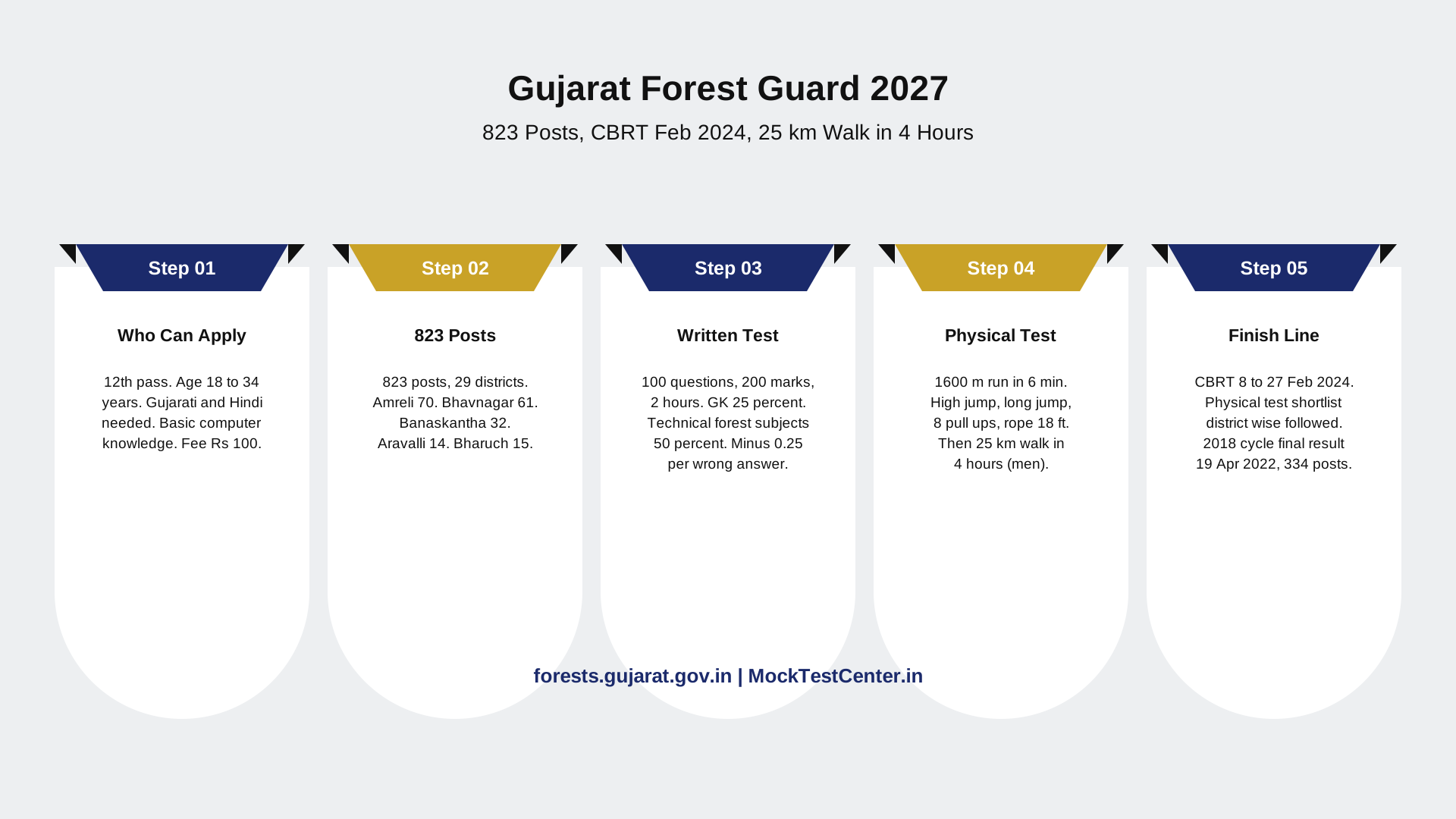
The Gujarat Forest Guard 2027 page on this site follows the last general recruitment of Forest Guards in Gujarat, and that cycle carried 823 posts of Vanrakshak, the Beat Guard of the Gujarat Forest Department. The Forest Department published the short notice for that cycle on 20 October 2022 under Advertisement Number FOREST/2022-23/1. Applications ran from 1 to 15 November 2022 on the OJAS portal. The written examination ran as a computer based test from 8 to 27 February 2024. The board then published a district wise list of candidates qualified for the physical fitness test, and the recruitment moved through the physical test, document verification, and final result stages. No fresh general Forest Guard notification for 2027 has appeared as of 22 November 2026, so this guide anchors on the 2022 cycle and says so wherever a 2027 figure would otherwise be guessed.
One older cycle still shapes how candidates read this examination. The 2018 cycle, under Advertisement Number FOREST/201819/1, carried 334 posts, took applications from 14 to 28 November 2018, and held its written examination on 27 March 2022, more than three years after the notification. Its final result came on 19 April 2022. That long wait is the signature of this recruitment. The Forest Guard examination moves slowly, the stages stretch across years, and the candidate who applies needs patience as much as preparation. This guide keeps the 2022 cycle as the anchor, uses the 2018 cycle as history, and labels each figure with the cycle it belongs to.
The examination has three gates, and the written paper is only the first. A candidate clears a written test of 100 questions for 200 marks, then a physical efficiency test with a run, jumps, pull ups, and rope climbing, then a walking test of 25 kilometres for men and 14 kilometres for women in four hours. The paper decides who gets to the ground. The ground decides who gets the post. Candidates who train only for the paper fail at the second gate, and candidates who train only for the ground fail at the first. The Gujarat Forest Guard 2027 guide covers both, because the recruitment demands both.
Gujarat Forest Guard 2027 at a glance
| Detail | Gujarat Forest Guard 2027, as run in the 2022 cycle |
|---|---|
| Conducting body | Gujarat Forest Department, with the written test run as a computer based test by the Gujarat Subordinate Service Selection Board (GSSSB) |
| Post | Forest Guard (Vanrakshak, Beat Guard), Class 3 |
| Live general cycle | 2022, short notice 20 October 2022, Advertisement Number FOREST/2022-23/1 |
| Posts in live cycle | 823, across 29 districts |
| Applications | 1 to 15 November 2022, online on OJAS, closed |
| Fee | Rs 100 plus Rs 12 postal charge for the general category |
| Written examination | 8 to 27 February 2024, computer based test, 100 questions, 200 marks, 2 hours |
| Physical efficiency test | Run, high jump, long jump, pull ups, rope climbing, with separate standards for men and women |
| Walking test | 25 km in 4 hours for men, 14 km in 4 hours for women |
| Education | Higher Secondary School Certificate (12th pass) or equivalent, plus knowledge of Gujarati and Hindi and basic computer knowledge |
| Age limit | 18 to 34 years as on 15 November 2022, relaxation under Gujarat rules |
| Salary | Fixed pay Rs 19,950 per month for the first five years |
| Previous cycle | 2018, Advertisement Number FOREST/201819/1, 334 posts, written examination 27 March 2022, final result 19 April 2022 |
| 2027 notification | Not published as of 22 November 2026 |
The 823 posts, and where they sat
The 2022 notification opened 823 Forest Guard posts across 29 districts of Gujarat, and the district table shows how unevenly the posts spread. Amreli carried the largest share at 70 posts. Bhavnagar followed with 61 posts. Banaskantha carried 32 posts. Aravalli carried 14 posts. Bharuch carried 15 posts. Ahmedabad carried 2 posts, and Anand carried 1 post. The rest of the 823 posts spread across the remaining districts, with the forest districts of Saurashtra and south Gujarat holding the largest shares. That spread follows the forests. Districts with large forest divisions need more beat guards, and districts with little forest need few. Candidates who read the district table before applying saw that at once.
The district wise split matters because the board runs the recruitment district by district. A candidate applies for a district, competes against the applicants for that district, and takes a place in that district list. The same written score can select in Amreli and fail in Anand, because Anand had one post and Amreli had seventy. The board published the physical test shortlist district by district after the written test, and the pattern held through every stage. Candidates who pick a district with care, and who compare the post count with the likely crowd, give themselves an edge before the paper starts. Candidates who apply to a one post district because it sits near home take the hardest route in the recruitment.
The 823 posts also show how the Forest Guard recruitment has grown. The 2018 cycle carried 334 posts. The 2022 cycle carried 823 posts, more than double. The jump reflects the vacancies that piled up while the 2018 cycle crawled through its three year wait. The Forest Department announced the 2022 recruitment in October 2022, only months after the 2018 cycle closed its final result in April 2022, and the state forest minister announced the 823 posts in the press on 18 October 2022. The department needed guards, and it needed them in numbers. That need is the best news in this guide for the next cycle. A department that doubled its intake in one cycle will need guards again, and the next notification will carry a large number when it comes.
What a Forest Guard actually does all day
The Forest Guard, called Vanrakshak in Gujarati, works as the Beat Guard of a forest beat, the smallest unit of forest administration. The guard patrols the beat on foot, watches for illegal felling and poaching, protects wildlife and forest resources, and reports fires, encroachments, and damage to the Range Forest Officer. The guard also helps during emergencies in the forest, assists in wildlife census work, and keeps the beat records. The job is outdoor work, on foot, in heat and rain, across ground that can turn steep and thorny without warning. It is not a desk job, and the recruitment tests prove it.
Gujarat gives this job a special weight. The Gir forest holds the only wild population of Asiatic lions in the world, and the guards of the Gir division protect those lions every day. The state also holds the Rann, the Gulf of Kutch mangroves, and the forests of the Dangs and the eastern tribal belt, and each of those places asks for different skills from its guards. A guard in Gir tracks lions. A guard in the Dangs walks steep hill forest. A guard in Kutch works in heat and salt desert. The written paper tests knowledge of forests, ecology, wildlife, medicinal plants, and timber, because the guard needs that knowledge on the beat, not in a classroom.
The posting follows the district, and the guard serves where the forest division needs hands. The first five years run on fixed pay of Rs 19,950 per month. The board confirms the guard as a regular employee after that period, with the full pay scale and allowances under the rules. The career runs through the forest service channel, and a guard can rise to Forester and beyond with seniority and departmental examinations. Candidates who love the outdoors and can walk long distances in heat will find this post suits them. Candidates who want office work should look at other examinations, because the beat will not suit them, and the walking test will prove it first.
Who can apply for the Gujarat Forest Guard examination
The education bar is a 12th pass. A candidate needs a Higher Secondary School Certificate, or an equivalent qualification from a recognised board or institute. The candidate also needs knowledge of Gujarati and Hindi, both languages, and basic knowledge of computers. That is the whole education list. No degree, no forestry diploma, no science stream requirement. The 12th pass rule holds across the 2018 cycle and the 2022 cycle, and the trackers agree on it. Candidates with a degree apply in large numbers anyway, and that pushes the written cut off up, but the degree gives no advantage in the paper, because the paper tests general knowledge and forest subjects at the school and general level.
The age rule sets the window at 18 to 34 years, counted as on the last date of application, 15 November 2022. The trackers agree on the 18 to 34 window, and the government job pages carry it as the age as on 15 November 2022. Relaxation applies under Gujarat government rules. StudyClap lists a relaxation of five years for unreserved women, and the detailed advertisement carries the full relaxation table for the reserved categories, ex servicemen, and other groups. This guide does not reproduce the full relaxation table, because the sources retrieved for this guide do not agree on every row. Candidates should read the age clause in their own advertisement, because the relaxation for their own category changes the number, and the cut off date decides it.
Physical standards sit inside the eligibility rules, not after them. The board measures height, chest, and weight before the physical efficiency test, and a candidate who misses a measurement does not reach the running track. Male candidates need a height of 163 cm, except Scheduled Tribe candidates, who need 155 cm. The chest must measure 79 cm without expansion and 84 cm with expansion, a minimum expansion of 5 cm, and the weight must reach 50 kg. Female candidates need a height of 150 cm, except Scheduled Tribe candidates, who need 145 cm, and a weight of 45 kg. Those figures come from the official notification as carried by GovernmentJobHub and TheMaruGujarat. StudyClap carries a different table, with 153 cm for men other than Scheduled Castes and 155 cm for Scheduled Caste men, and that table conflicts with the notification figures. This guide uses the notification figures and flags the StudyClap table as a tracker error.
Nationality follows the standard Gujarat pattern, and the application runs online only through the OJAS portal at ojas.gujarat.gov.in. The candidate opens the OJAS site, picks the Forest Guard advertisement, reads the notification, and fills the form with personal details, education, district choice, and category. The candidate uploads a photograph and signature, pays the fee, and saves the application number. The board uses that number for the call letter, the result, and the physical test list. The last date in the 2022 cycle was 15 November 2022, with the fee payable to 18 November 2022, and the portal closed after that. Late forms do not exist in this system.
Gujarat Forest Guard exam pattern: the written test
The written test carries 100 objective questions, each worth 2 marks, for a total of 200 marks. Candidates get 2 hours. The paper runs in Gujarati. Each wrong answer costs 0.25 marks. The passing mark is 40 percent, which is 80 marks out of 200. Those five facts come from the official notification as carried by JobsGyan, MaruGujaratPost, and the Gujarat text of the notification itself, and they hold for both the 2018 cycle and the 2022 cycle. The 2018 cycle ran the paper as an OMR test on 27 March 2022 from 12 noon to 2 in the afternoon. The 2022 cycle ran the paper as a computer based recruitment test from 8 to 27 February 2024. Candidates for the next cycle should expect a computer based test.
| Subject | Weightage | Marks out of 200 |
|---|---|---|
| General Knowledge | 25 percent | 50 |
| General Mathematics | 12.5 percent | 25 |
| General Gujarati | 12.5 percent | 25 |
| Technical subjects, forests and environment | 50 percent | 100 |
| Total | 100 percent | 200 |
The subject split is the most useful fact in this guide, because half the paper tests forest subjects. General Knowledge carries 25 percent, which is 50 marks. General Mathematics carries 12.5 percent, which is 25 marks. General Gujarati carries 12.5 percent, which is 25 marks. The technical section carries 50 percent, which is 100 marks. That section covers natural factors such as environment and ecology, knowledge of plants, wildlife, water, soil, medicinal plants, timber and timber based industries, and geographical factors. A candidate who studies only general knowledge prepares for a quarter of the paper and ignores half of it. A candidate who studies forests, ecology, wildlife, and Gujarat geography prepares for three quarters of it.
The duration needs a short note, because one tracker page contradicts the rest. JobsGyan lists the duration as 3 hours in its summary table, then quotes the Gujarat notification text on the same page, which sets the time at 2 hours. StudyClap lists 120 minutes. MaruGujaratPost lists 2 hours. The 2018 cycle ran from 12 noon to 2 in the afternoon, which is 2 hours. This guide uses 2 hours and flags the 3 hour figure as a tracker error. Candidates should read the time in their own call letter, because the board prints it there, and the call letter is the final word.
Negative marking at 0.25 per wrong answer shapes the attempt strategy. Eight wrong answers wipe out one right answer, because each right answer earns 2 marks and each wrong answer loses 0.25. Guessing across the paper loses marks slowly but surely, and the 40 percent passing mark means a candidate cannot pass on guesses. The sensible line is simple. Answer what you know, skip what you do not know, and guess only where you can rule out two of the four options. The paper gives 72 seconds per question on average, twice the time the Talati paper gives, so the candidate can afford to read each question with care and think before marking.
The syllabus for General Knowledge covers geography of India, economic issues in India, scientific observations, India and its neighbours, new inventions, world organisations, famous places in India, national news, international issues, tribes, important dates, music and literature, national dance, Indian culture, handicrafts, countries and capitals, political science, books and authors, science and innovations, art and culture. The mathematics syllabus covers arithmetic at the secondary level. The Gujarati syllabus covers grammar and language at the secondary level. The technical syllabus covers the forest subjects listed above, and it is the section where a prepared candidate pulls away from the crowd, because most candidates have never studied ecology, medicinal plants, or timber in a systematic way.
The physical efficiency test, event by event
The physical efficiency test follows the written test, and only candidates who clear the written paper reach it. The board published a district wise list of qualified candidates after the computer based test of February 2024, and that list set the field for the ground. The test has five events for men and three events for women, with separate standards for ex servicemen. Every event is qualifying, which means a candidate must clear each one. A fast run does not make up for a failed jump. The board measures each event on the day, and the candidate gets the attempts the rules allow, no more.
| Event, men | Other candidates | Ex servicemen |
|---|---|---|
| 1600 metre race | 6 minutes | 6 minutes 30 seconds |
| High jump | 4 feet 3 inches | 4 feet |
| Long jump | 15 feet | 14 feet |
| Pull ups | Minimum 8 times | Minimum 8 times |
| Rope climbing | 18 feet | 18 feet |
| Event, women | Other candidates | Ex servicemen |
|---|---|---|
| 800 metre race | 4 minutes | 4 minutes 20 seconds |
| High jump | 3 feet | 2 feet 9 inches |
| Long jump | 9 feet | 8 feet |
The 1600 metre race in 6 minutes sets the pace for the whole test. That is a kilometre in 3 minutes 45 seconds, twice over, and it asks for a trained runner, not a casual jogger. The 800 metre race in 4 minutes for women asks for a kilometre pace of 5 minutes, which is a steady run, not a sprint. The high jump at 4 feet 3 inches for men and 3 feet for women asks for technique as much as power, and candidates who have never jumped before should practise the approach and the take off, because the bar does not forgive a clumsy run up. The long jump at 15 feet for men and 9 feet for women asks for a strong take off and a clean landing. Pull ups at a minimum of 8 times ask for upper body strength that most candidates have never built. Rope climbing to 18 feet asks for grip and arm strength, and it is the event that ends the run of candidates who trained only for the race.
Women candidates face three events, and the standards are set to the same logic. The 800 metre race in 4 minutes, the high jump at 3 feet, and the long jump at 9 feet. Ex servicewomen get 4 minutes 20 seconds for the race, 2 feet 9 inches for the high jump, and 8 feet for the long jump. One tracker table lists the female long jump as 9 inches, which is a typing error for 9 feet, and this guide uses 9 feet, as carried by GovernmentJobHub and TechUFO. Candidates should train for the event as written in the notification, not as typed in a tracker table.
Training for this test needs months, not weeks. A candidate who starts running a month before the physical test will not make 1600 metres in 6 minutes, and a candidate who has never done a pull up will not do eight on the day. The sensible plan starts the day the written examination ends, or earlier. Run three to four times a week, build to 1600 metres at pace, add pull ups and rope work twice a week, and practise the jumps on a proper ground. The physical test comes weeks or months after the written result, and the board gives the date in the call letter, so the candidate has time. Candidates who use that time well pass. Candidates who wait for the call letter to start training do not.
The walking test, 25 kilometres in four hours
The walking test is the last physical gate, and it is the one that surprises candidates the most. Men walk 25 kilometres in 4 hours. Women walk 14 kilometres in 4 hours. The Forest Department rules, as quoted by IndianKanoon from the Surveyor Class 3 Forest Department Competitive Examination Rules 2013, set the test in plain words: a candidate who qualifies in the OMR test becomes eligible for the physical test, and on qualifying that test the candidate takes the walking test. The distance and time are 25 kilometres for a male candidate and 14 kilometres for a female candidate in four hours. The trackers agree, and the Gujarat Forest Guard syllabus pages carry the same figures.
Twenty five kilometres in four hours means an average speed of just over 6 kilometres an hour, including any rest, on ground that may be uneven and in heat. That is not a stroll. It is a brisk, sustained march, and candidates who only practise short runs fail it. Fourteen kilometres in four hours for women means 3.5 kilometres an hour, which is a demanding sustained effort over that distance, and it still ends the run of candidates who arrive unfit. The test is qualifying, so the candidate needs to finish inside the time, not to finish first. The candidate who walks steadily, drinks water, and wears the right shoes finishes. The candidate who sprints the first five kilometres and collapses at ten does not.
Train for the walk like an examination. Start with five kilometres at a brisk pace, add distance week by week, practise in the shoes that will be worn on the day, and practise carrying water sensibly. Walk on uneven ground, not only on a flat track, because the test ground may not be flat. Walk in the heat of the day at least sometimes, because the test may run in heat. The walk rewards the candidate who has walked long distances before, and it punishes the candidate who has only run short ones. Runners who have never walked 25 kilometres should not assume the run makes the walk easy. The muscles are different, the pace is different, and the blisters are different.
Fee, salary, and what the first five years look like
The application fee in the 2022 cycle was Rs 100 plus Rs 12 postal charge for the general category. The fee table in the notification carries that figure, and GovernmentJobHub reproduces it. The table also lists a lower fee for SC, ST, SEBC, EWS, and ex serviceman candidates, but the figure for those categories was cut off in the sources retrieved for this guide, so this guide does not state it. Candidates should read the fee clause in their own advertisement before paying. The fee was payable online and by challan, and the last date for the fee in the 2022 cycle was 18 November 2022, three days after the application closed.
The salary runs on the Gujarat fixed pay pattern. Selected candidates draw a fixed pay of Rs 19,950 per month for the first five years. GovernmentJobHub carries that figure as the five year fixed pay for the post. StudyClap lists the in hand salary for the first five years as Rs 18,400, and that figure conflicts with the Rs 19,950 figure. The two numbers cannot both be the fixed pay, and the sources do not explain the gap. This guide uses Rs 19,950, because the notification based pages carry it, and it flags the Rs 18,400 figure as a conflicting tracker number. Candidates should read the pay clause in their own advertisement, because the board prints the fixed pay there. The post probation pay scale was not verified from the sources retrieved for this guide, so this guide does not state it. Do not trust a tracker page that quotes a scale without a source.
The five year fixed pay period shapes the career in the same way it shapes the Talati career. The guard works under the Forest Department, and the post carries the usual Gujarat government benefits after confirmation, including leave, medical facilities, and pension under the rules that apply to the cadre. Promotion runs through the forest service channel, from Forest Guard to Forester and beyond, with seniority and departmental examinations. The post is an outdoor post, so the career stays in the forest divisions, in the beats and ranges, rather than in an office in Gandhinagar. Candidates who want a desk should look at other examinations. Candidates who want to work in the forest will find this post suits them.
The dates that mattered, cycle by cycle
| Event, 2022 cycle | Date |
|---|---|
| Short notice, Advertisement Number FOREST/2022-23/1 | 20 October 2022 |
| Applications open on OJAS | 1 November 2022 |
| Applications close | 15 November 2022 |
| Fee last date | 18 November 2022 |
| Written examination, computer based test | 8 to 27 February 2024 |
| Physical fitness test shortlist, district wise | After the written test, 2024 |
| Physical test, document verification, final result | Stages completed after the physical test |
| Event, 2018 cycle | Date |
|---|---|
| Notification, Advertisement Number FOREST/201819/1 | November 2018 |
| Applications | 14 to 28 November 2018 |
| Written examination, OMR, 12 noon to 2 pm | 27 March 2022 |
| Provisional answer key | 27 March 2022, 8 pm |
| Scanned OMR download | 28 March 2022, 2 pm |
| Final answer key | 18 April 2022 |
| Final result | 19 April 2022 |
The 2018 cycle is the cautionary tale of this recruitment. Candidates applied in November 2018 and sat the paper in March 2022, more than three years later. The board published the provisional answer key on the evening of the paper, the scanned OMR copies the next day, the final answer key on 18 April 2022, and the final result on 19 April 2022. More than one lakh candidates had filled forms for 334 posts. The wait tested patience as much as the paper tested knowledge. The 2022 cycle moved faster, with the paper in February 2024, about fifteen months after the notification, but it still stretched across years. Candidates for the next cycle should apply early, keep preparing until the call letter arrives, and keep training for the physical test through the wait, because the board does not announce the stages with much lead time.
The answer key pattern is worth noting, because it helps candidates estimate their scores. The board publishes the provisional answer key on the day of the paper or the day after, takes objections within a short window, and then publishes the final answer key with the result. The 2018 cycle also published scanned OMR copies, so candidates could check what they had marked. The 2022 cycle, as a computer based test, published response sheets in the same way. Candidates should download the response sheet when it appears, because it shows exactly what they marked, and it is the only proof they have if a question goes wrong.
Vanpal is a different post, and the 2025 pages are not real notifications
Two traps wait for Forest Guard candidates online, and both cost time. The first is the Vanpal recruitment of June 2026. The Forest Department notified 15 Vanpal posts in June 2026, and the post carries the words Forest Guard in its title on some tracker pages. Vanpal is a different post. It asks for graduation, and it follows its own advertisement and its own selection conditions. The general Forest Guard post asks for a 12th pass. BhartiStream states the difference in plain words: the 15 post Vanpal recruitment notified in June 2026 is a different post and should not be confused with the usual Class 3 Forest Guard or Vanrakshak recruitment. Candidates should check the advertisement number and the education before trusting any page that mixes the two.
The second trap is the set of pages that announce a Forest Guard Recruitment 2025 with a notification in August 2025. TazzaJobs carries such a page, with tentative dates and a full pattern, but no official notification stands behind it. BhartiStream, updated on 20 August 2026, states that no fresh general Forest Guard Recruitment 2026 application notification was open as of that date, and that the previous general advertisement was FOREST/2022-23/1. The 823 post recruitment had moved through its written examination, physical test, document verification, and final result stages, and it was not open for new applications. Candidates should treat any page that announces a 2025 or 2026 general Forest Guard notification without linking the official advertisement as speculation, and check forests.gujarat.gov.in and gsssb.gujarat.gov.in before acting on it.
The conducting body needs a plain statement too, because the tracker pages split on it. The notification came from the Gujarat Forest Department, and the applications ran on OJAS. The written examination ran as a computer based recruitment test, and the GSSSB advertisement page lists Advertisement Number FOREST/2022-23/1. BhartiStream lists the official Forest Department website as forests.gujarat.gov.in and the official recruitment website as gsssb.gujarat.gov.in. In practice the Forest Department owns the posts and the rules, and the selection board runs the test. Candidates should watch both websites, because the notification can appear on either, and the call letter and the lists can appear on either too.
How to prepare for a paper that is half forest subjects
Preparation for this paper starts with the weight of the subjects. The technical section carries 100 marks out of 200, so it gets half the study time. General Knowledge carries 50 marks, so it gets a quarter. Mathematics and Gujarati carry 25 marks each, so they get an eighth each. A study plan that gives equal time to all four subjects wastes time on mathematics and Gujarati and starves the forest section. A plan that follows the marks will match the paper. Most candidates do the opposite, because general knowledge feels familiar and forest subjects feel strange, and that is exactly why the forest section decides the merit list.
For the technical section, study the forests of Gujarat first. Learn the forest types, the national parks and sanctuaries of the state, the wildlife of Gir and the Rann, the mangroves of the Gulf of Kutch, the medicinal plants of the Dangs, the timber species and timber based industries, soil and water in forest areas, and the geography that shapes where forests grow. Read the Forest Department website and the India State of Forest Report for the Gujarat chapter, because the paper draws its questions from those sources. Candidates should also learn the basic ecology terms, food chains, and the role of forests in the environment, because the syllabus names environment and ecology first among the technical topics.
For General Knowledge, read India and Gujarat together. Geography, history, polity, the Constitution, sports, culture, science, and current affairs fill the 50 marks, and the questions stay at the general level. A daily newspaper and a Gujarat yearbook cover most of it. For mathematics, drill arithmetic at the secondary level until the answers come fast, because the 25 marks in this section are the easiest marks in the paper for a candidate who practises. For Gujarati, work from the grammar of the secondary classes, because the 25 marks there reward the candidate who knows the language well.
Mock tests help, and they help most when taken under the real conditions. The paper gives 72 seconds per question, so the candidate can afford to read with care, but the 200 mark scale means a careless guess costs more than in a 100 mark paper. Take mock tests with the 0.25 penalty applied, review every wrong answer, and track the score across tests. A score that climbs past 80 marks, the passing mark, and then past 100 marks, is a candidate on track. A score that stays below 80 is a candidate who needs to change the study plan, not take more tests. Take at least fifteen full mock tests before the paper, and take half of them on a computer, because the real paper is computer based.
Physical training runs alongside the study plan, not after it. Run three to four times a week, build to 1600 metres in 6 minutes for men and 800 metres in 4 minutes for women, add pull ups and rope work twice a week, and walk long distances once a week, building to 25 kilometres for men and 14 kilometres for women. Practise the jumps on a proper ground, because the high jump and long jump need technique, and technique needs repetition. The candidate who starts physical training only after the written result has weeks to build what takes months. The candidate who trains through the written preparation arrives at the ground ready. The recruitment has three gates, and the candidate who prepares for all three from the start is the one who walks through them.
What to check before the next notification
No fresh general Forest Guard notification for 2027 has appeared as of 22 November 2026. Candidates should check forests.gujarat.gov.in, gsssb.gujarat.gov.in, and the OJAS portal at ojas.gujarat.gov.in for the next advertisement, and they should not trust a portal that announces dates without linking the official notice. When the notification comes, read five things before applying: the advertisement number, the district wise vacancy table, the age clause with its cut off date, the fee clause, and the physical standards table. Those five decide the application, the district, the eligibility, and the training plan. The rest of the notification is detail.
Keep the documents ready before the notification arrives. The 12th pass certificate, the computer knowledge certificate, the caste certificate where claimed, the disability certificate where claimed, a photo identity card, and a photograph and signature in the sizes OJAS asks for. The board verifies documents after the physical test, and a missing certificate at that stage ends the run. Candidates who keep a folder of scanned documents, with the originals safe, walk into document verification without a worry.
The Forest Guard post will keep drawing large crowds for a few hundred posts, because it is one of the few Gujarat government posts that asks only for a 12th pass and offers outdoor work in the forests of the state. The paper is 200 marks, the ground is five events and a long walk, and the competition is fierce at every gate. The candidate who studies the forest subjects, practises under the clock, runs and walks through the wait, and respects the negative marking has a real chance. The numbers in this guide, the 823 posts, the February 2024 computer based test, the 25 kilometre walk, and the 19 April 2022 final result of the 334 post cycle, are the numbers to build that preparation on.
Sources
GovernmentJobHub, Vanrakshak Bharti Gujarat 2022, 823 vacancies across 29 districts, applications 1 to 15 November 2022, fee Rs 100 plus Rs 12 postal charge, age 18 to 34 as on 15 November 2022, physical standards male ST 155 cm, others 163 cm, chest 79 cm and 84 cm, weight 50 kg, female ST 145 cm, others 150 cm, weight 45 kg, physical test male 1600 m 6 minutes, high jump 4 feet 3 inches, long jump 15 feet, pull ups 8, rope climbing 18 feet, female 800 m 4 minutes, high jump 3 feet, long jump 9 feet, written examination 100 questions of 2 marks, negative marking 0.25, syllabus General Knowledge 25 percent, Mathematics 12.5 percent, General Gujarati 12.5 percent, technical subjects 50 percent. TheMaruGujarat, Gujarat Van Rakshak Bharti 2022, Advertisement Number FOREST/2022-23, 823 posts, short notice 20 October 2022, applications 1 to 15 November 2022, 12th pass, age 18 to 34, fee last date 18 November 2022. JobsGyan, Gujarat Forest Guard Recruitment 2022, 823 vacancies, 12th pass, age 18 to 34, applications 1 to 15 November 2022, selection OMR examination, computer test, physical test, written examination 100 questions, 200 marks, 2 hours, Gujarati text 100 questions of 2 marks, negative marking 0.25, 3 hour figure noted as conflicting. StudyClap, Gujarat Forest Guard 2026, applications 1 to 15 November 2022, age 18 to 34, relaxation UR women 5 years, physical standards table with 153 cm noted as conflicting, written examination 100 questions, 200 marks, 120 minutes, negative marking 0.25, physical efficiency test male 1600 m 6 minutes, ex servicemen 6 minutes 30 seconds, high jump 4 feet 3 inches, long jump 15 feet, pull ups 8, rope climbing 18 feet, female 800 m 4 minutes, ex servicewomen 4 minutes 20 seconds, high jump 3 feet, long jump 9 feet, walking test male 25 km in 4 hours, female 14 km in 4 hours, salary in hand Rs 18,400 noted as conflicting, 823 vacancies. BhartiStream, Gujarat Forest Guard Recruitment 2026, updated 20 August 2026, no fresh general notification open, previous advertisement FOREST/2022-23/1, 823 vacancies, written examination 8 to 27 February 2024 computer based, physical fitness test shortlist district wise, official websites forests.gujarat.gov.in and gsssb.gujarat.gov.in, Vanpal 15 posts June 2026 different post, graduation required. Testbook, Gujarat Forest Guard Previous Year Papers, written test, physical fitness test, walking test, 100 questions, negative marking 0.25, four sections General Knowledge, Mathematics, General Gujarati, environmental factors. GKNews, Gujarat Forest Guard Result 2022, 334 posts, Advertisement FOREST/201819/1, applications 14 to 28 November 2018, written examination 27 March 2022, 12 noon to 2 pm, provisional answer key 27 March 2022 8 pm, scanned OMR 28 March 2022, final answer key 18 April 2022, final result 19 April 2022, more than 1 lakh forms. MaruGujaratPost, Gujarat Van Rakshak Call Letter 2022, Advertisement FOREST/201819/1, 334 vacancies, written examination 27 March 2022, pattern 100 questions, 200 marks, 2 marks each, negative marking 0.25, 2 hours, passing marks 40 percent, 80 marks, syllabus General Knowledge 25 percent, Maths 12.5 percent, General Gujarati 12.5 percent, other 50 percent. GKNews, Gujarat Forest Guard Syllabus 2023, 823 posts, walking test male 25 km in 4 hours, women 14 km in 4 hours. IndianKanoon, Surveyor Class 3 Forest Department Competitive Examination Rules 2013, Section 10, written examination then physical screening test then walking test, 25 km male and 14 km female in four hours. TechUFO, Gujarat Forest Guard Syllabus and Exam Pattern 2025, 823 posts, selection written examination, physical efficiency test, walking test, male 1600 m 6 minutes, high jump 4 feet 3 inches, long jump 15 feet, female 800 m 4 minutes, high jump 3 feet, long jump 9 feet, walking test male 25 km 4 hours, female 14 km 4 hours. ExamCare, GPSC Gujarat Forest Service Examination 2026, physical standards male height 163 cm, 158 cm ST, chest 79 cm expansion 5 cm, female height 150 cm, 145 cm ST, walking test male 25 km in 4 hours, female 14 km in 4 hours. TazzaJobs, Gujarat Forest Guard Recruitment 2025, notification August 2025, noted as unverified speculation. SarkariResultNow, GSSSB Forest Guard Recruitment 2026, Vanpal 15 posts, pay scale Rs 25,500 to Rs 81,100 Level 4, walking test 25 km men and 14 km women in 4 hours.