
About MPPSC SSE 2027 Exam Series
📖 Table of Contents
- MPPSC SSE 2027 at a glance
- 158 posts, 155 posts, 283 posts and 191 posts: which number is which
- Which posts does SSE fill
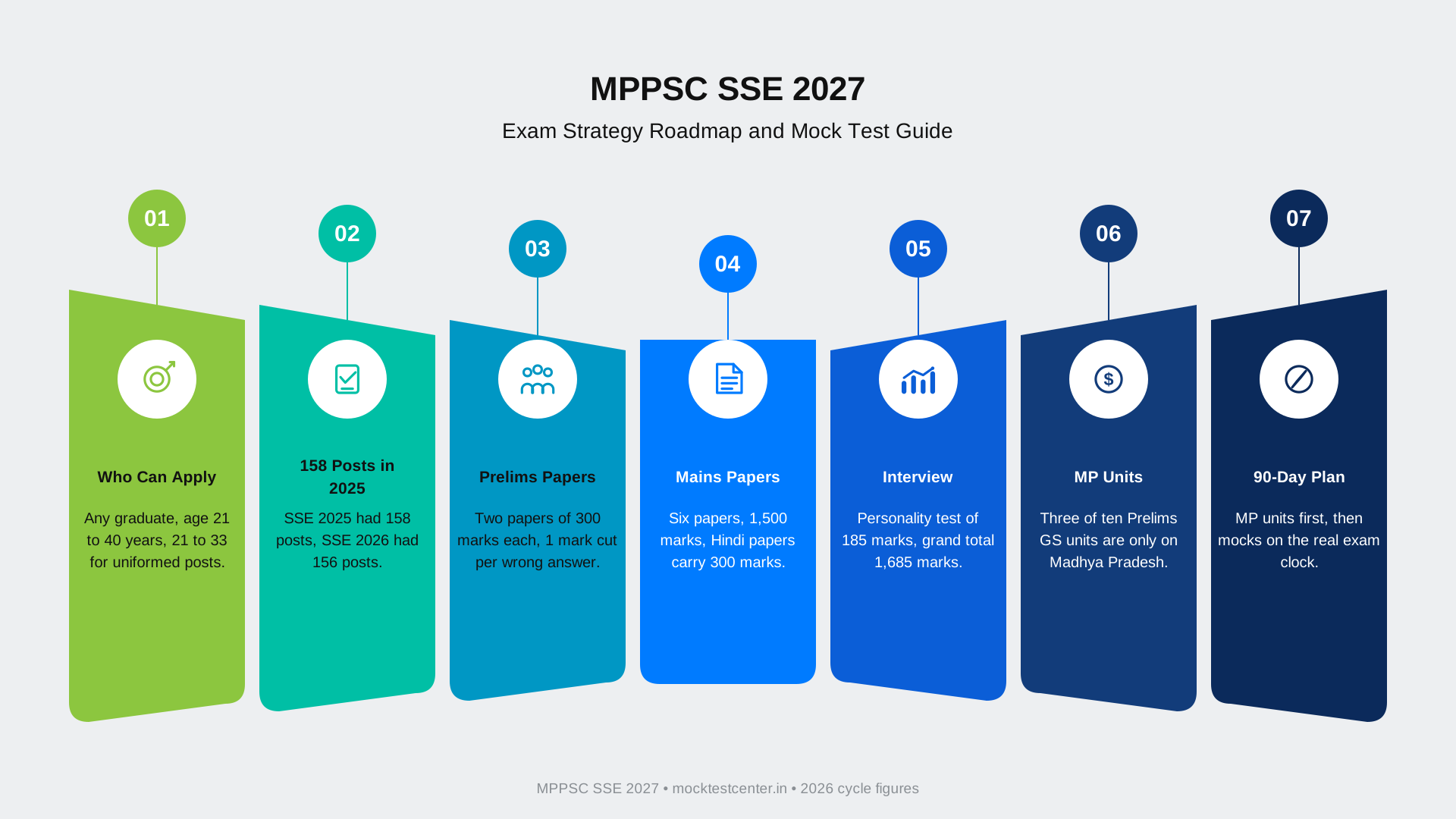
- Who can apply for MPPSC SSE 2027
- The Prelims pattern, old and new
- The Mains pattern, old and new
- Interview, merit list and the 87 and 13 split
- Fee, application and the late fee trap
- How a cycle runs, from notification to appointment
- A 90 day plan for Prelims
- A 90 day plan for Mains and interview
- Five mistakes that cost SSE candidates marks
- Sources
MPPSC SSE 2027: Complete Exam Guide
The Madhya Pradesh Public Service Commission runs the State Service Examination, known as MPPSC SSE, to fill Group A and Group B posts in the Madhya Pradesh government. This MPPSC SSE 2027 guide works from the two live cycles, SSE 2025 and SSE 2026, because no fresh SSE notification has appeared yet and the next advertisement will follow the shape of these two cycles.
SSE 2025 advertised 158 posts. Its Prelims took place on 16 February 2025 and its result came out on 5 March 2025, with 3,866 candidates shortlisted for Mains. SSE 2026 advertised 155 posts in its first notice, later fixed at 156 by corrigendum. Its Prelims took place on 26 April 2026, its result came out on 22 May 2026 with 3,044 candidates shortlisted, and its Mains ran from 7 to 12 September 2026.
Two things make this exam different from most state civil service exams. First, the pattern changed between these two cycles. Prelims moved from 200 marks per paper to 300, negative marking arrived, and Mains moved from 1,400 marks to 1,500 with the interview moving from 175 to 185. Second, MPPSC declares SSE results in two parts because cases on OBC reservation are still pending in court. Both facts sit at the centre of this MPPSC SSE 2027 guide, and both shape how a candidate should plan.
MPPSC SSE 2027 at a glance
| Detail | SSE 2025, the anchor cycle | SSE 2026, the newest cycle |
|---|---|---|
| Advertisement | Dated 31 December 2024, as per the notification | Advt. No. 29/2025, dated 31 December 2025 |
| Posts | 158 State Service and Forest Service posts | 155 in the first notice, fixed at 156 by corrigendum of 20 May 2026 |
| Application window | 3 to 17 January 2025 | 10 January to 9 February 2026 |
| Application fee | Rs 500 general and other state, Rs 250 MP reserved categories | Rs 500 general and other state, Rs 250 MP reserved categories |
| Age limit | 21 to 40 years, 21 to 33 for uniformed posts, as on 1 January 2025 | 21 to 40 years, 21 to 33 for uniformed posts, as on 1 January 2026 |
| Prelims | 16 February 2025, two papers of 200 marks each | 26 April 2026, two papers of 300 marks each |
| Prelims result | 5 March 2025, 3,866 candidates qualified | 22 May 2026, 3,044 candidates qualified |
| Mains | Six papers, 1,400 marks, scheduled 9 to 14 June 2025 | Six papers, 1,500 marks, held 7 to 12 September 2026 |
| Interview | 175 marks, total 1,575 | 185 marks, total 1,685 |
| Official website | mppsc.mp.gov.in | mppsc.mp.gov.in |
Read the table as the skeleton and the rest of this MPPSC SSE 2027 guide as the flesh. The dates belong to the 2025 and 2026 cycles. The newest pattern, the age rule and the fee structure carry over to the next advertisement unless MPPSC changes them in print.
158 posts, 155 posts, 283 posts and 191 posts: which number is which
Search results for MPPSC SSE throw four different vacancy numbers at a candidate, and each one belongs to a different cycle. Sorting them out takes five minutes and saves months of planning on the wrong figure.
The 158 figure is SSE 2025. MPPSC advertised 158 State Service and Forest Service posts, opened applications on 3 January 2025, closed them on 17 January 2025, and held Prelims on 16 February 2025. Scroll reported the Prelims result on 5 March 2025 and confirmed the 158 figure. Utkarsh reported the same dates and the same count. This is the anchor cycle for this guide.
The 155 figure is SSE 2026. MPPSC issued Advt. No. 29/2025 on 31 December 2025 for 155 State Service posts, opened applications on 10 January 2026, and closed them on 9 February 2026. Prepp, PW Live and TaiyarHo all report the 155 figure and the same dates. The Times of India reported that about 1.35 lakh candidates applied for these 155 posts, which puts the applicant to post ratio near 870 to 1. That number explains why Prelims cutoffs stay high even when the paper looks easy.
The 155 figure then moved. Corrigendum 04/29/2025 of 20 May 2026 fixed the SSE 2026 posts at 156, with 140 in the main part and 16 in the provisional part. The change is small, one post, but it shows a habit candidates should copy. MPPSC corrects its own vacancy count after the first notice, so the count in the first advertisement is a starting point and the corrigendum is the final word.
The 283 figure is old. It belongs to the State Service Examination 2021, advertised as Advt. No. 10/2021 with 283 posts and a last date of 27 May 2022. Trackers still carry that page, and a search that mixes cycles can easily surface it as if it were current. It has nothing to do with SSE 2025 or SSE 2026.
The 191 figure is a combined count. Advt. No. 29/2025 covered 155 State Service posts and Advt. No. 30/2025 covered the Forest Service posts alongside it. Some trackers add the two advertisements and report 191 posts for the 2026 recruitment as a whole. The State Service figure on its own is 155, later 156. A candidate who quotes 191 as the SSE vacancy count is counting two exams as one.
One more naming trap deserves a note. Some trackers call the 155 post drive SSE 2025 because its advertisement number carries 2025, while others call it SSE 2026 because its Prelims fell in 2026. Times Now called it SSE 2025 in a story dated 2 January 2026, and Prepp calls the same drive SSE 2026. Both labels point at the same advertisement, Advt. No. 29/2025 dated 31 December 2025, with Prelims on 26 April 2026. This guide calls it SSE 2026, after its Prelims year, and gives the advertisement number every time so the reader can match it.
Which posts does SSE fill
SSE fills the posts that run a district. The Deputy Collector, called Deputy District Magistrate in some notifications, sits at the top of the list and draws the largest share of serious aspirants. The Deputy Superintendent of Police follows, and then a long list of departmental posts that most candidates only study after they clear Prelims. That order is a mistake. The post list decides the age limit, the physical standards and the service a candidate spends a career in, so it deserves attention before the first mock test.
In SSE 2025 the largest blocks were Block Development Officer with 65 posts, Deputy Superintendent of Police with 22, MP Subordinate Revenue Service with 14, State Administrative Service Deputy District Magistrate with 10, Naib Tehsildar with 6, and Cooperative Inspector with 2. The Block Development Officer count dominates the 2025 list. A candidate who wants a field posting in rural development had 65 openings in that cycle, more than the Deputy Collector and DSP counts combined.
In SSE 2026 the shape changed. Deputy Collector held 17 posts, Deputy Superintendent of Police held 18, Block Women Empowerment Officer held 39, Cooperative Inspector and Cooperative Extension Officer held 16, Additional Assistant Development Commissioner held 16, Excise Sub Inspector held 10, Block Development Officer held 5, and Naib Tehsildar held 4. The Block Women Empowerment Officer count of 39 is the single largest block in the 2026 list, and it did not appear in the 2025 headline counts at all. Post counts swing hard between cycles because departments send their vacancy lists afresh each year, and no post is guaranteed a place in the next advertisement.
Other posts in the 2026 list include Commercial Tax Officer, Assistant Director in Public Relations, Child Development Project Officer, Sub Registrar, Assistant Labour Officer, Chief Municipal Officer in Class B and Class C, District Registrar, and Assistant Commissioner in the cooperative department. The advertisement prints the pay scale for each post, and it still prints the older scales. Deputy Collector and Deputy Superintendent of Police show Rs 15,600 to 39,100 with Rs 5,400 grade pay. Cooperative Inspector shows Rs 36,200 to 1,14,800 on the newer scale. Dearness allowance and other allowances come on top of these scales as the state sanctions them from time to time.
Forest Service posts run alongside SSE in a separate advertisement. In the 2024 cycle MPPSC advertised 88 posts in total, 60 for State Service and 28 for Forest Service. A candidate who wants the Forest Service should watch for its own advertisement number, because its posts, physical standards and service conditions differ from the State Service list.
Who can apply for MPPSC SSE 2027
A candidate needs a bachelor degree in any discipline from a university set up by a central or state Act, or deemed under the UGC Act, or an equivalent qualification. Any subject qualifies. Final year students may take Prelims but must pass graduation by the last date of the Mains application. That rule helps a final year student start a year early, and it punishes one who treats the degree as a formality, because a failed final paper after Prelims ends the attempt at the Mains application stage.
The age window runs from 21 to 40 years for non uniformed posts and from 21 to 33 years for uniformed posts, as on 1 January of the exam year. The lower limit of 21 is firm for every category. The uniformed posts are the police and excise posts, and their lower upper limit catches candidates who assume the 40 year limit covers every post. A 35 year old general candidate can apply for Deputy Collector but not for Deputy Superintendent of Police.
| Category | Upper age limit |
|---|---|
| General, non uniformed posts | 40 years |
| General, uniformed posts | 33 years |
| MP domicile SC, ST, OBC, women, PwD, government employees | 45 years, 38 for uniformed posts |
| Ex-servicemen | Defence service deducted, result not more than 3 years above the limit |
Relaxation of five years applies to MP domicile SC, ST, OBC, women, PwD candidates, government, corporation, board and autonomous body employees, and Nagar Sainik. With all relaxations the age may not exceed 45 years, or 38 years for uniformed posts. Reservation and age relaxation go only to natives of Madhya Pradesh. Candidates of these categories from other states are treated as unreserved, which means they pay the general fee and compete for unreserved posts.
Uniformed posts also carry physical standards. Men need a height of 168 cm and a chest of 84 cm, 89 cm expanded. Women need a height of 155 cm. These standards are checked after the written stages, and a candidate who clears Mains but fails the physical test loses the uniformed post. Candidates aiming at DSP should measure themselves in the first month, not after the Mains result.
There is no attempt limit in the MPPSC SSE rules as published. The age window is the only clock. A candidate who starts at 21 gets many attempts, and a candidate who starts at 35 gets few. That makes the first attempt worth taking seriously even when preparation feels incomplete, because Prelims experience itself is part of preparation.
The Prelims pattern, old and new
Prelims is a screening test. Its marks never count in the final merit. It exists to cut about 1.35 lakh applicants down to about 3,000 Mains candidates, and it does that job with two objective papers on one day.
In SSE 2025 each paper carried 200 marks, with 100 questions of 2 marks each. Paper I covered General Studies and Paper II covered the General Aptitude Test. Both papers ran for two hours. Paper I ran from 10 AM to 12 noon and Paper II ran from 2:15 PM to 4:15 PM on 16 February 2025. Paper II was qualifying only.
In SSE 2026 the papers grew. Each paper now carries 300 marks, with 100 questions of 3 marks each, and negative marking applies. Marks work out as 3R minus W, so each wrong answer costs 1 mark and each right answer earns 3. An unanswered question costs nothing. The change matters for strategy. Under the old 2 mark scheme a wrong answer cost half a right one. Under the new scheme a wrong answer costs a third of a right one, which sounds gentler, but the qualifying bar also rose, and the paper now punishes blind guessing across 100 questions instead of rewarding it.
| Paper | SSE 2025 | SSE 2026 |
|---|---|---|
| Paper I, General Studies | 100 questions, 200 marks, 2 hours | 100 questions, 300 marks, 2 hours, 10 AM to 12 noon |
| Paper II, General Aptitude Test | 100 questions, 200 marks, 2 hours, qualifying | 100 questions, 300 marks, 2 hours, 2:15 PM to 4:15 PM, qualifying |
| Marks per question | 2 marks | 3 marks |
| Negative marking | None reported in the 2025 plan | 1 mark deducted per wrong answer |
| Qualifying mark, Paper II | 33 percent as per the notification | 40 percent general, 30 percent SC, ST, OBC, EWS, PwD |
| Shortlisting for Mains | 3,866 candidates from Prelims | Up to 20 times the vacancies, 3,044 candidates qualified |
Only Paper I marks decide the Prelims merit list. Paper II marks never enter the ranking. A candidate must still clear the Paper II qualifying mark, and the bar is 40 percent for unreserved candidates and 30 percent for SC, ST, OBC, EWS and PwD candidates in the 2026 plan. A candidate who scores high in Paper I and falls short in Paper II goes home, which happens every year to candidates who treat the aptitude paper as an afterthought.
The General Studies paper carries ten units, and three of them belong only to Madhya Pradesh. History of India, Geography of India, Constitutional System of India and Madhya Pradesh, Economy of India and Madhya Pradesh, Science, Environment and Health, International, National and Current Events of Madhya Pradesh, Information and Communication Technology, and Tribes of Madhya Pradesh with their heritage, folk culture and folk literature make up the list. The MP units cover the state dynasties and major events, the state part in the freedom movement, tribes and their dialects, festivals, folk music and folk literature, writers and their works, tourist places and World Heritage sites, rivers, forests, soils, minerals, crops, irrigation projects and industries, the Governor, Cabinet, Legislative Assembly and High Court, Panchayati Raj, and schemes such as One District One Product.
The General Aptitude Test covers comprehension, communication skills, logical reasoning, decision making, general mental ability, basic numeracy and data interpretation at Class 10 level, and Hindi comprehension. The Hindi comprehension questions come only in Hindi, at about Class 10 level. Both papers are set in Hindi and English, and where the Hindi and English versions of a question differ, the Hindi version is final. A candidate who reads only the English version and finds a question odd should check the Hindi text before marking an answer.
Shortlisting runs to 20 times the vacancies, category wise. For 156 posts that means about 3,120 Mains seats, and the 2026 result shortlisted 3,044. The ratio of applicants to Mains seats runs near 44 to 1, and the ratio of applicants to final posts runs near 870 to 1. Prelims is the widest gate in the exam, and it is also the gate where the largest number of prepared candidates fall.
The Mains pattern, old and new
Mains decides the merit list. It is descriptive, it runs over six days, and it carries far more weight than Prelims. The 2025 Mains carried 1,400 marks and the 2026 Mains carries 1,500, so a candidate who prepares from an old pattern book is preparing for the wrong exam.
The 2025 Mains had six papers. General Studies Paper I, II and III carried 300 marks each. General Studies Paper IV, on ethics, carried 200 marks. General Hindi carried 200 marks and Hindi Essay carried 100 marks. The total was 1,400, and the interview added 175 for a grand total of 1,575. Optional papers had already been removed from the pattern before this cycle, so every candidate wrote the same six papers.
The 2026 Mains, under the revised exam plan and syllabus of 21 January 2026, also has six papers but a different split. General Studies Paper I covers History and Geography, Paper II covers Political Science and Sociology, Paper III covers Economics and Science, Technology and Public Health, and Paper IV covers Philosophy, Psychology, Public Administration and Case Study in one part and Entrepreneurship, Management, Personality Development and Case Study in the other. Each General Studies paper carries 300 marks, split 150 and 150 between its two parts, and each runs for three hours. Paper V covers General Hindi and Grammar for 200 marks in two hours, in Hindi only. Paper VI covers Hindi Essay and Draft Writing for 100 marks in two hours and 30 minutes, in Hindi only. The total is 1,500, and the interview adds 185 for a grand total of 1,685.
| Paper | SSE 2025 | SSE 2026 |
|---|---|---|
| General Studies Paper I | 300 marks, 3 hours | History and Geography, 150 plus 150, 3 hours |
| General Studies Paper II | 300 marks, 3 hours | Political Science and Sociology, 150 plus 150, 3 hours |
| General Studies Paper III | 300 marks, 3 hours | Economics and Science, Technology and Public Health, 150 plus 150, 3 hours |
| General Studies Paper IV | 200 marks, 3 hours | Philosophy, Psychology, Public Administration, Entrepreneurship, Management, 150 plus 150, 3 hours |
| Paper V, General Hindi | 200 marks, 3 hours | General Hindi and Grammar, 200 marks, 2 hours, Hindi only |
| Paper VI, Hindi Essay | 100 marks, 2 hours | Hindi Essay and Draft Writing, 100 marks, 2 hours 30 minutes, Hindi only |
| Mains total | 1,400 marks | 1,500 marks |
| Interview | 175 marks | 185 marks |
| Grand total | 1,575 marks | 1,685 marks |
Each part of General Studies Papers I to III has 30 questions. Fifteen very short answers carry 2 marks each with a 20 word limit, ten short answers carry 7 marks each with a 60 word limit, and five long answers carry 10 marks each with a 200 word limit. Each part of Paper IV has 29 questions, with sixteen of 2 marks, eight of 7 marks, four of 11 marks and one case study of 18 marks. Paper VI has two essays of 50 and 20 marks, a draft writing question of 15 marks and a report of 15 marks. Candidates who choose English for General Studies must still answer Paper VI in Hindi.
The minimum in each Mains paper is 40 percent for unreserved candidates and 30 percent for SC, ST, OBC, EWS and PwD candidates. A candidate who scores high in three papers and falls below the minimum in the fourth does not reach the interview. The Hindi papers cause more failures than candidates expect, because a candidate who writes General Studies in English still has to write a Hindi essay, a Hindi draft and a Hindi report under time pressure.
Mains has no separate paper on Madhya Pradesh. The state sits inside each General Studies paper. History asks about MP dynasties, the princely states of Gondwana, Bundeli, Bagheli, Holkar, Scindia and Bhopal, and tribal heroes such as Tantya Bhil and Bhimaji Nayak. Geography has a unit on the physical divisions, rivers, soils, forests, crops and industries of MP. Political Science covers the formation of MP in 1956, its partition in 2000, the state legislature, the High Court, district administration and Panchayati Raj. Sociology and Economics add the tribes and folk culture of MP and an overview of the state economy. A candidate who studies national topics and skips the MP units inside each paper gives away marks in every paper instead of one.
Interview, merit list and the 87 and 13 split
Three times the posts, category wise, are called for interview. For 156 posts that means about 468 interview calls. The interview carries 185 marks in the 2026 plan and 175 in the 2025 plan, and there is no pass mark printed for it. Final merit is the sum of Mains and interview marks. On a tie, higher written marks rank first, then the older candidate. Selected candidates are appointed on two years probation.
One feature of MPPSC results needs plain stating. Because cases on OBC reservation are pending, MPPSC declares SSE results in two parts, a main part of 87 percent of the posts and a provisional part of 13 percent. Candidates in the provisional part stay provisional until the courts decide. The 2026 corrigendum shows the split in numbers, 140 posts in the main part and 16 in the provisional part. A candidate whose rank falls in the provisional part has cleared the exam but waits for a court outcome before the appointment turns final. Any guide that quotes a single merit list without this split is hiding the last step of the process.
The interview itself tests what the written papers cannot. The board reads the candidate record, asks about the home district, the degree subject, current events in MP and India, and the service the candidate prefers, and watches how the candidate handles a question with no ready answer. The marks are small next to 1,500, about 11 percent of the total, but the interview decides close ranks. A gap of 20 marks in Mains can vanish in the interview, and a gap of 20 marks the other way can appear just as fast.
Fee, application and the late fee trap
The fee is Rs 500 for general and other state candidates and Rs 250 for MP domicile SC, ST, OBC, EWS and PwD candidates. Trackers also report totals of Rs 540 and Rs 290, and the difference is the portal charge of Rs 40, which some listings fold into the fee and others list apart. The correction charge is Rs 50. Applications run online through MP Online or the MPPSC website, and the form asks for post preferences in the same sitting, so a candidate should rank the posts before opening the form rather than during it.
The 2026 cycle added a late fee ladder that candidates should read as a warning. Forms were taken with a fee of Rs 3,000 till 16 February 2026 and Rs 25,000 till 3 April 2026. The Rs 25,000 figure is not a fee. It is a penalty for leaving the form to the last week, and it costs more than fifty normal applications. The correction window ran from 15 January to 11 February 2026 in one tracker listing and from 20 to 27 February 2026 in another, and the two windows belong to two different notices in the cycle, the first for the original dates and the second after the Prelims date moved. A candidate should trust the window printed on the MPPSC website on the day of applying, not a tracker page copied from an earlier notice.
Applications for SSE 2025 ran from 3 to 17 January 2025 with no late fee ladder reported. Applications for SSE 2026 ran from 10 January to 9 February 2026. The window is short in both cycles, about two to four weeks, and the last day brings the usual server load. A candidate who files on the first day gets the correction window as a safety net. A candidate who files on the last day gets the same window but no time to use it well.
How a cycle runs, from notification to appointment
MPPSC notifies SSE in the last week of December. SSE 2024 was notified on 30 December 2023, SSE 2025 was notified on 31 December 2024 as per the notification, and SSE 2026 was notified on 31 December 2025 as Advt. No. 29/2025. Applications open in the first week of January and close before the end of January or in early February. Prelims follows in February or April, and the result comes in about three weeks. In 2025 Prelims was held on 16 February and the result came on 5 March, a gap of 17 days. In 2026 Prelims was held on 26 April and the result came on 22 May, a gap of 26 days.
Mains follows after a gap of three to five months. Mains applications open for about three weeks, and the exam runs over six days at twelve centres. In 2026 the centres were Indore, Bhopal, Gwalior, Jabalpur, Chhindwara, Ratlam, Satna, Sagar, Shahdol, Barwani, Ujjain and Balaghat. The interview comes after the Mains result, and the final result follows in two parts, main and provisional.
The 2025 Mains needs a careful note. It was scheduled for 9 to 14 June 2025, and the Indian Express exam calendar recorded that it was not conducted as per schedule and that new dates would be announced. No held date for the SSE 2025 Mains was confirmed in the sources read for this guide. A candidate who quotes a 2025 Mains result date from a tracker should check it against the MPPSC website first, because the 2025 cycle ran into the 2026 cycle and the two sets of dates sit side by side on tracker pages.
The earlier cycles show the same December rhythm. SSE 2024 advertised 88 posts, 60 State Service and 28 Forest Service, notified on 30 December 2023, with applications from 19 January to 18 February 2024 and Prelims on 28 April 2024. SSE 2023 advertised 227 posts, notified on 5 September 2023, with applications from 22 September to 21 October 2023 and Prelims on 17 December 2023. The vacancy count swings from 88 to 227 to 158 to 156 across four cycles, which is why no candidate should plan a career on a single year count. The exam returns every year, the count moves, and the candidate who stays ready across two cycles has a better chance than the one who waits for a big vacancy year.
A 90 day plan for Prelims
Ninety days is enough for Prelims if the candidate already knows the national subjects and short if the MP units are still untouched. The plan below assumes six to eight hours a day and splits the time by the weight of the paper, not by the comfort of the subject.
Days 1 to 30 build the base. Read the ten General Studies units in order and finish the three MP units in this block, not later. History of MP, geography of MP and tribes of MP take about ten days together, and they return marks in both Prelims and Mains. Cover polity and economy next, because they carry the most questions after history and geography. Keep a notebook of MP facts alone, one page per district for the major districts, one page per tribe, one page per river system. End each week with a 100 question mock on the units finished so far, and write down every question missed with the reason, not just the right answer.
Days 31 to 60 shift to practice. Take two full mocks a week, Paper I in the morning and Paper II in the afternoon, on the real clock. Score Paper II against the qualifying bar of 40 percent and treat a score below it as a fail even when Paper I looks strong. Read current events daily, with MP events first, because unit 8 asks about international, national and current events of Madhya Pradesh together. Start the aptitude paper in this block if it has been ignored so far. Comprehension, reasoning and Class 10 numeracy need speed more than knowledge, and speed comes only from timed sets.
Days 61 to 90 turn to revision and previous papers. Read the MPPSC question papers from the last five years and note which topics repeat. MP history, MP geography, the state budget, central schemes in MP, major rivers and districts recur. Revise the MP notebook twice in this block, once at day 65 and once at day 85. Cut new reading after day 75. New topics in the last two weeks add stress faster than they add marks. In the last week take two full mocks on the real timetable, Paper I at 10 AM and Paper II at 2:15 PM, with the real gap between them. Mock tests taken at random hours build knowledge. Mock tests taken on the real clock build exam temperament.
A 90 day plan for Mains and interview
Mains needs a different plan because it tests writing, not recognition. A candidate who starts answer writing after the Prelims result has about fifteen weeks in a normal cycle, and in 2026 the gap from the Prelims result on 22 May to Mains on 7 September was fifteen weeks and two days. That gap is the whole Mains preparation for most candidates, so the writing habit should start before Prelims, not after it.
Days 1 to 30 of Mains preparation cover the four General Studies papers in pairs. History with geography, then polity with sociology, then economics with science and technology, then philosophy, psychology, public administration and case study. Write two answers a day in the real format, one very short answer of 20 words and one short answer of 60 words, and count the words. The word limits are part of the exam. An answer that runs to 120 words in a 60 word slot loses marks even when the facts are right.
Days 31 to 60 add the Hindi papers. Paper V needs grammar practice and Paper VI needs two essays, a draft and a report. Write one Hindi essay a week and one draft a week, and read one Hindi editorial a day to keep the formal register alive. Candidates who write General Studies in English lose the most marks here, because they practise Hindi only in the last month. Hindi carries 300 of the 1,500 Mains marks, a fifth of the total, and it deserves a fifth of the study time.
Days 61 to 90 run full mocks on the six day pattern. Write one paper a day in three hour sittings, mark it against the model answers, and rewrite the weakest answers the next day. Keep the last ten days for the MP units inside each paper, because the state content is the part that fades fastest. In the interview stage, read the home district, the degree subject and the last six months of MP current events, and practise answering aloud. The board tests composure as much as knowledge, and a candidate who has never answered aloud will find the first real question harder than any written one.
Five mistakes that cost SSE candidates marks
The first mistake is preparing from the old pattern. Prelims moved to 300 marks per paper with negative marking, Mains moved to 1,500 marks with a new Paper IV split, and the interview moved to 185 marks. A candidate who buys a 2024 pattern book and trusts it will practise the wrong marks scheme for a year. Check the pattern against the newest advertisement before buying any book.
The second mistake is skipping the MP units. Three of the ten Prelims units belong only to Madhya Pradesh, and the state sits inside every Mains paper. A candidate who studies national history and geography and leaves MP for the last month gives away the easiest marks in the exam, because MP questions repeat from a small set of topics and the state sources for them are short.
The third mistake is ignoring Paper II. It is qualifying, and its marks never count, so candidates treat it as free. The bar is 40 percent for general candidates, and a candidate who scores 150 in Paper I and 110 in Paper II fails Prelims. Give the aptitude paper one hour a day from the first month and the risk disappears.
The fourth mistake is guessing in Prelims. Negative marking at 1 mark per wrong answer turns wild guessing into a losing strategy under the new scheme. Attempt questions that can be narrowed to two options, and leave the rest. A blank answer costs nothing. A wrong answer costs marks earned elsewhere.
The fifth mistake is waiting for the result before preparing for the next stage. The 2026 cycle gave fifteen weeks between the Prelims result and Mains, and under four months between the last date and Prelims. Every stage rewards candidates who prepare for the next one while writing the current one. Start answer writing in the first month, even before the syllabus feels complete. Short answers written early beat long answers started late.
Candidates preparing for MPPSC SSE 2027 also practise with mock tests for UPSC CSE Prelims 2027, UPPSC PCS 2027, KPSC KAS 2027, JKAS 2027, UPPSC RO ARO 2027, SSC CGL 2027, IBPS PO 2027, SBI PO 2027, RBI Grade B 2027 and UP Police SI 2027.
Sources
Scroll, MPPSC PCS Prelims result 2025 declared, Prelims 16 February 2025, 158 vacancies, result 5 March 2025
Utkarsh, MPPSC SSE Prelims Result 2025, result 5 March 2025, Prelims 16 February 2025, 158 vacancies, answer key 17 February 2025
Subkuz, MPPSC 2025 State Service Preliminary Exam Results, 3,866 qualify, Mains scheduled 9 to 14 June 2025
Prepp, MPPSC State Service 2026, notification 31 December 2025, 155 vacancies, Prelims 26 April 2026, Mains 7 to 12 September 2026
PW Live, MPPSC Exam 2026, 155 vacancies, Prelims 26 April 2026, Mains 7 to 12 September 2026
Times of India, MPPSC SSE Prelims 2026, over 1.35 lakh apply for 155 posts, Prelims 26 April 2026
GK24, MP Exams 2026, MPPSC SSE and MPESB Group 2 pattern, syllabus, dates, Advt. No. 29/2025, revised exam plan 21 January 2026, corrigendum 20 May 2026, Mains notice 24 May 2026
StudyIQ, MPPSC Exam Pattern 2025, Prelims 2 papers of 200 marks, Mains 6 papers 1,400 marks, interview 175 marks
Indian Express Education, MPPSC Exam 2025, Mains scheduled 9 to 14 June 2025, not conducted as per schedule
SSC Adda, MPPSC Notification 2024, 88 posts, notification 30 December 2023, Prelims 28 April 2024
Jagran Josh, MPPSC SSE 2023 notification, 227 vacancies, notification 5 September 2023, Prelims 17 December 2023
Govt Job Guru, MPPSC State Service Exam 2022, Advt. No. 10/2021, 283 posts
PlacementStore, MPPSC SSE Recruitment 2026, 191 posts across Advt. 29/2025 and Advt. 30/2025







