
About MP Patwari 2027 Exam Series
📖 Table of Contents
- MP Patwari 2027 at a glance
- 2,306 posts, and where the 200 Patwari seats sit
- Who can apply for the Patwari post
- Age limit as on 1 January 2026
- Fee, and why some pages show Rs 560
- Dates that matter for MP Patwari 2027
- Exam pattern: one paper, 200 questions, two parts
- Qualifying marks and how the merit list works
- The job: what a Patwari does
- What the 2023 cycle tells MP Patwari 2027 aspirants
- How to prepare for Part A
- How to prepare for Part B
- A 90 day plan that fits the real paper
- Five mistakes that cost MP Patwari candidates marks
- Sources
MP Patwari 2027: Complete Exam Guide
The Madhya Pradesh Employees Selection Board, known as MPESB, opened the Group 2 Sub Group 4 Combined Recruitment Examination 2026 on 4 August 2026. The MP Patwari 2027 cycle sits inside that combined test, and it carries 200 Patwari posts reserved for candidates with disabilities, alongside 2,106 other posts across Madhya Pradesh government departments.
That headline needs care, because most trackers quote the wrong total. Some say 2,106 posts, and some say 2,306 posts. Both numbers are right, and both are incomplete on their own.
The combined test covers 2,306 posts in total, made of 200 Patwari posts plus 2,106 other posts. Any page that calls the whole test a Patwari recruitment of 2,106 posts has mixed up the combined total with the Patwari count.
The exam itself has already happened. It ran as a computer based test from 22 September 2026, in two shifts a day, with the admit card out on 18 September 2026 and the provisional answer key out on 6 October 2026. The result is awaited, and this MP Patwari 2027 guide works from the 2026 cycle and shows how the next one will run.
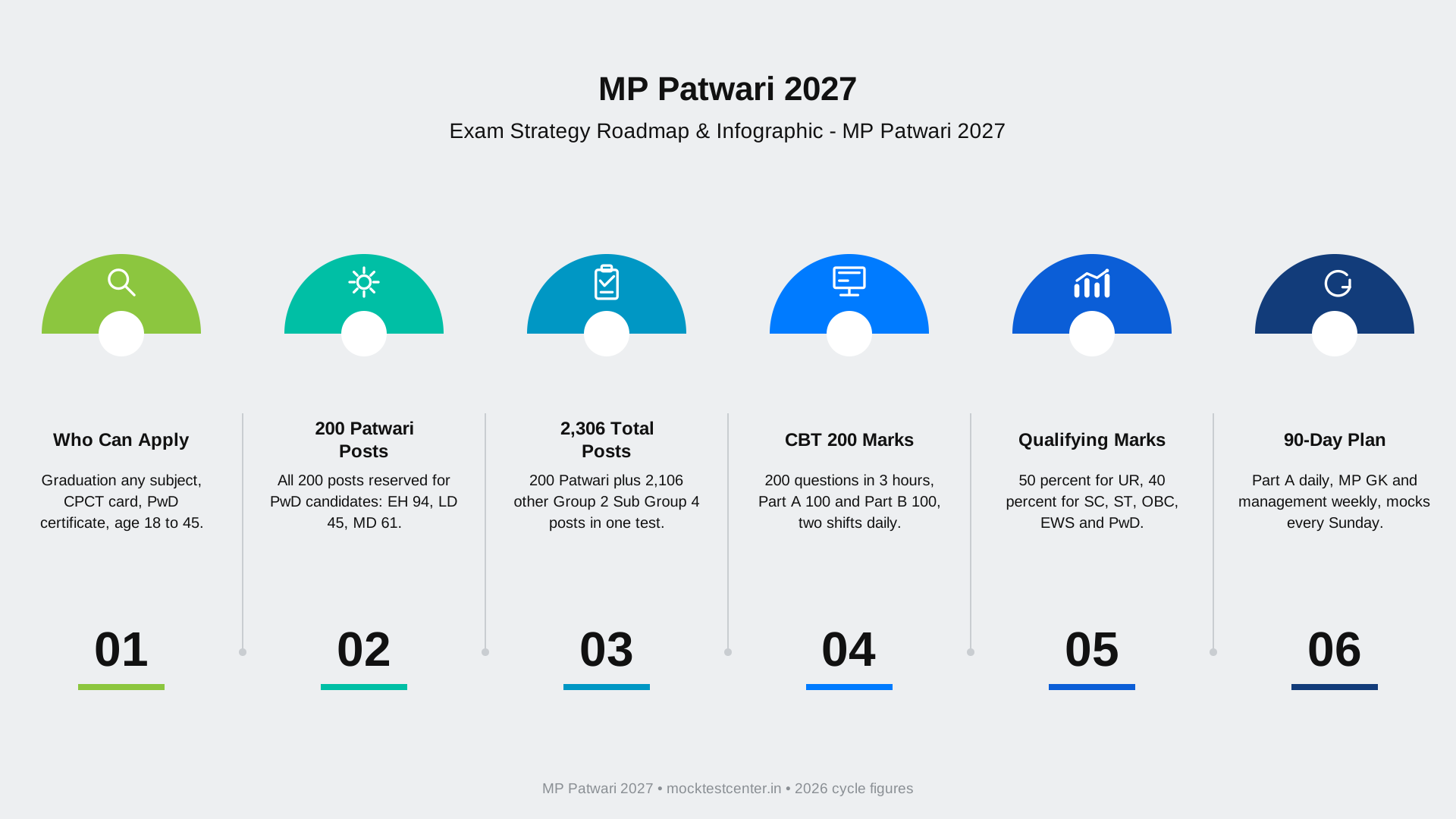
That matters because the Group 2 Sub Group 4 test follows the same shape every cycle. One paper of 200 questions in two parts of 100 marks each. Three hours on the clock, and a qualifying line that decides who reaches document checking. The Patwari post inside it is special, because in 2026 all 200 seats went to candidates with disabilities, and that rule shapes who should prepare for the next cycle.
MP Patwari 2027 at a glance
| Detail | MP Patwari 2027, the live cycle |
|---|---|
| Conducting body | Madhya Pradesh Employees Selection Board, Bhopal |
| Examination | Group 2 Sub Group 4 Combined Recruitment Examination 2026 |
| Notification | 4 August 2026 |
| Total posts | 2,306, made of 200 Patwari plus 2,106 other posts |
| Patwari posts | 200, all reserved for PwD candidates |
| Application window | 4 August to 21 August 2026, extended from 18 August |
| Correction window | 4 August to 23 August 2026 |
| Application fee | Rs 500 UR, Rs 250 reserved categories of MP, plus portal fee |
| Age as on | 1 January 2026, 18 to 45 for Patwari PwD posts |
| Exam | Computer based test from 22 September 2026, 200 questions, 200 marks, 3 hours |
| Admit card | 18 September 2026 |
| Answer key | 6 October 2026, provisional |
| Result | Awaited as of 20 November 2026 |
| Official website | esb.mp.gov.in |
Read the table as the skeleton and the rest of this MP Patwari 2027 guide as the flesh. The dates belong to the 2026 cycle. The pattern and the age rule carry over to the next advertisement, with the fee and the pay, unless MPESB changes them in print.
2,306 posts, and where the 200 Patwari seats sit
The combined test covers 2,306 posts, and the split is the first thing to understand. The Patwari chapter of the notification covers 200 posts under the Land Resource Management Department in Gwalior. Every one of those 200 seats is reserved for candidates with disabilities. The rest of the notification covers 2,106 posts across a large number of government departments, and those posts carry the normal reservation rules.
The 200 Patwari seats split across three disability categories. Hearing impaired candidates, marked EH, get 94 seats. Locomotor disability candidates, marked LD, get 45 seats.
Multiple disability candidates, marked MD, get 61 seats. The three numbers add to 200, and each category gets 2 percent horizontal reservation inside the total, making 6 percent in all.
Visually impaired candidates cannot apply for the Patwari post. The Revenue Department order dated 11 May 2009 bars visual impairment for this post, and the notification repeats that rule. A visually impaired candidate who applies for Patwari will fail document checking, so such candidates should look at the other 2,106 posts in the same test instead.
The Patwari seats spread across the districts of Madhya Pradesh, and Rewa takes the largest share with 17 seats. Dhar follows with 11, Barwani with 10. Balaghat and Khargone have 9 each, and Chhindwara has 8. The remaining districts take between 1 and 5 seats each, and the full district wise list sits in the first chapter of the official notification.
| Disability category | Patwari seats |
|---|---|
| EH, hearing impaired | 94 |
| LD, locomotor disability | 45 |
| MD, multiple disabilities | 61 |
| Total | 200 |
The other 2,106 posts span more than 100 post and department combinations, and the largest blocks are easy to name. Assistant Sub Inspector takes 530 seats, the largest single block in the whole test. Computer Operator and Assistant Grade 3 takes 124 seats. Deputy Auditor takes 105 seats.
Statistical Investigator takes 88 seats. Rural Agriculture Extension Officer takes 82 seats. Assistant Accountant takes 72 seats. Junior Assistant takes 67 seats.
That spread is the real opportunity in this test. A candidate who applies for Patwari alone competes for 200 seats. A candidate who applies for several posts in the same test, choosing every post the candidate qualifies for, competes for a share of 2,306 seats with one exam. The application form allows multiple post choices, and the smart move is to tick every post the candidate is eligible for.
Who can apply for the Patwari post
The Patwari post asks for four things. The candidate must be an Indian citizen and a domicile of Madhya Pradesh. The candidate must hold a graduation degree in any discipline from a recognised university.
The candidate must hold a valid CPCT score card covering Hindi typing and computer proficiency. And the candidate must hold a disability certificate from a competent authority in one of the three eligible categories, hearing impaired, locomotor disability or multiple disabilities.
CPCT stands for the Computer Proficiency Certification Test, run in Madhya Pradesh through MAP-IT. The score card proves Hindi typing and computer knowledge, and the Patwari post needs both, because the job runs on computers and Hindi records. Candidates who had not cleared CPCT at the time of application got a three year grace window after appointment to clear it, and the notification says the appointment will be cancelled if the candidate fails to clear it inside that window.
That grace window matters. It means a candidate without a CPCT score card could still apply in 2026 and clear the test after joining. It does not mean the CPCT requirement goes away. A candidate who joins on the grace window and then ignores CPCT for three years loses the job, so the sensible plan is to clear CPCT before the exam, not after joining.
Registration with the Madhya Pradesh Employment Exchange is mandatory for every post in this test, including Patwari. Candidates also needed Aadhaar registration proof and a valid original photo identity proof at the exam centre, and MPESB ran multi level biometric checks at entry. Electronic devices were banned from the exam hall.
Mobile phones stayed outside, and so did calculators and log tables. Digital watches and sunglasses stayed outside too.
The other 2,106 posts ask for different qualifications, ranging from Class 10 or 12 pass to graduation and technical qualifications, depending on the post and the department. Posts such as Assistant Grade 3 and Surveyor and Computer Operator each carry their own chapter in the notification, and candidates must check the post wise eligibility in the department wise section before applying. The same Employment Exchange registration rule applies to all of them.
Age limit as on 1 January 2026
Age counts as on 1 January 2026 for every post in this MP Patwari 2027 cycle. The Patwari posts for candidates with disabilities carry an age limit of 18 to 45 years for all categories, which is wider than the usual limit, because the whole Patwari chapter is a special recruitment drive for persons with disabilities.
The other Group 2 Sub Group 4 posts carry an age limit of 18 to 40 years for open and general competition direct recruitment. The limit rises to 18 to 45 years for MP domicile reserved category candidates. The same limit applies to government and board employees, to ex servicemen and to women candidates, through a five year relaxation on the maximum limit. EWS candidates get no age relaxation.
| Post category | Age limit as on 1 January 2026 |
|---|---|
| Patwari, PwD, all categories | 18 to 45 years |
| Other posts, general competition | 18 to 40 years |
| Other posts, reserved and women candidates | 18 to 45 years |
| Other posts, EWS candidates | 18 to 40 years, no relaxation |
In all cases, and after including any applicable relaxation, the maximum age limit does not exceed 45 years, except for contractual employees and categories listed under Rule 14 of the recruitment rules. Candidates near the edge should check the notification for the Rule 14 list before they decide.
Fee, and why some pages show Rs 560
The examination fee is Rs 500 for Unreserved candidates and Rs 250 for reserved category and Divyang candidates from Madhya Pradesh. Direct recruitment against backlog vacancies carries no fee. On top of the examination fee, the MP Online portal charges Rs 60 if the candidate applies through a kiosk or MP Online centre, or Rs 20 if the candidate applies through a registered citizen user login.
That portal fee explains the second set of numbers that some trackers show. A general candidate who applies through a kiosk pays Rs 500 plus Rs 60, which is Rs 560 in total. A reserved candidate who applies through a kiosk pays Rs 250 plus Rs 60, which is Rs 310 in total.
A candidate who applies through a citizen login pays Rs 520 or Rs 270 instead. The examination fee is Rs 500 and Rs 250, and the totals of Rs 560 and Rs 310 are the examination fee plus the kiosk portal fee.
The fee went with the form, and the last date for the fee was the same as the last date for the application. A form without the fee counted as incomplete, and the portal fee is not refunded if the candidate does not appear for the exam.
Dates that matter for MP Patwari 2027
| Event | Date |
|---|---|
| Notification | 4 August 2026 |
| Online application opens | 4 August 2026 |
| Last date to apply, original | 18 August 2026 |
| Last date to apply, extended | 21 August 2026 |
| Correction window | 4 August to 23 August 2026 |
| Exam starts | 22 September 2026, Tuesday, two shifts |
| Admit card | 18 September 2026 |
| Provisional answer key | 6 October 2026 |
| Result | Awaited as of 20 November 2026 |
The last date needs a note, because trackers disagree. The original last date was 18 August 2026. The board extended it to 21 August 2026.
Some tracker pages show 23 August 2026 as the last date, but 23 August was the last date of the correction window, not the last date to apply. The two dates are different, and a candidate who trusted the 23 August figure for the application would have missed the form.
The exam ran in two shifts a day. Shift 1 ran from 10 AM to 12 noon, with reporting from 8 AM and reading of instructions from 9:50 AM. Shift 2 ran from 3 PM to 5 PM, with reporting from 1 PM and reading of instructions from 2:50 PM. The three hour figure that some pages quote covers the full reporting and instruction and exam window per shift, and the answering time inside it is two hours.
Exam pattern: one paper, 200 questions, two parts
The written examination is a single online computer based test of 200 multiple choice questions for 200 marks, to be completed in three hours. Each correct answer earns 1 mark. The paper runs in Hindi and English, and it runs in two shifts a day at exam centres across the state.
The paper splits into two parts of 100 marks each. Part A covers General Science and General Hindi. It also covers General English and General Mathematics, with 25 questions in each subject.
Part B covers General Knowledge and Aptitude with General Computer Knowledge. It also covers General Reasoning and General Management, with 25 questions in each subject. Both parts count toward the merit list.
| Part | Subject | Questions | Marks |
|---|---|---|---|
| Part A | General Science | 25 | 25 |
| Part A | General Hindi | 25 | 25 |
| Part A | General English | 25 | 25 |
| Part A | General Mathematics | 25 | 25 |
| Part B | General Knowledge and Aptitude | 25 | 25 |
| Part B | General Computer Knowledge | 25 | 25 |
| Part B | General Reasoning | 25 | 25 |
| Part B | General Management | 25 | 25 |
| Total | 200 | 200 |
Negative marking is the one point on which trackers disagree. Testbook and PrepSahi report a deduction of 0.25 mark for each wrong answer. One other tracker page states that the exam carries no negative marking. This guide follows the 0.25 figure, because it appears in the pattern pages that reproduce the rulebook in full, and it flags the disagreement here so the upload check can confirm it against the official rulebook.
Each subject carries the same 25 marks, so no subject can be ignored. General Management is the subject that surprises first time candidates. Most other graduate level exams leave it out. It carries the same weight as General Science, and a candidate who skips it gives away an eighth of the paper.
The eight subjects also split into two kinds of work. General Science, Hindi, English and Mathematics reward school level knowledge and steady practice. General Knowledge and Computer Knowledge reward reading.
Reasoning and Management reward question practice. A plan that covers both kinds every week beats a plan that covers one kind and hopes for the other.
Qualifying marks and how the merit list works
MPESB sets a minimum qualifying mark for the written test. Unreserved candidates need 50 percent, which is 100 marks out of 200. Reserved category and PwD candidates need 40 percent, which is 80 marks out of 200. A candidate below the qualifying line for the category does not reach the merit list, no matter how strong the competition in that category.
The merit list runs on a percentile basis, which means the score is read against the scores of candidates in the same shift. That matters because the exam ran on several days and in two shifts a day, and different shifts can carry different difficulty. Percentile scoring keeps the comparison fair across shifts, and it means the raw score alone does not decide the rank.
After the exam, document checking decides who actually gets the post. For the Patwari posts, a document checking committee in the allotted district checks the certificates, and the District Medical Board checks the disability certificates again. In special cases the Divisional Medical Board steps in. For the other posts, the concerned department checks the educational and technical certificates of the successful candidates against the final merit list.
Eligibility filled in the online form is treated as provisional, and MPESB leaves that check for later. That rule cuts both ways. A candidate can apply and write the exam without a full check, but a candidate who clears the exam and then fails document checking loses the post. The time to fix a missing certificate is before the form goes in, not after the result comes out.
The job: what a Patwari does
A Patwari works in the revenue department at the village and circle level, under the Land Resource Management Department. The job is the upkeep of land records. That means measuring and mapping fields, recording crops and ownership changes, and collecting the revenue records that the district administration runs on. The Patwari is the first point of contact between the government and the landholder, and the record the Patwari keeps decides who owns what.
The work is field work as much as desk work. A Patwari walks the fields, checks boundaries, notes the crop sown, and records transfers and partitions. The computer has changed the tools, and the CPCT requirement shows that the board expects the Patwari to work on digital land records, but the field itself has not changed. A candidate who dislikes field work should think twice, because this post spends more time in villages than in an office.
The pay for the Patwari post is Rs 5,200 to Rs 20,200 with a grade pay of Rs 2,100. For directly recruited candidates, the salary during the first three years runs under the Madhya Pradesh General Administration Department circular dated 12 December 2019, which sets the stipend style pay for the probation period. The pay rises to the full scale after those three years, and the post carries the allowances of the state government.
The other posts in the combined test carry different pay scales, set post by post and department by department in the notification. The other posts each have their own scale, set post by post in the notification. Candidates should check the scale for the post they want before they apply, because the combined test mixes posts with very different pay.
What the 2023 cycle tells MP Patwari 2027 aspirants
The previous cycle ran under the same Group 2 Sub Group 4 banner, as the Combined Recruitment Test of 2022. The written examination for the Patwari posts ran from 15 March to 26 March 2023 in two shifts at exam centres across the state, and the combined test as a whole ran into April. The result came out on 30 June 2023.
The scale of that cycle was far bigger than 2026. Around 12.79 lakh candidates registered, and 9.78 lakh appeared for the exam. Trackers disagree on the exact vacancy total, with figures from 8,945 to 9,073 posts quoted, and one report puts the Patwari and allied posts at 3,555.
This guide does not pick one of those totals, because the trackers conflict, and the point that matters is the scale, not the exact count. The 2023 cycle was one of the biggest recruitment drives in the state, and the 2026 cycle is far smaller.
The 2023 result also carried a controversy that candidates should know about. Seven of the top ten candidates in the merit list came from the same exam centre in Gwalior, and the opposition alleged a scam. The board stood by the result.
The lesson for candidates sits in the competition, not in the controversy. When 9.78 lakh candidates appear for a few thousand posts, the qualifying line is not the challenge. The challenge is the rank, and the rank needs a score far above the qualifying mark.
One more pattern holds across both cycles. MPESB notifies the Group 2 Sub Group 4 test, runs it in the same year, and the Patwari post rides inside it. The 2026 cycle broke that pattern in one way, by making all 200 Patwari seats a special drive for candidates with disabilities. The next cycle may return to open Patwari seats, or it may repeat the special drive, and candidates should read the Patwari chapter of the next notification before they assume either way.
How to prepare for Part A
Part A carries 100 marks across four school level subjects, and it rewards the candidate who practises every day. General Science covers everyday physics and chemistry and biology at school level. It covers units and formulas, the human body, and diseases and nutrition. General Hindi is grammar led.
It covers sandhi and samas and tatsam and tadbhav. It covers spelling and error free sentences. It covers punctuation and idioms and synonyms. General English covers error spotting and fill in the blanks and spelling.
It covers synonyms and one word substitution and reading comprehension. General Mathematics covers arithmetic and percentages and ratios. It covers averages and time and work and basic algebra.
The four subjects share one trait. They do not need new learning for most graduates, and they need revision and speed. A candidate who studied these subjects in school can reach 25 out of 25 in a subject with a month of daily practice, and can also lose 10 marks in the same subject by skipping practice for a month. The marks in Part A belong to the candidate who keeps the practice going.
Solve previous papers first. The 2023 papers show the exact level of each subject, and the 2026 paper will show it again once MPESB releases the question paper with the answer key. A candidate who solves five years of Group 2 Sub Group 4 papers knows which topics repeat, and the repeat topics are the ones to drill.
Everyday science recurs every cycle. Hindi grammar recurs too, and so does basic maths.
Keep a notebook of mistakes. Every wrong answer in a mock test goes into the notebook with the right answer and the rule behind it, and the notebook gets read every Sunday. That habit turns a mock test from a score into a lesson, and it is the fastest way to lift Part A from 60 to 80 marks.
How to prepare for Part B
Part B carries 100 marks, and it decides the rank more often than Part A, because its subjects vary more between candidates. General Knowledge and Aptitude covers current affairs at national and international level, Madhya Pradesh affairs, and general awareness. General Computer Knowledge covers operating systems and MS Office. It covers internet basics and computer abbreviations, and it overlaps with the CPCT syllabus.
General Reasoning covers series and coding and blood relations. It covers directions and seating and puzzles. General Management covers the basics of management.
It covers planning and organising and staffing. It covers directing and controlling, and the management of government offices.
General Management needs a book, because it is the one subject most candidates have never studied. A basic management textbook, or the management notes from any standard competitive exam guide, covers the syllabus. Read one chapter a day for three weeks, and the subject stops being a stranger. A candidate who skips it gives away 25 marks, and 25 marks is the gap between selection and rejection in a test of this size.
Current affairs needs a daily habit, not a monthly rush. Read a newspaper every day, and note the Madhya Pradesh items separately, because the state items carry extra weight in this test. A monthly current affairs booklet helps in the last month, but it cannot replace the daily habit, because the daily habit builds the recall that the exam tests.
Reasoning needs timed practice. Solve 25 reasoning questions a day with a timer, and track the time per question. The reasoning section is the easiest place to save time in the whole paper, because a candidate who sees the pattern in ten seconds finishes the section with minutes to spare for the harder subjects.
A 90 day plan that fits the real paper
Start with Part A and Part B together, not one after the other. The eight subjects carry equal marks, and a plan that covers all eight from week one beats a plan that covers four and hopes for the other four. Give each subject a fixed slot every week, and keep the slots steady for 90 days.
Spend the first 30 days on the syllabus. Read the management book. Revise school science and maths. Drill Hindi and English grammar.
Start the daily newspaper. Solve 25 questions a day from each part, and keep the mistake notebook from the first week. The goal of the first month is coverage, not speed.
Spend the next 30 days on mocks. Take one full 200 question mock every Sunday, in three hours, on the real clock, with the two parts in order. Score it, read the mistake notebook, and move study time toward the weakest subject each week. The goal of the second month is a rising score, and a rise of 5 marks a week is a realistic target.
Spend the last 30 days on revision and previous papers. Read the 2023 papers again, revise the mistake notebook, and take two mocks a week instead of one. Keep the last week for light revision and rest, because a tired candidate loses marks that a fresh candidate keeps. The exam is three hours long, and it rewards the candidate who arrives fresh.
Five mistakes that cost MP Patwari candidates marks
The first mistake is applying for Patwari alone. The combined test covers 2,306 posts, and the form allows multiple post choices. A candidate who ticks only Patwari competes for 200 seats.
A candidate who ticks every eligible post competes for a share of 2,306 seats with the same exam. Tick every post you qualify for.
The second mistake is skipping General Management. It carries 25 marks, the same as every other subject, and most candidates have never studied it. A candidate who reads a basic management book for three weeks turns a zero into 15 marks, and 15 marks is often the gap between the qualifying line and the merit list.
The third mistake is ignoring the CPCT rule. Candidates who clear the exam and then fail document checking over a missing CPCT score card or a missing Employment Exchange registration lose the post after doing the hard work. Check the four Patwari requirements before the form goes in, and fix the missing one first.
The fourth mistake is guessing wildly if negative marking applies. Testbook reports a deduction of 0.25 mark per wrong answer, and another tracker says there is none. Until the rulebook is checked, the safe rule is to attempt questions you can narrow to two options and leave the rest. A blank answer costs nothing if there is no negative marking, and it costs far less than a wild guess if there is one.
The fifth mistake is waiting for the result to start preparing for the next cycle. The 2026 exam is done, and the next notification will come with a short application window, as the 2026 window lasted only 17 days from 4 August to 21 August. Candidates who keep studying through the wait will have their documents ready and their syllabus covered when the next advertisement lands.
Candidates preparing for MP Patwari 2027 also practise with mock tests for SSC CGL 2027, SSC CHSL 2027, IBPS Clerk 2027, SBI Clerk 2027, UPPSC PCS 2027, KPSC KAS 2027, UPSC CSE Prelims 2027, IBPS PO 2027, RBI Grade B 2027 and UP Police Constable 2027.
Sources
FreeJobAlert on the MPESB Group 2 Subgroup 4 Patwari Recruitment 2026: 2,306 posts, vacancy split, age, fee, pattern, dates
Sarkari Database on the MPESB Group 2 Subgroup 4 Recruitment 2026: 2,106 posts, fee, vacancy detail
Naukri Nama on the MPESB Group 2 Recruitment 2026: 2,106 posts, dates, qualifications
Sarkari Jobers on the MPESB Group 2 Sub Group 4 Patwari Online Form 2026: extended last date, age limit
Admit Cards on the MPESB Group 2 Sub Group 4 Patwari Admit Card 2026: exam date, admit card, answer key dates
Sarkari SC on the MPESB Group 2 Sub Group 4 Patwari Answer Key 2026: pattern, shifts, qualifying marks
Testbook on the MP Patwari Syllabus and Exam Pattern 2026: 200 questions, Part A, Part B
PrepSahi on MP Patwari 2026: syllabus, pattern, qualifying marks
Toppers Exam on the MP Vyapam Patwari Syllabus 2026: exam pattern, dates
Times of India on the MPPEB Patwari Result 2023: exam 15 to 26 March 2023, result 30 June 2023
Scroll on the MPESB result 2023 for Patwari and other posts: registrations, appearances
Times Now on MP Patwari News: 2023 toppers, Gwalior centre controversy







