About MP High Court 2027 Exam Series
📖 Table of Contents
- MP High Court 2027 at a glance
- 418 posts, and why Grade III holds most of them
- Pay: what each post earns
- Who can apply: degree, CPCT, shorthand, diploma
- Age limit as on 1 January 2026
- Fee and how the form window ran
- Dates that matter for MP High Court 2027
- Selection: prelims first, shorthand decides
- The skill test in detail
- The job after selection
- The 2025 cycle: 13 posts in the High Court itself
- How to build shorthand speed that survives the test
- A study plan for the prelims paper
- Five mistakes that cost candidates this exam
- Sources
MP High Court 2027: Complete Exam Guide
The High Court of Madhya Pradesh, Jabalpur, opened its biggest district court recruitment in years on 6 October 2026. The MP High Court 2027 cycle carries 418 posts of Stenographer Grade II, Stenographer Grade III, Stenographer Grade III for Court Manager Staff, and Assistant Grade III for candidates who know English shorthand.
Every one of those posts sits in a District and Sessions Court somewhere in Madhya Pradesh. The High Court runs the recruitment, and the Principal District Judge of the allotted district becomes the appointing authority. A candidate who clears this exam joins the district judiciary, not the High Court building in Jabalpur.
The window to apply has closed. Forms ran from 6 October 2026 at 12 noon to 27 October 2026 at 5 PM, with a correction window from 30 October to 1 November 2026. The exam date has not been announced yet, so the candidates who applied now wait for the admit card and the prelims date.
This MP High Court 2027 guide works from Advertisement Number 666/Pariksha/2026, dated 6 October 2026. It sets out the post wise vacancy and the pay, then the eligibility rules with the age limits and the fee, and it explains the two stage selection process. It also shows how to prepare for the shorthand test that decides the final merit.
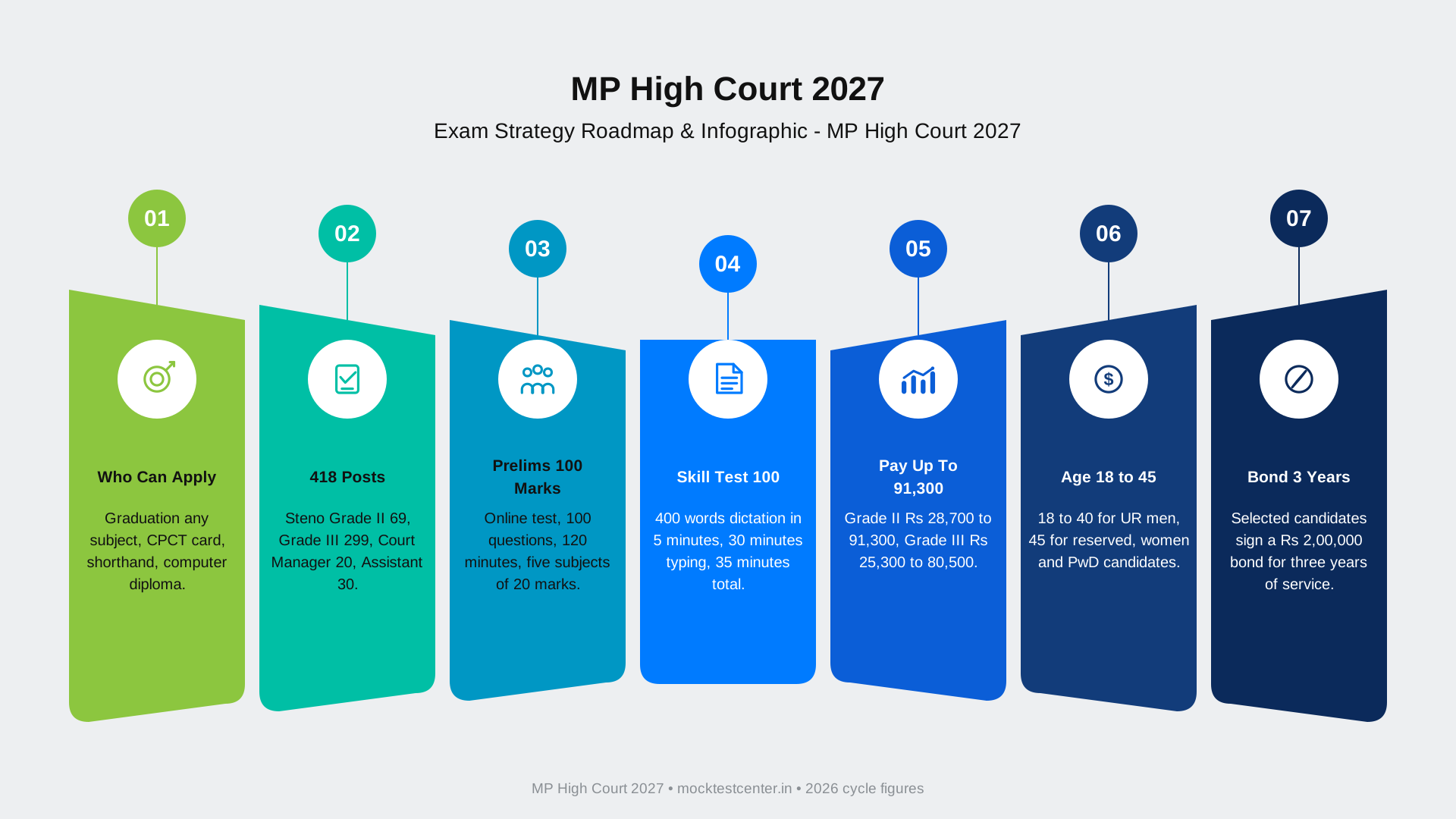
MP High Court 2027 at a glance
| Detail | MP High Court 2027, the live cycle |
|---|---|
| Conducting body | High Court of Madhya Pradesh, Jabalpur |
| Advertisement | Advt. No. 666/Pariksha/2026, dated 6 October 2026 |
| Posts | 418 in District and Sessions Courts |
| Application window | 6 October 2026, 12 noon, to 27 October 2026, 5 PM |
| Correction window | 30 October to 1 November 2026 |
| Application fee | Rs 943.40 for UR and outside MP, Rs 743.40 for reserved categories of MP |
| Age as on | 1 January 2026, 18 to 40 years, 45 for reserved and women candidates |
| Education | Graduation in any discipline, CPCT score card, shorthand, one year computer diploma |
| Selection | Online prelims of 100 marks, then shorthand skill test of 100 marks |
| Exam date | Not announced yet |
| Official website | mphc.gov.in |
Read the table as the skeleton and the rest of this MP High Court 2027 guide as the flesh. The dates belong to the 2026 advertisement. The pattern and the age rule carry over to the next advertisement, with the fee and the pay, unless the High Court changes them in print.
418 posts, and why Grade III holds most of them
Stenographer Grade III takes the largest share by far, with 299 of the 418 posts. Stenographer Grade II follows with 69 posts. Stenographer Grade III for Court Manager Staff has 20 posts, and Assistant Grade III for English knowing candidates has 30 posts.
The split matters because the four posts ask for different shorthand. Grade II needs Hindi shorthand at 100 words per minute. Grade III and the Court Manager Staff post need Hindi shorthand at 80 words per minute. Assistant Grade III needs English shorthand at 80 words per minute.
A candidate picks the post that matches the shorthand already learned, because learning a new shorthand script from zero takes months, and the exam does not wait.
Two posts carry only Unreserved seats. Court Manager Staff has 20 seats, all Unreserved. Assistant Grade III has 30 seats, all Unreserved.
Candidates from reserved categories can still apply for those two posts, and the notification counts such candidates as Unreserved for them. That rule changes the competition. Reserved category candidates compete in the open pool for those 50 seats, with no separate quota.
The other two posts split their seats across categories, and the notification divides each post into a main list of 87 percent and a provisional list of 13 percent. Grade II has 60 seats on the main list and 9 on the provisional list. Grade III has 260 seats on the main list and 39 on the provisional list. The provisional list covers seats held back against pending matters, and candidates should read the notification for the exact meaning of that split before they count their chances.
| Post | Main list | Provisional list | Total |
|---|---|---|---|
| Stenographer Grade II | 60 | 9 | 69 |
| Stenographer Grade III | 260 | 39 | 299 |
| Stenographer Grade III, Court Manager Staff | 20, all Unreserved | 0 | 20 |
| Assistant Grade III, English Knowing | 30, all Unreserved | 0 | 30 |
| Total | 370 | 48 | 418 |
Horizontal reservation runs inside those numbers. Women get 35 percent, ex servicemen get 10 percent, and persons with disabilities get 6 percent, applied within each category. A woman candidate from the OBC category, for example, competes for a seat that sits inside the OBC block, not outside it.
Grade III dominates the count for a plain reason. Every district court needs stenographers in its courtrooms, and Grade III is the entry grade that feeds those courtrooms. Grade II is the senior grade, so it has fewer seats.
The Court Manager Staff post is a small separate cadre. Assistant Grade III serves the English knowing work of the courts.
Pay: what each post earns
The notification gives the pay in the Seventh Pay Commission matrix, with the old Sixth Pay Commission grade pay shown alongside. Stenographer Grade II starts at Rs 28,700 and runs to Rs 91,300 in the matrix, on the old grade pay of Rs 2,800. Stenographer Grade III starts at Rs 25,300 and runs to Rs 80,500, on the old grade pay of Rs 2,400.
Court Manager Staff and Assistant Grade III share the lowest matrix in this recruitment. Both start at Rs 19,500 and run to Rs 62,000, on the old grade pay of Rs 1,900. The starting basic pay is the lower figure, and the upper figure is the top of the scale after years of increments. Allowances sit on top of the basic pay under the Madhya Pradesh government rules, and the take home pay varies with the posting district and the allowance rates in force.
| Post | Old grade pay | Seventh Pay Commission matrix |
|---|---|---|
| Stenographer Grade II | Rs 2,800 | Rs 28,700 to Rs 91,300 |
| Stenographer Grade III | Rs 2,400 | Rs 25,300 to Rs 80,500 |
| Stenographer Grade III, Court Manager Staff | Rs 1,900 | Rs 19,500 to Rs 62,000 |
| Assistant Grade III, English Knowing | Rs 1,900 | Rs 19,500 to Rs 62,000 |
One condition in the notification deserves attention before anyone celebrates the pay. Selected candidates must sign a service bond of Rs 2,00,000 and serve for at least three years. A candidate who leaves inside those three years pays the bond amount. That bond is the High Court's answer to early resignations, and candidates who plan to keep trying for other exams should count the cost of the bond before they sign.
The pay gap between Grade II and Grade III is about Rs 3,400 a month at the start. Over a career the gap widens, because Grade II also promotes faster. A candidate with Hindi shorthand at 100 words per minute who applies for Grade II earns that gap from day one. A candidate at 80 words per minute cannot apply for Grade II at all, so the shorthand speed decides the pay as much as the exam does.
Who can apply: degree, CPCT, shorthand, diploma
Every post in this MP High Court 2027 recruitment asks for four things, and only the shorthand part changes from post to post. The candidate needs a graduation degree in any discipline from a recognised university, a CPCT score card, a shorthand pass at the speed the post needs, and a one year diploma in Computer Application from an institution recognised by the Madhya Pradesh government.
CPCT stands for the Computer Proficiency Certification Test, run in Madhya Pradesh through MAP-IT, the state agency for promotion of information technology. The score card proves computer proficiency and typing ability. Candidates who have not taken CPCT should check whether the notification allows a score card obtained after the application date, because the rule on that point changes between recruitments, and a missing score card can end an application at document checking.
The shorthand requirement is the hard gate. Grade II needs Hindi shorthand passed at 100 words per minute from a board or institution recognised by the Madhya Pradesh government. Grade III and Court Manager Staff need Hindi shorthand at 80 words per minute. Assistant Grade III needs English shorthand at 80 words per minute.
The shorthand certificate must come from a recognised board, and the skill test at the end checks the same speed again on a computer.
The one year computer diploma is a separate requirement from CPCT. Some candidates hold both, and some hold only one. The notification asks for both, so a candidate with a CPCT score card but no diploma still falls short. The diploma must come from an institution recognised by the Madhya Pradesh government, and a diploma from an unrecognised private institute does not count.
| Post | Degree | CPCT | Shorthand | Computer diploma |
|---|---|---|---|---|
| Stenographer Grade II | Graduation, any discipline | Score card needed | Hindi, 100 words per minute | One year, recognised institute |
| Stenographer Grade III | Graduation, any discipline | Score card needed | Hindi, 80 words per minute | One year, recognised institute |
| Stenographer Grade III, Court Manager Staff | Graduation, any discipline | Score card needed | Hindi, 80 words per minute | One year, recognised institute |
| Assistant Grade III, English Knowing | Graduation, any discipline | Score card needed | English, 80 words per minute | One year, recognised institute |
Graduation in any discipline means the degree subject does not matter. Arts, science, commerce, engineering, all count. The degree must come from a recognised university, and candidates in the final year should check the notification for the cut off date by which the degree must be complete. A candidate who applies without a complete degree risks rejection at document checking even after clearing both exam stages.
Age limit as on 1 January 2026
Age counts as on 1 January 2026 for this MP High Court 2027 recruitment. The minimum age is 18 years for every post. The maximum age is 40 years for men from the Unreserved category, including men from outside Madhya Pradesh, and for men from the EWS category of Madhya Pradesh.
The maximum age rises to 45 years for several groups. Men and women from the reserved categories of Madhya Pradesh get 45 years. All women candidates get 45 years, whether from Madhya Pradesh or another state. All persons with disabilities get 45 years.
Employees of the Madhya Pradesh government and its corporations and boards get 45 years, and its autonomous bodies get the same limit. Nagar Sainik personnel get 45 years as well.
| Category | Maximum age as on 1 January 2026 |
|---|---|
| Unreserved men, including other states | 40 years |
| EWS men of Madhya Pradesh | 40 years |
| Reserved category men and women of Madhya Pradesh | 45 years |
| All women candidates | 45 years |
| All persons with disabilities | 45 years |
| MP government and board employees, Nagar Sainik | 45 years |
One tracker report put the age reference date at 1 August 2026, but three other tracker summaries of the same notification, and the pattern of the 2025 advertisement, put it at 1 January 2026. This guide follows 1 January 2026, and candidates near the edge should check the notification itself before they decide.
The age rule shapes who applies. A 42 year old woman from Madhya Pradesh qualifies, while a 42 year old Unreserved man does not. A 41 year old OBC man from Madhya Pradesh qualifies. The five year gap is the single biggest eligibility difference in the whole recruitment, and it explains why the applicant pool for this exam skews older than most graduate level exams.
Fee and how the form window ran
The fee for this recruitment is Rs 943.40 for Unreserved candidates and for candidates from outside Madhya Pradesh. Reserved category candidates of Madhya Pradesh pay Rs 743.40, and persons with disabilities from Madhya Pradesh also pay Rs 743.40. The fee covers the examination, and the odd paise figure comes from the portal charge folded into the total.
The same fee applied in the 2025 recruitment for Personal Assistant and Stenographer, which suggests the High Court has kept the fee steady across cycles. Payment ran online only, and the last date for the fee was the same as the last date for the form, 27 October 2026 at 5 PM. A form without the fee counted as incomplete.
The application opened at 12 noon on 6 October 2026, the day the advertisement came out. That same day opening is common in High Court recruitments, and it rewards candidates who keep their documents ready. The correction window ran from 30 October to 1 November 2026, and it allowed changes to the submitted form. Candidates who spotted a wrong photo, a wrong signature or a wrong category in that window could fix it, and candidates who missed the window live with the error.
Dates that matter for MP High Court 2027
| Event | Date |
|---|---|
| Advertisement, Advt. No. 666/Pariksha/2026 | 6 October 2026 |
| Online application opens | 6 October 2026, 12 noon |
| Last date to apply and pay the fee | 27 October 2026, 5 PM |
| Correction window | 30 October to 1 November 2026 |
| Prelims exam date | Not announced yet |
| Admit card | Not announced yet |
| Skill test | After the prelims result |
The gap between the last date and the prelims date is the preparation window, and it is the only part of the calendar a candidate controls. The High Court has not announced the prelims date, so candidates should treat every week from now as preparation time. Shorthand speed does not grow in a week, and the candidates who kept practising through the waiting period will show the difference on the skill test day.
Selection: prelims first, shorthand decides
Selection runs in stages. The online preliminary examination comes first, and it screens the applicants. Candidates who clear the prelims go through document scrutiny, and then they sit the shorthand skill test. The final merit list rests on the marks of the skill test, so the prelims opens the door and the shorthand test decides the rank.
The prelims is an online objective test of 100 questions for 100 marks, with a total duration of 120 minutes. Each question carries one mark. Five subjects share the paper equally, with 20 questions each, and the paper runs in Hindi and English.
| Subject | Questions | Marks |
|---|---|---|
| General Knowledge and General Studies, including MP General Knowledge | 20 | 20 |
| Mathematics and Logical Reasoning | 20 | 20 |
| General Hindi | 20 | 20 |
| English Knowledge | 20 | 20 |
| Computer Knowledge | 20 | 20 |
| Total | 100 | 100 |
The High Court shortlists candidates for the skill test at a ratio of one post to five candidates, on category wise merit in the prelims. With 418 posts, that means about 2,090 candidates reach the skill test. The prelims cut off therefore sits well above the pass mark, and a candidate who only aims to pass the prelims will fall short of the shortlist.
Each subject carries the same 20 marks, so no subject can be ignored. Computer Knowledge counts as much as General Knowledge, and a candidate who skips computers gives away a fifth of the paper. General Hindi and English together make 40 marks, which means language skill matters twice over in this exam, once in the prelims and again in the shorthand test.
The tracker summaries of the notification do not state a negative marking figure for the prelims. This guide does not invent one. Candidates should check the admit card instructions and the notification for the marking rule before they decide how to attempt doubtful questions.
The skill test in detail
The skill test carries 100 marks, and it runs for 35 minutes. The candidate hears a dictation of 400 words, spoken over about five minutes, and then gets 30 minutes to transcribe it by typing on a computer. Stenographer posts take the dictation in Hindi and type it in the Remington Gail font. Assistant Grade III takes the dictation in English and types it on the computer.
The speed in the dictation matches the post. Grade II hears Hindi at 100 words per minute, which means 400 words in about four minutes, rounded to five in the test design. Grade III, Court Manager Staff and Assistant Grade III hear their dictation at 80 words per minute, which means 400 words in five minutes. The transcription time stays the same for every post, 30 minutes, so the slower dictation does not buy extra typing time.
Marking is strict. The test deducts 0.50 mark for each mistake. Mistakes include wrong spelling and omitted words. Spacing errors count too.
A candidate who makes more than 120 errors gets zero marks in the skill test. At 0.50 mark per error, 120 errors would cost 60 marks, but the rule caps it at zero, so accuracy matters more than raw speed once the candidate can keep up with the dictation.
The minimum qualifying marks in the skill test vary by category. Unreserved and OBC candidates need 55 percent. EWS candidates need 49.5 percent. SC candidates need 45 percent.
ST candidates and persons with disabilities need 40 percent.
A candidate who scores below the qualifying line for the category fails the skill test even with a high prelims score, because the final merit rests on the skill test alone.
That structure makes the skill test the real exam. The prelims screens, the skill test ranks. A candidate who tops the prelims and stumbles in transcription can fall behind a candidate who scraped through the prelims and typed cleanly. Every hour spent on shorthand practice counts double, because it protects both the qualifying line and the final rank.
The job after selection
A selected candidate joins a District and Sessions Court in Madhya Pradesh. The work is the daily record of court proceedings, dictation from judges, typing of orders and judgments, and upkeep of the case record. Stenographers sit in courtrooms, take down what the judge dictates, and produce the typed record that becomes part of the case file.
District allotment happens through counselling on category wise merit. Candidates pick their district in merit order, so a higher rank buys a posting closer to home. The Principal District Judge of the allotted district becomes the appointing authority, and the candidate serves in that district. Transfers between districts follow the rules of the district judiciary, and a candidate should not expect a quick move to a preferred district.
Court Manager Staff works on the administrative side of the court, supporting the Court Manager in running the court establishment. Assistant Grade III handles the English knowing work of the courts. That means correspondence in English, records in English and orders in English. The four posts share the same court building and the same service conditions, but the daily work differs, and candidates should know which work they prefer before they pick a post.
The district court job is steady, and it carries the pay and allowances of the Madhya Pradesh government. It also carries the three year bond of Rs 2,00,000. Candidates who see this exam as a stopgap while they prepare for something else should weigh the bond, because leaving inside three years costs real money.
The 2025 cycle: 13 posts in the High Court itself
The previous cycle looked very different. In 2025 the High Court advertised 13 posts in the High Court itself, not in the district courts. Advertisement Number 325/EXAM/2025, dated 23 September 2025, offered 11 posts of Personal Assistant and 2 posts of Stenographer. Applications ran from 23 September to 14 October 2025, with a correction window from 17 to 20 October 2025.
The 2025 posts asked for English shorthand at 80 words per minute, for both Personal Assistant and Stenographer. Personal Assistant needed graduation, English shorthand at 80 words per minute, and a one year diploma in Computer Application. Stenographer needed graduation, English shorthand at 80 words per minute, and either a CPCT score card or a one year computer diploma.
The pay in 2025 was higher at the top. Personal Assistant carried a matrix of Rs 36,200 to Rs 1,14,800, and Stenographer carried Rs 19,500 to Rs 62,000. The fee was the same as in 2026, Rs 943.40 for Unreserved candidates and Rs 743.40 for reserved categories. Age ran from 18 to 40 years as on 1 January 2025.
The jump from 13 posts in 2025 to 418 posts in 2026 shows how the High Court recruits. Small High Court cadres come in small numbers, and district court cadres come in bulk when vacancies pile up. A candidate who missed the 2025 cycle for the small High Court posts got a far bigger chance a year later in the district courts, and the next bulk district recruitment may not come for years. That is the nature of court recruitment, and it rewards candidates who stay ready between advertisements.
How to build shorthand speed that survives the test
Shorthand speed is a physical skill, and it grows only through daily dictation. A candidate who writes shorthand once a week will not reach 80 words per minute, and a candidate who writes it every day for three months usually will. The work is boring, and that is the point. The test rewards the candidate who did the boring work.
Start with the alphabet of the shorthand system and the common word outlines, and drill them until the hand moves without thinking. Then move to dictation at 60 words per minute, and stay there until the transcription comes out clean. Speed without accuracy fails this test, because 0.50 mark goes for every mistake and 120 mistakes mean zero. A clean page at 70 words per minute beats a messy page at 90.
Raise the dictation speed by 10 words per minute only when the transcription at the current speed has fewer than 10 mistakes in 400 words. That rule keeps accuracy ahead of speed. Many candidates chase speed and arrive at the test able to keep up with the dictation but unable to read their own outlines back. The transcription half of the test exposes that gap in full.
Practise transcription on a computer, not on paper. The test types the transcript on a computer, and the Remington Gail font for Hindi changes the keyboard feel. A candidate who practises on paper and types only in the test will lose minutes to the keyboard. Type every practice transcription on the computer, in the font the test uses, and time the 30 minutes strictly.
Take one full mock skill test every week in the last two months. Dictation of 400 words, five minutes, then 30 minutes of transcription, then count the mistakes and the marks. The weekly mock shows whether the speed is rising and whether the mistakes are falling, and it builds the calm that the real test needs. A candidate who has done eight full mocks walks into the test hall knowing exactly how the 35 minutes feel.
A study plan for the prelims paper
The prelims paper gives 20 marks to each of five subjects, so the plan should give each subject its share of time. A candidate who spends all the time on General Knowledge and none on computers will drop 20 marks, and that gap is hard to close elsewhere. Split the week across all five subjects from the start, and keep the split steady.
General Knowledge and General Studies, including Madhya Pradesh General Knowledge, needs the most reading. Cover the history and geography of Madhya Pradesh. Learn its polity and its major rivers.
Know the districts and the state schemes. Follow the current affairs of the last year. Madhya Pradesh General Knowledge is the part of this paper that other exams do not test, so it separates the candidates who prepared for this exam from the candidates who prepared for any exam.
Mathematics and Logical Reasoning needs practice, not reading. Solve questions every day, and keep a notebook of the question types that slow you down. The maths in this paper stays at school level, and the reasoning questions follow standard patterns. Speed matters here, because the paper allows 72 seconds per question on average, and a candidate who spends three minutes on one maths question steals time from three other questions.
General Hindi and English together make 40 marks, and both reward the candidate who reads. Hindi grammar and vocabulary carry the Hindi section, with comprehension questions too. English grammar and vocabulary carry the English section the same way. A candidate who reads a Hindi newspaper and an English newspaper every day builds both sections at once, and also builds the current affairs the General Knowledge section needs.
Computer Knowledge is the easiest 20 marks in the paper for a candidate who holds a CPCT score card and a computer diploma, because the syllabus overlaps with what those courses already taught. Operating systems and MS Office come first, then internet basics and computer abbreviations. The CPCT syllabus itself covers most of the section. A candidate who ignores computers because the section looks small gives away marks that cost nothing to keep.
Take mock tests on the real clock. Sit a full 100 question paper in 120 minutes, and score it. Then spend twice as long on the review as on the test, because the review is where the learning happens.
Track the score by subject, and move study time toward the weakest subject each week. A candidate whose mock score rises by 5 marks a week for eight weeks gains 40 marks, and that gain decides the shortlist.
Five mistakes that cost candidates this exam
The first mistake is applying for the wrong post. A candidate with English shorthand at 80 words per minute who applies for Stenographer Grade III, which needs Hindi shorthand, will fail the skill test no matter how well the prelims goes. Match the post to the shorthand already learned, and check the certificate before applying.
The second mistake is treating the prelims as the whole exam. Candidates spend months on objective questions and then discover that the skill test needs shorthand they have not practised. Start shorthand practice in the first week, even before the prelims syllabus feels complete. Short practice sessions every day beat long sessions started late.
The third mistake is ignoring the computer diploma rule. Candidates with a degree and a CPCT score card assume they qualify, and then document checking finds no one year diploma. Read the eligibility table in this guide, check each of the four requirements, and fix the missing one before the form goes in.
The fourth mistake is guessing the transcription. Candidates who cannot read an outline in their shorthand guess the word, and each guess risks 0.50 mark. Leave a blank or mark the outline and move on, then return to it at the end of the 30 minutes if time remains. A blank costs one mistake, and a wrong guess costs the same, but a guess that looks confident can also break the sense of the sentence and cost more.
The fifth mistake is waiting for the exam date before starting. The High Court has not announced the prelims date, and candidates who wait will start when the date comes, which may leave only weeks. The candidates who started in October, when the advertisement came out, will have months of shorthand practice behind them. The exam date is the High Court's decision, and preparation is the candidate's.
Candidates preparing for MP High Court 2027 also practise with mock tests for UPSC CSE Prelims 2027, SSC CGL 2027, SSC CHSL 2027, SSC GD 2027, IBPS Clerk 2027, SBI Clerk 2027, UPPSC RO ARO 2027, JKSSB Junior Stenographer 2027, JKSSB Junior Assistant 2027 and KPSC KAS 2027.
Sources
High Court of Madhya Pradesh, mphc.gov.in, Advt. No. 666/Pariksha/2026
Jagran Josh on the MP High Court Recruitment 2026: 418 posts with dates and eligibility
Testbook on the MP High Court Stenographer Recruitment 2026: 418 vacancies with the selection process and exam pattern
GovtJobsAlert on the MP High Court Stenographer and Assistant Grade III Recruitment 2026: vacancy split with the pay matrix and age limits
Haryana Jobs on the MP High Court Stenographer and Assistant Recruitment 2026: prelims pattern with skill test detail
Schools360: MP High Court Steno Recruitment 2026, skill test qualifying marks and service bond
Sarkari Job on the MP HC Stenographer Online Form 2026: fee with the pay scale and exam status
Sarkari Entrance on the MP High Court Recruitment 2025: Advt. 325/EXAM/2025 for 13 Personal Assistant and Stenographer posts
Free Press Journal on the MPHC Recruitment 2025: pay scale with eligibility for Personal Assistant and Stenographer
Scroll on the MPHC recruitment 2025: last date with the fee for PA and Stenographer posts