About MP Police Constable 2027 Exam Series
📖 Table of Contents
- MP Police Constable 2027 at a glance
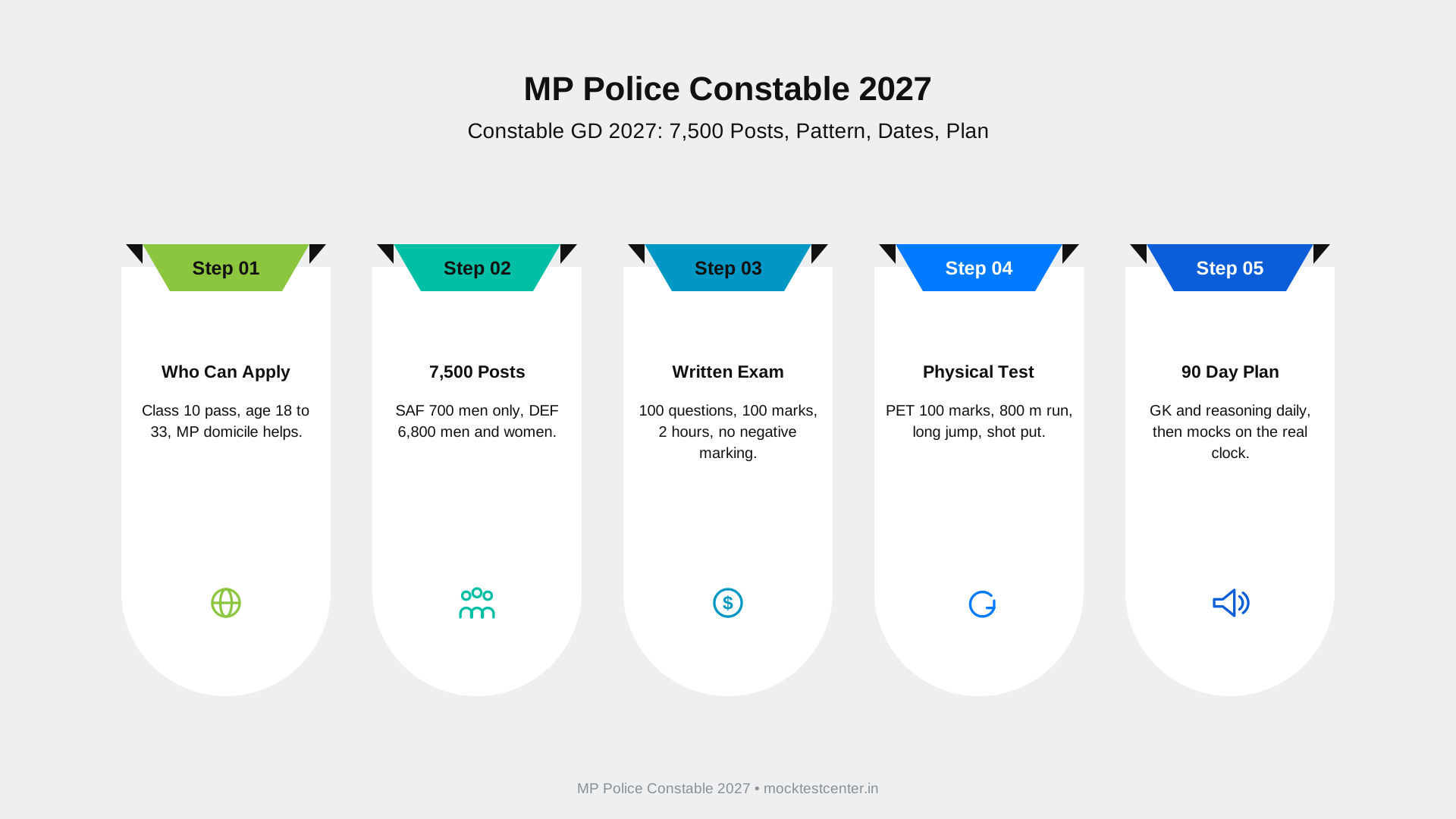
- 7,500 posts: 700 in SAF, 6,800 in DEF
- Who can apply for MP Police Constable 2027
- The dates, including the extension
- The written exam: 100 questions, no negative marking
- Why no negative marking changes how you attempt
- The physical test counts in the final merit
- Height and chest: the standards test
- Pay and posting: what the job looks like
- The 2023 cycle, and what it teaches
- A fresh 2026 cycle with the same 7,500 posts
- How to prepare in 90 days
- Five mistakes that cost constable candidates marks
- Sources
MP Police Constable 2027: Complete Exam Guide
The Madhya Pradesh Employees Selection Board runs the MP Police Constable recruitment to fill Constable (General Duty) posts in the state police. The live cycle is the 2025 recruitment, advertised for 7,500 posts, and this MP Police Constable 2027 guide works from that cycle to show how the next one will run.
The written exam for the 2025 cycle began on 30 October 2025 and ran into December 2025. The physical tests followed in February and March 2026, and the final result has been declared. No fresh constable notification has appeared for the 2027 cycle yet, so the 2025 pattern, age rule and fee structure are the working facts for the next advertisement unless the board changes them in print.
That matters because the exam has kept the same shape for years. One written paper of 100 marks. No negative marking.
A scored physical test that counts in the final merit. A Class 10 pass as the entry qualification. Candidates who understand those four facts can plan the whole preparation before the next notification lands.
The 2025 cycle also carried a warning about dates. The board first set the last date to apply as 29 September 2025, then extended it to 6 October 2025, and moved the correction window to 8 October 2025. Candidates who read only the first notice and stopped watching missed a full extra week. This MP Police Constable 2027 guide lists both the first dates and the revised dates, because the revision is part of the record.
MP Police Constable 2027 at a glance
| Detail | MP Police Constable 2025, the live cycle |
|---|---|
| Conducting body | Madhya Pradesh Employees Selection Board, Bhopal |
| Department | Home (Police) Department, Government of Madhya Pradesh |
| Post | Constable (General Duty) |
| Posts | 7,500, Special Armed Force 700 and District Executive Force 6,800 |
| Notification | Dated 13 September 2025 |
| Application window | 15 September to 6 October 2025, extended from 29 September 2025 |
| Correction window | To 8 October 2025, extended from 4 October 2025 |
| Admit card | 26 October 2025 |
| Written exam | From 30 October 2025, two shifts a day, to 12 December 2025 |
| Physical tests | 23 February to 13 March 2026 |
| Application fee | Rs 500 unreserved, Rs 250 SC, ST, OBC, EWS of Madhya Pradesh |
| Education | Class 10 pass, Class 8 pass for ST candidates |
| Age limit | 18 to 33 years for unreserved men as on 29 September 2025 |
| Written exam | 100 questions, 100 marks, 120 minutes, no negative marking |
| Physical test | 100 marks, 800 m run, long jump, shot put, 30 marks minimum |
| Salary | Rs 19,500 to Rs 62,000 a month plus allowances |
| Official website | esb.mp.gov.in |
Read the table as the skeleton and the rest of this guide as the flesh. The dates belong to the 2025 cycle. The pattern and the fee structure carry over to the next advertisement unless the board changes them in print.
7,500 posts: 700 in SAF, 6,800 in DEF
The 7,500 Constable (General Duty) posts split into two forces. The Special Armed Force, known as SAF, takes 700 posts. The District Executive Force, known as DEF, takes 6,800 posts. The two numbers add to 7,500 exactly, and every tracker that quotes the notification agrees on them.
The split decides who can apply where. SAF posts are for men only. DEF posts are open to men and women.
A woman candidate applies for the DEF posts. A man candidate can apply for either force, and the choice is made in the application form.
SAF is the armed reserve of the state police. Its battalions guard sensitive installations, support district police during law and order duty, and move where the state government sends them. DEF is the district police itself, the thana level force that handles crime, traffic, patrolling and public dealing in the districts.
The written exam is the same for both forces. The physical standards differ slightly, and the posting life differs a lot.
One figure in the public record does not add up, and this guide leaves it out on purpose. Several trackers print a category wise table with totals of 2,025 for unreserved, 975 for OBC, 1,200 for SC, 1,500 for ST and 2,025 for EWS. Those five numbers add to 7,725, not 7,500.
The table is internally wrong, so no category split is printed here. The post wise split of 700 and 6,800 is the reliable one, and the category split should be read from the official notification when the next cycle opens.
Reservation follows the Madhya Pradesh government rules in the notification. The rules cover SC and ST candidates. They cover OBC and EWS candidates too. Separate quotas exist for ex-servicemen and home guards.
Women hold their own quota. The detailed split sits in the rulebook, and it changes with the force and the category. Candidates should check the rulebook for their own category instead of trusting a tracker table that fails its own addition.
Who can apply for MP Police Constable 2027
A candidate needs to have passed Class 10, the High School examination under the 10+2 system, from a recognised board. Higher Secondary also qualifies. The rule is a pass, not a percentage, so marks in Class 10 do not affect selection. What matters is that the certificate is valid on or before the last date of application.
ST candidates get a lower bar. A candidate from a Scheduled Tribe needs only a Class 8 pass or its equivalent. That rule has stayed the same across cycles, and it applies to both SAF and DEF posts. No relaxation exists in the education rule for any other category.
The age window runs from 18 years at the minimum. The maximum age for an unreserved man is 33 years as on 29 September 2025 for the 2025 cycle. That date is the original last date to apply, and the board kept it as the age cut off even after extending the application window to 6 October 2025.
| Category | Maximum age as on 29 September 2025 |
|---|---|
| Unreserved men | 33 years |
| SC, ST, OBC, EWS men of Madhya Pradesh | 38 years |
| Women, all categories | 38 years |
| Government employees, home guards | 38 years |
| Inter-caste marriage, sports quota | 38 years, plus 5 years in some cases |
Some guides print 18 to 25 years as the age limit for this exam. That figure is wrong for the 2025 cycle. It appears in a news report that also gives the right exam date, so it is easy to copy by mistake.
The rulebook age is 18 to 33 for unreserved men, with 38 for reserved categories and women. One tracker prints 36 years as the unreserved maximum in its highlights box, then prints 33 years in its own detail table. The detail table matches the other trackers, so 33 is the figure this guide uses.
Reservation and age relaxation apply only to candidates who hold Madhya Pradesh domicile. A candidate from another state can apply, but only against unreserved open vacancies, and pays the unreserved fee. Domicile proof and caste certificates must be valid on the last date of application. The board verifies every document after the physical tests.
The dates, including the extension
The notification for the 2025 cycle is dated 13 September 2025. Some trackers say the notification was released on 15 September 2025, which is the day applications opened. Both dates describe the same event from different sides. The rulebook carries 13 September, and the application window opened on 15 September.
Applications ran online at esb.mp.gov.in from 15 September 2025. The first last date was 29 September 2025. The board then extended the window to 6 October 2025, and the correction window moved from 4 October to 8 October 2025. The extension was reported by Testbook, Patrika, the Free Press Journal and Scroll, and the admit card and exam dates that followed match the extended calendar.
The admit card came out on 26 October 2025. The written exam began on 30 October 2025. It ran in two shifts a day across the state, and the last shift ran on 12 December 2025.
One Times of India report prints 10 October 2025 as the exam date in one line and 30 October 2025 in its own schedule table. The schedule table matches every other source, so this guide states 30 October 2025 as the exam start and flags the 10 October line as an error in that report.
| Event | Date in the 2025 cycle |
|---|---|
| Notification dated | 13 September 2025 |
| Applications open | 15 September 2025 |
| Last date to apply, first notice | 29 September 2025 |
| Last date to apply, extended | 6 October 2025 |
| Correction window closes | 8 October 2025, first set as 4 October 2025 |
| Admit card | 26 October 2025 |
| Written exam begins | 30 October 2025 |
| Written exam ends | 12 December 2025 |
| Physical tests | 23 February to 13 March 2026 |
| Final result | Declared in 2026 |
The two shifts ran at fixed hours. The first shift ran from 9:30 AM to 11:30 AM, with reporting between 7:30 AM and 8:30 AM. The second shift ran from 2:30 PM to 4:30 PM, with reporting between 12:30 PM and 1:30 PM.
The exam ran in 11 cities: Bhopal, Indore, Jabalpur, Khandwa, Neemuch, Rewa, Ratlam, Sagar, Satna, Sidhi, Ujjain. Candidates got their city and shift on the admit card, and the board did not change shifts after issue.
The gap between the written exam and the physical tests was about three months. The physical tests ran from 23 February to 13 March 2026 across districts. That gap is the training window. A candidate who waits for the written result before starting to run has already lost it.
The written exam: 100 questions, no negative marking
The written exam is a computer based test of 100 objective questions. Each question carries one mark. The total is 100 marks. The duration is 120 minutes.
There is no negative marking for a wrong answer. That last fact is confirmed by Adda247 and StudyIQ, and by every other tracker that quotes the rulebook. It shapes the whole attempt strategy.
| Subject | Questions | Marks |
|---|---|---|
| General Knowledge and Reasoning | 40 | 40 |
| Intellectual Ability and Mental Aptitude | 30 | 30 |
| Science and Simple Arithmetic | 30 | 30 |
| Total | 100 | 100 |
General Knowledge and Reasoning carries the largest share at 40 marks. The section mixes general knowledge of Madhya Pradesh and India with reasoning questions. Current affairs appear through the year.
Madhya Pradesh content recurs every year: the districts, the rivers, the tribal regions, the state schemes, the folk culture, the minerals, the national parks. A candidate who studies only national material leaves a visible chunk of marks behind.
Intellectual Ability and Mental Aptitude carries 30 marks. The section tests series, coding, analogy, direction sense, blood relations, number puzzles, non verbal reasoning. The questions are short and the answers are quick for a candidate who has practised, which makes this the highest scoring section for most candidates.
Science and Simple Arithmetic carries 30 marks. The science stays at the Class 10 level. Physics and chemistry appear.
Biology and everyday science appear too. The arithmetic covers percentage; ratio; average; profit and loss; simple interest; time and work; number systems. The arithmetic is simple, but it is also the section where a careless calculation costs a mark that no negative marking rule gives back.
The fee is Rs 500 for unreserved candidates and for candidates from other states. It is Rs 250 for SC and ST candidates, and for OBC and EWS candidates who hold Madhya Pradesh domicile. The fee is charged per question paper. The portal fee is Rs 60 at a kiosk and Rs 20 for a registered citizen login.
One tracker also lists a departmental exam fee of Rs 200 for unreserved and Rs 100 for reserved candidates on the constable page. That fee is printed in the Sub Inspector rulebook, and its appearance on the constable page looks like a copy error. This guide does not state it as a constable fee, and the upload check should confirm the fee table against the official rulebook.
Why no negative marking changes how you attempt
No negative marking means a wrong answer costs nothing. A blank answer also costs nothing. The two are equal, so the right move is to answer every question. A candidate who leaves ten questions blank in a no negative marking exam gives away ten free chances at a mark.
That does not mean guessing blindly on every question. The smart order is to answer the sure questions first, then the questions that can be narrowed to two options, then the rest in the last ten minutes. A guess between two options wins half the time.
A guess across four options wins a quarter of the time. Both beat a blank.
Speed decides the paper. One hundred questions in 120 minutes gives 72 seconds per question on average. Reasoning and arithmetic questions take longer than general knowledge questions, so the real plan is to clear the general knowledge section in about 25 minutes, the reasoning section in about 45 minutes, and the science and arithmetic section in about 40 minutes, with ten minutes left for the guessed questions.
Mock tests taken on that clock build the habit. Mock tests taken without a clock build knowledge only.
The cut off is not published in advance. It moves with the paper and the number of applicants. In the 2023 cycle, about 58,000 candidates qualified from 6,52,057 who appeared, which is roughly one in eleven.
The 2025 cycle drew a similar crowd, so a score in the high 70s is a reasonable target for an unreserved man, and a score in the high 60s for a reserved category candidate. These are working targets from past cycles, not official cut offs, and the board publishes the real cut off with the result.
The physical test counts in the final merit
The physical stage has two parts. The Physical Standards Test checks height and chest. The Physical Efficiency Test is scored out of 100 marks. It covers the 800 metre run.
The long jump and the shot put complete the test. The physical test carries real weight. Its marks are added to the written exam marks for the final merit list, so a strong physical test can lift a candidate past a rival with a better written score.
The Physical Efficiency Test carries 100 marks across three events. The 800 metre run carries 40 marks, with one chance. The long jump carries 30 marks, with three chances.
The shot put carries 30 marks, with three chances. A candidate needs at least 30 marks out of 100 to qualify. The marks are scored on bands, not pass or fail, so every second and every centimetre matters.
| Event | Marks | Chances |
|---|---|---|
| 800 metre run | 40 | One |
| Long jump | 30 | Three |
| Shot put | 30 | Three |
| Total | 100 |
Full marks in the run need 124.2 seconds or less for men and 176 seconds or less for women. Full marks in the long jump need 5.57 metres or more for men and 4.36 metres or more for women. Full marks in the shot put need 8.76 metres or more for men with a 7.26 kg shot, and 7.20 metres or more for women with a 4 kg shot.
The zero marks floor sits at 198.3 seconds for the men run and 261.8 seconds for the women run. Between the floor and the full marks line, the score rises band by band.
The older pass or fail figures still appear in guides, and they are the same standards seen from the other side. Men had to run 800 metres in 2 minutes 45 seconds, throw the shot 19 feet, and jump 13 feet. Women had to run in 4 minutes, throw 15 feet, and jump 10 feet.
Those figures are the qualifying thresholds from the older framing. The current rulebook scores the same three events out of 100, so a candidate should train for the scored bands, not just the old thresholds.
Relaxed standards apply to home guards and ex-servicemen as the recruitment rules prescribe. Ex-servicemen run the 800 metres in 3 minutes 15 seconds under the older thresholds, throw 15 feet, and jump 10 feet. The exact relaxations sit in the rulebook schedule, and a candidate claiming one should read that schedule before the physical tests.
Height and chest: the standards test
The Physical Standards Test is qualifying. A candidate who fails it does not reach the scored physical test. The standards differ by force and category, and the table below gives the figures reported for the 2025 and 2026 cycles.
| Category | Height, men | Chest, men | Height, women |
|---|---|---|---|
| General, SC, OBC, other forces except SAF | 168 cm | 81 cm unexpanded, 86 cm expanded | 155 cm |
| ST, other forces except SAF | 160 cm | 76 cm unexpanded, 81 cm expanded | 155 cm |
| SAF, General / OBC | 168 cm | 79 cm unexpanded, 84 cm expanded | Not applicable |
| SAF, Maratha, SC, ST | 165 cm | 79 cm unexpanded, 84 cm expanded | Not applicable |
| SAF, Gorkha, Garhwal, Kumaon | 157 cm | 79 cm unexpanded, 84 cm expanded | Not applicable |
One older tracker prints 158 cm as the women height for constable. The 2025 and 2026 cycle pages print 155 cm for women in all categories. This guide uses 155 cm and flags the 158 cm figure as an older tracker number. Chest measurement does not apply to women candidates.
Document verification and a medical examination follow the physical tests. The board checks education certificates and domicile proof. It checks caste certificates and age proof.
Identity documents are checked too. A document that was invalid on the last date of application ends the candidature at this stage, even after a candidate has cleared the written exam and the physical tests. Candidates should get every certificate in order before applying, not after the result.
Pay and posting: what the job looks like
A selected constable earns Rs 19,500 to Rs 62,000 a month, plus allowances as the Madhya Pradesh government prescribes. The figure is reported by Adda247 and Patrika for the 2025 cycle. The pay level in the state pay matrix was not verified against the rulebook in this round, so this guide states the salary range and leaves the pay level for the upload check.
DEF constables work in the district police. The day covers patrolling and thana duty. Traffic and court escort fill the rest of the shift. The posting stays inside a district, and transfers move within the state police system.
SAF constables work in battalions. The day covers guard duty and law and order reserve. Battalions move to any district where the state government needs an armed force. The battalion life means more movement and less public dealing.
Women constables serve in the DEF. Thana duty and women help desks take most of their time. Traffic and investigation support fill the rest.
The 2026 cycle pages report 35 percent horizontal reservation for women in the non SAF posts. That figure is sourced from the 2026 cycle, not from the 2025 rulebook, so it is noted here and not stated as a 2025 fact.
The job is a state government post with a pension under the National Pension System and medical facilities. Promotion channels to head constable and beyond run through departmental exams and seniority. The promotion ladder is slow, and a constable who wants faster growth should plan for the departmental exams from the first years of service.
The 2023 cycle, and what it teaches
The previous constable cycle ran in 2023 for 7,411 posts across Constable GD and Radio. The notification came out on 23 June 2023. Applications ran from 26 June to 10 July 2023.
The written exam ran from 12 August to 12 September 2023 in 13 districts. The result came out on 7 March 2024.
The scale of that cycle explains the competition. The board received 9,67,118 applications. Of those, 6,52,057 candidates appeared for the written exam.
About 58,000 qualified for the next stage. The physical tests ran in late 2024, and 7,411 candidates were finally selected. Roughly 130 applications arrived for each post, and roughly 88 candidates appeared for each post.
The 2023 cycle also carries a caution. In 2025 the Chief Minister ordered an inquiry into irregularities in the 2023 recruitment, after reports of candidates using solvers and mismatched documents. Twenty one cases were filed.
The inquiry leaves the 2025 and 2027 pattern untouched. It explains why the board now runs tighter document checks. Candidates should keep their own application and admit card clean, and their certificates must match them.
The gap between the cycles is the other lesson. The 2023 exam ended in September 2023, and the next large constable notification came in September 2025. Two years passed with no large constable hiring.
The 2025 cycle filled that gap with 7,500 posts, and the 2026 cycle followed a year later with another 7,500. The rhythm now looks annual, which is good news for a candidate who misses one cycle.
A fresh 2026 cycle with the same 7,500 posts
Candidates reading this guide in late 2026 should know that a newer cycle already exists. The board notified the Constable (GD) Recruitment Test 2026 on 9 September 2026, again for 7,500 posts, again split 700 in the SAF and 6,800 outside it. Applications ran from 22 September to 6 October 2026, corrections to 11 October 2026, and the written exam began on 19 November 2026.
The pattern and the physical test match the 2025 cycle. The qualification does too.
The 2026 cycle also carries a separate track. Constable (Driver) was advertised for 1,000 posts, 800 in the district force and 200 in the SAF, for men only, with applications from 15 to 29 October 2026 and a computer based exam from 4 January 2027. The driver track needs a heavy motor vehicle driving licence in addition to the Class 10 qualification. It is a separate recruitment, and this guide does not cover it beyond this note.
The 2027 cycle, when it comes, will likely follow the same shape. The notification will probably land in September, the exam will probably start in late October or November, and the physical tests will follow three months later. That is a forecast from the last two cycles, not a promise, and the board website is the only place that confirms it.
How to prepare in 90 days
Ninety days is enough for this exam if the days are used in order. The first thirty days build the base. General knowledge of Madhya Pradesh and India, the reasoning question types, Class 10 science, and arithmetic to Class 10 level.
Read one newspaper a day for current affairs, and note every Madhya Pradesh item separately. The state items are the ones that repeat in the paper.
The next thirty days turn knowledge into speed. Two mock tests a week, each taken in 120 minutes on the clock, with the answers reviewed the same day. Every wrong answer gets a note: was it a knowledge gap, a calculation slip, or a misread question?
Knowledge gaps go back to the books. Calculation slips get a daily drill of twenty sums. Misread questions get a rule: read the question twice before marking.
The last thirty days are revision and physical training together. Morning is for the run. The jump and the throw follow.
Evening for the mock tests and the weak topics. The physical test needs 30 marks out of 100, and a candidate who starts running only after the written result has about twelve weeks to build from zero. A candidate who runs through the whole ninety days arrives at the physical test already fit.
Previous papers are the closest thing to a syllabus the board publishes. The 2023 papers and the 2025 papers show which topics repeat. Madhya Pradesh geography and the state budget recur. Central schemes in the state recur.
Major rivers and districts recur. Tribal culture and national parks recur too. Read them, note the repeats, and weight the revision toward them.
Books matter less than papers for this exam. One standard general knowledge book, one reasoning book, and the Class 10 science and maths books cover the syllabus. The rest of the preparation is mock tests and previous papers. A candidate who finishes three books and never sits a timed mock will score less than a candidate who finishes one book and sits twenty mocks.
Five mistakes that cost constable candidates marks
The first mistake is leaving questions blank. There is no negative marking, so a blank answer and a wrong answer cost the same, which is nothing. Answer every question. The candidates who leave ten blanks give away ten free chances.
The second mistake is ignoring Madhya Pradesh general knowledge. The paper carries state questions every year, and candidates who study only national material drop those marks. The state syllabus is small. The districts, the rivers, the dams, the parks, the tribal groups, the folk arts and the state schemes fit in a month of reading.
The third mistake is starting physical training after the written result. The physical test carries 100 marks and counts in the final merit. A candidate who trains for three months scores far more than a candidate who trains for three weeks. Run from the first week of preparation, even if it is only twenty minutes a day.
The fourth mistake is trusting a tracker table that fails its own addition. The category wise vacancy table printed by several trackers adds to 7,725 for a 7,500 post recruitment. Candidates who plan their category cut off from that table are planning from a wrong number. Read the rulebook for the category split, and read it again when the addenda come out.
The fifth mistake is missing the extension. The 2025 cycle extended the last date by a week and the correction window by four days. Candidates who applied on the first last date and then stopped watching the board website missed nothing, but candidates who planned to apply on the last day and found the site slow were saved by the extension. Watch the board website every week from the notification until the admit card.
Candidates preparing for MP Police Constable 2027 also practise with mock tests for UP Police Constable 2027, UP Police Sub Inspector 2027, Karnataka Police Constable 2027, Karnataka PSI 2027, Jammu and Kashmir Police Constable 2027, Jammu and Kashmir Police SI 2027, SSC GD 2027, SSC Delhi Police Constable 2027, Bihar Police Constable 2027 and Bihar Police SI Daroga 2027.
Sources
Hindustan Times, 15 September 2025, MP Police Constable Recruitment 2025 notification for 7,500 vacancies
JagranJosh, MP Police Constable 2025 recruitment, vacancy table, age limit, exam date 30 October to 12 December 2025
Adda247, MP Police Constable Exam Date 2025, pattern, fee, salary, physical test
Patrika, 15 September 2025, MP Police Constable Recruitment 2025, 7,500 vacancies, exam from 30 October 2025
News18, 15 September 2025, MP Police Constable Recruitment 2025, applications 15 to 29 September 2025
Testbook, MP Police 2025 deadline extended, last date 6 October 2025, correction to 8 October 2025
Scroll, MPESB Police Constable registration deadline deferred, 7,500 posts, exam 30 October 2025
Free Press Journal, MP Police Constable Recruitment 2025 registration date extended to 6 October 2025
IndGovtJobs, MP Police Constable Recruitment 2025, SAF 700 plus DEF 6,800 posts
StudyIQ, MP Police Constable Syllabus 2025, pattern, physical test standards
GovtJobsAlert, MP Police Constable Bharti 2025, age limit, physical standards, final result
Shishya, MP Police Constable Physical Test, scored PET bands from the 2026 rulebook
YojnaPortal, MPESB Police Constable Recruitment 2025, notification dated 13 September 2025, physical standards table
SarkariDisha, MP Police Constable Result 2026, admit card 26 October 2025, PET 23 February to 13 March 2026
India TV News, June 2025, 2023 MP police recruitment exam, 7,411 posts, exam 12 August to 12 September 2023
IANS, June 2025, inquiry into the 2023 constable recruitment, 9,67,118 applications, 6,52,057 appeared
CampusLoop, MP Police Constable 2026, 7,500 posts, notification 9 September 2026, exam from 19 November 2026
RojgarPulse, MP Police Constable Exam Date 2026, SAF 700 plus non SAF 6,800 posts