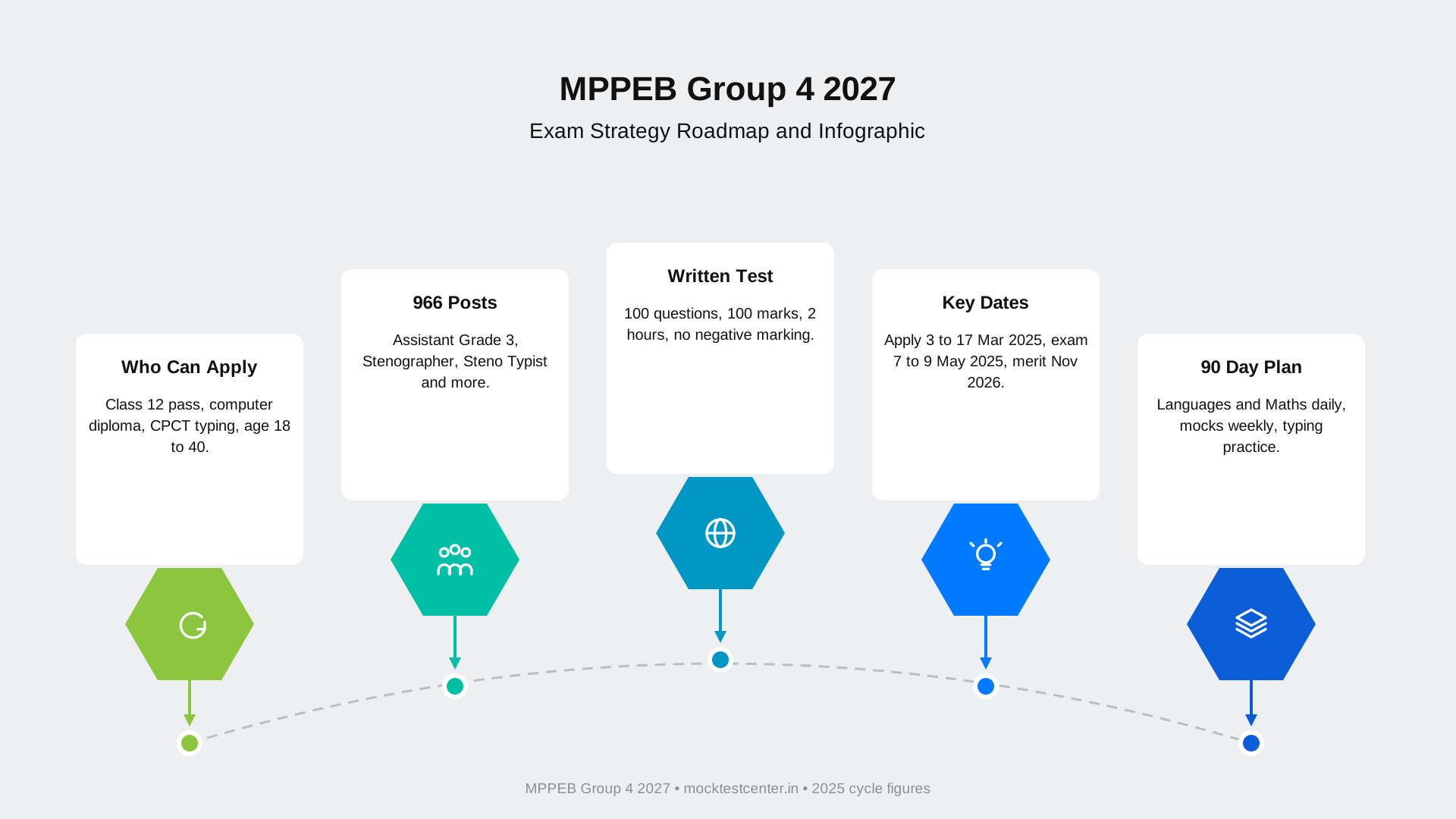
About MPPEB Group 4 2027 Exam Series
📖 Table of Contents
- MPPEB Group 4 2027 at a glance
- 966 posts, and the two revisions behind the number
- Who can apply for MPPEB Group 4 2027
- The age rule, 18 to 40, and the 45 year ceiling
- The fee, Rs 500 and Rs 250
- The pattern, 100 questions in 2 hours
- Negative marking, the one open conflict
- Exam days, shifts, admit card and answer key
- Exam cities, 13 across the state
- How selection works
- Pay, post by post
- Group 4 against Group 2 and Group 3
- The 2023 cycle, 3,047 posts
- What the 2025 timeline teaches
- Subject by subject preparation
- A 90 day plan that fits the real paper
- Five mistakes that cost Group 4 candidates marks
- Sources
MPPEB Group 4 2027: Complete Exam Guide
The Madhya Pradesh Employees Selection Board runs the MPPEB Group 4 2027 combined recruitment test for Class 3 clerical posts in state government departments. The live cycle is Group 4 2025, formally the Group 4 Assistant Grade 3, Steno Typist, Stenographer and Other Post Combined Recruitment Test 2024, which filled 966 posts.
That cycle finished its written test in May 2025, and its merit list came out in November 2026. No fresh MPPEB Group 4 2027 notification has appeared yet, so this guide works from the 2025 cycle and shows how the next one will run.
Group 4 is the entry point for Class 12 pass candidates who want a desk job in the Madhya Pradesh government. Assistant Grade 3, Stenographer, Steno Typist, Data Entry Operator, Computer Operator and Coding Clerk posts all come through this one test, and the whole selection rests on a single online paper of 100 questions.
The 2025 cycle also teaches a lesson about reading notices twice. The vacancy count, the application window and the exam date all changed after the first announcement. Candidates who tracked only the first notice prepared for the wrong exam. This MPPEB Group 4 2027 guide records every change, so the next cycle holds no surprise of that kind.
MPPEB Group 4 2027 at a glance
| Detail | Group 4 2025, the live cycle |
|---|---|
| Conducting body | Madhya Pradesh Employees Selection Board, Bhopal, earlier called MPPEB or PEB |
| Exam name | Group 4 Assistant Grade 3, Steno Typist, Stenographer and Other Post Combined Recruitment Test 2024 |
| Posts | 966, Assistant Grade 3, Stenographer, Steno Typist, Data Entry Operator, Computer Operator, Coding Clerk and others |
| Notification | 24 January 2025 |
| Application window | 3 March to 17 March 2025, corrections to 22 March 2025 |
| Application fee | Rs 500 for unreserved, Rs 250 for SC, ST, OBC, EWS and PwD candidates of Madhya Pradesh |
| Age limit | 18 to 40 years as on 1 January 2024, upper limit 45 for reserved categories |
| Education | Class 12 pass, plus a one year computer diploma and CPCT, shorthand for Stenographer posts |
| Written test | 7 May to 9 May 2025, online, 100 questions, 100 marks, 2 hours |
| Negative marking | None, as reported by Testbook and PW Live |
| Answer key | 13 May 2025 |
| Merit list | Released November 2026 |
| Pay | Rs 19,500 to Rs 62,000 for Assistant Grade 3, Level 4, other posts on lower scales |
| Official website | esb.mp.gov.in |
Read the table as the skeleton and the rest of this MPPEB Group 4 2027 guide as the flesh. The dates belong to the 2025 cycle. The pattern, the age rule and the fee structure carry over to the next advertisement unless the board changes them in print.
966 posts, and the two revisions behind the number
The board first printed 861 posts. The first application window ran from 4 February to 18 February 2025, and the exam was set for 30 March 2025. That plan did not hold. The board reissued the recruitment, raised the count to 966 posts, and opened a fresh window from 3 March to 17 March 2025, with corrections allowed to 22 March 2025.
One tracker gives a second account of the window. Testbook records that online applications were invited from 3 March to 22 March 2025.
The two accounts agree on the start date and on 22 March as a closing date, and they differ only on whether 17 March or 22 March was the last date to apply. The safest reading is the one the other trackers share. Applications closed on 17 March 2025, and the correction window ran to 22 March 2025.
The revised total of 966 breaks down as 956 direct posts plus 10 backlog posts. The category split in the revised notice reads as 278 unreserved, 84 EWS, 150 OBC, 229 SC and 215 ST posts, with 2, 1, 2, 2 and 3 additional posts in the same order. The SC and ST shares are large, and they shape the cut offs. A general candidate competes for 278 posts, while the reserved categories together hold more than two thirds of the seats.
Posts spread across many departments, and each department asked for a small number. The Madhya Pradesh Culture Council in Bhopal took 2 Stenographers and 5 Assistant Grade 3 staff.
The Nurses Registration Council in Bhopal took 10 Assistant Grade 3 staff. Dozens of departments took similar small blocks, and that spread is the point of a combined test. One paper feeds clerical posts in offices across the state, from Bhopal to the districts.
The lesson for the next cycle is plain. The first notice is a draft until the board says otherwise. Check the board website after applying, and check it again before the exam. A vacancy revision or a date change can arrive weeks after the first advertisement, and candidates who miss it prepare for the wrong count.
Who can apply for MPPEB Group 4 2027
The base qualification is simple. A candidate must have passed the Higher Secondary, Class 12, examination from a recognised board. That single condition opens the exam to lakhs of candidates every cycle, and it is also the reason the competition is so wide.
Class 12 alone does not finish the job. The notification also asks for a one year computer diploma or certificate from a recognised institution or university. Candidates should hold this before applying, because the document check at the end of the process asks for it.
Every candidate must also hold a Computer Proficiency Certification Test, CPCT, score card from the Madhya Pradesh Government Department of Science and Technology. The CPCT asks for Hindi typing at 20 words per minute or English typing at 30 words per minute, as the department specifies for the post. A candidate who clears the written test but holds no CPCT score card has no route to appointment.
Stenographer posts add one more condition. The Hindi shorthand writer or Stenographer must have cleared the Hindi shorthand test at 100 words per minute from a recognised institution, council or university. That speed takes months of daily practice, and it cannot be built in the weeks between the written test and the skill test.
Some posts need more than Class 12. The 2023 cycle listed posts such as Lab Assistant, Technician, Plumber, Fireman, Compounder and Accountant, and those posts asked for a diploma or a degree in the relevant field.
The 2025 cycle kept the same shape. The rule is simple. Read the post wise table in the notification, and match the qualification to the exact post code applied for, because a Class 12 pass qualifies for the clerical posts and not for the technical ones.
Indian citizens can apply, and candidates from outside Madhya Pradesh can apply too. The fee concession of Rs 250 applies only to SC, ST, OBC, EWS and PwD candidates who are natives of Madhya Pradesh. A candidate from another state pays the unreserved fee of Rs 500 and competes without the domicile based concessions.
The age rule, 18 to 40, and the 45 year ceiling
The age limit for the 2025 cycle ran from 18 to 40 years. The cut off date for age is a point of conflict between sources.
CareerPower and OB News both record the age as on 1 January 2024, while the task brief for this guide said 1 January 2025. Two trackers against one brief is a clear call. This guide uses 1 January 2024, and the upload pre check should confirm the cut off date against the official notification.
Reserved categories get a higher ceiling. SC, ST and OBC candidates, government servants and women candidates have an upper age limit of 45 years, as reported by OB News from the notification. That five year relaxation is the main age concession in this exam, and it applies to the same groups that get the fee concession.
The age rule matters more here than in graduate level exams. A Class 12 pass candidate can enter at 18, and the window runs to 40, or 45 with relaxation. That is a 22 year window, and it pulls in fresh school leavers, graduates waiting for a government job, and working candidates in their thirties. The competition is wide because the window is wide.
The fee, Rs 500 and Rs 250
Unreserved candidates paid Rs 500 for the 2025 cycle. SC, ST, OBC, EWS and Divyangjan candidates who are natives of Madhya Pradesh paid Rs 250. Portal charges applied on top of the fee, and the MP Online kiosk charged Rs 60 for candidates who filled the form through a kiosk. One tracker also records a correction charge of Rs 20 for edits made inside the correction window.
The fee is small next to the pay on offer, and that is part of the exam's pull. Five hundred rupees buys a shot at a permanent state government post with a Level 4 pay scale. The low fee also explains the crowd. When the cost of entry is low and the qualification is Class 12, applications run into lakhs, and the cut off climbs.
The pattern, 100 questions in 2 hours
The written test is a single online paper. It carries 100 multiple choice questions for 100 marks, one mark per question, and the time allowed is 2 hours. The paper ran in two shifts a day, 9 AM to 11 AM and 3 PM to 5 PM, across 7 May, 8 May and 9 May 2025.
The subject split gives the paper its shape. General Knowledge carries 20 marks, General Hindi 20, General English 20, General Mathematics 20, Computer Knowledge 10 and General Aptitude 10. Four subjects carry four fifths of the paper, and the two ten mark subjects decide the close contests.
| Subject | Marks |
|---|---|
| General Knowledge | 20 |
| General Hindi | 20 |
| General English | 20 |
| General Mathematics | 20 |
| Computer Knowledge | 10 |
| General Aptitude | 10 |
| Total | 100 |
That split is confirmed by PW Live, and it matches the subject list in the Testbook and CareerPower pages. General Knowledge here covers Madhya Pradesh as well as India, and the state share is heavy. Districts, rivers, dams, schemes of the state government, and the history of the region recur in the paper.
General Hindi and General English together carry 40 marks, and that is the largest block in the paper. Grammar, vocabulary, comprehension and sentence correction fill both sections. A candidate who reads Hindi and English daily has a head start of 40 marks, and no amount of last minute cramming closes that gap.
General Mathematics carries 20 marks at Class 10 level. Arithmetic, percentages, ratios, averages, simple interest and basic mensuration form the core. Speed matters more than depth here, because 20 questions in a 120 minute paper still need an answer in about a minute each once the other sections are counted.
Computer Knowledge carries 10 marks, and General Aptitude carries 10. The computer section tests basics, hardware, software, internet use and office tools, and it overlaps with the CPCT that candidates must already hold. The aptitude section tests reasoning, series, coding, and simple logical problems.
Negative marking, the one open conflict
Testbook states plainly that there is no negative marking in the written examination, and PW Live records the same, no negative marking, in its pattern table. OB News agrees, with one mark for every correct answer and no marks deducted for wrong answers.
One tracker disagrees. Sarkari Today prints a pattern table with negative marking of one fourth of a mark per wrong answer.
That single source stands against three, and its page also carries the superseded first cycle dates, 4 February to 18 February 2025 and the 30 March 2025 exam date, without noting the revision. This guide follows the majority. There is no negative marking in the MPPEB Group 4 2027 written test as far as the 2025 cycle shows, and candidates should attempt every question. The upload pre check should confirm this against the official notification, because a one fourth mark penalty would change the attempt strategy completely.
A second conflict concerns the duration. OB News states in one line that the exam runs for 3 hours, while its own pattern section and every other tracker record 2 hours, matching the two shift timings of 9 AM to 11 AM and 3 PM to 5 PM. Two hours is the correct figure, and the 3 hour line reads as a copy error.
Exam days, shifts, admit card and answer key
The exam was first set for 3 May 2025. Adda247 records a different first date, 30 March 2025, which was the date in the original February window. Both accounts agree on the end point. The board moved the exam to 7 May 2025, and the test then ran on 7, 8 and 9 May 2025, in two shifts each day.
The admit card came out on 30 April 2025, a week before the first shift. Candidates downloaded it from esb.mp.gov.in using the application number, date of birth, the first two letters of the mother name and the last four digits of the Aadhaar number. The card carried the exam centre, the shift timing and the venue, and the reporting time ran an hour before the shift, 7 AM for the morning shift and 1 PM for the afternoon shift.
The response sheet and answer key came out on 13 May 2025, four days after the last shift. Candidates could check their responses on the board website and raise objections inside the window the board set. The merit list followed much later, in November 2026, about eighteen months after the exam. That long gap between the test and the final list is normal for this board, and candidates should plan for it.
Exam cities, 13 across the state
CareerPower records that the exam ran in 13 cities across Madhya Pradesh. The standard MPESB city list for its online tests runs as Balaghat, Bhopal, Gwalior, Indore, Jabalpur, Khandwa, Neemuch, Ratlam, Rewa, Sagar, Satna, Sidhi and Ujjain, and the same list appears for the MP TET Varg 2 exam of the same year. The task brief for this guide listed 11 of those cities, leaving out Balaghat and Rewa. This guide uses the 13 city list, because the board runs its online tests on that list, and the upload pre check should confirm it against the notification.
Candidates pick their preferred cities in the application form, and the board allots centres on the basis of those preferences and seat availability. The exact centre and its address appear only on the admit card, so no candidate knows the venue until the card arrives. Candidates from small districts should be ready to travel to the nearest city on the list, and they should book travel only after the admit card shows the venue.
How selection works
Selection rests on the written test first. The online examination is the only stage that ranks candidates, and the merit list follows from its scores. Testbook's overview table lists the exam stages as the online examination and document verification, and that matches the CareerPower account, which says the selection process is based on the written exam.
Skill tests apply where the post needs them. Stenographer and Steno Typist posts need shorthand and typing speeds, and the CPCT score card is the proof the board asks for. The notification sets the speeds post wise, and candidates should hold the certificates before the document check.
Document verification closes the process. Candidates called from the merit list produce the Class 12 mark sheet, the computer diploma, the CPCT score card, the shorthand certificate where needed, the caste certificate where claimed, and the domicile certificate where the fee concession was taken. A missing certificate at this stage ends the candidature, whatever the written test score was.
One Testbook FAQ line says the selection includes a written examination and interview. That line conflicts with the same page's overview table, which lists only the online examination and document verification, and it conflicts with the other trackers. This guide treats the interview line as an error and states the process as written test, skill test where applicable, and document verification. The upload pre check should confirm this against the notification.
Pay, post by post
The headline pay figure belongs to one post only. Assistant Grade 3 sits on Level 4 of the pay matrix, with a scale of Rs 19,500 to Rs 62,000 per month under the 7th Pay Commission. Trackers put the in hand salary for this post between Rs 18,000 and Rs 25,000 a month after deductions, and the post also carries the allowances the Madhya Pradesh government allows.
Most other Group 4 posts sit lower. Steno Typist, Computer Operator and Data Entry Operator posts carry a pay band of Rs 5,200 to Rs 20,200 with a grade pay of Rs 1,900. Stenographer posts carry a higher scale, and one tracker records Rs 28,700 on Level 7 for Stenographer, while Stenotypist is recorded at Rs 25,300 to Rs 80,500 in the 2024 cycle detail. The exact scale for each post code sits in the notification, and candidates should read the post wise table before choosing their preferences.
Pay grows with service. The 7th Pay Commission matrix moves the basic pay up one cell every year, and the allowances rise with dearness allowance revisions. A candidate who joins as Assistant Grade 3 at Rs 19,500 reaches the top of the Level 4 matrix over a career, and promotion to higher clerical grades follows the department rules. The job is permanent, the pay is modest at entry, and the security is the real draw.
Group 4 against Group 2 and Group 3
MPESB runs its combined tests in numbered groups, and the number marks the level of the post. Group 4 is the Class 12 level test for clerical and stenography posts. Group 3 is the diploma level test for technical posts such as Sub Engineer, Draughtsman and Lab Technician. Group 2 is the graduate level test for posts such as Junior Engineer, Laboratory Technician, Field Officer, Occupational Therapist and Inspector.
The difference shows in the qualification first. Group 4 asks for Class 12 plus a computer diploma and CPCT.
Group 3 asks for a diploma in the relevant trade. Group 2 asks for a graduation degree in the relevant discipline. A candidate with only Class 12 can sit for Group 4 and not for the other two, and a graduate can sit for all three, though the graduate who sits for Group 4 competes with Class 12 candidates for a lower post.
The difference shows in the paper next. Group 4 tests general subjects only, General Knowledge, Hindi, English, Maths, Computer and Aptitude, with no technical paper.
Group 3 and Group 2 test the technical subject of the post, and the technical paper decides the merit. A Group 4 candidate prepares general subjects. A Group 2 or Group 3 candidate prepares a technical syllabus.
The difference shows in the post last. Group 4 posts are Class 3, non gazetted, clerical posts in government offices.
Group 3 posts are diploma level technical posts in engineering and laboratory departments. Group 2 posts are graduate level posts with higher pay scales and wider duties. Candidates should pick the group that matches their qualification, not the group with the most posts.
One more distinction matters. MPPSC runs the State Service Exam for officer level posts, with graduation as the minimum and an age window of 21 to 40. MPESB runs the group tests for subordinate posts. Group 4 is the lowest entry point in the MPESB ladder, and it is also the widest, because Class 12 is the most common qualification in the state.
The 2023 cycle, 3,047 posts
The previous full cycle ran in 2023, and it was far bigger than 2025. The board notified 2,716 posts on 13 December 2022, then raised the count to 3,047 revised posts. Applications ran from 6 March to 20 March 2023, extended to 25 March, and the exam ran from 15 July 2023 onwards.
The 2023 split shows the shape of a big cycle. Direct recruitment held 2,206 posts, direct backlog held 519, contract basis held 219, and contract backlog held 103. The category split read as 684 unreserved, 259 EWS, 459 SC, 978 ST and 667 OBC posts. The ST share was the largest block in the cycle, and that is a feature of Madhya Pradesh recruitment, where tribal districts hold many of the posts.
The 2023 post list was wider than 2025. It covered Personal Assistant, Stenographer, Assistant Grade 3, Office Assistant, Data Entry and IT and Computer Operator, Clerk, Coding and Record Clerk, Steno Typist, Outreach Worker, Garden Supervisor, Deputy Sanitary Supervisor, Animal Feeder, Compounder, Librarian, Technician, Lab Assistant, Plumber, Fireman, Leading Fireman, Assistant Photo Officer, Photography Teacher, Horticulture Director, Museum Keeper, Museum Assistant, Accountant and Assistant Revenue Inspector. The 2025 cycle narrowed the list to the clerical core, and the technical posts moved to their own tests.
The age rule in 2023 ran from 18 to 40 years as on 1 January 2023, the same window as 2025. The fee structure was the same too. The pattern of a revision stands out across both cycles. The board raised the vacancy count after the first notice in 2023 and again in 2025, and candidates who applied early in both cycles ended up competing for more posts than the first notice promised.
The fall from 3,047 posts in 2023 to 966 in 2025 is steep, and it sets the expectation for the next cycle. A big cycle clears backlogs across departments, and the next cycle fills only the fresh vacancies. Candidates should not plan on 3,000 posts returning. A count near 1,000, with the same services appearing in smaller numbers, is the safer assumption for MPPEB Group 4 2027.
What the 2025 timeline teaches
The 2025 cycle changed its dates four times, and each change is a warning. The first window opened on 4 February 2025 and closed on 18 February, with the exam set for 30 March. The board then reissued the recruitment, opened a fresh window from 3 March to 17 March, set the exam for 3 May, and then moved it again to 7 May. The test finally ran on 7, 8 and 9 May, in two shifts a day.
A candidate who prepared for a 30 March exam had five extra weeks. A candidate who booked travel for 3 May had to rebook for 7 May. A candidate who applied in the February window and never checked the board website again may have missed the reissue entirely. The board website is the only source that counts, and it should be checked every week from the notification to the exam.
The merit list gap teaches a second lesson. The exam ended on 9 May 2025, the answer key came out on 13 May, and the merit list arrived in November 2026.
Eighteen months passed between the test and the final list. Candidates who waited for the result before planning the next step lost a year and a half. The right move is to keep preparing for the next exam while the list is pending, because the list arrives on the board schedule, not on the candidate schedule.
Subject by subject preparation
General Knowledge carries 20 marks, and the Madhya Pradesh share decides it. Read the state budget, the state schemes, the districts and their headquarters, the rivers and dams, the national parks and sanctuaries, and the history of the region from the Gond and Maratha periods to the formation of the state in 1956. National current affairs from the six months before the exam fill the rest of the section. A daily newspaper habit covers both halves, and a state yearbook covers the static half.
General Hindi carries 20 marks, and it rewards daily reading more than any other section. Grammar rules, synonyms and antonyms, idioms, sentence correction and comprehension passages form the section. Candidates who read Hindi newspapers and books score here without extra study, and candidates who start Hindi only a month before the exam struggle with the idioms and the comprehension speed.
General English carries 20 marks at a similar level. Grammar, vocabulary, error spotting, synonyms and antonyms, and a comprehension passage fill the section.
The English here is school level, not competitive exam level, and a Class 12 pass candidate who reads English daily clears it. The trap is neglect. Candidates who focus on Maths and Knowledge and leave English to the last week lose marks in the easiest section of the paper.
General Mathematics carries 20 marks at Class 10 level. Percentages, ratios, averages, profit and loss, simple and compound interest, time and work, speed and distance, and basic mensuration recur every year.
The section needs practice, not theory. Fifty questions a day from these topics, timed, builds the speed the paper needs. A calculator habit is the enemy here, because the exam hall has no calculator and the clock has no mercy.
Computer Knowledge carries 10 marks, and the CPCT syllabus covers it. Hardware basics, operating systems, file handling, internet and email, and office tools form the section. Candidates who hold a CPCT score card already know most of this, and a week of revision is enough. Candidates without computer exposure should practise on a real machine, because reading about a spreadsheet teaches less than using one.
General Aptitude carries 10 marks, and it tests reasoning, not memory. Series, coding and decoding, blood relations, direction sense, and simple puzzles fill the section. Ten questions a day from a reasoning book, over three months, covers it. The section is short, and it is also the section where a calm mind gains marks, because reasoning questions punish haste more than ignorance.
A 90 day plan that fits the real paper
Start with the two 20 mark language sections and the 20 mark Maths section together, not one after the other. Hindi and English need daily contact, and Maths needs daily practice. Give each of the three a fixed hour a day for the first month, and the base builds itself. Knowledge and Computer and Aptitude can wait for the second month, because they need reading and revision, not daily drills.
Give the second month to General Knowledge and to mock tests. Read the state yearbook in the morning, solve one full paper every Sunday, and review every wrong answer the same day. The review matters more than the score. A mock test without review teaches nothing, and a mock test with a careful review teaches the paper.
Keep the last month for revision and for typing practice. Revisit the Maths formulas, the Hindi idioms, the English vocabulary lists, and the state facts. Sit a full mock test on the real clock, 9 AM to 11 AM, because the morning shift is the shift most candidates draw. Practise Hindi typing at 20 words per minute and English typing at 30 words per minute in the same weeks, because the CPCT score card must be ready before the document check.
Take mock tests on the real pattern. One hundred questions, 100 marks, 2 hours, no negative marking, so attempt every question. Track the score by subject, not by total, because the total hides the weak subject. A total of 70 with 4 in Computer means the next month belongs to Computer, not to more Maths.
Five mistakes that cost Group 4 candidates marks
The first mistake is applying without the CPCT score card. The written test is open to Class 12 pass candidates, and many apply before they hold the computer diploma or the CPCT certificate. The board asks for both at the document check, and a candidate who clears the paper without them loses the post. Get the CPCT done before applying, not after the result.
The second mistake is ignoring the two language sections. Hindi and English together carry 40 marks, and candidates who chase Maths and Knowledge leave 40 marks to chance. Read both languages daily from the first week, and the 40 marks take care of themselves.
The third mistake is trusting the first notice. The 2025 cycle changed its vacancy count, its application window and its exam date after the first announcement. Check esb.mp.gov.in every week until the admit card arrives, and read every corrigendum the board puts out.
The fourth mistake is preparing for the wrong group. Group 4 tests general subjects only, and candidates who study technical subjects for Group 2 or Group 3 waste weeks on a syllabus that never appears in this paper. Match the preparation to the group applied for, and keep the technical books for the technical test.
The fifth mistake is waiting for the merit list before moving on. The 2025 merit list took eighteen months to arrive. Candidates who stopped studying after the exam lost that time. Keep preparing for the next cycle while the list is pending, because the next notification can arrive before the last list does.
Sources
Testbook: MP Vyapam Group 4 2025, merit list, vacancy 966, exam 7 May 2025, pattern, fee, age, salary
CareerPower: MPESB Group 4 Exam Date 2025, response sheet, 7 to 9 May 2025, shifts, 13 cities, pattern, fee, age as on 1 January 2024
CareerPower: MPESB Group 4 Admit Card 2025, 30 April 2025, subjects, 100 questions, 100 marks
PW Live: MPESB Group 4 New Exam Date 2025, revised from 3 May to 7 May 2025, subject marks, no negative marking
Adda247: MP Group 4 Exam Date 2025, vacancies revised to 966, first date 30 March 2025, application 17 March to 22 March 2025
OB News: MPESB Group 4 Recruitment 2025, application 3 to 17 March 2025, CPCT and shorthand conditions, age relaxation to 45 years, 3 hour duration line noted as a conflict
Sarkari Today: MPESB Group 4 Recruitment 2025, first window 4 to 18 February 2025, 861 posts, 30 March 2025 exam date, one fourth negative marking noted as a conflict
Adda247: MPPEB Group 4 Recruitment 2023, 3,047 revised posts, apply 6 to 25 March 2023, exam from 15 July 2023
Hindustan Times: MPPEB Group 4 recruitment 2023, 2,716 posts first, raised to 3,047, registration to 20 March 2023
Improvam: Madhya Pradesh government exams, MPESB Group 2 graduate level, Group 3 diploma level, Group 5 paramedical
Moneycontrol: MPESB Group 2 Sub Group 3 Recruitment 2025, 339 graduate posts, apply 9 to 23 September 2025