About MPTET Varg 2 2027 Exam Series
📖 Table of Contents
- MPTET Varg 2 2027 at a glance
- 10,758 posts, and where they sit
- The name problem, settled
- The exam window moved, and why that matters
- Who can apply for MPTET Varg 2 2027
- Age limit and fee
- The pattern: 150 questions in 150 minutes
- Negative marking: the one fact trackers cannot agree on
- Sports, music and dance papers
- Qualifying marks: 60 percent and 50 percent
- How the application window actually ran
- Admit card, answer key and result
- What each subject paper tests
- The 2023 cycle, and what changed by 2025
- The separate 2026 test for teachers already in service
- A 90 day plan that fits the real paper
- Five mistakes that cost Varg 2 candidates marks
- What to watch for in the next notification
- Sources
MPTET Varg 2 2027: Complete Exam Guide
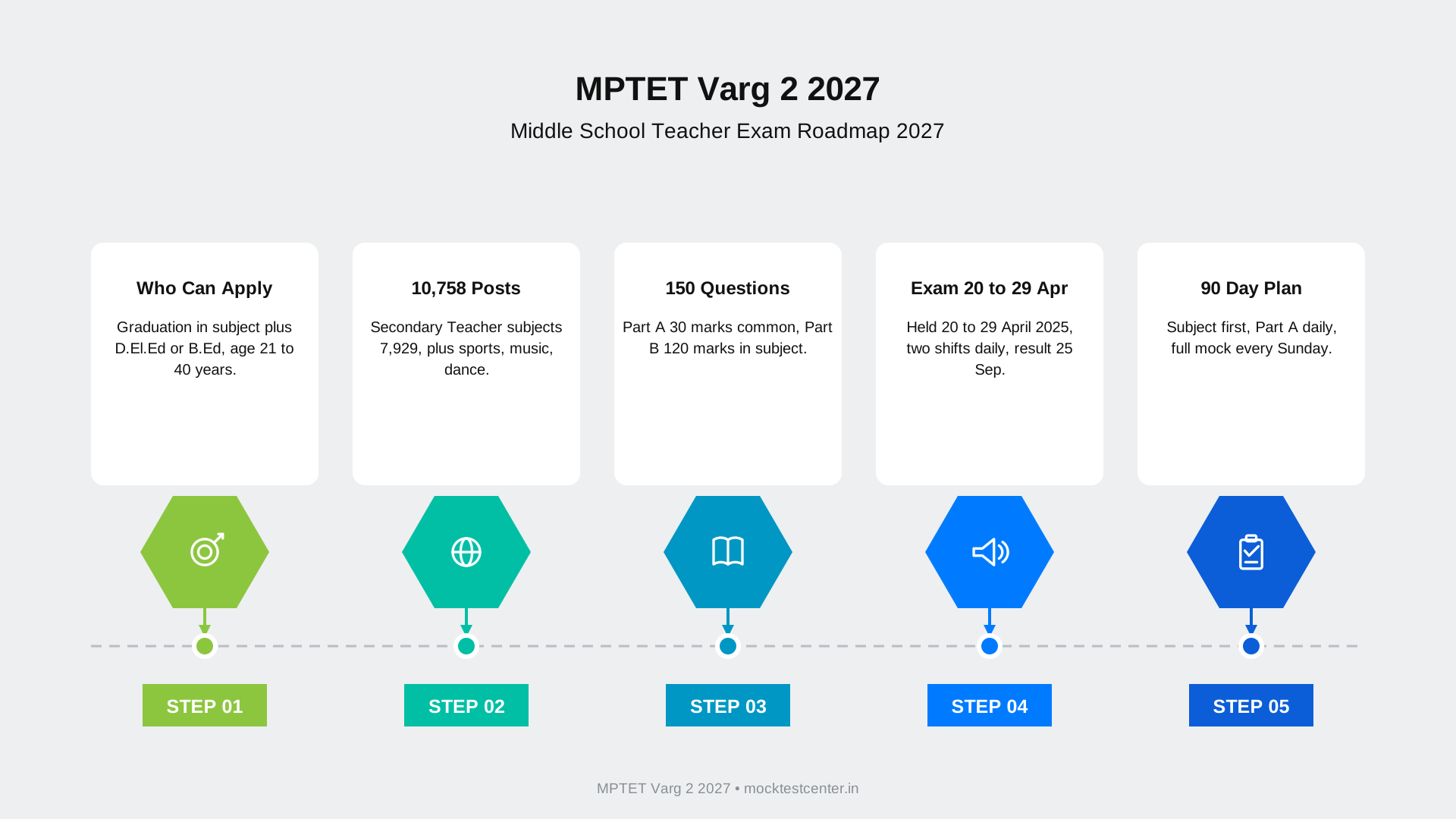
The Madhya Pradesh Employees Selection Board runs the Middle School Teacher Eligibility Test, known as MPTET Varg 2, for teachers of Classes 6 to 8 in government schools across Madhya Pradesh. The live cycle is the 2025 cycle, notified on 17 January 2025 for 10,758 posts.
That cycle ended with an exam held from 20 to 29 April 2025, an answer key on 6 May 2025 and a result on 25 September 2025. No fresh Varg 2 notification has appeared yet, so this guide works from the 2025 cycle and shows how the next one will run.
One thing makes this exam easy to misunderstand. The same notification is called a teacher eligibility test in some places and a teacher selection test in others. The two names describe two halves of one process. The eligibility test proves a candidate can teach.
The selection test ranks candidates for actual posts. The January 2025 notification did both at once, because it filled 10,758 named posts and tested candidates on the eligibility pattern.
Read this MPTET Varg 2 2027 guide with that in mind. The pattern below is the pattern of the exam that was actually held in April 2025. The eligibility rules are the rules of that notification. The next notification may change dates and post counts, and it will keep the same shape unless the Board says otherwise in print.
MPTET Varg 2 2027 at a glance
| Detail | MPTET Varg 2 2025, the live cycle |
|---|---|
| Conducting body | Madhya Pradesh Employees Selection Board, Bhopal |
| Notification | 17 January 2025, short notice 1 January 2025 |
| Posts | 10,758 Secondary Teacher and Primary Teacher posts |
| Departments | School Education Department and Tribal Affairs Department |
| Application window | 28 January to 20 February 2025, reopened 10 to 17 March 2025 |
| Application fee | Rs 500 general, Rs 250 reserved categories of Madhya Pradesh |
| Age limit | 21 to 40 years for general male candidates, 45 years for general female candidates |
| Exam | 20 to 29 April 2025, two shifts daily |
| Pattern | 150 questions, 150 marks, 150 minutes, one paper |
| Admit card | 13 April 2025 |
| Answer key | 6 May 2025, objections till 9 May 2025 |
| Result | 25 September 2025 |
| Official website | esb.mp.gov.in |
Read the table as the skeleton and the rest of this MPTET Varg 2 2027 guide as the flesh. The dates belong to the 2025 cycle. The pattern, the age rule and the fee structure carry over to the next notification unless the Board changes them in print.
10,758 posts, and where they sit
The Board announced 10,758 posts in the January 2025 notification. The largest block by far was Secondary Teacher for subjects, with 7,929 posts. Of those, 7,082 sat in the School Education Department and 847 in the Tribal Affairs Department.
The rest of the posts went to specialist teachers. Secondary Teacher for sports took 338 posts. Secondary Teacher for music took 392 posts, covering singing and playing. Primary Teacher for sports took 1,377 posts, split into 724 in School Education and 653 in Tribal Affairs.
Primary Teacher for music took 452 posts. Primary Teacher for dance took 270 posts.
That split tells a candidate two things. First, the subject teacher posts dominate the exam, and the competition for them is the main event. Second, the specialist posts are real openings with their own papers, and candidates with those skills should not treat them as an afterthought.
The pay scale in the notification was Rs 32,800 plus dearness allowance for Secondary Teacher posts and Rs 25,300 plus dearness allowance for Primary Teacher posts. Those figures are the starting pay in the notification, and allowances add to them under state rules.
Two departments share the posts. The School Education Department holds the larger share, and the Tribal Affairs Department holds the smaller one. A candidate applies for the post, and the department split decides where the selected teacher is posted. The Tribal Affairs posts serve schools in tribal areas, and candidates who take them should expect postings in those districts.
| Post | School Education | Tribal Affairs | Total posts |
|---|---|---|---|
| Secondary Teacher, subjects | 7,082 | 847 | 7,929 |
| Secondary Teacher, sports | Not split in the notice | 338 | |
| Secondary Teacher, music | Not split in the notice | 392 | |
| Primary Teacher, sports | 724 | 653 | 1,377 |
| Primary Teacher, music | 422 | 30 | 452 |
| Primary Teacher, dance | 254 | 16 | 270 |
| Total | 10,758 | ||
The department split for sports and music at secondary level was not published in the tracker summaries of the notification. The totals are firm. The split is not. Candidates should check the notification itself for that detail when the next cycle opens.
The name problem, settled
Search results for this exam use three names. Some call it MPTET Varg 2. Some call it the Middle School Teacher Eligibility Test. Some call it the Middle School Teacher Selection Test.
All three names point at the same January 2025 notification.
The confusion has a real cause. Madhya Pradesh runs teacher recruitment in two tiers. The first tier is the eligibility test, which gives a candidate a Teacher Eligibility Test certificate. The second tier is the selection test, which ranks certificate holders for named posts.
In older cycles the two tiers were separate exams held in separate years.
The 2025 cycle folded the two ideas into one notification. It named 10,758 posts, and it tested candidates on the 150 question eligibility pattern in April 2025. That is why one tracker calls the April exam a qualifying test and another calls it a selection test. Both labels fit, because the exam both tested eligibility and filled posts.
Some trackers also describe a two stage structure for Varg 2 in general. In that description, the eligibility test has 150 questions and the selection test that follows has 100 questions on the chosen subject alone, with a two hour duration. That 100 question paper did not appear as a separate stage in the April 2025 cycle. Candidates should treat it as a possible shape for a future cycle, not as a paper that was held in 2025.
The practical point is simple. Prepare for the 150 question paper, because that is the paper the Board held. Keep an eye on the next notification, because the Board can split the process into two stages again. The notification, not a tracker, decides which shape the next cycle takes.
The exam window moved, and why that matters
The short notice of 1 January 2025 said the exam would start on 20 March 2025. Several trackers still carry that date, and a candidate who reads only the early pages will plan for March. The exam did not happen in March.
The Board revised the schedule, and the exam ran from 20 to 29 April 2025. The admit card came out on 13 April 2025, a week before the first paper. PW Live and Adda247 confirm the revised dates. CareerPower confirms them too, and the answer key date of 6 May 2025 backs the April window.
The March date was the plan in the short notice. The April dates are the exam as held. Guides that still quote 20 March 2025 as the exam date are quoting the first plan, not the final one. The lesson for the next cycle is plain.
The first date in a short notice can move, and the admit card date is the one to trust.
The exam ran in two shifts on each day from 20 to 29 April 2025. Each subject had its own days inside that window. Hindi for middle school ran on 20 and 21 April. Social Science followed over the next three days.
Science ran across 24 to 26 April. Mathematics ran on 27 and 28 April. Sanskrit and English closed the window on 28 and 29 April. The specialist papers for primary and middle school ran alongside them on their own days.
A candidate wrote only one paper, on the day fixed for that subject. The ten day window existed because seven subjects and three specialist streams had to be fitted in, not because any candidate sat for ten days.
Who can apply for MPTET Varg 2 2027
Eligibility for Varg 2 rests on two things, a degree in the relevant subject and a teacher training qualification. The notification accepts several combinations, and a candidate needs only one of them.
The first route is a bachelor degree in the relevant subject with a two year Diploma in Elementary Education, known as D.El.Ed, or an equivalent diploma. The second route is a bachelor degree in the relevant subject with at least 50 percent marks and a Bachelor of Education, known as B.Ed. The third route is a bachelor degree in the relevant subject with at least 45 percent marks and a B.Ed under the norms of the National Council for Teacher Education.
Two more routes cover candidates who trained straight after school. Higher Secondary with at least 50 percent marks and a four year Bachelor in Elementary Education qualifies. Higher Secondary with at least 50 percent marks and a four year integrated BA Ed or BSc Ed qualifies too. A B.Ed in Special Education also counts, with a bachelor degree in the relevant subject at 50 percent marks.
Reserved category candidates of Madhya Pradesh get a 5 percent relaxation in the qualifying marks. That relaxation applies to candidates from the reserved categories of the state, including PwD candidates. The subject matters here. A mathematics graduate applies for the mathematics paper.
A science graduate applies for the science paper. The degree subject and the paper subject must match, and a candidate cannot pick a subject paper in a subject they did not study.
Specialist teachers follow their own qualification routes in the notification, built around degrees and diplomas in physical education, music and dance. The broad rule is the same. A relevant qualification plus teacher training, with the training route matched to the stream.
Live registration on the Madhya Pradesh employment portal, known as Rojgar Panjiyan, is mandatory for applicants. Candidates should keep that registration live before applying, because a lapsed registration can block the application at the portal stage.
Age limit and fee
The minimum age is 21 years. The maximum age for general male candidates is 40 years. General female candidates get a higher ceiling of 45 years. Reserved category candidates get further relaxation under Madhya Pradesh government rules, and the exact ceiling for each category is set in the notification with a cut off date.
PW Live reports the age as calculated on 1 January 2024 for the 2025 cycle. That cut off year looks odd against a January 2025 notification, and it may be a tracker error. Candidates should read the cut off date in the notification itself when the next cycle opens, because a wrong cut off date can wrongly rule a candidate in or out.
The application fee in the 2025 cycle was Rs 500 for general candidates and Rs 250 for reserved category candidates of Madhya Pradesh, including Divyangjan candidates. Portal charges sat on top of the fee. Candidates who applied through an MP Online kiosk paid Rs 60 extra, and candidates who used a citizen user account paid Rs 20 for postal services.
Those portal charges catch candidates by surprise every cycle. The fee in the headline is Rs 500 or Rs 250, and the amount that leaves the account is Rs 560 or Rs 270 at a kiosk. Budget for the portal charge, and keep the payment receipt until the admit card arrives.
The pattern: 150 questions in 150 minutes
The Varg 2 paper for subject teachers has 150 questions for 150 marks, and the duration is 150 minutes. Each question carries one mark. The paper has two parts, and every candidate attempts both.
Part A is common to all subject candidates and carries 30 marks. General Hindi has 8 questions. General English has 5 questions. General Knowledge and Current Affairs plus Reasoning and Numerical Ability has 7 questions.
Pedagogy, which covers child development and teaching method, has 10 questions.
Part B carries 120 marks, and it is the whole of the chosen subject. A candidate picks one of seven subjects, and all 120 questions come from that subject. The seven are Hindi, English, Sanskrit, Urdu, Mathematics, Science and Social Science. Part B decides the result, because it holds four fifths of the marks.
| Part | Section | Questions | Marks |
|---|---|---|---|
| Part A, common | General Hindi | 8 | 8 |
| Part A, common | General English | 5 | 5 |
| Part A, common | General Knowledge and Current Affairs plus Reasoning and Numerical Ability | 7 | 7 |
| Part A, common | Pedagogy | 10 | 10 |
| Part B, subject | Chosen subject, one of seven | 120 | 120 |
| Total | 150 | 150 |
One mark per question makes the arithmetic easy, and that ease hides a trap. A candidate who spends too long on Part B can lose the 30 marks of Part A by rushing it. Part A is only a fifth of the paper, and it is the fifth that separates candidates with equal subject scores. Give Part A its share of time, about 30 minutes of the 150, and do not let it become an afterthought.
The questions are multiple choice with four options and one correct answer, and all questions are compulsory. There is no choice inside a section. A candidate answers every question in the paper, including the ones they are unsure about.
Negative marking: the one fact trackers cannot agree on
Negative marking is the least settled fact in this exam. Testbook says the Varg 2 paper carries a negative mark of one for every four wrong answers, which works out to 0.25 per wrong answer. Sarkari Pariksha also reports 0.25 per wrong answer. Other trackers say there is no negative marking at all in the MPESB pattern.
This guide does not pick a side, because the notification itself was not read directly during preparation and the trackers flatly contradict each other. A candidate who assumes no negative marking and guesses freely could lose marks if the 0.25 rule applies. A candidate who assumes 0.25 and leaves questions blank could lose marks if there is no negative marking.
The safe approach is to check the rule in the notification and on the admit card instructions before the exam, and to practise both ways. Attempt every question in a mock test with no negative marking, and attempt only the questions you can narrow down in a mock test with 0.25 negative marking. The habit that survives both versions is the same. Narrow each question to two options before marking it, and leave nothing to a blind guess.
Sports, music and dance papers
The specialist streams do not follow the Part A and Part B split of the subject teachers. Their papers still have 150 questions for 150 marks in 150 minutes, and the shape is different.
For sports teachers and primary sports teachers, Child Development and Pedagogy carries 15 questions. Language I carries 10 questions, and the candidate picks Hindi or Sanskrit for it. Language II is English and carries 5 questions. Physical Education carries 120 questions.
The subject still holds four fifths of the paper, and the language and pedagogy sections fill the rest.
For music teachers and primary music teachers, the shape is the same with the subject changed. Pedagogy carries 15 questions. Language I carries 10 and Language II carries 5. The music subject, singing and playing or musical instruments, carries 120 questions.
For primary dance teachers, Pedagogy carries 15 questions, the two languages carry 10 and 5, and Dance carries 120 questions. The pattern is consistent across the specialist streams. The subject dominates, and pedagogy plus languages make up the remaining 30 marks.
That consistency helps a specialist candidate plan. The subject needs most of the study time, and the pedagogy and language sections need steady weekly work rather than a last minute rush. A music teacher who can play well but cannot answer pedagogy questions will still fall short, because 30 marks is a fifth of the paper.
Qualifying marks: 60 percent and 50 percent
The Teacher Eligibility Test qualifying marks are 60 percent for general category candidates and 50 percent for reserved category candidates. On a 150 mark paper, that means 90 marks for general candidates and 75 marks for reserved category candidates.
Those are the eligibility marks, and they are not the same as the selection cut off. The eligibility mark decides whether a candidate holds a valid Teacher Eligibility Test certificate. The selection cut off decides who gets a post, and it moves with the number of applicants, the difficulty of the paper and the number of posts in each subject.
A candidate who scores 90 marks as a general candidate has qualified. That same candidate may still miss a post if the merit list for the subject closes above 90. The reverse also holds. A candidate who scores well above the qualifying mark in a subject with few applicants can still make the merit list.
Treat 90 and 75 as floors, not as targets, and aim for the merit list of the subject, not for the qualifying line.
The Teacher Eligibility Test certificate carries lifetime validity under the current rules. That matters for candidates who qualify in one cycle and apply for posts in a later one. The certificate does not expire, and the candidate does not need to sit the eligibility test again to stay eligible.
How the application window actually ran
Applications opened on 28 January 2025 and first closed on 11 February 2025. That is the window in the early tracker pages. The Board then extended the last date to 20 February 2025, and that is the date most trackers carry as the final one.
The correction window ran alongside the application window, and Adda247 records it as open from 28 January to 16 February 2025. Candidates could fix errors in the form during that window. The Board treated the corrected form as the final one.
The window then reopened. CareerPower records application form reopen dates of 10 to 17 March 2025. That reopen gave a second chance to candidates who had missed the February window entirely. It also explains why some trackers show a March application date and others show February.
Both are right, for different windows.
The lesson for the next cycle is to apply in the first window and to treat every extension as a bonus, not as the plan. Extensions are announced at short notice, and a candidate who waits for one can miss it. Apply early, correct the form inside the correction window, and keep the application number safe for the admit card.
The application went through the MP Online portal, and the fee was paid online at the time of applying. Candidates applied on esb.mp.gov.in, which is the Board website, and the portal carried the form, the fee payment and later the admit card.
Admit card, answer key and result
The admit card came out on 13 April 2025, seven days before the first paper. Candidates downloaded it from esb.mp.gov.in with the application number and date of birth, and the card carried the exam date, the shift, the centre and the reporting time. A candidate should check the subject code on the admit card against the subject applied for, because a wrong subject code means the wrong paper.
The exam ran from 20 to 29 April 2025. The provisional answer key came out on 6 May 2025, a week after the last paper. Candidates could raise objections till 9 May 2025, and the Board settled the objections before the final result.
The result came out on 25 September 2025, almost five months after the exam. That gap is long, and it is the hardest part of the cycle for candidates. The answer key gives a fair idea of the score within days of the exam, and candidates should use that estimate to plan the next step instead of waiting for the result in silence.
The result was published on esb.mp.gov.in as a scorecard, and candidates checked it with the application number or roll number and date of birth. The scorecard carried the marks, the qualifying status and the details needed for document verification. Candidates who qualified moved to document verification, where the Board checked the degree, the training qualification, the caste certificate and the age proof against the notification.
What each subject paper tests
The seven subject papers share a shape and differ in content. Each one has 120 questions on the subject, and each one tests the subject at the level a middle school teacher must teach it, plus the depth a graduate should hold.
The Hindi paper tests language and literature at middle school and graduation level. It covers grammar and comprehension passages, with questions on teaching Hindi. The English paper does the same for English. It covers grammar and vocabulary as well as comprehension and the method of teaching English as a second language.
The Sanskrit paper tests classical language, grammar and literature, and it draws candidates who studied Sanskrit at graduation.
The Urdu paper tests Urdu language and literature, and it serves Urdu medium schools and Urdu subject posts. The Mathematics paper tests number systems, algebra and geometry. It also tests mensuration, trigonometry and data handling, with questions pitched at the level a Class 6 to 8 teacher must explain clearly. The Science paper covers physics and chemistry and biology together.
It tests concepts rather than recall of facts alone.
The Social Science paper is the widest of the seven. It covers history and geography, with civics and economics alongside. It includes Madhya Pradesh specific content, from state history to its districts and rivers. A candidate who studies only national material will leave state marks behind, and the state questions recur every cycle.
Pedagogy runs through all seven papers as the 10 questions of Part A, and it also shapes how the subject questions are framed. Child development and learning theories appear in every paper, along with inclusive education and classroom assessment and teaching method. The names Piaget and Pavlov recur in the pedagogy section, and so do Thorndike and Kohlberg. Candidates should know each theory well enough to apply it to a classroom situation rather than to recite a definition.
General Hindi and General English in Part A are lighter than the subject language papers. They test basic grammar and vocabulary and comprehension. General Knowledge covers current affairs of national and state importance. It also covers Madhya Pradesh static facts and reasoning and numerical ability at a basic level.
Those 30 marks reward steady reading of a newspaper and a state yearbook, and they punish candidates who ignore them for months.
The 2023 cycle, and what changed by 2025
The previous full eligibility cycle ran in 2023. The Varg 2 and Varg 3 eligibility exams were held in March 2023, and the results came out on 4 July 2023. The Varg 3 exam ran from 5 to 26 March 2023, and the Varg 2 exam ran in the same window.
The 2023 cycle was an eligibility cycle. It gave certificates. The 2025 cycle was different, because it named 10,758 posts and filled them. That change is the most important fact in this guide.
A candidate preparing for the next cycle should expect a notification that names posts, because the Board has moved to filling posts through the Varg 2 exam rather than running a standalone eligibility test.
The gap between the cycles also matters. Two years passed between the 2023 eligibility exam and the 2025 selection exam. Candidates who qualified in 2023 held a valid certificate when the 2025 posts were announced, and the lifetime validity of the certificate made that possible. A candidate who qualifies in the next cycle should keep the certificate safe for the same reason.
The separate 2026 test for teachers already in service
A different exam with a similar name appeared in August 2026. The Madhya Pradesh Secondary and Primary School Teacher Eligibility Test, known as MSPSTET 2026, is a special eligibility test for teachers who are already working in primary and secondary schools and have not yet qualified the eligibility test.
It is not a recruitment exam, and it is not open to fresh candidates. The notification came out on 17 August 2026, applications opened on 21 August 2026, and the last date was first 4 September 2026 and then extended to 18 September 2026. The exam began on 12 October 2026.
The special test exists because of a Supreme Court order of 1 September 2025, in Civil Appeals 1385 and 1386 of 2025, which required in service teachers to hold the eligibility qualification. The fee for the special test was Rs 1,000 for all categories, which is different from the Rs 500 and Rs 250 fee of the 2025 Varg 2 cycle. The result of the special test is valid only for continued service, not for future direct recruitment.
Candidates for Varg 2 2027 should not confuse the two exams. The special test is for teachers already in a job. The Varg 2 exam is for candidates seeking a post. The dates and the fee and the purpose are all different.
Only the Board website can confirm which exam a candidate should apply for.
A 90 day plan that fits the real paper
Start with the subject, because it holds 120 of the 150 marks. Spend the first 45 days on the subject syllabus from start to finish, one unit at a time, with previous papers alongside. The subject paper rewards depth, and a candidate who knows the subject well can afford a weaker Part A. The reverse is not true.
Give Part A a fixed slot every day from the start. Thirty minutes a day covers the four Part A areas across a week. Pedagogy needs the most of that time, because its 10 questions carry theory that cannot be guessed. General Knowledge needs a daily newspaper and a weekly revision of Madhya Pradesh facts.
Take a full mock test every Sunday from the sixth week onward. Sit the mock in one stretch of 150 minutes, with no breaks and no phone. The mock should follow the real split, 30 marks of Part A and 120 marks of the subject, so that the score means something. Track the Part A score and the subject score separately, and fix the weaker one first.
Use the last three weeks for revision and previous papers. Read the question papers of the last two cycles, and note which topics repeat. In Social Science, Madhya Pradesh history and geography recur. In Science, the concept questions recur.
In Mathematics, the same types of problems recur with new numbers. Previous papers are the closest thing to a syllabus the Board publishes.
Keep the last week for the admit card and the centre and the documents. Download the admit card as soon as it appears, check the subject code and the shift, and visit the centre if it is in an unfamiliar town. Pack the admit card, a photo identity card and a pen the night before, and reach the centre an hour early. The exam is long enough without a last minute rush at the gate.
Five mistakes that cost Varg 2 candidates marks
The first mistake is preparing for the wrong paper. Candidates who study the 100 question selection pattern and ignore Part A walk into a 150 question paper with 30 marks unprepared. Read the notification for the cycle you are applying for, and prepare for the paper it describes.
The second mistake is treating Part A as free marks. The 30 marks of Part A look small next to 120 subject marks, and candidates leave them to the last week. Those 30 marks are often the difference between qualifying and missing the line, because subject scores bunch together at the top.
The third mistake is guessing without a rule. With the negative marking rule itself disputed, the only safe habit is to mark an answer only when two options can be ruled out. A blind guess is a coin toss with marks at stake, and a paper with 150 questions punishes coin tosses.
The fourth mistake is trusting the first date in a short notice. The 2025 cycle moved from 20 March to 20 to 29 April, and candidates who booked travel for March lost money and time. Wait for the admit card before booking anything that cannot be changed.
The fifth mistake is stopping after the answer key. The result took almost five months in 2025, and candidates who waited in silence lost five months of preparation for the next stage. Use the answer key estimate to decide the next step, and keep studying while the Board finishes its work.
What to watch for in the next notification
Watch for the post count first, and for the split between School Education and Tribal Affairs. The 2025 cycle had 10,758 posts, and the next cycle could be larger or smaller. The subject wise split decides where the competition is thinnest, and the specialist posts often draw fewer applicants per post than the subject posts.
Watch for the exam shape second. The Board may hold the 150 question paper again, or it may split the process into an eligibility test and a 100 question selection test. The notification will say which shape applies, and no tracker can settle it before the notification appears.
Watch for the negative marking rule third. The notification carries the marking scheme, and the admit card instructions repeat it. Read both, and practise under the rule they state.
Watch for the age cut off date fourth. The 2025 cycle reported a cut off of 1 January 2024, and that date needs confirmation. A candidate near the upper age limit should check the cut off date on the day the notification appears, because a single year changes eligibility.
Watch the Board website, esb.mp.gov.in, for all four. The site carries the notification and the admit card and the answer key and the result, and it is the only source that settles a dispute between trackers.
Candidates preparing for this exam also practise with mock tests for UGC NET Paper 1 2027, UGC NET Commerce 2027, UGC NET Economics 2027, UGC NET Law 2027, UGC NET Management 2027, UPSC CSE Prelims 2027, SSC CGL 2027, IBPS PO 2027, KPSC KAS 2027 and UPPSC PCS 2027.
Sources
PW Live: MP TET Varg 2 Teacher 2025, notification 17 January 2025, 10,758 vacancies, exam 20 to 29 April 2025, answer key 6 May 2025, fee, pattern
Adda247: MP Teacher Exam Date 2025, 10,758 posts, application 28 January to 20 February 2025, correction window to 16 February 2025, exam 20 to 29 April 2025
CareerPower: MPESB Teacher Exam Date 2025 and Result, application reopen 10 to 17 March 2025, admit card 13 April 2025, result 25 September 2025
Testbook: MPTET Varg 2 Teacher Syllabus and Exam Pattern, 150 questions, Part A 30 marks, Part B 120 marks, and the 100 question selection test description
Testbook: MPTET Selection Process, written test plus document verification, 150 questions in 150 minutes
Sarkari Pariksha: MP Madhyamik TET, eligibility routes, age 21 to 40 years, negative marking 0.25 per wrong answer as reported
Naukari Adda: MP TET Varg 2 Master Guide, two tier eligibility and selection structure, 150 question eligibility test and 100 question selection test
FreeJobAlert: MPESB Teacher Eligibility Test 2026 for in service teachers, Supreme Court order 1 September 2025, application 21 August to 4 September 2026, exam 12 October 2026
Prepp: MP TET 2026 notification, in service teachers, application 21 August to 4 September 2026, correction to 9 September 2026, exam 12 October 2026, fee Rs 1,000
Times of India: MP TET Varg 3 result 2025, qualifying marks 60 percent general and 50 percent reserved