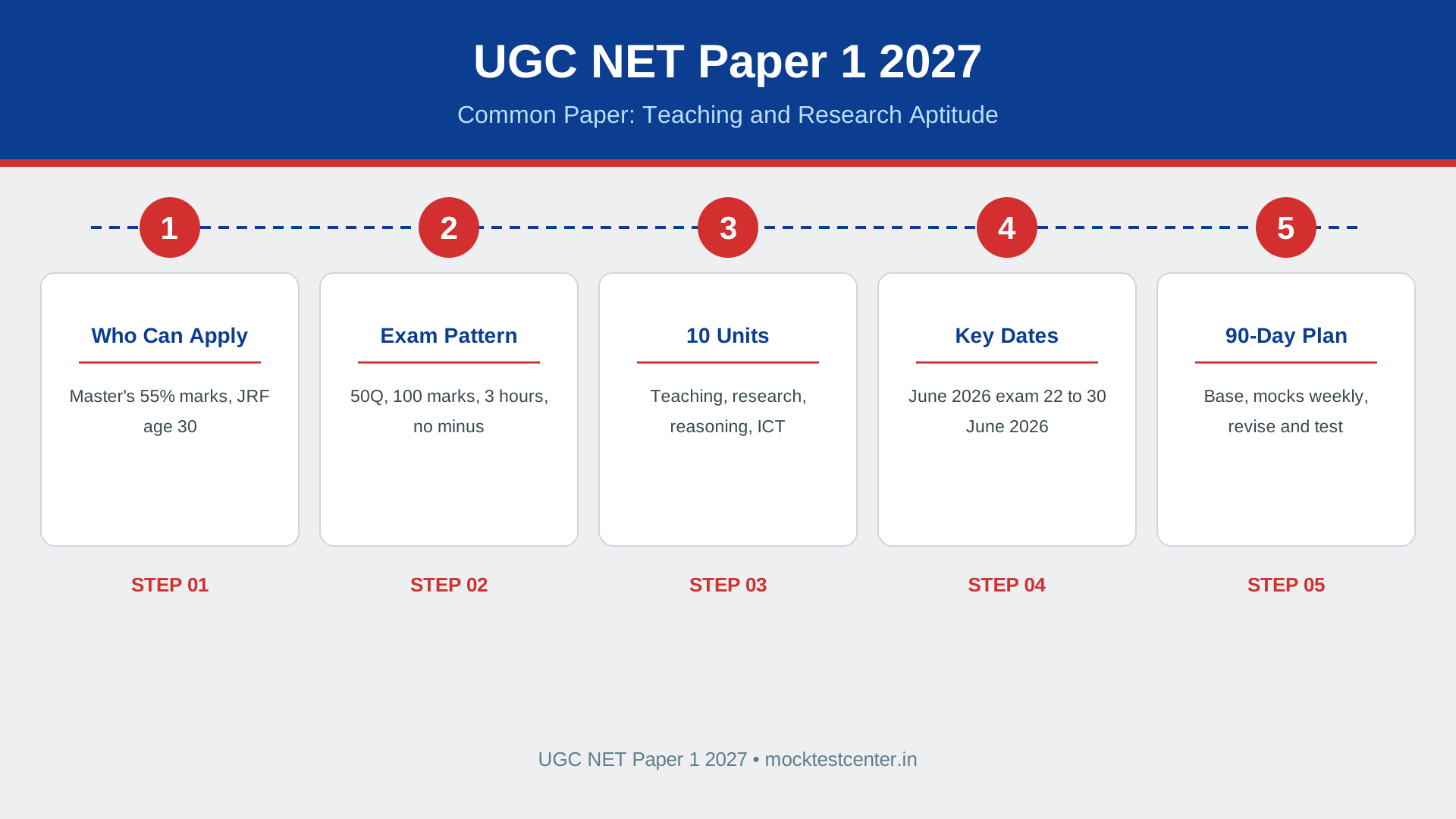
About UGC NET Paper 1 2027 Exam Series
📖 Table of Contents
- What Paper 1 is
- The paper at a glance
- Unit 1: Teaching Aptitude
- Unit 2: Research Aptitude
- Unit 3: Comprehension
- Unit 4: Communication
- Unit 5: Mathematical Reasoning and Aptitude
- Unit 6: Logical Reasoning
- Unit 7: Data Interpretation
- Unit 8: Information and Communication Technology
- Unit 9: People, Development and Environment
- Unit 10: Higher Education System
- Who can sit for UGC NET
- How the result works
- June 2026 and December 2026: the last two cycles
- June 2027: what we know so far
- Books that cover UGC NET Paper 1 2027
- A 90 day plan for UGC NET Paper 1 2027
- How to use mock tests for UGC NET Paper 1 2027
- Mistakes that cost marks
- What to do next
UGC NET Paper 1 2027
What Paper 1 is
UGC NET Paper 1 2027 is the common paper every candidate takes, whatever subject they pick for Paper 2. NTA sets the same 50 questions for all candidates, and the paper tests teaching and research aptitude. It carries 100 marks, one third of the 300 mark total. A weak Paper 1 score can pull down a strong Paper 2 score, so treat this paper as a scoring chance, not a formality.
The paper has the code 00 in the NTA list of subjects. It stays the same for every subject, from Commerce to Computer Science. The syllabus has not changed since the June 2019 cycle, so the 10 units below are the same ones candidates faced in June 2026 and December 2026. That stability helps you. You can plan your study around a fixed syllabus, and past papers still match it.
This page covers the full pattern, each of the 10 units in depth, eligibility, the result rules, the last two cycles, and a 90 day plan. The UGC NET 2027 June notification has not come out yet, as of 19 November 2026. This page gives no 2027 dates, because NTA has announced none. Check ugcnet.nta.ac.in for the notice when it comes.
The paper at a glance
Both papers run in one sitting of 3 hours. You get no break between Paper 1 and Paper 2. The test runs on a computer, and you answer 150 questions in that single sitting. Plan your energy for the full 3 hours, because the last 30 minutes decide as much as the first 30.
Paper 1 has 50 questions for 100 marks. Each question carries 2 marks. Paper 2 has 100 questions for 200 marks, also 2 marks each. All 150 questions are compulsory. There is no negative marking in either paper, so a wrong answer costs you nothing beyond the marks you miss. That fact shapes your exam hall plan. Attempt every question, and use the last minutes to answer the ones you skipped.
| Paper | Questions | Marks | What it tests |
|---|---|---|---|
| Paper 1 (Code 00) | 50 | 100 | Teaching and research aptitude, common for all |
| Paper 2 (subject) | 100 | 200 | Subject you chose in the form |
| Total | 150 | 300 | One sitting, 3 hours, no break |
The 10 units share the marks almost equally. Each unit gives about 5 questions, worth about 10 marks. Real papers vary a little, so one unit may give 4 questions and another 6, but the balance stays close. No unit is safe to skip. A unit you ignore can cost you 10 marks, and 10 marks can decide your category in the result.
The paper is bilingual. You can take it in Hindi or English, and you pick the language when you fill the form. Pick the language you read fastest in, because Paper 1 rewards quick reading more than deep subject knowledge. A candidate who reads fast finishes the comprehension passage and the data questions with time to spare.
Unit 1: Teaching Aptitude
Teaching Aptitude opens UGC NET Paper 1 2027, and it asks how teaching works. Start with the concept and the objectives of teaching. Teaching aims to change what a learner knows, how a learner thinks, and how a learner acts. The syllabus lists three levels of teaching, and you must know all three. Memory level teaching asks learners to recall facts. Understanding level teaching asks learners to grasp meaning and link ideas. Reflective level teaching asks learners to think hard, question, and solve new problems. Questions often give a classroom scene and ask which level it shows.
Next come learner characteristics. Learners differ in age, background, speed, and style. A good teacher reads those differences and changes the method to fit. The unit also covers factors that affect teaching, such as the teacher, the learner, the subject, and the setting. Expect questions that ask which factor matters most in a given scene, or which trait marks a good teacher.
Methods of teaching form the biggest chunk of this unit. Know the lecture method, the discussion method, the demonstration method, the seminar, the symposium, and brainstorming. Know what each method does well and where it fails. A lecture suits a large class and a fixed syllabus. A discussion suits a small group and an open question. A demonstration suits a skill you must show, not just tell.
Finish with teaching aids and evaluation. Teaching aids include charts, models, projectors, and digital tools, and each aid fits a different kind of lesson. Evaluation splits into formative, summative, and diagnostic types. Formative evaluation runs during teaching and guides the teacher. Summative evaluation runs at the end and grades the learner. Diagnostic evaluation finds the exact gap in learning. Questions in this unit often mix methods with evaluation, so learn the pairs together, not in isolation.
Unit 2: Research Aptitude
Research Aptitude asks how new knowledge gets made. Start with the meaning and the traits of research. Research is a careful search for answers, and it follows steps, checks evidence, and stays open to correction. The unit lists types of research, and you must tell them apart. Fundamental research seeks basic truth with no quick use in mind. Applied research solves a real problem. Action research improves practice in a classroom or a workplace. Descriptive research maps what exists. Historical research reads the past. Experimental research tests a cause by changing one factor and watching the effect.
Methods matter as much as types. Know the survey method, the case study, the experiment, and observation. Know sampling too, because questions love it. Random sampling gives every member a fair chance. Stratified sampling splits the group first, then picks from each part. Purposive sampling picks members for a reason, and it suits small, special studies.
Steps in research run in a fixed order, and questions often jumble them and ask you to fix the order. A study starts with a problem, then a review of past work, then a hypothesis, then a design, then data, then analysis, then a report. Learn that chain by heart, because it appears in almost every Paper 1.
End with ethics and writing. Research ethics forbids plagiarism, fabrication of data, and falsification of results. A thesis has a set shape, with a title, an abstract, chapters, and references. Referencing styles such as APA and MLA appear in questions, so know the basic shape of each. ICT in research covers data tools, online journals, and plagiarism checkers. This unit gives 5 easy questions if you learn the terms, and it punishes guesswork, because the terms sound alike.
Unit 3: Comprehension
Comprehension gives you one passage and 5 questions on it. The passage can come from any field, and you need no subject knowledge to answer. You need to read with care and find what the passage says, not what you think about the topic. That sounds easy, and it is, but only if you read the passage twice.
Read the passage once for the main idea. Read it again with the questions in mind. Most questions ask for the central idea, the meaning of a word in context, or an inference the passage supports. A few ask what the author feels about the subject. The trap is the option that sounds true in general but finds no support in the passage. If the passage does not say it, do not pick it.
These 5 questions carry 10 marks, and strong readers finish them in 8 to 10 minutes. Practise one passage a day from any good source, and time yourself. Speed matters here, because the minutes you save in this unit go to the reasoning units, where each question takes longer. Do not skip the passage to save time. Those 5 questions are the most certain 10 marks in the whole paper.
Unit 4: Communication
Communication asks how people share meaning. Start with the meaning, the nature, and the traits of communication. Communication is a two way process, and it needs a sender, a message, a channel, a receiver, and feedback. Without feedback, you cannot tell if the message landed. The unit lists types, and you must know them. Verbal communication uses words. Non verbal communication uses face, hands, and posture. Formal communication follows the official chain. Informal communication flows freely, and the grapevine is its best known form.
Models of communication appear in questions every year. Know the Shannon and Weaver model, with its sender, encoder, channel, decoder, receiver, and noise. Know Lasswell, who asked who says what, in which channel, to whom, with what effect. Know Aristotle, who split a speech into speaker, speech, and audience. Questions often give a model and ask what it misses, or give a scene and ask which model fits.
Barriers to communication form the next chunk. Physical barriers include noise and distance. Semantic barriers come from words with more than one meaning. Psychological barriers come from fear, bias, and closed minds. Organisational barriers come from long chains and rigid rules. Learn each barrier with one clear example, because questions test examples more than definitions.
Classroom communication closes the unit, with mass media beside it. In a classroom, the teacher speaks, the learners respond, and the loop keeps the lesson alive. Mass media covers newspapers, radio, television, and the internet, and questions ask about their role in education. This unit rewards plain reading. If you learn the types, the models, and the barriers with examples, you can score full marks here.
Unit 5: Mathematical Reasoning and Aptitude
Mathematical Reasoning tests number sense, not high maths. The questions stay at school level, and speed decides the score. Start with series. Number series asks you to find the next term, and the rule can hide in addition, multiplication, squares, or a mix. Letter series works the same way with the alphabet, so learn the position of each letter, A as 1, Z as 26, and the pairs that add to 27. Codes ask you to crack a pattern, and classification asks you to pick the odd one out.
Then come the arithmetic topics. Ratio and proportion, percentage, profit and loss, simple and compound interest, averages, and time and distance cover most questions. Learn the short methods for each, because the long method eats your time. For percentage, learn to move between a fraction and a percent in one step. For interest, learn the difference between simple and compound in two years, because that question repeats. For time and distance, learn the relation between speed, time, and distance, and the trick for average speed over equal distances.
Practise 20 questions a day from this unit, and keep a notebook of the short methods you forget. Do not learn new maths in the last month. Revise the methods you already know, and push your speed. A candidate who solves 4 of 5 questions in this unit gains 8 marks over a candidate who leaves them, and that gap is hard to close elsewhere.
Unit 6: Logical Reasoning
Logical Reasoning is the longest unit in UGC NET Paper 1 2027, and it splits into two parts. The first part covers general logic. The second part covers Indian logic, and many candidates ignore it. That is a mistake, because Indian logic gives 2 to 3 questions, and those questions are easy once you learn the terms.
General logic starts with the structure of an argument. Know the premise, the conclusion, and the difference between a sound argument and a valid one. Deductive reasoning moves from a general rule to a single case. Inductive reasoning moves from single cases to a general rule. Questions give an argument and ask which type it shows, or they give two statements and ask what follows. Venn diagrams help here, so learn to draw a quick diagram for statements about all, some, and no.
Analogies and fallacies come next. An analogy asks you to find the same relation in a new pair. A fallacy is an error in reasoning, and the common ones have names you must learn. A straw man twists the other side, an ad hominem attacks the person, a slippery slope claims one step must lead to disaster, and a hasty generalisation leaps from too few cases. Questions give a short argument and ask which fallacy it commits.
Indian logic closes the unit. The pramanas are the means of valid knowledge, and the list has six: perception, inference, comparison, verbal testimony, postulation, and non perception. Learn each with one line. Perception is direct sight or touch. Inference is the jump from a sign to a fact, such as smoke to fire. Comparison is knowledge by likeness. Verbal testimony is knowledge from a trusted word. Postulation fills a gap, such as a fat man who eats little must eat at night. Non perception is knowledge from absence, such as no pot on the table. The square of opposition also appears, so learn the four relations between universal and particular statements. This part looks strange at first, but it repeats the same 6 terms every year, so a day of study locks it in.
Unit 7: Data Interpretation
Data Interpretation gives you a table, a bar graph, a line graph, or a pie chart, and asks 5 questions on it. The data is simple, and the questions test whether you can read it right and compute fast. You need no statistics beyond percentage, ratio, and average. The skill is reading, not maths.
Start by reading the title, the units, and the labels before you touch a question. Many wrong answers come from reading a number in thousands as a plain number, or a percent as a count. Then pick the questions that need one step first, and leave the two step questions for later. A question that asks for the largest value needs one scan. A question that asks for a percentage change needs a subtraction and a division, so it takes longer.
Learn the short cuts for percentage change, growth rate, and share of total, because those three cover most questions. Practise with real sets from past papers, and time yourself at 10 minutes per set. A full set gives 10 marks, and it is the most predictable unit in the paper, because the format never changes. Candidates who practise 3 sets a week rarely lose marks here.
Unit 8: Information and Communication Technology
ICT tests what a teacher must know about computers and the internet. Start with the basics. Know the parts of a computer, the difference between hardware and software, and the types of memory. Know input and output devices, and the units of storage, from bytes to gigabytes. Questions often ask which device is input and which is output, or how many bytes make a kilobyte.
The internet forms the next chunk. Know how email works, what a URL means, and the difference between a website and a web page. Know the common tools a teacher uses, such as video calls, shared drives, and learning platforms. The syllabus also names digital initiatives in higher education, and you must know them by name. SWAYAM offers free online courses. MOOCs are massive open online courses. NPTEL offers engineering courses from the IITs. The National Digital Library gives free access to books and papers. Questions often ask which body runs which initiative, so learn the pairs.
End with ICT in teaching and research, plus basic safety. ICT helps a teacher reach more learners, store records, and check work. In research it helps with data tools, online journals, and plagiarism checks. Safety covers passwords, phishing, and the care needed with personal data. This unit changes slowly, and the questions stay close to the syllabus, so a good book plus the official sites covers it. Check ugc.gov.in for the latest digital schemes when you revise.
Unit 9: People, Development and Environment
This unit links people, growth, and nature. Start with development and environment as a pair. Growth brings jobs and income, and it also brings pressure on land, water, and air. The unit asks you to see both sides and to know the terms. Sustainable development meets the needs of today without cutting off the needs of tomorrow. That one line appears in questions in many forms, so learn it well.
Environmental issues form the biggest chunk. Know air pollution, water pollution, soil pollution, and noise pollution, with one cause and one effect for each. Know climate change and global warming, and the gases behind them. Know the ozone layer and the harm done by chlorofluorocarbons. Questions often link an issue to its source, such as vehicles to nitrogen oxides, or fertilisers to water pollution, so learn the links, not just the names.
Then come the goals and the laws. The Millennium Development Goals ran to 2015, and the Sustainable Development Goals run to 2030, with 17 goals in all. Learn the goal numbers that questions repeat, such as no poverty, quality education, clean water, and climate action. On laws, know the Environment Protection Act of 1986, the Air Act of 1981, and the Water Act of 1974, with the year for each. The years matter, because questions ask for them. Natural resources close the unit, with renewable and non renewable sources, and the care needed to use them. This unit rewards a candidate who reads the news with the syllabus in mind, because every big environmental story maps to a term here.
Unit 10: Higher Education System
Higher Education System asks how Indian higher education runs, from ancient times to today. Start with the past. Takshashila, Nalanda, and Vikramashila were the great centres of learning in ancient India, and questions ask what each one taught and when it flourished. The modern system began with the universities of Calcutta, Bombay, and Madras in 1857, and the University Grants Commission came in 1956. Learn those dates, because they repeat.
Then learn the types of institutions. A central university gets funds from the Union government. A state university gets funds from a state. A deemed university holds university status by declaration. A private university runs on private funds under a state act. Institutes of national importance, such as the IITs, stand apart by law. Questions often give a description and ask which type it is, so learn the funding and the control for each type.
Governance and quality come next. UGC funds and sets standards for higher education. AICTE looks after technical education. NAAC grades institutions on quality. NIRF ranks them each year. The National Education Policy 2020 reshaped the system, and you must know its main points. It aims for a gross enrolment ratio of 50 percent by 2035, it backs multidisciplinary institutions, and it pushes research through a national fund. Learn the policy in plain lines, because questions test the targets and the bodies, not the fine print.
End with the recent changes NTA and UGC announce each year. New schemes, new portals, and new rules appear in questions within a cycle or two of their launch. Read the UGC site once a month in your prep, and note one new fact each time. This unit gives 5 questions, and it is the unit most candidates leave for last. That is a mistake, because it is also the unit where a day of study can add 10 marks.
Who can sit for UGC NET
Eligibility rests on your degree. You need a Master's degree or an equal qualification from a UGC recognised university, with at least 55 percent marks if you belong to the General or General EWS group, and at least 50 percent if you belong to OBC NCL, SC, ST, PwD, or third gender. NTA counts the marks without rounding off, so 54.9 percent does not count as 55 percent. Final year Master's students can apply, and their result stays provisional till they pass with the needed marks.
A four year bachelor's degree opens a narrower door. If you hold a four year, 8 semester bachelor's degree with 75 percent aggregate, or 70 percent for reserved groups, you can sit for JRF and PhD admission. You cannot sit for Assistant Professor through this route, so read the bulletin with care before you apply. This rule came with the newer bulletins, and it catches many candidates by surprise.
Age matters only for JRF. The upper age limit for JRF is 30 years as on the 1st day of the exam month. For the June 2026 cycle that date was 1 June 2026, and for the December 2026 cycle it was 1 December 2026. NTA gives relaxation up to 5 years for OBC NCL, SC, ST, PwD, third gender, and women. Research experience, an LL.M. degree, and armed forces service also earn relaxation, and the total relaxation stays capped at 5 years. Assistant Professor and PhD admission carry no upper age limit at all.
One more rule needs a flag, because it rests on a single source. Candidates must complete their Master's within 2 years of the result date for the first two result categories, and within 1 year for the third category. Check the latest bulletin on ugcnet.nta.ac.in before you rely on this window, because NTA can change it in a new notice.
How the result works
The UGC NET 2027 result follows a clear chain, and you must know each link. First, you must appear in both papers. A candidate who skips either paper gets no result, even with a high score in the other. Second, you must cross the minimum aggregate across both papers. The bar is 40 percent, or 120 of 300 marks, for General and General EWS candidates. The bar is 35 percent, or 105 of 300 marks, for SC, ST, OBC NCL, PwD, and third gender candidates. These bars only open the door. The real cut off sits higher, and it changes with each cycle, subject, and category.
Third comes the 6 percent rule, which sets the cut off. NTA caps the number of candidates who qualify for Assistant Professor at 6 percent of the candidates who appeared in both papers. NTA then splits that 6 percent by reservation category and then by subject, and that split gives the subject wise, category wise cut off. A subject with more candidates gets more qualifying slots, and a category with more candidates gets more slots too. That is why the cut off for the same subject can differ sharply between categories.
The result gives three categories. Category 1 covers JRF and Assistant Professor plus PhD admission. Category 2 covers Assistant Professor and PhD admission. Category 3 covers PhD admission only. For Categories 2 and 3, universities give the NET score 70 percent weight and their own interview 30 percent weight for PhD admission. The NET score stays valid for PhD admission for 1 year from the result date, so plan your PhD applications inside that window.
The JRF money is fixed by the UGC scheme. A Junior Research Fellow gets 37,000 rupees a month for the first two years, then 42,000 rupees a month as a Senior Research Fellow, plus house rent allowance as per UGC rules. That stipend, plus the PhD door it opens, is why JRF draws the sharpest competition in the exam.
June 2026 and December 2026: the last two cycles
The June 2026 cycle ran on a tight calendar. NTA released the notification on 29 April 2026. One tracker says 28 April, but most sources say 29 April, and this page uses 29 April with that flag. Applications ran from 29 April to 20 May 2026, then NTA extended the window to 23 May 2026, with fee payment till 23 May, 11:50 PM. One source says the window closed on 24 May, and that claim stays flagged here. The exam ran from 22 to 30 June 2026, on 22, 23, 24, 25, 29, and 30 June, as a computer based test.
The fee for June 2026 was 1,150 rupees for General, 600 rupees for General EWS and OBC NCL, and 325 rupees for SC, ST, PwD, and third gender, paid online only, and non refundable. The number of subjects also needs a flag. Most trackers say 85 subjects, while Oswaal says 87, with Statistics and Forestry as two newly added subjects. This page does not settle that count, because the official bulletin was not opened in this pass. NTA released the cut off lists on 28 August 2026, and for English and Commerce a re exam cut off list came on 17 September 2026. Certificates came on 24 September 2026.
The December 2026 cycle followed quickly. NTA released the notification on 8 October 2026, then a revised bulletin on 16 October 2026. Applications ran from 8 October to 31 October 2026, with fee payment extended to 1 November 2026, and a correction window from 2 November 2026. The exam dates were revised too. NTA first announced 14 to 19 December, then fixed the exam for 14, 15, 16, 17, 18, and 21 December 2026. If you sat either cycle, your score and your rank came from these same rules, and the June 2027 cycle will use the same pattern unless a new bulletin changes it.
June 2027: what we know so far
As of 19 November 2026, NTA has released no notification for the June 2027 cycle. No dates, no fee, and no subject list exist for June 2027, and any site that gives a fixed June 2027 exam date today is guessing. The December 2026 exam is still ahead as this page is written, so the June 2027 notice will come after that cycle closes.
What you can count on in UGC NET 2027 is the pattern. The exam runs twice a year, in June and December, with Paper 1 and Paper 2 in one sitting of 3 hours, and the syllabus has stayed fixed since June 2019. Use the waiting time to finish the 10 units and to take mock tests on the June 2026 and December 2026 pattern. When the notice comes, check the fee, the dates, and the subject list on ugcnet.nta.ac.in first, and fill the form early, because the window is short and the site slows down near the last date.
Books that cover UGC NET Paper 1 2027
One good book per unit beats a shelf of half read books. For the full Paper 1, the standard picks are the Pearson book by KVS Madaan, Trueman's UGC NET General Paper 1, and the Arihant book on Teaching and Research Aptitude Paper 1. Pick one of the three as your base book, and read it cover to cover. Buy the latest edition, because the Higher Education System unit changes with new policies, and an old edition can carry old facts.
For practice, use past papers from the last five cycles. NTA publishes the question papers and the answer keys on its site, and a good book also prints them with solutions. Solve each past paper in 3 hours, in one sitting, and mark the units where you lose marks. For data and reasoning, any standard book on quantitative aptitude and logical reasoning at school level will do, because the questions stay at that level. For the environment unit, read a daily newspaper with the syllabus beside you, and note each story that matches a term in Unit 9. That habit turns the news into revision.
A 90 day plan for UGC NET Paper 1 2027
Days 1 to 30 build your base. Give 2 hours a day to Paper 1 and the rest to Paper 2. Read one unit a week, in this order: Teaching Aptitude, Research Aptitude, Communication, ICT, and Higher Education System first, because these five are pure reading. Finish each unit with 50 questions from your base book, and note the facts you miss. Start one comprehension passage a day from day 1, because reading speed grows slowly.
Days 31 to 60 go deep and test. Take one full Paper 1 mock test every week, in 1 hour, without a break. Check every wrong answer and note the right method in a thin notebook. Revise your weak units twice in this phase, and give 30 minutes a day to reasoning practice, 10 questions of maths and 10 of logic. In this phase, learn the Indian logic terms and the Higher Education System facts by heart, because they are pure memory marks.
Days 61 to 90 revise and test more. Take a full Paper 1 mock every 3 days, and in the last two weeks take one every 2 days. Revise your short notes daily, and in the last week solve only past papers and your error notes. Do not start a new book in this phase. Do not learn a new unit from scratch. If a unit is still weak in the last week, learn its most repeated facts only, and protect the marks in the units you already know.
How to use mock tests for UGC NET Paper 1 2027
A mock test works only if you take it like the real exam. Sit for the full 3 hours with both papers, or at least 1 hour for Paper 1 alone, with no phone and no pauses. Mark the questions you guess, and after the test, spend an hour on analysis. Note the questions you got wrong, and note the ones you guessed right, because a lucky guess hides a gap.
Track your score unit by unit, not just the total. If your score in Data Interpretation is low, practise data sets daily. If your score in Logical Reasoning is low, revise the fallacies and the Indian logic terms. Two or three good tests a week, with full analysis, beat ten tests taken in a rush. Take the subject mock tests on this site alongside Paper 1, because the two papers share one sitting and one score.
- UGC NET Commerce 2027 mock test, Paper 2 subject code 08
- UGC NET Economics 2027 mock test, Paper 2 subject code 01
- UGC NET History 2027 mock test, Paper 2 subject code 06
- UGC NET English 2027 mock test, Paper 2 subject code 30
- UGC NET Management 2027 mock test, Paper 2 subject code 17
- UGC NET Law 2027 mock test, Paper 2 subject code 58
- UGC NET Political Science 2027 mock test, Paper 2 subject code 02
- UGC NET Psychology 2027 mock test, Paper 2 subject code 04
- UGC NET Computer Science 2027 mock test, Paper 2 subject code 87
- UGC NET Geography 2027 mock test, Paper 2 subject code 80
Mistakes that cost marks
The first mistake is to ignore UGC NET Paper 1 2027 till the last month. Paper 1 carries 100 marks, and a candidate who starts it late cannot finish 10 units with care. The second mistake is to read without practice. Paper 1 rewards questions solved, not pages read, so every unit needs 50 questions after the reading.
The third mistake is to guess without a method. With no negative marking, you must attempt every question, but a blind guess on a reasoning question wastes the time a careful read would have used. Mark the question, move on, and come back with fresh eyes in the last minutes. The fourth mistake is to trust a single source for dates and fees. The June 2026 cycle alone had three different last dates in different trackers, so check the NTA bulletin before you pay or plan. The fifth mistake is to skip Indian logic and Higher Education System. Both units look dull, both repeat the same facts every year, and both give easy marks to the candidate who spends a day on them.
What to do next
Start with Unit 1 today, and take one UGC NET Paper 1 2027 mock test this week to find your base score. Keep the NTA site open when the June 2027 notice comes, and fill the form in the first week. Paper 1 is the same paper for every candidate, so the 100 marks in it are the fairest marks in the whole exam. Take them.