About MP Police SI 2027 Exam Series
📖 Table of Contents
- MP Police SI 2027 at a glance
- 500 posts after eight years
- Who can apply for MP Police SI 2027
- The dates: notification to exam in three months
- Four stages, and only three count in merit
- Prelims: 100 marks, no negative marking
- Mains: two papers, 600 marks, one third cut
- The physical test: 100 marks, 30 percent minimum
- Height and chest: the standards test
- Pay and the Subedar difference
- The same notification family: ASI and Steno
- The 2026 cycle: 504 posts, and the rhythm turns annual
- How to prepare in 90 days
- Five mistakes that cost SI candidates marks
- Sources
MP Police SI 2027: Complete Exam Guide
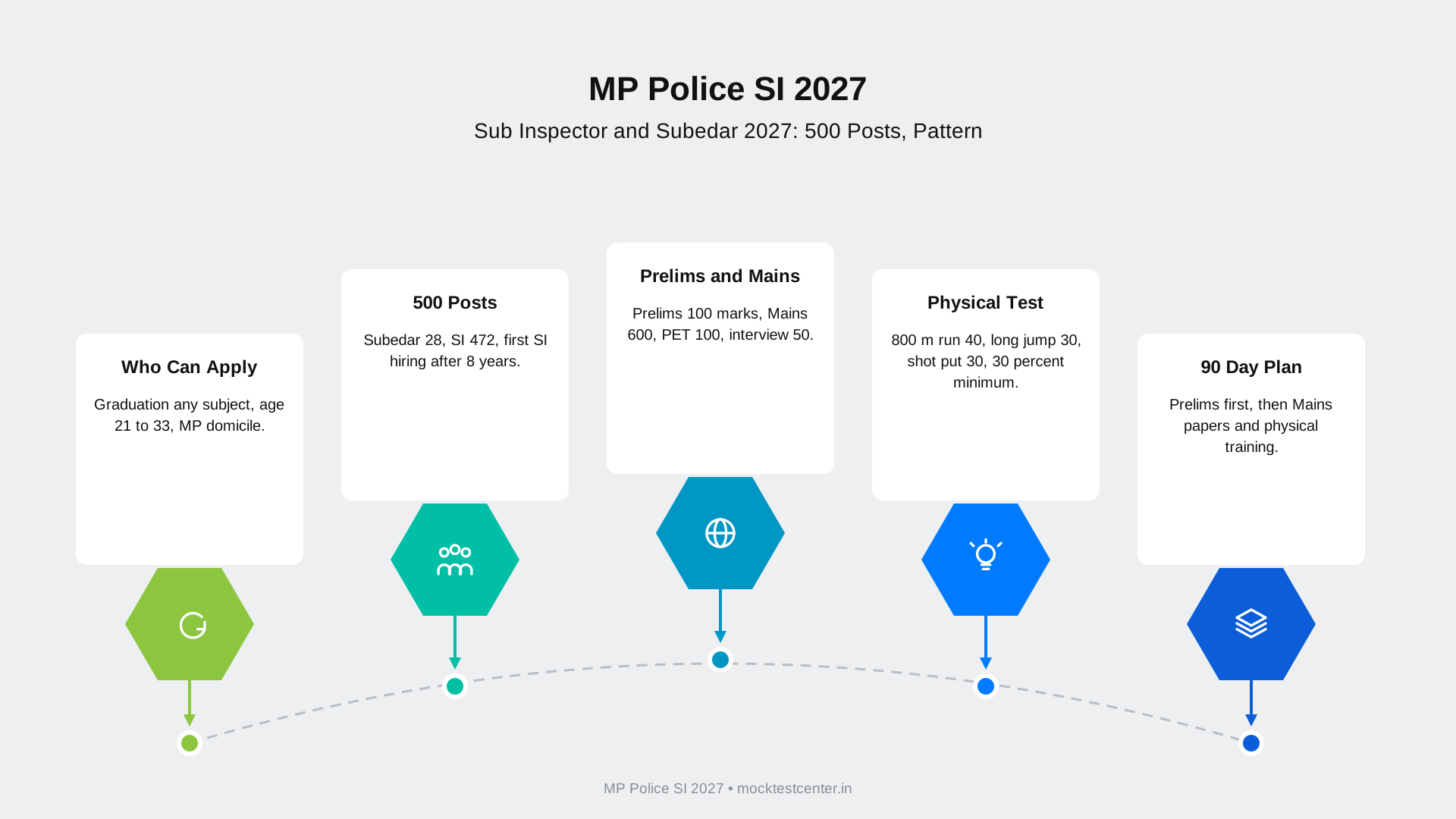
The Madhya Pradesh Employees Selection Board runs the MP Police Sub Inspector recruitment to fill Sub Inspector and Subedar posts in the state police. The live cycle is the 2025 recruitment, advertised for 500 posts, and this MP Police SI 2027 guide works from that cycle to show how the next one will run.
The written exam for the 2025 cycle began on 9 January 2026, the first Sub Inspector recruitment in eight years, and it drew graduates from across the state. No fresh SI notification has appeared for the 2027 cycle yet, so the 2025 pattern, age rule and fee structure are the working facts for the next advertisement unless the board changes them in print.
The exam has four stages. A qualifying Prelims screens the field. A Mains of 600 marks decides most of the merit. A scored physical test adds 100 marks.
An interview adds 50 marks. The final merit comes from the Mains, the physical test and the interview together. A candidate who plans only for the Prelims will clear the first gate and fail the second.
The 2025 cycle also shows how fast the board moves once the notification lands. Applications opened on 27 October 2025 and closed on 10 November 2025, just fourteen days later. The exam followed two months after that.
Candidates who waited to start preparation until the notification appeared had eight weeks to cover a graduate level syllabus. This MP Police SI 2027 guide is written for candidates who start before the notification, not after it.
MP Police SI 2027 at a glance
| Detail | MP Police SI 2025, the live cycle |
|---|---|
| Conducting body | Madhya Pradesh Employees Selection Board, Bhopal |
| Department | Home (Police) Department, Government of Madhya Pradesh |
| Posts | 500: Subedar 28 plus Sub Inspector 472 |
| Notification | 6 October 2025 |
| Application window | 27 October to 10 November 2025 |
| Correction window | 27 October to 15 November 2025 |
| Written exam | From 9 January 2026, two shifts a day |
| Application fee | Rs 500 unreserved, Rs 250 reserved, plus departmental fee |
| Education | Graduation in any discipline |
| Age limit | 21 to 33 years for unreserved men as on 10 November 2025 |
| Prelims | 100 marks, 2 hours, no negative marking, qualifying only |
| Mains | Two papers, 600 marks, negative marking of one third |
| Physical test | 100 marks, 800 m run, long jump, shot put, 30 percent minimum |
| Interview | 50 marks |
| Pay | Level 9, Rs 36,200 to Rs 1,14,800 a month |
| Official website | esb.mp.gov.in |
Read the table as the skeleton and the rest of this guide as the flesh. The dates belong to the 2025 cycle. The pattern and the fee structure carry over to the next advertisement unless the board changes them in print.
500 posts after eight years
The 2025 recruitment filled 500 posts. Subedar took 28. Sub Inspector took 472.
The Sub Inspector posts split into 95 in the Special Armed Force and 377 in the force other than the Special Armed Force. The numbers add cleanly: 95 plus 377 makes 472, and 472 plus 28 makes 500. Four sources print the same split: Hindustan Times, the Telegraph, the Times of India, Moneycontrol.
The eight year gap is the story of this cycle. Moneycontrol calls it the first SI recruitment after eight years, and the last Sub Inspector recruitment before it was held in 2017. Eight years of graduates waited for this notification. That backlog is why the competition was fierce and why the application window, short as it was, still drew a large field.
One tracker prints a different split for the Sub Inspector posts. It lists the District Executive Force at 339, the Special Armed Force at 42, Radio at 84, the Questioned Documents branch at 5, and Finger Print at 5. Those five numbers add to 475, not 472.
The split is internally wrong, and it also conflicts with the 95 plus 377 split printed by four other sources. This guide uses the 472 split and flags the 475 split as an error. The upload check should confirm the post wise break up against the official rulebook.
Subedar and Sub Inspector are different ranks with different work. A Sub Inspector runs a thana and investigates crime. A team of constables and head constables reports to the post.
A Subedar serves in the armed police, commands a platoon sized unit, and handles law and order duty with the battalion. Both posts carry the same Level 9 pay. The choice between them is made in the application form, and the physical standards for the two are the same.
Women candidates can apply for Sub Inspector posts outside the Special Armed Force, while the Special Armed Force Sub Inspector posts are for men only. The same rule applies to the constable recruitment, and it follows the force structure of the state police.
Who can apply for MP Police SI 2027
A candidate needs a graduation degree in any discipline from a recognised university, and the subject does not matter. A history graduate and an engineering graduate sit the same papers and chase the same posts. An equivalent degree also qualifies, and the board checks the degree certificate during document verification.
The age window runs from 21 years at the minimum. The maximum age for an unreserved man is 33 years as on 10 November 2025 for the 2025 cycle. That date is the last date to apply, and the board uses it as the age cut off for every category.
| Category | Maximum age as on 10 November 2025 |
|---|---|
| Unreserved men | 33 years |
| OBC, SC, ST men of Madhya Pradesh | 38 years |
| Women, all categories | 38 years |
| Government employees, home guards | 38 years |
| Inter-caste married, sports winners | 43 years |
One widely read report prints 18 to 33 years as the age limit for this exam. That minimum age is wrong for the Sub Inspector recruitment. The rulebook age starts at 21, and three tracker pages that quote the rulebook table print 21 as the minimum.
The 2026 cycle pages also print 21 to 33. The 18 year figure looks copied from the constable recruitment, where the minimum really is 18. This guide uses 21, and flags the 18 year figure as a tracker error.
Reservation and age relaxation apply only to candidates who hold Madhya Pradesh domicile. A candidate from another state can apply, but only against unreserved open vacancies, and pays the unreserved fee. Domicile proof and caste certificates must be valid on the last date of application.
The degree certificate must be valid too. The board verifies them after the physical tests, and a certificate that was invalid on the last date ends the candidature at that stage.
The dates: notification to exam in three months
The notification for the 2025 cycle came out on 6 October 2025. The Subedar and Assistant Sub Inspector notification in the same family carries the number PRT Subedar ASI 2025 and the date 6 October 2025. One Moneycontrol report says the notification was released on Monday, 27 October 2025.
That date is the day applications opened, not the day the notification came out. This guide states 6 October 2025 as the notification date and flags the 27 October line as a mix up between the notification and the application start.
Applications ran online at esb.mp.gov.in from 27 October to 10 November 2025, and the correction window ran from 27 October to 15 November 2025, five days past the last date. The window was short, and the board gave no extension in this cycle. A candidate who missed 10 November had no second chance.
The written exam began on 9 January 2026. It ran in two shifts a day. The first shift ran from 9:30 AM to 11:30 AM. The second shift ran from 2:30 PM to 4:30 PM.
Hindustan Times, the Times of India, the Telegraph and Moneycontrol all print 9 January 2026. One tracker lists the Prelims as starting on 16 January 2026. That date conflicts with the four other sources, so this guide states 9 January 2026 and flags the 16 January date as an error.
| Event | Date in the 2025 cycle |
|---|---|
| Notification | 6 October 2025 |
| Applications open | 27 October 2025 |
| Last date to apply | 10 November 2025 |
| Correction window closes | 15 November 2025 |
| Written exam begins | 9 January 2026 |
The gap from notification to exam was about three months. The gap from the last date to the exam was about two months. That is a tight calendar for a four stage exam, and it rewards candidates who prepared before the notification. The Mains, physical test and interview dates follow the Prelims result, and the board announces them stage by stage.
Four stages, and only three count in merit
The selection has four stages. The Prelims screens. The Mains scores. The physical test scores.
The interview scores. Document verification closes the process. The final merit comes from the Mains and the physical test, plus the interview. The total is 750 marks: 600 from the Mains, 100 from the physical test, and 50 from the interview.
The Prelims is compulsory for every applicant, and its marks do not count in the final merit. A candidate who tops the Prelims and fails the Mains goes home. A candidate who scrapes through the Prelims and tops the Mains gets the post. That is the whole logic of a screening test, and it decides how much time each stage deserves.
One tracker reports that the Prelims shortlists up to ten times the number of vacancies in each category for the Mains. Another reports that up to three times the vacancies in each category are called for the physical test and interview on the basis of Mains scores. Both figures are tracker sourced, not read from the rulebook in this round, and this guide notes them as reported figures rather than confirmed rules.
The physical standards test sits inside the process as a gate. Candidates must clear the height and chest standards before the scored physical test. The standards are given later in this guide. A candidate who fails the measurement does not reach the scored events, however strong the written scores are.
Prelims: 100 marks, no negative marking
The Prelims is a multiple choice test of 100 marks with a duration of 2 hours. Each question carries one mark.
There is no negative marking for a wrong answer. The marks do not count in the final merit. Moneycontrol and CareerPower agree, and so do the syllabus trackers.
The syllabus covers Hindi and English language comprehension. Analytical ability comes next, with history and geography alongside. The full subject list adds science and civics.
Basic computer knowledge appears. Reasoning and current affairs appear too. The paper mixes language with reasoning and general knowledge in one sitting, so a candidate cannot clear it on general knowledge alone.
| Prelims subject | What it tests |
|---|---|
| Hindi language comprehension | Reading, grammar, vocabulary |
| English language comprehension | Reading, grammar, vocabulary |
| Analytical ability | Reasoning, logic, problem solving |
| History | Indian history, Madhya Pradesh history |
| Geography | Indian geography, Madhya Pradesh geography |
| Science, civics, computers | Class level science, polity, basic computing |
| Current affairs | National and state events |
No negative marking changes the attempt plan completely. A wrong answer costs nothing, and a blank answer costs nothing. The two are equal, so the right move is to answer all 100 questions. A candidate who leaves fifteen blank in a no negative marking paper gives away fifteen free chances at a mark.
The Prelims still needs respect. It is the gate, and the gate is narrow. With 500 posts and a shortlist of ten times the vacancies, about 5,000 candidates reach the Mains from a much larger field of applicants.
A candidate who treats the Prelims as easy because it carries no negative marking is the candidate who fails it. The language sections decide it more often than the general knowledge sections, because graduates prepare general knowledge for years and neglect Hindi and English comprehension.
Mains: two papers, 600 marks, one third cut
The Mains is the stage that decides the merit, and it has two papers, each with two sections of 150 marks. Each paper has two sections of 150 marks. Each paper carries 300 marks.
The total is 600 marks. Every question is multiple choice. Each paper runs for 2 hours.
| Mains paper | Sections | Marks | Duration |
|---|---|---|---|
| Paper I | Two sections of 150 marks each | 300 | 2 hours |
| Paper II | Two sections of 150 marks each | 300 | 2 hours |
| Total | Four sections | 600 | 4 hours |
For non technical posts, Paper I covers general studies with reasoning and mental ability. Paper II covers general Hindi and English. For technical posts, the papers change: physics in one paper and chemistry in the other, each at 150 marks a section. A candidate should check which paper pair applies to the post applied for, because the technical and non technical tracks diverge at the Mains.
Negative marking applies in the Mains. Each wrong answer costs one third of a mark. That is the opposite of the Prelims rule, and candidates who carry the Prelims habit of answering everything into the Mains lose marks on every guess.
The Mains rewards accuracy. A candidate should attempt questions that can be narrowed to two options and leave the rest.
One tracker prints the Mains total as 300 marks, with Paper I at 150 and Paper II at 150. That figure conflicts with Moneycontrol, which prints two papers of two sections at 150 each for a total of 600, and with two other trackers that print 300 marks per paper. This guide uses 600 and flags the 300 figure as an error. The section structure of two sections of 150 inside each paper is the point that the 300 figure misses.
The Mains syllabus is graduate level and wide. General studies covers history and geography. Polity and economy appear.
Science and technology appear. Current affairs appear too, with Madhya Pradesh content running through it.
Reasoning and mental ability covers the standard non verbal and analytical types. Hindi and English cover comprehension and grammar. Vocabulary and usage appear at graduation level. The paper rewards steady study across all of it, and it punishes a candidate who prepares only one half.
The physical test: 100 marks, 30 percent minimum
The Physical Efficiency Test carries 100 marks across three events, starting with the 800 metre run at 40 marks and one chance. The long jump carries 30 marks, with three chances.
The shot put carries 30 marks, with three chances. A candidate must score at least 30 percent in the physical test to be called for the interview. The physical test marks count in the final merit, so a strong run and jump can lift a candidate past a rival with a better Mains score.
| Event | Marks | Chances |
|---|---|---|
| 800 metre run | 40 | One |
| Long jump | 30 | Three |
| Shot put | 30 | Three |
| Total | 100 |
The qualifying thresholds for the events are printed by the trackers as time and distance figures. Men run 800 metres in 2 minutes 40 seconds, jump 13 feet, and throw the 7.26 kg shot 19 feet. Women jump 10 feet and throw the 4 kg shot 15 feet.
The women 800 metre figure is disputed: one tracker prints 3 minutes 30 seconds and another prints 3 minutes 40 seconds. This guide uses 3 minutes 30 seconds and flags the 3 minutes 40 seconds figure. The upload check should confirm the women run time against the official rulebook.
The scored bands behind those thresholds work the same way as in the constable recruitment. Full marks in the run need about 124 seconds for men and about 176 seconds for women. Full marks in the long jump need about 5.57 metres for men and 4.36 metres for women.
Full marks in the shot put need about 8.76 metres for men and 7.20 metres for women. Those band figures come from the constable rulebook schedules quoted by trackers, and this guide notes them as the scoring scale rather than as SI rulebook figures. The SI rulebook figures for the bands were not separately verified in this round.
Relaxed standards apply to ex-servicemen and home guards as the recruitment rules prescribe. Ex-servicemen run the 800 metres in 3 minutes 15 seconds under the thresholds quoted by the trackers. The exact relaxations sit in the rulebook schedule, and a candidate claiming one should read that schedule before the physical tests.
Height and chest: the standards test
The Physical Standards Test is qualifying. A candidate who fails it does not reach the scored physical test. The standards for the Sub Inspector recruitment are printed by Prepp and PW, and by the syllabus trackers. They agree on the main figures.
| Category | Height, men | Chest, men | Height, women |
|---|---|---|---|
| General, OBC, SC | 167.5 cm | 81 cm unexpanded, 86 cm expanded | 152.4 cm |
| ST | 160 cm | 76 cm unexpanded, 81 cm expanded | 147 cm |
Women candidates also face a minimum weight of 40 kg. Chest measurement does not apply to women candidates. The chest expansion of 5 cm is compulsory for men.
Candidates must not have knock knee, flat foot, or any vision disability, and must be medically fit. The board checks these standards at the measurement stage, and the check is strict.
The SI height figures differ slightly from the constable figures. The constable minimum is 168 cm for men and 155 cm for women. The SI minimum is 167.5 cm for men and 152.4 cm for women. The difference is small, but a candidate near the line should measure carefully before applying, because the measurement test gives no second chance.
Pay and the Subedar difference
Subedar and Sub Inspector both carry Level 9 pay in the state pay matrix, with the scale running from Rs 36,200 to Rs 1,14,800 a month plus allowances as the Madhya Pradesh government prescribes. Hindustan Times and Moneycontrol print the same scale, and so does the Times of India. All 500 posts carry it.
Level 9 is an officer grade post. A Sub Inspector joins as the officer in charge of a thana after training, with constables and head constables reporting to the post. A Subedar joins as a platoon commander in the armed police.
The salary is the same. The difference sits in the work and the posting, and in the promotion path.
Promotion from Sub Inspector runs to Inspector, then to Deputy Superintendent of Police through seniority and departmental exams. The ladder is slow, and a Sub Inspector who wants faster growth should plan for the departmental exams from the first years of service. The state police also runs direct recruitment for Deputy Superintendent through the state civil services exam, so a Sub Inspector competes with direct entrants for the senior posts.
The fee for the exam has three parts. The board exam fee is Rs 500 for unreserved candidates and Rs 250 for SC and ST candidates, and for OBC and EWS candidates who hold Madhya Pradesh domicile. The departmental exam fee is Rs 200 for unreserved candidates and Rs 100 for reserved candidates.
The portal fee is Rs 60 at a kiosk and Rs 20 for a registered citizen login. An unreserved candidate therefore pays Rs 700 plus the portal fee, and a reserved candidate pays Rs 350 plus the portal fee.
One widely read report prints the fee as Rs 200 for unreserved and Rs 100 for reserved candidates. That is the departmental fee alone, not the total. A candidate who reads only that report will underpay and the application will fail. The full fee table is printed above, and it matches the tracker pages that quote the rulebook fee schedule.
The same notification family: ASI and Steno
The 2025 police recruitment came as a family of notifications, not a single one. The Subedar and Assistant Sub Inspector notification carries the number PRT Subedar ASI 2025 and the date 6 October 2025, the same date as the SI notification. It covers Subedar and Assistant Sub Inspector posts for men and women, except that the Special Armed Force posts are for men only. The age limit, the fee table and the application window match the SI cycle.
Assistant Sub Inspector is the rank below Sub Inspector. It needs the same graduation qualification and the same age window of 21 to 33 for unreserved men, with 38 for reserved categories and women. The ASI posts are not part of the 500 in this guide. They belong to their own notification and their own vacancy count, and this guide does not build a separate entry for them.
The brief for this package also notes Stenographer posts in the same notification family. The Steno posts were not verified against a notification in this round. They are noted here so that candidates know the family is wider than the SI posts alone, and the upload check may confirm the Steno notification number before publication.
Candidates should treat each notification in the family separately. The SI notification carries its own post count. The Subedar and ASI notification carries its own.
Any Steno notification does too. Each one has its own application form and its own fee. Applying for one does not apply for the others, and the fee must be paid for each one separately.
The 2026 cycle: 504 posts, and the rhythm turns annual
A newer cycle already exists. The board notified the Subedar and Sub Inspector Recruitment 2026 for 504 posts, with applications from 9 to 23 September 2026 and the Prelims on 28 October 2026. The 2026 cycle covers Subedar and SI posts in the SAF and the district force.
Arms and Photo posts appear. The Questioned Documents branch and Finger Print appear too, with separate qualification requirements for technical and non technical posts. The age window is 21 to 33 years as on 23 September 2026, with the same relaxations as the 2025 cycle.
The 2026 cycle confirms that the eight year gap is over, and the SI recruitment now runs every year like the constable recruitment. A candidate who misses the 2025 cycle has the 2026 cycle, and a candidate who misses the 2026 cycle has the 2027 cycle to aim for. The pattern, the age rule and the fee table have stayed stable across the two cycles, which makes preparation a matter of steady work rather than guesswork about the next notification.
The 2026 cycle also shows the wider post mix. The 2025 cycle filled only Subedar and GD Sub Inspector posts. The 2026 cycle adds Arms, Photo, Questioned Documents and Finger Print Sub Inspector posts, each with its own qualification. A graduate with a science background should watch the technical posts, because the competition there is thinner than in the GD posts.
How to prepare in 90 days
Ninety days is enough for the Prelims if the days are used in order, and the first thirty days build the base. Hindi and English comprehension every day, because the language sections decide the Prelims more often than the general knowledge sections.
History and geography of India and Madhya Pradesh come first. Analytical ability and current affairs follow. Read one newspaper a day, and note every Madhya Pradesh item separately.
The next thirty days turn knowledge into speed. Two Prelims mock tests a week, each taken in 2 hours on the clock, with the answers reviewed the same day. Every wrong answer gets a note: was it a knowledge gap, a language slip, or a misread question?
Knowledge gaps go back to the books. Language slips get a daily drill of ten comprehension passages. Misread questions get a rule: read the question twice before marking.
The last thirty days add the Mains and the physical test to the plan. Morning is for the run. The jump and the throw follow. Evening is for the Mains papers.
General studies and reasoning come first. Hindi and English follow at graduation level. The Prelims revision continues alongside, because the Prelims comes first and the Mains preparation must not push it out.
Previous papers are the closest thing to a syllabus the board publishes. The 2017 papers show the old pattern, and the 2025 papers will show the current one when they circulate. Madhya Pradesh history, the state geography, the rivers, the districts, the tribal culture and the state schemes recur. Read them, note the repeats, and weight the revision toward them.
Books matter less than papers for this exam. One standard general knowledge book, one reasoning book, and the graduation level Hindi and English grammar books cover the syllabus. The rest of the preparation is mock tests and previous papers. A candidate who finishes three books and never sits a timed mock will score less than a candidate who finishes one book and sits twenty mocks.
Five mistakes that cost SI candidates marks
The first mistake is preparing for the Prelims and forgetting the Mains. The Prelims marks do not count in the final merit. The Mains carries 600 of the 750 merit marks.
A candidate who spends ninety days on the Prelims and starts the Mains after the result has about eight weeks to cover two papers. Start the Mains subjects in the first month, even before the Prelims feels complete.
The second mistake is carrying the Prelims guessing habit into the Mains. The Prelims has no negative marking, so every question should be answered. The Mains cuts one third of a mark for every wrong answer, so a guess costs marks earned elsewhere. Change the habit at the stage boundary, or the Mains will punish it.
The third mistake is ignoring the language sections. Hindi and English comprehension appear in the Prelims and again in the Mains. Graduates prepare general knowledge for years and neglect language, then lose the Prelims on the language sections. Read every day, and practise comprehension passages under time pressure.
The fourth mistake is starting physical training after the Mains result. The physical test carries 100 marks and counts in the final merit, with a 30 percent minimum to reach the interview. A candidate who trains for three months scores far more than a candidate who trains for three weeks. Run from the first week of preparation, even if it is only twenty minutes a day.
The fifth mistake is trusting a tracker table that fails its own addition. The alternative SI split printed by one tracker adds to 475 for a 472 post Sub Inspector count. The fee printed by one report is the departmental fee alone, not the total.
The age printed by one report starts at 18, not 21. Read the rulebook for the numbers that decide an application, and read it again when the addenda come out.
Candidates preparing for MP Police SI 2027 also practise with mock tests for UP Police Sub Inspector 2027, UP Police Constable 2027, Karnataka PSI 2027, Karnataka Police Constable 2027, Jammu and Kashmir Police SI 2027, Jammu and Kashmir Police Constable 2027, Bihar Police SI Daroga 2027, Bihar Police Constable 2027, SSC GD 2027 and SSC Delhi Police Constable 2027.
Sources
Moneycontrol, 7 October 2025, MP SI Recruitment 2025, 500 vacancies after 8 year gap, apply from 27 October
Moneycontrol, 28 October 2025, MP Police SI Recruitment 2025, application window opens for 500 vacancies
Moneycontrol, 10 November 2025, MP Police SI Recruitment 2025 last date, 500 posts, exam 9 January 2026
Hindustan Times, 27 October 2025, MP Police SI Recruitment 2025, 500 posts of Sub Inspector and Subedar
Times of India, 27 October 2025, MPESB Sub Inspector recruitment 2025, registration begins for 500 posts
Moneycontrol, 7 October 2025, MP SI Recruitment 2025, 500 vacancies after 8 year gap, apply from 27 October
GovtJobLink, MP Police Subedar and Sub Inspector Recruitment 2025, age limit, fee, vacancy split
VacancyBoard, MPESB MP Police Subedar and ASI 2025, notification PRT Subedar ASI 2025 dated 6 October 2025
GovtCareerHub, MP Police SI and Subedar Syllabus 2025, exam pattern, PET details, rulebook 2025
GovtCareerHub, MP Police SI Subedar PET 2025, physical test details, PST table
CareerPower, MP Police SI Syllabus and Exam Pattern 2026, Prelims plus Mains pattern, PET plus interview
JobAlertRadar, MP SI Vacancy 2025, Prelims shortlist, Mains pattern, PET plus interview
RRBApply, MP Police SI Syllabus 2026, Prelims pattern, 100 marks, no negative marking
Prepp, MP Police SI Eligibility Criteria 2026, age limit, PST, PET standards
PW Live, MP Police SI Selection Process 2025, five stages, physical standards
Invictaa, MP Police SI Recruitment 2025, notification, 500 vacancies, physical standards
SarkariJobs, MP Police SI Recruitment 2026, 504 Subedar plus Sub Inspector vacancies, apply from 9 September 2026
GovtServiceInfo, MP Police SI Recruitment 2026, 504 posts, age 21 to 33, fee table