
About JKSSB Junior Assistant 2027 Exam Series
📖 Table of Contents
- The 2025 cycle in numbers
- The 2022 cycle and the 2022 paper
- Who can apply for JKSSB Junior Assistant 2027
- The written test, section by section
- The typing test and why it fails candidates
- What the job looks like day to day
- UT, Divisional and District cadres
- Fee and how to apply
- What to study first
- A 90 day plan that fits around a job
- Other exams worth preparing alongside
- Sources
JKSSB Junior Assistant 2027: Complete Exam Guide
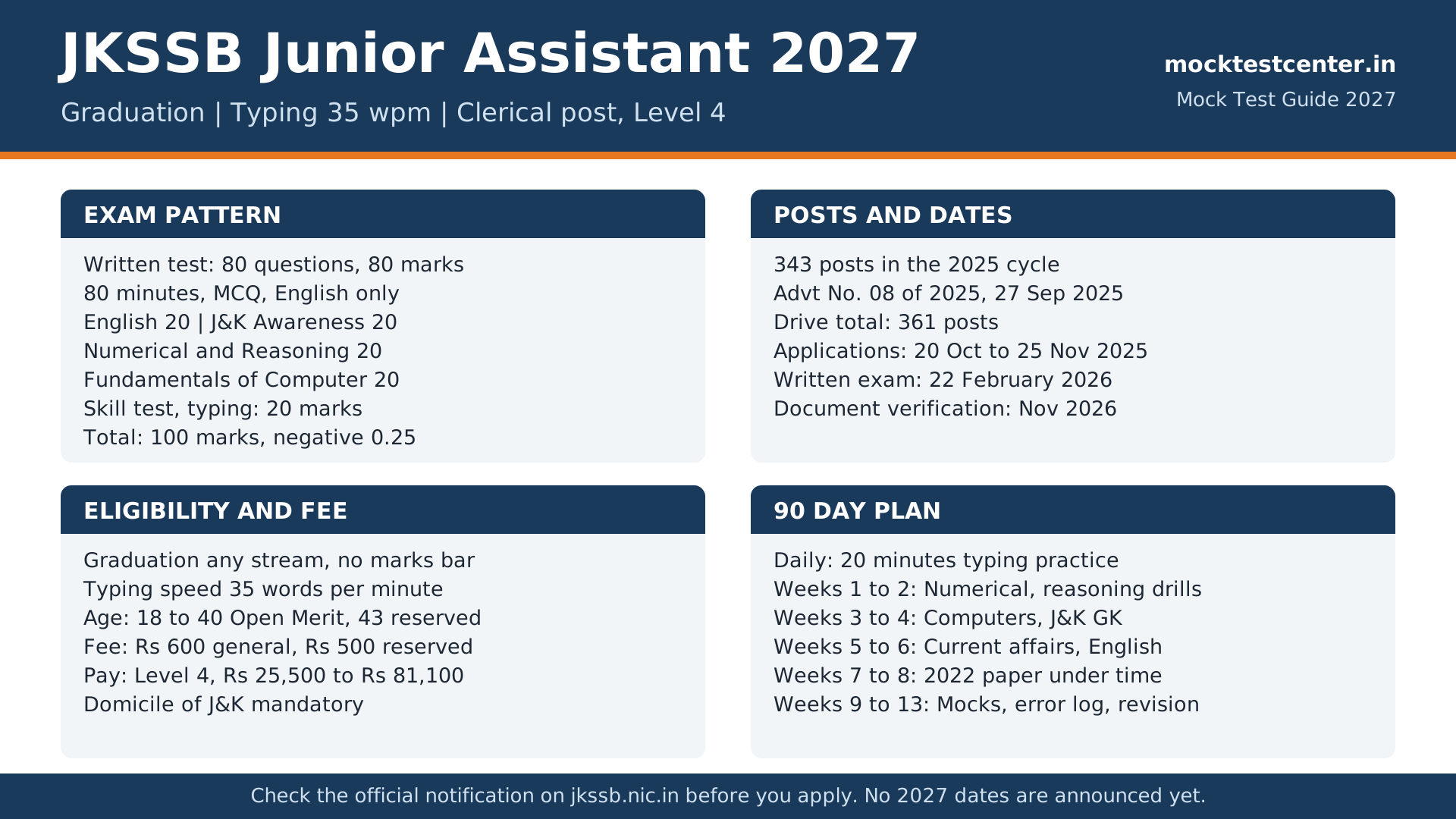
The Junior Assistant is the largest single post in the current JKSSB recruitment round. The Jammu and Kashmir Services Selection Board advertised 343 Junior Assistant posts under Advertisement No. 08 of 2025, dated 27 September 2025, as part of a 361 post drive that also covered 12 Junior Stenographers and 6 Junior Scale Stenographers. Applications ran from 20 October to 25 November 2025, the written examination followed on 22 February 2026, and document verification for the selected candidates was under way in November 2026. JKSSB Junior Assistant 2027 has no notification yet, so every fact in this guide comes from that 2025 cycle and the 2022 cycle before it. If you plan to sit for the next cycle, those two cycles are the closest picture you have of the posts, the paper, the typing test and the fees.
Junior Assistant is the clerical backbone of the Jammu and Kashmir government. The post sits in department offices across the Union Territory, and the work is the daily running of an office: typing letters and notes, keeping files, entering data, handling correspondence, and keeping the records that the section officer asks for. A graduate in any stream can apply, provided the typing speed of 35 words per minute is in hand. The selection has two parts: a written test worth 80 marks and a skill test worth 20 marks, for a total of 100. The written test decides the merit order, and the typing test decides whether the merit order stands. A candidate who scores high in the written test and fails the typing test loses the post, and that is the trap this exam sets for graduates who treat typing as an afterthought.
The 2025 cycle in numbers
| Item | Detail |
|---|---|
| Conducting body | Jammu and Kashmir Services Selection Board (JKSSB) |
| Post | Junior Assistant |
| Advertisement | Notification No. 08 of 2025, dated 27 September 2025 |
| Posts | 343, within a 361 post drive |
| Other posts in the same drive | Junior Stenographer 12, Junior Scale Stenographer 6 |
| Application window | 20 October to 18 November 2025, extended to 25 November 2025 |
| Written exam | 22 February 2026, as reported by trackers |
| Document verification | Under way in November 2026, as reported by trackers |
| Pay | Level 4, Rs 25,500 to Rs 81,100 |
| 2027 notification | Not issued as of 20 November 2026 |
Three hundred and forty three posts is the largest Junior Assistant vacancy count in a single JKSSB advertisement in recent years. The 2022 cycle offered 213 posts across two advertisements, 89 in the Department of Disaster Management, Relief, Rehabilitation and Reconstruction under Advertisement No. 1 of 2022, and 124 in the Rural Development and Panchayati Raj Department under Advertisement No. 2 of 2022. The 2025 figure of 343 is more than half as large again, and it covers departments across the Union Territory rather than two departments. The post list in Annexure A of the 2025 notification gives the department wise and cadre wise breakup, and a candidate who reads it can see which departments hold the most posts before choosing where to aim.
Two dates in the table need a note. The written exam date of 22 February 2026 and the document verification dates of 18 and 19 November 2026 come from tracker pages, not from a notice read directly on jkssb.nic.in during preparation. The Board site could not be reached by direct fetch on 20 November 2026. The advertisement number, the vacancy split of 343, 12 and 6, the application window, and the extension to 25 November 2025 are reported consistently across several independent trackers, so this guide states them as the cycle facts. The written exam and verification dates are stated as tracker reported dates, and the upload pre-check should confirm them against the Board site before any of them is quoted to candidates.
The 2022 cycle and the 2022 paper
The 2022 cycle ran under two advertisements issued together. Advertisement No. 1 of 2022 covered 89 Junior Assistant posts in the Department of Disaster Management, Relief, Rehabilitation and Reconstruction. Advertisement No. 2 of 2022 covered 124 Junior Assistant posts in the Rural Development and Panchayati Raj Department. The application window closed on 20 March 2022. The pattern in that cycle was the same as the 2025 cycle: a written examination of 80 questions for 80 marks in 80 minutes, and a skill test of 20 marks. The four sections of the written test were General English, General Awareness with special reference to Jammu and Kashmir, Numerical and Reasoning Ability, and Fundamentals of Computer, with 20 questions in each.
An official Junior Assistant paper from 24 January 2022 is hosted by trackers, in two shifts, and it belongs to the cycle that ran just before the two 2022 advertisements. That paper is the best preparation material available for the next cycle. It is an official paper, set by the Board, and it shows the level and the spread of the written test in a way that no mock test can. Solve it under time, 80 questions in 80 minutes, with the 0.25 negative marking applied, and log the errors by section. A candidate who has solved the 2022 paper knows the standard of the English questions, the depth of the Jammu and Kashmir questions, and the level of the numerical and reasoning questions. A candidate who has only read the syllabus knows none of that.
The Junior Assistant post also appeared in the combined 168 post notification of 2022, which covered Junior Scale Stenographer, Driver, Junior Assistant, Assistant Superintendent Jails, Assistant Scientific Officer and other posts, with applications from 10 February to 20 March 2022. That notification shows how JKSSB groups posts. A single advertisement can carry several posts, and the Junior Assistant is often the largest post in the group. A candidate who watches the Board site should watch for combined advertisements as well as single post advertisements, because the Junior Assistant vacancies arrive in both forms.
Who can apply for JKSSB Junior Assistant 2027
Eligibility rests on three things: a degree, the typing speed, and an age inside the limit. Graduation from a recognised university, in any discipline, is the educational qualification. There is no marks percentage condition for this post, which sets it apart from the Accounts Assistant post in the same Board, where Open Merit candidates need 50 percent. The typing speed is the second qualification. Knowledge of typewriting with a speed of not less than 35 words per minute is required, and it is tested in the skill test. A candidate who holds the degree but not the typing speed cannot clear the selection, however strong the written test score is.
| Category | Maximum age, as on 1 January 2025 |
|---|---|
| Open Merit | 40 years |
| SC, ST, RBA, ALC/IB, EWS, OBC | 43 years |
| Persons with Benchmark Disabilities | 42 years |
| Ex-servicemen | 48 years |
The minimum age is 18 years for every category, reckoned as on 1 January 2025 for the 2025 cycle. The age table above matches the standard JKSSB age table used across the 2025 notifications, and it is the same table that governs the Junior Stenographer posts in the same advertisement. Domicile is mandatory. Only domiciles of the Union Territory of Jammu and Kashmir can apply, and the domicile certificate must have been issued before the cut off date in the notification. The 2025 notification required the certificate to be in hand before 20 October 2025, the opening date of the application window.
The pay sits at Level 4, Rs 25,500 to Rs 81,100 per month, according to every tracker that reports the 2025 notification. That figure is consistent across sources, and it is the one pay figure in this guide that carries no conflict. The post is a Group C clerical post, and the first posting can sit in any department and any district in the Union Territory. Promotion runs through the clerical cadre, from Junior Assistant to Senior Assistant and then to section level posts, under the departmental rules in force at the time. This guide states no promotion timeline, because no notification quoted one.
The written test, section by section
| Section | Questions | Marks |
|---|---|---|
| General English | 20 | 20 |
| General Awareness with special reference to J and K UT | 20 | 20 |
| Numerical and Reasoning Ability | 20 | 20 |
| Fundamentals of Computer | 20 | 20 |
| Total written test | 80 | 80 |
| Skill test, typing | 20 | |
| Grand total | 100 |
The written test carries 80 objective questions for 80 marks, in 80 minutes, with 1 mark for a correct answer and a penalty of 0.25 marks for a wrong answer. The questions are multiple choice, set in English only. Sixty seconds per question is the arithmetic, and it is the same pace as the Stenographer written test. The four sections carry equal weight, 20 marks each, so there is no big section to hide behind and no small section to ignore. A candidate who is strong in three sections and weak in one will lose 20 marks, which is a fifth of the total. The plan must cover all four sections, and the weakest section deserves the most time.
A conflict in the pattern needs a plain statement. One tracker page gives a different written test for Junior Assistant: 100 questions in 60 minutes with a marking scheme of plus 1 and zero for a wrong answer. That conflicts with the 80 question, 80 minute, 0.25 negative marking pattern reported by Oliveboard and Testbook against the official notifications, and the two cannot both be right for the same cycle. This guide follows the 80 question pattern, because it is the pattern in the 2022 notification summaries and it matches the 80 plus 20 split that adds to the 100 mark total. The 100 question figure is flagged here as an unverified tracker figure. Do not build a study plan around it.
General English carries 20 marks and tests the standard set: narration, tenses, articles, modals, pronouns, homophones and homonyms, phrases, antonyms and synonyms, clauses, idioms and phrases, rearrangement of jumbled sentences, active and passive voice, prepositions, pairs of words, correction of sentences, correction of spellings, and error spotting. Twenty questions cannot cover all of that, so the paper picks a spread, and the spread changes between cycles. A graduate who reads English daily will answer most of these without special study, and a short daily drill on error spotting and synonyms will cover the rest.
General Awareness with special reference to Jammu and Kashmir carries 20 marks, and it is the section where local knowledge pays directly. The topics cover current events of national and international importance, and then Jammu and Kashmir in detail: history, geography, economy, culture and heritage, tourist destinations, rivers and lakes, climate and crops, and demography including the census. A candidate from the region who has read the local news for a year will recognise a large share of these questions. Keep a notebook of Jammu and Kashmir news from the application date onward, and update it weekly.
Numerical and Reasoning Ability carries 20 marks and covers the standard set: percentage, average, time, work and distance, ratios and proportions, problems of age, probability, LCM and HCF, mensuration, letter series, number series, statements and conclusions, analogies, classification, and Venn diagrams. These are Class 10 level topics, and they reward speed more than depth. Practise them as timed drills of 20 questions rather than as theory. Fundamentals of Computer carries 20 marks, the largest computer weight of any JKSSB clerical paper, and it covers computer fundamentals, the parts of a computer, operating systems in outline, the internet, email, word processing and spreadsheets, and common applications. A candidate who uses a computer daily will answer most of these, and a weekend read of a computer fundamentals note set will cover the rest.
The typing test and why it fails candidates
The skill test carries 20 marks and it tests typing at 35 words per minute. That speed is modest, and it is the reason candidates neglect it. Thirty five words per minute on a computer keyboard, with accuracy, is a skill that a graduate who types daily will hold without practice, and a skill that a graduate who never types will not hold at all. The test is the stage that decides the selection for candidates at the edge of the merit list, because the written test scores bunch tightly and the typing test separates those who prepared for it from those who did not.
The practice routine is simple. Type for 20 minutes a day on a computer keyboard, with passages from newspapers and government reports, and count the errors. Raise the speed only when the accuracy holds. A candidate who types at 25 words per minute needs about a month of daily practice to reach 35 with accuracy. A candidate who types at 35 already needs only a weekly check to hold the speed. The transcription in the skill test is typed from printed matter, so practise with printed passages rather than with copied text on the same screen. The habit of reading from paper and typing on a keyboard is the habit the test measures.
One more detail belongs here. The typing test in the Junior Assistant selection is a skill test, not a qualifying test in the narrow sense. Its 20 marks count in the total of 100, so a strong typing score adds to the merit and a weak typing score subtracts from it. That is different from a purely qualifying test, where the score does not count. Treat the typing test as 20 marks to earn, not as a hurdle to step over. A candidate who earns 18 of the 20 typing marks starts the merit list 18 marks ahead of a candidate who earns none, and that gap is larger than the gap between most written test scores.
What the job looks like day to day
A Junior Assistant spends the working day at a desk in a government office, and the desk is where the department runs. The morning starts with the dak, the incoming letters and files, which the assistant sorts, numbers and puts up to the section officer. The middle of the day is typing and data entry: letters, notes, statements, and the replies that go out to other offices and to the public. The afternoon is file work: pulling the old file for a case, noting the facts on it, and sending it up the chain with the relevant rules flagged. None of this work is dramatic, and all of it is necessary. A department that loses its files loses its memory, and the Junior Assistant is the person who keeps the memory in order.
The computer is the main tool, and the typing speed is the skill that the Board tests because the job needs it every hour. A Junior Assistant who types at 35 words per minute with accuracy finishes a letter in the time it takes a slower typist to finish half of one, and the difference shows in the number of files cleared in a day. The job also needs a working knowledge of office procedure: how a file moves, how a note is written, how a government letter is drafted, and how the records are kept. Those things are learned on the job, in the first months, and a new Junior Assistant who watches the senior assistant and asks questions will learn them fast. The examination tests the typing and the general ability. The office teaches the procedure.
The posting can sit in any department, and the department decides the flavour of the work. A Junior Assistant in the Rural Development department works with panchayat records, scheme files and village level data. A Junior Assistant in the Disaster Management department works with relief records, compensation files and emergency correspondence. A Junior Assistant in the Finance Department works with bills and accounts. The core of the work is the same in every department: files, typing, data and correspondence. The subject changes. The skill does not.
UT, Divisional and District cadres
JKSSB posts are advertised in three cadres, and the cadre decides where you can be posted. A UT cadre post can take you anywhere in the Union Territory, in Jammu division or in Kashmir division. A Divisional cadre post keeps you inside one division, Jammu or Kashmir. A District cadre post keeps you inside one district. The 2025 notification gives the cadre for each item in Annexure A, and a candidate who reads it can see the cadre before applying. The cadre matters for planning, because a UT cadre posting may sit far from home, while a District cadre posting sits in the home district.
The cadre also affects the selection, because the merit list is drawn cadre wise and category wise. A candidate applies for the items in the cadre that suits, and the competition is measured inside that cadre rather than across the whole Union Territory. The 2022 cycle illustrates the point. The 89 posts in the Disaster Management department and the 124 posts in the Rural Development department were advertised as separate items, and each item carried its own department and cadre. The 2025 cycle works the same way, with 343 posts spread across departments and cadres in Annexure A. Read the annexure before you apply, and apply for the items where your chances are best, not for every item in the list.
Fee and how to apply
The application fee for the 2025 cycle is reported differently across trackers, and the difference is large enough to state plainly. One set of trackers, including the notification summary that quotes the advertisement text, gives Rs 600 for all candidates and Rs 500 for SC, ST 1, ST 2 and EWS candidates. A second set gives Rs 700 for General, RBA, ALC and EWS and Rs 600 for SC, ST and PwBD. A third gives Rs 500 for General, OBC and EWS and Rs 400 for SC, ST and PwD. The 600 and 500 figures match the fee in the Accounts Assistant 2025 notification and the Class IV 2026 notification, both from the same Board in the same period, and the notification summary that quotes the fee text directly carries the 600 and 500 figures. This guide follows the 600 and 500 figures and flags the 700 and 600 figures and the 500 and 400 figures as conflicts. The 2022 cycle fee was reported as Rs 500 for General, SC and ST candidates and Rs 400 for Junior Scale Stenographer, Junior Assistant and Assistant Superintendent Jails candidates, which conflicts with itself across the same tracker page and is flagged here as unreliable.
Applications go in online only, through jkssb.nic.in, in the window the notification fixes. The 2025 window ran from 20 October to 18 November 2025, and the Board extended it to 25 November 2025. The form asks for personal details, the domicile certificate, the graduation details, the category certificate where applicable, a photograph and a signature, and the fee payment. The typing speed is not proved at the application stage. You declare the qualification, and the Board tests the speed in the skill test. Do not apply without the typing speed in hand, because the skill test follows the written test and there is little time to learn typing between the two stages.
What to study first
Start with the weakest section, because the four sections carry equal weight and the weakest section is where the marks are lost. For most graduates the weakest section is either Numerical and Reasoning Ability or Fundamentals of Computer, and those two sections deserve the first month. Then add General Awareness with special reference to Jammu and Kashmir, because it is the section where local knowledge pays and where a notebook of local news does the work. English comes last in the order of study, because a graduate who reads English daily will answer most of it without special preparation, and a short daily drill covers the rest.
Books are simple to list. For numerical and reasoning ability, a standard quantitative aptitude and reasoning book with timed drills. For computers, a computer fundamentals book that covers hardware, software, the internet, email, word processing and spreadsheets. For general awareness, a Jammu and Kashmir yearbook and a standard general knowledge book, plus a notebook of local news from the last twelve months. For English, a grammar and comprehension book with error spotting practice. For typing, any typing tutor software with accuracy tracking. The 24 January 2022 official paper is the most useful single document after the books, and solving it under time is the best check of where you stand.
One habit matters more than the book list. Practise typing every day without a break, even on days when the written test preparation feels urgent. Typing speed is a daily skill, and a week without typing costs more than a week without reading. Keep the typing practice beside the written test books, and do it first, when the mind is fresh. A candidate who protects the daily typing practice will reach the skill test ready. A candidate who lets the written test eat the typing practice will reach the skill test with a good written score and no typing speed, and that is a failed selection.
A 90 day plan that fits around a job
| Weeks | Focus | Daily time |
|---|---|---|
| 1 to 2 | Numerical and reasoning drills, plus typing every day | 2 hours |
| 3 to 4 | Computer fundamentals, plus Jammu and Kashmir history and geography | 2 hours |
| 5 to 6 | Jammu and Kashmir economy and current affairs, plus English drills | 2 to 3 hours |
| 7 to 8 | The 2022 paper under time, plus typing at 35 words per minute | 2 to 3 hours |
| 9 to 10 | Full mocks, 80 questions in 80 minutes, with negative marking applied | 2 to 3 hours |
| 11 | Revision of the error log, plus typing accuracy drills | 3 hours |
| 12 | Two full mocks, typing at exam speed, light revision | 3 hours |
| 13 | Final revision of the facts sheet and the formulae sheet, one rest day | 2 hours |
The plan gives typing the first 20 minutes of every day, and that is deliberate. The written test preparation fills the rest of the time, and the weakest section gets the first month. The last five weeks are mocks and revision, with the error log doing the teaching. Keep the log in a notebook, one line per mistake, with the section, the topic, and the correct rule. A candidate who reviews the log every Sunday will not repeat the same mistake in the second mock, and that is the whole point of mock tests. A mock that you score and forget is a morning spent.
The plan assumes you already type at some speed. If you type at 20 words per minute or below, add a month of typing practice before the 90 days start, and use that month to build the speed to 30 words per minute. The 90 day plan then takes the speed from 30 to 35 with accuracy, which is a realistic step. A candidate who starts typing from zero inside the 90 days will reach the written test ready and the skill test unready, and the skill test is the stage that ends the selection. Start the typing now, and let the written test preparation fit around it.
Other exams worth preparing alongside
JKSSB Junior Assistant aspirants often prepare for other state and national exams alongside this one. The SBI Clerk 2027, IBPS Clerk 2027, IBPS RRB Clerk 2027, RBI Assistant 2027, FSSAI Assistant 2027, LIC ADO 2027, SSC GD 2027, UP Police Constable 2027, IBPS PO 2027 and UGC NET Paper 1 2027 pages on this site carry the same style of mock test guide, and the pattern habit you build here transfers directly to them.
Sources
The Jammu and Kashmir Services Selection Board site at jkssb.nic.in, the official source for the notification, the syllabus, the admit card and the merit lists, which could not be reached by direct fetch during preparation on 20 November 2026, so the facts below rest on the tracker pages listed here and should be checked against the official notification before you apply. Oliveboard, for Advertisement No. 1 of 2022 with 89 Junior Assistant posts in the Department of Disaster Management, Relief, Rehabilitation and Reconstruction, Advertisement No. 2 of 2022 with 124 posts in the Rural Development and Panchayati Raj Department, the 213 post total, the written test of 80 questions for 80 marks in 80 minutes with four sections of 20 questions each, the negative marking of 0.25, the skill test of 20 marks, and the application window closing on 20 March 2022. Testbook, for the official Junior Assistant paper of 24 January 2022 in two shifts, the written test of 80 questions for 80 marks in 80 minutes, the skill test of typing at 35 words per minute for 20 marks, and the cut off guidance of 70 to 75 marks out of 100. Rojgar Warrior, Examlover, Sarkari Result Daily and JK Chrome, for Advertisement No. 08 of 2025 dated 27 September 2025, the 361 post total with Junior Assistant 343, Junior Stenographer 12 and Junior Scale Stenographer 6, the application window from 20 October to 18 November 2025, the typing speed of 35 words per minute, the age limit of 40 years for Open Merit as on 1 January 2025, and the pay of Level 4 Rs 25,500 to Rs 81,100. Examlover, for the written exam date of 22 February 2026, stated here as a tracker reported date. Shishya, for the Junior Assistant document verification dates of 18 and 19 November 2026, stated here as tracker reported dates. MySarkariNaukri, for the fee of Rs 600 for all candidates and Rs 500 for SC, ST 1, ST 2 and EWS candidates. Henceprove, for the conflicting 100 question and 60 minute pattern with no negative marking, flagged in this guide as unverified.







