
About Bihar ANM 2027 Exam Series
📖 Table of Contents
- Bihar ANM 2027 at a glance
- A job or a course, and why the difference decides everything
- 5,006 posts, split three ways
- Who can apply
- Fee and how to apply
- The computer based test, and a pattern dispute to settle
- Merit: 80 marks from the test, 20 from experience
- Pay, posting, and what an ANM actually does
- The syllabus, subject by subject
- A 12 week plan that fits the real exam
- Documents and verification traps
- What happens after the test
- Sources
Bihar ANM 2027: Complete Exam Guide
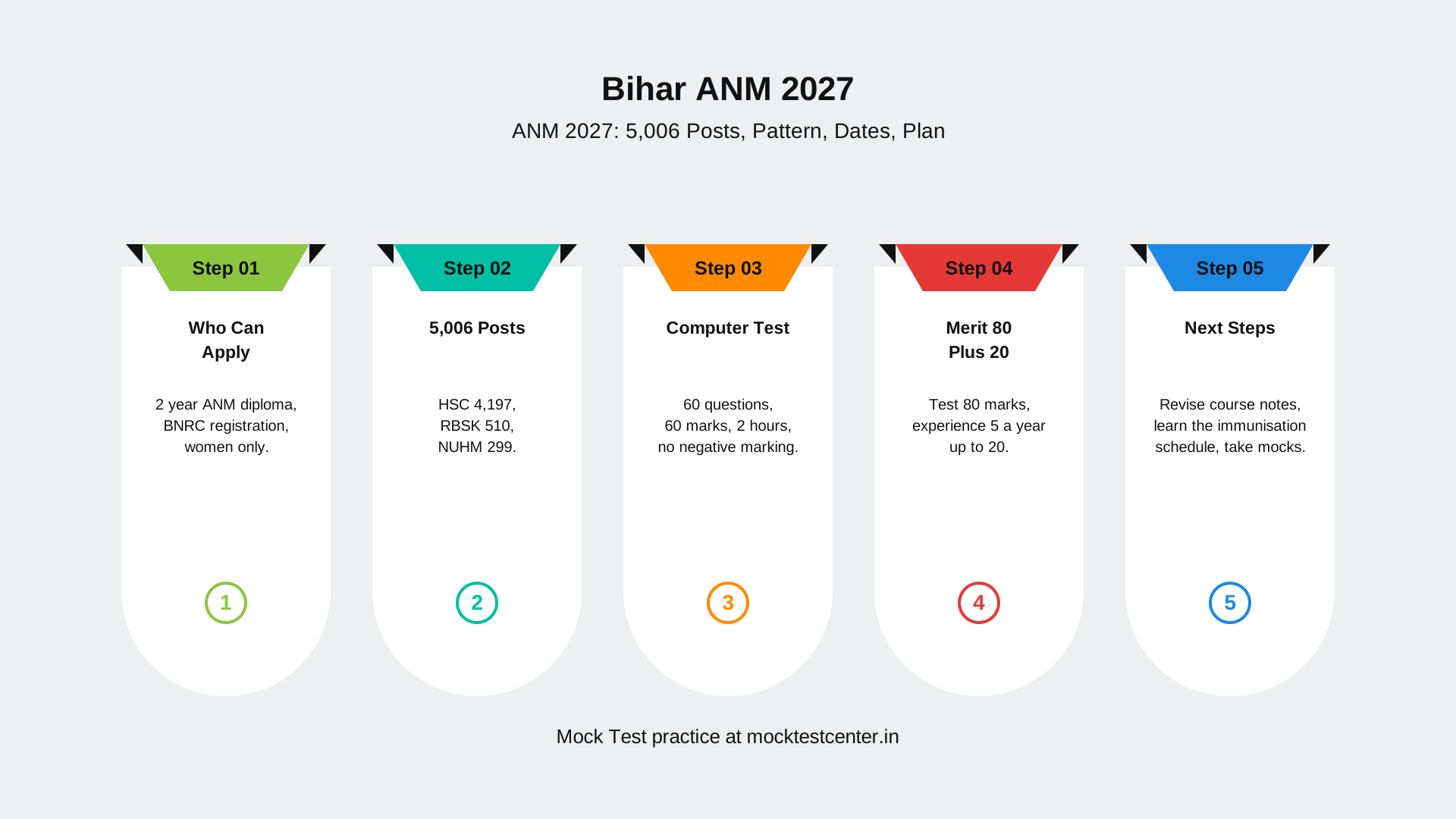
The Bihar ANM 2027 page sits on a recruitment that already ran, and that fact shapes everything below. The State Health Society, Bihar, advertised 5,006 Auxiliary Nurse Midwife posts under Advertisement No. 08/2025, dated 12 August 2025, for contractual work under the National Health Mission. Applications ran online from 14 August to 28 August 2025. The computer based test ran on 17 to 19 December 2025, the admit cards came out on 11 December 2025, and the board released the result on 23 January 2026. No separate 2027 ANM notice had appeared as of 21 November 2026.
That timing matters for anyone planning now. The 2027 page uses the 08/2025 cycle as its anchor, because that cycle holds the latest verified vacancy split, the latest eligibility rules, the latest fee and the latest exam pattern. A fresh notification will most likely follow the same scheme, and every figure in this guide comes from the 08/2025 advertisement as reported across tracker pages that cite it, with the source named wherever a figure is disputed.
The post needs a two year ANM diploma and registration with the Bihar Nurses Registration Council. The pay is Rs 15,000 a month on contract. The exam is a single computer based test of 60 questions for 60 marks in 2 hours, with no negative marking, and the merit list adds work experience marks to the test score. A candidate who holds the diploma and the registration, and who has worked in a health facility, starts with an edge that a fresh diploma holder cannot buy in the last month.
One confusion belongs at the top. Bihar has two different ANM routes, and tracker pages mix them freely. One route is a job, which is this page: the State Health Society recruits trained ANMs for health centres. The other route is a course, where a Class 12 pass student takes an entrance exam for admission to the two year ANM diploma itself. This guide covers the job, and it explains the course only where a reader needs to tell the two apart.
Bihar ANM 2027 at a glance
| Detail | Bihar ANM, live cycle Advt. No. 08/2025 |
|---|---|
| Conducting body | State Health Society, Bihar (SHS Bihar) |
| Programme | National Health Mission (NHM) |
| Post | Auxiliary Nurse Midwife (ANM), contractual |
| Advertisement | No. 08/2025, dated 12 August 2025 |
| Total posts | 5,006 (HSC 4,197, RBSK 510, NUHM 299) |
| Application window | 14 August to 28 August 2025, online |
| Education | Two year ANM diploma from a recognised institute, plus registration with Bihar Nurses Registration Council |
| Age as on 1 August 2025 | Minimum 21 years; maximum 40 years for UR and EWS and BC women, 42 years for SC and ST women |
| Fee | Rs 500 for General and BC and EBC and EWS; Rs 125 for SC and ST of Bihar and for women of Bihar and for PwD |
| Pay | Rs 15,000 a month, contractual |
| Exam | Computer Based Test, 60 questions, 60 marks, 2 hours, no negative marking |
| Exam dates | 17 to 19 December 2025 |
| Admit card | 11 December 2025 |
| Result | 23 January 2026, as reported |
| 2027 notice | Not out as of 21 November 2026 |
| Official website | shs.bihar.gov.in |
A job or a course, and why the difference decides everything
The ANM job and the ANM course share a name and almost nothing else. The job is for women who already hold the two year ANM diploma and who hold registration with the Bihar Nurses Registration Council. The course is for Class 12 pass girls who want to earn that diploma, and admission to it runs through the Bihar Combined Entrance Competitive Examination Board, through the DCECE paramedical entrance exam, with counselling on the BCECE Board portal. A candidate who applies for the job with only a Class 12 certificate faces rejection, and a candidate who applies for the course with a diploma already in hand will be applying to study what she already knows.
The course itself runs for two years in most institutes in Bihar, under the Bihar University of Health Sciences or Aryabhatta Knowledge University, and its entrance needs a Class 12 pass with Physics and Chemistry and Biology and English in many institutes, with 40 to 45 percent marks and an age of 17 to 35 years. The DCECE paramedical exam for 2026 ran on 24 May 2026, with the result on 11 June 2026, and counselling followed in July 2026. Those dates belong to admission, and they have no bearing on the SHS recruitment dates in the table above.
The job posting is also different in kind from a permanent nursing post. The 5,006 ANM posts are contractual, under the National Health Mission, and the monthly pay of Rs 15,000 reflects that contract. The notification summary also lists a pay scale of Rs 5,200 to Rs 20,200 with a grade pay of Rs 2,400, which is the scale quoted in the advertisement, while the monthly amount actually paid is Rs 15,000. A candidate should read the contract terms in the notification before applying, because a contractual post carries different leave and tenure rules from a permanent post, and the choice should be made with open eyes rather than on the vacancy number alone.
ANM is a female post. The age table in the notification lists female categories only, and the fee table gives a reduced fee of Rs 125 to women candidates of Bihar. A male candidate cannot apply for this post, and that is a feature of the post rather than an oversight, because ANM work centres on maternal and child health in villages, where the health worker is a woman by design.
5,006 posts, split three ways
The 5,006 posts split across three programmes under the National Health Mission, and the split shapes where a selected candidate will work. The Health Sub Centre programme, HSC, takes 4,197 posts, which is most of the drive. The Rashtriya Bal Swasthya Karyakram, RBSK, takes 510 posts. The National Urban Health Mission, NUHM, takes 299 posts. A candidate applies for the ANM post, and the programme allocation follows the vacancy list and the merit list rather than a separate choice in most cases.
| Programme | UR | EWS | SC | ST | EBC | BC | WBC | Total |
|---|---|---|---|---|---|---|---|---|
| ANM, Health Sub Centre | 2,231 | 420 | 609 | 53 | 603 | 104 | 177 | 4,197 |
| ANM, RBSK | 224 | 51 | 118 | 8 | 87 | 0 | 22 | 510 |
| ANM, NUHM | 123 | 25 | 48 | 5 | 70 | 21 | 7 | 299 |
| Total | 2,578 | 496 | 775 | 66 | 760 | 125 | 206 | 5,006 |
The HSC share is the story of the drive. Health Sub Centres are the first point of contact between a village and the health system, and the ANM posted there runs immunisation sessions and antenatal checkups and family planning counselling and basic record keeping for the village. The RBSK share works with child health screening, and the NUHM share works in urban health centres. A candidate who joins through the HSC list should expect a village posting, with travel to the block health centre for reporting and supplies, and a candidate who joins through NUHM should expect a town posting.
The category split is wide. Unreserved candidates hold 2,578 posts, EWS holds 496, SC holds 775, ST holds 66, EBC holds 760, BC holds 125, and WBC, women of backward classes, holds 206. The RBSK list carries no BC posts at all, which is a quirk of that programme list rather than a typing error, and it appears the same way across tracker pages that cite the notification. A candidate should apply under the category that matches her certificate, because the board verifies the category certificate at document verification, and a wrong category claim ends the selection.
The size of the drive is the largest ANM recruitment Bihar has run in years, and it reflects the expansion of Health and Wellness Centres across the state. The previous SHS ANM cycles were smaller, and the gap between the 2025 drive and the next one will most likely stretch over years rather than months, which is why the 08/2025 cycle matters even for a candidate aiming at 2027.
Who can apply
The education condition has two parts, and both must be met. A candidate must have completed the two year Auxiliary Nurse Midwifery course from a recognised institution, and she must hold registration with the Bihar Nurses Registration Council. A candidate who has finished the course but has not yet registered cannot apply, and a candidate registered in another state should check whether the notification accepts that registration or needs a Bihar registration, because the board verifies the registration certificate at document verification.
The age limits count as on 1 August 2025. The minimum age is 21 years for all categories. The maximum age is 40 years for unreserved and EWS and backward class women, and 42 years for SC and ST women. Persons with disability get 10 years of relaxation in the maximum age, and departmental employees get 5 years, subject to eligibility. The notification also carries a special window for candidates who crossed the maximum age between 1 June 2021 and 1 August 2025, who remain eligible if they meet all other conditions. That window matters, because it covers candidates who lost years to the pandemic period when recruitments stalled.
| Category, female | Minimum age | Maximum age as on 1 August 2025 |
|---|---|---|
| Unreserved and EWS | 21 years | 40 years |
| Backward Classes and Very Backward Classes | 21 years | 40 years |
| SC and ST | 21 years | 42 years |
| PwD, additional relaxation | 21 years | 10 years beyond the category limit |
| Departmental employees | 21 years | 5 years beyond the category limit |
Some tracker pages print a flat maximum of 40 years for all candidates, and others print 47 years. The category table above follows the notification based reporting, which gives 40 years for most categories and 42 for SC and ST women, before the PwD and departmental relaxations. A candidate near the edge should check her exact age against the notification table rather than against a tracker headline, because a headline that drops the category detail can mislead by two years.
Domicile matters in the fee and in the certificate list, and a candidate from outside Bihar pays the full fee of Rs 500 in every category. The application runs online only through shs.bihar.gov.in, and the form allows only one application per candidate. A candidate who submits two applications risks cancellation of both, and the notification says so plainly.
Fee and how to apply
The fee is category based, and the reduced fee of Rs 125 applies widely. General and BC and EBC and EWS candidates pay Rs 500. SC and ST candidates who live in Bihar pay Rs 125. Women candidates of Bihar, in unreserved or reserved categories, pay Rs 125. Persons with disability at 40 percent or more pay Rs 125. Candidates from outside Bihar pay Rs 500 in every category. Payment runs online through internet banking, credit or debit card, or UPI, and a candidate should keep the payment receipt until the end of the process.
The application steps in the live cycle were simple, and they will most likely repeat. A candidate registered on the SHS portal with her name and mobile number and email, received an application number and a password, logged in again, filled the form, uploaded a recent passport size colour photograph and a signature in the formats the portal specified, verified every detail, paid the fee, and downloaded and printed the submitted form. The printout matters, because the board asks for it at document verification, and a candidate who loses it must rely on the portal still being open.
The window was short. Applications opened at 10 in the morning on 14 August 2025 and closed at 6 in the evening on 28 August 2025, which gave candidates fifteen days, and the fee had to be paid inside the same window. A candidate who waited until the last evening met the same server load every cycle, and incomplete applications, where the form was filled but the fee was never paid, were not accepted. The lesson for the next cycle is to apply in the first week and to confirm the payment receipt on the same day.
The computer based test, and a pattern dispute to settle
The selection starts with a single computer based test, and the test is the only written stage. The Bihar ANM exam pattern as reported for the live cycle puts the paper at 60 questions for 60 marks in 2 hours, with objective multiple choice questions and no negative marking. That is the pattern this guide uses, because it comes from the reporting that cites the notification directly, and it matches the exam dates and the admit card notice from the same source.
| Detail | Bihar ANM CBT, Advt. No. 08/2025 |
|---|---|
| Mode | Computer Based Test, online |
| Questions | 60 |
| Marks | 60, one mark per question |
| Duration | 2 hours |
| Negative marking | None |
| Normalisation | Applied if the exam runs in multiple shifts |
That pattern needs a plain flag, because a large set of tracker pages prints a different one. Several pages describe a 100 question paper for 100 marks in 2 hours, and they disagree with each other on the rest. One page adds a negative marking of 0.25 marks per wrong answer. One page splits the paper into General Knowledge and Current Affairs for 20 marks and General Hindi for 20 and General Science for 20 and Nursing subjects for 40. Another page splits it into Nursing and Midwifery for 50 marks and General Knowledge for 25 and Reasoning and Aptitude for 25. Those three versions cannot all be right, and none of them cites the notification for its split.
The 60 question version is the one that matches the notification based reporting, and it is also the version that the exam date notices carry. The 100 question versions look like copies of older nursing exam patterns, pasted into ANM pages by sites that reuse a template across states. A candidate who prepares for 100 questions will still cover the same ground, because the subjects overlap, but a candidate who plans time and attempts on a 100 question paper will misjudge the real paper, where 60 questions in 2 hours gives 2 minutes a question, which is generous, and where no negative marking means every question should be attempted.
The syllabus, as the notification based reporting summarises it, covers General Ability and Analytical Ability and Numerical Ability and Technical Ability. The technical part is the core of the paper, and it draws on the ANM course itself: fundamentals of nursing and community health nursing and maternal health and child health and nutrition and immunisation and first aid and infection control. The general part draws on basic aptitude and reasoning and general knowledge, with Bihar schemes and current affairs in the mix. The notification does not publish a question by question subject split in the reporting this guide could verify, so this guide does not invent one. Any change to the Bihar ANM exam pattern will come from the official notification, and the upload pre-check should read the subject split there if a newer version publishes one.
Normalisation applies when the exam runs in multiple shifts, which it did, across 17 to 19 December 2025, and the board publishes the method with the result. A candidate should ignore shift gossip and focus on the raw score, because the board applies the same method to every shift, and a candidate cannot control which shift she is given.
Merit: 80 marks from the test, 20 from experience
The merit list is where this exam differs from most others, and it is the section a candidate should read twice. The test score carries a weight of 80 marks, after the board applies a 0.8 factor to the CBT marks, and work experience carries up to 20 marks, at 5 marks per year of experience. The total is 100 marks, and the final selection follows the total, category by category, against the vacancy list.
| Component | Marks |
|---|---|
| Computer Based Test, after 0.8 weightage | 80 |
| Work experience, 5 marks per year | 20 |
| Total | 100 |
Experience is worth a fifth of the total, and that changes the competition. A candidate with four years of relevant health work starts with 20 marks, which is the same as answering 20 more questions correctly in the test, after the weightage is applied. A fresh diploma holder with no experience starts at zero in that column, and must make up the gap in the test itself. The exact definition of relevant experience, and the certificate that proves it, sits in the notification, and a candidate with experience should gather that certificate before the form opens, because an experience claim without the right certificate earns nothing at verification.
Document verification follows the merit list, and the board calls shortlisted candidates with original certificates. The board checks the ANM diploma and the Bihar Nurses Registration Council registration and the category certificate and the experience certificate and identity proof. A candidate whose registration has lapsed, or whose experience certificate does not match the notification format, can lose a place that the test had already won. The final selection follows verification, and the board publishes the list on shs.bihar.gov.in.
The answer key came out on 26 December 2025, as reported, a week after the exam, and the result followed on 23 January 2026. That gap is short by government standards, and it shows that the board moved fast once the test was done. A candidate in the next cycle should expect the same rhythm, with the key in about a week and the result in about a month, and should keep the admit card and the application printout until the result is out.
Pay, posting, and what an ANM actually does
An ANM under the National Health Mission in Bihar is paid Rs 15,000 a month on contract, with allowances as per government norms. The work is village work. The ANM posted at a Health Sub Centre, which the National Health Mission now calls a Health and Wellness Centre, runs the immunisation sessions for children and for pregnant women, conducts antenatal checkups, counsels mothers on nutrition and breastfeeding and family planning, keeps the birth and death registers for the village, and refers complicated cases to the Primary Health Centre. She is often the only health worker a village sees in a week, and the trust she builds decides whether mothers come for checkups or stay away.
The day starts early. An ANM walks or cycles to the sub centre, opens the register, checks the due list of children for immunisation, and holds the session on the fixed village health and nutrition day. She visits homes for follow up, and she attends deliveries where the sub centre conducts them, and she escorts high risk pregnancies to the referral hospital. The record keeping is as much a part of the job as the clinical work, because the health system runs on the numbers the ANM reports, from immunisation coverage to antenatal registrations.
The RBSK posting works differently. The Rashtriya Bal Swasthya Karyakram screens children for birth defects and deficiencies and developmental delays, and the ANM in that programme works with a mobile health team that visits schools and anganwadi centres. The NUHM posting works in urban health centres, where the patient load is higher and the travel is shorter, and where the ANM works alongside a larger team. A candidate should know which programme she has joined, because the daily routine differs even though the diploma is the same.
The contract carries a trade off that a candidate should weigh plainly. The pay is modest, and the tenure follows the mission funding, while a permanent staff nurse post pays more and carries more security. The ANM post, on the other hand, takes a two year diploma rather than a three and a half year GNM course or a four year BSc Nursing degree, and it puts a candidate into government health work years earlier. Many ANMs use the experience marks from this post when they apply for the next recruitment, because the 5 marks a year in the merit formula rewards exactly that path.
The syllabus, subject by subject
The technical core is the ANM course itself, and a candidate who studied it well has already covered most of the paper. Fundamentals of nursing covers the basic procedures and the ethics of care and the handling of patients. Community health nursing covers the structure of the health system in India, from sub centre to district hospital, and the national health programmes that run through it. Maternal health covers antenatal care and safe delivery and postnatal care. Child health covers growth monitoring and immunisation and the common illnesses of childhood. Nutrition covers the balanced diet and the deficiencies that show up in villages, from anaemia to vitamin A deficiency. First aid and infection control cover the practical skills that the job needs every week.
Immunisation deserves a separate note, because it is the largest single block of ANM work and a favourite of examiners. A candidate should know the national immunisation schedule cold, with the age at which each vaccine is due, and the cold chain that keeps vaccines effective, and the records that prove a child is fully immunised. A candidate who can recite the schedule and explain the cold chain will answer most immunisation questions without thinking, while a candidate who revised it once will hesitate on the ages.
General Ability covers basic aptitude, with percentage and averages and time and work and simplification, and Analytical Ability covers reasoning, with series and coding and simple logic. Numerical Ability overlaps with both, and the level is basic, because the paper is a recruitment test for diploma holders rather than a graduate aptitude test. A candidate should practise 30 aptitude questions a day for a month, and the section will take care of itself.
General Knowledge carries Bihar in its centre. Bihar health schemes, from the Mukhyamantri Kanya Utthan Yojana to the Jeevika programme, the structure of Panchayati Raj, the rivers and districts of the state, and national current affairs all sit in this part. A candidate should read one newspaper a day and keep a one page note per week of the five most important news items, with a bias toward health news, because a new health scheme or a new vaccine announcement is the kind of item this paper asks about.
A 12 week plan that fits the real exam
Weeks 1 to 4 rebuild the course. Study three hours a day, with two hours on ANM subjects and one hour on aptitude and general knowledge in turn. Revise fundamentals of nursing in week 1, community health nursing in week 2, maternal health in week 3, and child health and nutrition in week 4, using the course notes rather than a new book. Make a one page summary per subject, because those summaries are the revision material of week 11.
Weeks 5 to 8 add tests. Keep the three hour study block, and add two topic tests a week, one for a technical subject and one for aptitude or general knowledge. Start the immunisation schedule by heart in week 5, and test it every morning for a minute until it is automatic. Gather the experience certificate and the registration certificate in these weeks, and check that the registration is current, because a lapsed registration discovered in week 12 cannot be fixed in time.
Weeks 9 to 10 switch to full mocks. Take three full 60 question mocks a week in 2 hours each, under exam conditions, and spend an hour after each mock on analysis. The analysis matters more than the score, because a mock that is scored and forgotten teaches nothing, while a mock whose errors are logged and revised teaches for weeks. Keep a mistake notebook, and revise it every Sunday.
Weeks 11 to 12 are revision only. Stop learning new topics in week 11, and revise only from the one page summaries and the mistake notebook. Take two mocks a week, and read the newspaper every morning for current affairs. Check the SHS website every day in these weeks, because the admit card window is short, and a candidate who misses it loses a cycle that took months to prepare for.
Documents and verification traps
The first trap is the registration. The Bihar Nurses Registration Council registration must be current at the time of application and at verification, and a candidate whose registration lapsed during the course of study, or who never collected the certificate, will be rejected even with a good test score. The second trap is the experience certificate. It must match the format and the definition in the notification, with the period and the nature of work stated, and a vague letter from an employer earns nothing.
The third trap is the category certificate. It must be the Bihar format, current, and in the name of the candidate, and a certificate issued for another purpose will not pass verification. The fourth trap is the photograph and signature. The portal specifies the size and format, and an upload that is too large or too dark fails, sometimes without a clear error message. The fifth trap is the single application rule. One candidate, one application, and a second application risks cancellation of both.
The sixth trap is the fee. An application without a completed fee payment is incomplete, and the board does not accept it, even if the form was filled on time. A candidate should pay the fee on the same day as the form, and should keep the receipt, because the portal receipt is the only proof of payment if the system record fails.
What happens after the test
The board publishes the answer key, then the result, and then the merit list with the experience marks added. Shortlisted candidates attend document verification with original certificates, and the final selection follows verification. The whole process in the 08/2025 cycle ran fast, with the exam in December 2025 and the result in January 2026, and the next cycle will most likely follow the same rhythm.
Watch shs.bihar.gov.in for the next notification, because no 2027 ANM notice had appeared as of 21 November 2026, and watch the same site for the answer key and the result, because the board publishes both there first. The 08/2025 cycle is the live anchor, and the Bihar ANM exam pattern in the next cycle will most likely repeat this shape, with the same diploma condition and the same 60 question test and the same 80 plus 20 merit formula behind it.
A candidate who holds the diploma and the registration should start now, with the course notes and a daily newspaper, because the next notification will give a short window, and the candidates who are ready when it opens are the ones who fill the form in the first week rather than the last evening.
Sources
State Health Society, Bihar, Advertisement No. 08/2025, dated 12 August 2025, as reported on shs.bihar.gov.in. CareerPower, Bihar ANM Exam Date 2025 Out for 5006 Vacancies, reporting the exam dates of 17 to 19 December 2025, the admit card date of 11 December 2025, the vacancy split, the age table, the fee table, the 60 question pattern with no negative marking, and the merit formula of 80 marks from the test and 20 from experience. Adda247, Bihar ANM Exam Date 2025 Out, Check Exam Schedule, reporting the same advertisement, vacancy and exam dates. Testbook, Bihar ANM Bharti 2025, reporting the result date of 23 January 2026 under Advertisement No. 08/2025 and the application fee table. Testbook, Bihar ANM Syllabus and Exam Pattern 2025, reporting a 100 question pattern, which this guide flags as a tracker version that conflicts with the notification based reporting. Hello Scholar, Bihar SHS ANM Recruitment 2025 Notification Released, reporting the pay scale of Rs 5,200 to Rs 20,200 with a grade pay of Rs 2,400 and the age limits. CollegeDunia, Ambedkar Institute of Higher Education Patna ANM, reporting the DCECE paramedical admission route, the two year diploma, and the 2026 entrance dates.







