About Bihar STET 2027 Exam Series
📖 Table of Contents
- The 2027 cycle at a glance
- What changed in the 2026 cycle
- Paper 1 and Paper 2: which one is yours
- Who can apply
- Application fee and how to pay
- Important dates
- Bihar STET exam pattern: what the paper looks like
- Qualifying marks: the line you must cross
- What to study: the subject section
- What to study: art of teaching and the other 20 marks
- How STET leads to a teaching post
- The computer based test: what the day looks like
- A 90 day plan that fits a working day
- Mistakes that cost candidates the certificate
- Documents to keep ready
- Sources
Bihar STET 2027: Complete Exam Guide
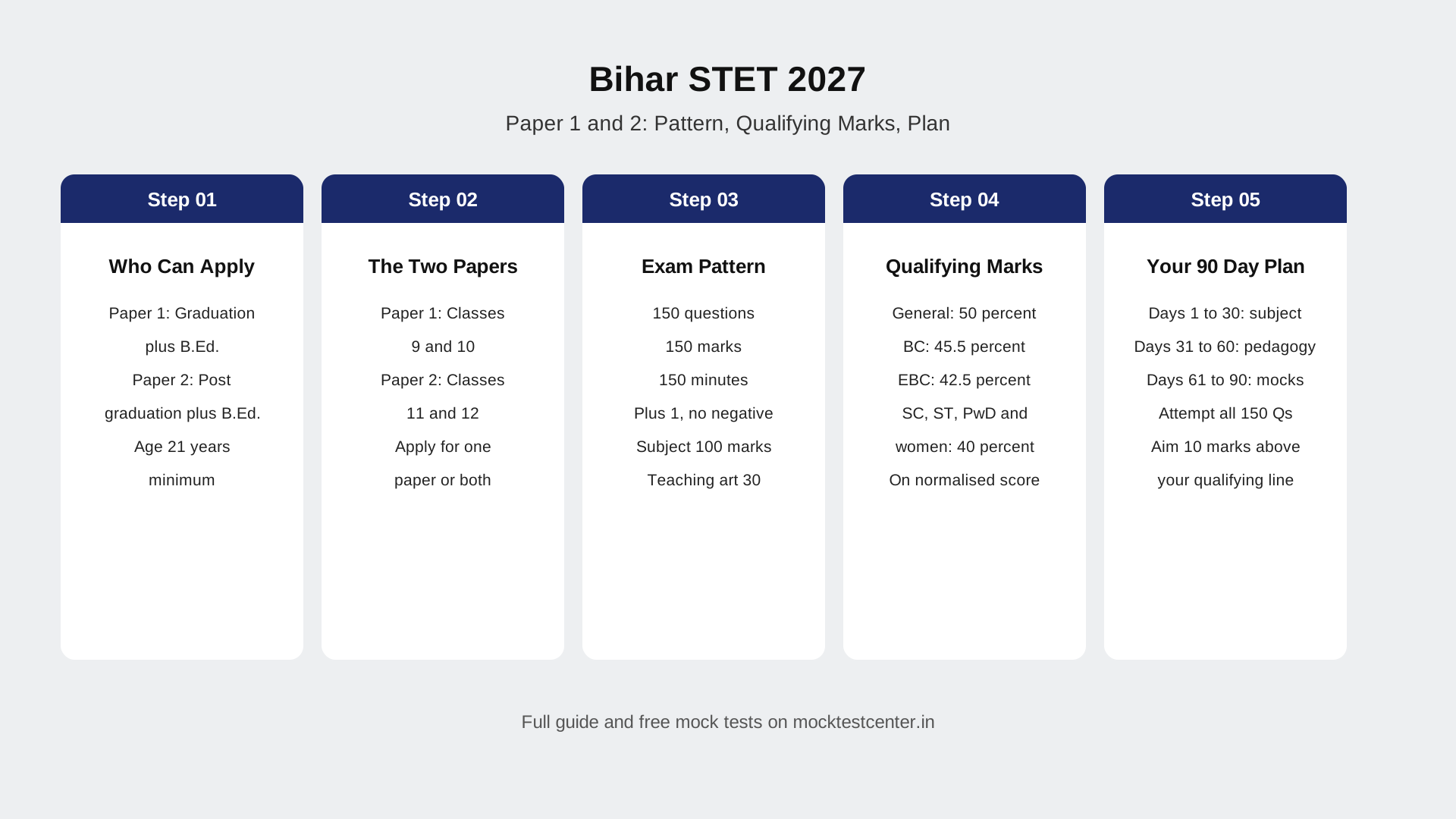
The Bihar STET 2027 exam is the test that decides who can teach in Bihar government schools. STET stands for Secondary Teacher Eligibility Test, and the Bihar School Examination Board runs it. Paper 1 covers Classes 9 and 10, and Paper 2 covers Classes 11 and 12. Pass it and you hold an eligibility certificate that lasts for life. Fail it and the teacher recruitment door stays shut, because the BPSC teacher recruitment rounds ask for a STET pass before they look at anything else.
This guide is built on the 2026 cycle, Advertisement P.R. 183/2026, issued on 14 August 2026. That cycle is the live one. Its computer based test ran from 25 October to 20 November 2026, and its last papers were still being held as this page was written on 21 November 2026. No 2027 notification has been issued yet. When it comes, the pattern below is the best guide to what it will look like, because the board has kept the same structure across recent cycles. Every date and number here comes from the 2026 notification and the board notices that followed it, and every place where sources disagree is marked plainly.
The single most misunderstood fact about STET comes first. STET is an eligibility test, not a recruitment. It gives you no post, no posting and no salary. It gives you a certificate that lets you apply when the BPSC advertises teacher posts under its TRE rounds. Candidates who treat STET as the finish line stop too early. Candidates who treat it as the entry ticket plan the next step while they prepare for this one.
The 2027 cycle at a glance
| Detail | What it is |
|---|---|
| Exam | Bihar Secondary Teacher Eligibility Test, Advertisement P.R. 183/2026 |
| Conducting body | Bihar School Examination Board (BSEB), Patna |
| Papers | Paper 1 for Classes 9 and 10, Paper 2 for Classes 11 and 12 |
| Mode | Computer based test, objective questions |
| Questions and marks | 150 questions, 150 marks, 150 minutes per paper |
| Marking | Plus 1 per correct answer, no negative marking |
| Qualifying marks | 50 percent for general, 45.5 percent for BC, 42.5 percent for EBC, 40 percent for SC, ST, PwD and women |
| Certificate validity | Lifetime, in the 2026 cycle |
| Fee, one paper | Rs 960 for general, BC, EBC and EWS; Rs 760 for SC, ST and PwD |
| Fee, both papers | Rs 1,440 for general, BC, EBC and EWS; Rs 1,140 for SC, ST and PwD |
| Official websites | bsebstet.org and biharboardonline.bihar.gov.in |
What changed in the 2026 cycle
Two changes in the 2026 cycle matter more than any other detail. The first is the certificate. Earlier STET certificates were valid for seven years from the date of issue. The 2026 notification gives the certificate lifetime validity. A candidate who qualifies now holds the certificate for life, and that changes the value of the exam completely. Older tracker pages still print seven years, because they were written before the change. This guide follows the 2026 notification, and the package notes flag the old figure so it is not copied by mistake.
The second change is the exam window itself. The board scheduled the computer based test from 25 October to 20 November 2026, across many days and many centres. One paper clashed with the KVS and NVS exams on 4 November, and the board moved that paper to 21 November 2026 and issued revised admit cards. Candidates who downloaded the admit card once and never checked again risked walking into the wrong date. The lesson is plain. Download the admit card, read the date on it, and check the portal again a few days before the exam.
Applications tell the same story of movement. The notification came on 14 August 2026. Applications opened on 17 August 2026 in the afternoon, with the first last date set at 31 August 2026. The board extended the window twice, and the final last date for form submission and fee payment became 22 September 2026. The admit card came out on 18 October 2026. If you prepare for the next cycle, expect the same pattern. The board extends dates, and the candidates who apply early never have to care.
Paper 1 and Paper 2: which one is yours
Paper 1 is for teaching Classes 9 and 10 at the secondary level. Paper 2 is for teaching Classes 11 and 12 at the higher secondary level. The two papers run on the same pattern, with the same marks and the same time, but the subject syllabus differs and the eligibility differs. A candidate who meets the rules for both papers can apply for both, and pays the two paper fee.
Paper 1 suits a graduate with a B.Ed. who wants to teach a subject at the secondary level. The subjects are Hindi, Urdu, Bangla, Maithili, Sanskrit, Arabic, Persian, Bhojpuri, English, Mathematics, Science and Social Science, with Physical Education, Music, Fine Arts and Dance as separate streams. Paper 1 carries 16 subject codes, numbered 101 to 116.
Paper 2 suits a postgraduate with a B.Ed. who wants to teach at the higher secondary level. The subject list is longer, and it runs from languages such as Hindi, Urdu, English, Sanskrit, Bangla, Maithili, Magahi, Arabic, Persian, Bhojpuri, Pali and Prakrit to Mathematics, Physics, Chemistry, Zoology, Botany, History, Geography, Political Science, Sociology, Economics, Philosophy, Psychology, Home Science and Commerce, with Computer Science and Agriculture among the newer additions. Paper 2 subject codes include Commerce at 225, Computer Science at 226 and Agriculture at 227.
Pick the paper that matches your degree, not the paper that looks easier. Paper 2 needs a postgraduate degree in the subject, and a graduation degree does not qualify you for it. Paper 1 needs a graduation degree in the subject with a B.Ed. A candidate who applies for the wrong paper loses the fee and the attempt, and the board does not shift candidates between papers after the form closes.
Who can apply
Eligibility differs by paper, and the degree percentage matters. For Paper 1, you need a graduation degree in the relevant subject with at least 50 percent marks from a recognised university, plus a B.Ed. degree from an NCTE recognised institution. Relaxed routes exist under NCTE norms, including 45 percent with a B.Ed. under the 2002 and 2007 regulations, and a four year integrated B.A. B.Ed. or B.Sc. B.Ed. degree. For Paper 2, you need a postgraduate degree in the relevant subject with at least 50 percent marks, plus a B.Ed. The relaxed routes for Paper 2 include a postgraduate degree with 45 percent and a B.Ed. under NCTE norms, and a postgraduate degree with 55 percent and a three year integrated B.Ed. M.Ed.
The minimum age is 21 years as on 1 August 2026. The maximum age is 37 years for a general male candidate, 40 years for a general female candidate and for BC and EBC candidates, and 42 years for SC and ST candidates. Age relaxation follows Bihar government rules, and the cut off date is 1 August 2026. A candidate who turns 21 on 2 August 2026 does not meet the minimum age for this cycle, and a candidate who turned 38 in July 2026 does not meet the maximum age for the general male category.
| Category | Maximum age as on 1 August 2026 |
|---|---|
| General, male | 37 years |
| General, female | 40 years |
| BC and EBC | 40 years |
| SC and ST | 42 years |
Subject choice needs care. The subject you pick must match your degree subject, and the notification lists the accepted degree combinations for each subject code. A mathematics graduate cannot pick physics, and a history graduate cannot pick geography. Read the subject wise eligibility table in the notification before you pay the fee. The fee is not refunded when the subject does not match the degree.
Application fee and how to pay
The fee for one paper is Rs 960 for general, BC, EBC and EWS candidates, and Rs 760 for SC, ST and PwD candidates. The fee for both papers is Rs 1,440 for general, BC, EBC and EWS candidates, and Rs 1,140 for SC, ST and PwD candidates. Payment is online through the STET registration portal, stetregistration.cbrt.co.in, and the helpline for portal problems is the number the board published in the notification.
Apply on the portal only. The board has said plainly that no offline or physical applications are accepted. A form sent by post does not exist in this process. Keep the registration number, the payment receipt and a printout of the submitted form. If the portal shows a payment failure, check your bank statement before paying again, because a second payment on a successful first payment is a loss you will not get back quickly.
Important dates
| Event | Date |
|---|---|
| Notification issued | 14 August 2026 |
| Online applications opened | 17 August 2026, afternoon |
| Last date to apply, after extensions | 22 September 2026 |
| Admit card released | 18 October 2026 |
| Computer based test | 25 October to 20 November 2026 |
| Rescheduled paper, moved from 4 November | 21 November 2026 |
The result date for the 2026 cycle was not announced in the notification, and this guide does not invent one. The board releases the result on bsebstet.org and biharboardonline.bihar.gov.in, and the certificate follows for candidates who qualify. Check the board websites for the result notice. Tracker websites that print a result date without a board notice are guessing.
Bihar STET exam pattern: what the paper looks like
Each paper has 150 objective questions and 150 marks, and the time allowed is 150 minutes. Each correct answer gives 1 mark. There is no negative marking. That last fact shapes the whole attempt strategy, and it is the opposite of exams like the BSSC Inter Level paper, where a wrong answer costs a mark. In STET, an unanswered question and a wrong answer both give zero, so there is no reason to leave a question blank. Attempt all 150 questions.
| Section | Questions | Marks |
|---|---|---|
| Chosen subject | 100 | 100 |
| Art of teaching, pedagogy | 30 | 30 |
| Other skills: general knowledge, environmental science, mathematical aptitude, logical reasoning | 20 | 20 |
| Total | 150 | 150 |
The split inside the 50 non subject marks is worth knowing. Art of teaching carries 30 questions. The other skills carry 20 questions, split as 5 each across general knowledge, environmental science, mathematical aptitude and logical reasoning. That means one third of the paper has nothing to do with your subject. A candidate who knows the subject well and ignores the other 50 marks is fighting with one hand tied.
Scores are normalised. The test runs in many sessions across many days, and the board adjusts raw scores through a normalisation formula before applying the qualifying marks. Your qualifying percentage is judged on the normalised score, not the raw score. That is why two candidates with the same raw marks can land on different sides of the line. The practical point is simple. Do not aim for the exact cut off. Aim 10 marks above it, because normalisation can move your score either way.
Qualifying marks: the line you must cross
STET has no merit list and no ranking. You either qualify or you do not, and the line depends on your category. The qualifying percentages in the 2026 notification are 50 percent for general candidates, 45.5 percent for BC, 42.5 percent for EBC, and 40 percent for SC, ST, PwD and women candidates of all categories.
| Category | Qualifying percentage | Marks out of 150 |
|---|---|---|
| General | 50 percent | 75 |
| BC | 45.5 percent | 68.25 |
| EBC | 42.5 percent | 63.75 |
| SC and ST | 40 percent | 60 |
| PwD | 40 percent | 60 |
| Women, all categories | 40 percent | 60 |
Read that table with care. A woman candidate in the general category qualifies at 40 percent, not 50 percent. A BC woman candidate qualifies at 40 percent, not 45.5 percent. The women relaxation applies across categories, and it is the single most overlooked fact in STET preparation. Candidates who aim for 75 marks when they need 60 waste effort that could have gone to the subject section.
The pass line also explains why the 50 non subject marks matter so much. A general candidate needs 75 marks. The subject section gives 100 marks. A candidate who scores 60 in the subject section needs only 15 from the other 50 marks to qualify. A candidate who scores 45 in the subject section needs 30 from the other 50, which is a much harder ask. The subject section decides the result, and the other sections decide it at the margin. Both need work, but the subject comes first.
What to study: the subject section
The subject section carries 100 questions, and the syllabus follows the graduation syllabus of Bihar universities for Paper 1 and the graduation honours syllabus for Paper 2. That sentence is the whole subject strategy. Your university books are the syllabus. A Paper 1 mathematics candidate revises graduation level mathematics. A Paper 2 physics candidate revises honours level physics. Coaching notes help, but they cannot replace the standard books of the subject.
Start with the previous years. STET has run for many years, and the subject questions repeat their themes even when the questions change. Collect the last five years of subject papers for your subject, solve them, and list the topics that appear again and again. Those topics get the first month. The topics that appear once get the second month. A topic that has never appeared gets attention only after the repeated topics are solid.
Depth beats breadth in this section. A candidate who knows 70 percent of the syllabus well scores more than a candidate who has skimmed all of it once. The questions test understanding, not memory of the textbook headings. For a language subject, that means grammar, literature, authors and the history of the language. For a science subject, that means concepts, formulas and the standard numerical problems. For a social science subject, that means the standard theories, the thinkers and the Bihar and India facts that sit inside the subject.
What to study: art of teaching and the other 20 marks
Art of teaching carries 30 questions, and it is the section most subject experts neglect. It covers teaching and learning, its meaning, process and characteristics, teaching objectives and instructional objectives, Bloom taxonomy, teaching methods with their types, merits and demerits, lesson planning, classroom management, student psychology, evaluation and assessment, and the qualities of a good teacher. These topics come from B.Ed. books, and a candidate who has done a B.Ed. has seen them all. The work is revision, not fresh learning.
Read one standard pedagogy book for B.Ed. and make short notes. Bloom taxonomy appears almost every year, in one form or another. Teaching methods appear every year. Lesson planning appears every year. If you know these three topics cold, you have a strong base for the 30 marks. Add evaluation types, learning theories and the names of the thinkers behind them, and the section starts to look friendly.
The other 20 marks split across four small parts, with 5 questions each. General knowledge covers current events, awards, sports, important days and Bihar facts. Environmental science covers pollution, climate, biodiversity and the standard environmental facts. Mathematical aptitude covers percentages, averages, ratio, simple interest and data reading at a basic level. Logical reasoning covers series, coding, odd one out, direction and ranking. Five questions each is small, but 20 marks is the difference between qualifying and missing the line for many candidates. Give this part 30 minutes a day, and do not leave it to the last week.
How STET leads to a teaching post
Qualifying STET opens the door to the BPSC teacher recruitment rounds, known as TRE. The BPSC advertises teacher posts, and a STET pass is the eligibility condition for secondary and higher secondary teacher posts. The TRE rounds have their own written exam, and the TRE pattern is different from STET. STET tests subject knowledge and teaching aptitude. TRE tests the subject again, with general studies and language, and it builds a merit list.
The current TRE round shows the scale of what follows STET. The BPSC TRE 4.0 advertisement, numbered 15/2026, carries 33,320 teacher posts, and the written exam is expected around December 2026 to January 2027. That round is a separate exam with its own pattern of 150 questions and 150 marks, and its own admit card and result. A STET certificate from the 2026 cycle is the entry ticket for it. The message for a STET candidate is plain. Qualify now, while the certificate lasts for life, and the next teacher recruitment is already waiting.
Plan the two exams as one road. Prepare for STET first, because the certificate is the entry ticket, and keep the TRE syllabus in view while you prepare. The subject study you do for STET carries straight into TRE. The general studies and language work you do for TRE will not hurt your STET score either, because the STET general knowledge and reasoning parts reward the same reading. A candidate who plans both exams together saves a year. A candidate who finishes STET and then starts TRE from zero loses it.
One caution belongs here. Some tracker pages mix STET with the TRE teacher posts and print a vacancy number for STET itself. STET has no vacancies. It is an eligibility test, and the number of posts belongs to the TRE advertisement, not to STET. A page that says STET 2026 has 37,337 posts is confusing the two exams. Do not plan around a post count that does not exist.
The computer based test: what the day looks like
STET runs as a computer based test at centres across Bihar, with Patna, Gaya, Muzaffarpur, Darbhanga, Bhagalpur, Purnea, Chapra and Ara among the cities named in the 2026 admit card reports. Your admit card names your centre, your shift and your reporting time. Reach the centre early. Biometric checks and frisking take time, and a candidate who arrives at the last minute starts the paper with a racing heart.
Inside the hall, you get a computer, a rough sheet and a pen. The screen shows one question at a time, with the option to mark a question for review and return to it later. Use that feature. A subject question that needs a formula you cannot recall at once is a question to mark and revisit, not a question to sit on for five minutes. The timer on the screen counts down from 150 minutes, and it does not pause.
Because there is no negative marking, the end of the paper has its own routine. When 15 minutes remain, stop solving fresh questions and go back through the marked ones. When 10 minutes remain, answer every question that is still blank, even if you must guess. A blank question is a certain zero. A guess has a one in four chance. Over 10 unanswered questions, guessing should add two or three marks on average, and two or three marks have decided many STET results.
Carry the admit card and the photo identity card the admit card names. Carry nothing else into the hall. Phones, watches, calculators and notes stay outside, and the centres provide no storage guarantee. Keep your admit card safe after the exam too, because the result and the certificate process both refer to the details on it.
A 90 day plan that fits a working day
Ninety days is enough if the days are used well. The plan below assumes three hours a day, which is what most working candidates and B.Ed. students can manage. If you have six hours, double the question practice, not the reading.
Days 1 to 30 build the subject base. Revise the graduation books of your subject, one unit at a time, and solve the previous year questions for each unit as you finish it. Read the pedagogy book for 30 minutes a day. Start the general knowledge notebook with Bihar facts and the last 6 months of current events.
Days 31 to 60 add the other sections. Take one timed section test a week for the subject part, 100 questions in 100 minutes. Finish the pedagogy revision and start solving 30 pedagogy questions a day. Practise the 20 mark part with 5 questions a day from each of the four small areas. Take one full mock test each week, 150 questions in 150 minutes, and analyse it the same day.
Days 61 to 90 switch to exam mode. Take two full mock tests a week. Revise the mistake notebook every Sunday. Stop learning new topics in the last 10 days and revise only. In the last week, practise the paper in the exact time slot of your admit card, with the same rough paper habit you will use on the day. A plan that is rehearsed feels familiar on the day, and familiarity keeps nerves down.
Mock test analysis matters more than mock test count. After each mock, list the questions you got wrong and find the fact or rule behind each one. List the questions you guessed and check how many of those guesses were right. With no negative marking, guessing is free, but a guess you could have turned into knowledge is a wasted mark. The analysis is where the marks come from.
Mistakes that cost candidates the certificate
The first mistake is preparing only the subject and ignoring the 50 other marks. A candidate who scores 70 in the subject and 5 in the rest misses the general line of 75 by nothing at all. The other 50 marks are the cheapest marks in the paper, because pedagogy and reasoning repeat their themes every year.
The second mistake is choosing the wrong paper or the wrong subject code. A graduation degree does not qualify you for Paper 2, and a degree in one subject does not qualify you for another subject code. The form gives no warning. The rejection comes later, after the fee is paid and the exam is taken.
The third mistake is aiming for the exact cut off. Normalisation moves scores, and a candidate who aims for exactly 75 marks can land at 74 after normalisation. Aim 10 marks above your line. That margin is the cheapest insurance in this exam.
The fourth mistake is leaving questions blank. There is no negative marking in STET. A blank question gives zero, and a guess gives you a one in four chance of a mark. Attempt all 150 questions, and use the last 10 minutes to answer the ones you skipped.
The fifth mistake is trusting tracker pages for the result date and the certificate validity. The result comes from the board websites. The certificate validity in the 2026 cycle is lifetime, and older pages that print seven years are out of date. Check the board notice, not the tracker.
Documents to keep ready
Keep these ready before the form opens, not after it closes. Graduation and postgraduate mark sheets and degree certificates. B.Ed. degree and mark sheet from an NCTE recognised institution. Class 10 certificate for age proof. A photo identity card. A recent passport photo and a scanned signature in the size the portal asks for. A caste certificate in the Bihar format if you claim reservation. A domicile certificate where the notification asks for one. A disability certificate if applicable. Check the spellings of your name and your father name on every document, and get mismatches corrected early.
Keep a folder on your phone with clear scans of each document, and keep the originals in a file at home. When the board asks for a document, a candidate who can produce it in an hour stays calm, and a candidate who has to search for it loses a day.
Sources
Bihar School Examination Board, STET notification P.R. 183/2026, 14 August 2026, on bsebstet.org and biharboardonline.bihar.gov.in, as reported by Adda247, CareerPower, FreeJobAlert and Jobslab. Times of India, Bihar STET 2026 notification released, 14 August 2026, exam pattern and qualifying marks. Times of India, Bihar STET 2026 application process to start on August 17, exam pattern and qualifying marks. CareerPower, Bihar STET Exam Date 2026 Out, CBT from 25 October to 21 November 2026 and the 4 November paper moved to 21 November. Prepp, Bihar STET Exam Pattern 2026, subject 100 marks and teaching aptitude 50 marks. Testbook, Bihar STET Syllabus and Exam Pattern 2026, Paper 1 and Paper 2 syllabus. Jobslab, Bihar STET 2026 Notification, fee, age limits, normalisation and lifetime validity. Crown Publications, Bihar STET Overview, papers, pattern, dates and process. Uttarakhand Jobs, Bihar STET 2026 admit card, CBT began 25 October 2026.