
About Bihar Forest Guard 2027 Exam Series
📖 Table of Contents
- Bihar Forest Guard 2027 at a glance
- Three vacancy numbers, and only one of them is live
- Who can apply
- The written test, and a pattern change to watch
- Physical standards and the walking test
- Pay and posting and what a Forest Guard actually does
- The syllabus, subject by subject
- A 16 week plan that fits the real exam
- Mistakes that cost selection
- What happens after the written test
- Sources
Bihar Forest Guard 2027: Complete Exam Guide
The Bihar Forest Guard 2027 page sits on a live cycle that already ran, and that fact shapes everything below. The Central Selection Board of Constable, CSBC, advertised Forest Guard posts inside a combined constable drive under Advertisement No. 03/2025, dated 26 September 2025. Forest Guard took the largest share of that drive, with 2,417 of the 4,128 posts. Applications ran online from 6 October to 5 November 2025. The written exam date had not been announced as of 21 November 2026, and no separate 2027 Forest Guard notice had appeared by that date.
That timing matters for anyone planning now. The 2027 page uses the 03/2025 cycle as its anchor, because that cycle holds the latest verified vacancy split, the latest age limits, the latest fee and the latest physical standards. A fresh notification will most likely follow the same scheme, and every figure in this guide comes from the 03/2025 advertisement as reported across tracker pages that cite it, or from the previous Forest Guard cycle, Advertisement No. 03/2020, where the text says so plainly.
The post needs only a Class 12 pass. The pay sits in Level 3, from Rs 21,700 to Rs 69,100 a month. The work happens outdoors, on foot in forests and at check posts, and the physical test reflects that with a long walk rather than a sprint. A candidate who trains only for a written paper and ignores the walk will clear the paper and fail the field test, which is the most common way this exam ends a candidacy.
One warning belongs at the top. Tracker pages mix up three different Forest Guard numbers, and they also paste the Bihar Police Constable running test into Forest Guard pages. This guide separates the three numbers and keeps the Forest Guard walking test where it belongs, because a candidate who trains for a 1 kilometre run instead of a 25 kilometre walk prepares for the wrong exam.
Bihar Forest Guard 2027 at a glance
| Detail | Bihar Forest Guard, live cycle Advt. No. 03/2025 |
|---|---|
| Conducting body | Central Selection Board of Constable (CSBC), Bihar |
| Department | Environment Forest and Climate Change Department, Government of Bihar |
| Post | Forest Guard (Vanrakshak) |
| Advertisement | No. 03/2025, dated 26 September 2025 |
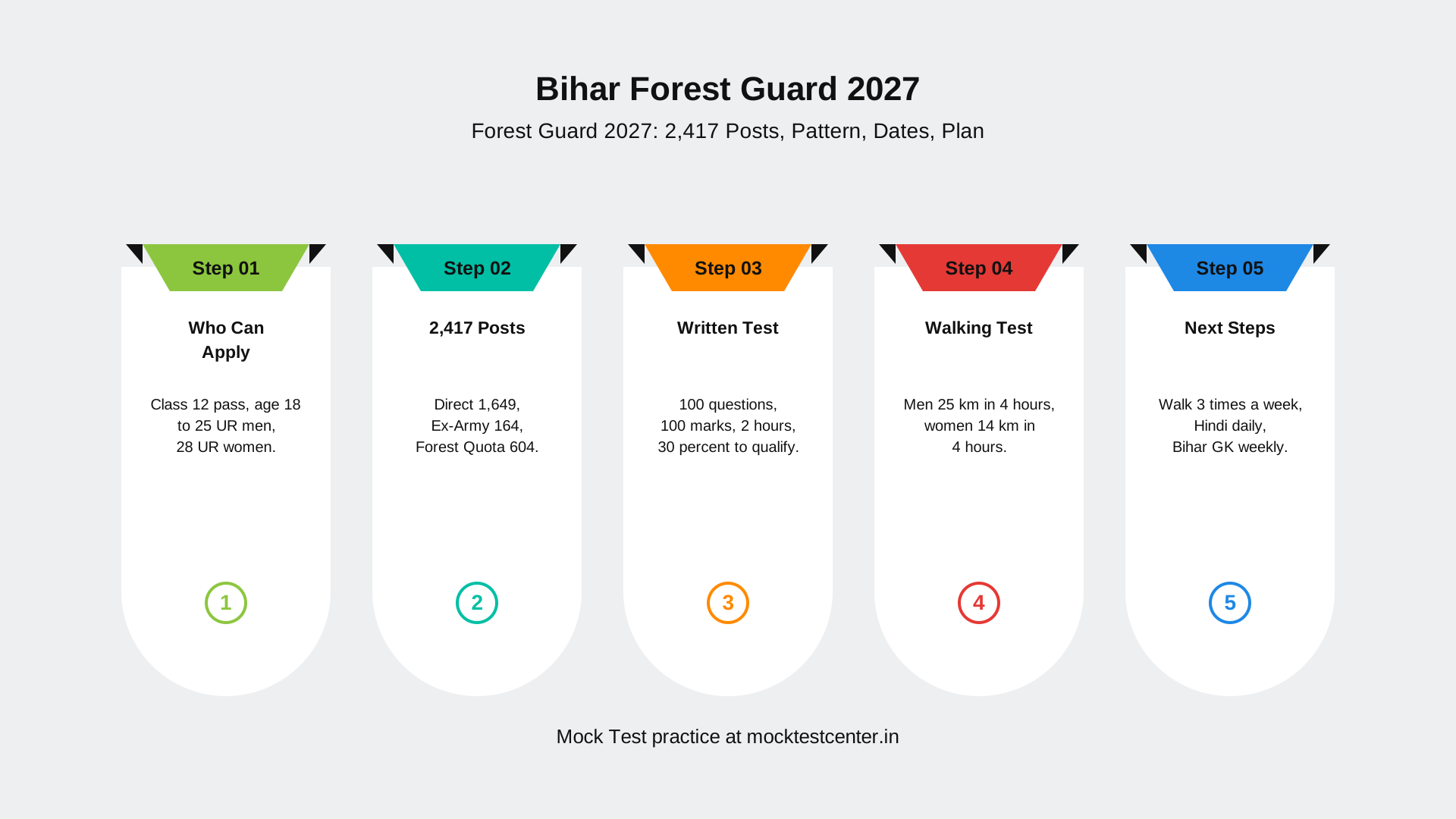
| Forest Guard posts | 2,417 (Direct 1,649, Ex-Army 164, Forest Quota 604) |
| Whole drive | 4,128 posts, including Mineral Development Constable 1,603 and Driver Constable 108 |
| Application window | 6 October to 5 November 2025, online |
| Education | Intermediate, Class 12 pass, from a recognised board |
| Age as on 1 August 2025 | UR male 18 to 25 years; UR female 18 to 28 years; EBC and BC male up to 27; SC and ST up to 30 |
| Fee | Rs 100 for all categories, online |
| Pay | Level 3, Rs 21,700 to Rs 69,100 |
| Written exam | 100 questions, 100 marks, 2 hours, 30 percent to qualify, as reported for Advt. No. 03/2025 |
| Physical test | PST plus walking test, men 25 km in 4 hours, women 14 km in 4 hours |
| Written exam date | Not announced as of 21 November 2026 |
| 2027 notice | Not out as of 21 November 2026 |
| Official website | csbc.bihar.gov.in |
Three vacancy numbers, and only one of them is live
Search results for Bihar Forest Guard throw up three numbers, and each one belongs to a different story. The live number is 2,417. That is the Forest Guard share of Advertisement No. 03/2025, split into Direct recruitment with 1,649 posts, Ex-Army with 164 posts, and Forest Quota with 604 posts. Women hold 781 of the Direct posts under the horizontal reservation for women. The whole 03/2025 drive carries 4,128 posts, and Forest Guard is the largest post in it, ahead of Mineral Development Constable at 1,603 and Driver Constable at 108.
The second number is 1,816. That figure comes from a ministerial announcement about a direct recruitment drive in the Forest Department covering 2,856 posts across several posts, from Assistant Conservator of Forests to Driver. Forest Guard accounts for 1,816 posts in that announced list. No detailed notification for that drive had been released as of 21 November 2026, and no application dates existed for it. Tracker pages that print application dates and exam dates for the 1,816 drive are guessing. The dates change from page to page, which is the clearest sign that no official source sits behind them.
The third number is 484. That was the Forest Guard vacancy in Advertisement No. 03/2020, the previous cycle. Its written exam ran on 16 December 2020, and its physical test ran in January 2022 after a postponement. The 484 figure still appears on old pages that rank well, and a candidate who reads only the first result can easily prepare for a cycle that closed years ago.
The three numbers also explain why the age limits on tracker pages disagree. The 03/2020 cycle capped unreserved candidates at 23 years. The 03/2025 cycle caps unreserved men at 25 years and unreserved women at 28 years, with EBC and BC men up to 27 and SC and ST candidates up to 30, all as on 1 August 2025. Ex-Army candidates for the Forest Guard Ex-Army quota can go up to 45 years. The 18 to 23 figure that still circulates belongs to 2020. This guide uses the 03/2025 limits, because they govern the live cycle.
The fee shows the same pattern. The 03/2025 fee was Rs 100 for all categories, paid online. Older pages quote Rs 450 for general candidates and Rs 112 for SC and ST candidates, which was the 2020 fee structure. A candidate who budgets from an old page will overpay in planning and underpay nowhere, since the fee is fixed by the notification in force.
Who can apply
The education bar is a pass in the Intermediate examination, Class 12, or its equivalent, from a recognised board. No minimum percentage applies, and no particular stream is required for the Direct quota. A candidate from any stream can apply, and graduates can apply too, since the notification sets a minimum qualification rather than an exact one.
The Forest Quota carries its own condition. Candidates under that quota must have training from the Central Training Institute at Valmiki Nagar. That quota exists for people who already work in the forest system in a trained capacity, and it accounts for 604 of the 2,417 posts. A Direct quota candidate needs no forest training at all.
The Ex-Army quota, with 164 posts, is for ex-servicemen. Its age ceiling runs to 45 years, which is far above the Direct quota ceiling, and its vacancy split sits apart from the Direct split in the notification. A candidate who qualifies under more than one quota should read the notification for that quota before choosing, because the quotas carry different conditions and different competition.
Age counts as on 1 August 2025 in the live cycle. Unreserved men must be 18 to 25 years old. Unreserved women must be 18 to 28 years old. EBC and BC men can go up to 27, and EBC and BC women up to 28. SC and ST candidates of either sex can be up to 30 years old. Government employees get relaxation under Bihar government rules, and the notification carries the full relaxation table. A candidate should check age against the matriculation certificate, because CSBC verifies date of birth from that document.
| Category | Minimum age | Maximum age as on 1 August 2025 |
|---|---|---|
| UR male | 18 years | 25 years |
| UR female | 18 years | 28 years |
| EBC and BC male | 18 years | 27 years |
| EBC and BC female | 18 years | 28 years |
| SC and ST, men and women | 18 years | 30 years |
| Ex-Army, Forest Guard quota | 18 years | 45 years |
Indian citizenship is required, and the application runs online only through csbc.bihar.gov.in. The 03/2025 form asked candidates to prioritise up to three posts in the combined drive, which means a candidate could list Forest Guard alongside Mineral Development Constable and Driver Constable in order of preference. A candidate should decide that order before opening the form, because the portal does not allow changes after submission, and duplicate applications from one mobile number lead to cancellation.
Documents deserve attention early. The form needs a photograph and a signature in the sizes the portal specifies, and the fee payment needs a receipt kept until the end of the process. Candidates who wait until the last day to apply meet the same server load every cycle, and the 03/2025 window closed on 5 November 2025 with no extension reported.
The written test, and a pattern change to watch
The written test is the first stage, and it is qualifying. The Bihar Forest Guard exam pattern as reported for Advertisement No. 03/2025 describes a single OMR paper with 100 questions for 100 marks in 2 hours, at Class 10 level, with 30 percent needed to qualify. The paper runs in Hindi and English, and those reports say there is no negative marking, so a candidate should attempt every question. Five times the vacancies are called for the physical test in each category, based on the written result.
| Subject as reported for Advt. No. 03/2025 | Questions | Marks | Level |
|---|---|---|---|
| Hindi | 20 | 20 | Class 10 |
| English | 10 | 10 | Class 10 |
| Mathematics | 15 | 15 | Class 10 |
| Social Science (History, Geography, Civics, Economics) | 25 | 25 | Class 10 |
| Science (Physics, Chemistry, Biology) | 20 | 20 | Class 10 |
| General Knowledge and Current Affairs | 10 | 10 | Class 10 |
| Total | 100 | 100 | 2 hours |
That pattern needs a plain flag. The 03/2025 advertisement covers three posts in one drive, and the 100 question paper described above is the common constable pattern that tracker pages report for the whole drive. The previous Forest Guard cycle used a different paper. Advertisement No. 03/2020 set a 100 question paper for 400 marks in 2 hours, with 4 marks for a right answer and a deduction of one third of a mark for a wrong answer, and 40 percent needed to qualify. Its four parts were General Studies with 30 questions for 120 marks, General Aptitude with 25 questions for 100 marks, General Knowledge with 25 questions for 100 marks, and Hindi with 20 questions for 80 marks. General Science and Maths in that paper were set at Class 10 level, and the rest of the paper was set at Class 12 level.
The two patterns cannot both govern the same post, so a candidate should treat the 100 mark version as the reported pattern for the live cycle and the 400 mark version as the last verified Forest Guard specific pattern. The official CSBC notification PDF for 03/2025 settles the question, and this guide could not verify the Bihar Forest Guard exam pattern from that PDF directly. The upload pre-check should read the pattern from the official PDF before publishing any change to this section. What is certain is that the written test is qualifying in both versions, and the physical test decides who moves forward, so the written paper is a gate rather than the final ranking.
Social Science carries the most marks in the reported 03/2025 pattern, at 25 of 100, and it is the section where Bihar knowledge pays. Bihar history, from the Champaran movement to the freedom struggle in the state, Bihar geography, with its rivers and minerals, Panchayati Raj and the Constitution and Bihar government schemes all sit in this section. Science carries 20 marks, and its base is NCERT Classes 6 to 10, with Physics on motion and energy, Chemistry on elements and reactions, and Biology on the human body and the environment. Hindi carries 20 marks, with grammar and comprehension and vocabulary, and it rewards daily reading far more than last week cramming. Mathematics carries 15 marks, mostly arithmetic: percentage and profit and loss and ratio work form the core. English carries 10 marks of basic grammar and comprehension. General Knowledge and Current Affairs carry 10 marks, and Bihar schemes and festivals sit alongside national current affairs in that section.
Normalisation applies when the exam runs in more than one shift, which a drive of this size almost certainly will. A candidate should ignore shift gossip and focus on the raw score, because the board publishes the normalisation method with the result. The qualifying mark of 30 percent is a floor, and the real cut off for a physical test call runs higher, since only five times the vacancies go forward in each category. For 2,417 Forest Guard posts, that means roughly 12,085 candidates reach the physical stage across categories, which is a wide funnel, and a candidate near the floor should expect to miss it.
Physical standards and the walking test
The physical stage has two parts, and both must be cleared. The Physical Standards Test measures height and chest, and the Physical Efficiency Test for Forest Guard is a walking test. No running test, no shot put and no high jump belong to the Forest Guard physical test, even though tracker pages copy those events from Bihar Police Constable pages into Forest Guard pages. The Forest Guard Rules 2014 set the walking test, and the 03/2020 notification printed it plainly.
| Standard | Male (UR, BC, EBC) | Male (SC, ST) | Female, all categories |
|---|---|---|---|
| Height | 165 cm | 160 cm | 155 cm |
| Chest, unexpanded | 81 cm | 79 cm | Not applicable |
| Chest, expanded | 86 cm | 84 cm | Not applicable |
| Weight | Not specified | Not specified | 48 kg as reported for Advt. No. 03/2025 |
| Walking test | 25 km in 4 hours | 25 km in 4 hours | 14 km in 4 hours |
Two figures in that table need flags. The female height of 155 cm comes from tracker reports of Advertisement No. 03/2025, while the 03/2020 table printed 160 cm for women in the general and OBC categories. This guide uses 155 cm as the live figure and flags the 160 cm figure as the older one, and the upload pre-check should confirm the female height from the official 03/2025 PDF. The female weight of 48 kg appears only in tracker reports of the 03/2025 cycle, and no 2020 source in this research printed a weight figure, so it is marked as reported rather than verified.
The walking test is the heart of this exam. Men must cover 25 kilometres in 4 hours, and women must cover 14 kilometres in 4 hours. That pace is about 6.25 kilometres an hour for men and 3.5 kilometres an hour for women, which sounds gentle on paper and feels very different on a forest track in the heat with a fourth hour ahead. The test is qualifying, and it is also the truest preview of the job, because a Forest Guard patrols on foot, and a guard who cannot walk the distance cannot do the work.
Training for the walk needs months, not days. A candidate should start with 5 kilometre walks three times a week, add distance by about 10 percent a week, and build to a full 25 kilometre practice walk at least three times before the test, in the same shoes that will be worn on the day. Blisters end more walking tests than fitness does, so shoes must be broken in over weeks, socks must be tested on long walks, and water discipline must be practised, with small sips at regular intervals rather than large drinks at long gaps. A candidate who starts walking only after the written result has about four to six weeks, which is enough to maintain fitness but rarely enough to build it from zero.
The constable PET that tracker pages paste into Forest Guard articles is a different test for a different post. It scores a 1 kilometre run plus shot put plus high jump out of 100 marks, and it belongs to the Bihar Police Constable selection, where the physical test carries marks. Forest Guard selection under the Forest Guard Rules uses the walking test as a qualifying efficiency test. A candidate who trains for shot put and high jump for a Forest Guard post wastes weeks on events that will never be held for this post.
After the physical stage comes document verification, where original certificates are checked against the application, and then a medical examination and character verification. A candidate should keep the matriculation certificate, the Intermediate certificate, the category certificate where applicable, the domicile certificate and the fee receipt in one folder from the day of application, because the board gives short notice for verification and a missing certificate at that stage ends a selection that the exam had already won.
Pay and posting and what a Forest Guard actually does
A Forest Guard in Bihar sits in Pay Level 3, with a scale from Rs 21,700 to Rs 69,100 a month. Tracker reports put the in hand salary at roughly Rs 32,000 to Rs 45,000 a month once dearness allowance and other allowances are added, and that figure should be read as an estimate rather than a payslip, because allowances change with posting and with dearness allowance revisions. The post carries the usual state government benefits, with medical facilities and leave and a pension under the National Pension System.
Promotion runs slowly and steadily. A Forest Guard can rise to Head Forest Guard and then to Forester, and the Forester post itself is a separate recruitment with 236 posts in the 2020 cycle and 188 posts in the announced 2,856 drive. A guard who studies while serving, and who learns the forest law and the survey work of the department, moves faster than a guard who treats the first posting as the end of the story.
The work is field work. A Forest Guard patrols an assigned beat, watches for illegal felling and poaching, reports forest fires and guards nurseries and plantations, assists in wildlife census work, and staffs check posts on forest roads. The posting can be in Valmiki Tiger Reserve in West Champaran, which is the only tiger reserve in Bihar, or in the reserve forests of Kaimur and Rohtas and Jamui, or in the protected areas around Rajgir and Nalanda. The department also runs the Sanjay Gandhi Biological Park in Patna, and guards posted there work with captive wildlife and with visitors rather than with remote beats.
Bihar holds about 7 percent of its area under forest cover, which is far below the national average, and that scarcity shapes the job. Every patch of forest carries pressure from fuelwood collection and from grazing and from encroachment, and the guard is the person who meets that pressure on the ground. The job suits a candidate who likes open air and long walks and early mornings, and it punishes a candidate who wants a desk and a fixed routine. A candidate should picture the walk before picturing the salary, because the walk is the daily reality and the salary is the monthly one.
Women hold a large share of this drive, with 781 of the Direct posts reserved horizontally for women, and the department has women guards on beats across the state. The walking distance for women is shorter, at 14 kilometres against 25 for men, and the height standard differs, but the patrol work after selection is the same. A woman candidate should train for the walk with the same seriousness as a man, because the beat does not shorten after joining.
The syllabus, subject by subject
Hindi deserves the first slot in the study plan, because it carries 20 marks in the reported pattern and because it is the section where steady reading beats last minute effort. Sandhi and Samas and Karak and Vachan form the grammar core, and comprehension passages test reading speed as much as grammar. Synonyms and antonyms and proverbs reward a notebook kept over months. A candidate who reads one Hindi newspaper every day, and who notes ten new words a week with their meanings, will cover this section without a separate book.
Social Science carries 25 marks, and Bihar is its centre of gravity. The Champaran Satyagraha of 1917, the Quit India movement in Bihar, the role of Bihar leaders in the freedom struggle, the rivers of Bihar from the Ganga to the Kosi, the minerals of the state, Panchayati Raj and the Constitution and current Bihar schemes such as Jeevika all appear in this section. NCERT textbooks for Classes 6 to 10 give the base, and a Bihar general knowledge book gives the state detail. A candidate should give this section the largest share of study hours, because it is the largest section and because it is also the section where other candidates score least.
Science carries 20 marks, and its base is also NCERT Classes 6 to 10. Physics covers motion and energy and light. Chemistry covers elements and common reactions and acids and bases. Biology covers the human body and plant life and the environment, and the environment part overlaps with the forest knowledge that helps a guard after selection. A candidate with a science background in Class 12 will find this section familiar, and a candidate from another stream should treat it as a fresh subject with a fixed book rather than as general reading.
Mathematics carries 15 marks of arithmetic, and the work is mostly percentage and profit and loss and ratio and simple equations and mensuration. Speed matters here, because the paper gives 2 hours for 100 questions, which is about 72 seconds a question across the whole paper, and a candidate who spends five minutes on one sum loses four other questions. Daily practice of 50 sums, with a timer, builds the pace that this paper needs.
English carries 10 marks, and the work is basic: tenses and articles and prepositions and a short comprehension passage and common vocabulary. A candidate should not spend weeks on English at the cost of Social Science, because English is the smallest section, and a candidate who scores 7 of 10 in English and 20 of 25 in Social Science beats a candidate who reverses those numbers.
General Knowledge and Current Affairs carry 10 marks, and the habit that covers them is a daily newspaper plus a monthly current affairs note. Bihar festivals and Bihar schemes and national awards and sports results and the Union Budget all sit in this section. A candidate should keep a one page note per week of the five most important news items, and revise those notes in the last fortnight, because current affairs learned in January will have faded by the exam unless it is revised.
A 16 week plan that fits the real exam
Weeks 1 to 4 build the base. Study four hours a day, with one hour each for Hindi and Social Science and Science and Mathematics, and read the newspaper every morning. Start walking 5 kilometres three times a week, and learn the pace that feels easy rather than the pace that feels fast. Finish NCERT Social Science and Science for Classes 6 to 10 in these four weeks, and make short notes as you go, because notes made now are the revision material of week 15.
Weeks 5 to 8 add drills. Keep the four hour study block, and add two topic tests a week, one for Social Science and one for Science or Mathematics in turn. Increase the walk to 8 kilometres, and add one longer walk of 12 kilometres on a weekend. Start a current affairs note, one page a week, and keep a mistake notebook for every question answered wrong in a test, with the correct answer and the reason for the error written beside it.
Weeks 9 to 12 switch to full mocks. Take three full 100 question mocks a week in 2 hours each, under exam conditions, and spend an hour after each mock on analysis. The analysis matters more than the score, because a mock that is scored and forgotten teaches nothing, while a mock whose errors are logged and revised teaches for weeks. Build the walk to 15 kilometres, and do one 20 kilometre walk in week 11 and one full 25 kilometre walk in week 12, in the shoes that will be worn on the test day.
Weeks 13 to 16 are revision and taper. Stop learning new topics in week 13, and revise only from notes and from the mistake notebook. Take two mocks a week, and keep the walking load steady with one long walk a week rather than building further, so that the legs arrive fresh rather than tired. Check the CSBC website every day in these weeks, because the admit card window is short, and a candidate who misses it loses a cycle that took months to prepare for.
Mistakes that cost selection
The first mistake is preparing for the wrong physical test. Candidates who train for a run and for shot put and high jump arrive at a walking test with the wrong muscles and the wrong shoes, and the walk exposes that within the first hour. The second mistake is starting the walk after the written result, when four to six weeks remain. The walk needs twelve weeks of steady building, and it should start in week 1 of preparation.
The third mistake is ignoring Hindi. Hindi carries 20 marks, which is more than Mathematics, and candidates who call it easy and skip it lose marks that no other section can replace. The fourth mistake is chasing the 1,816 figure and waiting for a notification that has no date, while the 2,417 live cycle moves ahead. The fifth mistake is applying with a wrong date of birth or a wrong category, because CSBC verifies from original certificates, and a mismatch at verification ends the selection.
The sixth mistake is reading old pattern pages without checking the advertisement year. The 400 mark paper belonged to 2020, and the 100 mark paper is the reported pattern for 2025, and a candidate who prepares for the wrong Bihar Forest Guard exam pattern will leave questions blank that should have been attempted, while a candidate who assumes no negative marking when the notification says otherwise will guess blindly and lose marks. Read the notification PDF for the cycle you are applying to, and treat every tracker page as a report of that PDF rather than as the PDF itself.
What happens after the written test
The board publishes the written result and calls about five times the vacancies for the physical test in each category. The physical stage runs in two parts, with the standards test first and the walking test after it, and both must be cleared. Candidates who clear the physical stage go to document verification with original certificates, and then to a medical examination and character verification.
One point about merit needs a flag rather than a firm statement. Tracker pages reporting the combined 03/2025 drive describe a scoring physical test for constable posts, with the physical test carrying 100 marks. Forest Guard selection under the Forest Guard Rules has traditionally treated the walking test as a qualifying efficiency test, with the written test as the qualifying gate. This guide could not verify from the official 03/2025 PDF whether the Forest Guard merit list uses the written marks, the physical marks, or a combination, so it states the uncertainty plainly. The upload pre-check should read the merit rule from the official PDF, because it changes how a candidate should split effort between the paper and the walk.
The final merit list follows verification, and the board publishes it on csbc.bihar.gov.in. Candidates should check the site directly rather than trusting a tracker headline, because tracker pages sometimes carry the result of a different post from the same drive. The whole process, from notification to final list, takes well over a year in the 2020 cycle, and candidates should plan for a long wait rather than a quick result.
Watch csbc.bihar.gov.in for the written exam date, because no date had been announced as of 21 November 2026, and watch the same site for the 2027 notification, because no separate 2027 Forest Guard notice had appeared by that date. The 03/2025 cycle is the live one, and the next cycle will most likely follow its shape, with the same education bar and the same walking test and the same department behind it.
Sources
Central Selection Board of Constable, Bihar, Advertisement No. 03/2025, dated 26 September 2025, as reported on csbc.bihar.gov.in. Mytestseries, Bihar Police Constable 2025, 4,128 Vacancies, Eligibility, Syllabus, 5 October 2025, reporting Advertisement No. 03/2025, the Forest Guard split of 2,417 posts, age limits, fee of Rs 100, and the written and physical pattern. CareerPower, Bihar Forest Department Recruitment 2025, reporting the ministerial announcement of 2,856 posts with 1,816 Forest Guard posts and the expected nature of that drive. Adda247, Bihar Van Vibhag Vacancy 2025, reporting the same 2,856 post announcement with the Forest Guard share of 1,816 posts. Jagran Josh, Bihar Police 2020 Forester and Forest Guard Exam Dates, reporting Advertisement No. 03/2020 with 484 Forest Guard posts, the written exam on 16 December 2020, and the physical standards and walking test. Testbook, CSBC Bihar Police Forest Guard Syllabus and Exam Pattern, reporting the 03/2020 paper of 100 questions for 400 marks with 4 marks per question and a deduction of one third of a mark, and the 40 percent qualifying mark. Sarkari Naukri Exams, Bihar Police Forest Guard Recruitment 2020, reporting the same 03/2020 vacancy split and pattern.







