
About BSSC Inter Level 2027 Exam Series
📖 Table of Contents
- The 2027 cycle at a glance
- Why this cycle is different
- Posts under Inter Level
- Who can apply
- Application fee and how to pay
- Important dates
- BSSC Inter Level exam pattern: Prelims
- What to study for Prelims
- General Studies
- General Science and Mathematics
- Mental Ability
- BSSC Inter Level exam pattern: Mains
- The Hindi paper most candidates ignore
- Skill test and document check
- How the merit list works
- A 90 day plan that fits a working day
- Mock tests: how to use them without wasting them
- Mistakes that cost marks every year
- Documents to keep ready
- Sources
BSSC Inter Level 2027: Complete Exam Guide
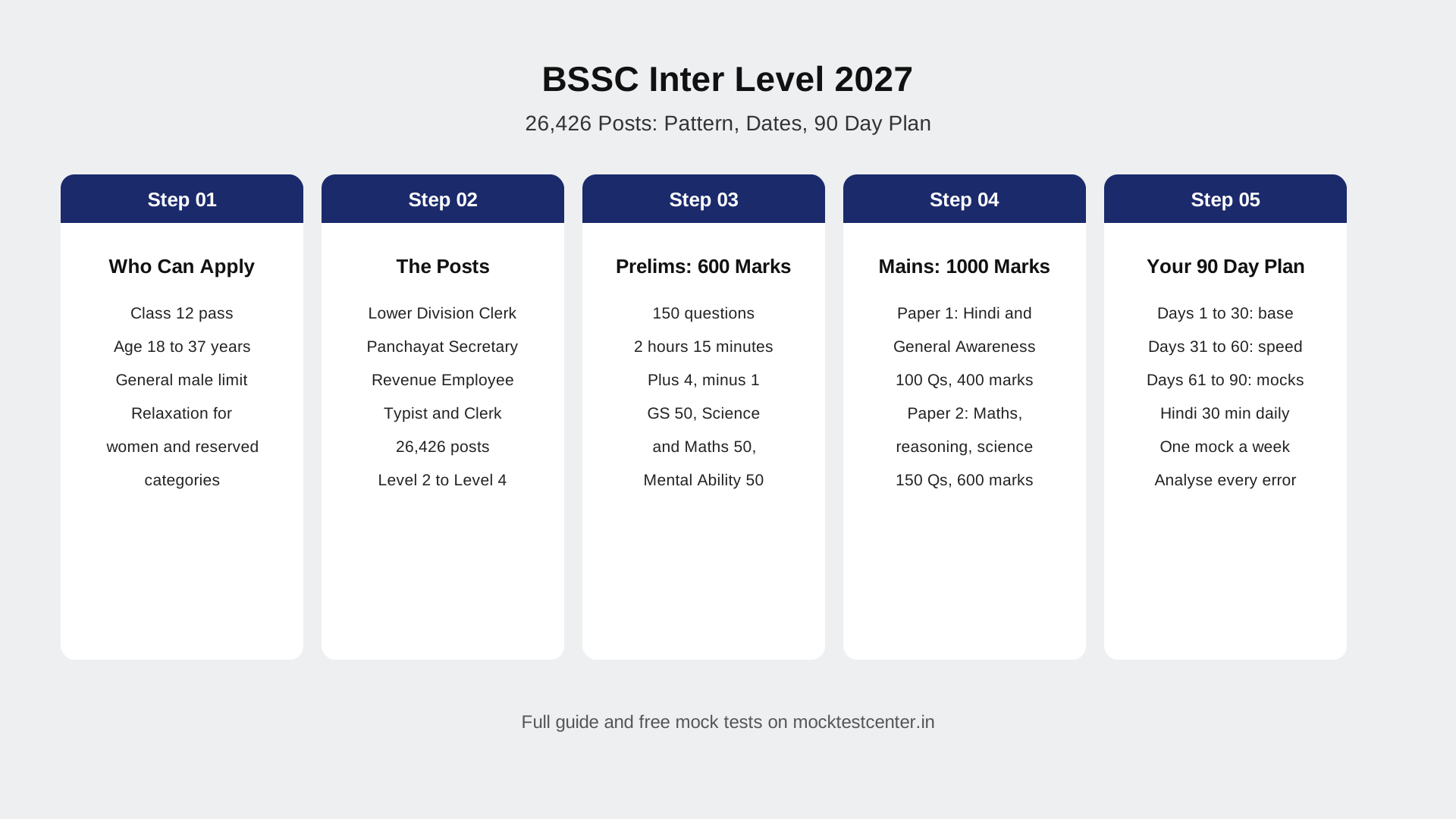
The BSSC Inter Level 2027 exam is the largest doorway into Bihar government service for candidates who have passed Class 12. One advertisement covers clerks and assistants, revenue staff and panchayat secretaries, and typists across dozens of departments. The latest cycle lists 26,426 posts. That number alone explains the rush. Every year, lakhs of candidates apply, and most of them prepare the same way. This guide takes a different path. It lays out the verified facts first, then shows where marks are actually won and lost.
Read this page with one habit in mind. Check every date and number against the Bihar Staff Selection Commission website, bssc.bihar.gov.in, before you act on it. The commission has extended deadlines and raised the vacancy count several times in this cycle. Tracker websites copy each other, and old figures stay online for months. The numbers in this guide come from the notification and from the corrigenda that followed it, and every place where sources disagree is marked plainly.
There is no 2027 notification yet. The cycle described here is Advertisement 02/23 (A), issued on 27 September 2025, with applications running from 15 October 2025 to 16 February 2026. The exam itself falls in the 2026 calendar, and the 2027 page carries it forward because this is the live cycle candidates are preparing for now. When the commission issues the next advertisement, this page will need a fresh check. Until then, the facts below are the ones that matter.
The 2027 cycle at a glance
| Detail | What it is |
|---|---|
| Exam | BSSC Inter Level Examination, Advertisement 02/23 (A) |
| Conducting body | Bihar Staff Selection Commission (BSSC) |
| Total posts | 26,426 in the latest corrigendum |
| Education | Intermediate, Class 12 pass, or an equivalent qualification |
| Age | 18 to 37 years for general male candidates, with relaxation for women and reserved categories |
| Stages | Prelims, Mains, skill test for some posts, document verification |
| Prelims | 150 questions, 600 marks, 2 hours 15 minutes, plus 4 and minus 1 per question |
| Mains | Two papers, 100 questions and 150 questions, 400 marks and 600 marks |
| Application fee | Rs 540 for general, BC and EBC candidates; Rs 135 for SC and ST candidates of Bihar |
| Official website | bssc.bihar.gov.in |
Why this cycle is different
The vacancy count moved four times. The notification opened with 23,175 posts. A corrigendum raised it to 24,492. A later update took it to 25,311. The latest corrigendum, reported in February 2026, puts the total at 26,426 after 1,115 more posts arrived from state departments. Each step added real posts, and each step also added confusion, because older pages still show the older totals. If a website quotes 23,175 or 24,492 without a date, it is showing an earlier stage of the same advertisement. The current figure is 26,426.
Deadlines moved too. Applications opened on 15 October 2025. The first closing date was 25 November 2025. Extensions pushed the fee date and the final submission date forward more than once, and the last extension set fee payment to 13 February 2026 and final submission to 16 February 2026. Candidates who waited for the last day in November found the window still open in February, and candidates who assumed February was final learned the same lesson the commission teaches every cycle. Apply early. A server that slows on the last evening has ended more applications than any eligibility rule.
The size of the drive changes the competition in a way that matters for preparation. With 26,426 posts, the prelims cut off will sit lower than it would for a small drive, but the number of applicants also rises because the drive is so large. The net effect is simple. A candidate who scores steadily across all three prelims sections, instead of leaning on one strong subject, has a better chance than a candidate who tops one section and collapses in another. The paper rewards balance.
Posts under Inter Level
Inter Level is a single advertisement for many posts. The common ones are Lower Division Clerk, clerk in various departments, Revenue Employee, Panchayat Secretary, Typist, Clerk cum Typist, Junior Regional Investigator, Animal Husbandry Helper, Bench Clerk, Assistant Instructor for typing, Filaria Inspector, and Data Entry Operator. Departments range from Revenue and Land Reforms, Home, Education and Health to Forest, Agriculture, Transport, Labour Resources, Urban Development and the Panchayati Raj Department.
Post wise vacancy figures differ across tracker websites, and the official annexure is the only safe source for them. One tracker lists Panchayat Secretary at 3,532 posts, while another table in the same cycle shows a far smaller figure for the same post name under a different department. Both cannot be right, and this guide will not pick one. The total of 26,426 posts is verified across sources. For the split by post, read the vacancy annexure in the notification PDF on bssc.bihar.gov.in.
Pay sits in Level 2, Level 3 and Level 4 of the Bihar pay matrix, depending on the post. A Lower Division Clerk post sits at the lower end of that range, while a Panchayat Secretary post sits higher. Exact starting pay varies by post and by the allowances that apply, so this guide does not print a single salary figure. The draw here is a permanent state government post with a pension structure and a posting inside Bihar, and that is what pulls lakhs of applicants.
Some posts carry a skill test after the Mains. Typing posts test typing speed, and stenography linked posts test shorthand where the notification says so. The skill test is qualifying in nature for the posts that require it. A candidate who clears the written papers and fails the skill test does not get the post. If your post needs typing, practise it from the first month, because typing speed grows slowly and cannot be rushed in the last two weeks.
Who can apply
The education rule is short. You need to have passed the Intermediate examination, Class 12, from a recognised board, or hold an equivalent qualification. Candidates in the final year of Class 12 do not meet the rule until the result is declared, and the notification measures eligibility on the date it specifies. Read that date in the PDF before you apply.
Age is measured as on 1 August 2025. The minimum age is 18 years for every category. The maximum age is 37 years for a general male candidate, 40 years for a general female candidate and for BC and EBC candidates, and 42 years for SC and ST candidates. Persons with disabilities get further relaxation as per Bihar government rules, up to 10 years in the usual pattern. The cut off date matters more than the number. A candidate who turns 38 on 2 August 2025 still qualifies, because the age is counted on 1 August. A candidate who turned 38 in July does not.
| Category | Minimum age | Maximum age |
|---|---|---|
| General, male | 18 years | 37 years |
| General, female | 18 years | 40 years |
| BC and EBC | 18 years | 40 years |
| SC and ST | 18 years | 42 years |
| Persons with disabilities | 18 years | Relaxation as per Bihar government rules |
Women candidates get 35 percent horizontal reservation in Bihar state recruitment, as per state norms. That reservation applies within each category, and it is one reason the women applicant count keeps rising in this exam. If you belong to a reserved category, keep your caste certificate and your domicile documents ready in the format the notification asks for. A certificate in the wrong format causes more rejections at document verification than any other paperwork error.
Application fee and how to pay
The fee is Rs 540 for general, BC and EBC candidates, and Rs 135 for SC and ST candidates of Bihar. Payment is online only, through debit card, credit card, net banking or UPI on the commission portal. Keep the payment receipt and the application number. If a payment fails, check the bank statement before paying again. A double payment is a small loss, but a missing receipt at a later stage is a bigger problem.
One detail catches candidates every cycle. The reduced fee of Rs 135 applies to SC and ST candidates of Bihar. A candidate from another state who belongs to SC or ST pays the general fee. The notification is clear on this, and the portal charges accordingly. Check your category and your state of domicile before you pay, because the portal will not refund the difference later.
Important dates
Dates in this cycle moved, so treat the table below as the last verified position, not as a promise. The notification came out on 27 September 2025. Online applications opened on 15 October 2025. Fee payment closed on 13 February 2026 after extensions, and the final date to submit the form was 16 February 2026.
| Event | Date |
|---|---|
| Notification issued | 27 September 2025 |
| Online applications opened | 15 October 2025 |
| Last date for fee payment | 13 February 2026, after extensions |
| Last date to submit the form | 16 February 2026, after extensions |
| Prelims exam | Expected mid 2026, final date to be confirmed by the commission |
| Mains exam | Expected September 2026, tentative |
The exam date needs a plain warning. Tracker websites give different months for the Prelims. Some quote June and July 2026 from the commission exam calendar, while others quote August 2026. The Mains month of September 2026 appears in the same calendar reports. None of these is a final admit card notice. The commission announces the firm date on its website, and the admit card follows a few weeks before the exam. As of 21 November 2026, this guide could not verify a final Prelims date from an official notice, so the months above are the calendar reports, not confirmed dates. Check bssc.bihar.gov.in before you plan travel or leave from work.
BSSC Inter Level exam pattern: Prelims
The Prelims is a single objective paper. It has 150 questions and 600 marks, and the time allowed is 2 hours 15 minutes. Each correct answer gives 4 marks. Each wrong answer takes away 1 mark. That minus 1 matters more than most candidates think. Four wrong answers wipe out the gain from one right answer, so blind guessing across the paper is a losing habit. The paper is qualifying in the sense that only Prelims qualifiers reach the Mains, and the Mains decides the final merit.
| Section | Questions | Marks | Time |
|---|---|---|---|
| General Studies | 50 | 200 | 2 hours 15 minutes for the whole paper |
| General Science and Mathematics | 50 | 200 | Same paper |
| Mental Ability Test, covering comprehension, logic, reasoning and mental ability | 50 | 200 | Same paper |
| Total | 150 | 600 | 2 hours 15 minutes |
Three sections of equal weight is the key fact of this paper. General Studies gets 50 questions, Science and Maths get 50, and Mental Ability gets 50. A candidate who scores 40 in General Studies and 15 in Maths has wasted the advantage, because the Maths section alone can lift or sink the total by 200 marks. The paper is set in Hindi and English, and there is no sectional timing. You can move between sections as you like, which makes time planning a skill of its own.
At 150 questions in 135 minutes, you get 54 seconds per question on average. That average hides the truth. A General Studies question that you know takes 20 seconds. A Maths question that needs working takes two minutes. The candidates who finish the paper are the ones who skip a hard question fast and return to it only if time remains. Mark it, move on, and let the easy marks pile up first.
What to study for Prelims
General Studies
General Studies covers current events in India and the world, Indian history and the freedom movement, geography of India and Bihar, the Constitution and Panchayati Raj, the economy, agriculture and community development, science and technology, sports, awards and important personalities, and government schemes. Bihar specific questions carry real weight. Know the districts, the rivers, the folk culture, the state schemes and the recent Bihar budget items. A candidate from Bihar who ignores Bihar in this section gives away easy marks.
Current affairs need a cutoff in your head. Read the last 12 months before the exam with care, and the last 6 months with more care. National schemes, state schemes, new appointments, awards, sports results and science news all appear. A monthly current affairs compilation, read twice, beats five newspapers skimmed once. Keep a small notebook of scheme names with one line each on what the scheme does and who it covers. That one line is usually what the question asks.
General Science and Mathematics
Science here stays at Class 10 level. Physics, chemistry and biology ask for basics, not depth. Everyday science, the human body, plants, the environment and simple machines appear often. If you passed Class 10 science, you have seen most of this before. The work is revision, not fresh learning. Read the NCERT Class 9 and 10 science books once, and make short notes of facts that can become a question.
Mathematics covers the number system, percentages, averages, profit and loss, ratio and proportion, simple interest and compound interest, time and work, speed and distance, simplification, algebra basics and data interpretation. The questions are short and formula based. Speed comes from practice, and practice means solving 30 questions a day from one source, not collecting ten books. A candidate who finishes one arithmetic book fully scores more than a candidate who starts five books and finishes none.
Mental Ability
Mental Ability covers comprehension, logic, reasoning and mental ability. Expect series, coding and decoding, odd one out, blood relations, direction sense, ranking, analogies, syllogisms and simple puzzles. Comprehension passages test reading speed as much as understanding. Read the questions before the passage, so you know what to look for while you read.
This section is the most scoring of the three for a prepared candidate, because reasoning questions have one right answer and no grey area. It is also the section where a weak candidate loses the most time, because a puzzle that resists you for five minutes has already cost you four other questions. Set a rule. If a reasoning question does not open up in 90 seconds, skip it and come back at the end if time is left.
BSSC Inter Level exam pattern: Mains
The Mains has two papers, and each paper runs for 2 hours 15 minutes. Paper 1 covers General Awareness and Hindi language, with 100 questions and 400 marks. Paper 2 covers mental ability, logical reasoning, general mathematics and science, with 150 questions and 600 marks. The marking stays the same, plus 4 for a correct answer and minus 1 for a wrong one. The final merit comes from the Mains, so this stage decides who gets a post.
| Paper | Subject | Questions | Marks | Time |
|---|---|---|---|---|
| Paper 1 | General Awareness and Hindi language | 100 | 400 | 2 hours 15 minutes |
| Paper 2 | Mental ability, logical reasoning, general mathematics and science | 150 | 600 | 2 hours 15 minutes |
| Total | 250 | 1000 | Two sessions |
One caution belongs here. Some tracker pages describe Paper 1 as a Hindi language paper only, while others describe it as General Awareness with Hindi. The notification pattern used in this guide follows the version that lists Paper 1 as General Awareness and Hindi language with 100 questions. The difference matters for preparation, because a pure Hindi paper needs grammar drills and a mixed paper needs general awareness too. Read the Mains syllabus in the official notification and prepare for both parts of Paper 1. That way, either description leaves you covered.
The Hindi paper most candidates ignore
Paper 1 of the Mains is where many Prelims toppers stumble. Hindi grammar, comprehension, vocabulary, synonyms and antonyms, sentence correction and fill in the blanks all appear, and a candidate who has not read Hindi seriously since school finds the paper harder than expected. General Awareness sits in the same paper, so the paper tests two different skills at once.
The fix is boring and it works. Read Hindi every day for 30 minutes. A Hindi newspaper editorial, read slowly with a dictionary nearby, builds vocabulary faster than any list. Practise 20 grammar questions a day from a standard Hindi grammar book, and keep a note of the rules you get wrong. Sandhi, samas, upsarg, pratyay, vilom and paryayvachi words repeat across years. The questions change, the rules do not.
Comprehension in Hindi needs the same method as comprehension in English. Read the questions first, then the passage. Mark the lines that answer each question as you read. A candidate who reads the passage twice without a plan loses ten minutes, and ten minutes in a 135 minute paper is a lot.
Skill test and document check
After the Mains, candidates for posts that need typing or shorthand take a skill test. The notification lists which posts need it, and the test is qualifying. Typing speed is the usual test, and the speed is measured in words per minute on a computer. Practise on the same keyboard layout you will face, and practise with the timer on. Speed without accuracy fails, because errors eat the speed gain.
Document verification is the last step. The commission checks your Class 12 certificate, your age proof, your caste certificate if you claimed reservation, your domicile documents where needed, and your photo identity. Carry originals and two sets of photocopies. A mismatch in the spelling of your name between two documents is the most common problem, and it is also the easiest to fix in advance. Check the spellings now, while there is time to get a correction.
How the merit list works
The Prelims screens candidates for the Mains. The Mains decides the merit. The skill test qualifies candidates for the posts that need it. Document verification confirms eligibility. That order is the whole selection process, and no interview stage exists for Inter Level posts in this cycle.
This guide does not print a cut off figure for this cycle, because the commission has not released one and any number online is a guess. Tracker websites quote expected cut offs, and those quotes move with every new article. Treat them as noise. The useful fact is the structure. With 26,426 posts and a Mains total of 1,000 marks, the final merit will stretch across a broad spread of scores, and a candidate in the middle of the range still has a real chance at a post. That is the advantage of a large drive, and it is the reason steady preparation across all sections pays off.
One more point about the Prelims deserves attention. The Prelims marks do not count in the final merit. That does not make the Prelims easy, because you have to clear it to reach the Mains, but it does change how you prepare. Once you are safely above the Prelims cut off, extra Prelims marks buy nothing. The Mains is where every mark counts. Prepare for the Prelims to qualify, and prepare for the Mains to win.
A 90 day plan that fits a working day
Ninety days is enough if the days are used well. The plan below assumes three hours a day, which is what most working candidates can manage. If you have six hours, double the question practice, not the reading.
Days 1 to 30 build the base. Read General Studies from one standard source and make short notes. Finish the NCERT Class 9 and 10 science books. Start arithmetic with 30 questions a day. Do 20 reasoning questions a day. Read Hindi for 30 minutes a day. Take one short quiz each Sunday on the week topics.
Days 31 to 60 add speed. Start full section tests, one section per day, timed. Revise current affairs of the last 6 months from a monthly compilation. Start Hindi grammar drills in earnest. Take one full Prelims mock test each week, and spend the same time analysing it as you spent taking it. The analysis is where the marks come from. Note every question you got wrong, find the rule or fact behind it, and write it in a mistake notebook.
Days 61 to 90 switch to exam mode. Take two full mock tests a week. Revise the mistake notebook every Sunday. Stop learning new topics in the last 10 days and revise only. In the last week, practise the paper in the exact morning slot, with the same rough paper and the same skipping rule you will use on exam day. A plan that is rehearsed feels familiar on the day, and familiarity keeps nerves down.
Current affairs deserve a slot of their own. Give them 30 minutes a day, every day, from day one. Read a monthly compilation for the last 12 months once, then read the last 6 months again in the final month. Bihar schemes get a separate page in your notes. The commission asks about the state it serves, and Bihar questions are the easiest marks in the paper for a candidate who lives there.
Mock tests: how to use them without wasting them
A mock test is a measuring tool, not a study book. Taking 50 mocks without analysis teaches less than taking 10 mocks with full analysis. After each mock, do three things. First, list the questions you got wrong and find the fact or rule behind each one. Second, list the questions you skipped and ask whether you could have solved them with more time or with a better method. Third, check your time per section and find the section that ate your minutes.
Negative marking changes mock strategy. In a mock, guess only when you can remove two options with confidence. A guess between two options is a fair bet at plus 4 and minus 1. A blind guess among four options is a losing bet over a full paper. Practise this discipline in mocks, so it holds on exam day when the pressure pushes you to attempt everything.
Take mocks in the same pattern as the real paper. 150 questions, 135 minutes, no breaks, no phone. Sit at a table, use an OMR style sheet or the online interface you will face, and stop when the time ends. A mock taken with pauses and lookups flatters you, and flattery is the last thing you need before an exam.
Mistakes that cost marks every year
The first mistake is preparing only for the Prelims and starting Mains preparation after the result. The Mains has a Hindi paper and a deeper second paper, and both need months. Prepare for both stages from the start. The Prelims syllabus and the Mains syllabus overlap heavily, so the extra work is smaller than it looks.
The second mistake is collecting books. Five books on one subject, none finished, lose to one book finished twice. Pick one source per subject and finish it. Add a second source only for current affairs, which no single book covers fully.
The third mistake is ignoring Maths and reasoning while reading General Studies all day. The three Prelims sections carry equal marks. A candidate who reads history for four hours and solves no maths questions is preparing for a paper that does not exist.
The fourth mistake is skipping Hindi. Paper 1 of the Mains punishes that skip with 400 marks at stake. Hindi needs daily work, and daily work needs only 30 minutes.
The fifth mistake is poor time sense in the exam hall. Candidates who spend six minutes on one Maths question lose four other questions. The skipping rule is not a sign of weakness. It is the main skill of this paper.
The sixth mistake is trusting tracker cut offs and exam date rumours. Dates and cut offs come from the commission website. Everything else is a guess, and guesses have cost candidates their preparation schedule more than once.
Documents to keep ready
Keep these ready before the form opens, not after it closes. Class 10 and Class 12 mark sheets and certificates. A photo identity card. A recent passport photo and a scanned signature in the size the portal asks for. A caste certificate in the Bihar format if you claim reservation. A domicile certificate where the notification asks for one. An income certificate if your category needs it. A disability certificate if applicable. Check the spellings of your name and your father name on every document, and get mismatches corrected early.
Keep a folder on your phone with clear scans of each document, and keep the originals in a file at home. When the commission asks for a document, a candidate who can produce it in an hour stays calm, and a candidate who has to search for it loses a day.
Sources
Bihar Staff Selection Commission, official website, bssc.bihar.gov.in, notification and corrigenda under Advertisement 02/23 (A). Adda247, BSSC Inter Level Vacancy 2026, vacancy raised to 26,426 posts and deadlines extended to 16 February 2026. Adda247, BSSC Inter Level Exam Date 2026, Prelims and Mains months from the exam calendar. Adda247, BSSC Inter Level Syllabus 2026, Prelims and Mains pattern and marking scheme. Testbook, BSSC Inter Level Syllabus 2026 and Exam Pattern, Mains papers and marks. JagranJosh, BSSC Inter Level Syllabus 2026, Prelims sections and Mains pattern. CareerPower, BSSC Inter Level Vacancy 2025, vacancy history and fee details. Rojgar Warrior, BSSC Inter Level Recruitment 2025, fee of Rs 540 and Rs 135 and age limits as on 1 August 2025. Rapido Jobs India, BSSC Inter Level Recruitment 2026, vacancy 25,311 and post wise groupings.







