About BSSC CGL 2027 Exam Series
📖 Table of Contents
- BSSC CGL 2027 at a glance
- The fourth graduate level cycle so far
- Posts on offer in the BSSC CGL 2027 drive
- Who can apply for BSSC CGL 2027
- The BSSC CGL exam pattern in full
- Prelims: 150 questions, 600 marks, 2 hours 15 minutes
- Mains Paper 1: Hindi, the qualifying gate
- Mains Paper 2: the merit paper
- General Studies: the biggest section in the BSSC CGL exam pattern
- General Science and Mathematics: the scoring section
- Reasoning and mental ability: the speed section
- What the last cycle teaches about BSSC CGL 2027
- A 180 day plan for BSSC CGL 2027
- Mistakes that cost BSSC CGL candidates their selection
- How mock tests fit the BSSC CGL 2027 preparation
- Sources
BSSC CGL 2027: Complete Exam Guide
The BSSC CGL 2027 cycle is the fourth graduate level drive from the Bihar Staff Selection Commission, and it is the largest graduate level opening Bihar has advertised in years. The commission published Advertisement 05/2025 on 4 August 2025 for 1,481 posts, then raised the count to 1,883 posts on 21 November 2025. Applications ran from 25 August 2025 and closed on 24 November 2025 after an extension and a reopened window. The preliminary exam sits in the commission calendar for July to August 2026, with the mains exam expected in October 2026.
That timing gives a candidate about eight months from the close of forms to the first paper. The gap is a gift only if it is used well. The BSSC CGL 2027 pattern rewards steady work across three subjects, and it punishes one weakness hard. The Hindi paper in the mains is the trap most candidates walk into blind. It carries 400 marks, it needs only 30 percent to pass, and a candidate who fails it never gets a mains Paper 2 score at all.
This guide works from Advertisement 05/2025 as reported by the Times of India and by Career Power and Testbook, because the commission site carries the notice and the trackers carry the detail. The last completed cycle, the third graduate level exam under Advertisement 01/2022, supplies the comparison where the new notice is silent. Every figure here names its source. Where two trackers disagree, this guide says so in plain words instead of picking the prettier number.
BSSC CGL 2027 at a glance
| Detail | BSSC CGL 2027, the live cycle |
|---|---|
| Conducting body | Bihar Staff Selection Commission (BSSC) |
| Exam | Fourth Graduate Level Combined Competitive Examination 2025 |
| Advertisement | Advertisement 05/2025, dated 4 August 2025 |
| Total posts | 1,883 (revised 21 November 2025; 1,481 at notification) |
| Application window | 25 August to 24 November 2025, online |
| Education | Graduation in any subject from a recognised university |
| Age limit | 21 to 37 years for unreserved men as on 1 August 2025 |
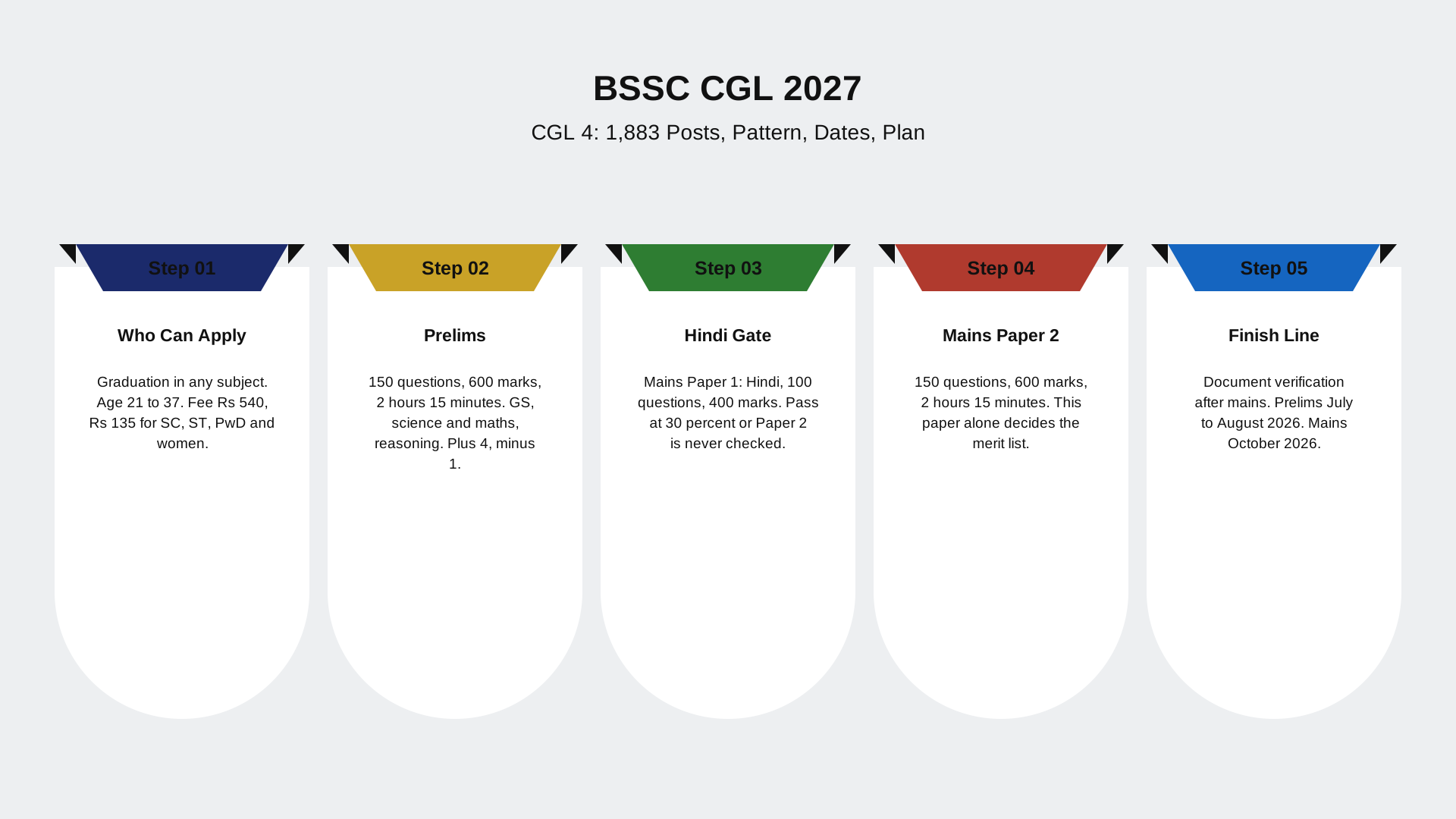
| Fee | Rs 540 for general, BC, EBC and EWS men; Rs 135 for SC, ST, PwD and women |
| Prelims | 150 questions, 600 marks, 2 hours 15 minutes; plus 4, minus 1 |
| Mains Paper 1 | Hindi language, 100 questions, 400 marks, 2 hours 15 minutes; pass at 30 percent |
| Mains Paper 2 | 150 questions, 600 marks, 2 hours 15 minutes; decides merit |
| Prelims date | July to August 2026 per the commission calendar; exact dates not announced |
| Mains date | October 2026, expected; exact dates not announced |
| Official website | bssc.bihar.gov.in |
The fourth graduate level cycle so far
The commission released the fourth graduate level notification on 4 August 2025. The Times of India reported 1,481 vacancies the same day, with applications opening on 18 August 2025 in its first report and on 25 August 2025 in the later reports from Career Power and Testbook. The later dates match the commission schedule, so this guide uses 25 August 2025 as the opening date and flags the 18 August date as an early report that the later trackers corrected.
Forms stayed open through September and October 2025. The commission reopened the window on 16 October 2025 and extended the last date to 24 November 2025, with the fee deadline a few days earlier on 21 November 2025. The vacancy count moved in the same window. Testbook records the revision to 1,883 posts on 21 November 2025, and Career Power confirms the same figure with the Industrial Extension Officer post added at 60 vacancies. A candidate who applied early and never checked back would have missed both changes.
One number needs a warning label. Adda247 reported that the Bihar Revenue Department is likely to recruit 8,054 posts through BSSC and that these may join the coming CGL 4 drive. That figure is a media expectation, and no notification supports it. This guide does not use 8,054 anywhere in its totals. Another tracker put the count near 2,450 and dated the notification to 12 November 2025. That conflicts with the Times of India report of 5 August 2025 and with the commission calendar, so this guide treats it as unreliable and leaves it out.
The preliminary exam has no fixed day yet. Career Power reports July to August 2026 from the commission calendar, with the mains exam in October 2026. Testbook reports September to October 2026 for the prelims. The two trackers disagree by a month or two, and the commission has published only a month window so far. A candidate should plan for July 2026 and treat September as slack, because planning for the later date and meeting the earlier one is the only mistake that cannot be fixed.
Posts on offer in the BSSC CGL 2027 drive
The 1,883 posts spread across six post groups, and the split explains why this exam draws graduates from every stream. The Secretariat Assistant post is the largest single group. The Auditor posts come next. The Planning Assistant and Malaria Inspector posts are smaller, and the Industrial Extension Officer post arrived with the November revision. A plain graduate degree opens most of these doors. A few posts ask for a specific subject in the degree, and the advertisement lists them post by post.
| Post | Vacancies at notification | Degree needed |
|---|---|---|
| Secretariat Assistant | 385 | Graduation in any subject |
| Assistant Branch Officer | 392 | Graduation in any subject |
| Auditor, Directorate of Audit | 352 | Graduation with commerce, economics, statistics or maths |
| Auditor, Cooperative Department | 97 | Graduation with maths, or a commerce degree |
| Planning Assistant | 125 | Graduation in any subject |
| Malaria Inspector | 30 | Graduation in any subject |
| Industrial Extension Officer and other posts added in the revision | 502 across the revision to 1,883 | As per the revised advertisement |
The post wise table above carries one honest gap. The Times of India table at notification lists six posts that add to 1,381, which is 100 short of the 1,481 total it reports in the same article. The missing 100 posts belong to post groups that the report did not itemise. The revision to 1,883 added 402 posts, including 60 Industrial Extension Officer posts reported by Career Power. The remaining added posts sit in groups the trackers did not break out. A candidate should read the revised advertisement on bssc.bihar.gov.in for the full post wise table before choosing preferences, because preference order is locked at the form stage and cannot be changed later.
Pay varies by post, and the range is wide enough to matter. Adda247 reports a starting salary between Rs 42,000 and Rs 73,000 a month across the CGL posts. Secretariat Assistant sits at the higher end of the scale as a secretariat post. Auditor and Planning Assistant posts sit in the middle. The exact pay level for each post comes from the advertisement, and a candidate should check it there rather than trust a tracker range. What no tracker disputes is the shape of the job: a permanent state government post with pension benefits, fixed hours in most departments, and promotion through departmental exams.
Women candidates get 35 percent horizontal reservation across categories in this drive, as the Times of India reported at notification. That reservation applies within each category, so a woman candidate competes first in her own category and then within the women quota of that category. The rule matters for cutoffs. Women candidates have a lower qualifying percentage in the prelims, and the reservation changes the effective competition in every post group.
Who can apply for BSSC CGL 2027
A graduation degree in any subject from a recognised university is the core qualification. The degree must be complete by the date the advertisement fixes, and provisional marksheets count only if the university has declared the candidate pass. A final year student whose result is still pending cannot apply, because the commission checks the degree at document verification and a missing degree ends the candidacy there. Candidates with a subject specific post in mind should check the degree rule for that post before applying, because the Auditor posts ask for commerce, economics, statistics or maths in the degree and a plain arts degree does not open them.
The age window runs from 21 to 37 years for unreserved men, counted as on 1 August 2025. Women candidates and BC and EBC candidates get a higher upper limit of 40 years. SC and ST candidates get 42 years in the last cycle, and the same relaxation structure carries into this cycle as reported by the trackers. The minimum age of 21 years applies to every category without exception. A candidate who turns 21 after 1 August 2025 waits for the next cycle, and no relaxation covers the minimum age.
Bihar domicile matters for the fee and for reservation. Candidates from outside Bihar pay the general fee of Rs 540 and compete in the unreserved category. SC, ST and PwD candidates of Bihar domicile pay Rs 135, and women candidates pay Rs 135 as well. The fee includes a processing charge of Rs 40 in the tracker reports, and it is not refundable once paid. A candidate who pays twice by mistake cannot claim a refund from the commission, so the payment step deserves a slow minute and a saved receipt.
The application ran only online through bssc.bihar.gov.in and its application portal. The form asked for personal details and education details. It asked for post preferences, a photograph and a signature in the prescribed size, plus the fee payment. Post preference order is the part candidates rush and regret. The commission allots posts by merit and preference, so a candidate who lists a lower paying post above a better one gets the lower post if the merit reaches it. The right order is personal, and it should follow pay and posting location first and promotion speed next, not the order a friend used.
The BSSC CGL exam pattern in full
The BSSC CGL exam pattern has two written stages and then document verification. There is no interview. The prelims screens candidates for the mains. The mains decides the merit list. The prelims marks never reach the final merit, so a candidate who tops the prelims and slips in the mains loses the race, while a candidate who scrapes through the prelims and peaks in the mains wins it. That structure shapes the whole preparation plan, and it is the first thing a new candidate should absorb.
Prelims: 150 questions, 600 marks, 2 hours 15 minutes
The prelims paper carries 150 objective questions across three sections of 50 questions each. Each correct answer earns 4 marks, and each wrong answer loses 1 mark. A blank answer loses nothing. The paper runs for 2 hours 15 minutes, which gives 54 seconds per question on average. The paper has three sections of 50 questions each. General Studies comes first. General Science and Mathematics comes second. Comprehension with Logical Reasoning and Mental Ability comes third. The paper is bilingual, set in Hindi and English, and the candidate can switch between languages question by question.
| Prelims section | Questions | Marks |
|---|---|---|
| General Studies | 50 | 200 |
| General Science and Mathematics | 50 | 200 |
| Comprehension, Logical Reasoning and Mental Ability | 50 | 200 |
| Total | 150 | 600 |
The qualifying percentages from the last cycle were 40 percent for unreserved candidates, 36.5 percent for BC candidates, 34 percent for EBC candidates, and 32 percent for SC, ST, women and PwD candidates. Those figures come from the third graduate level cycle, and the trackers report the same structure for this cycle. The commission calls about five times the vacancies for the mains, so the real cutoff sits above the qualifying percentage in most categories. A candidate should target 55 percent in mock tests before the exam, because a score that only clears the qualifying line rarely survives the shortlist ratio.
Negative marking is the quiet killer in this paper. Each wrong answer costs 1 mark, which is a quarter of a correct answer. A candidate who guesses on 20 questions and gets 5 right and 15 wrong gains 20 marks and loses 15, a net of 5 marks for 20 attempts. The same candidate skipping those 20 questions keeps the score clean. The rule is simple to state and hard to follow under pressure: attempt a question only when two options can be eliminated, and leave the rest blank.
Mains Paper 1: Hindi, the qualifying gate
Mains Paper 1 is a Hindi language paper of 100 questions for 400 marks, with a duration of 2 hours 15 minutes. A candidate needs 30 percent in this paper, which is 120 marks, to stay in the race. Paper 2 is not checked for a candidate who falls below 30 percent in Paper 1. The paper covers Hindi grammar and comprehension, plus vocabulary and usage, and it is set at a level a graduate who studied Hindi through school should handle. The trap is that many graduates have not touched Hindi grammar since school, and they discover the gap in the exam hall.
The Hindi paper deserves a fixed slot in every week of preparation, not a last month crash course. Thirty minutes a day from the start of preparation is enough. Grammar rules, one comprehension passage a day, and a weekly vocabulary list of 50 words will carry a candidate past 30 percent with room to spare. A candidate who scores 30 percent exactly passes the gate and nothing more, since Paper 1 marks do not count for merit. The goal is a safe 45 to 50 percent, which leaves no doubt and costs little time.
Mains Paper 2: the merit paper
Mains Paper 2 carries 150 questions for 600 marks in 2 hours 15 minutes, with the same three sections as the prelims: General Studies at 50 questions, General Science and Mathematics at 50 questions, and Reasoning Ability at 50 questions. Each correct answer earns 4 marks and each wrong answer loses 1 mark. This paper decides the merit list, and the final ranking comes from Paper 2 alone. Document verification follows the mains result, and the commission allots posts by merit and preference after verification.
| Mains paper | Questions | Marks | Time | Role |
|---|---|---|---|---|
| Paper 1, Hindi language | 100 | 400 | 2 hours 15 minutes | Qualifying at 30 percent |
| Paper 2, GS and science and reasoning | 150 | 600 | 2 hours 15 minutes | Decides merit |
The two mains papers run on the same day or on consecutive days as the commission schedules them, and the candidate should prepare for a long day. Two papers of 2 hours 15 minutes each mean four and a half hours of testing with a break between them. Stamina matters. Mock tests should be taken back to back at least four times before the exam, because the second paper is where tired candidates lose marks they would never lose fresh.
General Studies: the biggest section in the BSSC CGL exam pattern
General Studies carries 50 questions in each paper, and it is the section where a candidate gains the most from reading the news every day. The syllabus tests awareness of the world around the candidate, with questions on current events, Indian history, geography, the constitution, the economy, and Bihar in particular. Bihar gets special attention in this exam. Questions on Bihar history, Bihar geography, Bihar culture and Bihar government schemes appear in every paper, and a candidate who knows the national syllabus but skips Bihar loses 8 to 10 questions in each paper.
Current affairs should cover the last 12 months before the exam, with a focus on the last 6 months. National awards and major appointments form the core, along with government schemes, state news from Bihar, sports results and science developments. A monthly current affairs magazine and a daily newspaper habit will cover it. The mistake is to read current affairs only from a monthly compilation in the last month. That produces recognition without recall, and the exam tests recall. A candidate should make short notes each week and revise them each Sunday, because the note made in August is the mark scored in July next year.
Indian history questions lean on the freedom movement, the medieval period, and ancient India in that order. The freedom movement deserves the most time, because it produces the most questions and the facts are stable. Geography questions cover physical geography, Indian rivers, climate, agriculture, and minerals. The constitution section covers fundamental rights and the parliament, plus the judiciary and the panchayati raj system. Economics questions stay at a basic level: planning, banking, inflation, and government schemes. None of this needs a degree in the subject. It needs a standard book per subject and two revisions.
Bihar specific preparation is the edge that separates a selected candidate from a near miss. The candidate should know the districts of Bihar and their headquarters, the rivers of Bihar, the folk culture of the state, the major movements in Bihar history, and the current schemes of the Bihar government. The state budget and the economic survey of Bihar deserve one reading each. The questions are rarely deep, and a candidate who spends two weeks on Bihar specific material will answer most of them.
General Science and Mathematics: the scoring section
General Science and Mathematics carries 50 questions in each paper, and it is the most scoring section for a candidate with a science background in school. The science part stays at the Class 10 level, with physics and chemistry and biology in equal measure. The maths part stays at the Class 10 level as well: number systems, percentages, ratio and proportion, averages, interest, profit and loss, time and work, and basic geometry. A candidate who revises Class 10 NCERT books for science and maths will find the questions familiar, because the exam rarely goes beyond that level.
The science questions test understanding rather than memory. A question on why the sky is blue or how a rainbow forms expects the candidate to know the principle, not a formula. Biology questions cover the human body and plants, plus diseases and nutrition. Chemistry questions cover acids and bases, plus metals and everyday chemical processes. Physics questions cover motion and light, plus sound, electricity and magnetism. A candidate should solve the NCERT exemplar questions for Classes 9 and 10, because they match the exam level closely.
Maths needs practice rather than reading. The topics are fixed, the question types repeat, and speed decides the score. A candidate should solve 20 maths questions a day from the start of preparation, timing each set. The goal is 20 questions in 18 minutes with at least 17 correct. Shortcuts help only after the basics are solid. A candidate who learns a shortcut without understanding the method behind it will fail the twisted version of the question that the exam always includes.
The science and maths section also carries the highest risk of negative marking for a careless candidate. A science question with a confident wrong answer costs the same as a guess. The section rewards a candidate who marks only the questions they can solve, and it punishes a candidate who attempts all 50. The mock test data should show the candidate their own accuracy per section, and the attempt strategy should follow that data rather than a fixed rule.
Reasoning and mental ability: the speed section
The reasoning section carries 50 questions in each paper, and it tests verbal and non verbal reasoning with analogy and series. Coding, blood relations, direction sense, ranking, puzzles and comprehension appear as well. This section has no syllabus to memorise. It has patterns to practise. A candidate who solves 30 reasoning questions a day for three months will see the patterns repeat, and the section becomes the fastest scoring part of the paper.
Comprehension passages sit inside this section, and they deserve a specific method. A candidate should read the questions first, then read the passage looking for the answers. Reading the passage first and then the questions wastes time and memory. The passages are short and factual, and the answers sit in the text rather than between the lines. A candidate who practises two passages a week will finish the comprehension questions in 10 minutes on exam day.
Puzzles and seating arrangement questions take the most time in this section, and they should be attempted last. A candidate who starts with a puzzle and gets stuck loses 8 minutes on 5 questions. A candidate who finishes the direct questions first and returns to the puzzle with time in hand solves it calmly. The order of attempt inside the paper is a skill, and it should be fixed in mock tests long before the exam. The best order for most candidates is reasoning first, then science and maths, then General Studies, because reasoning questions are quick and build confidence for the rest of the paper.
What the last cycle teaches about BSSC CGL 2027
The third graduate level cycle under Advertisement 01/2022 is the best teacher for this exam, because it ran the full course from notification to final result. The commission published the notification on 6 April 2022 for 2,187 posts: Secretariat Assistant 1,360, Planning Assistant 125, Malaria Inspector 74, Data Entry Operator Grade C 2, and Auditor 626. Applications ran from 14 April to 1 June 2022 after an extension from the first last date of 17 May 2022. The fee was Rs 540 for general candidates and Rs 135 for SC, ST, PwD and women candidates, the same fee structure the new cycle uses.
The prelims ran on 23 and 24 December 2022. A paper leak allegation forced a re-exam on 5 March 2023 for the affected shift, and the prelims result came on 30 May 2023. The mains exam ran on 23 July 2023, the mains result came on 26 September 2023, and document verification ran from 5 to 9 October 2023. The whole cycle took about 18 months from notification to verification. A candidate who measures this cycle by the same clock should expect the prelims in mid 2026 and the final result in early 2027, though the commission has given no date for the result yet.
The leak episode carries a lesson that no syllabus covers. The commission cancelled the affected paper and held a re-exam, and candidates who had prepared for one date had to hold their preparation for three more months. The candidates who survived that delay were the ones who kept a daily routine through the uncertainty instead of stopping and restarting. The new cycle may run clean, and a candidate should assume it will, but the preparation plan should survive a postponement without falling apart.
The third cycle also shows how the shortlist works. The commission called about five times the vacancies for the mains, which meant roughly 11,000 candidates from a prelims field that ran into lakhs. The mains merit list then decided the 2,187 posts. The ratio is the reason the prelims cutoff sits well above the qualifying percentage. A candidate should treat the prelims as a race against the shortlist, not against the qualifying line.
A 180 day plan for BSSC CGL 2027
A candidate starting now has roughly six months to the prelims, and the plan below fits that window. It assumes four hours of study a day on weekdays and six hours on weekends, which is enough for a working candidate and comfortable for a full time candidate. The plan splits into three phases: foundation, practice, and revision. Each phase has a job, and the phases do not mix.
Days 1 to 60 build the foundation. General Studies gets two hours a day: one hour of a standard book and one hour of current affairs notes. Science and maths get one hour a day: NCERT revision and 20 solved questions. Reasoning gets 30 minutes a day: 30 questions from one topic at a time. Hindi gets 30 minutes a day: grammar rules and one comprehension passage. The candidate finishes the first reading of every subject in this phase and makes short notes for revision. No mock tests in this phase except one diagnostic test at the start to find the weak section.
Days 61 to 120 are the practice phase. The candidate takes one full mock test every week and two sectional tests per subject each week. Each mock test gets a full day of analysis: every wrong answer is logged with the reason, and every guessed right answer is marked as a risk. General Studies revision shifts to the short notes made in the first phase. Science and maths practice rises to 30 questions a day. Hindi practice rises to a full paper every Sunday. The candidate should see the mock score rise by 5 to 8 percent across this phase. A flat score means the analysis is missing, not the effort.
Days 121 to 180 are the revision phase. No new books enter the table. The candidate revises short notes, solves previous year papers from the third cycle, and takes two mock tests a week. The last 15 days are for light revision only: formula sheets and current affairs of the last six months, plus Bihar facts and Hindi grammar rules. The candidate should sleep eight hours in the last week and avoid any new material. A new topic learned in the last week costs more marks in confusion than it gains in knowledge.
Mistakes that cost BSSC CGL candidates their selection
The first mistake is ignoring the Hindi paper until the mains admit card arrives. Paper 1 needs 30 percent, and a graduate who has not read Hindi grammar in years can score below it. The fix costs 30 minutes a day from the first week. The second mistake is reading General Studies without notes. A candidate who reads a book twice without writing anything remembers less than a candidate who reads it once and writes short notes. The notes are the revision material, and without them the last month has nothing to revise from.
The third mistake is taking mock tests without analysing them. A mock test score without analysis is entertainment, and it teaches nothing. The analysis should take longer than the test itself. The fourth mistake is attempting too many questions in the prelims. Negative marking of 1 mark per wrong answer turns a 70 percent attempt rate with 60 percent accuracy into a failing score. The fifth mistake is changing books mid preparation. Three standard books finished twice beat ten books started once, and the candidate who keeps buying new material is usually avoiding revision.
The sixth mistake is skipping Bihar specific preparation. The exam asks about Bihar in every paper, and the questions are easy marks for a candidate who spends two weeks on the state. The seventh mistake is preparing alone without a peer group. A small group of three or four serious candidates shares notes, discusses current affairs, and keeps the routine alive on bad days. The group should meet once a week and compare mock scores, because a candidate who hides a falling score from the group hides it from themself as well.
How mock tests fit the BSSC CGL 2027 preparation
Mock tests serve three purposes in this exam: they teach time management, they expose weak topics, and they build exam stamina. A candidate should take the first mock test before preparation begins, to find the starting score and the weakest section. The second mock test comes after 60 days, and weekly mocks start after that. The final month should have two mocks a week, with at least four taken as back to back pairs to simulate the two mains papers on one day.
Each mock test should mirror the real pattern: 150 questions, 600 marks, 2 hours 15 minutes, and the same three sections. The candidate should sit for the test at the same time of day as the real exam, with a phone switched off and no breaks. The score matters less than the analysis. The candidate should sort every question into four groups: correct and known, correct and guessed, wrong and known, and wrong and unknown. The second group is the danger group, and the fourth group is the syllabus gap. The next week of study should fix the fourth group first.
A candidate should track five numbers across mock tests: total score, accuracy per section, questions attempted, time spent per section, and the score lost to negative marking. A rising total score with falling accuracy is a warning sign, because it means the candidate is guessing more. A falling negative marking loss with a steady score is progress, because it means the candidate is choosing questions better. These five numbers tell the truth about preparation, and the candidate should review them every Sunday without fail.
Sources
Times of India, BSSC CGL notification 2025 released for 1,481 vacancies, 5 August 2025. Career Power, BSSC CGL Exam Date 2026 Out for 1,883 vacancies, exam pattern and Advertisement 05/2025 dates. Testbook, BSSC CGL Exam Date 2026, revised 1,883 vacancies, vacancy revised 21 November 2025. Adda247, BSSC CGL Recruitment 2026 for 8,054 vacancies, salary range and Revenue Department expectation, flagged as unverified. News18, BSSC CGL 2022 applications open for 2,187 posts, 14 April 2022. Scroll, BSSC CGL exam 2022 registration deadline for 2,187 posts, age and fee details. Jagran Josh, BSSC CGL Recruitment 2022, 2,187 vacancies and post wise split. Exam Syllabus Hub, Bihar CGL syllabus and exam pattern, prelims and mains structure and qualifying percentages. Entri, BSSC CGL Syllabus 2022, prelims and mains pattern tables. Bihar Staff Selection Commission, bssc.bihar.gov.in, the official website for Advertisement 05/2025 and all notices.