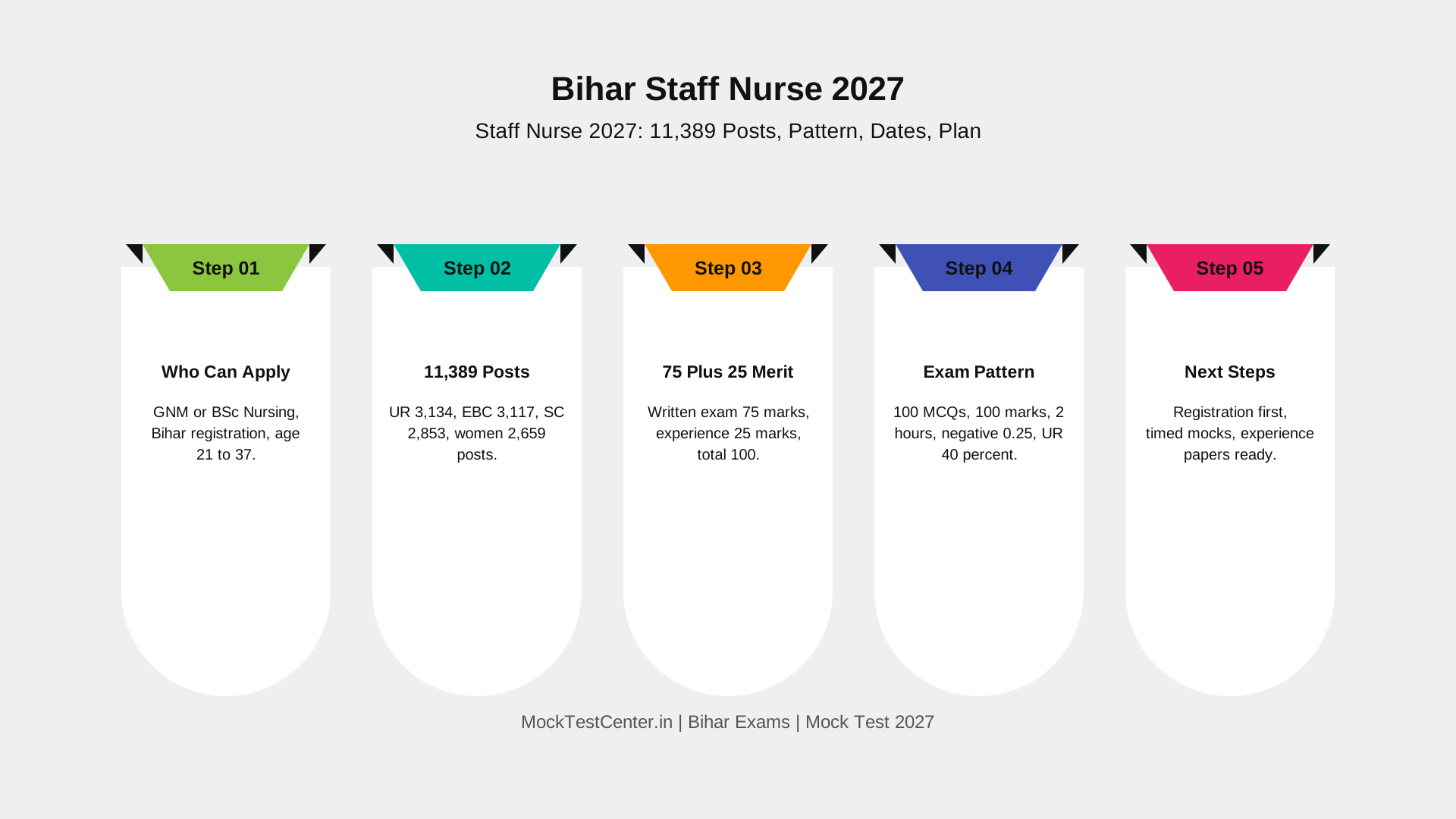
About Bihar Staff Nurse 2027 Exam Series
📖 Table of Contents
- Bihar Staff Nurse 2027 at a glance
- Two bodies hire Staff Nurses in Bihar
- 11,389 posts, split seven ways
- Who can apply
- The 75 plus 25 split decides the merit list
- Bihar Staff Nurse exam pattern
- What the syllabus actually covers
- Fee, form, documents
- What happened after the exam
- Pay, posting, the job itself
- What the 2027 cycle looks like from here
- A 90 day plan that fits the real paper
- Mistakes that cost candidates the post
- Sources
Bihar Staff Nurse 2027: Complete Exam Guide
The Bihar Staff Nurse 2027 cycle has a number that stops most readers cold. The last full recruitment, Advertisement 23 of 2025 from the Bihar Technical Service Commission, carried 11,389 Staff Nurse posts in one go. Applications ran from 25 April to 23 May 2025. The written exam ran on 30 and 31 July and on 1 and 3 August 2025. Document verification followed between 17 April and 12 May 2026, and the final result came out in August 2026. That scale explains why this page draws so much attention, and it also explains why so many pages about it get the details wrong.
This guide works from that 2025 cycle, because no new BTSC Staff Nurse notification had been published as of 21 November 2026. The next cycle will most likely follow the same scheme, and every figure here comes from the commission notification as reported by the trackers that read it, or from the result and verification notices BTSC published afterwards. Where tracker pages disagree, this guide says so instead of picking the smoother number.
One warning belongs at the top. Two different bodies hire Staff Nurses in Bihar, and their drives are not the same exam. The Bihar Technical Service Commission runs the permanent Health Department recruitment. The State Health Society Bihar runs contractual hiring under the National Health Mission. A candidate who prepares for one and applies to the other wastes a year. This guide covers the BTSC permanent recruitment first, then explains the State Health Society channel so the two never get mixed up again.
Bihar Staff Nurse 2027 at a glance
| Detail | Bihar Staff Nurse, the last verified cycle |
|---|---|
| Conducting body | Bihar Technical Service Commission, BTSC |
| Post | Staff Nurse, Health Department, Government of Bihar |
| Advertisement | Advertisement 23 of 2025, released 24 April 2025 |
| Total posts | 11,389 |
| Application window | 25 April to 23 May 2025, online |
| Education | GNM or BSc Nursing, plus Bihar Nurses Registration Council registration |
| Age | 21 to 37 years for unreserved men, 21 to 40 for unreserved women |
| Fee | Rs 600 for General, BC, EBC, EWS; Rs 150 for SC, ST, Bihar domicile women, PwD |
| Written exam | 100 MCQs, 100 marks, 2 hours, negative marking 0.25, Hindi, English paper |
| Merit split | Written exam 75 marks, work experience 25 marks, total 100 |
| Exam dates | 30 and 31 July and 1 and 3 August 2025 |
| Result | Written result December 2025, document verification April to May 2026, final result August 2026 |
| Pay | Level 7 of the pay matrix, grade pay Rs 4600, pay scale Rs 9300 to Rs 34800 |
| Official website | btsc.bihar.gov.in |
| 2027 notice | Not published as of 21 November 2026 |
Two bodies hire Staff Nurses in Bihar
Search results for Bihar Staff Nurse mix two recruitments into one pile, and the mix causes real damage. The BTSC drive is permanent government service under the Health Department. The State Health Society drive is contractual work under the National Health Mission, usually called NHM. The BTSC drive of 2025 carried 11,389 posts. Tracker pages in November 2026 talk about an expected State Health Society drive of about 3,950 contractual posts, with applications possibly opening in June 2026. That 3,950 figure comes from tracker pages only, and no official State Health Society notification had confirmed it as of 21 November 2026. Treat it as a rumour with a number attached, not as a vacancy.
The difference matters for preparation too. BTSC selection rests on a written exam plus experience marks. State Health Society hiring in past cycles has leaned on merit lists and walk in processes, with different documents and different age rules. A candidate who reads a State Health Society news item and assumes the BTSC exam dates apply will miss the real form entirely. Check the body named on the notice before anything else. BTSC notices live on btsc.bihar.gov.in. State Health Society notices live on statehealthsocietybihar.org.
The BTSC route is the bigger prize and the harder race. A permanent post under the Health Department carries Level 7 pay, a pension path, and postings across district hospitals, medical colleges, primary health centres and community health centres in every district of Bihar. The contractual NHM route pays less, renews year to year, and still counts as experience for the BTSC merit list, which is a point this guide returns to later, because experience is worth a full quarter of the final merit.
11,389 posts, split seven ways
The 2025 advertisement split the 11,389 posts across seven categories, and the split tells a story about where the competition sits. Unreserved candidates got 3,134 posts. Extremely Backward Class candidates got 3,117, almost as many as the unreserved pool. Scheduled Caste candidates got 2,853. EWS got 784. Backward Class got 933, with a further 447 reserved for Backward Class women. Scheduled Tribe got 121. Add those seven numbers and the total lands exactly on 11,389.
Women held a large share of the drive. Career Power reported 2,659 posts reserved for women across the categories, about one post in four. That matters for women candidates who sometimes assume nursing recruitment favours men in government hospitals. It does the opposite here. The women quota sits inside the category split, so a woman candidate competes within her own category pool with the women reservation applied on top.
| Category | Posts |
|---|---|
| Unreserved | 3,134 |
| Extremely Backward Class | 3,117 |
| Scheduled Caste | 2,853 |
| Backward Class | 933 |
| EWS | 784 |
| Backward Class women | 447 |
| Scheduled Tribe | 121 |
| Total | 11,389 |
Big numbers cut both ways. Eleven thousand posts sound like easy selection, and that impression pulls in applicants who have not studied the syllabus at all. The written exam in July and August 2025 ran in multiple shifts across four days, which means the applicant pool ran into lakhs. BTSC applied normalisation across shifts, so a candidate in a tough shift did not lose out to a candidate in an easy one, but the qualifying marks still filtered hard. General candidates needed 40 percent. The full qualifying table sits in the exam pattern section below, and it deserves a careful read, because the bar differs by category in a way that surprises first timers.
Who can apply
Education first, because it ends more candidacies than any other rule. A candidate needs a General Nursing and Midwifery course, GNM, from an institution recognised by the Indian Nursing Council in New Delhi, or a BSc Nursing degree from a recognised institution. The GNM route is the one most applicants take, which is why this page carries GNM in its name. BSc Nursing graduates apply on the same form and sit the same paper, and the syllabus follows the GNM curriculum for everyone.
Registration is a separate requirement, and it is not a formality. Every applicant must hold registration with the Bihar Nurses Registration Council in Patna. A candidate with a GNM certificate and no Bihar registration cannot apply. Candidates from outside Bihar need a suitability certificate from the Indian Nursing Council, and the registration step still applies. Get the registration done months before the form opens, because council paperwork moves slowly and the application window in 2025 lasted under a month.
Age limits run from 21 years at the lower end to a maximum that changes by category and by sex. Unreserved men top out at 37 years. Unreserved women top out at 40 years. Backward Class and Extremely Backward Class candidates of both sexes top out at 40 years. Scheduled Caste and Scheduled Tribe candidates of both sexes top out at 42 years. Age counts as on the date the notification fixes, and the 2025 advertisement fixed it in the notification itself, so candidates must read the new advertisement the day it appears rather than trusting this page for the cut off date.
| Category | Maximum age |
|---|---|
| Unreserved men | 37 years |
| Unreserved women | 40 years |
| Backward Class and Extremely Backward Class, men, women | 40 years |
| Scheduled Caste and Scheduled Tribe, men, women | 42 years |
| Minimum age, all categories | 21 years |
Indian citizenship is required. Bihar domicile shapes the fee and the reservation, and candidates from outside Bihar pay the full Rs 600 fee even in categories that pay Rs 150 inside Bihar. The notification spells out the domicile documents, and the document verification stage in 2026 checked them strictly, so a candidate should gather caste, domicile, education, registration papers before the form opens, not after the result.
The 75 plus 25 split decides the merit list
Here is the fact most tracker pages bury in a footnote, and it changes how a serious candidate should spend the year. The final merit list totals 100 marks, and only 75 of those marks come from the written exam. The other 25 come from work experience. The written paper itself carries 100 marks, and BTSC scales the score down by multiplying by 0.75. A candidate who scores 80 out of 100 in the paper banks 60 merit marks. A candidate who scores 60 banks 45. The gap between a good paper and a great paper shrinks to 15 merit marks at most.
Experience pays 5 marks per completed year of satisfactory work as a Staff Nurse on contract in a government health facility inside Bihar, up to a maximum of 25 marks for five years. The facilities named in the notification include health institutions run by central government, municipal bodies, Panchayati Raj bodies in the state. Part of a year earns proportional marks, worked out by multiplying working days by 5 and dividing by 365. Only experience gained after the qualifying nursing exam counts.
Do the maths on that split and the strategy becomes clear. A fresher with no experience starts the race 25 marks behind a five year contractual nurse, and the written exam cannot close the whole gap, because the exam itself is worth only 75. A fresher needs a paper score near the top of the scale and a bit of luck with the cut off. A contractual nurse with three years of service starts with 15 merit marks in hand and needs a solid but ordinary paper score. This is why so many GNM graduates take contractual NHM postings first. The posting pays, it teaches, it banks merit marks for the permanent exam.
The trap sits in the proof. Experience marks need clean service certificates from the facility, with dates that match the attendance record, and the document verification stage checks them line by line. A candidate who worked without a proper contract letter, or whose certificate carries a gap, can lose the whole 25 marks at verification. Keep every appointment letter, every pay slip, every attendance sheet. The verification list of April 2026 gave candidates a narrow window, and missing papers could not be fetched in time.
Bihar Staff Nurse exam pattern
The written exam is a computer based test with 100 multiple choice questions for 100 marks, and the clock runs for 2 hours. Each correct answer earns 1 mark. Each wrong answer loses 0.25 marks. The paper comes in Hindi, English. The syllabus follows the GNM level curriculum, which the department publishes on the BTSC website. BTSC applied normalisation when the exam ran in multiple shifts, which it did in 2025, with two shifts a day across four days.
| Exam detail | What the 2025 cycle fixed |
|---|---|
| Mode | Computer based test |
| Questions | 100 multiple choice questions |
| Marks | 100 marks, 1 mark per question |
| Duration | 2 hours |
| Negative marking | 0.25 marks deducted per wrong answer |
| Medium | Hindi and English |
| Syllabus base | GNM level curriculum |
| Normalisation | Applied across shifts |
| Weight in merit | 75 marks out of 100 |
Qualifying marks decide who enters the merit list at all. General candidates needed 40 percent. Backward Class candidates needed 36.5 percent. Extremely Backward Class candidates needed 34 percent. Scheduled Caste, Scheduled Tribe, women, PwD candidates needed 32 percent. Those are qualifying marks, not cut offs. The cut off for actual selection runs higher wherever the applicant pool is deep, and with 11,389 posts the pool ran very deep indeed.
Negative marking of 0.25 per wrong answer rewards restraint in a way many nursing candidates miss. Four wrong answers erase one right answer. A candidate who guesses on 20 questions she does not know, and gets 5 right by luck, nets 5 marks gained and 3.75 lost, a gain of 1.25 marks for 20 gambles, and that is the lucky case. The unlucky case loses marks outright. The rule of thumb that survives contact with this paper is simple. Answer what you know, attempt what you can narrow to two options, and leave the rest alone.
Two hours for 100 questions gives 72 seconds per question on paper, but the real budget is tighter. The GNM syllabus questions run long, with case stems that describe a patient before asking the question. Reading speed decides the score as much as nursing knowledge does. Candidates who practise with a timer, and who learn to read the last line of the question first, finish the paper. Candidates who read every stem twice run out of time around question 70.
What the syllabus actually covers
The syllabus follows the GNM curriculum, and the notification lists the subject areas rather than a chapter by chapter plan. The areas BTSC and the trackers name are basic sciences, nutrition, dietetics, psychology, mental health, psychiatric nursing, fundamental nursing, community health nursing, medical surgical nursing, obstetric nursing, paediatric nursing, related nursing subjects. That list is broad on purpose. The paper tests the whole GNM course, not a favoured corner of it.
Medical surgical nursing carries the heaviest weight in practice, because it covers the largest part of the GNM course and the largest part of daily ward work. Community health nursing comes next, and it rewards candidates who have actually worked in primary health centres, because its questions turn on national health programmes, immunisation schedules, the referral chain from sub centre to district hospital. Obstetric and paediatric nursing follow, and both reward memorised numbers, doses, schedules, stages, the kind of detail that fades fast without revision.
Fundamental nursing looks easy and punishes carelessness. Questions on hand washing steps, bed making, temperature, pulse, blood pressure, infection control, drug administration sound like first year material, and they are, but the paper asks them with close options that differ by one word. Basic sciences underpin the rest: anatomy, physiology, biochemistry, microbiology. A candidate who cannot place an organ or a lab value will misread the clinical questions built on top of them.
Nutrition, dietetics, psychology, mental health nursing together form the section most candidates underprepare, and that is exactly why it separates ranks. These questions are short, factual, quick to answer for a candidate who revised them once. They are also the questions a candidate skips while chasing the big clinical subjects. A week spent on these three areas returns more marks per hour than a third week on medical surgical nursing.
One honest gap belongs here. BTSC published the syllabus areas in the notification, and the trackers reproduce the same list, but no subject wise question count has been published for this exam. Pages that print a neat table of questions per subject are guessing. This guide does not print one. Study the whole GNM course, weight medical surgical and community health heaviest, and do not trust a page that claims 20 questions come from a subject nobody has counted.
Fee, form, documents
The 2025 fee table is short and worth memorising. General, Backward Class, Extremely Backward Class and EWS candidates paid Rs 600. Scheduled Caste and Scheduled Tribe candidates with Bihar domicile paid Rs 150. Women candidates with Bihar domicile paid Rs 150 in every category. Candidates from outside Bihar paid Rs 600 in every category. PwD candidates paid Rs 150. Payment ran online through debit card, credit card, internet banking, UPI. The last date for fee payment matched the last date for the form, 23 May 2025.
| Category | Fee |
|---|---|
| General, BC, EBC, EWS | Rs 600 |
| SC and ST, Bihar domicile | Rs 150 |
| Women, Bihar domicile, all categories | Rs 150 |
| Candidates from outside Bihar, all categories | Rs 600 |
| PwD candidates, all categories | Rs 150 |
The form itself ran online on btsc.bihar.gov.in in four moves that every BTSC form follows. Register with a mobile number and email, fill the form with personal, education, registration details, upload the photograph, signature, certificates in the sizes the portal asks for, pay, submit, save a copy. The 2025 window ran 25 April to 23 May, under four weeks, and the portal slowed badly in the last three days, as BTSC portals always do. A candidate who files on day one avoids the rush and gets time to fix a rejected photograph.
Documents to keep ready cover education, registration, identity, experience. GNM or BSc Nursing certificate and marksheets, Bihar Nurses Registration Council certificate, Class 10 certificate for date of birth, caste certificate where claimed, domicile certificate, EWS certificate where claimed, disability certificate where claimed, and experience certificates with appointment letters for every year claimed. The verification stage in 2026 asked for originals, and candidates carried them to the verification centre in two shifts, 10 AM to 1.30 PM and 2 PM to 5.30 PM.
What happened after the exam
The 2025 cycle ran long, and candidates who watched it learned how BTSC timelines actually work. The written exam ran on 30 and 31 July and on 1 and 3 August 2025, in two shifts a day. The written result followed in December 2025, with tracker pages split on the exact day, Testbook reporting 10 December and Career Power reporting 11 December. The answer key and scorecard came out around the same period, and candidates could raise objections to the provisional key on the BTSC portal.
Document verification came next, and the notice for it appeared on 10 April 2026. Verification ran from 17 April to 12 May 2026 in two shifts a day, and candidates downloaded the verification call letter with their registration number, mobile number, date of birth. The final result followed months later, with Testbook noting results out on 27 August 2026. That is thirteen months from notification to final result, and a candidate planning around this exam should expect a similar stretch, not a quick three month finish.
The long gap between the written result and verification is the part that catches candidates off guard. Certificates expire, caste certificates need renewal, and experience letters from a hospital that shut down become hard to fetch. The candidates who sailed through verification were the ones who kept their papers in order from the day they applied. Keep a folder with every certificate scanned, in paper form and as a digital copy, and check the BTSC website every week after the written result, because BTSC gives short notice for verification dates.
Pay, posting, the job itself
Selected Staff Nurses join at Level 7 of the pay matrix, with grade pay of Rs 4600, in the pay scale of Rs 9300 to Rs 34800. That is the figure the 2025 notification carried, and it reflects the older pay band language BTSC still prints alongside the Level 7 matrix. Allowances follow Bihar government rules, and postings run across the state health system, district hospitals, medical college hospitals, primary health centres, community health centres, and referral hospitals.
The work is ward work, and candidates should picture it as it is before applying. Shifts rotate, nights included. A Staff Nurse runs the ward routine, administers drugs, maintains records, assists doctors on rounds. She handles immunisation clinics, antenatal clinics in primary centres, supervises junior staff. The permanent post brings job security and a transfer system, and it also brings rural postings early in service, which is where the state needs nurses most. Candidates who want only a city posting should think twice, because the first posting rarely offers a choice.
Career growth runs through senior Staff Nurse grades and nursing superintendent posts, with departmental exams and seniority both playing a part. Further study, post basic BSc Nursing and MSc Nursing, opens teaching posts in nursing colleges and specialist roles. The GNM qualification that gets a candidate into this exam is a starting point, not a ceiling, and the nurses who rise fastest are usually the ones who keep studying after selection.
What the 2027 cycle looks like from here
No new BTSC Staff Nurse notification had been published as of 21 November 2026. The 2025 cycle is still closing, with final results out in August 2026 and verification completed in May 2026, so a fresh advertisement in the near term would be a surprise. The honest expectation is a new cycle only after the 2025 appointments settle, and the date of that advertisement is something nobody outside BTSC knows. Any page that prints a 2027 application date today is inventing it.
That gap is preparation time, not dead time. A GNM graduate who starts now, and who takes a contractual posting in a government facility while studying, arrives at the next notification with both knowledge and experience marks. A graduate who waits for the notification to start studying arrives with neither. The exam rewards steady work over six to nine months far more than it rewards a frantic final month, because the syllabus is the whole GNM course and no shortcut covers it.
Watch two websites and ignore the rest. BTSC notices appear on btsc.bihar.gov.in. State Health Society notices appear on statehealthsocietybihar.org. Tracker pages will carry the news within hours of either site, but the form itself lives only on the official portal, and the notification PDF on the official portal is the only document that fixes the posts, the dates, the fee, the rules. Read it the day it appears, and read it fully, because the experience marks rule and the qualifying marks hide in its fine print.
A 90 day plan that fits the real paper
Ninety days is enough if the days are honest. The plan below assumes four to five hours of study a day, and it assumes the candidate already holds a GNM or BSc Nursing qualification, so this is revision, not first learning. A fresher out of college will need longer, and a working nurse will need to protect study hours around shifts.
Days 1 to 30 belong to the big subjects. Medical surgical nursing takes two weeks. Community health nursing takes one. Obstetric nursing, paediatric nursing share the fourth week. Study one system a day in medical surgical nursing, and close each day with 50 practice questions on that system. Community health nursing needs the national programmes learned as a set, immunisation, family planning, tuberculosis, malaria, the referral chain, because the paper asks how programmes connect, not just what each one is.
Days 31 to 60 belong to the rest of the course and to the first full mocks. Fundamental nursing, basic sciences, nutrition, psychology, mental health nursing take two weeks. Then take a full mock every third day, 100 questions in 2 hours, with negative marking applied in scoring, so the mock score means something. Review every wrong answer the same evening, and write the correct fact in a notebook in one line. The notebook becomes the revision source for the last week, and it works because it holds only the facts the candidate actually got wrong.
Days 61 to 90 belong to speed and to weak spots. Two mocks a week, timed strictly, with the last 15 minutes reserved for review of marked questions. The weak subjects from the mock analysis get one hour a day, and the strong subjects get only the notebook. In the final week, stop learning new material. Re read the notebook, re read the programme schedules, and sleep properly. A candidate who crams new chapters in the final three days arrives tired and scores less than a candidate who revised what she already knew.
Working nurses need a different shape for the same plan. Two hours on duty days, five hours on off days, with audio revision during commutes where the hospital allows it. The ward itself teaches medical surgical nursing every shift, and a nurse who connects the textbook to the patient in front of her remembers more than a nurse who only reads. Use the ward. Ask the senior nurse why a drug was chosen, why a dressing changed, why a patient was referred upward. Those answers are the paper.
Mistakes that cost candidates the post
The first mistake is applying without Bihar registration, or with a registration that lapsed. The form accepts the application, the exam happens, and the verification stage rejects the candidate. Check the registration status today, not in the application week.
The second mistake is claiming experience without proof. Five marks a year sounds small until the merit list runs on 100 marks, and then it is the difference between selection and the waiting list. Contract letters, pay slips, attendance records for every claimed year, kept from the first day of service, decide whether those marks survive verification.
The third mistake is guessing on every question. Negative marking of 0.25 turns a hopeful paper into a leaking one. Four wrong answers cancel a right one, and a candidate who guesses 30 questions usually loses more than she gains. Leave the questions you cannot narrow down. The paper rewards knowledge, and it punishes hope.
The fourth mistake is studying only the big subjects. Nutrition, psychology, mental health nursing look small, and together they carry enough quick factual questions to move a rank by hundreds of places. A week on them is the cheapest marks in the whole syllabus.
The fifth mistake is trusting a tracker page for dates. The 2025 cycle showed how fast dates move, with the written result reported on two different days by two big trackers, and the final result stretching to August 2026. The BTSC website is the only source for dates. Check it weekly from the day the notification appears, and download every notice the day it appears, because BTSC sometimes replaces a notice without a fresh announcement.
The sixth mistake is waiting for the notification to start. The syllabus is the entire GNM course, and no candidate covers it well in a month. Start with the subjects you fear most, keep a wrong answer notebook, and take timed mocks with negative marking from the first month. When the notification comes, you will be ready to file the form on day one and sit the paper with confidence, while the candidates who waited are still opening their first textbook.
Sources
BTSC Staff Nurse Recruitment 2025. Advertisement 23 of 2025. Notification and result notices on btsc.bihar.gov.in. Reported by Testbook; Career Power; Jagran Josh; Adda247; Govt Jobs Alert. Read November 2026. Testbook page on BTSC Staff Nurse 2025 Recruitment covers the written test result and document verification dates, updated 2 November 2026. Career Power page on Bihar BTSC Staff Nurse Exam Date 2025 covers the response sheet and vacancy details. Jagran Josh page on BTSC Staff Nurse Syllabus 2025 covers the exam pattern and subject wise topics. Adda247 page on Bihar BTSC Staff Nurse Syllabus 2026 covers the exam pattern and work experience weightage. Govt Jobs Alert page on BTSC Staff Nurse Recruitment 2025 covers the application fee and selection process. Test Paper Live page on Bihar Staff Nurse Vacancy 2026 carries the State Health Society NHM expectation of about 3,950 posts. That figure is an unverified tracker claim with no official notification as of 21 November 2026.