About TNPSC Group 1 2027 Exam Series
📖 Table of Contents
- TNPSC Group 1 2027 at a glance
- 72 posts, 46 posts and 26 posts: which number is which
- What the 2026 posts look like after the addendum
- Who can apply for TNPSC Group 1 2027
- TNPSC Group 1 2027 Prelims paper: 200 questions, 300 marks, no negative marking
- What Prelims actually tests
- The Mains papers: Tamil first, then three General Studies papers
- The interview and the 850 mark final rank
- Fees, registration and how to apply
- The traps that cost candidates a cycle
- A 90 day plan that fits the real pattern
- What the 2025 result tells the next candidate
- Sources
TNPSC Group 1 2027: Complete Exam Guide
The Tamil Nadu Public Service Commission runs the Combined Civil Services Examination I, known as TNPSC Group 1, to fill the top posts in the Tamil Nadu government. This TNPSC Group 1 2027 guide works from the two live cycles, the 2025 cycle and the 2026 cycle, because the next notification will follow the shape of these two cycles and no fresh notification has appeared yet.
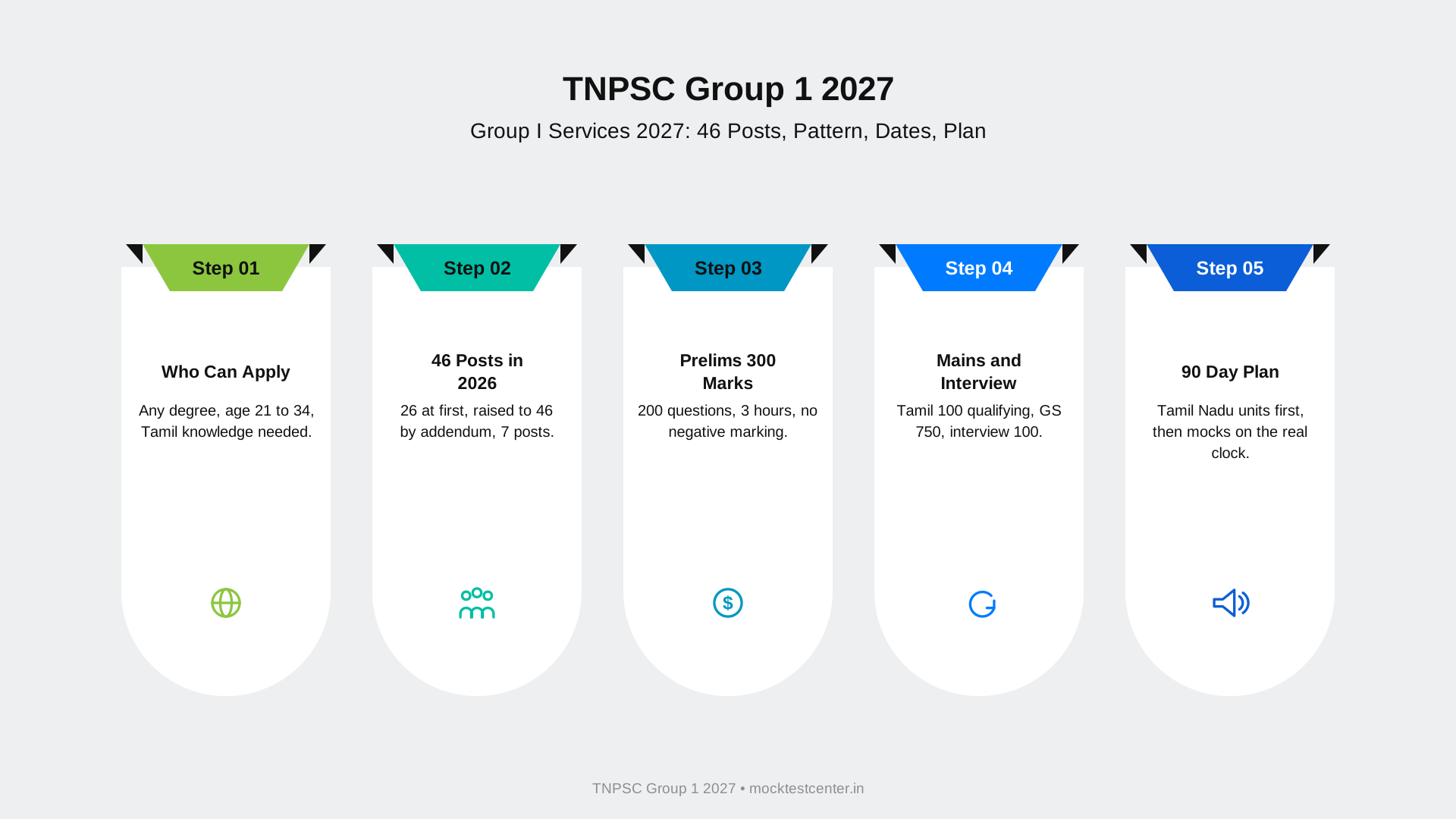
TNPSC Group 1 2027 preparation starts with two numbers. The 2025 cycle advertised 72 posts. Its Prelims took place on 15 June 2025 and its Mains ran from 1 to 4 December 2025 in Chennai. The 2026 cycle started with 26 posts, then an addendum raised the count to 46 posts. Its Prelims took place on 27 September 2026 and its tentative answer key came out on 6 October 2026. The Prelims result had not been published as of 7 November 2026, and the Mains date will be announced with that result.
Three stages decide selection. Prelims is one objective paper of 200 questions for 300 marks in 3 hours. It only screens candidates and its marks never count in the final rank. Mains is descriptive, with a qualifying Tamil paper of 100 marks and three General Studies papers of 250 marks each. The interview, called the oral test, carries 100 marks. The final rank rests on 850 marks, the three Mains papers plus the interview.
TNPSC Group 1 2027 at a glance
| Detail | 2025 cycle | 2026 cycle |
|---|---|---|
| Notification | No. 04/2025, Advt. No. 706, dated 1 April 2025 | No. 05/2026, Advt. No. 736, dated 23 June 2026 |
| Posts | 72 in all, 70 Group I plus 2 Group IA | 26 at first, raised to 46 by Addendum 5B/2026 of 13 August 2026 |
| Application window | 1 to 30 April 2025 | 30 June to 29 July 2026 |
| Correction window | 5 to 7 May 2025 | 2 to 4 August 2026 |
| Prelims | 15 June 2025, 9.30 AM to 12.30 PM | 27 September 2026, 9.30 AM to 12.30 PM, moved from 6 September 2026 |
| Prelims answer key | 23 June 2025 | Tentative key 6 October 2026, challenges till 13 October 2026 |
| Prelims result | 28 August 2025 | Not out as of 7 November 2026 |
| Mains | 1 to 4 December 2025, Chennai only | Date to be announced with the Prelims result |
| Age as on 1 July | 21 minimum, 34 maximum for Others, 39 for reserved categories | 21 minimum, 34 maximum for Others, 39 for reserved categories |
| Fees | OTR Rs 150, Prelims Rs 100, Mains Rs 200 | OTR Rs 150, Prelims Rs 100, Mains Rs 200 |
| Final rank | 850 marks, Mains 750 plus interview 100 | 850 marks, Mains 750 plus interview 100 |
| Official website | tnpsc.gov.in | tnpsc.gov.in |
Read the table as the skeleton and the rest of this TNPSC Group 1 2027 guide as the flesh. The dates belong to the 2025 and 2026 cycles. The pattern, the age rule, the fee structure and the Tamil language rule carry over to the next advertisement unless TNPSC changes them in print.
72 posts, 46 posts and 26 posts: which number is which
Search results for TNPSC Group 1 throw three different vacancy numbers at a candidate, and each one belongs to a different point in time. Sorting them out takes five minutes and saves months of planning on the wrong figure.
The 72 figure is the 2025 cycle. TNPSC issued Notification No. 04/2025 on 1 April 2025 for 72 posts. That total splits into 70 Group I posts and 2 Group IA posts. The Group IA posts are Assistant Conservator of Forests, post code 1009, in the Tamil Nadu Forest Service. Applications ran from 1 to 30 April 2025 and Prelims took place on 15 June 2025. The Prelims answer key came out on 23 June 2025 and the result came out on 28 August 2025. Mains ran from 1 to 4 December 2025 at Chennai, with the admit card released on 21 November 2025.
The 26 figure is the 2026 cycle at birth. TNPSC issued Notification No. 05/2026 on 23 June 2026 for 26 posts. Applications ran from 30 June to 29 July 2026. The original Prelims date was 6 September 2026, fixed in the annual planner. Addendum 5A/2026 of 16 July 2026 moved Prelims to 27 September 2026. The exam was held on that date at 38 district centres, in the forenoon session from 9.30 AM to 12.30 PM.
The 46 figure is the same 2026 cycle after correction. Addendum 5B/2026 of 13 August 2026 added 20 posts and raised the total from 26 to 46. Addendum 5C/2026 of 4 November 2026 then gave the split of each post by reservation category, without changing the post totals. A candidate who quotes 26 as the 2026 vacancy count is using the first notice and missing the addendum. A candidate who quotes 46 is using the current figure.
One more number deserves a note because it still appears in stale pages. Some older pages list 29 vacancies for a Group 1 cycle and a Prelims date of 12 July 2025. That figure belongs to an earlier cycle and to pages that were never updated after the 1 April 2025 notification. The 2025 notification fixed the count at 72, and the 2026 notification fixed it at 46 after the addendum. Trust the notification number and the addendum, not the stale page.
What the 2026 posts look like after the addendum
The 2026 post list has seven posts and no Deputy Superintendent of Police. That absence matters more than any other detail in the list, because DSP is the post many candidates prepare for first. In 2025 the DSP post carried 7 vacancies. In 2026 it carries none. A candidate whose first choice is DSP has no opening in the 2026 cycle and must wait for the next notification.
After Addendum 5B/2026 the 46 posts break down as Deputy Collector 12, Assistant Commissioner in Commercial Taxes 10, District Registrar 8, Deputy Registrar of Co-operative Societies 6, Assistant Director of Rural Development 6, District Employment Officer 3 and Assistant Commissioner of Labour 1. All seven posts sit at Level 22 of the Tamil Nadu pay matrix. The commonly cited band for Level 22 is Rs 56,100 to Rs 2,05,700, which is the standard pay matrix value for that level rather than a figure printed in the notice itself. All seven posts sit at the same level, so there is no pay difference between Deputy Collector and the other roles at entry.
The 2025 post list was different in shape. Deputy Collector held 28 posts, Assistant Commissioner in Commercial Taxes held 19, Assistant Director of Rural Development held 7, Deputy Superintendent of Police held 7, Assistant Commissioner of Labour held 6 and District Employment Officer held 3, making 70 Group I posts, plus 2 Assistant Conservator of Forests posts under Group IA. The Deputy Collector count fell from 28 to 12 between the two cycles, while the Commercial Taxes count fell from 19 to 10. Post counts swing hard between cycles because departments send their vacancy lists afresh each year, and no post is guaranteed a place in the next advertisement.
Deputy Collector is the post at the top of most lists. It belongs to the Tamil Nadu Civil Service and leads to district administration work. Assistant Commissioner in Commercial Taxes belongs to the Tamil Nadu Commercial Taxes Service and leads to tax administration. District Registrar, a post that appears in the 2026 list with 8 vacancies, belongs to the registration department. Deputy Registrar of Co-operative Societies belongs to the Tamil Nadu Co-operative Service. Assistant Director of Rural Development belongs to the Tamil Nadu Panchayat Development Service. District Employment Officer belongs to the Tamil Nadu General Service. Assistant Commissioner of Labour belongs to the Tamil Nadu Labour Service.
Two posts carry extra conditions. Assistant Commissioner in Commercial Taxes gives first preference to candidates with a B.Com degree, a B.L. degree and a Diploma in Taxation Laws. That preference is an order of preference, not a bar on other graduates. Any degree holder can apply, and the preference only decides the order among candidates who hold the preferred qualifications. Assistant Director of Rural Development lists preferred qualifications that include a postgraduate degree in Rural Services, Extension or Sociology, again as a preference and not as a bar.
Who can apply for TNPSC Group 1 2027
Any bachelor degree from a recognised university qualifies a candidate for all seven posts in the 2026 list. The degree must be held on the notification date, 23 June 2026 for the 2026 cycle. Final year candidates can sit Prelims and prove their pass before the Main exam. That rule helps a final year student start a year early, and it punishes one who treats the degree as a formality, because a failed final paper after Prelims ends the attempt at the Mains stage.
The age rule is counted as on 1 July of the notification year, 1 July 2026 for the 2026 cycle and 1 July 2025 for the 2025 cycle. The minimum age is 21 years for every post. The maximum age depends on the category and the post, and the table below gives the 2025 and 2026 position, which is the same in both cycles.
| Category | Maximum age, most posts | Assistant Commissioner, Commercial Taxes, with B.L. degree |
|---|---|---|
| Others | 34 years | 35 years |
| BC, BCM, MBC and DC, SC, SC(A), ST, destitute widows | 39 years | 40 years |
| Persons with benchmark disability, Others | 44 years | 44 years |
| Persons with benchmark disability, reserved categories | 49 years | 49 years |
| Ex-servicemen, Others | 50 years | 50 years |
| Ex-servicemen, reserved categories | 55 years | 55 years |
Two details in the age rule catch candidates out. First, DSP is not open to persons with benchmark disability. Second, candidates in the Others category who already have five or more years of government service are not eligible in the 2026 cycle. Both points sit in the notification, and both are easy to miss in a tracker summary that only prints the headline ages of 21 to 34.
The Tamil language rule catches out of state candidates. A candidate must have adequate knowledge of Tamil as on the notification date. That can be proved by having passed SSLC, HSC or the degree with Tamil as a language, or by having studied in Tamil medium, or by clearing the TNPSC Second Class Language Test in Tamil. A candidate who cannot prove it upfront must pass that test within two years of appointment. There is no separate domicile bar beyond this Tamil knowledge requirement and the usual community certificate rules. A graduate from another state who studied Tamil at school can apply, and a graduate who never studied Tamil cannot, unless the language test is cleared in time.
There is no attempt limit in the TNPSC Group 1 rules as published. The age window is the only clock. A candidate who starts at 21 gets many attempts, and a candidate who starts at 33 gets few. That makes the first attempt worth taking seriously even when preparation feels incomplete, because Prelims experience itself is part of preparation.
TNPSC Group 1 2027 Prelims paper: 200 questions, 300 marks, no negative marking
Prelims is one paper, objective type, answered on an OMR sheet. It carries 200 questions for 300 marks and runs for 3 hours, from 9.30 AM to 12.30 PM. Each correct answer carries 1.5 marks. General Studies at degree standard carries 175 questions, and Aptitude and Mental Ability at SSLC standard carries 25 questions. The paper is set in English and Tamil.
There is no negative marking in TNPSC Group 1 Prelims. A wrong answer costs nothing. That fact needs stating plainly because one popular tracker page carries a table that says one third of a mark is deducted for each wrong answer in Prelims. That table contradicts the notification and contradicts the same tracker's own pattern section, which says there is no negative marking. The notification position is clear: no deduction for a wrong answer. A candidate should still attempt with care, because a guess that lands wrong wastes the time spent on it, but the guess itself carries no penalty in marks.
Prelims is a screening test. Its marks never count in the final rank. It only decides who moves to Mains, at 20 times the number of vacancies. With 46 vacancies in 2026, that ratio points to about 920 Mains candidates. With 72 vacancies in 2025, it pointed to about 1,440. The qualifying mark in Prelims is 120 marks for Others and 90 marks for SC, SC(A), ST, MBC and DC, BC and BCM candidates. Clearing that mark is necessary but not enough. The real cutoff is set by the scores of the candidates at the 20 times line, and it sits well above the qualifying mark in most years.
Prelims was held in 32 cities across Tamil Nadu in the 2025 cycle, and at 38 district centres in the 2026 cycle. Mains is held only in Chennai. A candidate from a far district should plan travel and stay for Mains early, because the Mains admit card arrives close to the exam and Chennai rooms fill fast in exam week.
What Prelims actually tests
The General Studies part of Prelims runs to degree standard and covers a wide field. General Science carries 10 questions. Geography of India carries 10 questions with special reference to Tamil Nadu. History and Culture of India carries 10 questions. Indian Polity carries 10 questions. Indian Economy carries 10 questions. Indian National Movement carries 10 questions. History, Culture, Heritage and Socio Political Movements of Tamil Nadu carries 15 questions. Current Events carries 20 questions. General Aptitude and Mental Ability carries 25 questions, and the rest of the paper is spread across the remaining units. The exact question counts per unit sit in the syllabus annexure of the notification, and they shift a little between cycles, so the annexure is the document to trust.
Current Events carries the largest single block in the paper, 20 questions. That block rewards a candidate who reads Tamil Nadu news every day, not one who reads a yearly compilation in the last month. The Tamil Nadu units together, geography, history and culture, heritage and socio political movements, reward a candidate who knows the state in depth. A candidate who prepares only national level material gives away a large share of the paper before it starts.
The Aptitude and Mental Ability part runs to SSLC standard. It covers number system and simplification, HCF and LCM, ratio and proportion, simple and compound interest, area and volume, time and work, logical reasoning, diagrams, data interpretation and basic numeracy. The standard is school level, but the questions are set to test speed. Twenty five questions at 1.5 marks each carry 37.5 marks, and a candidate who finishes them fast buys time for the General Studies questions that need thought.
One practical point about the OMR sheet deserves a line. TNPSC asks candidates to darken bubble E if they do not wish to attempt a question. That instruction exists because an unshaded item can create trouble in evaluation. With no negative marking, a candidate should still mark E for questions left blank rather than leaving the row empty.
The Mains papers: Tamil first, then three General Studies papers
Mains is descriptive. It has four papers, each of 3 hours. Paper I is the Tamil Eligibility Test at SSLC standard, for 100 marks, with a minimum pass mark of 40 for all categories. Its marks do not count in the final rank. A candidate who fails Paper I is out, whatever the scores in the other papers. That makes Tamil the first gate of Mains, and a candidate weak in Tamil should treat Paper I as a paper to pass with a margin, not as a formality.
Papers II, III and IV are General Studies papers at degree standard, 250 marks each, descriptive in form. Their total of 750 marks decides the written rank. Paper II covers Modern History of India and Indian Culture, Social Issues in India and Tamil Nadu, and General Aptitude and Mental Ability. Paper III covers Indian Polity and Emerging Political Trends across the World affecting India, Administration of Union and States with special reference to Tamil Nadu, and General Economics. Paper IV covers Science and Technology, Geography of India with special reference to Tamil Nadu, Environment, Bio Diversity and Disaster Management, and Ethics and Integrity. The unit lists sit in the syllabus annexure, and the annexure is the only safe source for the full list.
The qualifying marks in Mains work differently from Prelims. Paper I needs 40 marks out of 100. For Papers II, III and IV taken together, the minimum qualifying mark is 340 out of 750 for Others and 255 out of 750 for SC, SC(A), ST, MBC and DC, BC and BCM candidates. A candidate below that line does not reach the interview, even with a strong Prelims score, and Prelims marks do not help because they are not counted.
Mains answers are written by hand, in English or Tamil, and the quality of writing decides a large share of the score. A candidate who only practises objective questions will find Mains hard in a way that no amount of reading fixes. Answer writing needs its own practice, with a clock, because each paper is 3 hours and the paper rewards candidates who finish every question with a structured answer.
The interview and the 850 mark final rank
The interview is called the oral test and carries 100 marks. There is no minimum pass mark in the interview. It tests personality, judgement, communication and awareness of Tamil Nadu and India, and it is held after Mains results. The final rank is built from 850 marks: 750 from the three General Studies papers and 100 from the interview. Prelims marks and Paper I marks are not added.
That arithmetic shapes preparation. Prelims decides entry to Mains and nothing else. Paper I decides survival and nothing else. The three General Studies papers and the interview decide the rank and the post. A candidate who spends a year on Prelims and a month on Mains has the priorities backwards. Mains writing and interview practice deserve the larger share of the year, because they carry every mark that counts.
After the interview comes counselling in rank order, then a medical examination, then appointment. Reservation of appointments applies at the counselling stage. The number of vacancies notified is tentative and liable to change until the publication of the Main exam results, so the final post count can move after the notification, as the 2026 addendum showed.
Fees, registration and how to apply
Three charges sit in a TNPSC Group 1 cycle. One Time Registration, called OTR, costs Rs 150 and stays valid for five years. Aadhaar linking is mandatory for OTR. The Prelims exam fee is Rs 100, paid at the time of applying. The Mains exam fee is Rs 200, paid later, only by candidates shortlisted for Mains. SC, SC(A), ST, persons with benchmark disability and destitute widows are fully exempt from the exam fee. Backward class candidates under MBC and DC, BC and BCM get three free chances, and ex-servicemen get two free chances.
Applications run only online, through the TNPSC exam portal at tnpscexams.in and the commission website at tnpsc.gov.in. The steps are simple and the order matters. First, complete OTR and link Aadhaar. Second, keep a photo and signature scanned in the sizes the form asks for, at 200 DPI. Third, open the exam specific application for the notification and fill in the details exactly as the degree reads. Fourth, pay the Rs 100 Prelims fee unless exempt, through net banking, card or UPI, then submit. Fifth, use the correction window after the last date if an edit is needed, because no changes are allowed after it closes. In the 2026 cycle the correction window ran from 2 to 4 August 2026.
One safety note matters. Use only the official website, and remember that a genuine government recruiter never asks for an unofficial fee. Pages that promise a direct application link outside tnpsc.gov.in and tnpscexams.in should be ignored.
The traps that cost candidates a cycle
The first trap is the stale tracker page. TNPSC Group 1 pages are updated slowly, and many still show the old Prelims date of 6 September 2026, the old vacancy count of 26, or the 2024 cycle figures. The 2026 Prelims moved to 27 September 2026 by Addendum 5A/2026, and the vacancy count moved to 46 by Addendum 5B/2026. A candidate who plans from a stale page plans for an exam that no longer exists. The fix is simple: read the notification and its addenda on tnpsc.gov.in, and treat every other page as a summary that may lag.
The second trap is the negative marking claim. One popular page says one third of a mark is deducted for each wrong answer in Prelims. The notification says there is no negative marking, and the same page contradicts itself in its own pattern section. The safe position is the notification: no deduction. A candidate who avoids guessing because of a wrong table gives away marks that the exam does not take.
The third trap is the DSP assumption. DSP is the most visible Group 1 post, and many candidates assume it appears in every cycle. It does not. The 2026 cycle has no DSP post. A candidate whose whole plan rests on DSP should check the post list of the cycle in hand before starting, and should keep Deputy Collector and the other posts in view as real options.
The fourth trap is Tamil. A candidate from outside Tamil Nadu who clears Prelims and Mains can still fail at Paper I or at the language test. Tamil decides survival in Mains as a qualifying paper and it is a condition of appointment. A candidate weak in Tamil should start Tamil preparation in the first month, not after the Prelims result.
The fifth trap is the Prelims only plan. Prelims marks do not count. A candidate who spends the whole year on objective questions and starts descriptive writing after the Prelims result has about two months to learn a skill that needs six. Mains writing should start alongside Prelims preparation, with one descriptive answer a day from the second month onwards.
A 90 day plan that fits the real pattern
Days 1 to 30 belong to the base. Read the notification and the syllabus annexure first, then build a notebook per Prelims unit. Cover General Science, Geography, History and Culture, Polity, Economy, National Movement and the Tamil Nadu units in that order, with Current Events every day from a Tamil Nadu newspaper. Do 25 aptitude questions a day at SSLC level with a timer. Write one short descriptive answer a day from a Mains unit, so the writing habit forms early. Take one full Prelims mock a week, 200 questions in 3 hours, and review every wrong answer the same day.
Days 31 to 60 belong to depth. Finish the Tamil Nadu units, because they carry the largest share of the paper. Revise Polity and Economy with Tamil Nadu examples wherever the syllabus asks for them. Raise the mock count to two a week and start timing each section inside the paper. For Mains, move to two descriptive answers a day, one from Paper II and one from Paper III or IV in turn. Read the tentative answer key habit into the routine: after every mock, check the key, note the questions that turned on a single fact, and add those facts to the notebook.
Days 61 to 90 belong to the clock. Take three mocks a week in the real 9.30 AM to 12.30 PM slot, so the body learns the exam hour. Revise only from the notebook and the mock error list, and stop adding new books. For Mains, write one full 3 hour paper a week under exam conditions. In the last ten days, cut new reading to zero, revise Current Events of the last six months, and keep Tamil writing practice daily so Paper I never becomes a risk.
One more point about mocks. A mock that only reports a score is half a mock. The useful part is the review: which unit leaked marks, which questions took too long, which guesses were right for the wrong reason. A candidate who reviews properly gains more from ten mocks than a candidate who takes thirty without review.
What the 2025 result tells the next candidate
The 2025 Prelims result came out on 28 August 2025, about ten weeks after the exam of 15 June 2025. Mains followed from 1 to 4 December 2025, about fourteen weeks after the result. That gap is the realistic window between Prelims result and Mains in this exam. A candidate who waits for the result before starting Mains writing gets about three months. A candidate who starts writing during the Prelims wait gets six. The difference shows in the Mains hall.
The 2026 cycle follows the same shape so far. Prelims on 27 September 2026, tentative answer key on 6 October 2026, challenges till 13 October 2026, and the result still awaited as of 7 November 2026. The Mains date will be announced with the Prelims result, as the notification promises. A candidate preparing for the next notification should expect the same rhythm: notification in mid year, Prelims about three months later, result about ten weeks after that, Mains about three months after the result.
TNPSC Group 1 is a small exam by vacancy count and a large exam by competition. Forty six posts in 2026 and 72 in 2025 draw applications in the lakhs, and the 1 to 20 shortlist for Mains keeps the cutoff high. That is the honest picture. It is also the reason the exam rewards steady preparation over a full year rather than a burst in the last month. Start with the notification, build the Tamil Nadu units first, write every day, and let the mocks show where the marks leak. The next notification will reward the candidate who did that work before it arrived.
Sources
Official sources only. Tamil Nadu Public Service Commission, tnpsc.gov.in, Notification No. 04/2025, Advertisement No. 706, dated 1 April 2025, Combined Civil Services Examination I, Group I Services. Tamil Nadu Public Service Commission, tnpsc.gov.in, Notification No. 05/2026, Advertisement No. 736, dated 23 June 2026, with Addendum 5A/2026 of 16 July 2026, Addendum 5B/2026 of 13 August 2026 and Addendum 5C/2026 of 4 November 2026. Tamil Nadu Public Service Commission exam portal, tnpscexams.in. Tracker pages that quote these notifications were used to cross check dates and figures, including PrepMatic, NaukriTips, JagranJosh, Careers360, Testbook, Indian Express Education and Chegg India, and are listed here as plain text without links, per the official sites only rule for link